
The Highland Games
Contents
Caber tossing, hammer throwing, pipe bands and Highland dancing: the Highland Games are among the most recognisable Scottish traditions, held across Scotland every summer and at more than 200 events around the world. They draw on older clan gatherings and contests of strength, but the organised Games, with their rules, societies and royal patrons, are largely a 19th-century creation. This card tests the history of the Games and some of the claims made about them.
TL;DR
- traditional The story that King Malcolm III founded the Games with a hill race at Braemar in the 11th century has no contemporary evidence.
- established Organised Highland Games took shape in the 19th century, after the post-Culloden suppression of Highland dress and gatherings. The historian Grant Jarvie's 1991 study calls them a "making of the myth".
- established The Braemar Gathering has run in its present form since 1832. Queen Victoria first attended in 1848, and reigning monarchs have attended regularly since; it became "Royal" in 1866.
- established The caber toss is judged on how straight the caber falls, not on distance. The Scottish heavy events are ancestors of the Olympic hammer and shot put.
- traditional Claims that Ceres in Fife has held Games since 1314, or that the Highland Games inspired the modern Olympics, are not documented.
- established Competitive piping began at the Falkirk Tryst in 1781 and moved to Edinburgh in 1783, where pipers first danced for the audience. Dancing competitions followed in the 1790s, the sword dance entered them in 1832, and girls competed only from the early 20th century.
Key Facts
- Earliest documented antecedent
- 1703 summons of the Grant clan, Regality of Grant
- Braemar Wright Society founded
- July 1815
- Braemar Gathering in present form
- 1832
- Queen Victoria first attends Braemar
- 1848
- Braemar becomes "Royal"
- 1866
- First US games
- New York, 1836
- Caledonian Club of San Francisco games
- From 1866
- Aboyne Highland Games
- Founded 1867
- Cowal Highland Gathering
- First held 11 August 1894
- Scottish Highland Games Association
- Founded 1947
- Grandfather Mountain Games, North Carolina
- Since 1956
- Games outside Scotland
- More than 200 a year
Scottish Impact Index (SI Score)
- Cultural Reach
- 9/10
- Continuity of Tradition
- 10/10
- Social & Economic Importance
- 9/10
- Scottish Distinctiveness
- 10/10
- Cultural Legacy
- 10/10
- Recognition
- 10/10
58/60
Ranked =2nd of 19 in Traditions
A Note on Claims and Evidence
Each major claim carries one of three labels. established means supported by primary records, official bodies or several independent reliable sources. shared means the core fact is sound but sources disagree on details, dates or interpretation. traditional means widely repeated but not traceable to a primary or independent source.
The 19th-century history of the Games is well documented in the records of the Highland societies and in newspapers. Claims of medieval origins are not: they rest on legend or on local traditions recorded much later. Tourism and promotional sources often repeat these claims uncritically. Records, attendance figures and equipment weights vary between events and sources.
Timeline
According to legend, Malcolm III holds a hill race at Braemar.
Ceres in Fife traditionally dates its games to a charter after Bannockburn.
The Laird of Grant summons his clan to appear in Highland dress and armed.
After Culloden, the Act of Proscription bans Highland dress.
The Highland Society of London holds the first modern piping competition at the Falkirk Tryst.
The ban on Highland dress is repealed.
The piping competition moves to Edinburgh, where some of the pipers also dance for the audience.
The Northern Meeting is founded in Inverness.
Dancing becomes a competition in its own right at the Edinburgh piping exhibition.
The Braemar Wright Society is founded.
The Strathfillan Society holds its first games at St Fillans, Perthshire, with Highland reels and the "Ancient Scotch Sword Dance".
The Reel of Tulloch is first danced at the Edinburgh competition.
The Braemar Gathering begins in its present form; the sword dance (Gille Callum) enters the Edinburgh competition.
The Northern Meeting adds competitions for pipers and dancers.
The last Edinburgh competition of piping and dancing is held.
The New York Highland Society holds a "sportive meeting" at the Elysian Fields in Hoboken, across the Hudson, the first Highland games recorded in the United States.
Queen Victoria first attends the Braemar Gathering.
At Queen Victoria's invitation, the Braemar Highland Society holds its Gathering at Balmoral; it does so again in 1890, 1898 and 1899.
The Braemar Gathering receives royal status; the Caledonian Club of San Francisco holds its first games.
The Aboyne Highland Games are founded.
Under its Scottish president James McCosh, Princeton becomes the leading American college to adopt Caledonian games events.
The first Cowal Highland Gathering is held in Dunoon.
Luss holds separate Highland Fling contests for boys and for girls under sixteen.
The Aboyne Games sponsor a distinct dancing costume for girls.
The Scottish Games Association, now the Scottish Highland Games Association, is founded.
The Grandfather Mountain Highland Games begin in North Carolina.
Grant Jarvie publishes Highland Games: The Making of the Myth.
Details
1. Origins and Antiquity
The Malcolm III / Craig Choinnich hill race (LEGEND-MYTH). The most frequently repeated origin story holds that King Malcolm III (Malcolm Canmore, r. 1058–1093) organized a foot race up Craig Choinnich (Creag Chòinnich) overlooking Braemar in the 11th century to select the fastest runner as his royal messenger (gille-ruith); a commonly cited date is 1064. This must be flagged clearly: it is legend, not documented history. There is no contemporary 11th-century record of it, and every credible source hedges the story with "tradition says," "supposedly," "legend," "apocryphal," or "alleged." John T. Koch's Celtic Culture: A Historical Encyclopedia (ABC-CLIO, 2005), a peer-reviewed academic reference, states in its Highland Games entry (by Andrew Wiseman): "The origin of the Games remains unclear, and thus recourse to folklore provides a romantic image which has been sustained since their Victorian 'invention' around the 1820s. According to tradition, the Games were begun during the reign of Mael Coluim mac Donnchada, 'Ceann Mór'..." David Webster, the leading specialist historian of the Games, in Scottish Highland Games (1973), recounts the story "labelling it as story, or legend only." The University of Aberdeen's Elphinstone Kist archive presents the tale explicitly as Doric folklore ("The Origins of the Braemar Games Hill Race" by Les Wheeler, a fictional account). Source quality: high (academic encyclopedia + specialist historian both explicitly label it legend).
The genuine scholarly picture — "invention of tradition." The definitive academic study is Grant Jarvie's Highland Games: The Making of the Myth (Edinburgh: Edinburgh University Press, 1991), which won the Glenfiddich Award; Jarvie is Professor of Sport at the University of Edinburgh. Jarvie argues the Games "could not be properly understood without a rigorous and systematic attempt to ask how the development of these activities were influenced by the historical and social conditions of the day," and that "their formal organisation and annual occurrence seems to have taken off after about 1820." Crucially for accuracy, his position is NOT that the Games were wholly fabricated: he acknowledges that "many of the sporting traditions and cultural artifacts upon which today's Highland Gatherings are dependent existed in various antecedent forms." The organized, codified, annually-recurring institution is a 19th-century construction; the antecedent forms (clan gatherings, weapon-showings/wappinschaws, martial strength contests) are genuinely older. His list of the "traditional" organized gatherings underscores this — all are 19th-century foundations: St Fillans (1819), Lonach (1823), Ballater (1866), Aboyne (1867), Argyllshire (1871) and Cowal (1871/1894). This sits alongside the broader "invention of tradition" scholarship — Hugh Trevor-Roper's chapter "The Highland Tradition of Scotland" in Hobsbawm & Ranger's The Invention of Tradition (Cambridge University Press, 1983) — though Trevor-Roper's blunter thesis has been criticized as overstated. Source quality: highest (university-press monograph + CUP volume).
The earliest DOCUMENTED antecedents. The earliest often-cited documentary record is the 1703 summons in the Court Books of the Regality of Grant, in which the Laird of Grant summoned his clan to appear in Highland coats and armed "with gun, sword, pistill [pistol] and dirk" — from which historians infer feats of arms/martial contests. This is a genuine archival record, though its interpretation as a "Highland Games" precursor is inference. The first full-scale modern Highland Games is generally credited to the St Fillans Highland Society (Perthshire) in 1819 (Stirling Council Archives hold an 1823 programme describing the "5th annual meeting," implying a start around 1818). Source quality: DOCUMENTED (archival).
The 19th-century revival and codification (DOCUMENTED). Following the 1745 Jacobite rising and the Battle of Culloden (1746), the Act of Proscription (1746, including the Dress Act) suppressed Highland dress, weapons and clan gatherings as part of dismantling the clan system; it was repealed in 1782. From the 1780s, Highland Societies began organizing to revive Highland traditions. The revival received an enormous boost from King George IV's 1822 visit to Edinburgh — stage-managed by Sir Walter Scott, with the king in Highland dress — which triggered the tartan/Highland-dress craze. The Northern Meeting, founded in 1788 as an annual week of balls and dinners for the northern gentry, came to its games in stages: the dance historian George S. Emmerson, in A Social History of Scottish Dance (1972), notes "games" at its close under Macdonell of Glengarry in 1822, the society's own history records sports and games at Dochfour in 1835, and an exhibition of pipers and dancers, the origin of its piping competitions, was added in 1841. This mirrors the pattern in the site's Beltane and Up Helly Aa companion pieces: ancient roots exist, but the recognizable modern event is a Victorian-era codification. (For the post-Culloden suppression of Highland culture, cross-reference the site's Kilt and Great Highland Bagpipe articles on the Act of Proscription.) Source quality: DOCUMENTED (Stirling Archives, academic).
The Ceres Games claim (TRADITIONAL). The Ceres Games in Fife claim to be the oldest free/continuous Highland Games in Scotland, dating to a charter said to have been granted by Robert the Bruce in 1314 in recognition of the Ceres men who fought at Bannockburn, held every year (except during war, the 1746–82 Proscription, and COVID) since. This is presented by the organizers themselves as local tradition ("it is said," "purportedly"). It should be flagged as a TRADITIONAL claim: the 1314 date rests on local tradition rather than an authenticated surviving charter, and Ceres is fundamentally a Lowland fair-and-market games tradition rather than a Highland gathering in origin. Source quality: mixed (organizer's own site + tourism sources; no independent primary documentation of the 1314 charter located).
2. The Heavy Events: History and Rules
Tossing the caber (DOCUMENTED rules; correcting a misconception). The caber (Gaelic for "beam/pole"), usually made from larch, is roughly 16–20 feet long and weighs about 90–150 pounds, though there is no standardized dimension — each caber is selected to challenge the field. The scoring correction is essential: the caber toss is NOT judged on distance. It is judged on accuracy and straightness using the "clock face method." The thrower runs and flips the caber end-over-end; a perfect toss has the caber pass through the vertical (90°) and land with the small end pointing directly away at "12 o'clock" relative to the thrower's run. A shorter, straighter toss beats a longer crooked one, and if no competitor achieves a full turn, the caber is judged on the maximum vertical angle achieved. This is codified in the rules of bodies such as Scottish Athletics International and the Canadian Scottish Athletic Federation (CSAF). The famous Braemar caber is notably heavy: sources cite it at 132 lb and about 19 ft 9 in long (Sports Illustrated in 1954 described it as a 19-foot, 120-pound log, "the stoutest in the Highlands"). Source quality: DOCUMENTED (official rule books, Braemar Gathering).
The Scottish hammer throw (DOCUMENTED; distinct from Olympic). The Scottish hammer is a metal sphere (16 lb "light" or 22 lb "heavy" for men; 12/16 lb for women) fixed to a rigid shaft about 4 feet / 50 inches long made of wood, rattan, bamboo or PVC — unlike the Olympic wire-and-ball hammer. The technique is fundamentally different: the Scottish thrower stands with back to the field and feet fixed in a stationary position, whirls the hammer around the head, and releases over the shoulder — versus the Olympic spinning-across-the-circle technique. Scottish throwers often wear boots with flat blades/spikes to dig into the turf and resist centrifugal force. The event is regarded as the precursor to the modern Olympic hammer throw; peer-reviewed sport-science literature (Frontiers in Sports and Active Living, 2022) states, "The origins date back to the Highland Games, in which a real blacksmith's hammer was thrown." One of the earliest recorded distances is 40 ft with a 24 lb hammer by John Brown at St Fillan's Games, Lochearnhead, on 6 September 1826. The claim about "throwing actual blacksmith's hammers/sledges" is TRADITIONAL-to-DOCUMENTED: 17th–18th century British sources genuinely reference "throwing the sledge" (actual sledgehammers — 8–16 lb blacksmith tools and heavier quarrying hammers). The Cú Chulainn / Tailteann Games (Tara, Ireland, c. 1800 BC) origin story is LEGEND-MYTH. Source quality: high (peer-reviewed + specialist).
The stone put (DOCUMENTED precursor to shot put). Competitors put a heavy stone from the shoulder with one hand, like a shot put. Two forms exist: the Braemar stone (heavier, ~20–26 lb for men, thrown from a stationary standing position with no run-up — the most ancient form) and the open stone (lighter, ~16–22 lb, with an allowed run-up/glide resembling modern shot put). World Athletics, the sport's global governing body, explicitly states on its shot put page that "a modern version of shot put first appeared in the Scottish Highland Games during the 19th century," and Britannica notes shot put "derives from the ancient sport of putting the stone." The term "put" itself comes from "putting the stone." The claim that stone-putting was used by clan chieftains to identify their strongest warriors is TRADITIONAL/folklore. Source quality: high (World Athletics, Britannica).
Weight for distance (DOCUMENTED). A metal weight with a handle attached by a chain is thrown one-handed for distance with a full-body rotation. Two disciplines: 28 lb (light) and 56 lb (heavy) for men. Bill Anderson held both world records simultaneously — light 87 ft 2 in (from the 1966 Crieff games) and heavy 41 ft 11 in (from the 1969 Aboyne games) — each standing for 12 years. Source quality: DOCUMENTED.
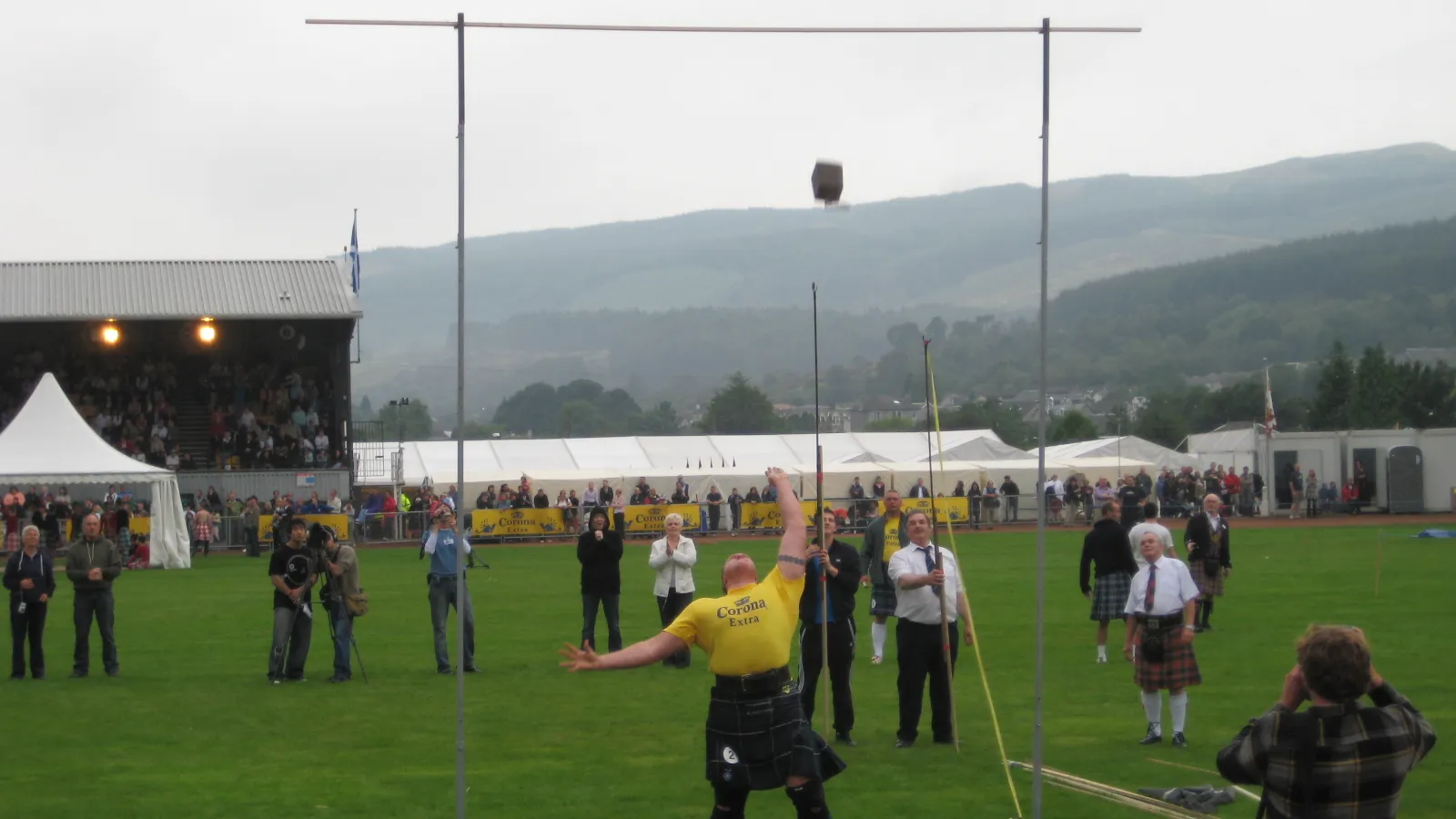
Weight over bar (DOCUMENTED, with records). A 56 lb (half-hundredweight) weight is swung one-handed in a pendulum motion and thrown over a horizontal bar for height; the bar is progressively raised, eliminating competitors. The event's world record has been advanced dramatically by Icelandic strongman Hafþór Júlíus Björnsson, who set 6.17 m (20 ft 3 in) at the 2022 Rogue Invitational (Round Rock, Texas), breaking his own previous 20 ft 2 in mark from the 2019 Arnold Strongman Classic; he is regarded as the greatest ever at the event. Within the SHGA's traditional-games context, the record has been progressed by athletes including Poland's Lukasz Wenta (17 ft 3 in at Inveraray) and Czechia's Vlad Tulacek. Bill Anderson broke the world record four times (peaking at 16 ft 1 in in 1977); Geoff Capes advanced it to 16 ft 9 in in 1982. Source quality: DOCUMENTED (SHGA; strongman records databases).
Tug o' war (DOCUMENTED; broader-than-Scotland history). Tug o' war is a team rope-pulling contest (typically eight per side) that is genuinely a Highland Games staple but has a much broader global history and should not be presented as Scottish in origin. Britannica notes it was "a rural pastime in England and Scotland" and an Olympic event from 1900 to 1920. Wikipedia and the Tug of War International Federation note it was practiced in ancient Egypt, China, India and Greece. It is thus best framed as a universal contest incorporated into the Games, not a Scottish invention. Source quality: high (Britannica).
3. The Braemar Gathering and Royal Patronage (DOCUMENTED)
The Braemar Gathering is organized by the Braemar Royal Highland Society, originally the Braemar Wright Society founded in July 1815 — the oldest surviving Friendly Society in the UK. The Society began giving prizes at the Gathering in 1832, and the Gathering has run in its present form since 1832. Per the Braemar Gathering's official site: "Since 1848, The Gathering has been attended regularly by the reigning Monarch and members of the wider Royal Family. The foot races at the Gathering are the world's oldest, having been organised on a regular basis since 1832." Queen Victoria first attended in 1848 (the Games were delayed to mid-September that year to allow her, newly at Balmoral, to attend); she became a regular patron. In 1866, by command of Queen Victoria, "Royal" was added to the Society's title. King Charles III is the current Chieftain. Braemar is widely regarded as the most prestigious and most royally-associated of the Games — but it is NOT the largest (that is Cowal). Source quality: DOCUMENTED (Braemar Royal Highland Society official site, BBC).
established The tie between the Gathering and the Court grew closer after 1848. Emmerson records that the 1848 Gathering the Queen attended was held at Invercauld and the next year's at Braemar Castle. On 22 September 1859 Queen Victoria invited the Braemar Highland Society to hold its Gathering at Balmoral, and the invitation was repeated in 1890, 1898 and 1899. Royal involvement in Deeside sport was older than Victoria: Malcolm III is linked in tradition with hunting in the Forest of Mar, and the Queen had already shot deer on Highland visits in 1842 and 1844.
shared In his chapter "Royal games, sport and the politics of the environment", in Scottish Sport in the Making of the Nation (1994), Grant Jarvie argues that the bond between Balmoral, the Queen and Braemar stood for loyalism and a particular definition of state, crown and nation. In his reading, royal Highland sport helped present the Highlands as harmonious and loyal while pushing aside popular struggles over land. He also notes how the Games sort their crowds: at Aboyne the royal banner is raised first, then that of the Marquess of Huntly as feudal superior and patron, then the banners of other notables. One organiser told him in 1986 that the flags "also indicate who is present". This is a sociological argument, not a settled finding, but it explains why Braemar, the grouse and deer seasons, and the Argyllshire Gathering and Oban Ball belong to the same upper-class social calendar.
established Unease about the Games' direction is not new. In the Scots Magazine in 1931 the novelist Neil Gunn criticised professional athletes who toured the Games collecting prize money. He described a prize-winning piper who appeared to play for the dancers in a blue suit and bowler hat, having dropped his borrowed kilt to catch an early train.
Other historically significant Games (DOCUMENTED):
- Cowal Highland Gathering (Dunoon) — the largest Highland Games in the world. Per its official site, "the very first Gathering was held on the 11th August 1894 and was the idea of a local man, Robert Cameron." CLAN (clan.com) describes it as "the single, largest gathering in Scotland," with "over 23,000 visitors" annually (historic peak over 50,000 in 1910). It hosts the World Highland Dancing Championship and the Cowal Pipe Band Championship.
- Aboyne Highland Games (Royal Deeside), founded 1867, styled "The Traditional Highland Games."
- The "Kindred Gatherings" — Braemar, Ballater, Lonach and Aboyne — form a loose affiliation of traditional Royal Deeside games.
- The Northern Meeting (Inverness, founded 1788) and the Argyllshire Gathering (Oban) are the two most prestigious solo piping venues.
4. The Highland Games Diaspora and Global Spread (DOCUMENTED)
The Games spread internationally via 18th–19th-century Scottish emigration (post-Culloden clearances and later). The first US games were held in New York in 1836; the Caledonian Club of San Francisco held its first in 1866 and runs the oldest continuously running games in the USA, now the largest in the Northern Hemisphere by attendance. According to Scotland.org (Scotland's official national brand website): "Today, in addition to the games across Scotland itself, there are more than 200 annual games and gatherings across the US and Canada, with games also held in New Zealand and Australia." Higher counts appear in some sources — Highlands.scot states "there are over 260 annual Highland Games worldwide, with over 100 events taking place in the United States alone." Notable examples:
- Grandfather Mountain Highland Games (Linville, North Carolina), held since 1956, is among the first and largest modern US games, drawing crowds of over 30,000 (some estimates 35,000–40,000). It was founded by Agnes Morton and Donald F. MacDonald after MacDonald was impressed by the Braemar Gathering on a 1954 visit.
- North Carolina has deep Scottish roots: after Culloden, the colony actively recruited Highland Scots with land and tax exemptions.
Caledonian games and American track and field. shared The historian David Hackett Fischer, in Albion's Seed (1989), argues that Scottish "Caledonian games" became the ancestor of track and field in the United States. Following Gerald Redmond's The Caledonian Games in Nineteenth-Century America (1971), he records that the New York Highland Society held a "sportive meeting" at the Elysian Fields across the Hudson as early as 1836. A typical programme included the shot, hammer, long and high jumps, pole vault, hop-step-and-jump, hurdles, a one-mile race, a walking match, novelty races, Highland dancing and the caber, all inside a ring about 500 feet round. The games were gradually opened to competitors without Scottish ancestry. Colleges then took them up, dropping events judged too strenuous (the caber), not strenuous enough (sack races) or unmanly (men's dancing). Fischer names McGill University in Montreal as the first college to sponsor them formally, and Princeton, under its Scottish president James McCosh and the Scottish gymnastics instructor George Goldie, as the American leader.
shared Fischer adds that Caledonian games were held in 125 American cities "by the mid-nineteenth century". His own chronology does not support that dating: McCosh did not become Princeton's president until 1868, and the Caledonian clubs peaked in the decades after the Civil War, so the figure is better read as describing the 1860s–1870s. Redmond also stresses that such games were never purely Highland: Lowlanders and Borderers held similar meetings and disputed the Highlanders' claimed superiority. Fischer folds the games into his argument that "borderers and Scots" carried a sporting culture of running, leaping and throwing to America; much of his evidence for that culture comes from Cumbrian sports at Grasmere and Ambleside in England, and the nineteenth-century Caledonian clubs were mainly founded by recent urban emigrants rather than descendants of eighteenth-century settlers.
Heavy events ("Scottish heavy athletics") have indeed become an internationally competitive, professional sport distinct from the cultural-festival context — with world championships, international circuits, prize money, and athletes from Czechia, Poland, Iceland, Ukraine, the USA and Canada now dominating records. Source quality: DOCUMENTED.
5. Modern Structure, Governing Bodies, and Notable Athletes
Governing body (DOCUMENTED). In Scotland the sport is governed by the Scottish Highland Games Association (SHGA), established in 1947 as the Scottish Games Association to standardise competition rules and ensure judging consistency. It represents 60+ member events, is recognized by the UK and Scottish governments, administers national and international championships and regional leagues, and provides drug testing, legal support and insurance. In 2017 (its 70th anniversary) Prince Charles (then Duke of Rothesay) became its first Royal Patron; the body was subsequently renamed the Royal Scottish Highland Games Association (RSHGA). Highland games are estimated to generate around £25 million. Source quality: DOCUMENTED (SHGA/RSHGA).
Notable athletes (DOCUMENTED):
- Donald Dinnie (1837–1916) — the outstanding 19th-century figure, from Aberdeenshire, an all-round athlete (sprinting, hurdles, jumps, pole vault, stone, hammer, caber, wrestling). He reigned as Scottish Highland Games champion for roughly 21 years (1856–1876), is credited with over 11,000 competitive wins over a ~50-year career, and toured North America (from 1870), Australia and New Zealand as a professional. The Dinnie Stones at Potarch (combined ~733 lb) remain a global test of strength. Sometimes called "the Nineteenth Century's greatest athlete." Note: the BBC's claim that he could have won seven golds at an 1896 Olympics is a retrospective hypothetical, not an achieved fact — flag it as such.
- Bill Anderson MBE (b. 1937) — the dominant modern "heavy," who won 16 Scottish championships and dominated the sport from 1959 to 1988; the first man to throw the light Scottish hammer over 150 ft (151 ft 2 in, 1969 Lochearnhead, a record that stood 28 years). He won the World Highland Games Championship in 1981 and was inducted into the Scottish Sports Hall of Fame (2007) — the only Games athlete so honoured.
- Contemporary record-holders include Hafþór Björnsson (weight over bar) and various international circuit athletes.
Tug o' war within the Games (DOCUMENTED). Tug o' war remains a fiercely contested team event at most Scottish Games (eight per side), and Braemar hosts an InterService Unit Tug o' War Championship. As noted, its Olympic history (1900–1920) and ancient global roots mean it is a universal sport hosted by the Games, not a Scottish original.
6. Cultural and Field Events
Highland dancing and piping (cross-reference). Highland dancing (including the sword dance / Gille Chaluim and the Highland fling) and piping (solo bagpipe competitions and massed pipe bands) are central cultural pillars of the Games — the World Highland Dancing Championship finals are held at Cowal, and Aboyne, Oban and Inverness host the most demanding solo piping competitions. Per the site's editorial standard, readers should be directed to the existing Highland Dancing and Great Highland Bagpipe articles rather than duplicating that coverage here. (Note that the traditional attribution of the sword dance's origin to Malcolm III at Dunsinane in 1054 is itself LEGEND, of a piece with the broader Malcolm Canmore myth-making.)
established How piping and dancing entered the Games. Emmerson traces the music and dance of the modern Games to the cattle trysts and the Highland societies rather than to the clan gathering. Following John Graham Dalyell's Musical Memoirs of Scotland (1849), he records that the Highland Society of London (founded 1778) held the first modern piping competition at the Falkirk Tryst in 1781: thirteen pipers each played four pieces over three days. At the third competition, judged on the society's behalf in Glasgow, the judges found thirteen of seventeen entrants almost equal and could not decide. Dissatisfied pipers held their own competition in Edinburgh from 22 October 1783 under the patronage of Macdonald of Clanranald, and the event stayed there, annually until 1826 and then every three years until 1844.
established Dancing arrives as an interlude. At that first Edinburgh competition in 1783 some of the pipers, "by desire of the company", gave a display of Highland dancing, and the managers apologised for their poor dress, since they had expected only to play at Falkirk. From 1785, when the "Exhibition of Martial Music" was held in Dunn's Assembly Rooms with 25 competitors, dancing was put on between the pibrochs, and competitors were told to appear in "the Highland habit". A dancing competition proper followed about 1795, and it drew the crowds: in 1817 the promoters conceded that two-thirds of the audience came "merely to see the dances". All the dancers were men, often the competing pipers themselves; the records from 1816 name more than 170 of them, from 18 competitors in 1819 to 44 in 1844.
established The repertoire grows dance by dance. Highland reels came first. A "Strathspey" for two, danced by two men, appears by 1813 and had faded by 1838. The Reel of Tulloch was introduced in 1829, and the Gille Callum (sword dance) in 1832, when five men competed and John MacKay, piper at Drummond Castle, won; from 1838 the sword dance was played on the pipes instead of by the orchestra. A solo "Strathspey Dance" of 1841 and 1844 appears to be what is now called the Highland Fling, since Peter Comrie's 1844 win is noted in draft as "for Highland Fling". The Strathfillan Society's games at St Fillans from 1819 included Highland reels and an "Ancient Scotch Sword Dance" for adults and juveniles. At Braemar in 1853 the dances were the Highland Fling, Reel of Tulloch and Seann Triubhas, which, with the Gille Callum and Highland Reel, became the standard competition set. The Northern Meeting's first dance prizes in 1841 paid three guineas for the Fling and two for the others. At a private gathering at Balmoral in 1859 Queen Victoria noted that the judges, unable to settle the sword dance, left out the best dancer because he danced "Too well!"
established Women, dress and the modern platform. Girls entered competitive Highland dancing only in the early 20th century, first through juvenile events. Luss, founded in 1875, held separate Fling contests for boys and girls under sixteen in 1908; Cowal's early rules let girls enter some solo piping events but not open dancing, and Cowal awarded its first juvenile dancing cup about 1910. The two world wars thinned the ranks of male dancers, and by the late 1930s girls already outnumbered boys. Dress rules grew from the Edinburgh society's wish to encourage Highland dress; because every competitor was then a man, the standard was a military-style costume, which girls later copied. In 1952 the Aboyne Games sponsored a separate girls' costume modelled on 18th-century Highland women's dress with the arisaid. Emmerson noted that Braemar, Oban and a few other games still barred women from their dancing competitions in 1972.
shared Emmerson's verdict. Writing as a dancer and judge, Emmerson regretted that athletics had come to outrank dancing at most games, that piping and dancing were no longer cultivated together, and that male dancers had become scarce. He asked whether Highland dancing was "an art, a sport, or a business?" That is his view from 1972, not a settled judgement, and the rules, costumes and numbers of the competition world have changed since.
Track and field, cycling, and hill races (DOCUMENTED). Most Games include running and cycling races, often run under a handicap system, alongside the heavy and light field events; the SHGA awards league points for these. Hill races — running up steep local terrain and back — are a distinctive feature (Aboyne runs an 11 km hill race), and are the event most directly echoing the legendary Malcolm III origin story, though the modern hill race is a 19th/20th-century competitive fixture, not a documented continuation of an 11th-century royal-messenger trial.
7. Myths, Disputed Claims and Exaggerations
- Malcolm III origin (LEGEND-MYTH). The 11th-century Craig Choinnich hill-race origin is legend with no contemporary documentation. Even Braemar's own materials carefully phrase their heritage as "traced back to the time of King Malcolm Canmore, over 900 years ago" — a claim of tradition, not of documented continuity.
- Caber scoring (COMMON MISCONCEPTION, corrected). The caber is scored on accuracy/straightness (12 o'clock clock-face), not distance.
- "Continuous since [ancient date]" claims (TRADITIONAL/overstated). Ceres's 1314 claim and Braemar's "900 years" both conflate genuine antecedents with the actual Victorian-era codification. The honest framing: organized Games are a 19th-century institution built on older, looser practices.
- The de Coubertin/Olympics claim (UNVERIFIED-TO-EXAGGERATED). Several popular sources claim Baron Pierre de Coubertin was inspired to found the modern Olympics after seeing Highland Games at the 1889 Paris Exhibition. This is unverified: authoritative sources (Britannica, the IOC) document de Coubertin's inspirations as British public-school athletics and William Penny Brookes's Wenlock Olympian Games, plus the Greek archaeological finds at Olympia — they do NOT credit the Highland Games. Present the Highland Games claim as folklore/unverified.
- Uniqueness of strength contests (context). Caber-tossing analogues exist elsewhere (e.g., "casting the bar" in 16th-century England; stångstörtning in Sweden), and tug o' war, stone-putting and hammer-throwing all have broad global antecedents. The Scottish contribution is the distinctive codified forms and their packaging into a single cultural gathering — not the invention of strength competition itself.
Did You Know?
- The caber toss is scored like a clock face: a perfect throw lands at 12 o'clock.
- There is no standard size of caber; each one is chosen by the games.
- The Scottish hammer is thrown with a rigid wooden or rattan shaft, unlike the Olympic hammer.
- The Braemar Wright Society, founded in 1815, organises the Braemar Gathering.
- Donald Dinnie was the outstanding Highland Games athlete of the 19th century.
- Bill Anderson won 16 Scottish heavy-events championships between 1959 and 1988.
- The Cowal Gathering in Dunoon is the largest Highland Games in the world.
- The Grandfather Mountain Games in North Carolina draw crowds of more than 30,000.
- The first recorded Highland games in the United States, in 1836, were held at the Elysian Fields in Hoboken, New Jersey, a ground better known as an early home of baseball.
- American colleges dropped the caber when they adopted Caledonian games, judging it too strenuous for undergraduates.
- Highland dancing entered competition by accident: in 1783 pipers at an Edinburgh piping contest danced for the audience, still in the clothes they had brought for a cattle fair.
- By 1817 the organisers of Edinburgh's piping competition admitted that two-thirds of the audience came only for the dancing.
- At Balmoral in 1859 Queen Victoria watched the judges leave out the best sword dancer because he danced "too well".
FAQ
1How old are the Highland Games?
Their antecedents are older, but the organised Games date from the 19th century.
2Did Malcolm III start the Highland Games?
That is a legend with no contemporary evidence.
3How is the caber toss judged?
On how straight the caber falls after turning over, not on distance.
4Which are the heavy events?
Caber toss, Scottish hammer, stone put, weight for distance and weight over bar.
5Why does the monarch go to Braemar?
Queen Victoria attended in 1848, and reigning monarchs have attended regularly since.
6Has the Braemar Gathering ever been held at Balmoral?
Yes. Queen Victoria invited the Braemar Highland Society to hold it there in 1859, and again in 1890, 1898 and 1899.
7Which is the largest Highland Games?
The Cowal Highland Gathering at Dunoon.
8Are there Highland Games outside Scotland?
Yes, more than 200 a year, especially in the United States, Canada and Australia.
9Did the Highland Games inspire the modern Olympics?
That claim is unverified.
10Did the Highland Games influence American athletics?
Yes, substantially. Nineteenth-century Caledonian games in the United States and Canada included running, jumping, hurdling and throwing events that colleges such as McGill and Princeton adopted, and historians see them as one ancestor of American track and field.
11When were the first Highland games held in the United States?
In 1836, when the New York Highland Society held a "sportive meeting" at the Elysian Fields in Hoboken.
12Is tug o' war a Scottish invention?
No. It is a Highland Games staple, but it has a much wider history.
13Who runs the Games in Scotland?
Most are members of the Scottish Highland Games Association, founded in 1947.
14When did piping and dancing become competitions?
Piping in 1781, at the Falkirk Tryst. Dancing began as an interlude at the Edinburgh piping competition in 1783 and became a competition about 1795.
15When was the sword dance first danced in competition?
In 1832 at the Edinburgh competition, won by John MacKay, piper at Drummond Castle. Juvenile and adult sword dances also featured at the St Fillans games from 1819.
16Have women always competed in Highland dancing?
No. All competitors were men through the 19th century. Girls entered through juvenile events in the early 20th century and now make up most dancers.
Sources and Further Reading
Primary/Institutional
- The Northern Meeting, "History" (northern-meeting.org/history)
Scholarly/Critical
- George S. Emmerson, A Social History of Scottish Dance: Ane Celestial Recreatioun (McGill-Queen's University Press, 1972)
- Murray G. H. Pittock, "The Jacobite Cult", in Edward J. Cowan and Richard J. Finlay (eds), Scottish History: The Power of the Past (Edinburgh University Press, 2002)
- David Hackett Fischer, Albion's Seed: Four British Folkways in America (Oxford University Press, 1989)
- Grant Jarvie, "Royal games, sport and the politics of the environment", in Grant Jarvie and Graham Walker (eds), Scottish Sport in the Making of the Nation (Leicester University Press, 1994)
Further reading
- Grant Jarvie, Highland Games: The Making of the Myth (Edinburgh University Press, 1991)
- David Webster, Scottish Highland Games (Collins, 1959)
Caveats: Myths and Disputed Claims
- Do not present the Malcolm III hill-race story as history.
- Do not present Ceres's 1314 date, or "900 years" or "1,000 years" claims, as documented.
- Do not say the caber is thrown for distance.
- Do not say the Highland Games inspired the modern Olympics.
- Do not present tug o' war or strength contests as uniquely Scottish.
- Do not give caber sizes, records or attendance figures as fixed.
- Do not date Queen Victoria's first Braemar visit to 1843; the documented year is 1848.
- Do not repeat that Caledonian games were held in 125 American cities "by the mid-nineteenth century" without qualification; the figure fits the 1860s–1870s better.
- Do not present Fischer's claim that Border sporting culture was carried to America as settled; much of his evidence is from English Cumbria.
- Do not say the Northern Meeting added Highland games in 1840; it had games by the 1820s–1830s and added piping and dancing in 1841.
- Do not say women have always competed in Highland dancing; competitors were all men until the early 20th century.
Card 032 · Traditions