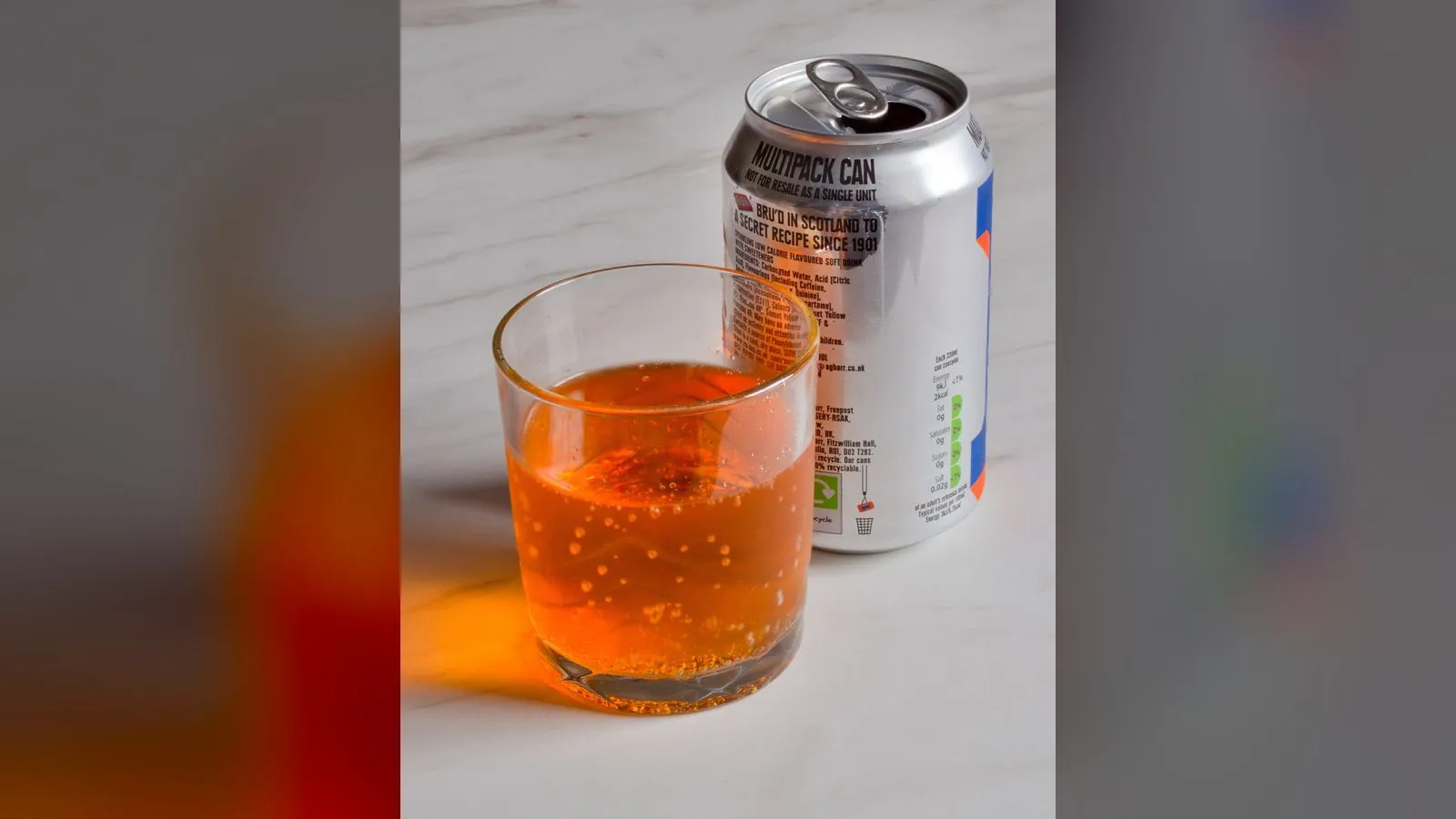

Irn-Bru: Scotland's "Other National Drink"
Contents
Irn-Bru is the bright orange soft drink that Scots call their other national drink. It is made by A.G. Barr, a family firm that began in Falkirk in the 19th century and still has its head office in Scotland. But the name, the idea of an "iron brew" and even the strongman on the label came from somewhere else. This card tests what is genuinely Scottish about Irn-Bru, and which of the famous stories about it are company history, marketing, or myth.
TL;DR
- established A.G. Barr launched its "Iron Brew" in Glasgow on 15 April 1901. The firm's roots go back to Robert Barr's aerated-water business in Falkirk, which the company dates to 1875.
- established Iron Brew was not invented in Scotland. A New York firm, Maas & Waldstein, sold "IRONBREW" from 1889, and a London firm, Stevenson & Howell, launched an Iron Brew essence in 1898 with a strongman trademark.
- established The spelling changed to Irn-Bru after a 1946 law required brand names to be literally true: the drink was not brewed. The new trademark was registered on 18 July 1946 and the drink went back on sale under it in 1947.
- shared "Irn-Bru outsells Coca-Cola in Scotland" was true for much of the 20th century, but by 2003 independent sales data put Coca-Cola products ahead in key shops. Who leads now depends on how sales are measured.
- traditional The recipe of 32 flavours is said to be known to only three people. The tale that it sits in a Swiss vault is a rumour, not a documented fact.
Key Facts
- Maker
- A.G. Barr p.l.c.
- Firm's roots
- Robert Barr, aerated waters, Falkirk (company date 1875)
- Glasgow branch
- Opened 1887 by Robert Fulton Barr; run by Andrew Greig Barr from 1892
- Iron Brew launched
- 15 April 1901
- Earliest "IRONBREW"
- Maas & Waldstein, New York, 1889
- Irn-Bru trademark
- Registered 18 July 1946
- Back on sale as Irn-Bru
- 1947
- Iron content
- 0.002% ammonium ferric citrate
- Sugar cut
- January 2018, ahead of the UK soft drinks levy
- Head office and factory
- Cumbernauld (production centralised there from 1996)
Scottish Impact Index (SI Score)
- Cultural Reach
- 9/10
- Continuity of Tradition
- 6/10
- Social & Economic Importance
- 9/10
- Scottish Distinctiveness
- 10/10
- Cultural Legacy
- 8/10
- Recognition
- 10/10
52/60
Ranked #12 of 19 in Traditions
A Note on Claims and Evidence
Each major claim carries one of three labels. established means supported by primary records, official bodies or several independent reliable sources. shared means the core fact is sound but sources disagree on details, dates or interpretation. traditional means widely repeated but not traceable to a primary or independent source.
The weak points are dates and sales. Sources give Robert Barr's start in aerated waters as 1875 (the company's own history) or 1880 (Falkirk's council archives). Sales figures for the whole Scottish soft-drinks market are owned by research firms and are rarely published in full, so any "number one" claim needs to say which shops and which year it means. Much of Irn-Bru's folklore comes from its own advertising.
Timeline
Robert Barr starts making aerated waters in Falkirk, the date A.G. Barr gives for its founding. Falkirk's archives date his Burnfoot Works to 1880.
Robert Fulton Barr, the founder's son, opens a second business in Glasgow.
Maas & Waldstein of New York sell "IRONBREW", marketed as "The Ideal American drink".
Andrew Greig Barr takes over the Glasgow business; its labels become "AG Barr & Co."
Stevenson & Howell of London launch an Iron Brew essence and register a strongman trademark. Barr's is selling an Iron Brew by the same year.
Glasgow has 37 soft-drink manufacturers and Falkirk 11, according to John Burnett.
Barr's officially launches IRON BREW.
Andrew Greig Barr dies, aged 31.
The IRN-BRU trademark is registered.
Irn-Bru appears on the market in place of Iron Brew.
Sugar rationing ends and the British soft-drinks industry revives.
The Glasgow and Falkirk businesses combine when AG Barr & Co. buys Robert Barr Ltd.
A.G. Barr floats on the Stock Exchange.
A Glasgow billboard calls Irn-Bru Scotland's "Other National Drink".
All of Barr's Scottish production moves to a new factory at Cumbernauld.
Nielsen data puts Coca-Cola products ahead of Irn-Bru in Scottish shops.
Barr's cuts the sugar in Irn-Bru by about half before the soft drinks levy; a petition against the change passes 21,000 signatures within days.
Details
A Falkirk firm and a Glasgow drink
shared The Barr story starts in Falkirk. Robert Barr began making aerated waters there; A.G. Barr dates this to 1875, while Falkirk Council's archives date his Burnfoot Works to 1880. Both towns have a fair claim to the drink. In 1887 his son Robert Fulton Barr opened a second business in Glasgow, and in 1892 Andrew Greig Barr took it over. His initials are the "A.G." in the company name. The Glasgow business soon ran independently, and it was there that Iron Brew was launched on 15 April 1901. The two family firms only became one company in 1959. Some histories blur the two branches: the social historian John Burnett, in a 1997 paper published in Order and Disorder (2000), credits the 1901 Iron Brew to "Robert Barr, a mineral water manufacturer of Falkirk". The company's own history places the launch with the Glasgow firm.
established Barr's was one of many such firms. Burnett counts 37 soft-drink makers in Glasgow and 11 in Falkirk by the end of the 19th century, part of a new mass market as working-class incomes rose and sugar became cheap after its duty was abolished in 1874. Ginger beer was the best-known commercial drink in the north of England and Scotland, where more than a thousand trade names have been identified.
An American name and an English strongman
established Barr's did not invent the idea. Research by David Leishman of Grenoble Alpes University, reported in 2017 and later published in his book Consumer Nationalism and Barr's Irn-Bru in Scotland (Palgrave Macmillan, 2020), traced "IRONBREW" to Maas & Waldstein, a New York chemicals firm, in 1889. The American drink was sold on its health benefits until US food and drug laws stopped that, and it had largely faded by the 1920s.
established The flavour reached Britain through Stevenson & Howell of London, which launched an Iron Brew essence in the summer of 1898 and sold it to bottlers. It also registered the strongman trademark that Barr's later used. Leishman's conclusion is that Irn-Bru became Scottish through branding and advertising rather than being invented in Scotland. Barr's has never claimed to have invented iron brew drinks; it says there have been many Iron Brews but only one Irn-Bru.
A tonic in the age of temperance
established Iron Brew was sold as a health drink as well as a treat. Burnett places it alongside Vimto, created by a Manchester druggist in 1906 as a temperance drink and "Health Tonic", and Tizer. All three were strongly flavoured drinks that echoed older home-made herb beers and copied the methods of Coca-Cola, launched in 1886 as a temperance drink and "brain tonic". According to Burnett, Iron Brew was promoted as "a stimulating tonic, restorative and hangover cure".
established Burnett's wider argument is that soft drinks, from medieval cordials onwards, have nearly always claimed health benefits to justify what is mostly sugar and water. He counts their main real benefit as offering an alternative to alcohol. He also notes the costs: by the 1990s heavy soft-drink consumption had helped push British sugar intake above 100 lb a head a year, with harm to children's teeth.
established During the Second World War the Ministry of Food put the whole industry, a heavy user of sugar and imported ingredients, under the Soft Drinks Industry (War Time) Association. Supplies were rationed, prices fixed and many small firms closed. The industry revived when sugar rationing ended in 1952.
Why "Irn-Bru"?
established During the Second World War, soft drinks were controlled and Iron Brew disappeared from sale. A law of 1946 required brand names to be literally true, and the drink was not brewed. Barr's answer was a new spelling. The IRN-BRU trademark was registered on 18 July 1946, and the drink returned to the market under that name in 1947. Many accounts give 1948 for the relaunch; the company's own history gives 1947.
established A common version of this story says the problem was that the drink contained no iron. That is wrong. Irn-Bru contains a trace of iron, 0.002 per cent ammonium ferric citrate. The issue was the word "brew".
The secret recipe
traditional Barr's says the recipe contains 32 flavours and that only three people know it in full: former chairman Robin Barr, his daughter Julie Barr, and one director. These are company statements and cannot be checked independently. The further story that the recipe is kept in a vault in Switzerland is a rumour repeated in the press, not something the company has documented.
Does it outsell Coca-Cola?
shared For much of the 20th century Irn-Bru was one of very few local drinks anywhere to outsell Coca-Cola in its home market. Burnett repeats a claim from the Chambers Scottish Drinks Book (1990) that in the 1980s it outsold Coca-Cola in Scotland by three to one; he presents this as a claim, and no independent figures for it have been published. By the early 2000s that was no longer clearly true. Nielsen figures reported by The Scotsman for the year to 16 August 2003 put standard Coca-Cola top of Scotland's "impulse" sales, in corner shops and petrol stations, at £23.4 million, with Irn-Bru second at just under £20 million. In supermarkets, Diet Coke led at £24.4 million, with Irn-Bru third at about £16 million. Coca-Cola's regional director called Irn-Bru's market leadership "an urban myth"; the editor of Scottish Grocer thought the two were neck and neck.
established A related claim went viral in 2017: a map showing Scotland as the only country where Coca-Cola is not the best-selling drink. The fact-checking site The Ferret rated it false. Coca-Cola cannot legally be sold in Cuba or North Korea because of US trade embargoes, so Scotland is not unique. The Ferret did not dispute Irn-Bru's popularity in Scotland.
The 2018 sugar cut
established In January 2018, ahead of the UK soft drinks levy, Barr's cut the sugar in Irn-Bru by about half, from around 8.5 teaspoons a can to 4, adding sweeteners. A petition started by Ryan Allen on change.org passed 21,000 signatures within days. Barr's said the drink kept "the same secret Irn-Bru flavour essence" and that nine in ten regular drinkers in its taste test rated the new version a good or excellent match.
Advertising and the strongman
established Advertising made Irn-Bru Scottish as much as the drink did. Early labels used a strongman, later linked to the Highland Games athlete Adam Brown. For decades newspapers carried a comic strip, The Adventures of Ba-Bru. The slogan "Made in Scotland from girders" played on the iron in the name. Later campaigns were deliberately cheeky and often drew complaints to the advertising regulators.
traditional Irn-Bru's reputation as a hangover cure is folk belief, not medical fact, though Burnett's account suggests the idea was in the drink's early promotion. Its status at Hogmanay, at weddings and in Scottish humour is real, but it is cultural, not scientific.
Did You Know?
- The first "IRONBREW" was sold in New York in 1889, twelve years before Barr's official launch.
- The strongman on the label was registered as a trademark by a London firm in 1898, not by Barr's.
- Irn-Bru does contain iron, about 0.002 per cent ammonium ferric citrate.
- The new spelling was registered as a trademark on 18 July 1946.
- The "A.G." in A.G. Barr is Andrew Greig Barr, who died in 1903 aged 31.
- Barr's two family firms, in Falkirk and Glasgow, did not merge until 1959.
- A 1983 Glasgow billboard first called it Scotland's "Other National Drink".
- When the sugar was cut in 2018, a petition against the change passed 21,000 signatures within days.
- Another Scottish firm made a soft-drinks first: Rose's, ships' chandlers of Leith, created Rose's Lime Juice, which Burnett calls the first commercially made concentrated fruit juice in Britain.
- Early Iron Brew was advertised as a hangover cure, according to the historian John Burnett.
FAQ
1Was Irn-Bru invented in Scotland?
No. A drink called IRONBREW was sold in New York from 1889, and a London firm sold an Iron Brew essence from 1898. Barr's made it Scottish through its branding.
2When was Irn-Bru first made?
Barr's officially launched IRON BREW on 15 April 1901, though it was selling an Iron Brew by 1898.
3Why is it spelled "Irn-Bru"?
A 1946 law required brand names to be literally true, and the drink was not brewed. Barr's registered the new spelling as a trademark.
4Does Irn-Bru contain iron?
Yes, a trace: 0.002 per cent ammonium ferric citrate.
5Who makes Irn-Bru?
G. Barr p.l.c., headquartered in Cumbernauld.
6Was the company founded in Falkirk or Glasgow?
Both have a claim. The family business began in Falkirk; Iron Brew was launched by the Glasgow branch.
7Does Irn-Bru outsell Coca-Cola in Scotland?
It did for much of the 20th century. Since at least 2003, independent data has put Coca-Cola products ahead in some kinds of shop, so the answer depends on what is measured.
8Is Scotland the only country where Coke isn't number one?
No. The Ferret rated that claim false in 2017; Coca-Cola is not legally sold in Cuba or North Korea.
9How many people know the recipe?
The company says three. That cannot be independently checked.
10Is the recipe kept in a Swiss vault?
That is a rumour, not a documented fact.
11Why did Irn-Bru change in 2018?
Barr's cut the sugar by about half ahead of the UK soft drinks levy, which taxes drinks above a set sugar level.
12Is Irn-Bru a hangover cure?
That is a popular belief, not a medical finding. Early Iron Brew was advertised as one.
13Was Iron Brew sold as a health drink?
Yes. Like Vimto and Coca-Cola, it was promoted as a tonic and restorative, in an era when temperance drinks were popular.
14Did Irn-Bru outsell Coca-Cola three to one?
That claim was made for the 1980s in the Chambers Scottish Drinks Book (1990). No independent sales figures for it have been published.
Sources and Further Reading
Primary/Institutional
- A.G. Barr, "Our history" (agbarr.co.uk)
- Falkirk Council Archives, "Barr, A G & Co" (collections.falkirk.gov.uk)
Scholarly/Critical
- David Leishman, "From Girders: Discourses of National Strength", in Consumer Nationalism and Barr's Irn-Bru in Scotland (Palgrave Macmillan, 2020), chapter page (link.springer.com)
- John Burnett, "From cordial waters to Coca-Cola: soft drinks and health in Britain", in Alexander Fenton (ed.), Order and Disorder: The Health Implications of Eating and Drinking in the Nineteenth and Twentieth Centuries (Tuckwell Press, 2000)
- The Ferret, "Claim Scotland is only country where Coca-Cola is not most popular drink is false", 24 August 2017 (theferret.scot)
General
- Edinburgh Evening News, "Was Irn-Bru actually invented in America?", 22 June 2017 (edinburghnews.scotsman.com)
- The Scotsman, "Irn-Bru: the surprising and secretive history of Scotland's 'other national drink'" (scotsman.com)
- The Scotsman, "Coke takes sparkle from Irn-Bru", 2003 (scotsman.com)
- STV News, "Irn-Bru recipe petition hits more than 21,000 signatures", 5 January 2018 (stv.tv)
Caveats: Myths and Disputed Claims
- Do not say Irn-Bru was invented in Scotland. The name and the essence came from New York (1889) and London (1898).
- Do not say the name changed because the drink contains no iron. It contains a trace of iron; it is not brewed.
- Do not say "Irn-Bru outsells Coca-Cola in Scotland" without a date and a measure.
- Do not repeat the claim that Scotland is the only country where Coca-Cola is not number one.
- Do not present the Swiss vault as fact.
- Do not give a single founding date without noting that sources say 1875 or 1880.
- Do not call Irn-Bru a hangover cure. The claim began as advertising.
- Do not quote "three to one" over Coca-Cola as a fact; it is an unsourced 1980s claim.
Card 026 · Traditions