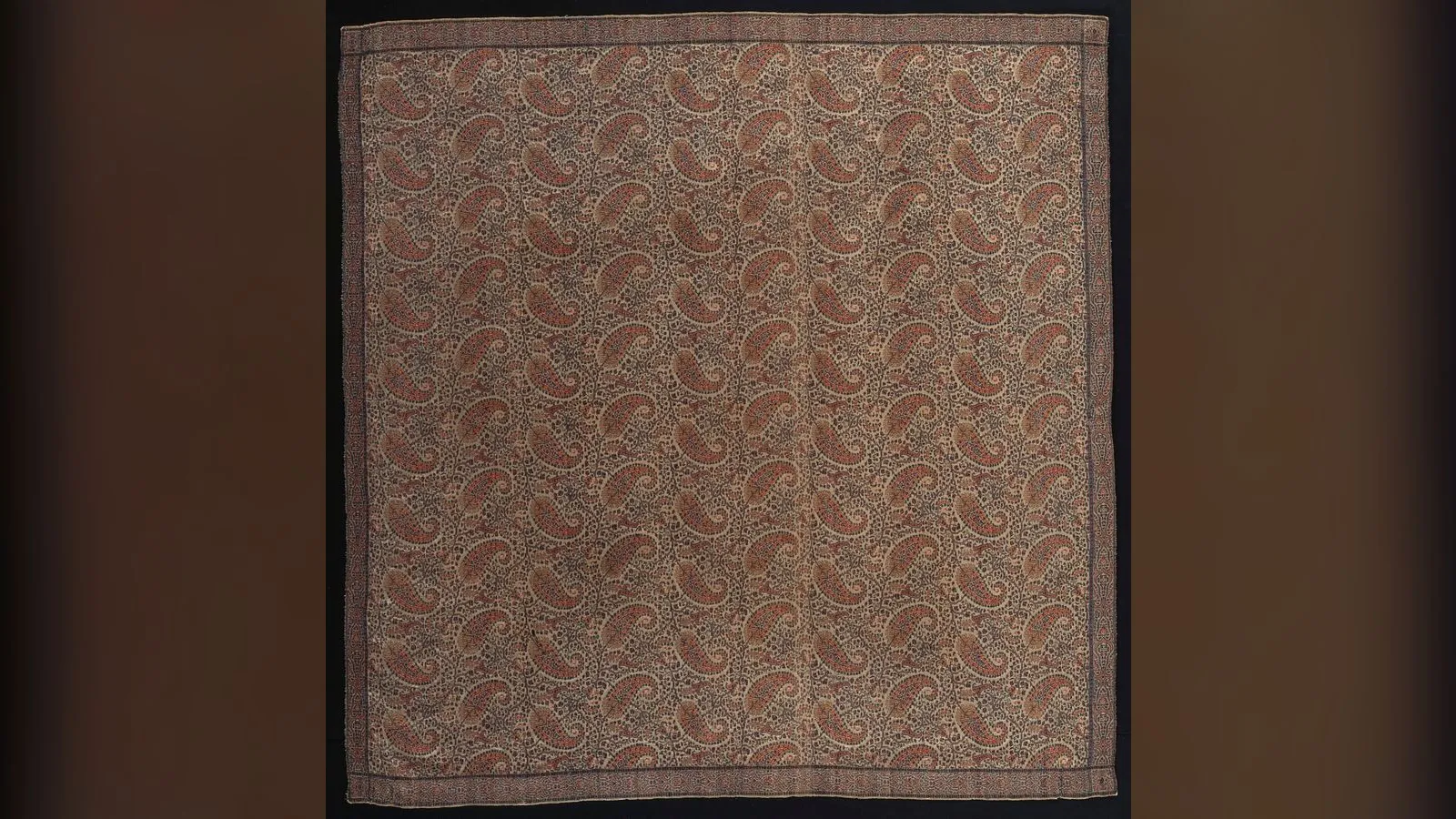

The Paisley Pattern
Contents
The curved teardrop known around the English-speaking world as "paisley" carries the name of a Renfrewshire weaving town. The motif was not invented there. It is the buta or boteh of Kashmir shawls, woven in India long before any Scot copied it. Paisley's achievement was industrial. Its manufacturers made imitation Kashmir shawls on a larger scale, and more cheaply, than their rivals in Edinburgh, Norwich, France and Vienna, until shoppers asked their drapers simply for "Paisleys". This card tests what is Scottish about the paisley pattern, and tells the story of the shawl trade that gave it the name. The main guide is Valerie Reilly, curator at Paisley Museum, whose The Paisley Pattern (1987) was published for Renfrew District Council Museums. As she puts it, "The one sure fact is that it did not originate in Paisley."
TL;DR
- established The motif came from Kashmir, where shawls of soft goat down bearing the buta were woven by hand and worn by men. The East India Company brought them to Britain in the 18th century, at a price only the richest could pay.
- shared Edinburgh and Norwich made imitation shawls about 25 years before Paisley. Reilly's earliest documented Edinburgh maker dates from 1777; Heriot-Watt University puts the first Edinburgh shawl at 1767.
- established Paisley took up the trade in the first decade of the 19th century. Tradition says an Edinburgh manufacturer sent work there in 1805; the first contemporary reference, in 1812, counts about 100 looms. Paisley was probably the first British centre to use the Jacquard loom on a large scale, and it won the mass market.
- established The shawl was fashionable for about a century. The big plaid suited the crinoline of the 1840s to 1860s, but not the bustle. By 1875 shawls were worn only by old ladies and the very poor, and the last harness shawl was woven in Paisley in 1903.
- traditional What the motif means is unknown. It has been read as a date-palm shoot, a mango, a gourd, a flame, a pine cone and a teardrop. None of these is proven.
Key Facts
- Motif names
- Buta or boteh (India and Persia); "pine" to the Paisley weavers; "tadpole" in France; "little onion" in Vienna
- Origin of the design
- Hand-woven Kashmir shawls; motif present by the late 17th century
- Price of a Kashmir shawl
- About 200 to 300 guineas in the mid-18th century
- Earliest British imitations
- Edinburgh (documented maker 1777) and Norwich (1784); about £20 each
- Paisley takes up shawls
- Traditionally 1805; about 100 looms by 1812
- Paisley "pine" shawls
- From about 1814
- Shawl manufacturers in Paisley
- 8 in 1827; 27 by the mid-1830s
- Looms
- Drawloom first; Jacquard from the mid-1820s, widespread by the 1830s
- Standard plaid
- About 10 by 5 feet (3 by 1.5 m)
- Average woven plaid price, 1862
- 27s 1d, about four weeks' pay for a Paisley weaver
- Worst slump
- 1841 to 1843: 67 of 112 manufacturers bankrupt
- Last harness shawl woven in Paisley
- 12 June 1903, Waters and Cook
- Paisley Museum collection
- Over 800 shawls by 1987
Scottish Impact Index (SI Score)
- Cultural Reach
- 9/10
- Continuity of Tradition
- 9/10
- Social & Economic Importance
- 9/10
- Scottish Distinctiveness
- 10/10
- Cultural Legacy
- 9/10
- Recognition
- 10/10
56/60
Ranked =6th of 19 in Traditions
A Note on Claims and Evidence
Each major claim carries one of three labels. established means supported by primary records, official bodies or several independent reliable sources. shared means the core fact is sound but sources disagree on details, dates or interpretation. traditional means widely repeated but not traceable to a primary or independent source.
The industrial history is well documented. Trade directories, pattern books, price tables, the records of the Board of Manufacturers and parliamentary inquiries all survive, and Paisley Museum holds much of this material. Reilly's book draws on it and on the earlier work of Matthew Blair (1904), C. H. Rock (1966) and Dorothy Whyte. Where she writes from that record, this article treats her account as Established.
Three areas are weaker. First, the earliest years of British shawl-making are poorly recorded, so the start dates for Edinburgh and for Paisley differ between sources. Second, Reilly notes that it is very hard to tell where a surviving shawl was made: designers sold freelance, manufacturers copied each other, and few French records survive. Third, the meaning of the motif is a matter of interpretation. Reilly's own account, which traces it to a Babylonian date-palm symbol, is one theory among several and is treated here as Traditional.
Timeline
Shawls are woven in Kashmir by the laborious twill-tapestry method.
Kashmir shawls carry an early, naturalistic form of the buta; a painting of about 1670 shows Abdullah Qutb-Shah of Golconda wearing one.
The motif becomes a tight pyramid of flowers above a vase.
The novelist Laurence Sterne mentions shawls in a letter as a fashionable garment.
The Kashmir buta takes on the shape of a curling, pointed leaf filled with flowers.
William Mortimer is making shawls in Edinburgh, according to the Board of Manufacturers.
The Board awards Mortimer a premium of £10.
Barrow and Watson of Norwich are making "shawls", closer to neckerchiefs, mainly for America.
George Richmond has 13 looms making shawls in Edinburgh.
Fashion copies Greek and Roman dress, and the long stole shawl reaches its first peak.
By tradition, an Edinburgh manufacturer with too many orders sends work to idle Paisley silk weavers.
John Wilson records about 100 looms in Paisley weaving "richly ornamented shawls and plaids".
William Moorcroft brings 50 shawl goats from Tibet for the East India Company; none survives in Scotland.
Paisley begins weaving shawls with the "pine" motif.
George IV's visit to Edinburgh popularises the "pale-end" shawl.
The first Jacquard looms are in use in Paisley.
Eight Paisley firms describe themselves as shawl manufacturers.
Shawls worth an estimated £1,000,000 are made in Paisley.
Queen Victoria comes to the throne and is known to prefer the long plaid to the square shawl.
The worst slump in Paisley's history: 67 of 112 manufacturers go bankrupt.
In February, 14,791 weavers and dependants are on relief; the town itself goes bankrupt. Queen Victoria buys 17 shawls.
Complaints about Paisley copying rivals' designs lead to short-term design protection.
The first Sma Shot Day holiday celebrates the weavers' victory over the manufacturers.
A price table shows woven plaids at 17s 6d to 46s, and printed plaids at an average of 7s 8d.
Paisley perfects a reversible shawl; the crinoline starts to flatten at the front.
The bustle is in fashion and the shawl trade collapses.
Paisley Museum opens, Scotland's first municipally run museum.
Shawls are seen only on old ladies and the very poor.
Waters and Cook of Thread Street weave the last harness shawl in Paisley, on 12 June.
The Paisley Loan Exhibition shows more than 650 shawls and related items.
Paisley's last handloom weaving shop closes; one of its Jacquard looms goes to the museum.
Paisley Museum opens a purpose-built shawl gallery.
Paisley Museum is due to reopen early in the year after a £68.7m redevelopment.
Details
A motif from Kashmir
established The shawl. Reilly describes the Kashmir shawl as a man's garment in its homeland, prized even by princes, who gave shawls to one another as gifts of rank. The Cooper Hewitt museum notes that the Mughal emperors gave shawls as robes of honour. The best were woven on a simple frame loom by the twill-tapestry method. The weft threads did not run across the full width of the cloth. Instead, the weaver worked one small patch of colour at a time with a needle-like shuttle. A fine shawl could take two or three years. Cheaper versions were woven in small sections by several weavers and sewn together like patchwork, and some were embroidered.
established The wool. The softness came from pashmina, the downy underfleece that a Central Asian goat grows against the cold of the high Himalayas. It was shed each summer and gathered from rocks and thorn bushes, and the Kashmir weavers had a monopoly of it. Reilly gives the yield of a domesticated goat as about two pounds (900 g) of down a year, enough for one shawl about 4 feet 6 inches (1.4 m) square. The British valued the goats too. Under an 1846 treaty, Gulab Singh, ruler of Kashmir after the First Sikh War, promised Britain an annual tribute of one horse, twelve shawl goats and three pairs of shawls.
shared The name. The motif is called buta in India and boteh in Persian. Reilly glosses the word as "flower". Persian dictionaries more often give boteh as "shrub" or "bush", so the translation varies with the language and the source. In India today it is also called the mango pattern.
established How the shape changed. Reilly traces the motif through surviving Kashmir shawls. In the late 17th century it was delicate and naturalistic. Early in the 18th century, under Indo-Persian influence, it became a tightly packed pyramid of flowers above a vase. By the middle of the century its outline was more formal and tended to bend over at the top. From about 1770 it took the familiar form of a curling, pointed leaf filled with flowers, usually in primary colours. European copiers knew little of its Indian meaning and gave it new names: the "pine" in Paisley, the "tadpole" in France and the "little onion" in Vienna.
What does the shape mean?
traditional Competing readings. Nobody knows what the motif first represented. It has been likened to a mango, to a gourd or pitcher plant, to a cypress, a flame, a pine cone and a teardrop. Reilly reports that the consensus of her day favoured the growing shoot of the date palm, which looks like a young bracken frond uncurling. On her account the symbol began in ancient Chaldea (Babylonia), where the date palm was a tree of life, and spread to India and to prehistoric Europe.
traditional The Celtic link. Reilly also sees traces of the shape in Celtic art, illustrating the Desborough Mirror in the British Museum. This is a resemblance of curves, not evidence that the paisley motif descends from Celtic art. The documented line runs from Kashmir to Europe in the 18th century, and every European centre copied it from Indian shawls.
Fashion before Paisley
established Not Napoleon's soldiers. A popular story says French soldiers brought Kashmir shawls home from Napoleon's campaigns in the Near East. Reilly rejects it. Shawls were fashionable in Britain long before that, carried home by East India Company officers as gifts. Sterne mentioned them as fashionable in 1767. For once, she notes, Britain was ahead of Paris in fashion.
established The price problem. A mid-18th-century Kashmir shawl cost about 200 to 300 guineas (£210 to £315). Supply was small, because each took years to weave. That gap is what created the imitation industry. Early British copies cost about £20 and were mainly silk. Some were square with patterned borders sewn on to a plain centre. "Turn-over" shawls had two borders sewn to each side, so that all four showed when the shawl was folded corner to corner. Medallion-centre shawls were known to the weavers as "pot-lid" shawls.
established Edinburgh. Reilly says Edinburgh may have been the first British centre, though the early years are poorly recorded. The Board of Manufacturers records William Mortimer making shawls there in 1777 and paid him a £10 premium in 1781. George Richmond had 13 looms on shawls by 1791. By 1798 the Board was offering premiums for "cheap shawls, such as servants wear", a sign of how widely shawls were worn. The best-known Edinburgh firm was Gibb and MacDonald, who in 1830 sold red, white and black shawls to retailers for £6 to £16. After the 1830s the Edinburgh trade shrank to a few specialists. The last known manufacturer, David Sime, registered designs from 1843 to 1847 and seems to have closed in 1853.
shared The Edinburgh start date. Heriot-Watt University, which holds a textile collection, says the first imitation Kashmir shawl was woven in Edinburgh in 1767, that more than 100 Edinburgh weavers were at work on shawls by 1810, and that the last Edinburgh shawl was made in 1847. Reilly's earliest documented maker is Mortimer in 1777, and her introduction dates the start in Edinburgh and Norwich to around 1780. She ties the year 1767 only to Sterne's letter. Both accounts agree that Edinburgh came well before Paisley.
established Norwich. Barrow and Watson of Norwich were making shawls by 1784, though these were closer to neckerchiefs and went mainly to America. John Harvey mixed Norfolk and Spanish yarns, and wool with silk, trying to match the softness of cashmere. In P. J. Knights' early "shawl counterpane", presented to Queen Charlotte in 1792, the pattern was darned in by hand. Around 1800 Norwich weavers learned to weave the pattern on the drawloom. These "fill-overs" took about three weeks to weave and sold for £40 to £50.
established France and Vienna. In France, Empress Josephine was said to own several hundred shawls, and the shawl became part of every wealthy bride's trousseau. Reilly gives the rule as two French shawls and one Kashmir. French design led Europe. Under Napoleon, leading artists were commissioned to adapt the Kashmir pattern to French taste, and by the 1840s British manufacturers were copying French copies. Guillaume Ternaux of Reims and Paris won the Legion of Honour for his shawls. Lyons overtook Paris after about 1830. Vienna built its own industry from the early 19th century: by the 1830s more than 4,000 looms there were making shawls, and annual output was recorded at 400,000, over two-thirds of them exported.
Paisley takes up the shawl
shared The beginning. Paisley was already a weaving town, famous for fine silk gauze, when that trade fell into depression. Reilly says the slump was caused partly by Napoleon's Continental Blockade. Tradition, which she reports as tradition, says an Edinburgh manufacturer with more orders than his own weavers could fill sent work to Paisley in 1805. Heriot-Watt dates the move to 1808. The first contemporary record is John Wilson's survey of Renfrewshire in 1812, which counts about 100 looms weaving silk shawls and plaids.
established The first Paisley shawls. The early imitations had narrow floral or seaweed-like borders rather than the true "pine". A 19th-century writer described the first Paisley sprig as "perverse-looking" and "wry-necked". Paisley began weaving the pine about 1814. At first it was filled with a mosaic of small blocks of colour. Later it was filled with flowers, buds and leaves, wrapped in a band of pattern called the "laurel", and set among sprays called the "wreath".
established The "big corks". The manufacturers, known locally as "big corks", provided the capital. They bought yarn and designs, gave out work to weavers, and sold the finished shawls from their own warehouses or to drapers. In 1827 eight Paisley firms called themselves shawl manufacturers. By the mid-1830s there were 27, and in 1834 shawls worth an estimated £1,000,000 were made in the town. By the 1840s Paisley was almost a one-industry town.
How a shawl was made
established Designing. A designer drew a quarter or half of the shawl in pencil or ink, then detailed drawings of borders, corners and centre. A colourer painted these on oiled paper. A draughtsman then transferred them to "point-paper", a kind of graph paper on which each square stood for one crossing of warp and weft. Reilly says the point-paper design for a full plaid could cover the floor of a large room. Designers took ideas from real Kashmir shawls, from other imitations, and from French books of shawl designs such as Le Cachemirien.
shared Copying. Reilly says Paisley produced few designs of its own until its British rivals were beaten. Norwich and Edinburgh complained repeatedly that Paisley pirated their patterns. One Norwich maker said Paisley copied four in every six shawls his firm brought out. Complaints peaked in the early 1840s, and Norwich persuaded the government to allow designs to be protected for three, six or nine months. A popular story says Paisley firms kept agents on the London docks around 1812 who traced new Kashmir shawls and had copies on sale within weeks at £20 against £200. Reilly calls this "nonsensical". Preparing the point-paper, warping, lashing the harness and weaving would take weeks, and simply getting a tracing from London to Paisley by road would take about a week.
established Yarn. Matching the feel of cashmere was the hardest problem, and Reilly says European makers were always thought to have failed. Before 1820 no British wool yarn was strong enough to serve as warp in a harness loom, so early shawls used silk warps with silk, wool or cotton wefts. The best Paisley warp later came from Amiens: cashmere spun round a silk core. The weft was fine botany worsted, spun in Bradford from Australian wool and sent to Paisley through Liverpool and the Clyde. All-wool shawls appeared in the 1820s and 1830s. Reilly adds that quality depended more on how tightly a shawl was woven than on its fibre, and that some cotton plaids are as good as woollen ones.
established The goat that never settled. Britain tried to raise its own shawl goats. In 1812 the veterinarian William Moorcroft took an East India Company expedition into western Tibet and brought back 50 goats. The females were lost at sea, and the four males that reached Scotland soon died. A French expedition of 1818 caught more than 1,200 goats; two pairs reached England, where by 1828 a herd of 27 produced enough wool for three shawls. These goats grew only two to four ounces of down a year, and the quality fell. British winters were not cold enough.
established Dyeing. Paisley's dyers became highly skilled. One surviving dye book, belonging to James Barclay, records recipes using logwood, indigo, saffron, chrome and other dyestuffs. From the 1850s chemical aniline dyes began to replace natural ones, and many plaids of the 1850s and 1860s show their harsh purples and yellows. Dyeing sections of the warp before weaving, for multicoloured borders and centres, needed great accuracy. Reilly says the results made Paisley famous as a dyeing centre.
established The drawloom and the drawboy. At first Paisley wove shawls on the drawloom, a handloom with an overhead harness. A "flower-lasher" read the point-paper line by line and tied the harness cords. A drawboy, or sometimes a drawgirl, pulled cords called "simples" to lift groups of warp threads, raising between 6 ounces and 3 pounds of lead weights each time. The shawl was woven face down, so the weaver saw only loose threads, and a mistake might not show until the shawl came off the loom up to two weeks later. Reilly gives the drawboys' average age as about ten, on a working day that was often 12 hours, and says many were beaten for a moment's inattention.
established The Jacquard. Joseph-Marie Jacquard's mechanism, perfected in the first years of the 19th century, replaced the drawboy with a chain of punched cards. British weavers resisted it at first as a way to cut jobs. Pattern books show a few Jacquards in Paisley by the mid-1820s, and many more by the 1830s. Reilly credits Paisley as probably the first British weaving centre to use the Jacquard on a large scale, and sees this as one reason it beat its slower rivals. The cards were cut on a keyboard machine called a "piano". A full plaid needed a huge number of cards, and a tax on the card could push the cost of a set to about £100. Manufacturers complained that this favoured their tax-free continental rivals, and they often wove a second web in new colours to get more use from each set.
established Finishing. About a dozen specialists handled each shawl from design to finish. Because the pattern threads floated loose on the back, the shawl had to be clipped. Girls did this with shears until the 1830s, when a French machine with revolving blades arrived. Its inventor, M. Vergniais, charged £300; Paisley soon made its own for £40. Clipping could remove two-thirds of the yarn. A plaid that came off the loom weighing about 100 ounces might end up at 30 to 40. Fringes were rolled by hand in the warehouse, and the shawl was washed, stretched ("stented") and steam-pressed ("calendered") to give it a sheen.
established Printed shawls. Printing was almost a separate trade. Printed chintz shawls are recorded in Scotland by 1785, and the Dunbartonshire firm of Todd, Shortridge and Company was printing pine patterns by the mid-1790s. Paisley came to printing late, probably in the 1830s, starting with expensive prints on silk gauze. Patterns were cut on wooden blocks about a foot square, later with copper strips set into the wood, and every colour in every section needed its own block. Once the blocks were made, prints were cheap. In 1862 a printed plaid averaged 7s 8d and a printed shawl 3s 6d.
A century of fashion
established The three shapes. Reilly defines three types. The stole or scarf shawl was about 9 feet by 20 inches (2.75 m by 50 cm). The square shawl began at about 3 feet, classed as a "handkerchief" for export duty, and grew to 6 feet. The long shawl, twice as long as it was broad, was called a plaid. A full plaid was about 10 by 5 feet (3 by 1.5 m) and a three-quarter plaid about 8 by 4 feet.
established The early phases. Around 1800 the long stole shawl suited the high-waisted, column-like dresses of the day. After 1820 patterns grew larger and covered more of the shawl. George IV's visit to Edinburgh in 1822 popularised the "pale-end", a creamy-white centre with large blue pines on the border. In the 1830s many shawls dropped the pine for naturalistic flowers. A manufacturer, asked whether he wanted a naturalistic pattern, is said to have replied, "a wee natural, but no desperate natural". Between 1820 and 1840 fashionable men also wore shawls over their topcoats when travelling, until enclosed railway carriages replaced draughty coaches.
established The plaid and the crinoline. When Queen Victoria came to the throne in 1837 it became known that she preferred the rectangular plaid to the square shawl, and Paisley soon made few square ones. In the 1840s skirts swelled into the crinoline, and coats were hard to make to fit over them. The large plaid became the normal outdoor garment. By 1850, Reilly writes, managing a plaid correctly was seen as a test of gentility. A moderately wealthy woman owned at least two: a heavy all-over pattern for winter and a lighter white or scarlet centre for summer. White-centred plaids became the standard wedding present and were worn by new brides and mothers at their first church service afterwards, so they were called "kirking shawls".
established The best years for the pattern. In the 1840s the pine bent and twisted, often in intertwined groups of two or three. Reilly considers this probably the best period for the design. Later the Victorian dislike of a plain surface pushed the pines to stretch from corner to centre until nothing was left bare. Apart from a brief fashion for a fern pattern called "Fanny's Fern" around 1853, the pine dominated to the end.
established The reversible shawl. Around 1865 Paisley found a way to weave a shawl patterned on both sides, ending the waste of clipping. But the spare threads were trapped between the two faces, which made a full plaid too heavy to wear. Since Victoria's lead had made the square shawl unfashionable, the reversible never caught on.
established Who could afford one. A table of prices from leading Paisley firms in 1862 gives woven all-over plaids at 17s 6d to 46s, with an average of 27s 1d. That was far cheaper than a Kashmir, still about £200, but it was about four weeks' wages for a Paisley weaver. Working-class women wore shawls too, but usually the warm checked "Scotch plaid" or a cheap printed shawl rather than the woven imitation Indian type.
Boom and slump
established Falling wages. Reilly writes that a good weaver at the start of the 19th century could earn up to three guineas a week, but that by the late 1830s wages had fallen to about seven shillings. She puts this down partly to the division of labour, which left the weaver only the mechanical work of weaving, and partly to the Jacquard. Weavers could build their own drawlooms but not Jacquard machines, and could not afford the cards. Work moved into factories. Robert Kerr's firm went from 35 looms in Thread Street to a new factory at Seedhills with 182 Jacquards, considered one of the best weaving works in Europe.
established The slump of 1841 to 1843. Fashion changed fast. Each design was copied until it became "common", and manufacturers stopped giving out work until they had cleared their stock. The worst slump came in 1841 to 1843, when 67 of Paisley's 112 manufacturers went bankrupt. In February 1842, 14,791 weavers and dependants were on relief. Provost John Henderson said people came to ask for help in borrowed clothes, having sold their own for food. The government ran a quiet relief scheme through the civil servant Edward Twistleton, and more than £50,000 in food and clothing was handed out in 1841. The town itself went bankrupt in 1842 and took about 30 years to clear its debts.
shared The royal rescue. Queen Victoria supported a national appeal and, in 1842, chose 17 shawls from 30 sent to her on approval, paying £91. Not all were paisley pattern; some were tartan or velvet. She is reputed to have worn one to the christening of the Prince of Wales, but Reilly reports this as "reputed" rather than recorded. Orders followed and the trade recovered.
shared Paisley and the exhibitions. Reilly says the official reports on the 1851 and 1862 exhibitions praised Paisley shawls. She also records that Paisley manufacturers at first refused to show at the Crystal Palace in 1851, when told they could not display prices, because they knew their shawls beat the French only on cost.
Why "paisley"?
established Mass production. Reilly's answer is organisation, a loyal and underpaid workforce, savings on design through copying, and above all mass production. Edinburgh's makers had needed Paisley weavers to fill their orders; Paisley's "big corks" took the trade and ran with it. By the 1850s most shawls in any British draper's shop were made in Paisley, and a customer would ask to see a selection of "Paisleys".
established A late name. The name came slowly. Pine-patterned shawls were sold as "Imitation Indian" until well into the mid-19th century. Only when the fashion ended did the word "Paisley" pass from the shawl to the pattern. The name is an English one. In France such shawls were all called cachemire, whatever their origin, and in much of Europe imitation shawls were thought of as French. Reilly is clear that Paisley never matched the French on quality.
The end of the trade
established The bustle. By 1865 the crinoline was flattening at the front and gathering at the back. By 1870 the bustle was in fashion, and a plaid hid the very part of the outfit a woman now wished to show. Mantles, capes and dolmans replaced it. By 1875 shawls were worn only by old ladies or the very poor, and by the 1880s even country villages thought them old-fashioned. Reilly adds that the manufacturers may have hastened the end by pushing cheap shawls to beat earlier slumps, which made the luxury article look common.
established What happened to the weavers. Most remaining handloom weavers were old men. Younger men had seen that handlooms could not compete with power looms elsewhere and found work in the growing heavy engineering trades of Clydeside. Some firms turned to tartan shawls, ponchos for South America, curtains, table covers and even butchers' aprons, and one installed 60 old looms for "fur" and velvet shawls exported to Ireland. The number of manufacturers did not fall below ten until 1890. A local paper later warned that "fashion is too fickle a structure on which to rest".
shared The last looms. Waters and Cook of Thread Street wove the last harness shawl in Paisley on 12 June 1903, running off a single web for a small order. Heiton, Clark and Company, the last firm weaving fur shawls on handlooms, closed during the Second World War. Reilly gives the end of weaving in Paisley as 1942 in her introduction and as 1943 in her chapter on the museum, so the exact year is uncertain. What survived were the trades that grew up around weaving: thread, dyeing, and starch, which led Brown and Polson into cornflour.
The weavers
established A thinking trade. Reilly describes Paisley's early 19th-century weavers as famous across Scotland for their intellect. Weaving was quiet work that could be left and resumed, and loomshops held four or six looms, so men talked and argued as they worked. Each shop clubbed together to buy a weekly newspaper. Many weavers were Radicals and later Chartists, and the town's many dissenting congregations reflect their independence in religion. Paisley produced a string of weaver-poets, the best known being Robert Tannahill, and its weavers bred canaries and laced pinks. The town's horticultural society, founded in 1782, is claimed as the oldest in Scotland.
established Sma Shot Day. The "sma shot" was a binding thread hidden in the cloth. Manufacturers refused to pay for the yarn because it did not show on the surface. After a long dispute they gave way, and the Sma Shot Day holiday began in 1856. Weavers marched with their banners to the river pier and took a steamer trip down the Clyde.
Afterlife and the museum
established The pattern without the shawl. The motif outlived the shawl trade. Reilly records a New York firm hand-printing silk with copies of Paisley shawl designs in the 1910s, Paisley shawls given as royal gifts by the town in 1922 and 1938, and Liberty of London selling a printed revival on cashmere from 1976. The 1960s brought a craze for paisley on everything from ties and dresses to wallpaper, mugs and umbrellas, and Paisley Museum staged an exhibition of it in 1969. The pattern has never really gone out of fashion since.
established Paisley Museum. The museum opened in 1871, funded by Sir Peter Coats of the thread firm J. and P. Coats, and Reilly calls it Scotland's first municipally run museum. It collected few shawls at first: no more than 30 by 1900. A Glasgow loan exhibition in 1902 prompted the former drawboy Matthew Blair to call for a permanent collection, and the Paisley Loan Exhibition of 1905 showed more than 650 shawls and related items from over 200 lenders, many of which were then given to the museum. In 1943 one of the two Jacquard looms from Paisley's last weaving shop came to the museum. Big gifts followed: about 115 shawls from the family of Provost Robert Cochran in 1964, and more than 45 from Dorothy Whyte, the museum's wartime acting curator, in 1965. A purpose-built shawl gallery opened in 1974, paid for with money given by Daniel Coats in 1918. By 1987 the collection held over 800 shawls, with pattern books, a manufacturer's correspondence and weavers' union records. Reilly describes the gallery as "probably the most comprehensive permanent display" of such shawls anywhere.
established The museum today. Paisley Museum closed for a £68.7m redevelopment designed by AL_A, Amanda Levete's practice. After delays caused by Covid, construction problems and inflation, the Museums Association reported in September 2026 that it would reopen early in 2027. Press coverage describes its shawl holdings as the largest collection of Paisley shawls in the world.
Did You Know?
- Reilly writes that the Kashmir shawl was a man's garment in Kashmir before it became a woman's fashion in Europe.
- A fine Kashmir shawl could take two or three years to weave and cost 200 to 300 guineas in the mid-18th century.
- An 1846 treaty bound Gulab Singh of Kashmir to send Britain twelve shawl goats and three pairs of shawls every year.
- The point-paper design for one Paisley plaid could cover the floor of a large room.
- The drawboys who worked the early looms were on average about ten years old.
- Clipping the loose threads from the back could remove two-thirds of the yarn in a shawl.
- Fashionable men wore shawls over their topcoats when travelling between about 1820 and 1840.
- Queen Victoria bought 17 shawls in 1842 to help Paisley through its worst slump.
- Weavers' wives sometimes wore a new shawl before it went back to the warehouse, which is said to be why shawls were washed before sale.
- In France the motif was called the "tadpole", and in Vienna the "little onion".
- The last harness shawl woven in Paisley came off the loom on 12 June 1903.
- Starch for dressing the warp led the Paisley firm of Brown and Polson into cornflour.
FAQ
1Did Scotland invent the paisley pattern?
No. The motif is the buta or boteh of Kashmir shawls, woven in India long before Scots copied it. Paisley's contribution was manufacturing.
2Why is it called "paisley"?
Because by the 1850s Paisley made most of the imitation Kashmir shawls sold in Britain, and customers asked for "Paisleys". After the fashion ended, the name passed to the pattern.
3Was Paisley the first place in Britain to copy Kashmir shawls?
No. Edinburgh and Norwich were making shawls about 25 years earlier. Paisley joined in the first decade of the 19th century.
4When did Edinburgh start making shawls?
Sources differ. Heriot-Watt University gives 1767. Reilly's earliest documented maker, William Mortimer, dates from 1777.
5What does the teardrop shape represent?
No one knows. It has been read as a date-palm shoot, a mango, a gourd, a cypress, a flame and a pine cone. Reilly favoured the date palm, but that is an interpretation.
6What does "boteh" mean?
It is usually translated from Persian as "shrub" or "bush". Reilly gives buta as "flower". Translations vary.
7Did Napoleon's soldiers bring the shawl to Europe?
No. Shawls were already fashionable in Britain, brought by East India Company officers, before Napoleon's campaigns.
8Did the Jacquard loom start the Paisley shawl trade?
No. Paisley's first shawls were woven on drawlooms worked by drawboys. Jacquards appeared in the mid-1820s and spread in the 1830s, when they helped Paisley dominate the mass market.
9How big was a Paisley plaid?
A full plaid was about 10 by 5 feet (3 by 1.5 m). A three-quarter plaid was about 8 by 4 feet.
10How much did a Paisley shawl cost?
In 1862 a woven plaid averaged 27s 1d, about four weeks' wages for a Paisley weaver. A printed plaid averaged 7s 8d.
11Were Paisley shawls as good as French or Kashmir ones?
Not usually. Reilly says Paisley competed on price, and European makers never matched the feel of real cashmere.
12Why did the shawl trade end?
Fashion changed. The plaid suited the crinoline but not the bustle, which took over around 1870. Handloom Paisley also could not compete with power looms elsewhere.
13When was the last Paisley shawl woven?
The last harness shawl was woven by Waters and Cook on 12 June 1903. Handloom weaving of fur shawls lasted until the Second World War.
14Where can I see Paisley shawls?
Paisley Museum holds the main collection. It is due to reopen early in 2027 after redevelopment.
Sources and Further Reading
Primary/Institutional
- Valerie Reilly, The Paisley Pattern: The Official Illustrated History (Richard Drew, 1987), published for Renfrew District Council Museums and Art Galleries Service
- Heriot-Watt University Heritage, "Paisley shawls" (hw.ac.uk)
- Heriot-Watt University, "Edinburgh was weaving Paisley shawls 40 years before Paisley, a new exhibition shows" (hw.ac.uk, 2024)
- Cooper Hewitt, Smithsonian Design Museum, "Kashmir to Paisley", 2016 (cooperhewitt.org)
Scholarly/Critical
- John Irwin, The Kashmir Shawl (HMSO for the Victoria and Albert Museum, 1973)
- T. C. Smout, "Paisley in Depression 1841–3", in T. C. Smout (ed.), The Search for Wealth and Stability (Macmillan, 1979)
- Natalie Rothstein, "The Introduction of the Jacquard Loom to Great Britain", in Studies in Textile History (Royal Ontario Museum, 1977)
Specialist
- Matthew Blair, The Paisley Shawl and the Men who Produced it (Paisley, 1904)
- C. H. Rock, Paisley Shawls: A Chapter of the Industrial Revolution (Paisley Museum and Art Galleries, 1966)
- D. A. Whyte, "Edinburgh Shawls and their Makers", Costume, no. 10 (1976)
- Pamela Clabburn, Shawls (Shire, 1981)
General
- Museums Association, "Paisley Museum now set to open in early 2027", Museums Journal, September 2026 (museumsassociation.org)
- Time Out, "First look inside the radical redesign of one of Scotland's greatest museums", February 2026 (timeout.com)
Further reading
- Frank Ames, The Kashmir Shawl and its Indo-French Influence (Antique Collectors' Club, 1986)
Caveats: Myths and Disputed Claims
- Do not say Scotland or Paisley invented the paisley motif; it came from Kashmir shawls.
- Do not say Paisley was the first British centre to imitate Kashmir shawls; Edinburgh and Norwich came first.
- Do not give 1767 as a settled start date for Edinburgh shawl-making; Reilly's earliest documented maker is from 1777.
- Do not say Napoleon's soldiers introduced the Kashmir shawl to Europe; shawls were fashionable in Britain before his campaigns.
- Do not say the Jacquard loom launched Paisley's shawl trade; the first shawls were woven on drawlooms, and Jacquards spread from the mid-1820s.
- Do not repeat the story of Paisley agents on the London docks copying new Kashmir shawls within a week; Reilly shows it could not work.
- Do not present any single meaning of the teardrop shape, including Reilly's date palm, as proven.
- Do not claim a Celtic origin for the motif; resemblances in Celtic art are not evidence of descent.
- Do not say Paisley shawls matched French or Kashmir shawls for quality; Paisley won on price and volume.
- Do not state as fact that Queen Victoria wore a Paisley shawl at the Prince of Wales's christening; it is reputed, not recorded.
- Do not say Paisley Museum is open now without checking; it was due to reopen early in 2027.
Card 005 · Traditions