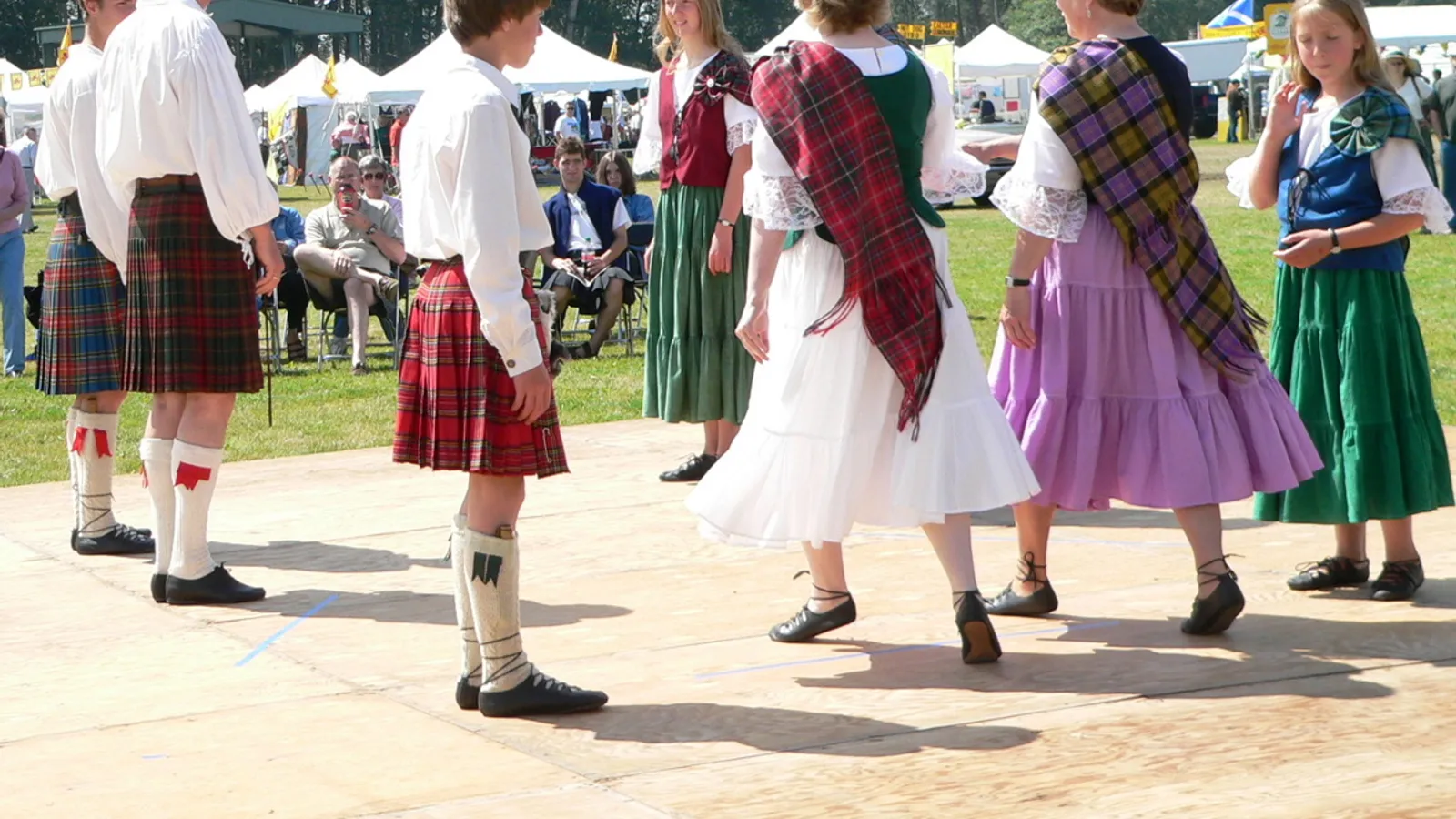

Scottish Country Dancing
Contents
Scottish country dancing is social dancing in sets of couples, moving through set patterns of figures to reels, jigs and strathspeys. It is danced at clubs, balls and weddings around the world, and taught to a common standard by the Royal Scottish Country Dance Society (RSCDS). It is a genuine Scottish tradition with a long and well-documented history, but its form was not invented in Scotland. The longwise "country dance" came north from the English court and the London music trade in the late 17th and early 18th centuries, and the Scots then made it their own with their tunes, their steps and one figure borrowed from their favourite dance, the reel. This card follows that story from the Renaissance court to the Edinburgh assembly rooms, through the itinerant dancing masters and the long 19th-century decline, to the 1923 revival and the fieldwork that later recovered what the revival had missed. It also tests the myths: that the dances came from Mary, Queen of Scots, that they are purely native, and that the versions danced today are the old ones unchanged.
TL;DR
- established The longwise country dance "for as many as will" first appears in print in John Playford's The English Dancing Master, published in London in 1651 with 105 dances. Scottish country dancing grew from this shared British form.
- shared Its deeper roots may lie in the Italian figured court dances called contrapassi, described by Fabritio Caroso in 1581. James VI owned Caroso's book, but there is no record of such dances being performed in Scotland.
- established The earliest surviving Scottish collections of country dances are manuscripts: the Drummond Castle manuscript of 1734, the Holmain (c.1730–50), the Bodleian (1740), the Menzies (1749) and the Bowman (c.1760). The first surviving book of figures printed in Scotland is John Bowie's, published in Perth in 1789.
- established Country dances were the staple of the Edinburgh Assembly, which opened in 1723. Each set danced minuets first, then country dances, under the eye of a lady directress.
- shared The dance historian George S. Emmerson argued that the Scottish contribution lay in the music and the steps, plus one figure, setting to and turning corners followed by reels of three, which comes from the Scotch Reel. Other historians found little Scottish influence on the form before 1800.
- established Itinerant dancing masters carried country dances into barns and farm kitchens across the Lowlands from the 1750s. They reached the West Highlands and Hebrides only in the 1850s, and parts of Orkney as late as 1891.
- established By 1910 town ball programmes held only about half a dozen country dances, danced carelessly. The Scottish Country Dance Society was founded at a public meeting in the Athenaeum, Glasgow, on 26 November 1923. It became "Royal" in 1951.
- shared The Society did not restore any single historical state of the dance. It chose the 18th-century assembly-room dance as its model and, in Emmerson's word, "re-created" it, with a standard technique that the old dancing masters never fully fixed.
- established Scottish country dancing is social and danced in sets. Highland dancing is solo, athletic and competitive. They are different traditions, though some country dances use Highland setting steps.
Key Facts
- Type
- Social dancing in sets of couples, usually longwise
- First printed country dances
- Playford, The English Dancing Master, London, 1651 (105 dances)
- Possible Renaissance ancestor
- Italian contrapassi, e.g. Caroso, Il Ballarino (1581)
- Earliest Scottish country dance record
- Manuscript description of "John Anderson", 1704
- Earliest Scottish collection
- Drummond Castle manuscript, 1734, for the Duke of Perth
- First London collection of "Scotch" dances
- John Walsh, Caledonian Country Dances, 1733 (nine books to c.1760)
- First surviving Scottish printed collection
- John Bowie, Perth, 1789
- First Edinburgh public assembly
- 7 November 1723, Patrick Steil's Close
- Distinctive Scottish figure
- Set to and turn corners, then reels of three on the sides
- Tune types today
- Reels, jigs, strathspeys and common-time hornpipes
- Society founded
- 26 November 1923, the Athenaeum, Glasgow
- Founders
- Ysobel Stewart of Fasnacloich, Jean Milligan, with Michael Diack of Paterson's
- First RSCDS book
- January 1924, twelve dances
- Royal patronage
- Princess Elizabeth patron 1947; "Royal" title 1951; King Charles III patron 2024
- Key fieldwork
- J. F. and T. M. Flett, Traditional Dancing in Scotland (1964)
- Related but different
- Highland dancing (solo and competitive); ceilidh dancing (looser and called)
Scottish Impact Index (SI Score)
- Cultural Reach
- 7/10
- Continuity of Tradition
- 9/10
- Social & Economic Importance
- 6/10
- Scottish Distinctiveness
- 8/10
- Cultural Legacy
- 9/10
- Recognition
- 8/10
47/60
Ranked =14th of 19 in Traditions
A Note on Claims and Evidence
Each major claim carries one of three labels. established means supported by primary records, official bodies or several independent reliable sources. shared means the core fact is sound but sources disagree on details, dates or interpretation. traditional means widely repeated but not traceable to a primary or independent source.
The documentary history is unusually rich: printed collections from Playford onwards, a run of Scottish manuscripts from 1734, the minute books of the Edinburgh Assembly, the letters of visitors such as Captain Edward Topham, and the dancing masters' own books. Its weakness is technique. Almost no one wrote down how the steps were danced before the 19th century, so claims about how 18th-century Scots actually moved are inference. The dance historian George S. Emmerson, in A Social History of Scottish Dance (1972), is the main source for this card. His documentary references are treated as established; his arguments about what made the dance Scottish are labelled as his. Two of his dates are corrected here: the Duke of York's stay at Holyrood (he gives 1688–90 in one chapter, but the duke was in Scotland between 1679 and 1682, as Emmerson himself says elsewhere), and the founding of the Scottish Official Board of Highland Dancing (he gives 1954; the board was formed in 1950).
Timeline
A painted chest made for the Adimari wedding in Florence shows a longwise dance for several couples, the Chiarenzana.
The Scots poem Colkelbie's Sow names "Rusty Bully", which Emmerson identifies with an Italian figured dance of the contrapasso type.
The Complaynt of Scotland lists the "licht dances" of the countryside, among them rounds, branles and winding dances.
Fabritio Caroso publishes Il Ballarino, describing contrapassi; James VI later owns a copy.
Elizabeth I's court enjoys much dancing of country dances in the privy chamber.
John Playford publishes The English Dancing Master in London, with 105 dances.
James, Duke of York, holds court at Holyrood, an obvious route for the latest English dances to reach the Scottish gentry.
Glasgow licenses a dancing master on condition that young men and women are taught separately.
A manuscript describes the dance "John Anderson", the earliest country dance identifiably linked with Scotland.
The West Bow Assembly, a private dance assembly, is founded in Edinburgh.
The Edinburgh Assembly opens in Patrick Steil's Close, with tickets at half a crown.
The last of the eighteen editions of The Dancing Master appears.
John Walsh publishes the first book of Caledonian Country Dances in London.
David Young writes the Drummond Castle manuscript for the Jacobite Duke of Perth.
The same hand writes "A Collection of the Newest Country Dances Performed in Scotland", now in the Bodleian Library.
The Edinburgh Assembly is refounded with directors and directresses; sets are limited to ten couples.
The Menzies manuscript uses the term "strathspey reele" for a country dance, one of the earliest uses of the word for a dance.
Johnny McGill, fiddler and dancing master of Girvan, writes out "Twelve of the newest Country Dances" for his pupils.
The Bowman manuscript: 78 of its 122 dances end with set to and turn corners and reels of three.
Robert Bremner moves his music business from Edinburgh to London and publishes figures for 28 country dances set to Highland reels.
Miss Nicky Murray rules the Edinburgh Assembly as directress.
The George Street Assembly Rooms open in Edinburgh's New Town.
John Bowie's collection, printed in Perth, is the earliest surviving Scottish publication of country dance figures.
Francis Peacock of Aberdeen publishes Sketches Relative to Dancing, the first technical account of Scottish reel steps.
The quadrille is first danced publicly in Edinburgh.
New strains of country dance appear in London: Ecossaises, "Spanish" waltz country dances, Circassian Circles and "Swedish" dances.
Country dances begin to reach the West Highlands and Hebrides.
David Anderson teaches in Dundee and on circuit as far north as Inverness.
Anderson's Ballroom Guide is published.
Country dances are first danced in Flotta, Orkney.
D. R. Mackenzie's list of ball favourites contains only six country dances.
The Northern Meeting ball in Inverness is played by the "Yahoo Jazz Sextet".
The Scottish Country Dance Society is founded at a public meeting in the Athenaeum, Glasgow.
The Society's first book of twelve dances is published.
The Society's summer school begins, later held at St Andrews under Jean Milligan.
Princess Elizabeth becomes the Society's patron.
King George VI grants the title "Royal".
J. F. and T. M. Flett carry out fieldwork among older dancers across Scotland.
The Fletts publish Traditional Dancing in Scotland.
King Charles III accepts the Society's patronage.
Details
Licht dances and the reel
established Long before the word "country dance" reached Scotland, the countryfolk had their own social dances. The Complaynt of Scotland (1548–49) calls them "licht dances", to set them apart from the grave dances of the court, and lists dozens by name: rounds, branles, processionals and winding dances. Weaving in and out was called "reeling" in Scots, the same figure the English called a "hey". Gavin Douglas, translating Virgil in the early 16th century, describes dancers reeling through one another. As Emmerson notes, the Scots word "reel" came to mean three things at once: a figure, a whole class of country dances, and the common-time dance music of the countryside. Fixed longwise dances such as Strip the Willow, for four couples, belong to this older strain. In them the top couple works down to the bottom in one turn of the dance, rather than progressing one place at a time.
Renaissance roots: the contrapassi
shared Where did the English country dance itself come from? By the end of the 16th century the dances of the English countryside had been taken up at Elizabeth I's court. A letter of 1602 reports dancing of country dances in the privy chamber, with Irish tunes in favour, and another letter has the Queen watching the ladies dance both old and new country dances. Emmerson follows the English dance scholar Melusine Wood in suggesting that the "new" dances combined the native country round with the Italian figured court dances called contrapassi. Fabritio Caroso described several in Il Ballarino (1581), among them the Chiarenzana, a wedding dance shown on a Florentine painted chest of about 1450 as a longwise dance for several couples, with the top couple working down the set. Emmerson thought it possible that a contrapasso reached the Scottish court: the 15th-century poem Colkelbie's Sow names "Rusty Bully", which he identifies with a dance described by a French writer of the early 16th century, and James VI owned a copy of Caroso. But he also stressed that Scottish court fashion leaned on France, which showed no interest in contrapassi, and that there is no sign before the 18th century of the longwise progressive dance developing in Scotland. This line of descent is an informed hypothesis, not a documented one.
shared A different French link is sometimes made. The Branle d'Écosse, a suite of "Scottish" round dances in fashion in France in the 1560s and described by the dancing master Arbeau, uses a step that Emmerson found almost identical to the strathspey setting step taught in country dancing today. He suspected the branles were a French creation built on a step seen in Scottish rounds, and he dismissed the story that the young Henri d'Angoulême brought Scottish dances to the French court as reading far more into the sources than they say.
Playford and the London trade
established The country dance first appears in print in John Playford's The English Dancing Master, published in London in 1651, the year of the Royalist defeat. It contained 105 dances, each with its tune, and by Emmerson's account was compiled at the prompting of the gentlemen of the Inns of Court. Contrary to the modern image, most of the first edition's dances were not longwise sets. They were rounds for three, four or more couples and squares for two and four couples; the longwise sets were for three or four couples or "for as many as will". Playford described figures, not steps. The book was taken over by his son Henry in 1684 and by John Young in 1706, and ran to eighteen editions by about 1728, publishing in all more than a thousand dances and tunes. Its first editions are also the earliest printed source of many Scottish and Irish airs.
established In the 1690s the royal dancing masters Isaac and Beveridge devised new longwise dances called "maggots" to triple-time hornpipe tunes. These were taken up in France, where Raoul Feuillet published a collection of contredanses after the English model and set out a more polished way of dancing them; his book was translated into English in 1710 and 1712. Lady Mary Wortley Montagu found English country dances ending every ball in Vienna in 1717. The longwise dance for as many as will, progressing one place at a time, now became the dance meant by the term "country dance". Emmerson rejects the old idea that the English term is a corruption of French contredanse: the borrowing ran the other way.
established From 1705 John Walsh published annual collections of 24 country dances in London. His Caledonian Country Dances of 1733, with nearly seventy dances, was the first London collection to trade on Scottish tunes, and his son carried the series to nine books by about 1760. The bibliographer William C. Smith dated most of the books: 1733, 1737, about 1740, 1744, 1748, 1751, 1757 and about 1760. John Johnson's Caledonian Country Dances of 1744 and 1748 copied Walsh. The Walshes were careless about what was "Scotch": dances called Scotch include Meillionen, a Welsh tune, and some clearly Scottish tunes are not marked. From Walsh the RSCDS later drew The Border Reel, The Reel of Glamis, John Black's Daughter and The Yellow-Haired Laddie.
How the country dance reached Scotland
established There are several plausible routes by which the court fashion reached polite Scottish society: Scottish noblemen who knew the London court, and the residence of James, Duke of York, at Holyrood between 1679 and 1682, when balls, plays and masques were given to the alarm of the stricter Presbyterians. But there is no sign of country dances being taught in the Edinburgh and Glasgow dancing schools of the time, which were licensed on strict terms. In 1699 Glasgow allowed John Smith to teach only if young men and women were taught separately and he kept no balls. The earliest country dance identifiably linked with Scotland is a manuscript description of "John Anderson", dated 1704. Its note that the tune should be played through once so that "the first couple has time to take their drinks" says something about the setting.
The Scottish manuscripts
established A number of Scottish noblemen had their own collections written out, a sign that the London books were not meeting a demand for dances to Scottish tunes. The earliest is the Drummond Castle manuscript of 1734, written for the Jacobite Duke of Perth by David Young; a copy is in Glasgow University Library. The same hand wrote "A Collection of the Newest Country Dances Performed in Scotland" at Edinburgh in 1740, now in the Bodleian Library, Oxford. Other important manuscripts are the Holmain (c.1730–50), the Menzies (1749) and the Bowman (c.1760, in the Laing Collection at Edinburgh University). Emmerson counted 48 dances in each of the Drummond and Bodleian collections, with no title repeated between them.
established The dances are mostly simple. Their figures include setting to partner, casting off, four hands round, setting in lines and "right and left"; the allemande, promenade and poussette had not yet arrived. Many tunes are in rhythms later dropped from Scottish dancing: the Drummond has seven 3/2 hornpipes and eight 9/8 jigs. Not every tune is Scottish: "Hunt the Squirrel" and the Northumbrian "Jack Leighton" are English, and "Welsh Fusileers" is the tune now known to dancers as "Maid of the Mill". The descriptions usually say "reel" where an English source would say "hey". The Menzies manuscript dates itself by its Jacobite titles from the '45, such as "O'er the watter to Charly", and calls The Montgomeries' Rant a "strathspey reele". The RSCDS has reconstructed three dances from the Holmain manuscript, This is No My Ain Hoose, Argyll's Bowling Green and Lennox Love to Blantyre, and the Drummond versions match them closely. Emmerson criticised the Society for keeping old titles while setting the dances to different tunes, as with This is No My Ain Hoose, since in the old practice a dance was named after its tune. Jack McConachie published the Bodleian dances in 1960, with much licence and new tunes in place of the 9/8 and 3/2 airs.
Bremner, Bowie and the printed Scottish dance
established Robert Bremner built up a music business in Edinburgh in the 1750s and in 1762 moved it to London, to a shop under the sign of the Harp and Hoboy opposite Somerset House. There he published figures for 28 country dances set to well-known Highland reels, all with Scottish titles, from The New Town of Edinburgh to Gille Callum. One, Straglass House, is labelled a strathspey, the first such label in a printed collection; it, Miss Cahoon's Reel and The Bridge of Nairn were later restored by the RSCDS. Bremner, writing for a London public, used the English "hey" for the reel and "foot" for setting. Other London publishers supplied dances still danced: Miss Nancy Frowns and She's Ower Young to Marry Yet (Thompson), The Gates of Edinburgh and The Machine Without Horses (Rutherford), Hamilton House (Campbell) and Monymusk (Preston).
established No book of country dance figures is known to have been printed in Scotland before 1774, when an Edinburgh dancing master, William Frazer, advertised The Dancer's Pocket Companion, with forty "Scots and English" figures; no copy survives. The earliest surviving Scottish publication of the kind is John Bowie's Collection of Strathspey Reels and Country Dances, printed in Perth in 1789. Of its six dances only Miss Murray of Ochtertyre had found a place in the RSCDS books by Emmerson's time.
What made it Scottish
shared Did the Scots change the dance, or simply dance the English one to their own tunes? The Scottish dance historian Hugh Thurston wrote in Scotland's Dances (1954) that there is no hint of Scottish influence on the figures, steps, style or technique of the country dance until well after 1800. Emmerson disagreed. He found one figure with a clear Scottish origin: setting to and turning corners, followed by reels of three on the sides, which is plainly taken from the Scotch Reel. It runs through the Bowman manuscript, where 78 of 122 dances end with it, and through Bremner's dances. He noted that Scottish collections lack the "game" dances and antics, the clapping, peeping and kissing, that filled English books of the period. And he argued that a people who leapt up at the sound of a reel tune would naturally set and travel in a country dance with the steps they used in the reel. The English dancing master Thomas Wilson, around 1816, mentions a "Scotch" setting step taking two bars, which may have been the pas de basque. Emmerson's conclusion was that the Scots shaped the borrowed form through music and steps, as the English had once shaped the Italian dances, giving a family of British forms: English, Scottish and Irish country dances on a common base. Both views agree that the Scottish contribution to the figures was small.
The Edinburgh assemblies
established In Scotland the country dance belonged first to the public assembly. A private assembly met in a mansion in Edinburgh's West Bow from about 1710. A public one opened on 7 November 1723 in the great hall in Patrick Steil's Close, run by the Countess of Panmure and other ladies for the benefit of the city's charities, with tickets at half a crown. Allan Ramsay wrote verses in its support; some ministers preached against it. The assembly moved to Bell's Wynd in 1736, faltered, and was refounded in 1746 with a board of directors and seven lady directresses. Its rules limited each set to ten couples dancing one country dance at a time, required couples to dance their minuets in the order they stood, and banned dancing out of turn without the directress's leave. The band was four fiddles, a bassoon and two oboes.
established The procedure, as described by visitors, was formal. The directress issued tickets fixing each dancer's set and place. The first set took the floor; each couple danced a minuet in turn; then the set danced a country dance. Then the next set did the same, and later rounds were country dances only. Oliver Goldsmith in 1753 found the sexes ranged at opposite ends of the room in near silence. The most famous directress was Miss Nicky Murray, sister of the Earl of Mansfield, who ruled from 1765 until her death in 1777. Captain Edward Topham, an English officer who wrote letters from Edinburgh in 1774–75, was struck by the passion for dancing: as quoted by Emmerson, he knew no place "where dancing is made so necessary a part of polite education as in Edinburgh". The Bell's Wynd Assembly closed in 1784 as fashionable society moved to the New Town, where the George Square Assembly opened in 1785 and the George Street Assembly Rooms in 1787. By the 1770s Aberdeen, Glasgow, Dundee, Leith and Haddington also had assemblies. In Aberdeen in 1777, Alexander Jaffray recalled, country dances to lively Scotch tunes were kept up with great spirit, partners being engaged for the whole night.
established Standards slipped later in the century. The Edinburgh publisher William Creech complained that by 1786 minuets had been given up and country dances had often become more like "a game of romps". Emmerson saw the decline in the list of "fashionable" Edinburgh dances that Niel Gow published for the 1787–88 season, all with foreign titles such as La Belle Catherine and Les Piedmontese. Yet the Scots' own taste held: Topham noted that they would sit unmoved through an English country dance tune and leap up for one of their own.
The dancing masters
established Dancing masters carried the form from the assembly room into the wider country. In Edinburgh they included Davie Strange, an Ayrshire mason who trained in London and Paris and taught from 1764 until about 1788, and the Frenchmen Lamotte and Le Picq. In Aberdeen Francis Peacock taught for sixty years from 1745 and published Sketches Relative to Dancing in 1805, the first technical description of Scottish reel steps. Alexander Jaffray, his pupil in 1770, remembered that the only part of the lessons he enjoyed was the weekly practice of country dances. Peacock called his simple back step, the "minor kemkossy", a step the English used a great deal in their country dances.
established The itinerant masters mattered more for most people. Johnny McGill, fiddler and dancing master of Girvan and Dumfries, taught country dances on a largely rural circuit in the 1750s; his manuscript of 1752 for his pupils listed "Twelve of the newest Country Dances", to tunes such as "Up and war them a' Willy" and "Cadgers of the Canongate". In Ayrshire about 1770, James Currie wrote, the peasantry learned reels, strathspeys, country dances and hornpipes in winter in barns lit by candles stuck in cloven sticks. Out of such teaching came rural strains not drawn from print, such as the sprightly strathspey country dances of the Borders, Haughs of Cromdale, Braes of Busby and Loch Erichtside, later collected by Ian Jamieson. Robert Burns named Loch Erroch Side among the dances he threw himself into at a Loch Lomondside house in 1787, alongside Bab at the Bowster and Tullochgorum, contrasting them with the insipid, formal dancing of the French and English.
The nineteenth century
established While the English country dance fell before the quadrille and the waltz, the Scottish country dance kept its place in the countryside, alongside the reel, until the 20th century. Its active centres, Emmerson thought, were Perthshire, Kincardine and Aberdeenshire in the north and Ayrshire and the Borders in the south, where the fiddler still ruled. New strains of longwise dance arrived from London in the 1820s: Ecossaises, "Spanish" dances to waltz music, Circassian Circles and the "Swedish" dances of the London dancing master G. M. S. Chivers, in which a man dances with a partner on each side. The Dashing White Sergeant is one of these. Borrowing between country dance, reel and quadrille produced new dances, of which the Eightsome Reel and the Glasgow Highlanders are the outstanding examples, and the quadrille's ladies' chain entered the country dance.
established Country dances reached the West Highlands and Hebrides only in the 1850s, and in Orkney they were first danced on Flotta in 1891. The main printed sources of the period, from J. P. Boulogne's The Ballroom (1827) to David Anderson's Ballroom Guide (1886), are dominated by 32-bar dances for two couples to reel music, ending with "down the middle and up and poussette". The allemande had vanished, and strathspey tunes were used only in the Borders. Anderson taught in Dundee from about 1870 to 1905 and on circuit as far as Dingwall and Inverness, and named dances for the towns he served, among them Kingussie Flower, Perth Inch and Tayport Beauty. In the Borders the best-known master, R. F. Buck, taught a long list of country dances to country pupils, among them Petronella, the Duke of Perth, Flowers of Edinburgh and Roxburgh Castle, but only the standard half dozen to his town classes. In Kincardineshire around 1886 a Mr Lilly taught boys how to bow and how to ask a girl's mother for leave to take her to the end-of-season ball.
Decline
established By 1910, D. R. Mackenzie's National Dances of Scotland suggests, town ball programmes held only six country dances: Rory O'More, Petronella, Triumph, Flowers of Edinburgh, The Duke of Perth and Mary Queen of Scots. They were danced clumsily: "down the middle and up" had become a walk, and the poussette a two-step waltz, a habit first described in a manuscript of 1818 in the National Library of Scotland. Strip the Willow, now danced to reels rather than its old 9/8 jig, and the Eightsome Reel survived as the two remnants known to almost everyone. The Circassian Circle, quadrille and lancers barely survived the First World War. After the war, traditional dancing could be seen at the Perth Hunt and Glasgow Police balls, but at the Northern Meeting in Inverness in 1923 the music was supplied by the Yahoo Jazz Sextet, and the ball ended with a galop.
The RSCDS and the 1923 revival
established In the same winter, on 26 November 1923, a public meeting at the Athenaeum in Glasgow founded the Scottish Country Dance Society. It was called by Mrs Ysobel Stewart of Fasnacloich, Guide Commissioner for Argyll, and Jean Milligan, a lecturer in physical education at Jordanhill College; Michael Diack of the Glasgow music publishers Paterson's, which had agreed to publish Mrs Stewart's proposed book, is also counted among the founders. The first book, of twelve dances, appeared in January 1924. The Society began with the dances best remembered by older people, published them, and set up a system of teacher training. Its summer school, later held at St Andrews under Milligan's direction, also taught Highland dancing to men, for many years under Bobby Watson. Princess Elizabeth became patron in 1947, King George VI granted the title "Royal" in 1951, and King Charles III accepted the patronage in May 2024.
shared What exactly was the Society restoring? Emmerson, writing as a teacher within its tradition, thought the task of finding an "authentic" form and style was close to impossible, since style had varied so much over time and place. He argued that the Society did not revive the licht dances and reels of the countryfolk, nor the rural country dances of the 19th century, but took as its model the country dance of the 18th-century Scottish assembly room, deliberately fostering the elegance and grace of the minuet era. In his judgement this was justified, but the result was not a restoration of any one moment in the past; it was "re-created". He credited the Society with remarkable success in spreading a common system of figures, while noting that some norms it fixed came from the Society rather than from tradition.
shared The Society is the main reason Scottish country dancing survives and is danced worldwide, with branches across the Commonwealth and beyond. But in recording the dances it also standardised them, choosing one version and one style, more precise and balletic, for dances that had varied from region to region and from barn to ballroom. The Society saved the tradition and shaped it at the same time.
Technique
established The RSCDS sets dances to four basic rhythms: the reel (including the rant and the Scottish measure), the strathspey, the jig, and the common-time hornpipe. The 3/2 hornpipes and 9/8 jigs of the early manuscripts are left out. There is essentially one travelling step and one setting step for reel, jig and hornpipe, and another pair for strathspey. The travelling step, skip change of step, is the first of the two "kemshoole" steps described by Peacock in 1805. The setting step is the pas de basque, a step widely known in folk dance; the name does not appear in Scottish dance books until J. G. Atkinson's Scottish National Dances (1900), and David Anderson called it the "Petronella step". The strathspey travelling step was taken from the Border country, where Buck had taught it; the strathspey setting step, often called the "common schottische", is, Emmerson argued, at least as old as the Branle d'Écosse, whatever the recent name.
shared The slow, legato strathspey of RSCDS dancing owes much to Jean Milligan's own taste. Emmerson linked it to Burns's description of the bold, kindling strathspey as slow and broad in the playing, and defended her tempo against critics who cited faster playing in the past, though he thought the smooth step did not suit every sprightly strathspey tune. Hornpipe stepping, known in Scotland as "treepling", was common in 19th-century barn dancing but has no place in the Society's style. Figures have also changed. The poussette was once called "the draw", with partners holding hands; the allemande means different things in different periods; and "right and left" once named both a chain for two couples and a diagonal change.
The Fletts' fieldwork
established The revival worked from memory and print in a hurry. A fuller picture of what ordinary people had danced came later, from the fieldwork of J. F. and T. M. Flett, a husband-and-wife team who interviewed older dancers across Scotland in the 1950s and published Traditional Dancing in Scotland in 1964, with an appendix by Frank Rhodes on Cape Breton. They recorded the repertoires and methods of itinerant dancing masters such as Buck and Lilly, local dances found in no printed source, such as Peggy's Love from Moray and the Border strathspeys, and the circular foursome reels of the Hebrides. Emmerson leaned heavily on their work for the 19th century and referred his readers to it as the richest source on rural dancing. J. F. Flett also published a study of the early Scottish manuscript collections in Scottish Studies in 1967. Their evidence shows how much more varied, and how much less polished, the country dancing of the countryside was than the dancing the Society chose to teach.
Not the same as Highland dancing
established Scottish country dancing and Highland dancing are often confused. Country dancing is social: groups of couples in a set move through patterns together, for enjoyment. Highland dancing is solo and competitive, judged on technique, and usually danced to the bagpipes. The two share some steps: the Eightsome Reel and its relatives and the Glasgow Highlanders use Highland reel setting steps, and the reel itself lent country dancing its most Scottish figure. Emmerson argued that the Highland tradition is what keeps Scottish dancing fertile, and that without it the country dance would have little identity of its own.
Today
established In 1972 Emmerson listed the favourite country dances of the 1960s, among them Cadgers in the Canongate, Montgomeries' Rant, General Stuart's Reel, Miss Nancy Frowns, The Duchess of Atholl's Slipper and The White Cockade. Newer compositions such as Mairi's Wedding, The Reel of Mey and The White Heather Jig were popular with less able dancers because they used only the travelling step, which he thought a threat to the dance's Scottish character. New figures of progression had appeared, notably Robert Campbell's tournée and John Drewry's rondel, and the mathematician Hugh Foss composed dances on a "fugue" principle. At balls, sets are limited to four couples (five with an extra couple), each couple dances the dance twice through, and the kilt, though not traditional in the country dance, is standard men's dress. Emmerson noted a shortage of male dancers and some waning of enthusiasm in Scotland, against growth in the Commonwealth. The Society now has branches and affiliated groups worldwide.
Did You Know?
- The first edition of Playford's Dancing Master (1651) contained more round and square dances than longwise ones.
- The earliest Scottish country dance on record, "John Anderson" (1704), allowed time for the first couple to take a drink.
- The earliest Scottish collection was written in 1734 for the Jacobite Duke of Perth.
- The Menzies manuscript of 1749 is full of Jacobite tune titles from the '45.
- The first London book of "Caledonian" country dances appeared in 1733, before any were printed in Scotland.
- No Scottish-printed collection of country dance figures survives from before 1789.
- The Edinburgh Assembly of 1746 limited each set to ten couples, and its band was four fiddles, a bassoon and two oboes.
- Country dances did not reach the Orkney island of Flotta until 1891.
- The 1923 Northern Meeting ball in Inverness was played by the Yahoo Jazz Sextet.
- The RSCDS was founded in the same winter, at the Athenaeum in Glasgow.
- The pas de basque was called the "Petronella step" by the Dundee dancing master David Anderson.
- The poussette was once called "the draw".
FAQ
1What is Scottish country dancing?
Social dancing in sets of couples, following set patterns of figures to reels, jigs, strathspeys and hornpipes.
2Is Scottish country dancing purely Scottish?
No. The longwise country dance came from England, possibly with Italian Renaissance roots. The Scots shaped it with their tunes, their steps and figures taken from the reel.
3Did Mary, Queen of Scots bring Scottish country dancing from France?
No. Emmerson called this a romantic extravagance. The country dance reached Scotland from England more than a century after her reign.
4What is the difference between country dancing and Highland dancing?
Country dancing is social and done in sets; Highland dancing is solo and competitive.
5When did country dancing start?
It first appears in print in Playford's The English Dancing Master in 1651. The earliest dance linked with Scotland is from 1704, and the earliest Scottish collection from 1734.
6What is the oldest Scottish collection of country dances?
The Drummond Castle manuscript of 1734, written by David Young for the Duke of Perth.
7What is distinctively Scottish about the figures?
Above all, setting to and turning corners followed by reels of three on the sides, a figure taken from the Scotch Reel.
8What is a strathspey?
A Scottish dance tune in common time, slower than a reel, with a sharp "snap" in the rhythm. As a dance style it was named after Strathspey, the district on the River Spey.
9Where was country dancing done in the 18th century?
In the public assemblies of Edinburgh and other towns, at private balls, and increasingly in barns and kitchens, where itinerant dancing masters taught it.
10Why did country dancing decline?
The quadrille, waltz and polka took over fashionable ballrooms in the 19th century, and after the First World War jazz and modern ballroom dancing pushed out most of what was left.
11What is the RSCDS?
The Royal Scottish Country Dance Society, founded in Glasgow in 1923 to preserve Scottish country dancing.
12Who founded the RSCDS?
Ysobel Stewart of Fasnacloich and Jean Milligan, with Michael Diack of the publishers Paterson's.
13When did the Society become Royal?
In 1951.
14Did the RSCDS change the dances?
Yes and no. It preserved them, but it also standardised them, modelling them on the 18th-century assembly-room dance rather than the rural dancing of the 19th century.
15Who were the Fletts?
J. F. and T. M. Flett, who recorded the memories of older dancers in the 1950s and published Traditional Dancing in Scotland in 1964.
16Is Scottish country dancing the same as a ceilidh?
No. Ceilidh dancing is looser and called; country dancing follows the RSCDS's set forms and technique.
Sources and Further Reading
Primary/Institutional
- Royal Scottish Country Dance Society, "Our history" (rscds.org)
- Royal Scottish Country Dance Society, "The founders" (rscds.org)
- Royal Scottish Country Dance Society, "What is Highland dancing?" (rscds.org)
Scholarly/Critical
- George S. Emmerson, A Social History of Scottish Dance: Ane Celestial Recreatioun (McGill-Queen's University Press, 1972)
General
- Early Dance Circle, "English country dance" (earlydancecircle.co.uk)
Further reading
- John Playford, The English Dancing Master (London, 1651)
- Francis Peacock, Sketches Relative to the History and Theory, but More Especially to the Practice of Dancing (Aberdeen, 1805)
- Edward Topham, Letters from Edinburgh (1776)
- Hugh A. Thurston, Scotland's Dances (1954)
- J. F. and T. M. Flett, Traditional Dancing in Scotland (1964)
- J. F. Flett, "The Scottish Country Dance", Scottish Studies, vol. 11 (1967)
Caveats: Myths and Disputed Claims
- Do not say Scottish country dancing is a purely native invention; the longwise country dance came from England.
- Do not say Mary, Queen of Scots brought the dances from France.
- Do not say the English term "country dance" is a corruption of French contredanse; the borrowing ran the other way.
- Do not present the descent from Italian contrapassi as proven; it is an informed hypothesis.
- Do not say the Scots added nothing; the reel figures, the strathspey and the steps are their contribution, though historians disagree on how much and how early.
- Do not say today's RSCDS versions are the only historical forms of each dance, or that they restore one moment in the past.
- Do not call the Reel of Tulloch or the Foursome Reel country dances; they are reels.
- Do not confuse Scottish country dancing with Highland dancing.
- Do not treat country dancing and ceilidh dancing as the same.
Card 012 · Traditions