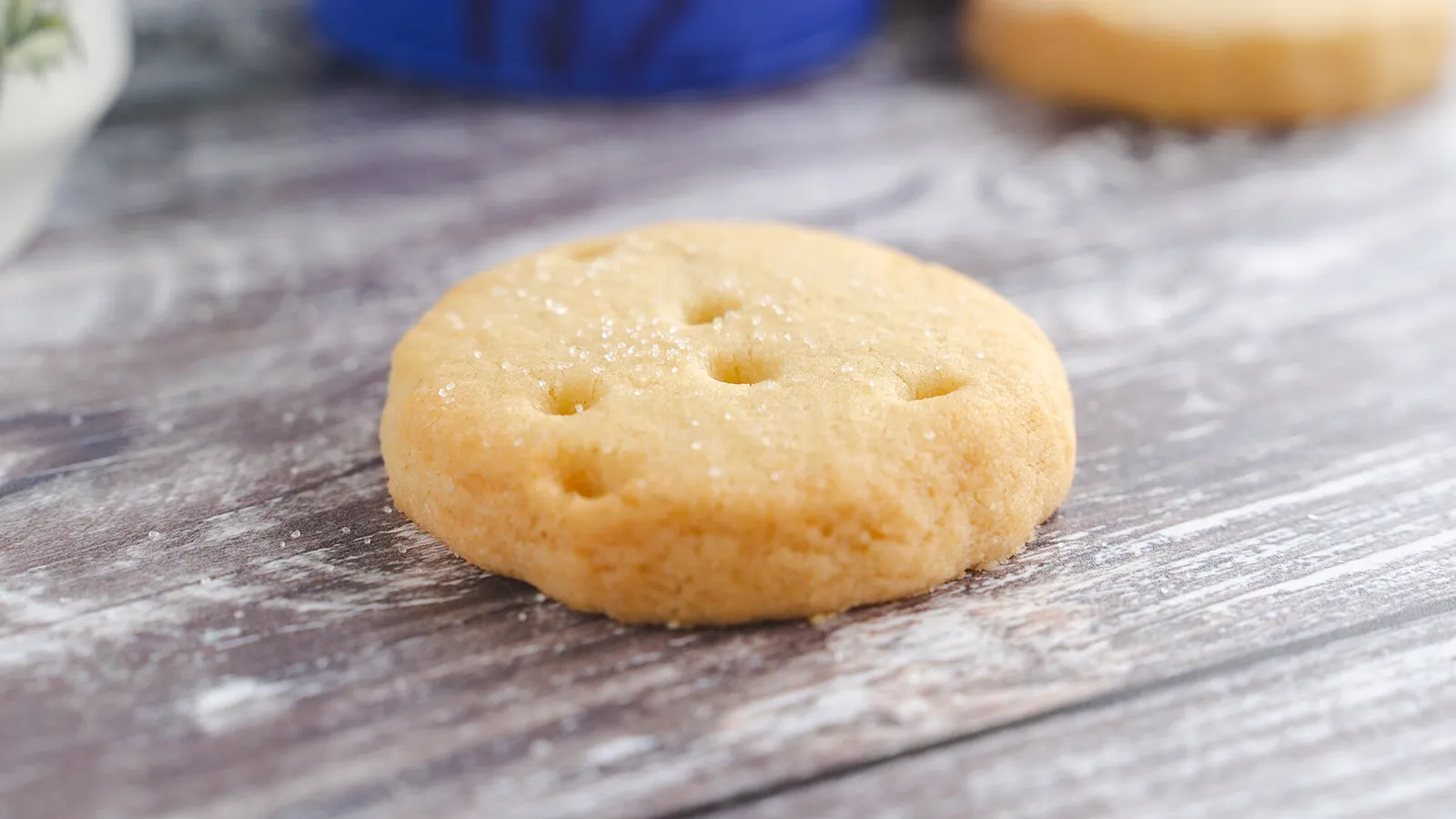

Shortbread: Scotland's Butter Biscuit
Contents
Shortbread is a rich biscuit of flour, butter and sugar, baked so that it crumbles: "short" in the old sense of fat breaking up the dough. It is one of Scotland's best-known foods and one of its most-bought souvenirs. Its Scottish history is better documented than most people realise, going back to the 1590s. The story most often told about it, that Mary, Queen of Scots introduced it from France, is not. This card tests what the records show.
TL;DR
- established "Short-bread" is recorded in Scotland from 1597, when Ayr ruled that it must contain at least half a pound of butter to a peck of flour.
- established The first printed shortbread recipe is Scottish, in Mrs McLintock's Receipts for Cookery and Pastry-Work, published in Glasgow in 1736, the oldest cookery book printed in Scotland.
- shared Shortbread grew out of "biscuit bread", dried and twice-baked bread dough, a practice found across Britain and Europe, not only in Scotland.
- traditional The story that Mary, Queen of Scots brought "petticoat tails" shortbread from France has no documentary support. The food historian Emma Kay says she can find no legitimate link.
- established Shortbread comes in three classic shapes: a large round scored into wedges (petticoat tails), individual rounds, and thick fingers.
- traditional The derivation of "petticoat tails" from French petites gatelles (little cakes) was already debated in a note in Meg Dods's Cook and Housewife's Manual (first published 1826) and was later listed by the folklorist F. Marian McNeill among her Franco-Scottish kitchen words. It is a romantic etymology, not a proven one, and none of these early sources mentions Mary, Queen of Scots.
Key Facts
- Ingredients
- Flour, butter, sugar (classically in a 3:2:1 ratio by weight)
- "Short" means
- Crumbly: the butter stops the dough forming a tough structure
- Earliest Scottish record
- 1597, Ayr burgh regulation
- Older Scots spelling
- Schort breid
- First printed recipe
- Mrs McLintock's Receipts, Glasgow, 1736
- Three shapes
- Petticoat tails, rounds, fingers
- Regional variant
- Ayrshire shortbread, with egg yolk and cream
- Best-known maker
- Walkers, founded 1898 by Joseph Walker, later based in Aberlour
Scottish Impact Index (SI Score)
- Cultural Reach
- 9/10
- Continuity of Tradition
- 9/10
- Social & Economic Importance
- 8/10
- Scottish Distinctiveness
- 8/10
- Cultural Legacy
- 9/10
- Recognition
- 10/10
53/60
Ranked #11 of 19 in Traditions
A Note on Claims and Evidence
Each major claim carries one of three labels. established means supported by primary records, official bodies or several independent reliable sources. shared means the core fact is sound but sources disagree on details, dates or interpretation. traditional means widely repeated but not traceable to a primary or independent source.
The record from 1597 onwards is strong: the Dictionary of the Older Scottish Tongue quotes burgh records through the 17th century. The weak points are the stories told about earlier origins. Claims that shortbread dates from the 12th century refer to rusks and twice-baked bread in general, not to any dated record of shortbread. The link with Mary, Queen of Scots is a story, not a record.
Timeline
Across Britain and Europe, leftover bread dough is dried in a low oven into twice-baked "biscuit bread".
Ayr rules that shortbread must contain at least half a pound of butter to the peck, and fixes its price at 16 pence.
Dumbarton's accounts repeat the half-pound-of-butter rule.
Peebles records "four schort breid" bought with a box of sweets.
Hawick records "a pint of wine with a short bread".
Mrs McLintock's Receipts for Cookery and Pastry-Work, the oldest cookery book printed in Scotland, includes a shortbread recipe made with yeast.
Scott's The Bride of Lammermoor lists "petticoat-tails" among old-fashioned festive baking.
Meg Dods's Cook and Housewife's Manual is first published, with a petticoat-tails recipe; a note in the Manual records the dispute over the name.
Most recipes have dropped yeast and use only butter, flour and sugar.
McNeill's The Scots Kitchen records shortbread as the indispensable Hogmanay fare for first-footers and gives Ayrshire, Pitcaithly and Shetland variants.
Joseph Walker, aged 21, opens his own bakery with a £50 loan; the business later moves to Aberlour.
Details
Where shortbread came from
shared Shortbread is usually traced to medieval "biscuit bread": leftover bread dough dried slowly into a hard rusk. "Biscuit" itself means "twice cooked". Over time butter replaced yeast, and because fat stops the dough developing a chewy structure, the result was crumbly, or short. Food historians stress that this practice was common across Britain and Europe; England had its own short cakes. Scotland's genuine claim is to the refined butter biscuit and to the long record of it, not to the idea.
traditional The folklorist F. Marian McNeill, in The Scots Kitchen (1929), points to Edinburgh's "caik-baxteris" (cake-bakers), who in 1503 were ordered to make eight-ounce cakes for a penny and were convicted the same year of selling them underweight. She thought it "almost certain" that shortbread came from these town bakers. That is her inference; the records she cites do not name shortbread.
traditional Many accounts, including makers' own histories, date shortbread to the 12th century. No 12th-century document describes shortbread. The date refers to the general age of twice-baked bread.
The Scottish record
established The Dictionary of the Older Scottish Tongue, the standard dictionary of Scots before 1700, defines schort breid as food made from flour, butter and sugar mixed so that it bakes to a short, biscuit-like texture. Its earliest quotation is from Ayr in 1597, where the burgh ruled that shortbread must contain at least half a pound of butter to the peck of flour and be sold at 16 pence. The same rule appears in Dumbarton's accounts in 1617–18. Peebles bought "four schort breid" in 1635–36; Irvine records "aill and schorte bread" in 1648; and in Hawick in 1690 it was served with a pint of wine. It was a food for occasions, made expensive by its butter.
established The first printed recipe appeared in 1736, in Mrs McLintock's Receipts for Cookery and Pastry-Work, published in Glasgow. It is the oldest cookery book printed in Scotland, and a copy is held by the University of Glasgow Library. Mrs McLintock's shortbread still used yeast. By around 1850 most recipes used only butter, flour and sugar.
Mary, Queen of Scots and "petticoat tails"
traditional The most popular story is that Mary, Queen of Scots, raised at the French court, brought a refined shortbread called "petticoat tails", sometimes flavoured with caraway, to Scotland in the 1560s. It is repeated by makers, tourist sites and recipe books. But there is no record of it. In A History of British Baking (2020), the food historian Emma Kay writes that she cannot find any legitimate or authentic links between Mary and shortbread.
shared The name "petticoat tails" has two explanations, and both were in print in the nineteenth century. In Meg Dods's Cook and Housewife's Manual (first published 1826), a note from the fictional Cleikum Club reports that an English traveller familiar with France had told them the name was a corruption of the French petites gatelles, "little cakes". The club replied that "it may be so", but thought the name came from the shape, "exactly that of the bell-hoop petticoats of our ancient Court ladies". The Meg Dods recipe explains why: a large round is rolled thin, a small circle is cut from its centre with a saucer and left whole, and the outer ring is cut into eight pieces, laid round the centre like the panels of a hooped skirt.
traditional The French derivation is the romantic one. The American writer Kate Douglas Wiggin played with it in Penelope's Experiences in Scotland (1890s), suggesting petits gastels, and McNeill lists "petticoat tails" against petites gatelles in her appendix of Franco-Scottish domestic terms, as quoted in The Scots Kitchen. Neither offers evidence beyond the resemblance of the sounds, and none of the nineteenth-century sources links the name to Mary, Queen of Scots; that connection appears to be later embroidery.
Shapes and styles
established Shortbread is made in three classic shapes. Petticoat tails are a large round, scored into wedges while still hot. Rounds are individual biscuits. Fingers are cut from a thick oblong slab. Regional variants include Ayrshire shortbread, made richer with egg yolk and a little cream.
established McNeill records more variants. Her standard Scots shortbread uses a little rice flour with the wheat flour, is pressed by hand or in a carved wooden mould rather than rolled, and is pinched round the edge and pricked. For festive cakes she gives white "sweetie almonds", caraway comfits ("sweetie carvies") and strips of candied peel. Pitcaithly bannock adds chopped almonds and citron peel. In Shetland, the bride's bonn was a large round of shortbread with caraways, fired on the girdle where there was no oven. Meg Dods's petticoat tails, made with butter melted in milk, could include caraway, though McNeill notes they were usually made without.
traditional The pinched edge and pricked centre of a round are sometimes said to represent the sun's rays, linking shortbread to old midwinter cakes. The idea is McNeill's: she calls the round Hogmanay shortbread "the lineal descendant of the ancient Yule-bannock", an oatcake notched to symbolise the sun, which she believed white-flour shortbread gradually replaced at Yule and at weddings. That is folklore, not a documented origin.
established McNeill, writing in 1929, says shortbread was "invariably provided" for first-footers at New Year, and describes the great quantities posted each Yule to Scots overseas, many iced with sprigs of heather and mottoes such as "A gude New Year to Ane an' A'".
shared Shortbread is also linked with weddings, where it was broken over a bride's head in parts of Scotland. McNeill records that the older infar-cake, broken over the bride at her new threshold, was originally a rich oatcake, and that shortbread later took its place before the iced fruit cake displaced both. In Shetland, according to Jessie Saxby as quoted by McNeill, unmarried guests each broke a piece from a notched cake with a sweet at its centre; whoever touched the sweet would stay single.
Shortbread today
established Shortbread is now a major Scottish export and souvenir. Walkers, the best-known maker, began when Joseph Walker opened his own bakery in 1898, aged 21, with a £50 loan, and later moved to Aberlour on Speyside. His grandchildren began exporting in the 1970s, and the company is still family-run.
Did You Know?
- Ayr regulated the amount of butter in shortbread in 1597.
- In 1597 a shortbread in Ayr was priced at 16 pence.
- The oldest cookery book printed in Scotland, from 1736, has a shortbread recipe that uses yeast.
- "Short" means crumbly: the butter keeps the dough from becoming tough.
- The word "biscuit" means "twice cooked".
- Shortbread was traditionally broken over a bride's head at some Scottish weddings.
- Walkers began with a £50 loan in 1898.
- No record links Mary, Queen of Scots to shortbread.
FAQ
1Is shortbread Scottish?
Yes, in its refined form, with records from 1597. Its ancestor, twice-baked bread, was common across Europe.
2When was shortbread first recorded?
In Ayr in 1597, in a rule about how much butter it must contain.
3What is the first shortbread recipe?
The recipe in Mrs McLintock's Receipts for Cookery and Pastry-Work, Glasgow, 1736.
4Why is it called "short"?
Because the butter makes it crumble. "Short" here means crumbly.
5Did Mary, Queen of Scots invent petticoat tails?
There is no evidence of it. The story is legend.
6Where does the name "petticoat tails" come from?
Probably from the shape: in the old recipe the outer ring of a round is cut into pieces that resemble the panels of a hooped petticoat. The French petites gatelles derivation, debated in Meg Dods's Manual and listed by McNeill, is romantic and unproven.
7Why is shortbread eaten at Hogmanay?
By McNeill's account it was the standard offering to first-footers. Her claim that it descends from the sun-notched Yule bannock is folklore, but she is a good witness that it had replaced oatcakes as the festive bake by her time.
8What are the three shapes of shortbread?
Petticoat tails, rounds and fingers.
9What is Ayrshire shortbread?
A richer version made with egg yolk and cream.
10Did early shortbread use yeast?
Yes. The 1736 recipe did. By about 1850 most recipes used only butter, flour and sugar.
11Does shortbread date from the 12th century?
No record shows that. The claim refers to twice-baked bread in general.
12When is shortbread traditionally eaten?
At Hogmanay and New Year, and at weddings.
Sources and Further Reading
Primary/Institutional
- Dictionaries of the Scots Language, Dictionary of the Older Scottish Tongue, "Schort breid" (dsl.ac.uk)
- Walkers Shortbread, "History & Heritage" (walkersshortbread.com)
Scholarly/Critical
- Emma Kay, A History of British Baking: From Blood Bread to Bake-Off (Pen & Sword, 2020), pp. 113–114, as quoted in Wikipedia, "Shortbread"
Specialist
- F. Marian McNeill, The Scots Kitchen: Its Traditions and Lore with Old-Time Recipes (Blackie, 1929; 2nd edn 1963), including its quotations from Meg Dods, The Cook and Housewife's Manual (1826)
General
- Edinburgh Evening News, "Is this Scotland's oldest recipe book?" (edinburghnews.scotsman.com)
- Wikipedia, "Shortbread" (en.wikipedia.org)
Caveats: Myths and Disputed Claims
- Do not say Mary, Queen of Scots invented or introduced shortbread or petticoat tails. No record supports it.
- Do not present the French petites gatelles origin of "petticoat tails" as fact; it was reported second-hand in Meg Dods's Manual and repeated by McNeill, without evidence.
- Do not treat McNeill's view that the Edinburgh cake-bakers of 1503 made shortbread as a record; it is her inference.
- Do not date shortbread to the 12th century.
- Do not say the idea of a butter biscuit was uniquely Scottish; twice-baked bread was common across Europe.
- Do not treat the sun-ray reading of the pinched edge as a documented origin.
Card 024 · Traditions