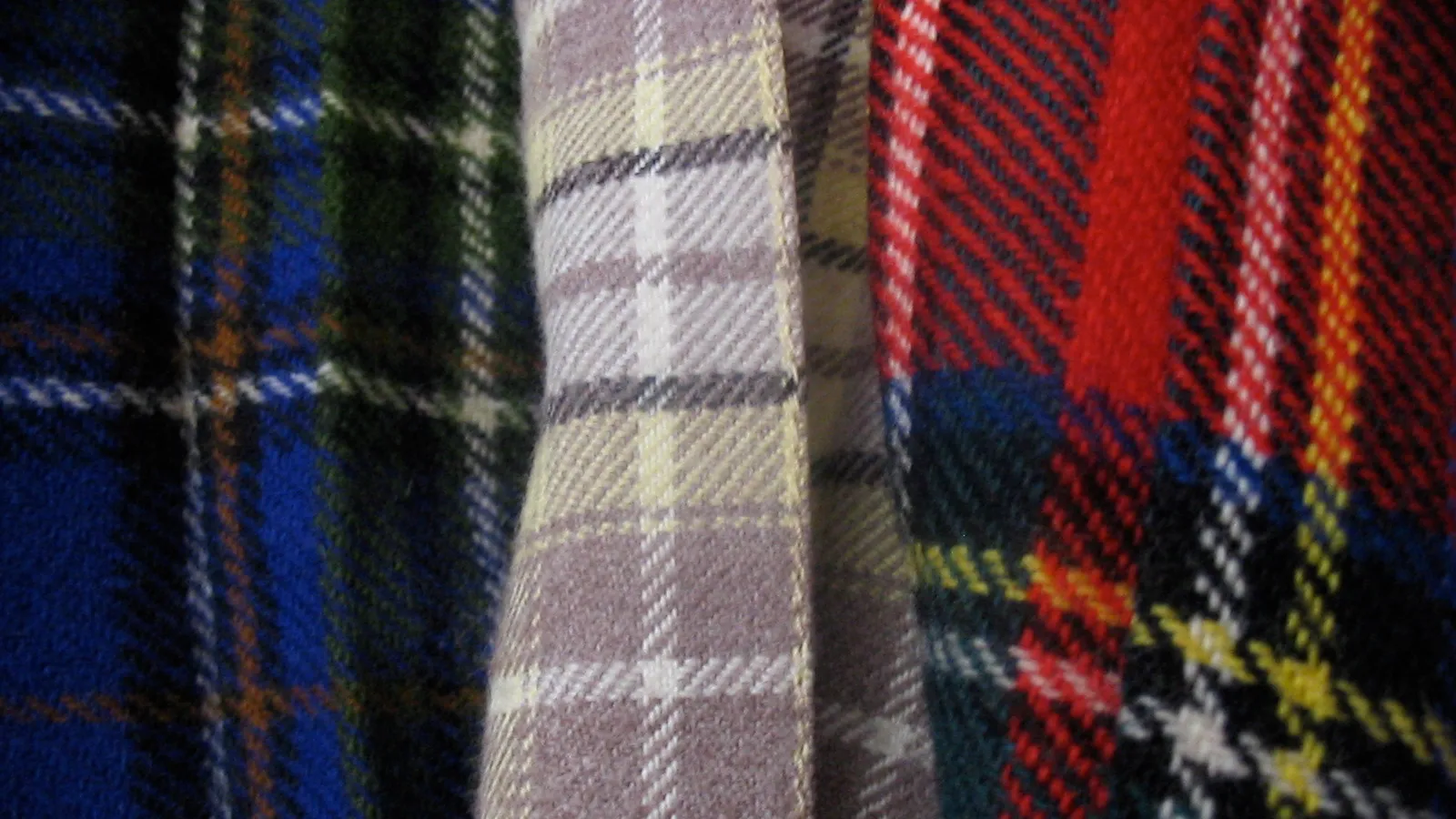

Tartan and the Clans
Contents
Tartan is one of the best-known symbols of Scotland, and the idea that every clan has its own ancient tartan is part of the national image. The clans themselves are genuinely old, and so is checked woollen cloth. But the system of one official pattern for each clan was largely created between about 1815 and 1850, by weavers, a London society, a royal visit and a forged book. This card separates the documented history of the clans and of tartan from the romantic invention.
TL;DR
- established The Highland clans emerged in the 12th and 13th centuries. The Gaelic word clann means "children", but most clansmen were not related to their chief.
- established Tartan cloth is old: the "Falkirk tartan", a simple two-colour check, dates to about the 3rd century AD. In 1703 Martin Martin recorded that patterns differed by district, not by clan.
- established The clan-tartan system was largely created in the early 19th century. The Highland Society of London began collecting "clan tartans" in 1815, George IV's visit to Edinburgh in 1822 created a rush for them, and the Vestiarium Scoticum of 1842 was a forgery.
- established After Culloden, the Dress Act of 1746 banned Highland dress, and the Heritable Jurisdictions Act of 1746 removed chiefs' hereditary courts. The Highland Clearances later emptied much clan land.
- established Since 2008 the Scottish Register of Tartans, run by National Records of Scotland, has been the official register of tartan designs.
- shared In North America clan tartan became the chief badge of Scottish descent, and new tartans multiplied for states, colleges, armed forces and causes, including a contested Confederate Memorial Tartan (1997). The anthropologist Celeste Ray, in Transatlantic Scots (2005), argues that tartan now works there as a kind of heraldry.
Key Facts
- "Clan"
- From Gaelic clann, "children"
- Clans emerge
- 12th–13th centuries
- Falkirk tartan
- c.3rd century AD; a simple two-colour check
- Martin Martin's account
- 1703: patterns differed by district
- William Wilson & Sons, Bannockburn
- Major tartan maker from c.1765
- Dress Act
- 1746, repealed 1782
- Heritable Jurisdictions Act
- 1746, effective 1747
- Highland Society of London collects clan tartans
- From 1815
- George IV's visit to Edinburgh
- 1822
- Vestiarium Scoticum forgery
- 1842
- Standing Council of Scottish Chiefs
- Founded 1951–1952; about 135 chiefs
- Scottish Register of Tartans
- Established 2008
Scottish Impact Index (SI Score)
- Cultural Reach
- 10/10
- Continuity of Tradition
- 10/10
- Social & Economic Importance
- 9/10
- Scottish Distinctiveness
- 10/10
- Cultural Legacy
- 10/10
- Recognition
- 10/10
59/60
Ranked #1 of 19 in Traditions
A Note on Claims and Evidence
Each major claim carries one of three labels. established means supported by primary records, official bodies or several independent reliable sources. shared means the core fact is sound but sources disagree on details, dates or interpretation. traditional means widely repeated but not traceable to a primary or independent source.
The key distinction is between tartan cloth, which is ancient, and the clan-tartan system, which is modern. Surviving textiles, early travellers' accounts, weavers' records and the papers of the Highland Society of London document how clan tartans were created. Hugh Trevor-Roper's famous 1983 essay on "the invention of tradition" is foundational but polemical. Figures such as the number of recognised chiefs change over time.
Timeline
The Falkirk tartan, a simple check, is made.
The Highland clans emerge.
The Court of the Lord Lyon is established in statutory form.
Martin Martin records that tartan patterns differ by district.
After Culloden, the Dress Act bans Highland dress and the Heritable Jurisdictions Act abolishes chiefs' courts.
William Wilson & Sons of Bannockburn become the leading tartan makers.
The Dress Act is repealed.
The Highland Society of London asks chiefs to supply their clan tartans.
George IV visits Edinburgh in a pageant stage-managed by Sir Walter Scott.
The Sobieski Stuart brothers publish the forged Vestiarium Scoticum.
The Standing Council of Scottish Chiefs is founded.
The Citadel, South Carolina, registers its own tartan.
Hugh Trevor-Roper's essay "The Invention of Tradition" is published.
The Scottish Tartans Authority is launched at Aviemore and at the Stone Mountain Highland Games in Georgia.
Radford University, Virginia, adopts the MacFarlane as its official tartan.
A Confederate Memorial Tartan is introduced in the United States; the Virginia Military Institute gains a tartan.
The Scottish Register of Tartans is established.
Details
Origins, nature and geography of the clan system
The word "clan" comes from Scottish Gaelic clann, meaning "children," "offspring" or, more broadly, "kindred." This etymology is the single biggest source of confusion, because it implies pure descent. In reality, as Wikipedia's survey of the scholarship (citing Roberts, Clan, King and Covenant) states plainly: "Contrary to popular belief, the ordinary clansmen rarely had any blood tie of kinship with the clan chiefs, but they sometimes took the chief's surname as their own when surnames came into common use in the sixteenth and seventeenth centuries." The ScotClans FAQ, written by clan historians, adds that clans were "territorial, accepting the authority of the dominant local grouping" and that "very often there is no genetic descent from a common ancestor." So the accurate framing is: a clan is a territorial kin-group built around a core lineage but incorporating unrelated tenants, dependants and followers who accepted a chief's protection. [DOCUMENTED — reference works and clan-history bodies]
On timing: the clans "emerged from the turmoil of the 12th century and 13th century when the Scottish crown pacified northern rebellions and re-conquered areas taken by the Norse." The system incorporated Celtic/Gaelic, Norse and — crucially — Anglo-Norman feudal elements; several famous "clans" (Cameron, Fraser, Chisholm, Menzies, Grant, Stewart) were founded by families of Anglo-Norman, Anglian or Flemish origin who arrived during and after the Wars of Independence. The system "reached its peak in the medieval and early modern periods but began to decline in the 17th century due to increasing centralization," with 1745–46 as the decisive break. established
Geographically, the clan system was a Highland phenomenon. By the early eighteenth century the Lowlands were more urbanised and culturally closer to England; Lowland society ran on feudal landholding — lords, vassals, tenants by contract — rather than the kin-bond. Even the Border "riding surnames" were technically distinct from Highland clans. Britannica situates the tension precisely: in the Highlands, land was "traditionally held in common by the clan," which could put chiefs at odds with crown property law, whereas some chiefs (the Campbells being the classic example) secured crown charters and became "feudal landlords and clan patriarchs at once." [DOCUMENTED — Encyclopaedia Britannica]
Clan structure and the feudal/kinship hybrid
The internal structure was a clear hierarchy. At the top sat the chief (ceann-cinnidh), whose principal historic function, per the heraldic literature, was to lead the clan in war; below him were the chieftains of cadet (junior) branches. The key intermediate figure was the tacksman (Gaelic fear-taic, "supporting man"): a landholder of intermediate status, usually a kinsman — often a cadet-branch member — who leased a "tack" (a lease) from the chief, sublet it to tenants, and, critically, "made sure that when the chief's call came, the clan could be mobilised for war." Below the tacksmen were tenants, sub-tenants and cottars. Dr Johnson, who toured the Highlands in 1773, defined the tacksman as "a large taker or lease-holder of land, of which he keeps part as a domain in his own hand, and lets part to under-tenants." established
The hybrid authority worked through two complementary concepts: dùthchas (collective clan heritage — the customary, inalienable right of clanspeople to rent land in the clan territory, with the chief as trustee/protector) and oighreachd (the chief's legal authority derived from crown charters). While dùthchas held precedence in the medieval period, the balance shifted toward Scots feudal law over time — a shift that later enabled chiefs to behave as commercial landlords. Chiefs also held real judicial power through heritable jurisdictions (regality and barony courts), enabling them to try serious crimes and enforce discipline. established
Today, the Court of the Lord Lyon — a standing court of law established in its statutory form by the Scottish Parliament in 1592, integrated into the Scottish legal system and headed by the Lord Lyon King of Arms — is the body that officially recognises clan chiefs. It does so by determining, on genealogical evidence, who is entitled to bear the undifferenced arms of the last known chief, then confirming that person as "Chief of the Name and Arms." (This article cross-references the site's dedicated Court of the Lord Lyon piece for the Court's fuller heraldic remit.) The Standing Council of Scottish Chiefs states there are "now about 140 clans that have chiefs recognised by the Lord Lyon." [DOCUMENTED — Court of the Lord Lyon / Standing Council of Scottish Chiefs]
The myth of ancient clan tartans
This is the pivotal claim, and the evidence is decisive: tartan cloth is old; the clan-tartan system is a late-Georgian/Victorian invention. Scholars carefully separate the two.
What tartan cloth genuinely is. The oldest surviving patterned wool from Scotland, the "Falkirk tartan," was found near the Antonine Wall stuffed into a pot of Roman coins and dates to roughly the 3rd century AD — but it is only a simple two-colour check in undyed wool, not a "true" multicolour tartan. The oldest known true tartan is the Glen Affric tartan: according to the V&A Dundee/Scottish Tartans Authority press release of 26 March 2023, radiocarbon testing at the SUERC Laboratory in East Kilbride gave "a broad date range between 1500 and 1655 AD, with the period between 1500 and 1600 AD the most probable," making it "the oldest-known piece of true tartan found in Scotland." National Museums Scotland's dye analysis found no artificial dyes, consistent with a pre-1750s date, and the STA's Peter MacDonald noted that no other piece of tartan survived from before the 1700s. Art historian Sally Tuckett of the University of Glasgow noted its rarity as a piece "which predates the clan tartan mania of the 19th century, worn or used by an ordinary person." [DOCUMENTED — STA, V&A Dundee, National Museums Scotland, University of Glasgow]
Pre-18th-century tartan was regional/personal, not clan-coded. The best early eyewitness is Martin Martin's A Description of the Western Islands of Scotland (1703), who recorded that plaids differed by locality: "Every Isle differs from each other in their fancy of making Plaids as to the stripes in breadth and colours… they who have seen those places are able at the first view of a man's Plaid to guess the place of his residence." This is a description of district variation driven by local weavers, available dyes and personal taste — not a system of clan uniforms. The Scottish Tartans Museum confirms the pattern names on early commercial tartans "were not meant to be representative in any way — they were there as a sales tool." established
How the myth was manufactured — a documented chain of events:
-
c.1765 onward — William Wilson & Sons of Bannockburn. This firm became the dominant commercial tartan manufacturer and near-sole supplier to the Highland regiments. Producing at scale, it standardised setts, first numbering them, then giving them names — of towns, districts, and eventually families — purely as a sales/identification tool. As the Scottish Tartans Museum records, "in Wilsons' Key Pattern Book of 1819, some 250 tartans are included, about 100 of which were given names… The names were not meant to be representative in any way -- they were there as a sales tool." Their standardised colours were in use by the 1780s. This is the commercial origin of pattern-to-name association. established
-
1815 — The Highland Society of London. The Society (an expatriate gentry club founded 1778) set out to collect and seal "clan tartans." Per the Scottish Tartans Authority, on 8 April 1815 its officer David Stewart of Garth wrote to Highland chiefs urging them to submit and seal a specimen of their tartan; "fifty-five specimens were submitted between 1815-22 and included in the Society's volume of Certified Tartans." The STA states flatly that this was done "notwithstanding the fact that there had never been clan tartans before this initiative." Many chiefs had no idea what their pattern was: they wrote to suppliers like Wilsons or polled elderly clansmen. Alexander Robertson, Chief of Clan Donnachaidh, recorded that he had asked old clansmen, "most of whom pretended to know what the pattern was but as no two of the descriptions I received were exactly similar, and as they were all very vulgar and Gaudy, I did not think proper to adopt any of them." This episode is the documented birth of the concept of clan tartans. [DOCUMENTED — Scottish Tartans Authority]
-
1822 — George IV's visit to Edinburgh. Stage-managed by Sir Walter Scott, the pageant demanded attendees appear "all plaided and plumed in their tartan array," triggering a scramble among Lowland lairds — who had never worn tartan — to acquire "their" tartan. This cemented tartan as national dress in the popular mind. (This article cross-references the site's Kilt article for the full 1822/George IV narrative and the tartan revival.) established
-
1842 — the Vestiarium Scoticum, a documented forgery. Two brothers calling themselves John Sobieski Stuart and Charles Edward Stuart (real names John Carter Allen and Charles Manning Allen), who falsely implied descent from Bonnie Prince Charlie, published a lavish folio claiming to reproduce an ancient (15th/16th-century) manuscript of clan tartans. They cited two manuscripts — the "Cromarty MS" (dated 1721) and an older "Douay MS" (claimed 1571) — but no independent scholar ever saw the originals. Sir Walter Scott himself had denounced the source as "an absolute fabrication" and blocked an earlier attempt to publish. An 1847 Quarterly Review article, later attributed to Professor George Skene of Glasgow University, systematically demolished it on linguistic and provenance grounds. In 1895 Andrew Ross had the 1721 copy chemically tested by the chemist Stevenson Macadam, who found it "had been treated with chemical agents in order to give the writing a more aged appearance than it is entitled to" and concluded "the manuscript cannot be depended upon as an ancient document." Modern scholarship, including 2010s non-destructive spectroscopic analysis, universally regards the Vestiarium as a 19th-century fabrication. Yet the tartans it depicted were widely adopted as "official" clan patterns anyway. [DOCUMENTED as forgery — Wikipedia, Citizendium, academic consensus]
The scholarly verdict. The Scottish Tartans Authority's official history (authored by Peter Eslea MacDonald OBE) states flatly that "in 1815 the Highland Society of London established the concept of clan tartans" and that the concept was adopted despite the fact that "there had never been clan tartans before this initiative." Hugh Cheape of National Museums Scotland, author of Tartan: The Highland Habit, writes that tartan "developed over little more than a century as the badge of the Scottish clans," distinguishing genuine medieval tartan "display culture" from the Victorian invention of exclusive clan identity. National Museums Scotland's own exhibition text describes clan tartans as having "a controversial history now more than 200 years in the making" and notes that "despite its characterisation as ancient… there was much about the Georgian style of Highland dress that was materially modern." Peter MacDonald, honorary Head of Research at the STA, estimates that "fewer than 50 of the over 12,000 setts recorded by The Scottish Tartans Authority" can be shown to have existed at the time of the Jacobites, and that "only one, the so-called Glen Affric tartan, pre-dates the 18th century" — and most of those early setts had no clan names at the time. The classic scholarly statement of the whole "invented tradition" thesis is Hugh Trevor-Roper's essay "The Invention of Tradition: The Highland Tradition of Scotland" in The Invention of Tradition (Cambridge, 1983); note that Trevor-Roper's work is provocative and has been criticised for overstatement (e.g. downplaying the Clearances and the antiquity of tartan cloth), so it should be cited as the origin of the thesis rather than as unqualified fact. [DOCUMENTED / scholarly interpretation]
Post-Culloden suppression and dismantling
After the Jacobite defeat at Culloden (April 1746), the government moved to break the clans by three distinct mechanisms:
-
The Dress Act 1746 (part of the Act of Proscription, in force 1 August 1746/1747) made it illegal for men and boys in the Highlands to wear "Highland Clothes" — the belted plaid, philibeg (kilt), trews, tartan hose — with penalties of six months' imprisonment for a first offence and seven years' transportation for a second. Highland regiments and the landed gentry were exempt. It was repealed in 1782, after 36 years, by which time everyday Highland dress had largely died out. (Cross-reference: the site's Kilt article covers Highland dress in full.) established
-
The Heritable Jurisdictions (Scotland) Act 1746 (effective 1747) was arguably the more fundamental blow: it abolished the hereditary judicial powers — regality and barony courts — that had let chiefs hold courts, try serious crimes and command loyalty. It transferred these to crown-appointed sheriffs, reducing chiefs, in the standard formulation, to landlords whose noble titles thereafter granted "no rights beyond those of landlordship (collecting rents)." Prime Minister Henry Pelham reportedly considered it the most important measure against Jacobitism. Because the 1707 Union had recognised these jurisdictions as property, dispossessed holders received compensation. (Cross-reference: the site's Sheriff Courts article covers the Act's judicial dimension.) established
-
The Highland Clearances (mid-18th to mid-19th century) completed the destruction economically. Landlords — including former chiefs now behaving as commercial landlords — evicted tenants to make way for large-scale sheep farming. Britannica states the Clearances "resulted in the destruction of the traditional clan society and began a pattern of rural depopulation and emigration." The Sutherland clearances (c.1807–1821), associated with the factor Patrick Sellar, became the emblematic case, with thousands removed to coastal crofts or emigration. The evictions violated dùthchas, the customary right of clanspeople to the land — starkly demonstrating that the "clan family" bond had always coexisted with, and was now overridden by, hierarchy and property. (Cross-reference: the site's Scottish Gaelic article covers the wider suppression of Highland culture.) established
The modern clan system and tartan registration
Today the clan system functions as a cultural and heritage institution, not a political or military one:
-
Chiefs and the Standing Council. Some 135 chiefs are members of the Standing Council of Scottish Chiefs (founded 1951/52 by the Countess of Erroll), all being Chiefs of the Name and Arms recognised by the Lord Lyon; the current convenor is Sir Malcolm MacGregor of MacGregor, chief of Clan Gregor. The Council itself states "there are now about 140 clans that have chiefs recognised by the Lord Lyon," while over 1,000 clan/family names are associated with Scotland; clans with a registered coat of arms but no recognised chief are termed "armigerous." established
-
Societies and Highland Games. Clan societies (especially strong in the diaspora — an estimated 41 million people of Scots descent in the English-speaking world) maintain the network; Highland Games feature "clan tents" where societies help visitors trace ancestry, and clan parades of tartan and banners. The Games themselves have genuine roots in clan gatherings but were substantially reshaped in the Victorian era. established
-
The Scottish Register of Tartans (2008). Established by the Scottish Register of Tartans Act 2008 and administered by the National Records of Scotland, it is "the world's only official government register of tartan patterns." It records thread counts, colours and ownership; it launched on 5 February 2009, incorporating the earlier private databases of the Scottish Tartans Society, the Scottish Tartans Authority and the Scottish Tartans World Register. Anyone worldwide may register a new tartan for a fee. Per National Records of Scotland, the register "now contains over 10,000 designs, with around 400 tartans added each year"; the 10,000th milestone design was "the 131 Argyle tartan, registered by the Diocesan Boys' School of Hong Kong." Crucially, it is a recording mechanism, not an authentication of antiquity: it "records what is registered, not whether it is genuinely ancient." Its creation was partly motivated by concern over commercially fabricated "clan tartans" sold as historic. This is a modern regulatory institution, entirely distinct from any claimed ancient tradition. [DOCUMENTED — legislation.gov.uk, National Records of Scotland]
Tartan in North America
shared The anthropologist Celeste Ray, in her chapters of Transatlantic Scots (2005), shows how far tartan's meaning has shifted in the diaspora. Many Scottish Americans' ancestors emigrated before the clan-tartan convention existed, yet wearing the clan tartan has become one of the main markers of identity in the Scottish-American community, for descendants of Lowlanders and Ulster Scots as much as of Highlanders. Clan society members choose among dress (usually on a white ground), mourning (black and white), hunting, district, military and chiefs' setts, each in "modern", "muted" or "ancient" colourings; district tartans, from which Ray thinks clan tartans probably developed, serve people without a clan. Newcomers are warned not to buy too much tartan before finishing their family research, in case it points to a different clan. Because tartan is now read as kinship, Ray argues that it works as a kind of heraldry: the wearer claims the clan's deeds and reputation, and its traditional enemies, who can be recognised by their own tartans.
established Tartans have multiplied for American institutions as well as families. Ray lists tartans for American states, Highland games, pipe bands, the US Navy, the Marine Corps and the armed forces in general. The Citadel in South Carolina registered its tartan in 1981 and the Virginia Military Institute gained one in 1997, while Radford University in Virginia adopted the MacFarlane as its official tartan in 1996 to honour its Scots-Irish roots. Clan tartans are blessed in church at the Kirkin' o' the Tartan, and at many American events kilts are required for men, though few are seen at Highland games in Scotland except on judges and officials.
shared Some new tartans carry political weight. In 1997 Mike Bowen of Georgia and Phil Smith of Pennsylvania introduced a Confederate Memorial Tartan: a Confederate grey ground with stripes of infantry blue, cavalry yellow and artillery red. Ray was told it was the work of at least ten people on both sides of the Atlantic, including a past commander-in-chief of the Sons of Confederate Veterans and a retired archivist from Wick. The literary historian Andrew Hook, in his chapter of the same book, objects that the tartan was approved by the Scottish Tartans Authority, itself launched in 1995 at Aviemore and simultaneously at the Stone Mountain Highland Games in Georgia, a place associated with the Confederacy and the Klan, and that it has appeared on the websites and publications of the League of the South and the white supremacist Council of Conservative Citizens. Its designers present it as a memorial; Hook sees it as a fusion of Scottish and Confederate identity that extremists have exploited.
shared Commerce has kept pace. Ray reports that in 2004 a company set up by Glasgow University neuroscientists hoped to build a database linking genetic patterns to surnames, and that kiltmakers expected to sell more tartan by telling North Americans which patterns they were entitled to. "The Sobieski-Stuarts must be laughing in their graves," she remarks.
Myths, disputed claims and exaggerations
-
"Each clan has always had its own ancient tartan." FALSE / LEGEND. The clan-tartan system dates to c.1815–1850 (Highland Society of London 1815; Wilsons' commercial naming; the forged Vestiarium Scoticum of 1842). Tartan cloth is old; clan-specific identifying tartans are not.
-
"Clan tartans have Pictish or pre-medieval origins." UNSUPPORTED / MYTH. There is no textile-archaeological evidence for clan-coded tartans in antiquity. The Falkirk fragment (~3rd century) is a plain undyed check; the oldest true tartan (Glen Affric) is only c.1500–1600. The Picts were culturally assimilated by the 11th century and left no evidence of clan tartan patterns. Claims of specific clans being "granted" tartans by, e.g., Robert the Bruce after Bannockburn are apocryphal (tartans may not have been worn as patterns in the 14th century at all).
-
"The clan was one big egalitarian family." MISLEADING. Clans were steep hierarchies of chief, cadet chieftains, tacksmen, tenants and cottars, combining kinship with feudal obligation and extraction (rents, dues such as calp and cain, military service). The very landlords who later evicted clanspeople in the Clearances were often their former chiefs.
-
"The whole clan descended from one common ancestor." LARGELY FALSE. This is itself an 18th-century myth arising from the literal meaning of clann; most clansmen were unrelated dependants who adopted the surname.
-
"The 1746 Act banned tartan as such." IMPRECISE. The Dress Act banned Highland dress (the plaid, kilt, trews, Highland tartan garb) for Highland men/boys; tartan made into conventional Lowland-style clothing was not the target, and the gentry and Highland regiments were exempt. [Clarified]
-
"Tartan/the kilt are uniquely and anciently Scottish inventions." OVERSTATED. Checked/twill cloth appears across many ancient cultures (finds from Hallstatt Europe and Bronze-Age Central Asia); the tailored small kilt is an early-18th-century development. Scotland's genuine claim is to the elaboration and cultural adoption of tartan and Highland dress, not to inventing checked cloth. (Cross-reference: Kilt article.) [Clarified]
Did You Know?
- The Gaelic word clann means "children".
- The oldest Scottish check, the Falkirk tartan, was found stuffed into a pot of Roman coins.
- In 1703 tartan patterns were associated with districts, not clans.
- A Bannockburn weaving firm gave many tartans their names to sell them.
- The Highland Society of London began collecting clan tartans in 1815.
- George IV wore Highland dress for his 1822 visit to Edinburgh.
- The Vestiarium Scoticum of 1842, a supposed medieval record of clan tartans, was a forgery.
- Scotland has an official government register of tartans, set up in 2008.
- The US Navy and Marine Corps have their own tartans.
- The Scottish Tartans Authority was launched in 1995 at Aviemore and at a Highland games in Georgia on the same day.
FAQ
1Is tartan ancient?
Checked woollen cloth is ancient. The idea of one pattern for each clan is modern.
2When did clan tartans begin?
Mainly between about 1815 and 1850.
3Were all clan members related?
No. Most clansmen were not related to the chief; they took the clan name for protection.
4Did the 1746 Act ban tartan?
It banned Highland dress for Highland men and boys, rather than tartan cloth as such.
5What was the Vestiarium Scoticum?
A book of supposed ancient clan tartans published in 1842, now known to be a forgery.
6What part did George IV play?
His 1822 visit to Edinburgh created a fashion for wearing clan tartan.
7Who recognises clan chiefs today?
The Court of the Lord Lyon.
8Is there an official list of tartans?
Yes. The Scottish Register of Tartans, run by National Records of Scotland since 2008.
9Is the kilt ancient?
No. The belted plaid is older; the tailored small kilt dates from the early 18th century.
10Is tartan uniquely Scottish?
No. Checked and twill cloth has been found in many ancient cultures.
11Do American states and institutions have tartans?
Yes. States, colleges, Highland games, pipe bands and branches of the US armed forces have their own tartans.
12What is the Confederate Memorial Tartan?
A tartan introduced in 1997 to commemorate the Confederacy. Its designers call it a memorial; critics such as Andrew Hook object to its use by neo-Confederate groups.
Sources and Further Reading
Scholarly/Critical
- Celeste Ray, 'Scottish Immigration and Ethnic Organization in the United States', in Celeste Ray (ed.), Transatlantic Scots (University of Alabama Press, 2005)
- Celeste Ray, 'Bravehearts and Patriarchs: Masculinity on the Pedestal in Southern Scottish Heritage Celebration', in Celeste Ray (ed.), Transatlantic Scots (University of Alabama Press, 2005)
- Andrew Hook, 'Troubling Times in the Scottish-American Relationship', in Celeste Ray (ed.), Transatlantic Scots (University of Alabama Press, 2005)
- Colin Kidd and James Coleman, "Mythical Scotland", in T. M. Devine and Jenny Wormald (eds), The Oxford Handbook of Modern Scottish History (Oxford University Press, 2012) — further reading on the 1822 royal visit and tartanry
Further Reading
- Hugh Trevor-Roper, "The Invention of Tradition: The Highland Tradition of Scotland", in Eric Hobsbawm and Terence Ranger (eds), The Invention of Tradition (Cambridge University Press, 1983)
- Hugh Cheape, Tartan: The Highland Habit (National Museums of Scotland, 1991)
Caveats: Myths and Disputed Claims
- Do not say each clan has always had its own tartan.
- Do not claim Pictish or prehistoric origins for clan tartans.
- Do not describe clans as egalitarian families descended from one ancestor.
- Do not say the 1746 Act banned tartan cloth outright.
- Do not call tartan or the kilt uniquely or anciently Scottish inventions.
- Do not give the number of recognised chiefs or registered tartans as fixed figures.
- Do not assume a tartan's registration or approval means it is old, or that it is politically neutral.
Card 001 · Traditions