
The Ba' Game: When the Town Becomes the Pitch
Contents
Not an eccentric ancestor of football, but a family of Scottish street-ritual games where the goal is a harbour, the pitch is the whole town, and the winning ball ends up on a mantelpiece, not in a trophy cabinet.
Series: Culture & Traditions
TL;DR
- Established/Documented: The Ba' is not one game but a family of local Scottish folk-football and hand-ball traditions in which a town's own streets, landmarks and geography become the playing field. Kirkwall's Christmas and New Year Ba' between the Uppies and Doonies is the fullest surviving example; Jedburgh's Hand Ba' (traced by Scottish Borders Council to 1704) and Duns's Hand Ba' (now played within Reivers Week) are the other clearly living traditions.
- Shared/Traditional: The division of players into inherited sides — Uppies vs. Doonies at Kirkwall and Jedburgh, historically married men vs. bachelors at Duns and Scone — carries real social and ritual meaning (rite of passage, inherited belonging), but this is best understood as anthropological interpretation of the pattern, not a meaning every historical player consciously articulated.
- Disputed / unverified: Kirkwall's supposed Norse origins are plausible cultural context, not proof — the earliest specific Kirkwall record cited in modern local histories dates only to 1650. Jedburgh's "1704" starting date, as presented by Scottish Borders Council, still needs its underlying primary document located and checked. No reliable national participation figures exist for any of these games.
- Legend/Myth — actively flagged here: Jedburgh's story that the first "ball" was an Englishman's severed head, with the modern ball's ribbons representing hair, is presented locally as legend and should never be written as established history. The cliché that Ba' games have "no rules" is also a myth this card corrects — unwritten but genuinely enforced customary rules govern safety and conduct at every surviving game.
This card treats the Ba' as belonging to Culture rather than Sport: its defining features are calendrical ritual, inherited allegiance, town geography, family apprenticeship, ceremonial balls-turned-heirlooms, and the temporary transformation of ordinary streets into a contested landscape — not simply an eccentric early form of football.
Key Facts
- Meaning of "Ba'"
- Scots for "ball" — the Dictionary of the Scots Language records it for both the object and the annual contest itself, in Border towns (Ancrum, Hobkirk, Duns, Jedburgh, Kelso) and Orkney | —
- Strongest surviving example
- Kirkwall's Ba' (Christmas Day and New Year's Day) — Uppies aim for Mackinson's Corner, Doonies for the harbour | No reliable total attendance/participation count — only rough estimates (c. 75–100 active players per side at once)
- Kirkwall's earliest record
- A Ba'-type game near St Magnus Cathedral, 1650 | Any proof of a continuous, unbroken line back to the Norse period — this is plausible cultural context, not documented fact
- Jedburgh's Hand Ba'
- Scottish Borders Council traces it to 1704; Uppies and Doonies split around the Market Place | The underlying 1704 primary record has not yet been located and verified
- Duns's Hand Ba'
- Now played within Reivers Week/Duns Summer Festival (July), using several flat, cushion-like balls; historically divided married men from bachelors | Precise chronology of its move from Shrovetide to the summer festival calendar
- The ball as object
- Kirkwall's Men's Ba' averages roughly 1.3 kg and 19 cm across, hand-stitched leather packed with cork dust, becomes the winner's personal trophy | Jedburgh's exact ball construction is less strongly documented and needs direct verification
- Rules
- Genuinely thin written regulation, but extensive, actively enforced unwritten rules on danger, property and conduct (per ethnographer Laurent-Sébastien Fournier's fieldwork) | —
- Danger/incidents
- Real historical injuries recorded, including a 1903 Kirkwall death; attempts to restrict or suppress the games (Kirkwall 1875/1883; Scone, discontinued by the 1790s) | A 2001 "legal threat" reported by the BBC — no underlying court judgment or legal file has been located
A Note on Claim Status
This card applies the site's standard evidence framework — Established/Documented, Shared/Traditional, disputed, and Legend/Myth — with particular discipline around two temptations common to Ba' folklore: presenting plausible-sounding "ancient/Norse" origin stories as proven fact when the actual documentary record is much later and thinner, and repeating dramatic origin legends (Jedburgh's severed head) as history rather than the folklore they explicitly are. This card also corrects the popular cliché that Ba' games have "no rules" — the evidence instead shows genuinely thin written regulation alongside extensive, actively enforced unwritten conventions.
Timeline
Earliest specific Kirkwall Ba' record cited in modern Orkney local histories, near St Magnus Cathedral at the Ba' lea
Date to which Scottish Borders Council traces the Jethart Hand Ba' tradition
Scone's historic Shrove Tuesday Ba' (married men vs. bachelors) recorded as recently discontinued "because of the inconvenience it caused"; at Inveresk the fishwives are recorded playing an annual Shrove Tuesday football match, married women against unmarried
A great Border ba' match at Carterhaugh, near Selkirk, under the patronage of the Duke of Buccleuch, with the Earl of Home and Sir Walter Scott each backing a side (exact date and line-up vary between sources)
The Kirkwall game moves from open ground into the town's streets
Kirkwall's game increasingly becomes a carrying/wrestling contest rather than a kicking one, as the narrower street environment made ground football impractical
The Christmas Day Ba' becomes established in Kirkwall (New Year had originally been the principal fixture)
Kirkwall sees an attempt to substitute rugby (1875) and a proposal to restrict teams to 20 men (1883) — evidence that tension between public order and customary licence is not a modern phenomenon
Ba' documented in Stromness, Orkney, including Christmas games
A Kirkwall Youth's Ba' operates for ages 16–21
A Doonie player dies of a heart attack during the Kirkwall Ba' — a genuine, recorded historical incident
Orphir's Ba' recorded, Orkney
Holm's Ba', Orkney, comes to an end
A short-lived women's Ba' is tried at Kirkwall
Kirkwall's game duration varies wildly — as short as four minutes (Christmas Day 1952) and as long as seven hours (New Year's Day 1975)
A BBC report, Ba' game legal threat fears, flags concern over liability and regulation — though the underlying legal correspondence has not been located
Ethnographer Laurent-Sébastien Fournier undertakes fieldwork on related games at Kirkwall, Jedburgh, Duns, Ancrum, Lilliesleaf, Hobkirk and Denholm
One of the rare interruptions to the Kirkwall tradition
King Charles formally starts a Hand ba' during his visit to the Jethart Callant's Festival — recorded in the official Court Circular alongside the festival cavalcade
Details
There Is No Single Point of Origin
The safest historical position — and the one this card adopts throughout — is that Scottish Ba' games belong to the wider European family of pre-codified communal ball games, rather than being a single ancestor of modern association football. Ethnographer Laurent-Sébastien Fournier describes British folk football generally as contests in which large groups push or carry a ball through a settlement or landscape, often on Shrovetide or other winter festival dates, regulated by custom rather than a written sporting code — directly comparable to the French tradition of la soule.
This distinction matters for how the Ba' should be understood: it should not be presented as "football before football was invented." Modern association football and rugby emerged by formalising particular kinds of ball play into fixed written rules; the Ba' followed a different trajectory entirely, retaining the town itself, the crowd, and customary practice as its actual infrastructure. The vocabulary confirms this geographical breadth — the Scottish National Dictionary records ba' as the annual football or handball of many Border settlements and Orkney, and Uppie for participants playing towards an "upper" goal in annual games historically held at Candlemas, Shrovetide or Christmas across the Borders, Perthshire, East Lothian and Orkney. The terminology, in other words, is Scottish and regional — not a quirk unique to Kirkwall.
Kirkwall: The Fullest Surviving Example
Modern Orkney accounts place a Ba'-type game east of St Magnus Cathedral, at the Ba' lea, in 1650 — the earliest specific record cited in modern local histories. The game later moved to the Kirk Green and, around 1800, into the town's streets; because the narrower street environment made ground football increasingly impractical, by around 1850 the ball was predominantly being picked up and carried rather than kicked. New Year was originally the principal fixture, with the Christmas Day Ba' becoming established from around the 1870s.
This chronology is considerably firmer than any claim of demonstrably Viking origins, and this card is careful to preserve that distinction. Orkney tourism material describes the tradition as said to have roots in the Norse period, and local heritage sources note Orkney's wider Norse sporting heritage and parish games fields — plausible cultural context, but not proof of an unbroken game running continuously from Norse Orkney to the recorded 1650 Kirkwall contest.
Kirkwall's history also shows the tradition evolving rather than staying fixed: a Youth's Ba' for ages 16–21 operated from 1892 to 1910; a short-lived post-war women's version was tried; and other Orcadian games disappeared entirely, including Stromness's Ba' (documented 1884–1923), Orphir's game (1890s) and Holm's (ended 1910). Today Kirkwall stands as the sole surviving Orcadian centre of the custom.
Jedburgh and the Wider Borders
Scottish Borders Council describes Jethart Hand Ba' as an annual street sport played since 1704 — a date well embedded in modern civic presentation, though this card notes plainly that the underlying primary 1704 record still needs to be located and checked directly rather than treated as equivalent to verified evidence.
Jedburgh's own visitor material also preserves a far more colourful story: that the first "ball" was the head of an Englishman, and that the ribbons attached to the modern ball represent his hair. This is excellent evidence of how the Ba' generates origin myths — but the source material itself presents it explicitly as legend, and this card labels it as such rather than as history. The Dictionary of the Scots Language offers firmer ground: it quotes a 1909 Jedburgh Gazette reference to the "Callants' Ba'," a 1916 Kelso Chronicle reference to Fastern's E'en Handball at Jedburgh, and an older account noting that burgh authorities had once attempted to suppress the annual handball — and records historical hand-ba traditions at Ancrum, Hobkirk, Duns, Jedburgh and Kelso more broadly.
Duns demonstrates yet another survival path: its present Hand Ba' has migrated from its older Shrovetide date into the modern Duns Summer Festival/Reivers Week (running 5–11 July in 2026) — a clear example of cultural continuity achieved through recontextualisation rather than exact, unchanged preservation.
Historical Scone: A Vivid Discontinued Example
One of the most illuminating historical comparisons is Scone, whose Ba' survives today only in the Scots saying "A's fair at the ba' o' Scone." The Scottish National Dictionary identifies it as an annual Shrove Tuesday game between married men and bachelors, formerly played at the same festival in many Border towns, Highland districts and East Lothian. An 18th-century description drawn from the Old Statistical Account portrays an intensely communal contest: married men and bachelors held opposing goals; the ball could be carried and thrown; the married side tried to "hang" it at one goal while the bachelors tried to "drown" it in the river; the contest could run from afternoon until sunset; and adult men of the parish were socially expected to support their side. By 1796 the custom was reported as discontinued "because of the inconvenience it caused" — valuable evidence that concern about disruption from these games is not a modern phenomenon at all.
Carterhaugh, Antiquarians and the Romantic Revival
shared Border ba' games caught the attention of the Romantic movement. In December 1815 a famous match was played at Carterhaugh, near Selkirk, on the Duke of Buccleuch's land. The sources disagree on the details. William Hone's Every-Day Book (1827) dates it to Tuesday 5 December and describes the men of Ettrick against the men of Yarrow, with the Earl of Home backing one side and Sir Walter Scott, as sheriff of Selkirkshire, the other; Scott wrote songs for the occasion. A modern Borders account dates it to 4 December and describes the Duke's estate men, captained with the Earl of Home, against men from Selkirk, Hawick and Galashiels. The historian Christopher Harvie, in "Sport and the Scottish state", a chapter of Grant Jarvie and Graham Walker (eds), Scottish Sport in the Making of the Nation (1994), gives the date as 14 December and names James Hogg as organiser. The early-December date is better supported. Harvie also suggests the occasion helped revive the Common Ridings of the Border burghs; that is his interpretation rather than an established link.
shared Later in the century the games became material for scholars. Harvie notes that Border antiquarians of the 1880s tried to give rugby a local pedigree by tracing it to the hand-ba', and that the anthropologist Sir James George Frazer linked the rough communal games played at Lent to rituals of purging and scapegoating. Both are readings imposed on the games from outside, and this card treats them in the same cautious way as the modern ritual interpretations discussed below.
established The calendar that sustained these games was shrinking. The sports historian Hamish Telfer, in another chapter of the same book, notes that in the 19th century traditional sporting dates such as Fastern's E'en, Handsel Monday and Hallowe'en dropped out of many local calendars, along with the fairs that went with them. The surviving ba' games are the exceptions that kept their fixed days, or, like Duns, found new ones.
How the Games Work: No Universal Rulebook
There is no single Ba' rulebook across Scotland. The characteristic pattern is two locally constituted sides, a ball thrown or released into a crowd, goals embedded directly in the physical landscape, a large moving scrum or "pack," and customary limits enforced by the participants themselves rather than a conventional referee. Fournier argues explicitly that describing these games as having "no rules" is misleading: written regulation is genuinely thin, but experienced players transmit extensive unwritten rules about unacceptable danger, property and conduct — a distinction this card treats as central to correcting the popular "lawless mob football" cliché.
At Kirkwall, the game begins around the Mercat Cross/Kirk Green beside St Magnus Cathedral. The two sides are the Uppies and Doonies — historically determined by where a player was born or how he first entered Kirkwall, though as hospital birth has weakened that old geographic mechanism, side allegiance is now substantially inherited through family, with sons following fathers and grandfathers. The goals are not posts: Uppies aim to get the Ba' to Mackinson's Corner, while Doonies must get it into the salt water of Kirkwall Harbour Basin. Carrying, wrestling, short breaks from the scrum, decoy breaks and deliberately concealing or "smuggling" the ball are all part of the tactical repertoire. There is no fixed player limit or match duration — roughly 75–100 players per side may be actively engaged at any one time, with many more spectators, and games have ranged from as short as four minutes (Christmas Day 1952) to as long as seven hours (New Year's Day 1975).
At Jedburgh, the Hand Ba' begins in the Market Place and likewise divides participants into Uppies and Doonies, conventionally associated with the parts of town above and below the Mercat Cross — Uppies working towards the Castle Jail area, Doonies towards the Pleasaunce/Townfoot side. Several balls may be played during the event rather than one continuous contest deciding everything, with the ball able to disappear through closes, yards or crowds. There are distinct youth and adult games, and Jedburgh Grammar Campus has published arrangements allowing pupils to leave under normal attendance procedures on Ba' Day — unusually strong evidence that the custom is embedded in real local family life, not staged heritage for visitors.
At Duns, the structure is different again: the game is played in and around the Market Place, using several relatively flat, cushion-like balls thrown into play. Older tradition divided married men from bachelors; the modern allocation is less rigid. Contemporary goals are associated with the Post Office and White Swan sides of the square, whereas historical accounts describe entirely different objectives involving the parish church and a mill — direct evidence that the Ba' is not a frozen fossil: its goals, calendar placement and team divisions can change while the community continues to recognise it as the same living custom.
The Town Itself Is the Stadium
The central cultural fact uniting every surviving Ba' is that the game does not merely happen in the town — the town becomes part of the rules. A cathedral, market cross, harbour, closes, streets, rivers or mills become tactical features and goals in their own right. Kirkwall's movement between the Mercat Cross, narrow lanes, Mackinson's Corner and the harbour Basin is inseparable from how the game actually works; in Duns and historical Scone, civic, ecclesiastical and economic landmarks structured play in exactly the same way. This is one reason ordinary sporting language can obscure more than it explains: there is no neutral rectangular pitch imposed on the town — the inherited landscape determines the contest, meaning knowledge of streets, bottlenecks and local routes is itself a form of sporting knowledge.
Belonging, Inheritance and Rite of Passage
Kirkwall's Uppie/Doonie distinction has evolved from geography towards genealogy: where hospital birth makes the old birthplace boundary impractical, family allegiance increasingly determines which side a player belongs to, producing an unusually literal inheritance of sporting identity — fathers and sons in the same Ba' lineage for generations. The Scots vocabulary itself carries this geography: an Uppie is defined as a player towards the upward hail or goal, historically associated with the upper part of a settlement, and Kirkwall's own names — "up the gates" and "doon the gates" — use gate in its Norse-derived sense of road or path. Jedburgh's division similarly maps social belonging onto the town above and below its Mercat Cross, while Duns and Scone reveal an older, different pattern entirely: married versus unmarried men. This card treats the anthropological interpretation of such divisions — as part of a broader ritual symbolism of renewal and the passage between social states — as a scholarly reading of the pattern, not necessarily a meaning consciously articulated by every historical player.
Kirkwall gives the clearest evidence of the Ba' functioning as a genuine male rite of passage: the Boys' Ba', for under-16s, precedes the Men's contest and is explicitly described locally as an apprenticeship for the adult game, with fathers and experienced participants watching younger players and transmitting practical rules about danger and conduct. At Jedburgh, the continuing youth game and the local school's specific accommodation for Ba' Day point to a similar intergenerational structure — the custom is learned not from a printed manual but through watching, listening, and eventually taking part.
Gender: Real History, Requiring Careful Treatment
The best-known surviving games remain strongly male-coded in their published categories — "Boys'" and "Men's" Ba'" — but this card avoids the oversimplification that women have no role at all. Women's folk football has a real Scottish history. The historian Neil Tranter, in "Women and sport in nineteenth-century Scotland", a chapter of Scottish Sport in the Making of the Nation (1994), drawing on Robert Scott Fittis's Sports and Pastimes of Scotland (1891), notes that the fisherwomen of Musselburgh and Inveresk played football in the late 18th or early 19th century. The Old Statistical Account for Inveresk describes a standing Shrove Tuesday match between the married and unmarried women, the same married-against-single division found in the men's games at Scone and Duns. Tranter stresses that such cases were rare: working-class women in Victorian Scotland mostly watched rather than played. Kirkwall genuinely experimented with a women's Ba' in the post-war period, and local accounts emphasise women's place in the broader supporting community around the tradition. This card treats the precise history of women's participation as deserving further archival verification rather than reducing it to a novelty aside, and notes that published visitor material does not currently provide enough evidence to say confidently whether today's categories represent formal eligibility rules, inherited terminology, or simply established practice.
The Ba' as Object: From Match Ball to Family Heirloom
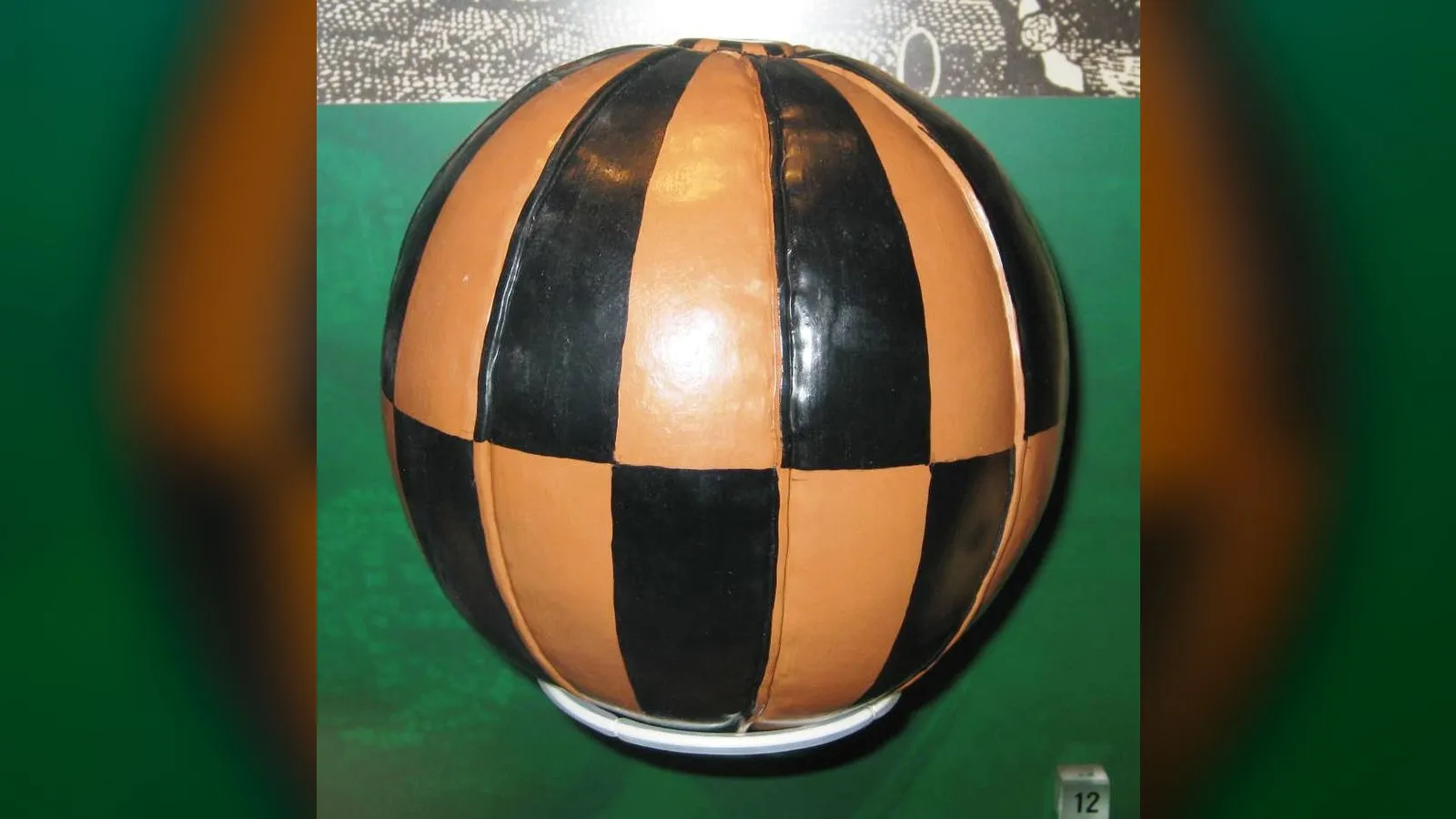
Kirkwall's ball is exceptionally rich material culture. It resembles an old panelled football but is built to withstand prolonged grappling: leather panels are hand-stitched and packed hard with cork dust, allowing the ball to float if the Doonies manage to reach the harbour. The average Men's Ba' weighs roughly 1.3 kg and measures about 19 cm across, with a fresh ball ordinarily made for each individual game. At the end of the contest, the Ba' ceases to be communal playing equipment entirely and becomes a personal trophy — the winning side selects an individual recipient, who need not even be the man who physically completed the winning move, and the ball is subsequently repaired, varnished and displayed in the winner's home. This makes the object something closer to a combination of match ball, trophy and heirloom than an ordinary piece of sporting equipment.
Jethart's ball is traditionally described as leather, stuffed and decorated with ribbons — locally connected to the severed-head legend, though this card notes the construction details are less strongly documented in available sources and would benefit from direct verification with current organisers. Duns uses a markedly different form again — flat, round, cushion-like balls, several thrown during the same evening — a variation that alone demonstrates why a single Kirkwall-style ball should never be used to illustrate "the Scottish Ba'" as though the design were universal.
Danger, Discipline and the "No Rules" Myth
The Ba' is genuinely physically rough, but this card actively corrects the cliché that it has "no rules." Kirkwall's scrum can place extraordinary pressure on participants, particularly where streets narrow, with real documented danger of players being crushed against walls — yet play is also expected to stop when someone is injured or unconscious, and Fournier's fieldwork found equivalent customary restraint across the wider tradition: experienced players distinguish legitimate roughness from unacceptable violence, using calls, experience and communal sanction to stop situations judged too dangerous. One Jedburgh maxim recorded in that research was, in essence, to play the ball rather than attack the person.
Kirkwall's history nevertheless contains genuine, documented incidents: a 1903 death, when a Doonie player suffered a heart attack, along with accounts of broken bones and games spilling into buildings. Some of the more colourful anecdotes — including a doctor allegedly splinting a broken leg before returning to the game — belong clearly to the realm of remembered local anecdote and are not presented here with the same certainty as a dated newspaper or medical record. Attempts to constrain the game are similarly old, not a recent "health and safety" intrusion: Kirkwall saw an 1875 attempt to substitute rugby and an 1883 proposal to restrict teams to twenty men, while Scone's game had already been effectively suppressed by the 1790s over the inconvenience it caused. Modern scholarship also records concern over liability, referencing a 2001 BBC report titled Ba' game legal threat fears — but this card is careful to note that the underlying legal correspondence or council documentation behind that story was not located in the research reviewed, and does not describe any Ba' as having been judicially banned or formally found unlawful without stronger evidence.
Crucially, adaptation appears to be one real reason these games have survived at all — Fournier documents changes to routes, goals and forms of play made in direct response to injuries, drowning risk, road traffic or other modern hazards, while participants continue to regard the tradition as fully authentic. Continuity, in other words, has never required refusing every safety change.
Modern Continuity: Alive, Not Preserved
Kirkwall's Ba' remains highly active today: Orkney's tourism service continues to list the Christmas and New Year Ba' as public events, with organisers explicitly warning spectators to maintain an appropriate distance from the action; wartime and the COVID-19 pandemic are identified as rare interruptions rather than the beginning of any terminal decline. Jedburgh likewise remains a living practice, not historical re-enactment — its youth/adult fixture was publicly promoted in 2025, and the 2026 royal visit gave the Hand Ba' exceptional national ceremonial visibility, with the official Court Circular recording that King Charles started a game after viewing the Jethart Callant Festival cavalcade. Duns's survival is directly tied to its Summer Festival/Reivers Week, which continued in July 2026.
What cannot presently be substantiated, and what this card does not claim, is any Scotland-wide participation trend — "numbers are rising" or "the games are dying out." Kirkwall's prominence and Jedburgh's visibility are clear from the evidence; reliable year-by-year participation series simply do not exist, and the current status of smaller historical Border games (Ancrum, Hobkirk, Lilliesleaf, Denholm and others) would need direct present-day confirmation before any claim could responsibly be made about them.
Is the Ba' a Sport?
In one sense, plainly yes: it has opposing teams, territorial goals, possession, tactics, physical skill, strategic deception, victory and individual prestige. Kirkwall even has a standing Ba' Committee, made up of five Uppie and five Doonie representatives, which raises money, commissions the balls and arranges the throw-up, with teams meeting beforehand to discuss tactics. Yet applying the model of modern organised sport leaves a great deal unexplained: player numbers are not standardised, the field is not symmetrical, duration is not fixed, allegiance may be inherited rather than chosen, the "winner" is an individual acclaimed by the team rather than a scorer, and the whole event is tied to Christmas, New Year, Fastern's E'en or civic festival calendars rather than a sporting season.
Fournier's anthropological framing is therefore the more productive one this card adopts: these are competitive physical contests embedded in seasonal ritual, local territorial identity and customary social order — and roughness itself is kept in check partly because participants are not anonymous opponents, but remain neighbours, relatives and fellow townspeople once the contest ends. Kirkwall's own tradition captures this directly: after the Ba', opposing sides return immediately to ordinary neighbourly relations, and local tradition even associates an Uppie victory with a good harvest and a Doonie victory with good fishing — a symbolic pairing of town division with older land-and-sea livelihoods that need not be literally believed today to remain meaningful.
British and European Parallels
Scottish Ba' is not unique in Europe. Fournier compares Scottish examples directly with the French tradition of la soule, where communities likewise contested a ball across large informal territories on festival occasions, arguing that the meaningful comparison is with this broader folk-game family rather than with modern eleven-a-side football. The closest famous English analogue is Royal Shrovetide Football at Ashbourne, which retains its own Up'Ards and Down'Ards, town-wide play, and distant goals — and where, as recently as 2026, proposed housing development near part of the traditional playing territory prompted real concern that new building could obstruct the game, reinforcing the point that in folk football, landscape itself functions as part of the rulebook. Related surviving mass-football traditions are also recorded at Alnwick, Sedgefield and Workington in England — Workington's own terminology, Uppies and Downies, offers an especially striking parallel with Scottish usage, though this card notes that similarity of names alone does not prove direct descent from a single shared origin.
Did You Know?
- The Ba' at Kirkwall doesn't end in a trophy cabinet — the winning team's ball becomes a personal keepsake, repaired, varnished and proudly displayed in the winner's own home.
- Kirkwall's Men's Ba' is packed with cork dust specifically so it can float — useful, since the Doonies' actual goal is to get it into the sea at Kirkwall Harbour.
- Game length at Kirkwall is wildly unpredictable: one Christmas Day match in 1952 lasted just four minutes, while a New Year's Day game in 1975 went on for seven hours.
- The earliest solid record of Kirkwall's Ba' dates only to 1650 — the popular idea that it's an unbroken survival from Viking-age Orkney is plausible-sounding folklore, not proven fact.
- Jedburgh's colourful legend that the game began with an Englishman's severed head, and that the ball's ribbons represent his hair, is explicitly presented locally as legend — not history.
- At Kirkwall, which side you play for — Uppies or Doonies — has shifted over time from where you were literally born in town to which side your father and grandfather played for.
- In 2026, King Charles personally started a Hand Ba' during a visit to Jedburgh — a striking piece of modern royal recognition for a street game still rooted entirely in local families.
- Concern about the danger and disruption caused by these games isn't new: Scone's historic Ba' had already been effectively shut down by the 1790s for causing "inconvenience," and Kirkwall saw attempts to restrict or replace its own game as early as 1875.
FAQ
1
- What does "Ba'" actually mean?
It's simply Scots for "ball." The word is used both for the object itself and, historically, for the annual contest — recorded in Border towns including Ancrum, Hobkirk, Duns, Jedburgh and Kelso, as well as in Orkney.
2
- Is the Ba' the ancestor of modern football?
Not really, and this card avoids that framing deliberately. Modern football and rugby developed by formalising ball play into written rules; the Ba' instead kept custom, the crowd and the town itself as its structure. It's better understood as a separate, surviving branch of the wider pre-codified European folk-football family, alongside things like the French la soule.
3
- Is Kirkwall's Ba' really a Viking-age survival?
This is widely said, and plausible as cultural context, but it isn't proven. The earliest specific documented record of a Kirkwall Ba'-type game dates only to 1650 — centuries after the Norse period.
4
- Did Jedburgh's Hand Ba' really begin with an Englishman's severed head?
No — this is a colourful local legend, explicitly presented as such by local sources, not an established historical origin. It's a great example of how these traditions generate their own dramatic origin stories.
5
- Who are the "Uppies" and "Doonies"?
The two sides at both Kirkwall and Jedburgh, historically tied to which part of town a player was from (or was born in, at Kirkwall). At Kirkwall today, side allegiance is largely inherited through family rather than determined by literal birthplace.
6
- Is it true the Ba' has no rules at all?
No — this is a myth worth correcting. Written regulation is genuinely thin, but experienced players enforce extensive unwritten rules about acceptable roughness, safety and conduct, and play stops when someone is seriously hurt.
7
- What happens to the ball after the game?
At Kirkwall, it stops being sporting equipment entirely. The winning side selects one player to receive it as a personal trophy — repaired, varnished, and kept as a treasured heirloom in their home.
8
- Has anyone ever died playing the Ba'?
Yes — a documented case exists: a Doonie player died of a heart attack during the Kirkwall Ba' in 1903. Genuine injuries have occurred at various points in the tradition's history, alongside customary safety practices intended to prevent them.
9
- Do women take part in the Ba'?
Historically and today, the most visible categories ("Boys'" and "Men's") are male-coded, but Kirkwall did try a short-lived women's Ba' in the post-war period, and women have long been part of the wider supporting community. Current formal eligibility rules aren't clearly documented in public sources.
10
- Is the Ba' still played today, or is it more of a historical re-enactment?
It's very much still alive. Kirkwall's Christmas and New Year games continue as genuine community events; Jedburgh's Hand Ba' was prominently played in 2025 and 2026 (including a royal visit); and Duns's version continues as part of its modern summer festival.
11
- Why is this treated as Culture rather than Sport?
Because its defining features — inherited team allegiance, calendrical ritual, rite of passage, town geography as the actual playing field, and a ball that becomes a family heirloom rather than a trophy — are fundamentally about community identity and memory, not standardised competitive sport.
12
- Did Sir Walter Scott play in a ba' game?
He backed one side, and wrote songs for the occasion, at a famous match at Carterhaugh near Selkirk in early December 1815, staged on the Duke of Buccleuch's land with the Earl of Home backing the other side. Accounts differ on the exact date and on who made up the teams.
13
- Did women ever play these games?
Yes, occasionally. The fishwives of Inveresk and Musselburgh played an annual Shrove Tuesday football match, married against unmarried, in the late 18th century. Such games were rare.
14
- Are there similar games outside Scotland?
Yes — the closest English parallel is Royal Shrovetide Football at Ashbourne (Up'Ards vs. Down'Ards), with related mass-football traditions also recorded at Alnwick, Sedgefield and Workington (whose "Uppies and Downies" closely echoes Scottish terminology), and a broader historical comparison exists with the French tradition of la soule.
Sources and Further Reading
Primary / Institutional
- Scottish Borders Council — official description and 1704 chronology of Jethart Hand Ba'
- Royal Household — Court Circular, 2 July 2026, recording King Charles starting a Hand ba' at Jedburgh
- Dictionary of the Scots Language / Scottish National Dictionary — entries for Ba', Hand-ba and Uppie
- Orkney.com / Visit Orkney — current Kirkwall Ba' event information and spectator safety guidance
- Visit Jedburgh — Jethart Hand Ba' routes, teams and local origin tradition
- School of Scottish Studies Archives, University of Edinburgh — folklore/sound/manuscript collections, including Tocher 53 (Orkney Ba')
- Orkney Library & Archive — council, organisational and local collections relating to Orkney history
Scholarly
- Laurent-Sébastien Fournier, "Violence and Roughness in Traditional Games and Sports: The Case of Folk Football (England and Scotland)," Folklore: Electronic Journal of Folklore 54 (2013), pp. 39–50
- Christopher Harvie, "Sport and the Scottish state"; Neil Tranter, "Women and sport in nineteenth-century Scotland"; and Hamish Telfer, "Play, customs and popular culture of west coast communities 1840–1900", in Grant Jarvie and Graham Walker (eds), Scottish Sport in the Making of the Nation: Ninety Minute Patriots? (Leicester University Press, 1994)
General
- NorthLink Ferries, "A Beginner's Guide to the Ba'" — detailed modern synthesis of Kirkwall gameplay, material culture and history
- British Newspaper Archive — digitised Orkney Herald, Orcadian and Jedburgh Gazette runs
- Calendar Customs — documentation of the contemporary Duns Ba' format
- Contemporary reporting on Royal Shrovetide Football (Ashbourne) and related English folk-football traditions
- William Hone, The Every-Day Book, vol. II, 5 December — https://honearchive.org/etexts/edb/day-pages/339-dec05.html
- Border Telegraph, "Pitch fever arrives with cup appeal" — https://www.bordertelegraph.com/news/13539825.pitch-fever-arrives-with-cup-appeal/
Caveats: Myths and Disputed Claims
- Do not present Kirkwall's Ba' as a proven, unbroken survival from the Norse period — the earliest specific documented record dates only to 1650; Norse origins are plausible cultural context, not established fact.
- Do not state Jedburgh's "1704" starting date as fully verified primary-source history — Scottish Borders Council presents it as the tradition's chronology, but the underlying 1704 record has not been located and checked directly.
- Do not repeat Jedburgh's "severed Englishman's head" origin story as history — local sources present it explicitly as legend.
- Do not describe the Ba' as having "no rules" — written regulation is thin, but extensive, actively enforced unwritten rules govern safety and conduct.
- Do not cite a single Kirkwall-style ball design as representative of "the Scottish Ba'" generally — Jedburgh's and especially Duns's balls differ significantly in form and construction.
- Do not state or imply that a Ba' game has ever been formally judged unlawful or judicially banned — a 2001 BBC report flagged concern over legal liability, but no underlying court judgment or legal file has been located.
- Do not present national participation trends ("numbers are rising/falling") as established — no reliable long-run or nationwide figures exist; only Kirkwall has even rough estimates, and these should not be extrapolated to other towns.
- Do not state as fact that the 1815 Carterhaugh match revived the Border Common Ridings; that is one historian's interpretation.
- Do not treat historical anecdotes (such as a doctor splinting a broken leg mid-game) with the same certainty as documented incidents like the 1903 Kirkwall death — distinguish remembered local anecdote from verified record.
Card 034 · Traditions