
The Ceilidh
Contents
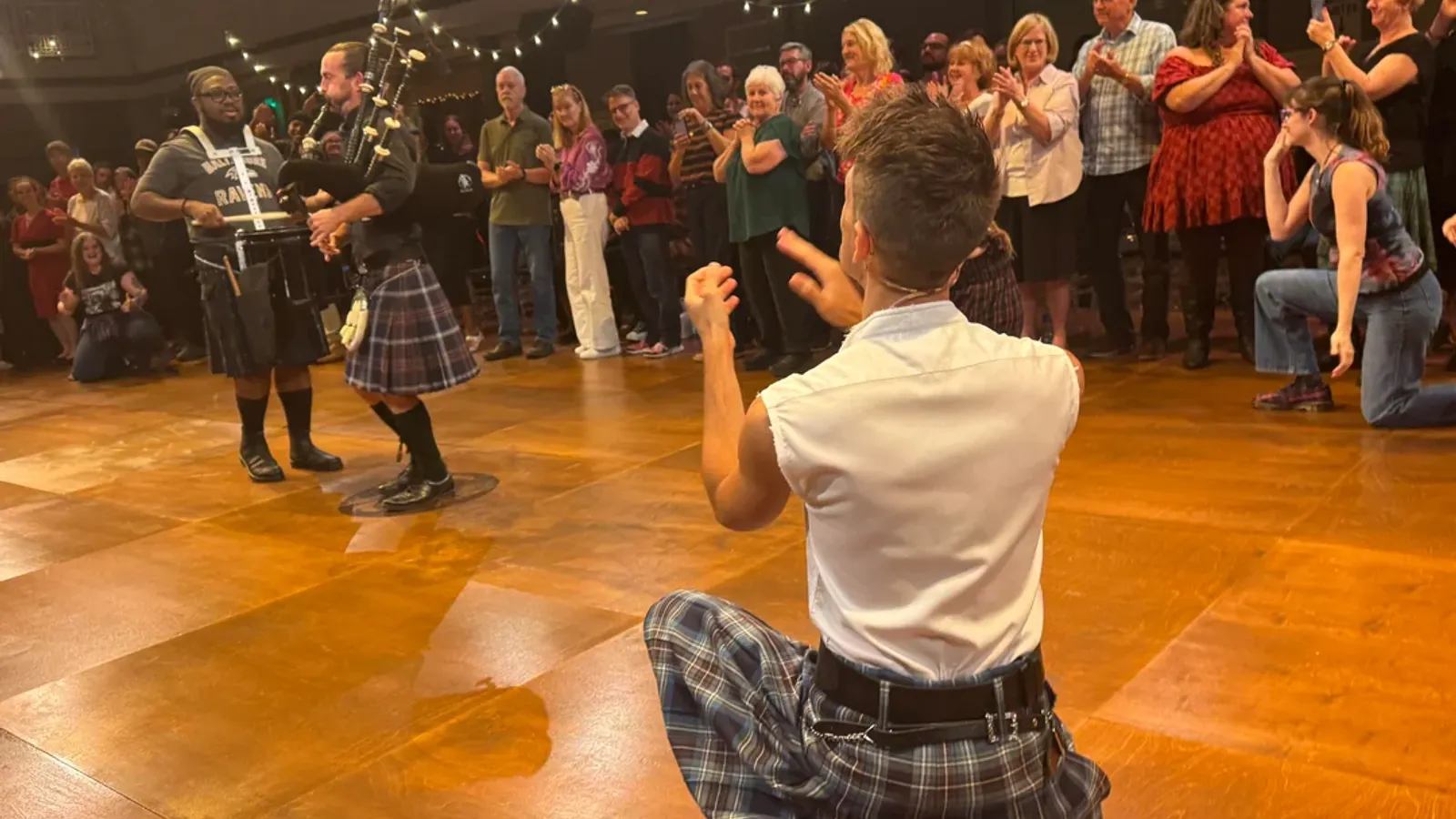
Today a ceilidh means a night of Scottish dancing: a band, a caller, and a hall full of people spinning through Strip the Willow and the Gay Gordons. For most of its history the word meant something else: a visit to a neighbour's house for an evening of stories, songs and talk. The dancing came from elsewhere in Scottish rural life: the penny wedding, the harvest kirn, the fair, the farm-kitchen dance and the laird's ball for his tenants. This card tests where the word comes from, what a ceilidh used to be, where the dancing of the modern ceilidh really comes from, and how old the famous dances are.
TL;DR
- established "Ceilidh" comes from the Gaelic for a visit, from an Old Irish word for a companion. Scottish cèilidh and Irish céilí share the same root; the ceilidh is a shared Gaelic tradition.
- established The original ceilidh was an informal evening gathering of neighbours with stories, songs and conversation. Alexander Carmichael described it in 1900 as a "literary entertainment" of tales, poems and ballads.
- shared Dancing was not the point of the old ceilidh, but it was not absent. Accounts from the West Highlands describe reels and tunes on the Jew's harp, and young people going out to dance on the green or the road when the moon and weather allowed. Most houses were too small to dance in.
- established The big dances of rural Scotland were held at weddings, harvest homes, fairs, New Year and in the barns and kitchens of larger farms. The Kirk tried for over a century to curb dancing at "penny weddings" but never stopped it.
- established The modern ceilidh as a dance event, with a band and a caller who teaches each dance, is a 20th-century development, built on the social dances of the 19th-century countryside.
- shared Several "traditional" ceilidh dances are fairly recent or not Scottish in origin. The tune of the Dashing White Sergeant was set by the English composer Henry Bishop in 1826; the dance belongs to the "Swedish" country dances devised by London dancing masters in the 1820s.
- established The Scottish Country Dance Society, which standardised many dances, was founded in Glasgow in 1923 by Ysobel Stewart and Jean Milligan. It became "Royal" in 1951.
Key Facts
- Word
- Scottish Gaelic cèilidh; Irish céilí
- Root
- Old Irish céile, "companion"; later "visit"
- Original meaning
- An evening visit or gathering for talk, stories and song
- Classic descriptions
- Norman Macleod, Reminiscences of a Highland Parish (1867); Alexander Carmichael, Carmina Gadelica (1900)
- Scots form
- Kailie / kaley, a friendly evening visit
- Lowland parallel
- The Ayrshire "rocking", a spinning gathering that became a young people's dance
- Old occasions for dancing
- Penny weddings, kirns (harvest homes), fairs, Hogmanay, farm-kitchen dances, lairds' balls
- Old instruments
- Fiddle, bagpipe, Jew's harp ("trump"), mouth music (puirt-a-beul), later the melodeon
- Customary last dance
- The Kissing Reel or Babbity Bowster
- Modern meaning
- An evening of social dancing with a band and a caller
- RSCDS founded
- 26 November 1923, the Athenaeum, Glasgow
- "Royal" title
- 1951
- Dashing White Sergeant tune
- Henry Bishop, 1826
A Note on Claims and Evidence
Each major claim carries one of three labels. established means supported by primary records, official bodies or several independent reliable sources. shared means the core fact is sound but sources disagree on details, dates or interpretation. traditional means widely repeated but not traceable to a primary or independent source.
The word's history is well documented in dictionaries and in Carmichael's account. Rural dancing is documented through Kirk session records, visitors' journals and memoirs, gathered by the dance historian George S. Emmerson in A Social History of Scottish Dance (1972); those records are treated as established, his interpretations as his. The weak points are the origins of individual dances, which often rest on the accounts of dance societies and later collectors. The idea that today's ceilidh dances are ancient Highland tradition is the main myth: many were composed, adapted or standardised in the 19th and 20th centuries.
Timeline
Céile, "companion", gives rise to words meaning a visit.
The Complaynt of Scotland describes shepherds and their wives dancing in a ring to eight instruments, from bagpipe to fiddle.
The General Assembly of the Kirk orders presbyteries to put "penny bridals" under severe restriction.
The presbyteries of Haddington and Dunbar limit weddings to twenty guests and ban piping and dancing at them.
An Act of Parliament limits the numbers at weddings, baptisms and burials.
Boswell and Johnson find the household on Raasay dancing every night; at Armadale in Skye they dance "America", a new dance about emigration.
Ayrshire "rockings", once spinning gatherings, have become young people's evenings of games and dancing.
Robert Burns dances Bab at the Bowster and other reels until three in the morning at a house on Loch Lomondside.
The Rev. James Hall watches a country wedding of about four hundred people near Montrose, with reels and country dances on the green.
Henry Bishop sets the song "The Dashing White Sergeant".
Dr Norman Macleod describes a West Highland ceilidh evening in the first Gaelic magazine.
Neighbours gather in the ceilidh house for stories and song; Scots speakers use kailie for a friendly evening visit.
Country dances begin to reach the West Highlands and Hebrides.
Alexander Smith describes a farm-kitchen dance in Skye, ending in the Reel of Tulloch.
The races of the St Michael's Day festival in South Uist end, and its all-night balls decline.
The Eightsome Reel is said to have been devised by the Earl of Dunmore and friends.
The Gaelic League is founded in Ireland and promotes dance classes.
Alexander Carmichael describes the ceilidh in Carmina Gadelica.
The Scottish Country Dance Society is founded in Glasgow.
The first Irish céilí band is formed for Irish radio.
Princess Elizabeth becomes the Society's patron.
The Society becomes the Royal Scottish Country Dance Society.
Details
A word for a visit
established "Ceilidh" comes from Gaelic words meaning a visit, ultimately from Old Irish céile, "companion". Scottish Gaelic cèilidh and Irish céilí come from the same source, because Scottish Gaelic itself descends from the Gaelic brought from Ireland. The ceilidh is therefore a shared Gaelic inheritance, not a Scottish invention. The word also passed into Scots as kailie or kaley, which the Scottish National Dictionary defines as a social evening among neighbours with singing and storytelling, or simply a friendly visit.
The old ceilidh
established The original ceilidh was not a dance. It was an evening when neighbours gathered in a house, often one particular house in a township, to talk, share news, tell stories, recite poetry and sing. Alexander Carmichael, the collector of Gaelic oral tradition, described it in Carmina Gadelica in 1900 as a "literary entertainment where stories and tales, poems and ballads, are rehearsed and recited". These evenings carried the oral culture of the Gaelic world: genealogies, songs and long hero tales passed on by heart.
established One of the fullest pictures comes from Dr Norman Macleod, minister of Campsie, writing in Gaelic around 1830, later translated by his son Norman Macleod in Reminiscences of a Highland Parish (1867). Round the peat fire of a black-house, girls knit, one man busks fishing hooks and another makes baskets, while herd boys listen from the floor. A shepherd opens the evening on two Jew's harps, the famous "Lochaber trumps", playing reels, strathspeys and jigs; then come songs, stories, improvised verses, riddles and more tunes. Emmerson called the ceilidh the public forum of the Gaelic township, where news was discussed and culture handed from one generation to the next.
established A Jew's harp, not a clàrsach. The "harp" of the ceilidh house was the small mouth-played Jew's harp, not the Gaelic harp. Keith Sanger and Alison Kinnaird, in Tree of Strings (1992), their archival history of the harp in Scotland, stress that the clàrsach was never a folk instrument. It was played by trained professionals and by the gentry, in chiefs' halls and lairds' houses, and would not have been found in a croft, where the whistle, the Jew's harp and the fiddle were the instruments to hand. By the time of the township ceilidhs described above, the professional Highland harper had already died out: Murdoch MacDonald, harper to MacLean of Coll and called the last of the Hebridean harpers, died about 1739. The tales and ballads told at the ceilidh did keep the harp alive in story, from harpers who lull whole households to sleep to the mermaid in a South Uist tale who gives back a swallowed husband in return for harp music.
shared An older pattern. Sanger and Kinnaird quote a letter of 1693 from a student from Strathspey to his professor at King's College, Aberdeen, describing bands of nine to twelve women who went from house to house singing the poets' songs, "ordinarlie" with a fiddler, and then dancing. They read it as the fiddle taking over a role once held by the harp. It also shows song, verse and dance travelling from house to house more than a century before the ceilidh accounts quoted here.
Dancing at the old ceilidh
shared Dancing was part of this world, but not usually indoors. Emmerson points out that a typical Highland house of the 18th and 19th centuries had scarcely room for a threesome reel. When the moon and the weather were fair, the young people would go out to dance on the green or the road, to a piper or fiddler if one was there, otherwise to mouth music (puirt-a-beul), "deedling", a Jew's harp or, later, the melodeon. Emmerson noted that the practice could still be met in the Hebrides in his own day. Hogmanay in the West Highlands brought songs and then dramatic dances: a woman with a bunch of keys capering as "the old wife of the mill-dust" (Cailleach an Dudain), the Black Sluggard, the goat dance, "Weave the Gown" and "The Thorny Croft". In South Uist the St Michael's Day balls ran all night in the largest house with the evenest floor, with many curious scenes acted and dances performed, until the festival's races ended in 1866.
established In the Lowlands the nearest equivalent was the Ayrshire "rocking", named after the rock or distaff the women brought to spin together. By the 18th century, John Mitchell recalled of Ayrshire about 1780, rockings had become gatherings of young people who played games and danced in a neighbour's house.
Weddings, kirns and fairs
established The great dancing occasions of rural Scotland were the wedding, the harvest home and the fair. The "penny wedding", at which each guest paid towards the feast, could draw two hundred people or more. The Kirk objected less to dancing as such than to "superfluous banqueting", pipers and promiscuous (mixed) dancing. In 1645 the General Assembly told presbyteries to restrict penny bridals; in 1647 Haddington and Dunbar limited them to twenty guests and banned piping and dancing; Parliament legislated on numbers in 1681. Weddings went on regardless. In 1805 the Rev. James Hall came on a country wedding near Montrose with about four hundred guests, cauldrons of broth, a tent, and dancing on the green: reels, country dances, minuets and Highland capers.
established Wedding dancing had its own customs. In the Strathspey of about 1820, the guests made a ring on the lawn by torchlight for the bridal party's "shemit reel". In the West Highlands the first dance was the Wedding Reel, for the couple, best man and bridesmaid; in the Catholic islands the Stealing Reel let first the bride and then the groom slip away to bed. Everywhere the last dance was the Kissing Reel, Babbity Bowster or the Cushion Dance, in which each dancer in turn chose a partner, knelt with them on a cushion or handkerchief and kissed, until the ring had danced itself out. In South Uist it was danced to "The White Cockade" and couples left the dance, and the hall, two by two. Kissing one's partner before and after a reel survived in parts of the countryside into the 20th century.
established The kirn, or harvest home, was held in the empty granary after the last sheaf, the "maiden", had been cut and carried home in triumph; there was a feast, dancing, songs and sometimes a dramatic jig, and the old and young danced together. At fairs, William Aiton described Ayrshire lads and lassies in 1811 struggling for room to dance reels in crowded ale-house long rooms and barns. Enterprising fiddlers and dancing masters began to hire halls for the day of a fair and charge a penny a dance, "penny reels", which Emmerson saw as the beginning of the 20th-century public dance hall.
Kitchen dances and lairds' balls
established Where there was room, the dancing came indoors. In 1773 Boswell and Johnson found the MacLeods of Raasay dancing every night of the year to a fiddler, and Johnson, as quoted by Emmerson, said "I know not how we shall get away". In Skye in 1860 the poet Alexander Smith watched a farm kitchen cleared after dark: candles in tin sconces, the dogs put out, girls in white stockings and shepherds in their best, and a fiddler by the fire, the dancing ending in a whirl of the Reel of Tulloch. In the Strathspey of about 1813 Elizabeth Grant of Rothiemurchus described the harvest-home and foresters' balls, with servants, labourers and family dancing together in the hay loft and threshing-mill floor. By the late 18th century the laird's ball for his tenants and neighbours had become a custom, and by the late 19th century the dances there were reels, strathspeys and the Reel of Tulloch, with country dances such as Petronella, Haymakers and Strip the Willow, the polka and the Highland schottische.
established These dances were spread and refreshed by itinerant dancing masters, known as the "dancie" or "professor", who followed a circuit and held classes for several weeks in a barn or village hall, ending with a ball. Robert Burns's Ayrshire learned its reels, strathspeys, country dances and hornpipes from such teachers, in barns lit by candles stuck in cloven sticks. Country dances reached the West Highlands and Hebrides only in the 1850s; before that the islands danced reels, including circular foursome reels, and simple game-like dances such as the Pin Reel and Coille Bharrach.
Hard times and silence
established In the 19th century the Clearances, poverty and an intense evangelical revival bore hard on the music and dancing of parts of the Highlands and Islands. Carmichael recorded an old woman in Lewis who described how the new ministers and elders did away with songs, stories, music and dancing, and broke and burnt the people's instruments. Emmerson thought the effect easy to exaggerate but real, and noted that the Catholic islands, such as South Uist and Barra, kept most for the collectors.
From visit to dance
established In the 20th century the word narrowed to mean an organised evening of social dancing. A modern ceilidh band usually has between two and six players, typically on fiddle, accordion, keyboard, drums and bass or guitar. A caller teaches each dance before it starts, so that anyone can join in. Ceilidhs are now held for weddings, birthdays and fundraisers, and the format has spread to England, where callers are in demand and the melodeon is a central instrument.
established Ireland developed its own dance tradition under the same name. The Gaelic League, founded in 1893, promoted dance and music classes, and the first Irish céilí band was formed for radio in 1926.
How old are the dances?
shared Many of the dances done at ceilidhs are not ancient. The tune of the Dashing White Sergeant was set by the English composer Sir Henry Bishop in 1826, to words traditionally attributed to General John Burgoyne. The dance itself, done in trios facing trios round the room, is usually said to take its steps from Swedish circle dancing. Emmerson placed it among the "Swedish Dances" invented by the London dancing master G. M. S. Chivers in the 1820s, in which each man dances with a partner on either side; he saw it as a round-the-room development of the threesome reel, which appeared in English ballrooms around the middle of the 19th century. Either way, it is a ballroom creation, not a Highland folk dance.
shared The Eightsome Reel is said to have been devised in the early 1870s by the Earl of Dunmore and his friends at the time of the Atholl Gathering Ball, then danced at Portree and Perth, according to a note in the RSCDS books. Emmerson showed it was built on older material: reels for eight appear in manuscripts of 1805 and 1818, and a version with the square formation and double wheel was printed in 1830. It merged the reel, the round reel and the country dance, and by the early 20th century it was the one reel almost every Scot knew. It reached some districts late: one of Emmerson's friends brought it to Knapdale in Argyll in the late 19th century, having learned it at a dance in Lochgilphead.
established Strip the Willow belongs to an older family of weaving dances, danced with accented running steps in 9/8 time; in England it was known as Drops of Brandy, after its tune. By the 20th century it was usually danced to reels or marches. Emmerson counted it and the Eightsome as the two survivors of Scottish traditional social dance still known to the general public, outside the dance clubs, in 1972. The Highland Schottische, a Scottish version of a Nordic polka to strathspey-like tunes, was popular at Victorian balls; Queen Victoria noted how well it was liked at a ball at Inveraray in 1875. The Gay Gordons is a couple dance of the "old-time" ballroom type of the late 19th and early 20th centuries.
Standardising the steps
established By the early 20th century the old social dances were fading. In the towns the quadrille, lancers, waltz and polka had taken over; after the First World War jazz and modern ballroom dancing pushed out most of the rest, and Emmerson found that by 1923 even the Northern Meeting ball in Inverness was played by a jazz band. On 26 November 1923 a public meeting at the Athenaeum in Glasgow founded the Scottish Country Dance Society, led by Ysobel Stewart and Jean Milligan. Its aim was to preserve the dances, music and traditions of Scottish country dancing. It grew out of the publication of a book of dances and went on to publish many more, fixing versions of dances that had varied from place to place. Princess Elizabeth became patron in 1947, and King George VI granted the title "Royal" in 1951. The country dancing taught by the RSCDS and the looser, called dancing of a ceilidh are related but distinct traditions.
Did You Know?
- "Ceilidh" originally meant a visit, not a dance.
- The word comes from an Old Irish word for a companion.
- In Scots, a friendly evening visit was a kailie.
- Alexander Carmichael called the old ceilidh a "literary entertainment".
- The old ceilidh's favourite instrument in many houses was the Jew's harp, or "trump".
- In Ayrshire, spinning evenings called "rockings" turned into young people's dances.
- In 1647 two East Lothian presbyteries tried to limit weddings to twenty guests and ban dancing at them.
- The last dance at an old Scottish wedding was usually a kissing dance, Babbity Bowster.
- At Raasay in 1773 the laird's household danced every night of the year.
- "Penny reels" at fairs, a penny a dance, were an ancestor of the public dance hall.
- Country dances reached the Hebrides only in the 1850s.
- The tune of the Dashing White Sergeant was written by an English composer in 1826.
- The Eightsome Reel built on reels for eight dancers recorded as early as 1805.
- The Scottish Country Dance Society was founded in Glasgow in 1923.
- The first Irish céilí band was formed for radio in 1926.
FAQ
1What does "ceilidh" mean?
Originally, a visit or an evening gathering of neighbours. Today it usually means a dance.
2Is the ceilidh Scottish or Irish?
Both. The Scottish cèilidh and Irish céilí share the same Gaelic root.
3What happened at an old ceilidh?
Stories, songs, poetry, riddles, news and conversation, usually in a neighbour's house, often with tunes on the Jew's harp or fiddle.
4Was the Gaelic harp played at ceilidhs?
No. The "harp" of the ceilidh house was the Jew's harp. The clàrsach was an instrument of professionals and the gentry, and its professional players had died out by the mid-18th century.
5Was there dancing at the old ceilidh?
Sometimes, but houses were small. Young people often went out to dance on the green or the road when the weather allowed.
6Where did ordinary Scots dance in the past?
At weddings, harvest homes, fairs, New Year gatherings, farm-kitchen dances and the laird's ball for his tenants.
7What was a penny wedding?
A wedding at which each guest paid towards the feast. They could draw hundreds of people, and the Kirk spent over a century trying to restrict them.
8What was the last dance of the night?
Usually the Kissing Reel, also called Babbity Bowster or the Cushion Dance.
9Did the Kirk ban dancing?
Not outright. It attacked mixed dancing, pipers at weddings and dancing during service time, with mixed success.
10When did ceilidhs become dances?
In the 20th century.
11What is a caller?
The person who teaches each dance before it begins.
12Are ceilidh dances ancient?
Many are not. Several date from the 19th or early 20th century, though Strip the Willow and the kissing dances belong to older families of dances.
13Is the Dashing White Sergeant Scottish?
Its tune is by an English composer, and the dance is a 19th-century ballroom creation, though it is now danced as a Scottish country dance.
14Who invented the Eightsome Reel?
It is said to have been devised in the 1870s by the Earl of Dunmore and friends, from older reels for eight.
15What is the RSCDS?
The Royal Scottish Country Dance Society, founded in Glasgow in 1923 to preserve Scottish country dancing.
16Is country dancing the same as a ceilidh?
They are related but different: country dancing follows set forms taught by the RSCDS, while ceilidh dancing is looser and called.
Sources and Further Reading
Primary/Institutional
- Royal Scottish Country Dance Society, "Our history" (rscds.org)
- Dictionaries of the Scots Language, Scottish National Dictionary, "Kailie" (dsl.ac.uk)
Scholarly/Critical
- Alexander Carmichael, Carmina Gadelica, vol. 1 (1900), further reading
- George S. Emmerson, A Social History of Scottish Dance: Ane Celestial Recreatioun (McGill-Queen's University Press, 1972)
Specialist
- Keith Sanger and Alison Kinnaird, Tree of Strings: Crann nan Teud. A History of the Harp in Scotland (Kinmor Music, 1992)
General
- Wikipedia, "Cèilidh" (en.wikipedia.org)
- Wikipedia, "Dashing White Sergeant" (en.wikipedia.org)
Further reading
- Norman Macleod, Reminiscences of a Highland Parish (1867)
- Alexander Smith, A Summer in Skye (1865)
- Elizabeth Grant of Rothiemurchus, Memoirs of a Highland Lady
- J. F. and T. M. Flett, Traditional Dancing in Scotland (1964)
Caveats: Myths and Disputed Claims
- Do not say the ceilidh was always a dance; it began as a visit and gathering for stories and song.
- Do not say there was no dancing in the old Gaelic world; it happened outdoors, at weddings, kirns and in larger kitchens and barns.
- Do not say the Kirk banned dancing outright; it restricted it, mostly at weddings and in service time.
- Do not present the ceilidh as a purely Scottish invention; it is shared with Ireland.
- Do not call the Dashing White Sergeant or the Eightsome Reel ancient Highland dances.
- Do not treat RSCDS country dancing and ceilidh dancing as identical.
- Do not picture the clàrsach (Gaelic harp) at a township ceilidh; the "harp" there was the Jew's harp.
Card 010 · Traditions