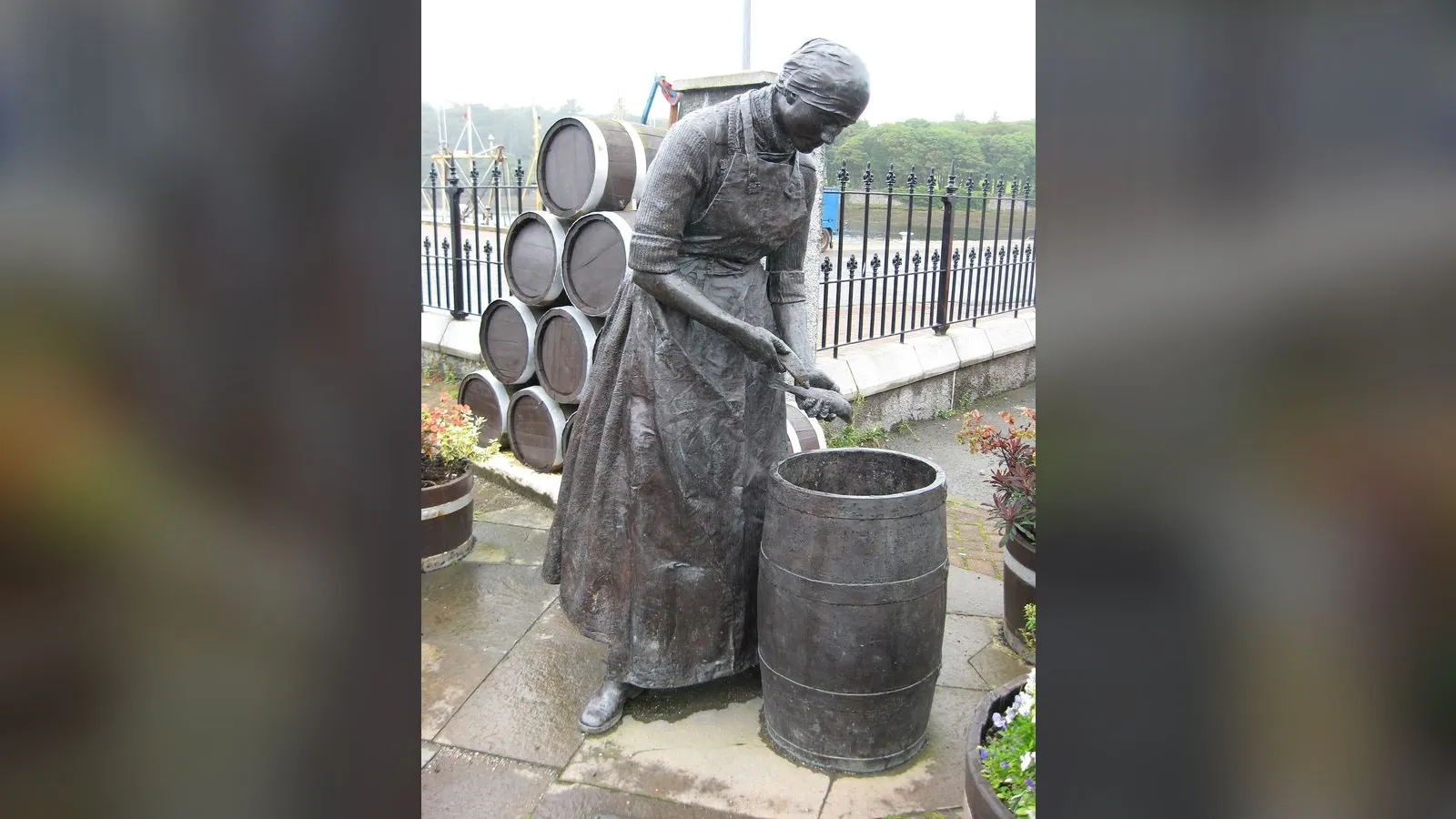

The Herring Girls
Contents
For about a hundred years, thousands of women followed the herring fleet around the coast of Britain, gutting and packing the catch on the quayside. The herring girls, or herring lassies, came largely from the Highlands and Islands and the fishing towns of Scotland's north and east. They worked in crews of three in all weathers, travelled hundreds of miles from home, and in the 1930s went on strike. This card tests how they worked, how fast they really were, and why their trade disappeared.
TL;DR
- established Herring girls worked in crews of three, two gutters and one packer, hired by fish-curing companies for the season and paid by the barrel, with an engagement fee called arles.
- established Most gutters averaged about 40 herring a minute, according to the Highland archives and Suffolk Archives. Some were much faster.
- established The women followed the shoals south through the season, from Scottish ports in summer to Great Yarmouth and Lowestoft in the autumn. At the peak more than 6,000 travelled to East Anglia each year.
- established In 1936 the women struck at Great Yarmouth and won a rate of one shilling a barrel. In 1938, 2,400 women at Lowestoft refused to pack herring caught on a Sunday.
- established The trade declined after the First World War, when the German and Russian markets were lost. 1950 was the last good season, and the traditional trade had almost ended by the 1960s.
Key Facts
- Crew
- 3 women: 2 gutters, 1 packer
- Average speed
- About 40 herring a minute
- Barrel
- About 1,000 herring; a skilled crew filled one in about 15 minutes
- Pay
- By the barrel, plus a weekly allowance
- Arles (engagement fee)
- Usually 10 shillings
- Wick season
- June to August
- East Anglian season
- October to December
- Peak catches
- 1900–1913
- Travelling to East Anglia at peak
- More than 6,000 women a year
- Yarmouth strike
- 22 October 1936
- Lowestoft protest
- 24 October 1938, 2,400 women
- Last good season
- 1950
A Note on Claims and Evidence
Each major claim carries one of three labels. established means supported by primary records, official bodies or several independent reliable sources. shared means the core fact is sound but sources disagree on details, dates or interpretation. traditional means widely repeated but not traceable to a primary or independent source.
The herring girls are well documented in archives, letters, photographs and the memories of the women themselves. The figure most often exaggerated is their speed: popular accounts often say 60 or more herring a minute, while archive sources give an average of about 40. Numbers of women vary between sources and years.
Timeline
Herring catches reach their peak.
The Great Yarmouth rest house for the women serves 11,571 meals and treats 2,354 medical cases in a season.
The trade declines after the loss of the German and Russian markets.
Peggy Macleod of Stornoway writes to Donald Waters and Son, fish curers in Wick, about her seasons.
Herring girls strike at Great Yarmouth and win one shilling a barrel.
2,400 women at Lowestoft refuse to pack herring caught on a Sunday.
The last good herring season.
The traditional trade has almost ended.
Details
Crews of three
established Fish-curing companies engaged the women in crews of three: two gutters and one packer, often the tallest of the three. On being hired, each woman received an engagement fee called arles, usually ten shillings. The herring were tipped into long wooden troughs called farlans, and the gutters removed the guts with a single stroke of a short knife. The packer laid the fish in the barrels in layered rosettes, bellies up and heads outward, with rough salt between the layers, under the eye of a cooper. In Stornoway, barrels were filled three times as the fish settled before being sealed.
How fast?
established The Highland archives record that "most women could gut an average of 40 fish each minute but some were significantly faster", and Suffolk Archives gives the same typical figure. A skilled crew could fill a barrel of about 1,000 herring in about 15 minutes. Experienced crews were known as "first-class women".
traditional Claims that herring girls routinely gutted 60, or even 80, fish a minute are common in popular accounts. Such speeds may have been reached by the fastest gutters, but they were not the norm.
Hard work
established The work was hard and dangerous to the hands. Gutters wrapped their fingers in strips of washed flour sacks to protect them from the knives, but cuts were common, and the brine made them painful. In one recorded week at Wick, each woman in a crew worked 83.5 hours, about 12 hours a day. Pay was by the barrel, so the women sometimes waited unpaid for the boats to come in. First-season learners earned less until they were fully skilled.
Following the fish
established Many herring girls came from crofting families in the Hebrides, who depended on the seasonal earnings. They travelled with their belongings in wooden kists, slept in dormitories above the curing yards, or lodged with local families. The Wick season usually ran from June to August; the women then followed the shoals south, ending the year at Great Yarmouth, Gorleston and Lowestoft from October to December. At the peak of the trade more than 6,000 Scottish herring girls travelled to East Anglia each season. Many were the main earners in their families, and many remembered the life fondly: one recalled that "it was a happy, healthy life", though "it didn't matter how much we washed our hair, it always smelt of herring!"
On strike
established The herring girls were not passive. On 22 October 1936 almost all the women at Great Yarmouth struck and marched along the harbour, demanding one shilling a barrel. The union agreed the rate and backdated it to the start of the season. On 24 October 1938, 2,400 women at Lowestoft refused to pack herring caught on a Sunday by English boats, for religious reasons, and the catch was left to spoil on the quay.
The end of the trade
established Herring catches peaked between 1900 and 1913. After the First World War the trade lost its main markets in Germany and Russia. Later, modern trawlers put pressure on stocks, freezing replaced traditional salt curing, and after the Second World War women had more choice of work. 1950 was the last good season, and by the 1960s the traditional trade had all but disappeared.
Did You Know?
- Herring girls protected their fingers with strips of flour sacks.
- A gutter removed a herring's guts with one stroke of the knife.
- The typical speed was about 40 herring a minute.
- A skilled crew could fill a 1,000-fish barrel in about 15 minutes.
- Women were hired with a fee called arles, usually ten shillings.
- In one week at Wick, a crew worked 83.5 hours each.
- The Yarmouth rest house treated 2,354 medical cases in 1913.
- In 1938, 2,400 women refused to pack fish caught on a Sunday.
FAQ
1Who were the herring girls?
Women who gutted and packed herring at ports around Britain, many of them from Scotland's Highlands and Islands.
2How did they work?
In crews of three: two gutters and one packer.
3How fast could they gut a herring?
About 40 a minute on average; some were faster.
4How were they paid?
By the barrel, with a weekly allowance and an engagement fee called arles.
5Where did they travel?
Around the coast following the herring, from Scottish ports in summer to Great Yarmouth and Lowestoft in the autumn.
6How many travelled to East Anglia?
More than 6,000 a season at the peak.
7Did they ever go on strike?
Yes, at Great Yarmouth in 1936, winning a shilling a barrel.
8What happened at Lowestoft in 1938?
2,400 women refused to pack herring caught on a Sunday.
9Why did the trade end?
Lost export markets, pressure on stocks, freezing, and new jobs for women after the Second World War.
10When did it end?
1950 was the last good season, and the trade had almost ended by the 1960s.
Sources and Further Reading
Primary/Institutional
- High Life Highland, Highland Archive Service, "Herring gutters", online exhibition Wick: History of a Harbour (highlifehighland.com)
- High Life Highland, Nucleus: The Nuclear and Caithness Archives, herring gutters photograph (highlifehighland.com)
- Suffolk Archives, "Following the Fish" (suffolkarchives.shorthandstories.com)
General
- Stornoway Historical Society, "Work of the herring girls", 19 September 2016 (stornowayhistoricalsociety.org.uk)
Caveats: Myths and Disputed Claims
- Do not give 60 or more herring a minute as the normal speed; the documented average is about 40.
- Do not describe the herring girls as passive or unorganised; they struck in 1936.
- Do not describe the 1938 Lowestoft protest as a pay strike; it was a religious objection.
- Do not say the trade ended suddenly; it declined over decades after the First World War.
Card 038 · Traditions