
The Quaich: Scotland's Cup of Friendship
Contents
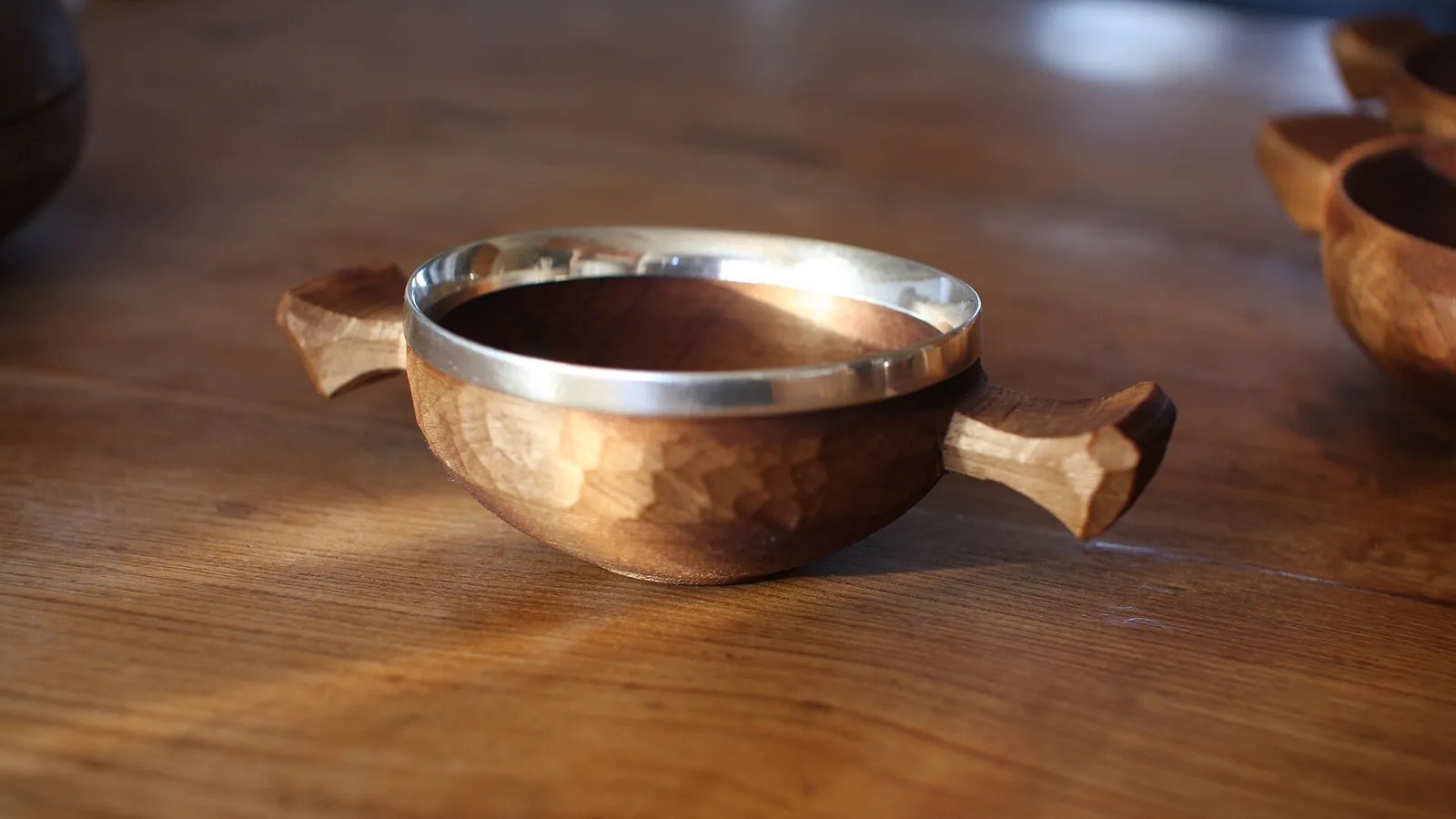
The quaich is a shallow drinking bowl with two short, flat handles, called lugs. It began as a wooden cup, became a piece of fine silver in the 17th century, and is now Scotland's ceremonial cup: shared at weddings, given as a trophy, and handed to visiting leaders. It is often explained with a story about trust and hidden weapons. This card tests what museum collections and records show, and where the romance begins.
TL;DR
- established The name comes from the Gaelic cuach, "cup".
- established Early quaichs were wooden, either turned on a lathe or built from staves like a tiny barrel. Silversmiths began adding silver mounts in the mid-17th century and were making quaichs wholly of silver by the 1660s.
- established National Museums Scotland presents the quaich, with its box-like lugs on a shallow footed bowl, as a distinctively Scottish form. Two-handled shared cups in general are not unique to Scotland.
- traditional The story that two handles meant neither drinker could hold a weapon, and that the host drank first to prove there was no poison, is a modern romantic explanation. No early source for it has been found.
- established The quaich is now a ceremonial gift. In January 2017 the UK government gave one to President Donald Trump, describing its handles as a sign of trust.
Key Facts
- Name
- From Gaelic cuach, "cup"
- Form
- A shallow bowl on a foot rim with two lug handles
- Early materials
- Wood, turned or stave-built and bound with willow
- Silver mounts
- From the mid-17th century
- All-silver quaichs
- By the 1660s
- Other materials
- Horn, stone, brass, pewter
- Early written mentions
- Mackintosh of Borlum, 1729 ("the big quaigh"); Smollett, Humphry Clinker, 1771
- Keepers of the Quaich
- Whisky society founded 1988; ceremonies at Blair Castle
- Famous gift
- To President Trump from the UK government, January 2017
Scottish Impact Index (SI Score)
- Cultural Reach
- 6/10
- Continuity of Tradition
- 9/10
- Social & Economic Importance
- 5/10
- Scottish Distinctiveness
- 9/10
- Cultural Legacy
- 8/10
- Recognition
- 8/10
45/60
Ranked =17th of 19 in Traditions
A Note on Claims and Evidence
Each major claim carries one of three labels. established means supported by primary records, official bodies or several independent reliable sources. shared means the core fact is sound but sources disagree on details, dates or interpretation. traditional means widely repeated but not traceable to a primary or independent source.
The quaich's history is documented through surviving objects and the work of museum curators. The weak points are its supposed ancient origins and its symbolism. Claims that Druids used quaichs, that they copy the scallop shells Highlanders drank from, or that the handles prove trust, are not supported by early sources. Exact dates for the earliest wooden quaichs are also uncertain.
Timeline
The wooden quaich develops; no securely dated example from this period is known.
Silversmiths begin adding silver rims, feet and plates to wooden quaichs.
Quaichs are being made wholly of silver, often engraved to imitate wooden staves and willow bands.
William Mackintosh of Borlum regrets that guests are now offered tea in the morning instead of "the big quaigh with strong ale and toast".
James Macpherson's Ossian poems popularise romantic Highland imagery, later linked to quaich origin stories.
Tobias Smollett's novel Humphry Clinker describes a Highland breakfast at which spirits are drunk from a silver "quaff" and ale from horns.
F. Marian McNeill's The Scots Kitchen gathers these and other references to the quaich and related vessels.
The Keepers of the Quaich, a whisky industry society, is founded.
Prime Minister Theresa May gives President Donald Trump a quaich.
Details
Name and making
established "Quaich" comes from the Gaelic cuach, meaning "cup". National Museums Scotland describes the earliest quaichs as wooden. Some were turned on a lathe from a single piece. Others were built like a miniature barrel, from staves, often alternating light and dark woods, bound with strips of willow, with the handles carved from the staves themselves. Quaichs were also made in horn, stone, brass and pewter.
From wood to silver
established In the mid-17th century Scottish silversmiths began adding silver to wooden quaichs: rims, feet, and plates on the handles or in the centre of the bowl. By the 1660s they were making quaichs entirely of silver. They kept the look of the wooden originals, engraving lines to imitate the joins of staves and the willow bands, and copying the thick, box-like lugs. National Museums Scotland points out that they deliberately avoided the flat handles of British and continental wine tasters.
shared National Museums Scotland treats the quaich as distinctively Scottish because of this particular form. But shared two-handled drinking cups are found in many places, including English loving cups, so the general idea of a cup passed between friends is not uniquely Scottish.
Where did the quaich come from?
traditional Several origin stories circulate. One says Druids used quaichs. Another says quaichs copy the scallop shells from which Highlanders drank, an idea linked to the romantic Highland imagery of James Macpherson's Ossian poems of the 1760s, which are now regarded as largely his own invention. A third derives the quaich from the medieval mazer, a much larger wooden bowl. None of these is supported by documentary or archaeological evidence.
The two handles and trust
traditional The most popular explanation for the quaich's shape is that holding it with both hands meant neither giver nor receiver could hold a weapon, and that the host drank first to show the drink was not poisoned. It is repeated by tourism, wedding and gift companies, and even by the UK government. When Theresa May gave President Trump a quaich in January 2017, Downing Street said its two handles "signify trust, both on the part of the giver and the receiver" and that quaichs had "been used across Scotland for centuries as a cup of friendship". But no early source for the weapon-and-poison story has been found, and museum accounts of the quaich's history do not include it. It is best treated as a modern way of explaining a tradition, not as its origin.
The quaich in use: the written record
established The folklorist F. Marian McNeill, in The Scots Kitchen (1929), collects several early descriptions of the quaich in use. The best for dating is from William Mackintosh of Borlum, writing in 1729 and quoted by McNeill, who complained that when he called on a friend in the morning he was no longer asked whether he had had his "morning draught" but whether he had had his tea; in place of "the big quaigh with strong ale and toast", and a dram of whisky, there was now the tea-kettle with its silver and china. The quaich was the vessel of the old Highland morning dram and ale, not yet a ceremonial gift.
established In Tobias Smollett's Humphry Clinker (1771), a lavish Highland breakfast ends with spirits drunk "out of a silver quaff", which McNeill glosses as quaich, while the ale went round in horns. McNeill also quotes Walter Scott's notes on the stirrup-cup, the deoch an doruis or "door drink" given to a departing guest at the mounting-stone. In the passage she gives, it is drunk from a quaich, "a timber bowl with two ears", and is also called a bonalay or bonally, a name McNeill derives from French bon aller, "good going". That derivation is hers and is not certain.
shared The quaich belonged to a wider family of Scottish wooden drinking and milk vessels: the cog or coggie, a larger wooden bowl, and the luggie, a small wooden dish with a lug. McNeill remembered the Orkney bride's cog, "a large wooden vessel with three lugs", passed round at rural weddings like a loving cup, filled with ale, whisky, spices and beaten eggs. She also notes that before glass came into common use drinking vessels were often of horn, the better ones rimmed with silver, and that hornware was still made in her day. These vessels show that shared drinking from a lugged wooden bowl was a real part of Scottish hospitality, but they do not support the later story about handles and hidden weapons.
The quaich today
established The quaich is now a ceremonial object. Couples share one at Scottish weddings. It is given as a trophy and a prize, and offered as a gift to visiting dignitaries. The Keepers of the Quaich, founded in 1988, is an invitation-only society that honours people who have made an outstanding contribution to Scotch whisky; it holds its induction ceremonies at Blair Castle in Perthshire.
Did You Know?
- "Quaich" comes from the Gaelic cuach, "cup".
- Some wooden quaichs were built like miniature barrels, from staves bound with willow.
- Silver quaichs were engraved with fake staves to look like wooden ones.
- Silversmiths were making all-silver quaichs by the 1660s.
- The handles are called lugs, the Scots word for ears.
- The Keepers of the Quaich, a whisky society, was founded in 1988.
- In 2017 the UK government gave a quaich to President Donald Trump.
- In 1729 a Highland laird complained that tea was replacing the morning quaich of strong ale.
- Orkney weddings used a three-handled wooden "bride's cog" as a shared loving cup.
- No early source supports the story that the handles kept drinkers from holding weapons.
FAQ
1What is a quaich?
A shallow two-handled Scottish drinking bowl.
2Where does the word come from?
From the Gaelic cuach, meaning "cup".
3How old is the quaich?
Wooden quaichs probably date from the 16th century; silver ones were made by the 1660s.
4What were quaichs made of?
First wood, then horn, stone, brass, pewter and silver.
5Is the quaich uniquely Scottish?
Its particular form is distinctively Scottish, but two-handled shared cups exist elsewhere.
6Why does a quaich have two handles?
The handles, or lugs, follow the shape of the early wooden quaichs. The idea that they prevented drinkers from holding weapons is a later story.
7Did Druids use quaichs?
There is no evidence that they did.
8Are quaichs based on scallop shells?
That is a romantic story, not a documented origin.
9How is a quaich used at a wedding?
The couple drink from it together, usually whisky, as a sign of their union.
10What was drunk from a quaich in the past?
Early writers mention ale, often in the morning, and spirits. A quaich was also used for the parting stirrup-cup given to a guest.
11Is a quaich the same as a cog?
No. A cog was a larger wooden bowl, used for milk or ale; the Orkney bride's cog had three handles and was passed round at weddings.
12What are the Keepers of the Quaich?
A whisky industry society founded in 1988 to honour outstanding contributions to Scotch whisky.
13Did the UK give a quaich to Donald Trump?
Yes, in January 2017.
Sources and Further Reading
Primary/Institutional
- National Museums Scotland, "Uniquely Scottish silver: top 5 highlights from the silver collections" (nms.ac.uk)
Specialist
- F. Marian McNeill, The Scots Kitchen: Its Traditions and Lore with Old-Time Recipes (Blackie, 1929; 2nd edn 1963)
General
- NBC News, "UK PM Theresa May to give Trump a quaich: what is it, and why?", January 2017 (nbcnews.com)
- Whisky.com, "The Keepers of the Quaich" (whisky.com)
Caveats: Myths and Disputed Claims
- Do not say the two handles were designed so that drinkers could not hold weapons; no early source supports it.
- Do not say the host drank first to prove there was no poison as a documented custom.
- Do not say Druids used quaichs.
- Do not say quaichs copy scallop shells.
- Do not claim shared two-handled cups are found only in Scotland.
- Do not give a precise date for the first wooden quaich.
Card 042 · Traditions