
The Thistle: Scotland's National Flower
Contents
The thistle is Scotland's national flower, found on coins, regimental badges, the royal arms and the badge of the country's highest order of chivalry. It is usually explained by a story: a barefoot Norse raider treads on a thistle, cries out, and wakes the sleeping Scots in time to win the Battle of Largs. This card tests that story, the question of which thistle is meant, and the real history of the emblem.
TL;DR
- shared The thistle appears on Scottish coins under James III in the 1470s; sources give 1470 or 1474 for the first. That is the earliest firmly dated royal use.
- traditional The story of a barefoot Norseman stepping on a thistle at Largs in 1263 is a legend. The main contemporary account of the battle, a Norwegian saga, does not mention it.
- shared There is no single "Scottish thistle". The native spear thistle (Cirsium vulgare) is thought to be the emblem. The cotton thistle (Onopordum acanthium), often sold as the "Scotch thistle", is not native.
- established The Order of the Thistle was established by James VII on 29 May 1687. Its claims to older origins, back to the 8th or 9th century, are not accepted by historians.
- established The motto Nemo me impune lacessit, "No one provokes me with impunity", first appears on coins of James VI in 1578.
Key Facts
- "Thistle"
- Covers more than 20 plant species
- Likely emblem species
- Spear thistle, Cirsium vulgare (native)
- Often sold as "Scotch thistle"
- Cotton thistle, Onopordum acanthium (not native; introduced by the 16th century)
- First thistle coins
- James III, 1470s (1470 or 1474)
- Order of the Thistle
- Established 29 May 1687 by James VII; refounded by Queen Anne, 1703
- Knights of the Thistle
- Sovereign plus 12 (1687); increased to 16 in 1827
- Thistle Chapel
- St Giles' Cathedral, 1911
- Motto
- Nemo me impune lacessit, first on coins in 1578
- Battle of Largs
- 2 October 1263
Scottish Impact Index (SI Score)
- Cultural Reach
- 9/10
- Continuity of Tradition
- 10/10
- Social & Economic Importance
- 7/10
- Scottish Distinctiveness
- 10/10
- Cultural Legacy
- 10/10
- Recognition
- 10/10
56/60
Ranked =6th of 19 in Traditions
A Note on Claims and Evidence
Each major claim carries one of three labels. established means supported by primary records, official bodies or several independent reliable sources. shared means the core fact is sound but sources disagree on details, dates or interpretation. traditional means widely repeated but not traceable to a primary or independent source.
The royal history of the thistle is documented from the 15th century on coins, literature and the records of the Order of the Thistle. Before that, nothing firm is known. The Largs legend has no medieval source, and the order's claimed ancient foundation was written into its own 1687 warrant. Which species the emblem shows is an informed judgement rather than a recorded fact.
Timeline
The Battle of Largs, the setting of the thistle legend.
James III issues the first coins bearing a thistle (dated 1470 or 1474).
William Dunbar writes "The Thrissil and the Rois" for the marriage of James IV and Margaret Tudor.
The cotton thistle is introduced to Scotland from Europe.
The motto Nemo me impune lacessit appears on James VI's merk coins.
James VII issues letters patent establishing the Order of the Thistle.
Queen Anne refounds the order.
The cotton thistle becomes popularly known as the "Scotch thistle" around George IV's visit to Scotland.
George IV increases the number of knights to 16.
The Thistle Chapel is added to St Giles' Cathedral, Edinburgh.
Hugh MacDiarmid publishes A Drunk Man Looks at the Thistle.
Details
The legend of Largs
traditional The popular story says that Norse invaders, creeping up at night on a sleeping Scottish camp, took off their shoes to move silently. One stepped on a thistle, cried out in pain and woke the Scots, who won the battle. It is usually set at Largs in 1263. The National Trust for Scotland, which tells the story, notes that no one is truly sure how the thistle became Scotland's emblem.
established The real battle does not fit the legend. The main source, Hákonar saga Hákonarsonar, written by Sturla Thordarson and drawing on eyewitnesses, describes storms driving several Norwegian ships aground on the Ayrshire coast near Largs at the end of September 1263. Over the following days the Scots harassed the stranded crews, and on 2 October the main Scottish army arrived while the Norwegians were salvaging their ships. The fighting was on the beach, by day. The result was indecisive; King Haakon withdrew to Orkney and died there that December, and in the Treaty of Perth of 1266 Norway ceded the Hebrides and Man to Scotland.
Which thistle?
shared "Thistle" covers more than 20 plant species. The Royal Botanic Garden Edinburgh and the National Trust for Scotland both point to the native spear thistle, Cirsium vulgare, as the plant behind the emblem. The cotton thistle, Onopordum acanthium, is the plant most often sold as the "Scotch thistle", but it is not native. It was introduced from Europe by the 16th century and became associated with Scotland after Sir Walter Scott chose it as an emblem for George IV's visit in 1822.
shared The naturalist Peter Marren reached the same view in his essay "The Scottish thistle", in Richard Mabey's Flora Britannica (1996). He argued that if the Stuarts had any particular thistle in mind it was the one they saw everywhere, the spear thistle, which Burns called the "burr thistle", and that it best matches the early coins. The cotton thistle suits later heraldry only because its neat head fits the stylised design. He also noted that the Largs story implies the dwarf thistle, which he said is found no further north than Yorkshire, and that the tale seems to date from no earlier than 1829. His suggestion that the Stuarts borrowed the emblem from their French allies, where an Order of the Thistle was founded in 1370, is a theory rather than a recorded fact. Mabey adds that a spear thistle is carried at the Langholm Common Riding each July.
The royal thistle
shared The thistle's firm royal history begins with James III, whose coins of the 1470s were the first to bear a thistle; sources give 1470 or 1474. Some accounts take the emblem back to Alexander III in the 13th century, but without a dated record. By 1503 the thistle stood for Scotland in literature: William Dunbar's poem "The Thrissil and the Rois", "The Thistle and the Rose", celebrated the marriage of James IV of Scotland and Margaret Tudor of England.
The Order of the Thistle
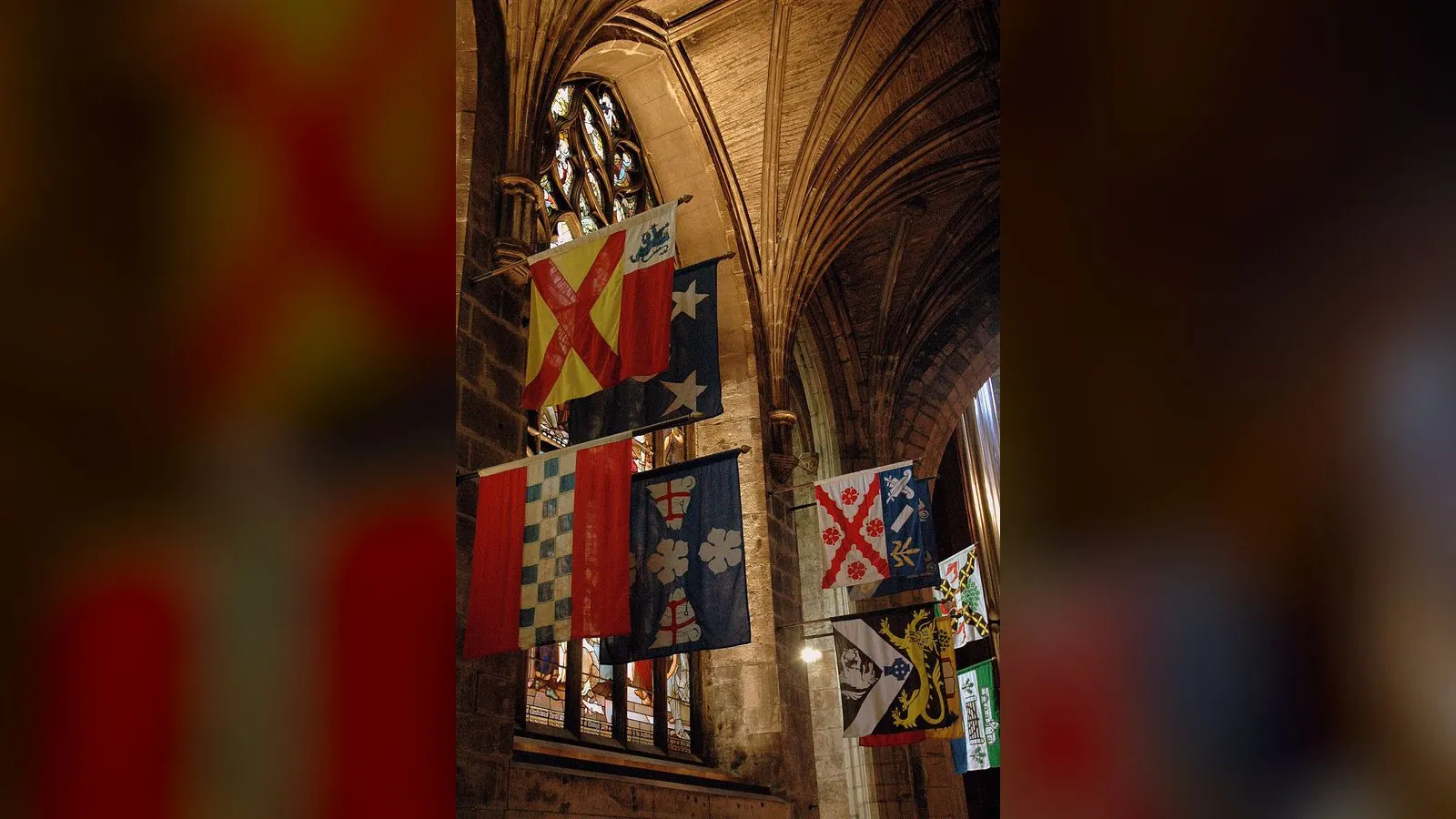
established Scotland's highest order of chivalry was established by James VII, who issued letters patent on 29 May 1687 "reviving and restoring" the Order of the Thistle. The wording was deliberate: the warrant claimed the order began after a battle in 786, when St Andrew's cross appeared to a King Achaius. Other claims link it to Charlemagne or to Robert the Bruce. Historians do not accept these origins; James III in the 15th century is the earliest credible candidate for any earlier order. The 1687 order was made up of the sovereign and twelve knights, but the 1688 revolution ended appointments, and Queen Anne refounded it in 1703. George IV increased the number of knights to sixteen in 1827. The order had no chapel until 1911, when the Thistle Chapel was added to St Giles' Cathedral in Edinburgh.
The motto
established The thistle's motto, Nemo me impune lacessit, means "No one provokes me with impunity", loosely rendered in Scots as "Wha daur meddle wi' me?". It first appears on merk coins of James VI in 1578. It is the motto of the Order of the Thistle and of the Royal Regiment of Scotland.
Did You Know?
- The word "thistle" covers more than 20 species.
- The plant usually sold as the "Scotch thistle" is not native to Scotland.
- The first thistle coins were issued by James III in the 1470s.
- The Norwegian saga of the Battle of Largs does not mention a thistle.
- The real fighting at Largs began with Norwegian ships driven ashore by a storm.
- The 1687 warrant for the Order of the Thistle claimed an origin in the year 786.
- The Order of the Thistle had no chapel until 1911.
- Nemo me impune lacessit first appeared on coins in 1578.
FAQ
1Why is the thistle Scotland's national flower?
No one knows for certain. It has been a royal emblem since at least the 1470s.
2Did a Norseman really step on a thistle at Largs?
That is a legend. The contemporary account of the battle does not mention it.
3What happened at the Battle of Largs?
Storm-driven Norwegian ships ran aground near Largs in 1263, and fighting on the beach followed on 2 October. The result was indecisive.
4Which thistle is Scotland's?
Probably the native spear thistle, Cirsium vulgare.
5What is the "Scotch thistle"?
The name usually given to the cotton thistle, which is not native to Scotland.
6When was the thistle first used as a royal symbol?
On coins of James III in the 1470s.
7When was the Order of the Thistle founded?
In its documented form, by James VII on 29 May 1687.
8Is the Order of the Thistle ancient?
Its 1687 warrant claimed an ancient origin, but historians do not accept it.
9What does Nemo me impune lacessit mean?
"No one provokes me with impunity."
10Who uses the motto today?
The Order of the Thistle and the Royal Regiment of Scotland, among others.
Sources and Further Reading
Primary/Institutional
- Royal Botanic Garden Edinburgh, Botanics Stories, "Towards 3 million: the thistle" (stories.rbge.org.uk)
- National Trust for Scotland, "The thistle: Scotland's national flower" (nts.org.uk)
Specialist
- Richard Mabey, Flora Britannica (Sinclair-Stevenson, 1996), including Peter Marren, "The Scottish thistle".
General
- Wikipedia, "Order of the Thistle" (en.wikipedia.org)
- Wikipedia, "Battle of Largs" (en.wikipedia.org)
- Wikipedia, "Nemo me impune lacessit" (en.wikipedia.org)
Caveats: Myths and Disputed Claims
- Do not present the barefoot Norseman at Largs as history.
- Do not say the "Scotch thistle" (cotton thistle) is native to Scotland.
- Do not say there is one official thistle species.
- Do not date the Order of the Thistle to 786, 809 or 1314.
- Do not say the motto dates from the 13th century; it first appears in 1578.
- Do not give 1470 or 1474 as the certain date of the first thistle coin.
Card 044 · Traditions