
Up Helly Aa: Shetland's Fire Festival
Contents
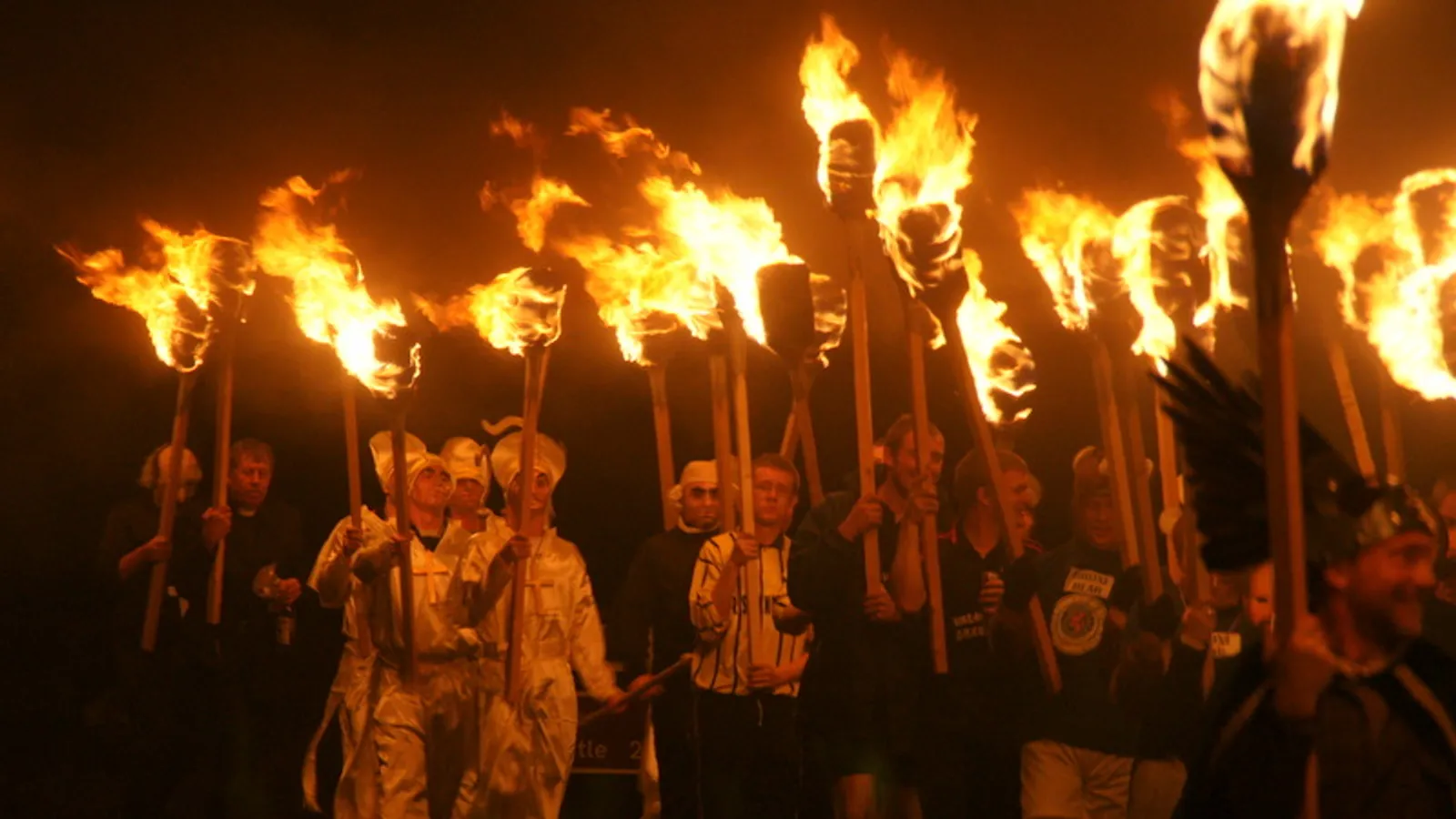
On the last Tuesday of January, nearly a thousand torch-bearing guizers march through Lerwick behind a replica Viking longship, which they then set alight. Up Helly Aa looks like an ancient Norse rite. It is not. It grew out of riotous Yule customs in 19th-century Lerwick, took its name and its January date in the 1870s, and put on Viking dress in stages between 1889 and 1921. But Shetland's Norse past is real; the islands were Norwegian until 1469. This card tests what is old, what is Victorian, and how the festival has changed. It leans on the fullest history of the festival, Callum G. Brown's Up-helly-aa: Custom, Culture and Community in Shetland (1998), checked against later sources.
TL;DR
- established Up Helly Aa is not an ancient Viking festival. Lerwick kept Yule and New Year on the old calendar dates, 5 and 12 January, and from about 1800 young men marked them with guns, guizing and, from the early 1840s, burning tar-barrels dragged along Commercial Street.
- established A tar-barrel was first dragged through Lerwick on 29 January, the end of the Yule holidays, in 1873, and the name was first printed in a Lerwick report in 1874. The first torchlit Up Helly Aa procession followed in 1881, the galley in 1889, the satirical Bill in 1899 and the Guizer Jarl in 1906. The Jarl's squad has dressed as Vikings every year since 1921.
- shared Why the tar-barrels gave way is disputed. The historian Callum G. Brown argues that the young men of Lerwick changed the custom themselves, in step with a new temperance-minded respectability. Earlier writers saw it as social control by the town's elite or as the creation of romantic intellectuals.
- established Shetland's Norse heritage is genuine. The islands were part of the Norwegian-Danish realm until 1469, when King Christian I mortgaged Shetland to James III of Scotland; Scotland annexed Orkney and Shetland on 20 February 1472.
- established Lerwick's procession was for men and boys only until 2023, when women and girls guized in its squads for the first time. Women joined the Jarl Squad in 2024. Several rural Shetland fire festivals had included women for decades.
- traditional The claim that the festival continues a thousand-year-old Norse ritual, descends from Viking ship burials or grew from old beliefs about chasing trows (trolls) has no evidence behind it.
Key Facts
- Where
- Lerwick, Shetland; about ten other Shetland communities hold their own fire festivals
- When
- Last Tuesday of January (fixed in 1908); first kept on 29 January
- First Lerwick Yule revels described
- 1806
- Tar-barrelling
- Early 1840s to 1878
- Name first recorded in Lerwick
- 1874 ("up-haly-a'")
- First torchlit Up Helly Aa procession
- 1881
- First galley
- 1889
- The Up-Helly-A' Song
- 1897, words by J. J. Haldane Burgess
- First Bill
- 1899
- First Guizer Jarl
- 1906
- Jarl Squad always in Viking dress
- From 1921
- Not held
- 1901, 1915–1919, 1940–1948, 2021–2022
- Women and girls in Lerwick squads
- From 2023; in the Jarl Squad from 2024
- Size today
- Nearly 1,000 guizers in more than 40 squads
- Shetland pledged to Scotland
- 1469
- Annexed by Scotland
- 20 February 1472
Scottish Impact Index (SI Score)
- Cultural Reach
- 7/10
- Continuity of Tradition
- 8/10
- Social & Economic Importance
- 6/10
- Scottish Distinctiveness
- 10/10
- Cultural Legacy
- 8/10
- Recognition
- 8/10
47/60
Ranked =14th of 19 in Traditions
A Note on Claims and Evidence
Each major claim carries one of three labels. established means supported by primary records, official bodies or several independent reliable sources. shared means the core fact is sound but sources disagree on details, dates or interpretation. traditional means widely repeated but not traceable to a primary or independent source.
The festival's 19th-century history is unusually well documented. Lerwick town council minutes, the Up Helly Aa Committee's minutes from 1908, and reports in the John O'Groat Journal, Shetland Times and Shetland News record it year by year. The historian Callum G. Brown, in Up-helly-aa (1998), built his account on these records and on the research of the Shetland archivist Brian Smith. Facts drawn from them are marked Established. Brown's explanations of why the festival changed, and his readings of class, gender and Shetland identity, are his argument; they are marked Shared where other scholars disagree. The Up Helly Aa Committee's own history places the name and the move to late January "around 1870", a little earlier than the dated newspaper reports Brown uses. This card follows the dated reports and notes the difference. The weakest claims are those that tie the festival directly to the Vikings or to folk belief.
Timeline
Norse settlers arrive in Shetland.
Christian I of Denmark-Norway pledges Orkney, then Shetland, to James III of Scotland in place of his daughter Margaret's dowry.
James III annexes Orkney and Shetland to the Scottish crown.
Dutch herring fishers begin trading from the beach at Lerwick, and a settlement grows there.
The minister George Low lists "Uphaliday (the last day of Yule)" among Shetland's festivals.
The earliest description of a Lerwick Yule: armed young men parade the town at 3 a.m. with fiddles and drums, firing guns.
Burning tar-barrels become the centre of the Old Christmas and New Year revels.
Tar-barrellers chase more than forty special constables into the town house.
Youths drag a tar-barrel through Lerwick to mark the end of the Yule holidays, the first such report.
A newspaper calls the night "up-haly-a'"; the Commissioners of Police threaten arrest for tar-barrelling.
A satirical flysheet names the "Festival of Uphelly 'a".
The last tar-barrel on Up Helly Aa night is seized.
A modest torchlit procession is held on Up Helly Aa night.
130 guizers with torches parade before the Duke of Edinburgh.
The first galley is burned.
J. J. Haldane Burgess writes The Up-Helly-A' Song.
The first satirical Bill is posted at the Market Cross.
The Worthy Chief Guizer is renamed the Guizer Jarl.
The date is fixed as the last Tuesday in January.
The Jarl's squad dresses as Vikings every year from now on.
The festival resumes after the Second World War, with live commentary on BBC radio.
Not held because of the Covid-19 pandemic.
Women and girls guize in Lerwick squads for the first time.
Women and girls march in the Jarl Squad for the first time.
Details
Shetland's real Norse past
established Shetland's Viking heritage is not invented. Norse settlers arrived in the 9th century, and the islands remained part of the Norwegian, later Danish-Norwegian, realm for six centuries. In 1468–69 Christian I of Denmark-Norway, unable to pay the dowry for his daughter Margaret's marriage to James III of Scotland, mortgaged Orkney and then Shetland to the Scottish king. In May 1469 he told his Shetland subjects to obey the King of Scots. On 20 February 1472 James III annexed both island groups to his crown. Shetland's archivist Brian Smith argues there is no evidence that Christian ever intended to redeem them.
Lerwick: a town without customs
established Lerwick is young. The town grew in the 17th century on a beach where Dutch herring fishers traded, and in 1625 the sheriff ordered its alehouses pulled down. It had no town council until it became a burgh of barony in 1818, and smuggling, especially of Dutch gin, was part of ordinary life until the 1820s.
shared Brown finds no record of any structured Yule custom in 18th-century Lerwick, though rural Shetland had winter dances and guizing. He argues that a town which already defied the kirk and the Customs every day had no need for a ritual of misrule. Silence in the records cannot prove that nothing happened, so this is an argument rather than a finding.
The name and the date
established "Uphalie day" was a Lowland Scots name for the end of the Christmas season, usually Twelfth Night. The kirk session of Elgin prosecuted people for marking it between the 1580s and 1630s. In Shetland the minister George Low listed "Uphaliday (the last day of Yule)" in 1774. Later writers placed it either on Twelfth Night or on "Twenty-fourth night", 29 January by the old calendar. The Lerwick festival took the later date.
shared The word's origin is uncertain. The linguist Jakob Jakobsen, who collected Shetland Norn words in the 1890s, linked the parts to Norse words for "holy day" and "ended", but doubted that the compound was old in Shetland. Brown thinks it plausible that Scottish settlers brought the Scots term north, but says this is probably impossible to prove. There is no record of the term being used in Lerwick itself before 1874.
Guns, guizers and tar-barrels, 1800–1874
established The first account of a Lerwick Yule describes 1806. Sixty or seventy young men met at 3 a.m. with fiddlers, drummers and guns, and marched through the town so that nobody could sleep. The Justices of the Peace banned guns and drums in 1818, without effect. In 1836, eighty-eight panes of glass were broken by home-made bombs of gunpowder wrapped in paper.
established Around 1839 a wheeled "krate" carrying guizers and musicians was pulled through the town by torchlight. By about 1845 it had given way to tar-barrelling. Half-barrels of tar and rags were fixed to a sledge, or later an old boat, set alight and hauled along Commercial Street on chains. The street narrowed to little over six feet at a point called the Roost, where krates often stuck. In the 1860s rival krates came from the "Docks boys" of the north end and the "Southerners" of the old town.
established The town council swore in special constables for the revels from at least 1845. In 1846 the crowd drove more than forty of them into the town house and burned tar-barrels under its smashed windows. Masked guizers went from door to door asking for food and drink, and houses that refused could have their doors smeared with tar. In 1855 a nail-filled bomb was thrown into the procurator fiscal's lobby.
shared Brown reads this "mischief" as misrule aimed at the town's new authorities, such as the fiscal, the police and some merchants. The guizers' favourite costumes, red coats, cocked hats and swords, mocked official dress. The reading is his; the incidents are documented.
Temperance and the end of the tar-barrels
established A sober counter-festival grew alongside the riot. Temperance societies existed in Shetland by 1840, and by 1846 Lerwick's teetotallers held their soirée on Old New Year's Day. In 1851 musicians led three hundred children wearing white ribbons on a Christmas abstinence parade. The Oddfellows, the Royal Naval Reserve and the Volunteer riflemen added daytime parades. The International Order of Good Templars arrived in the early 1870s, and an evangelical revival followed in 1874.
established In the early 1870s fewer young men turned out with the tar-barrels. On 29 January 1873 a few youths dragged one along Commercial Street to mark the end of the Christmas holidays, the first report of that date being kept in Lerwick. In January 1874 a correspondent recorded guizers out on the last night of the holidays, "called 'up-haly-a''". That December the Commissioners of Police warned that tar-barrelling would lead to arrest. In 1877 an anonymous satirical flysheet, usually credited to the newspaper editor J. B. Laurence, called people to the Market Cross for the "Festival of Uphelly 'a". The last tar-barrel on Up Helly Aa night was seized in 1878. In 1879 the town council moved the Christmas and New Year holidays to the modern dates, and the old Yule revels faded.
shared Brown argues that the change came from within. Police numbers stayed tiny, and the crowd itself grew more orderly. In his words, the custom was reshaped "because... the people wanted it to change." Earlier writers disagree. Christopher Harvie and Graham Walker saw a custom made "controllable" by Victorian conservatism. Bronwen Cohen saw a festival shaped for the town's leaders and intellectuals. The social anthropologist Jonathan Church saw an invented tradition. Brian Smith, the Shetland archivist, called the festival a spontaneous creation of young working men.
Torches, the galley and the Bill
established A small torchlit procession was held on Up Helly Aa night in 1881. On 24 January 1882 the town council asked the guizers to parade early for the Duke of Edinburgh, who had come to lay the foundation stone of the new town hall. A procession of 130 torch-bearers, led by a "Worthy Chief Guizer", cheered him. The organiser was Alex Ratter, a twenty-year-old apprentice printer who later became Lerwick's first socialist councillor.
established A committee was organising the event by 1885. From 1888 only authorised guizers could join, and a brass band played. In 1889 the first galley appeared, set alight and dragged along Commercial Street like the old krates. It was about twelve feet long in 1894 and thirty feet by 1912. The galley gained a mast and raven banner in 1893, and later a red hand on a pole at the bow.
established In 1899 a satirical placard, the Bill, replaced the plain notice at the Market Cross. Written by what became the Joke Committee, it mocks local people and councillors and is signed by the Jarl. A Collecting Sheet asking businesses for money is recorded from 1894. Both carry the motto "We axe for what we want", a pun on the Shetland pronunciation of "ask".
The songs
established J. J. Haldane Burgess, a blind Lerwick poet and later a socialist, wrote The Up-Helly-A' Song for the 1897 festival. It was first sung to the tune of "John Brown's Body"; the present tune, by T. Manson, dates from 1921. Its last verse is openly radical: "Our Galley is the People's Right, the dragon of the free." The Galley Song, with words by John Nicolson, is sung as the guizers circle the galley. After the burning they sing The Norseman's Home, a version of the song The Hardy Norseman, which the organisers' instructions already named in 1896.
The Guizer Jarl and the Jarl Squad
established In 1906 the Worthy Chief Guizer was renamed the Guizer Jarl and wore Viking dress, though he changed into other costume after the procession. The first was J. W. Robertson. The Jarl swapped his sword for an axe in 1912. His squad wore varied costumes until 1921, and Viking dress every year since. Each Jarl takes the name of a figure from the Norse sagas. Recent Jarls include Neil Moncrieff as Njal Thorgeirsson in 2023, Richard Moar as Harald Olafsson in 2024, Calum Grains as Eystein Magnusson in 2025 and Lynden Nicolson as Knut the Great in 2026.
established The route to the Jarlship is slow. Each October the guizers elect one new member to the committee, and that member becomes Jarl about fifteen years later. Brown reported in the 1990s that a Jarl's year could cost a five-figure sum, and that some Jarls saved or borrowed for it years ahead.
Squads, halls and the night
established The evening procession forms in squads of guizers, each in a costume kept secret until the night and approved by the committee to avoid duplicates. After the galley burns, the squads tour the halls until morning, performing a short satirical skit and dancing at each. Until 1903 guizers visited private houses. That year the Rechabite temperance hall opened, and by 1928 public halls had replaced house visits entirely. Some halls were teetotal and others were not. The committee has registered every squad since 1908 and photographed them since 1922. The day after the festival is a local holiday in Lerwick.
established In 1973 a five-year residency rule was brought in, partly to keep casual oil-construction workers out of the squads. In 2020 campaigners asked every Shetland committee to ban blackface in squad costumes, and several committees said it would not be tolerated.
The Victorian Norse revival
established The Viking theme came from a wider movement. From the 1870s Shetland writers and antiquaries such as Arthur Laurenson, J. B. Laurence and Laurence Williamson promoted Norse history, Norn words and place names. Laurenson wanted Lerwick's new town hall to be "Scandinavian and not English, nor even Scottish". Its hall, opened in the 1880s, has stained glass of Norse heroes, and in 1882 the burgh adopted arms showing a galley and a raven. Some of these writers also claimed Shetlanders were a separate Norse race, an idea that has not survived.
shared Brown argues that Up Helly Aa "at its birth in the 1870s had no Norse theme". In his view the Vikings were added to a working men's festival, rather than the festival being invented to stage the Vikings. Bronwen Cohen and others give the romantic intellectuals a larger role. Both sides agree that the Norse costume is a later layer.
Class, temperance and hard times
established The early festival was run by working men, many of them radicals. Four of the first eight Guizer Jarls, from 1906 to 1914, belonged to the British Socialist Party. The temperance friendly society the Rechabites helped to start the halls. Lerwick voted itself "dry" in 1920 and its public houses stayed shut until 1947.
established The festival was not held in 1901 after Queen Victoria died, nor from 1915 to 1919 or 1940 to 1948. In the slump of 1931–32 some proposed cancelling it because guizers could not afford costumes, but it went ahead. When it returned in 1949 there were forty-nine squads and more than six hundred guizers. In 2021 and 2022 it was cancelled because of Covid-19.
shared Brown reads the Jarl as a modern Lord of Misrule, with the Bill keeping alive the old mockery of authority. This is an influential reading but an interpretation.
Women and the Lerwick procession
established For over a century women hosted the halls, cooked and helped sew costumes, but could not guize in Lerwick. Newspapers reported rumours of women in disguise in the procession around 1900–1902. In the 1980s women posted an alternative Bill. In the 1990s girls joined Viking classroom work at school but not the junior procession. Brown noted that the rural festivals admitted women, and wrote that "it seems ironic that the more urbane and 'modern' Lerwick has not."
established The campaign group Up Helly Aa for Aa pressed for change. In June 2022 the Lerwick committee announced that women and girls could take part. In 2023 they guized in Lerwick squads for the first time, and nearly thirty girls joined the junior procession. The 2023 Jarl Squad had been formed before the decision and was all male. In 2024 women and girls marched in the Jarl Squad for the first time, including the Jarl's sixteen-year-old daughter.
Fire festivals elsewhere in Shetland
established Other Shetland communities copied Lerwick. Scalloway was burning a boat by 1898 and called its festival Up Helly Aa by 1905. Uyeasound followed in 1912, Bressay in the 1930s, Cullivoe in 1958, Brae in 1970 and Northmavine in 1975, among others. Most began or were revived after oil money arrived in the 1970s. They run from January to March. Women took part in Bressay by the early 1930s, and the South Mainland festival chose a female Jarl in 2015. Shetland emigrants held an Up Helly Aa in Wellington, New Zealand, in 1928.
Broadcasting and tourism
established The BBC broadcast a radio talk on the festival in 1933 and live commentary in 1949, which Brown says tightened the festival's timing. In 1967 the committee rejected a tourist body's idea of an extra summer version for visitors. Today the procession is streamed live online and watched by 5,000 or more people in the streets.
What Up Helly Aa is not
traditional Up Helly Aa is often described as an ancient or thousand-year-old Viking festival, or as a survival of Viking ship burials or pagan midwinter rites. None of these claims is supported. Another story says it began as a rite to drive the trows underground at the end of Yule. That idea comes from the folklorist Jessie Saxby, whose 1888 account of rural Yule gained torches and a link to Up Helly Aa only in versions of 1915 and 1932. F. Marian McNeill later printed a 1939 photograph of a Lerwick squad as Shetland's vanishing "Yule guizers".
Did You Know?
- Lerwick kept Christmas on 5 January and New Year on 12 January until 1879.
- In 1846 tar-barrellers chased forty special constables into the town house and smashed its windows.
- Revellers in 1855 fired a cannon at Fort Charlotte loaded, by local tradition, with dead cats.
- A prankster in the 1860s planted a fake "runic" stone spelling ASSES for the town's learned society to find.
- The Up-Helly-A' Song was first sung to the tune of "John Brown's Body".
- Four of the first eight Guizer Jarls were members of the British Socialist Party.
- In 1929, after a hospital complained about a joke in the Bill, the committee posed for its official photograph holding eggs.
- Women and girls joined the Lerwick squads in 2023 and the Jarl Squad in 2024.
FAQ
1What is Up Helly Aa?
A fire festival in Lerwick, Shetland, in which torch-bearing guizers burn a replica Viking longship.
2Is Up Helly Aa an ancient Viking festival?
No. It grew out of 19th-century Yule customs in Lerwick and took its present form between 1873 and 1921.
3Was Shetland really Norse?
Yes. It was part of the Norwegian and Danish-Norwegian realm until 1469.
4When did Shetland become part of Scotland?
It was pledged in 1469 and annexed on 20 February 1472.
5What was tar-barrelling?
From the early 1840s young men set barrels of tar alight on sledges or old boats and hauled them along Commercial Street at Old Christmas and New Year.
6Why did tar-barrelling stop?
Fewer young men took part, temperance and respectability grew, and the authorities threatened arrests. Historians disagree about which mattered most.
7When was the first galley burned?
In 1889.
8Who is the Guizer Jarl?
The festival's chief guizer, first named in 1906, who leads the Jarl Squad and takes a saga name for the year.
9What does "Up Helly Aa" mean?
It comes from an old name for the end of the Yule holidays, related to the Scots "Uphalie day". Its deeper origin is uncertain.
10What is the Bill?
A large satirical placard posted at the Market Cross on festival morning, first used in 1899.
11Why is it held on the last Tuesday of January?
It was first kept on 29 January, the 24th night after Old Christmas. Because that date moved around the week, in 1908 the committee, merchants and town council agreed on the last Tuesday, with a holiday the next day.
12Can women take part?
Yes. Women and girls have guized in Lerwick squads since 2023 and marched in the Jarl Squad since 2024.
13Did the festival ever stop?
Yes: in 1901, from 1915 to 1919, from 1940 to 1948, and in 2021 and 2022.
14Are there other Up Helly Aas?
Yes. About ten other Shetland communities hold their own fire festivals between January and March.
Sources and Further Reading
Primary/Institutional
- Lerwick Up Helly Aa Committee, "The History of Up Helly Aa" (uphellyaa.org)
- Shetland Museum and Archives, "550 years ago: how Shetland became part of Scotland" (shetlandmuseumandarchives.org.uk)
- Promote Shetland, "Lerwick Up Helly Aa" (shetland.org)
Scholarly/Critical
- Callum G. Brown, Up-helly-aa: Custom, Culture and Community in Shetland (Manchester University Press, 1998)
Specialist
- Brian Smith, "'Up-Helly-A' — separating the facts from the fiction", Shetland Times, 22 January 1993 (cited by Brown)
- James W. Irvine, Up-Helly-Aa: A Century of Festival (Shetland Publishing, 1982) (cited by Brown)
- Wikipedia, "List of Lerwick Up Helly Aa Guizer Jarls" (en.wikipedia.org)
General
- Euronews, "Shetland's Up Helly Aa Viking fire festival squads open to women for first time", 22 June 2022 (euronews.com)
- STV News, "Women join Up Helly Aa fire festival procession for first time", 2023 (news.stv.tv)
- Shetland News, "The wait is over: Lerwick's Up Helly Aa is back", 31 January 2023, and "All eyes on Lerwick as Up Helly Aa returns", 27 January 2026 (shetnews.co.uk)
- Guernsey Press (PA), "Viking festival Jarl Squad includes female participants for first time", 30 January 2024 (guernseypress.com)
- Shetland News, "Ignorance does not make this acceptable", 9 June 2020 (shetnews.co.uk)
Further reading
- Wikipedia, "Up Helly Aa" (en.wikipedia.org)
Caveats: Myths and Disputed Claims
- Do not call Up Helly Aa an ancient or thousand-year-old Viking festival.
- Do not say it descends from Viking ship burials, pagan rites or the chasing of trows.
- Do not say Shetland was sold or given to Scotland outright; it was pledged in 1469 and annexed in 1472.
- Do not present any single meaning of "Up Helly Aa" as settled.
- Do not say the Viking costume was there from the start; the galley came in 1889, the Jarl in 1906 and the all-Viking Jarl Squad in 1921.
- Do not say the authorities simply abolished tar-barrelling and invented Up Helly Aa to replace it; the change was gradual and its causes are disputed.
- Do not date the name or the late-January date firmly to 1870; the first dated Lerwick records are from 1873 and 1874.
- Do not say women have always been able to join the squads, or that women first joined the Jarl Squad in 2023; that was 2024.
- Do not call the straw-clad "skeklers" or "grulacks" the ancestors of Lerwick's guizers without evidence; the link comes from later folklorists.
Card 018 · Traditions