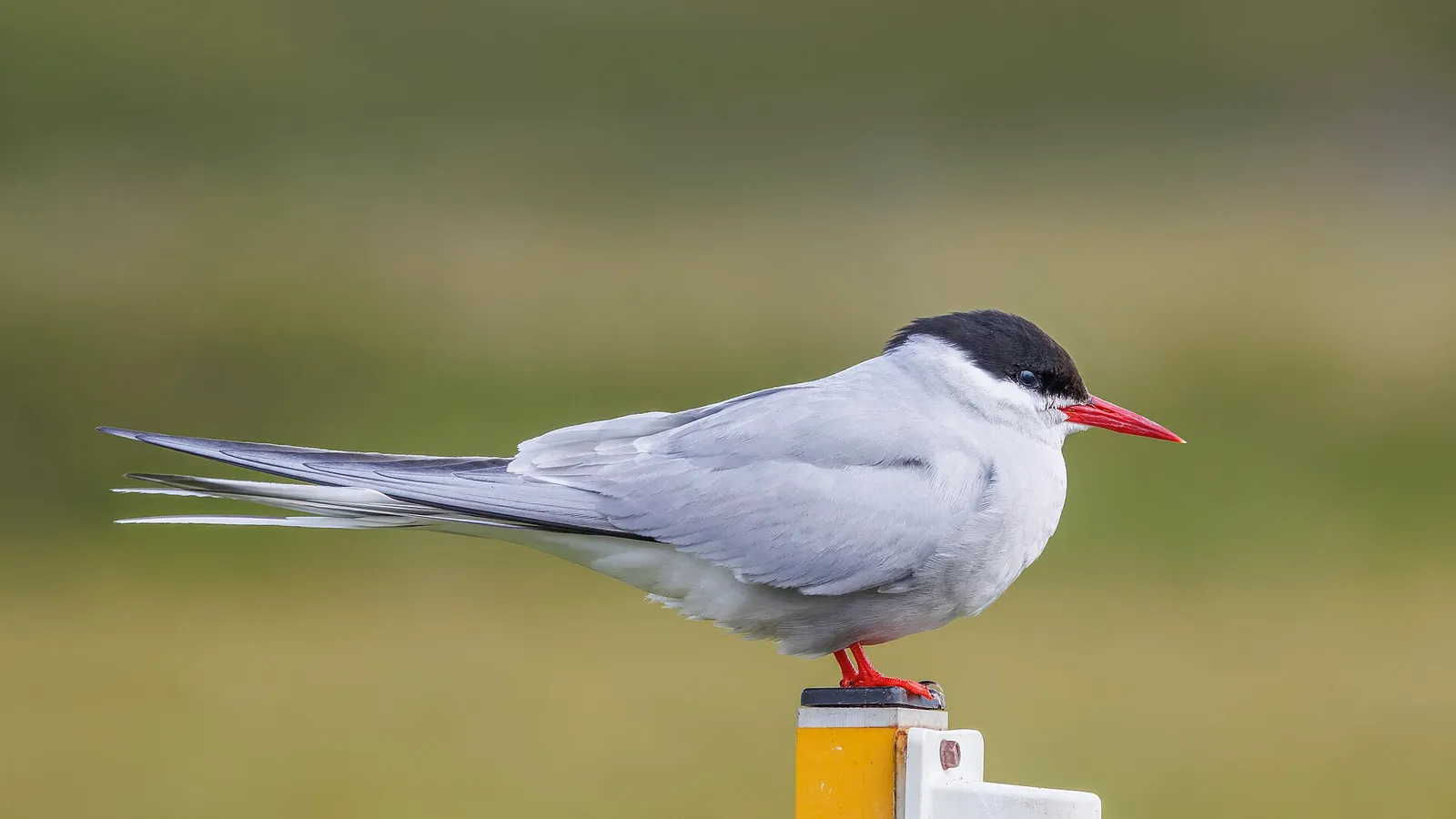

Arctic Tern (Sterna paradisaea)
Contents
The Arctic tern is a slender, grey-and-white seabird with a blood-red bill that breeds in the far north and spends the northern winter near the Antarctic pack ice. Scotland, above all Orkney and Shetland, holds most of the British and Irish population, and its colonies have a long record of booms and crashes tied to sandeel supply.
TL;DR
- established The Arctic tern undertakes one of the animal kingdom's most extraordinary migrations, travelling between Arctic breeding grounds and Antarctic wintering areas on a round trip estimated at 44,000 to 59,000 miles per year — a specific, documented scale of travel this article states with its real figures rather than a vague claim of long-distance migration.
- established Scotland's Northern Isles, Orkney and Shetland, host major Arctic tern colonies. Birds arrive from mid-April, most colonies are empty by mid-August, and the last migrants pass in October. They nest on rocky islets and skerries, sand, shingle and, in the north, by lochans and on peat moss, in noisy, fiercely defended colonies.
- established The Scottish Ornithologists' Club's The Birds of Scotland (2007) records 47,306 nests in Scotland in 2000, 84% of the British Isles total. That was 34% fewer than in 1987, with Orkney down 60% and Shetland 19% after repeated breeding failures. J. C. A. Craik's account notes that closing the Shetland sandeel fishery in 1991 did not restore tern productivity, suggesting natural change also plays a part.
- established The species was added to the UK Red List under Birds of Conservation Concern 5, reflecting a documented decline of 50% over the past 25 years — a severe, specific figure this article states plainly rather than a vague reference to "struggling populations."
- established Threats are named specifically rather than generally: shifts in the availability of key prey, particularly sandeels and other small fish, alongside overfishing, coastal breeding colony disturbance, and climate change, are all identified as contributing pressures — a precise threat picture this article states directly.
- established Scotland's seabird populations as a whole are now approximately half their 1980s levels, based on NatureScot's assessment of 19 species breeding around Scottish coasts between 1986 and 2024, with the most severely affected species including Arctic skua (93% decline), little tern (75% decline), and common tern (73% decline) — this article states the Arctic tern's own decline within this wider documented context rather than treating it as an isolated case.
- established Orkney and Shetland folk had their own names for the bird, shared with the common tern: Pickie, Rittack, Ritto and Sheer Tail in Orkney, and Tirrock or Tarrock in both island groups. The northern isles' colonies have long swung wildly from year to year, and sandeel shortages caused near-total breeding failures in Shetland as early as 1990.
Key Facts
- Scientific name
- Sterna paradisaea
- Category
- Seabirds
- Annual migration distance
- 44,000–59,000 miles
- Key Scottish range
- Northern Isles (Orkney, Shetland); first arrivals average 17 April, colonies mostly empty by mid-August, last birds usually October
- Scottish population (2000, historical)
- 47,306 apparently occupied nests, 84% of British Isles (The Birds of Scotland)
- Largest colony in 2000
- Dalsetter, Mainland Shetland, 4,444 nests
- Largest recorded colony
- Papa Westray, Orkney, 6,600 nests (1980)
- Gaelic name
- Steàrnag-Artaigeach
- UK Red List status
- Red (Birds of Conservation Concern 5)
- Population decline (25 years)
- 50%
- Orkney and Shetland names
- Pickie, Pickie-terno, Peerag, Rittack, Rittick, Ritto, Sheer Tail (Orkney); Tirrock, Tarrock (Orkney and Shetland)
- Orkney and Shetland breeding (c. 2005, historical)
- About 30,000 pairs in more than 800 colonies (Birds Britannica)
Scottish Impact Index (SI Score)
- Scottish Significance
- 8/10
- Ecological Persistence
- 9/10
- Ecological Importance
- 9/10
- Biological Distinctiveness
- 8/10
- Conservation Significance
- 8/10
- Recognition
- 8/10
50/60
Ranked =23rd of 42 in Wildlife
A Note on Claims and Evidence
Migration distance and Scottish breeding presence details are drawn from published wildlife trust and ornithological sources. Red List status, decline figures, and threat details are drawn from the Birds of Conservation Concern 5 assessment and the "Terning the Tide" project's published reporting. Broader Scottish seabird decline context, including comparative species figures, is drawn from NatureScot's published 1986–2024 assessment.
The national survey totals, colony history, ringing recoveries, breeding biology and the 2007 view of threats come from J. C. A. Craik's account in the Scottish Ornithologists' Club's The Birds of Scotland (2007). Its figures end around 2004 and are history beside the BoCC5 and NatureScot assessments.
Timeline
Arctic terns are very common breeders in the north and west, the Outer Hebrides and the Northern Isles, arriving each April and mostly gone by October.
A few pairs nest inland on Inchmoan, Loch Lomond.
A tern ringed as a chick that July on Machias Seal Island, on the Canada–USA border, is killed by a raptor at Kylesku in Sutherland, the only known transatlantic arrival in Scotland.
A tern ringed in west Greenland is found dead in Durban harbour, South Africa, less than three months later, at least 8,700 miles away.
The Papa Stour colony in Shetland holds about 400 pairs through the 1970s, jumps to 3,000 pairs in 1980 and more than trebles again in 1981.
The Isle of May colony, up to 800 pairs in 1936, dies out; terns return in 1984.
Operation Seafarer counts 46,385 nests in Scotland.
Foula's colony peaks at about 6,000 pairs; about 200 tern chicks are found bitten by the island's sheep.
Papa Westray holds 6,600 nests, the largest single colony on record.
Years of breeding failure in Shetland; almost no terns nest on Foula.
The Seabird Colony Register census finds 71,178 nests in Scotland.
Amid sandeel shortages, Shetland ornithologists debate whether a single Arctic tern fledged from the islands' 500-plus colonies.
The Shetland sandeel fishery is closed; 1,000 pairs suddenly reappear on Foula.
Rats are eradicated from Handa, and 52 pairs of Arctic terns breed there the next year.
Seabird 2000 finds 47,306 nests, 34% fewer than in 1987; Dalsetter in Shetland, with 4,444, is the largest colony in the British Isles.
NatureScot's long-term monitoring of 19 Scottish seabird species finds Scotland's overall seabird population has roughly halved since the 1980s, with almost all species studied declining over the long term and eight species significantly affected, including Arctic skua (93%), little tern (75%), and common tern (73%).
Arctic tern populations specifically decline by approximately 50%, a fall severe enough to see the species added to the UK Red List under Birds of Conservation Concern 5.
The "Terning the Tide" project begins work across five Scottish regions, including restoring breeding habitat at Brora on the east coast by clearing overgrown vegetation and installing new sand and shell substrate, supplemented with 3D-printed decoys built by local schoolchildren, alongside signage and fencing to protect colonies from human disturbance.
The project aims to protect 40 tern colonies from disturbance and enhance further breeding sites, as Arctic terns continue to face threats from shifting prey availability, overfishing, climate change, and colony disturbance.
Details
A migration stated with its real, almost unimaginable scale
This article presents the Arctic tern's annual journey with its actual documented figures rather than a vague superlative: a round trip between Arctic breeding grounds and Antarctic wintering areas estimated at 44,000 to 59,000 miles per year. This article states this range directly because it conveys the genuine, measurable extremity of the longest migration undertaken by any animal, a context that makes the species' brief Scottish summer presence considerably more remarkable.
A Scottish breeding presence named with its real seasonal pattern
This article states the species' Scottish presence specifically: major colonies in Orkney and Shetland, nesting in noisy, fiercely defended colonies on rocky islets, skerries, sand and shingle, and in the north also by lochans and on peat moss. The Birds of Scotland (2007) gives an average first arrival of 17 April (1968–2000), a main influx in May, laying in June and colonies usually empty before mid-August; migrants are last seen in October. This article names this seasonal window directly because it clarifies that Scotland hosts only part of the species' extraordinary annual cycle, not a year-round population.
A severe, specific decline, not a vague concern
This article states the Arctic tern's documented recent decline with its real figure: 50% over the past 25 years, severe enough to see the species added to the UK Red List under Birds of Conservation Concern 5. This article names this specific percentage directly because it represents a genuinely severe, measured decline, not a general impression of difficulty.
Threats named specifically, not generically
This article names the pressures facing the species with real precision rather than a vague reference to "seabird decline": shifts in the availability of key prey, particularly sandeels and other small fish, alongside overfishing, coastal breeding colony disturbance, and climate change. This article states these specific, documented threats because they clarify the actual, varied mechanisms behind the species' decline rather than treating it as an unexplained mystery.
A decline situated honestly within a wider Scottish seabird collapse
This article does not present the Arctic tern's own decline as an isolated story: NatureScot's assessment of 19 Scottish seabird species between 1986 and 2024 found the country's overall seabird population has roughly halved since the 1980s, with species including Arctic skua (93% decline), little tern (75% decline), and common tern (73% decline) among the most severely affected. This article states these comparative figures directly because situating the Arctic tern's 50% decline within this wider documented pattern clarifies that it reflects a genuinely broad, systemic pressure on Scottish seabirds generally, not a species-specific anomaly.
Pickie and Tirrock: the tern in Orkney and Shetland
established Mark Cocker and Richard Mabey, in Birds Britannica (2005), list the bird's northern names: Peerag, Pickie, Pickie-terno, Rittack, Rittick, Ritto and Sheer Tail in Orkney, and Tirrock or Tarrock in Orkney and Shetland, alongside the widespread Sea Swallow. Every one of these names is shared with the common tern, a sign of how hard the two are to tell apart; birders still log uncertain birds as "commic terns". Even Linnaeus, naming the common tern Sterna hirundo, the "swallow tern", in the eighteenth century, probably worked from the skin of an Arctic tern.
established In Britain the Arctic tern is almost exclusively a Scottish bird, with a large southern outpost on Anglesey. In 2005 the book put Orkney and Shetland at about 30,000 pairs in more than 800 colonies, against about 2,000 pairs in the whole of Ireland. That figure is historical context, not a current count.
established Northern colonies have always been unpredictable. On Papa Stour in Shetland there were about 400 pairs between 1969 and 1979; numbers rose to 3,000 in 1980 and more than trebled the following season. The Scottish weather plays its part, but by 2005 the book described overfishing of sandeels as the major anxiety of the previous 15 years. A Shetland observer recalled that "In 1990 there was considerable debate" over whether even one Arctic tern had fledged from Shetland's 500-plus colonies. That early warning foreshadows the sandeel pressures named above.
established Predators include introduced mink and hedgehogs, and on Foula an odder one: the island's sheep, which bite the heads, legs and wings off chicks, probably for calcium. In 1975 about 200 chicks were found bitten. The adults defend their nests fiercely and strike human intruders on the head; an umbrella or a raised tripod is the usual defence.
established The bird's travels were proved early by ringing. One tern ringed in west Greenland on 8 July 1951 was found dead in Durban harbour, South Africa, less than three months later, a minimum journey of 8,700 miles (14,500 km). Spending both summers in polar latitudes, an Arctic tern sees eight to nine months of continuous daylight each year.
The Scottish record to 2007
established Numbers. J. C. A. Craik's account in the Scottish Ornithologists' Club's The Birds of Scotland (2007) gives three national counts: 46,385 nests in 1969–70, 71,178 in 1985–88 and 47,306 in 2000. The last was 84% of the British Isles total of 56,123. Shetland with Fair Isle (24,716) and Orkney (13,476) held 81% of Scotland's birds, and with the Outer Hebrides and Argyll over 93%. The fall since 1987 lay mostly in Orkney (60%) and Shetland (19%), while the Outer Hebrides rose by 277%, which may partly reflect birds moving between regions. Separating Arctic from common terns has always clouded the older record.
established Boom and bust. Colonies come and go as birds move with the food. Foula, watched since 1956, grew from 250 pairs to about 6,000 in 1975, had almost no nesting in 1984–90 and suddenly held 1,000 pairs again in 1991. Eleven adults ringed there in 1979–82 were caught there again in 1991, so birds return to old sites after long gaps. The account lists 1980, 1984–90, 1993–94, 1996–2001, 2003 and 2004 as poor or disastrous years in the Northern Isles, with most chicks starving. Further south, colonies without predators usually raise about one young per pair.
established Not only overfishing. Craik reports that the closure of the Shetland sandeel fishery in 1991 did not significantly improve seabird productivity or restore sandeels, which suggests that "over-fishing is not the prime cause". Natural changes, perhaps climatic or hydrographic, also play a part, and the ultimate cause was still unknown in 2007. Away from the Northern Isles predators matter more: mink, otters, peregrines, rats, cats, stoats, foxes, hedgehogs and even buzzards have all cut breeding success. After rats were cleared from Handa in 1997, 52 pairs nested there the next year.
established Breeding. Most clutches hold two eggs, with an Orkney and Shetland mean of 1.95 from 453 clutches. Chicks can fly in under 20 days. Downy chicks vary from silvery grey to dark brown and scatter to hide when alarmed. Adults defending chicks near people "sometimes draw blood", but those on undisturbed skerries are far less aggressive. Unusual sites have included a rooftop in Montrose and fox-fenced gas terminals such as St Fergus.
established Ringing. Of 114 Scottish-ringed chicks recovered abroad, most were found along the African coast from Morocco to Mozambique, with the largest numbers in Ghana (22), Nigeria (16) and South Africa (14). Only one Scottish bird is known to have crossed the Atlantic: ringed in Shetland in 1981, it was found dying in Minnesota in July 1995. Twenty-eight foreign-ringed terns, mostly from the Baltic, have been found in Scotland.
Did You Know?
- The Arctic tern's annual migration between Arctic and Antarctic regions is estimated at 44,000 to 59,000 miles — the longest migration of any animal.
- Scotland's Northern Isles, Orkney and Shetland, host major Arctic tern colonies; the birds arrive in April and most colonies are empty by mid-August.
- Arctic tern chicks can fly in under 20 days.
- A Shetland-ringed Arctic tern was found dying in Minnesota in 1995, the only Scottish bird known to have crossed the Atlantic.
- Foula's colony went from about 6,000 pairs in 1975 to almost none in 1984–90, then 1,000 pairs reappeared in 1991.
- The species has declined by 50% over the past 25 years, earning it Red List status under Birds of Conservation Concern 5.
- Key threats include shifting availability of sandeels and other small prey fish, overfishing, colony disturbance, and climate change.
- Scotland's overall seabird population has roughly halved since the 1980s, based on long-term monitoring of 19 species.
- The "Terning the Tide" project has restored breeding habitat at sites including Brora, using 3D-printed decoys built by local schoolchildren to help attract breeding birds.
- The project aims to protect 40 tern colonies from disturbance across five Scottish regions.
- In Orkney the Arctic tern was a Pickie or Ritto, and in Shetland a Tirrock; the same names served for the common tern.
- On Foula, sheep have been seen biting the heads and wings off tern chicks, probably in search of calcium.
- An Arctic tern sees eight to nine months of continuous daylight a year.
FAQ
1How far do Arctic terns migrate?
An estimated 44,000 to 59,000 miles per year, between Arctic breeding grounds and Antarctic wintering areas — the longest migration of any animal.
2Where are Arctic terns found in Scotland?
Major colonies are in Orkney and Shetland, with others in the Outer Hebrides, Argyll and around the mainland coast, and a few inland by lochs.
3Is the Arctic tern declining?
Yes — by around 50% over the past 25 years, placing it on the UK Red List under Birds of Conservation Concern 5.
4What is causing the decline?
Shifts in the availability of key prey, particularly sandeels and other small fish, alongside overfishing, colony disturbance, and climate change.
5Is this decline specific to Arctic terns?
No — Scotland's overall seabird population has roughly halved since the 1980s, with several species, including Arctic skua and little tern, declining even more severely.
6What conservation work is being done?
The "Terning the Tide" project is restoring breeding habitat, installing protective fencing and signage, and using decoys to help attract breeding birds at colonies across five Scottish regions.
7How many colonies does the project aim to protect?
Around 40 tern colonies from disturbance, alongside enhancing existing breeding sites.
8When can Arctic terns be seen in Scotland?
From mid-April, when the first birds return, to October, when the last migrants pass. Breeding colonies are usually empty before mid-August.
9How many Arctic terns breed in Scotland?
The Birds of Scotland (2007) gives 47,306 nests in 2000, 84% of the British Isles total. Numbers have fallen since.
10Did closing the sandeel fishery help?
Not clearly. The Shetland sandeel fishery closed in 1991, but by 2007 tern productivity and sandeel stocks had not significantly recovered, which points to natural changes in the sea as well as fishing.
11Where do Scottish Arctic terns go in winter?
South along the African coast, many young birds wintering off West and southern Africa, and most adults reaching the Antarctic pack ice.
12What did Orkney and Shetland people call the Arctic tern?
Names recorded in Birds Britannica (2005) include Pickie, Rittack, Ritto and Sheer Tail in Orkney, and Tirrock or Tarrock in both Orkney and Shetland. The same names were used for the common tern.
13How can you tell an Arctic tern from a common tern?
The Arctic tern is darker, smaller and narrower-winged, with a longer tail, shorter legs and an all blood-red bill; the common tern's bill is orange-red with a black tip.
14When did sandeel shortages first hit Shetland's terns?
By 1990 breeding had failed so badly that Shetland ornithologists debated whether a single Arctic tern had fledged from the islands' 500-plus colonies.
Sources and Further Reading
Primary/Institutional
- Forrester, R. W., Andrews, I. J. et al. (eds), The Birds of Scotland (Scottish Ornithologists' Club, 2007), account by J. C. A. Craik
- Arctic tern — The Wildlife Trusts
- Terning the Tide — Species on the Edge
Scholarly/Critical
- Mark Cocker and Richard Mabey, Birds Britannica (Chatto & Windus, 2005)
- Scottish sea birds 'under threat' with populations now half what they were in the 1980s — The Scotsman
- Arctic Tern — BTO BirdFacts
General
Caveats: Myths and Disputed Claims
- Clarification: This article does not present the Arctic tern's decline as an isolated or unexplained species-specific mystery; it is situated directly within a documented, broader Scottish seabird population collapse affecting multiple species since the 1980s.
- Note: This article does not state a single precise migration distance, since published estimates range from 44,000 to 59,000 miles per year depending on methodology; both bounds of this documented range are given rather than an invented single figure.
- Do not blame the Northern Isles crashes on overfishing alone; the 1991 Shetland sandeel closure did not restore productivity, and natural changes in the sea are also implicated.
- Do not say Arctic terns nest only on sand and shingle beaches; in Scotland many colonies are on rocky islets and skerries, and some are inland on peat.
Card 045 · Wildlife