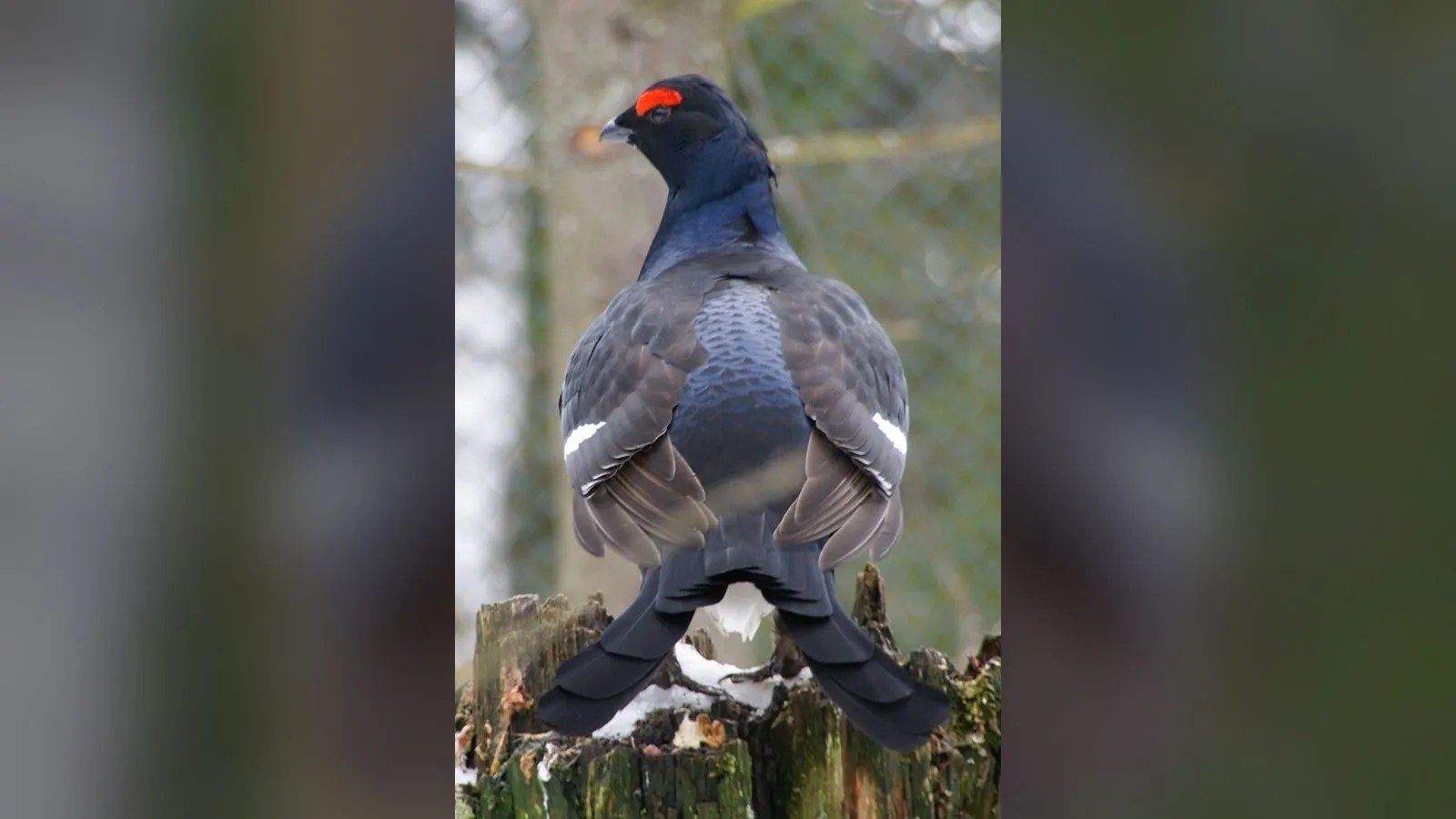

Black Grouse (Lyrurus tetrix)
Contents
TL;DR
- established Black grouse are one of the UK's most rapidly declining bird species, locally extinct across many regions, with the last UK-wide survey (2005) estimating just 5,100 displaying males remaining in total — a severe, precisely documented national decline this article states directly.
- established Southern Scotland's collapse has been especially severe: monitored lek sites in southwest Scotland fell from 70 displaying males to zero between 1989 and 2018, while southeast Scotland fell from 340 to just 44 over the same period — an 82% decline in monitored breeding display sites overall, figures this article states with their full, stark severity rather than averaging them into a gentler national picture.
- established In clear contrast, a long-term Highland study in the Affric Highlands near Inverness recorded 405 lekking males in 2024 — the highest count in 17 years of monitoring and a substantial rise from 250 in 2007 — demonstrating that the species' overall UK decline is not uniform, and that genuine, measured local recovery is achievable under the right conditions.
- established Research attributes the Affric Highlands recovery specifically to active, multi-pronged habitat restoration: native woodland regeneration, peatland and wetland recovery, and herbivore exclusion reducing deer overgrazing, together creating the mosaic of open moorland and woodland habitat black grouse specifically require — a concrete, documented conservation success this article credits directly rather than attributing the recovery to chance.
- established The Scottish Ornithologists' Club's The Birds of Scotland (2007) gives the Scottish share of the 2005 total as about 3,344 lekking males, down 29% from about 4,700 in the first national survey of 1995–96. The fall was 69% in south-east Scotland and 49% in the south-west, but only 9% in the north-east.
- established The same account, by Murray Grant, singles out the maturing of conifer plantations as a widespread cause of decline: young pre-thicket plantings suit black grouse, but the ground vegetation they need is lost once the canopy closes.
- disputed Research has found that leks situated on moorland actively managed for red grouse shooting support roughly twice as many black grouse males as other sites, likely linked to predator control and better-maintained moorland vegetation — a specific, documented finding this article states plainly, while noting it sits within the broader, genuinely contested debate over driven grouse moor management's overall costs and benefits to Scottish upland wildlife.
Key Facts
- Scientific name
- Lyrurus tetrix
- Category
- Birds
- UK population (2005 survey)
- 5,100 displaying males
- Scottish population (2005 survey)
- About 3,344 lekking males (range 2,580–4,171)
- Scottish decline, 1995–96 to 2005
- 29% (south-east 69%, south-west 49%, north-east 9%, north 16%)
- Scottish range loss, 1968–72 to 1988–91
- 21% of occupied 10km squares
- Strongholds (2007)
- Perth and Kinross, North-east Scotland, Badenoch and Strathspey
- Breeding
- Clutch 5–9 eggs; main hatch mid-June; chicks can fly at about a week
- Gaelic name
- Coileach-dubh (the blackcock)
- Southwest Scotland lek decline (1989–2018)
- 70 males to zero
- Southeast Scotland lek decline (1989–2018)
- 340 to 44 males
- Affric Highlands count (2024)
- 405 males (17-year high)
- Fence collision reduction (marked fencing)
- 91% fewer black grouse collisions
- Traditional names
- Blackcock (male), greyhen (female), black game (shooting term)
- 20th-century loss
- Estimated at 95% from falling game bags (per Birds Britannica, 2005)
Scottish Impact Index (SI Score)
- Scottish Significance
- 8/10
- Ecological Persistence
- 6/10
- Ecological Importance
- 8/10
- Biological Distinctiveness
- 8/10
- Conservation Significance
- 9/10
- Recognition
- 7/10
46/60
Ranked =35th of 42 in Wildlife
A Note on Claims and Evidence
Population decline figures for southern Scotland and the UK-wide 2005 estimate are drawn from peer-reviewed research and conservation body reporting. The Affric Highlands recovery figures are drawn from long-term volunteer-based lek monitoring reported by the restoration project involved. The deer fence collision marking study is drawn from a randomised, controlled field experiment published in the peer-reviewed conservation literature. The Scottish survey results for 1995–2005, the history of the range and the breeding biology come from the Scottish Ornithologists' Club's The Birds of Scotland (2007), whose black grouse account is by Murray Grant; they are dated history alongside the later regional figures. The relationship between grouse moor shooting management and black grouse lek numbers is treated as a documented finding sitting within a broader, genuinely Disputed policy debate, which this article does not resolve.
Timeline
Black grouse are widespread from the Highlands to the Home Counties; flocks of 200–300 birds are recorded, and greyhens are used at Taymouth in Perthshire to hatch capercaillie eggs for the 1837 reintroduction.
Black grouse occur in every Scottish faunal district except the Outer Hebrides and the Northern Isles.
Black grouse are almost extinct south of a line from the Wash to the Severn, apart from Dartmoor and Exmoor.
Falling game bags suggest a total population loss of around 95% across Britain, with drainage, moorland overgrazing and blanket conifer afforestation implicated.
The Scottish range contracts by 21%, with the sharpest losses in the south and west as earlier plantings reach closed canopy. By 1988–91 breeding on the islands is confirmed only on Islay and Jura; the birds have gone from Skye, Raasay, Arran and Bute.
Monitoring at southwest Scotland leks records 70 displaying male black grouse; southeast Scotland leks record 340.
At Abernethy Forest, breeding success varies from 0.44 to 4.71 chicks per hen, best in years with dry Junes and little crow activity.
A wandering male visits Aberlady Bay in East Lothian, one of only four coastal records for Lothian.
Steep declines in a 700 square kilometre study area in Perth and Kinross, followed by a levelling out and small recovery in the late 1990s.
The first national survey estimates about 4,700 lekking males in Scotland.
A randomised, controlled study across thirteen Highland sites tests orange netting marking on deer fences, recording 437 bird collisions, 92% involving gamebirds, and finding marked fence sections reduced black grouse collisions by 91% and capercaillie collisions by 64% compared to unmarked sections.
348 lekking males are counted in the Perth and Kinross study area, fewer than in earlier years.
The last UK-wide black grouse survey estimates the total population at 5,100 displaying males, confirming the species among the UK's most rapidly declining birds. About 3,344 are in Scotland, 29% fewer than in 1995–96.
Affric Highlands lek monitoring near Inverness records 250 displaying males.
Southwest Scotland's monitored lek population reaches zero; southeast Scotland's falls to 44 — an 82% decline in monitored lek sites overall since 1989.
Sustained habitat restoration work in the Affric Highlands — including native woodland regeneration, peatland recovery, and herbivore exclusion — coincides with lek counts rising to 405 males by 2024, the highest total recorded in 17 years of monitoring.
Details
A national decline stated with its real, severe scale
This article presents the UK black grouse population with the actual figures behind its "rapidly declining" status: the last UK-wide survey, in 2005, recorded just 5,100 displaying males in total, with the species now locally extinct across many regions. This article states this figure directly because it conveys the genuine national scale of the species' crisis rather than a vague sense of concern.
established The Birds of Scotland (2007) breaks the Scottish part of that survey down. The first national survey, in 1995–96, estimated about 4,700 lekking males in Scotland. The 2005 survey gave about 3,344, a fall of 29% in a decade. The decline was 69% in south-east Scotland, 49% in the south-west, 16% in the north and 9% in the north-east. In 2005 that left roughly 250 males in the south-east, 800 in the south-west, 1,500 in the north-east and 770 in the north. Perth and Kinross and North-east Scotland were the main strongholds, and most birds lived between 250m and 450m. Earlier, between the atlases of 1968–72 and 1988–91, the Scottish range had shrunk by 21%, and island populations on Skye, Raasay, Arran and Bute had disappeared, leaving breeding confirmed only on Islay and Jura.
A southern collapse too severe to soften
This article does not average southern Scotland's black grouse collapse into a gentler national trend: monitored leks in southwest Scotland fell from 70 males to zero between 1989 and 2018, and southeast Scotland fell from 340 to just 44 over the same period, an 82% overall decline in monitored breeding sites. This article states these regional figures with their full severity because this specific, localised collapse represents a documented near-total loss in these areas, not a modest regional dip within an otherwise stable picture.
A genuine, documented recovery — not an isolated anecdote
This article credits the Affric Highlands recovery with its real, quantified figures: 405 lekking males recorded in 2024, the highest count across 17 years of monitoring and a substantial rise from 250 in 2007. This article states this directly because it demonstrates, with real data rather than optimistic generalisation, that the species' overall decline is not uniform and that meaningful local recovery has genuinely occurred.
A recovery attributed to specific, active interventions
This article names the documented drivers of the Affric Highlands recovery specifically rather than crediting vague "conservation efforts": native woodland regeneration, peatland and wetland restoration, and herbivore exclusion reducing deer overgrazing and overbrowsing, together restoring the mosaic of open moorland and young woodland habitat black grouse specifically require. This article states these mechanisms directly because they represent concrete, replicable management actions rather than an unexplained or coincidental local improvement.
A genuinely contested management finding, stated honestly
This article presents directly, rather than omitting for its political sensitivity, a specific documented research finding: leks on moorland actively managed for red grouse shooting have been found to support roughly twice as many black grouse males as other sites, likely linked to predator control and better-maintained moorland vegetation under that management regime. This article states this finding plainly while noting that it sits within a far broader and genuinely contested debate over the overall costs and benefits of driven grouse moor management to Scottish upland wildlife and ecosystems — a wider dispute this article does not attempt to resolve on the basis of this single finding.
A concrete, measured mitigation success
This article states the deer fence collision study's findings with their real figures: across thirteen Highland sites, marking deer fence sections with orange netting reduced black grouse collision rates by 91% and capercaillie collision rates by 64% compared to unmarked sections, out of 437 total recorded bird collisions, 92% of which involved gamebirds. This article names this specific intervention because it represents a concrete, evidence-based, and already-implemented mitigation measure rather than a theoretical proposal.
Plantations, deer and the closing canopy
established Black grouse live where trees, heather and rough grassland meet. The Birds of Scotland (2007) notes that they were once tied to native pine and birch woods but, in the later 20th century, came to depend increasingly on young conifer plantations. Pre-thicket plantings, with open ground between small trees, make good habitat; once the canopy closes, the ground vegetation disappears. Over 75% of Scottish males attend leks within 200m of woodland, most of it conifer plantation. A study in Perth and Kinross linked falling lek numbers there to forest maturation, and Grant suggests that the ageing of the great post-war plantations may explain declines across much of Scotland. He argues that recovery may depend on managing plantations to keep suitable young growth.
established Other pressures add to this. Chicks need insect-rich flushes, damp grassy areas and blaeberry in their first two or three weeks, and heavier grazing by sheep and red deer reduces that food. More deer has meant more deer fences and more collisions. At Abernethy, breeding was poorer in years of high crow activity. Raptors and foxes are the main direct cause of adult deaths, but the account finds no evidence that this has driven the Scottish decline. It also names wetter summers under climate change, and the fragmentation of small populations, as threats.
Nest, brood and home range
established Hens nest alone, often in tall, dense heather, and lay 5–9 eggs a few days after mating. The main hatch in Scotland is around or just after mid-June, timed to the peak of moth caterpillars. Chicks leave the nest within a day or two and can fly at about a week; broods have been tracked moving up to 900m in 24 hours. At Abernethy between 1989 and 1999, hens reared between 0.44 and 4.71 chicks a year, with the best years being those with dry Junes and few crows. Grant estimates that 1.5–2.0 chicks per hen are needed to keep numbers stable. Birds are sedentary: in North-east Scotland males used home ranges of about 3.5–4.6 square kilometres and hens about 0.75. Most of the 13 Scottish ringing recoveries were within 9km of where the bird was ringed.
Blackcock and greyhen: a long decline
established Mark Cocker and Richard Mabey, in Birds Britannica (2005), record that the black grouse has been dwindling since the 19th century. "Blackcock" strictly means the male; the smaller brown female is the "greyhen", and shooters spoke of "black game". The bird was once common from the Highlands to the heaths of Kent and Cornwall, but releases of captive stock by keepers blurred the picture of its natural range. By 1905 it had almost gone from southern England, and it has been an exclusively northern bird since the 1970s. The book calls it a bird of the temporary habitats where upland woods and moorland meet, trapped by the "improvement" of both: drainage of marginal farmland, overgrazing of heather and blanket afforestation with exotic conifers. Over the 20th century falling game bags suggest a 95% loss.
established Writing in 2005, the authors noted that the Borders hill country south of Edinburgh and large parts of the Highlands still held good numbers, and that the species could still legally be shot, though 19th-century flocks of 200–300 birds would "almost certainly never be seen again". Black grouse were also a table bird: Mrs Beeton advised hanging them for a few days and serving them roasted with bread sauce. The figures in the sections above show how far the southern Scottish strongholds have since fallen.
The lek
established At dawn in spring up to a dozen males gather at a traditional display ground, the lek, some of which have been in use for 50–60 years. Each cock fans a lyre-shaped black tail over a white bustle of undertail feathers, droops his wings to show white bars, and gives a soft, dove-like bubbling, known as "rookooing", that can carry about 400m. The nearer a male holds ground to the centre of the lek, the more females he is likely to mate with. The word "lek" may come from the Scandinavian leka, "to play".
established The Birds of Scotland (2007) adds that males visit leks all year, but numbers peak from late March to early May, when most hens attend, with a smaller autumn peak and a low in July during the moult.
Did You Know?
- The UK's last full black grouse survey, in 2005, recorded just 5,100 displaying males nationally.
- Black grouse display at communal gathering sites called "leks," where males compete to attract mates.
- Southwest Scotland's monitored black grouse lek population fell from 70 males to zero between 1989 and 2018.
- In contrast, the Affric Highlands near Inverness recorded 405 lekking males in 2024, a 17-year high.
- The Affric Highlands recovery has been linked to native woodland restoration, peatland recovery, and reduced deer overgrazing.
- Marking deer fences with orange netting has been found to reduce black grouse collision deaths by 91%.
- Leks on moorland managed for red grouse shooting have been found to support roughly twice as many black grouse males as other sites.
- Only the male is properly a "blackcock"; the smaller brown female is the "greyhen".
- Greyhens were used as foster mothers to hatch capercaillie eggs when that species was reintroduced at Taymouth in the 1830s.
- The male's display song, "rookooing", can carry about 400m across a moor.
- A century ago black grouse still displayed within a few dozen miles of London.
- Black grouse once bred on Skye, Raasay, Arran and Bute; by 1988–91 the only island breeding was on Islay and Jura.
- Black grouse chicks can fly when about a week old.
- More than three-quarters of Scottish blackcocks display within 200m of woodland.
FAQ
1How endangered is the black grouse in the UK?
Severely — it is one of the UK's most rapidly declining bird species, with only around 5,100 displaying males recorded in the last full national survey.
2Has the decline been the same everywhere in Scotland?
No — southern Scotland has seen a near-total collapse (southwest Scotland's monitored population reached zero by 2018), while the Affric Highlands has shown a genuine, documented recovery to a 17-year high.
3What caused the Affric Highlands recovery?
Active habitat restoration — native woodland regeneration, peatland recovery, and reduced deer overgrazing — restoring the mix of habitats black grouse need.
4Why do deer fences matter to black grouse?
Collisions with unmarked deer fences are a significant, documented cause of mortality; marking fences with orange netting has been shown to cut black grouse collision deaths by 91%.
5Does grouse moor shooting management help or harm black grouse?
This is genuinely contested — research has found leks on actively managed red grouse shooting moorland support roughly twice as many black grouse males, but this sits within a much broader, unresolved debate over grouse moor management's overall ecological impact.
6Are black grouse locally extinct anywhere in Scotland?
Yes — southwest Scotland's monitored lek population had fallen to zero by 2018.
7How many black grouse are there in Scotland?
The 2005 national survey estimated about 3,344 lekking males in Scotland, according to The Birds of Scotland (2007), down from about 4,700 in 1995–96. Later regional monitoring shows further steep falls in the south.
8Why do conifer plantations matter?
Young plantations with open ground between the trees are good black grouse habitat, but once the canopy closes the heather and blaeberry beneath disappear. The ageing of plantations is thought to explain many local declines.
9What is a "lek"?
A traditional gathering site where male black grouse display competitively to attract females during the breeding season.
10Is recovery possible elsewhere in Scotland?
The Affric Highlands case suggests genuine recovery is achievable with sustained, active habitat restoration, though this has not yet been demonstrated at the scale needed to reverse the species' overall UK decline.
11What is the difference between a blackcock and a greyhen?
"Blackcock" is the male, glossy blue-black with a lyre-shaped tail and red wattles over the eye; "greyhen" is the smaller, mottled brown female.
12How long has the black grouse been declining?
Since at least the 19th century. Birds Britannica (2005) cites an estimated 95% loss over the 20th century, based on falling game bags.
13Why is the scientific name sometimes given as Tetrao tetrix?
Older works, including Birds Britannica (2005), place the black grouse in Tetrao with the capercaillie; many current lists use Lyrurus tetrix. Both refer to the same bird.
Sources and Further Reading
Primary/Institutional
- Forrester, R. W., Andrews, I. J. et al. (eds), The Birds of Scotland (Scottish Ornithologists' Club, 2007), account by Murray Grant.
- Black Grouse in Trouble: A Moorland Bird in Decline — Moorland Association
- Highland black grouse numbers on rise — Scottish Banner
- Marking deer fences reduces capercaillie and black grouse collision mortality — Conservation Evidence
Scholarly/Critical
- Mark Cocker and Richard Mabey, Birds Britannica (Chatto & Windus, 2005)
- A Focus on Black Grouse Declines — Conservation Jobs
- Species showcase: Black grouse — IUCN UK Peatland Programme
General
Caveats: Myths and Disputed Claims
- Clarification: This article does not suggest grouse moor shooting management has been established as net beneficial or harmful to Scottish upland wildlife overall; the twice-as-many-males finding concerns black grouse leks specifically and sits within a much broader, unresolved policy debate.
- Do not present the UK figure of 5,100 males as the Scottish total; about 3,344 of them were in Scotland in 2005.
- Do not treat conifer forestry as simply good or bad for black grouse; young plantations help, mature closed-canopy ones do not.
- Note: This article does not claim the Affric Highlands recovery indicates the species' UK-wide decline has reversed; it demonstrates genuine local recovery under specific, active management conditions, not a general trend.
Card 024 · Wildlife