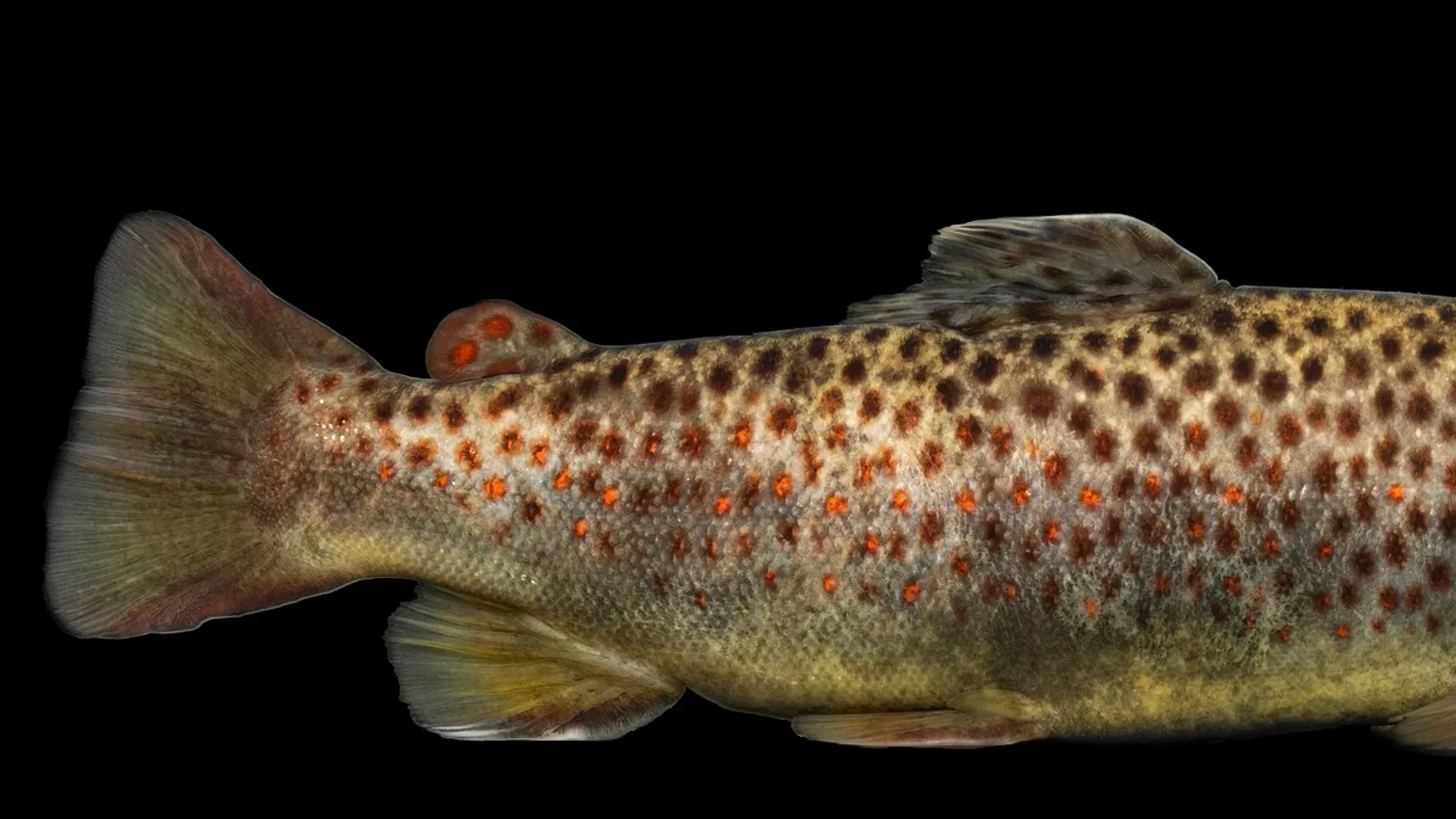

Brown Trout (Salmo trutta)
Contents
TL;DR
- established Scotland's brown trout are genuinely polymorphic, with many distinct morphotypes occurring across the country's rivers, lochs, and upland lochans — populations that colonised these waters independently after the last Ice Age now represent genetically distinct, irreplaceable evolutionary lineages, a scientific significance this article states directly rather than treating brown trout as a single uniform species.
- established Among these forms, the piscivorous "ferox" trout — large, late-maturing, fish-eating individuals first named by naturalist Sir William Jardine in 1835 — can reach remarkable size, including the British rod-caught record of 14.4kg from Loch Awe, and can live for decades, with one documented individual from Loch Killin reaching 23 years old.
- disputed Genetic research has found that ferox trout from Scotland's Loch Awe and Loch Laggan are more genetically similar to ferox trout from Lough Melvin in Ireland than to ordinary brown trout living in the very same Scottish lochs — a genuinely striking finding that has fuelled an unresolved scientific debate, with bodies including the IUCN's Freshwater Fish Specialist Group treating ferox as a separate species while other researchers regard them as a distinctive form of brown trout rather than a taxonomically separate one — this article presents both positions rather than declaring a winner.
- established Despite their recognised conservation value as UK Biodiversity Action Plan priority species and the genuine evolutionary significance of Scotland's genetically distinct trout populations, neither standard brown trout nor these specialised forms receive substantial protection under Scottish conservation legislation — a specific, documented legislative gap this article states directly rather than assuming conservation priority status translates into legal protection.
- established Ferox trout are now estimated to occur in fewer than 10% of Scottish freshwater sites, and the IUCN currently lists their conservation status as Data Deficient — reflecting genuine scientific uncertainty about their population trends rather than a confirmed assessment either way.
Key Facts
- Scientific name
- Salmo trutta
- Category
- Fish
- Status in Scotland
- Native; UK Biodiversity Action Plan priority species
- Conservation legislation
- Limited — exploitation controls only, no comprehensive protection
- Ferox trout British record
- 14.4kg (31.7lb), Loch Awe
- Oldest documented ferox
- 23 years (Loch Killin)
- Ferox occurrence (Scottish sites)
- Estimated under 10%
- Ferox IUCN status
- Data Deficient
A Note on Claims and Evidence
The polymorphism and genetic distinctiveness of Scotland's trout populations, and the limited extent of current legal protection, are drawn from NatureScot's own published assessment. Ferox trout size, longevity, genetic findings, and taxonomic status are drawn from peer-reviewed fisheries science and specialist angling research. The question of whether ferox trout constitute a genuinely separate species is treated as Disputed, reflecting an active, unresolved scientific and taxonomic disagreement this article presents from multiple documented positions.
Timeline
Brown trout independently colonise Scotland's rivers, lochs, and upland lochans following the last Ice Age, giving rise over time to genetically distinct local populations and morphotypes.
Naturalist Sir William Jardine first coins the term "ferox" to describe the large, piscivorous form of brown trout found in some of Scotland's deep glacial lochs.
Fisheries science documents ferox trout's distinctive life history: later maturity, an earlier shift to a fish-based diet, active pursuit-predator behaviour at depths of up to 30 metres, and markedly faster growth than typical brown trout on this richer diet.
Studies find that ferox trout from Scotland's Loch Awe and Loch Laggan are genetically more similar to ferox trout from Lough Melvin in Ireland than to ordinary brown trout sharing the same Scottish lochs, prompting ongoing taxonomic debate.
The IUCN's Freshwater Fish Specialist Group regards ferox as a separate species, while the group's own listed conservation status for ferox remains Data Deficient, reflecting continuing scientific uncertainty about both taxonomy and population trends.
Both ordinary brown trout and ferox trout retain UK Biodiversity Action Plan priority species status, while continuing to lack comprehensive conservation legislation protection in Scotland.
Details
A species that is really many, stated precisely
This article presents Scotland's brown trout not as a single uniform species but with the genuine biological complexity NatureScot itself documents: the species is polymorphic, with many distinct morphotypes occurring across the country, many representing populations that colonised individual river systems and lochs independently after the last Ice Age. This article states this directly because these isolated lineages carry genuine, irreplaceable evolutionary and conservation value, not merely cosmetic variation.
A remarkable predator, with its real documented figures
This article presents the ferox trout's size and longevity with the actual recorded figures rather than general claims of impressiveness: the British rod-caught record stands at 14.4kg (31.7lb), caught in Loch Awe, and the oldest documented individual, from Loch Killin, reached 23 years of age. Ferox behave as active pursuit predators, diving to depths of up to 30 metres to hunt prey fish, a markedly different ecological role from the invertebrate-feeding typical of ordinary brown trout, and one reflected in documented faster growth rates — one recorded individual gained 4.5kg over four years.
A genuinely unresolved taxonomic question
This article treats directly, rather than resolving in either direction, a striking and genuinely contested scientific finding: genetic research has found that ferox trout from Scotland's Loch Awe and Loch Laggan are more closely related to ferox trout from Lough Melvin in Ireland than to the ordinary brown trout sharing their own home lochs. This finding has fuelled an active debate over whether ferox represent a taxonomically distinct species — a position the IUCN's Freshwater Fish Specialist Group holds — or a specialised ecological form within brown trout more broadly, a view other researchers maintain. This article presents both positions because the underlying genetic evidence, while striking, has not settled the taxonomic question to scientific consensus.
Conservation priority without matching legal protection
This article states plainly a specific, documented gap between recognition and protection: both brown trout and their specialised forms, including ferox, hold UK Biodiversity Action Plan priority species status, reflecting genuine conservation concern, yet neither receives substantial protection under Scottish conservation legislation, with existing safeguards limited largely to exploitation controls within fisheries law. This article names this gap directly rather than assuming that priority species designation automatically confers meaningful legal protection.
A rare form, honestly uncertain in status
This article states that ferox trout are now estimated to occur in fewer than 10% of Scottish freshwater sites, while the IUCN's current conservation status listing for ferox remains Data Deficient. This article presents this combination honestly — genuine rarity alongside genuine scientific uncertainty about population trend — rather than asserting a confident decline or stability narrative the current data does not support.
Did You Know?
- Scotland's brown trout are genuinely polymorphic, with many genetically distinct forms shaped by independent post-Ice Age colonisation of different river systems and lochs.
- The piscivorous "ferox" trout form was first named by naturalist Sir William Jardine in 1835.
- The British rod-caught ferox trout record, 14.4kg, was caught in Loch Awe.
- One documented ferox trout from Loch Killin lived to 23 years old.
- Ferox trout dive to depths of up to 30 metres as active fish-hunting predators.
- Genetic research has found Scottish ferox trout more closely related to Irish ferox trout from Lough Melvin than to ordinary brown trout sharing their own lochs.
- Ferox trout are now estimated to occur in fewer than 10% of Scottish freshwater sites.
- Despite their conservation priority status, brown trout and ferox trout receive limited legal protection in Scotland.
FAQ
1Are all Scottish brown trout the same?
No — the species is genuinely polymorphic, with many distinct forms shaped by independent post-glacial colonisation of different waters.
2What is a ferox trout?
A large, late-maturing, fish-eating form of brown trout found in some deep Scottish lochs, first named in 1835.
3How big can ferox trout get?
The British rod-caught record is 14.4kg (31.7lb), caught in Loch Awe; they can also live for decades.
4Are ferox trout a separate species?
This remains genuinely disputed — some bodies, including the IUCN's Freshwater Fish Specialist Group, treat them as a separate species, while other researchers regard them as a distinctive form of brown trout.
5Why is the Scottish-Irish genetic link significant?
Scottish ferox trout from Loch Awe and Loch Laggan have been found genetically more similar to Irish ferox trout than to ordinary brown trout in their own lochs, a striking finding fuelling the taxonomic debate.
6Are brown trout protected in Scotland?
Only to a limited extent — despite holding UK Biodiversity Action Plan priority species status, they lack comprehensive conservation legislation protection, with safeguards largely limited to fisheries exploitation controls.
7How rare are ferox trout?
They are estimated to occur in fewer than 10% of Scottish freshwater sites, with their conservation status currently listed as Data Deficient by the IUCN.
8What do ferox trout eat?
Unlike typical invertebrate-feeding brown trout, ferox shift to a fish-based diet earlier in life and actively hunt prey at depth.
Sources and Further Reading
Primary/Institutional
- Brown trout — NatureScot
- Genetic Scorecard Indicator - Sea Trout; Brown Trout; Ferox Trout — NatureScot
Scholarly/Critical
- Ferox Trout — Wild Trout Trust
- Reproductive isolation and genetic differentiation of ferox trout from sympatric brown trout in Loch Awe and Loch Laggan, Scotland — ResearchGate
General
Caveats: Myths and Disputed Claims
- Clarification: This article does not assert that ferox trout have been scientifically confirmed as a distinct species; this remains an active taxonomic debate, with credible scientific positions on both sides.
- Note: This article does not claim a confirmed population trend for ferox trout; their Data Deficient IUCN status reflects genuine current scientific uncertainty, not an established decline or stability.
Card 017 · Wildlife