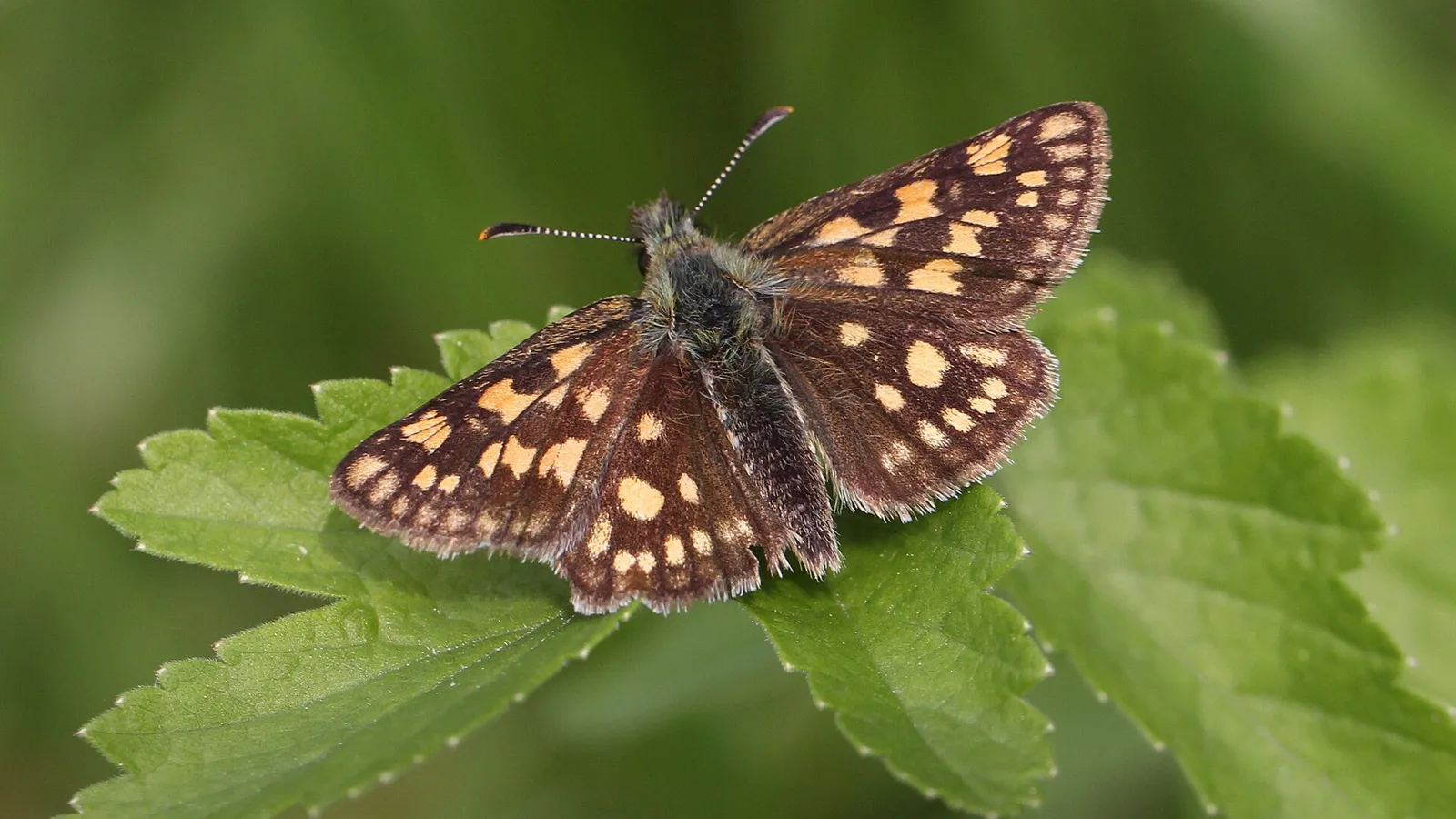

Chequered Skipper (Carterocephalus palaemon)
Contents
TL;DR
- established The chequered skipper was first documented in Britain near Bedford in 1798 and was historically restricted to a band of woodlands stretching from Oxfordshire to Lincolnshire and Cambridgeshire, with Rockingham Forest serving as a major stronghold until the mid-20th century — it was officially declared extinct in England in 1976, a specific, documented loss this article states directly.
- established The cause of this English extinction is named specifically rather than attributed to vague "habitat loss": changing woodland management practices eliminated the sunny, flower-rich open rides and glades the butterfly depended on, as woodlands were managed differently and traditional coppicing declined.
- established Scotland's chequered skipper population was first recorded only in 1942 — strikingly late given the species was already established in England by 1798 — and today represents the species' only surviving British stronghold, confined to western Scotland within roughly a 30-mile radius of Fort William, including Allt Mhuic Butterfly Reserve and Glasdrum Wood National Nature Reserve.
- established Since 2021, sightings have been recorded further north, east, south and west than the species' previously known Scottish range, including first records on Mull (2021) and Skye (2025) — a specific, documented range expansion this article states directly, with Butterfly Conservation linking it to climate change, particularly early, warm springs such as that of 2025.
- established When conservationists reintroduced the species to England's Rockingham Forest from 2018 onward, they sourced the founding population not from Scotland but from a healthy wild population in Belgium, judged ecologically similar to the restored English habitat — a specific, documented sourcing decision this article states directly, since it runs against any assumption that the nearest surviving British population would automatically have been the source.
Key Facts
- Scientific name
- Carterocephalus palaemon
- Category
- Invertebrates
- First British record
- Near Bedford, 1798
- Declared extinct in England
- 1976
- First Scottish record
- 1942
- Current UK stronghold
- Western Scotland, ~30 miles around Fort William
- Flight period
- Mid-May to June
- English reintroduction source (from 2018)
- Belgium
Scottish Impact Index (SI Score)
- Scottish Significance
- 9/10
- Ecological Persistence
- 6/10
- Ecological Importance
- 7/10
- Biological Distinctiveness
- 9/10
- Conservation Significance
- 9/10
- Recognition
- 6/10
46/60
Ranked =35th of 42 in Wildlife
A Note on Claims and Evidence
Historical distribution, extinction timeline, and extinction cause are drawn from published conservation history sources. Current Scottish distribution, recent range-expansion records, and the climate-change link are drawn from Butterfly Conservation's published Scottish assessment. The English reintroduction's Belgian sourcing is drawn directly from Butterfly Conservation's own reporting on the project, which does not itself explain why Scottish stock was not used.
Timeline
The chequered skipper is first documented in Britain, near Bedford, already restricted to a band of woodlands between Oxfordshire, Lincolnshire, and Cambridgeshire.
Rockingham Forest serves as a major English population stronghold.
The species is first recorded in Scotland.
Changing woodland management practices eliminate the sunny, open rides and glades the species depends on in England, driving a sustained population collapse.
The chequered skipper is officially declared extinct in England.
Western Scotland, particularly the area around Fort William, becomes the species' sole surviving British stronghold.
Conservationists begin a reintroduction project at Rockingham Forest, England, sourcing founding butterflies from a healthy wild population in Belgium judged ecologically similar to the restored habitat.
The species is recorded on Mull for the first time, part of a wider pattern of sightings further from the previously known Scottish range.
The species is recorded on Skye for the first time, with Butterfly Conservation linking this and other recent range-expansion records to climate change, including early, warm spring conditions.
The chequered skipper persists as a reintroduced population in England and a native, apparently expanding population in western Scotland, with ongoing citizen-science monitoring tracking both.
Details
An extinction with a specific, named cause
This article states the chequered skipper's 1976 English extinction with its real documented cause rather than a vague reference to habitat loss: changing woodland management practices eliminated the sunny, flower-rich open rides and glades the species depended on, as traditional management approaches including coppicing declined across its former English range. This article names this specific mechanism because it clarifies that the extinction resulted from a particular, identifiable shift in land management, not an unavoidable general decline.
A surprisingly late first Scottish record
This article states a specific, striking historical detail directly: the species was not recorded in Scotland until 1942, well over a century after its first British documentation near Bedford in 1798. This article names this date because it is a genuine curiosity in the species' British history — whether this reflects a genuinely later establishment in Scotland or simply a lack of earlier recording in the area is not resolved by the sources available to this article, and this article does not assert either explanation as settled.
A current range stated with its real geographic confinement
This article names the chequered skipper's present UK distribution precisely: confined to western Scotland within roughly a 30-mile radius of Fort William, with strongholds including Allt Mhuic Butterfly Reserve and Glasdrum Wood National Nature Reserve. This article states this specific area because it represents the species' entire native British range today, following its English extinction.
A range expansion, stated with its documented recent evidence
This article presents the species' recent range changes with real, dated records rather than a general claim of spread: sightings further north, east, south and west than the previously known range since 2021, including first confirmed records on Mull in 2021 and Skye in 2025. This article states these specific records because they represent genuine, documented evidence of change, with Butterfly Conservation itself linking the pattern to climate change, particularly early, warm spring conditions such as those of 2025.
A reintroduction sourced from an unexpected direction
This article states directly a specific, documented detail about the English reintroduction effort that runs against an intuitive assumption: when founding Rockingham Forest's restored population from 2018, conservationists sourced butterflies not from the nearest surviving British population in Scotland, but from a healthy wild population in Belgium, selected for ecological similarity to the restored English habitat. This article names this sourcing decision because it is a genuine, documented fact about the reintroduction, while also stating honestly that the reasoning behind not using Scottish stock is not explained in the sources available to this article, so this article does not speculate about genetic or logistical considerations it cannot verify.
Did You Know?
- The chequered skipper was declared extinct in England in 1976, driven by changing woodland management that eliminated its sunny, open-ride habitat.
- It was first recorded in Scotland only in 1942, over 140 years after its first British record near Bedford in 1798.
- Western Scotland around Fort William is now the species' only native British stronghold.
- Since 2021, it has been recorded for the first time on islands including Mull and Skye, further from its previously known range.
- Butterfly Conservation links this recent range expansion to climate change, including early, warm spring conditions.
- When the species was reintroduced to England's Rockingham Forest from 2018, the founding population came from Belgium, not Scotland.
- The butterfly flies for a brief period from mid-May to June and favours damp grassy habitats with purple moor-grass as its foodplant.
FAQ
1Is the chequered skipper extinct in England?
It was declared extinct there in 1976, but a reintroduction project at Rockingham Forest has established a new population there from 2018 onward.
2Why did it go extinct in England?
Changing woodland management practices eliminated the sunny, open rides and glades the species depended on.
3Where is it found in Scotland today?
Within roughly a 30-mile radius of Fort William in western Scotland, including Allt Mhuic Butterfly Reserve and Glasdrum Wood National Nature Reserve.
4When was it first recorded in Scotland?
In 1942 — notably later than its first British record near Bedford in 1798.
5Is its Scottish range expanding?
Recent records since 2021, including first sightings on Mull and Skye, suggest a genuine range expansion, which Butterfly Conservation links to climate change.
6Where did the English reintroduction population come from?
Belgium, not Scotland — conservationists selected a Belgian population judged ecologically similar to the restored Rockingham Forest habitat.
7Why wasn't Scottish stock used for the English reintroduction?
This isn't explained in available reporting on the project, so this article does not speculate on the reasoning.
8When can you see a chequered skipper?
During its brief flight period, from mid-May to June.
Sources and Further Reading
Primary/Institutional
- Chequered Skipper in Scotland — Butterfly Conservation
- Extinct butterfly brought back to England from Belgium — Butterfly Conservation
Scholarly/Critical
- The history, science and preliminary results from the reintroduction of the Chequered Skipper, Carterocephalus palaemon into Rockingham Forest, England — Journal of Insect Conservation (Springer)
- UK Butterflies — Chequered Skipper
General
Caveats: Myths and Disputed Claims
- Clarification: This article does not explain why the 1942 first Scottish record occurred so much later than the species' 1798 first English record; whether this reflects later establishment or earlier under-recording is not resolved by available sources.
- Note: This article does not assume the English reintroduction used Scottish stock; it documents directly that the founding population came from Belgium, without speculating on the unexplained reasoning behind that choice.
Card 040 · Wildlife