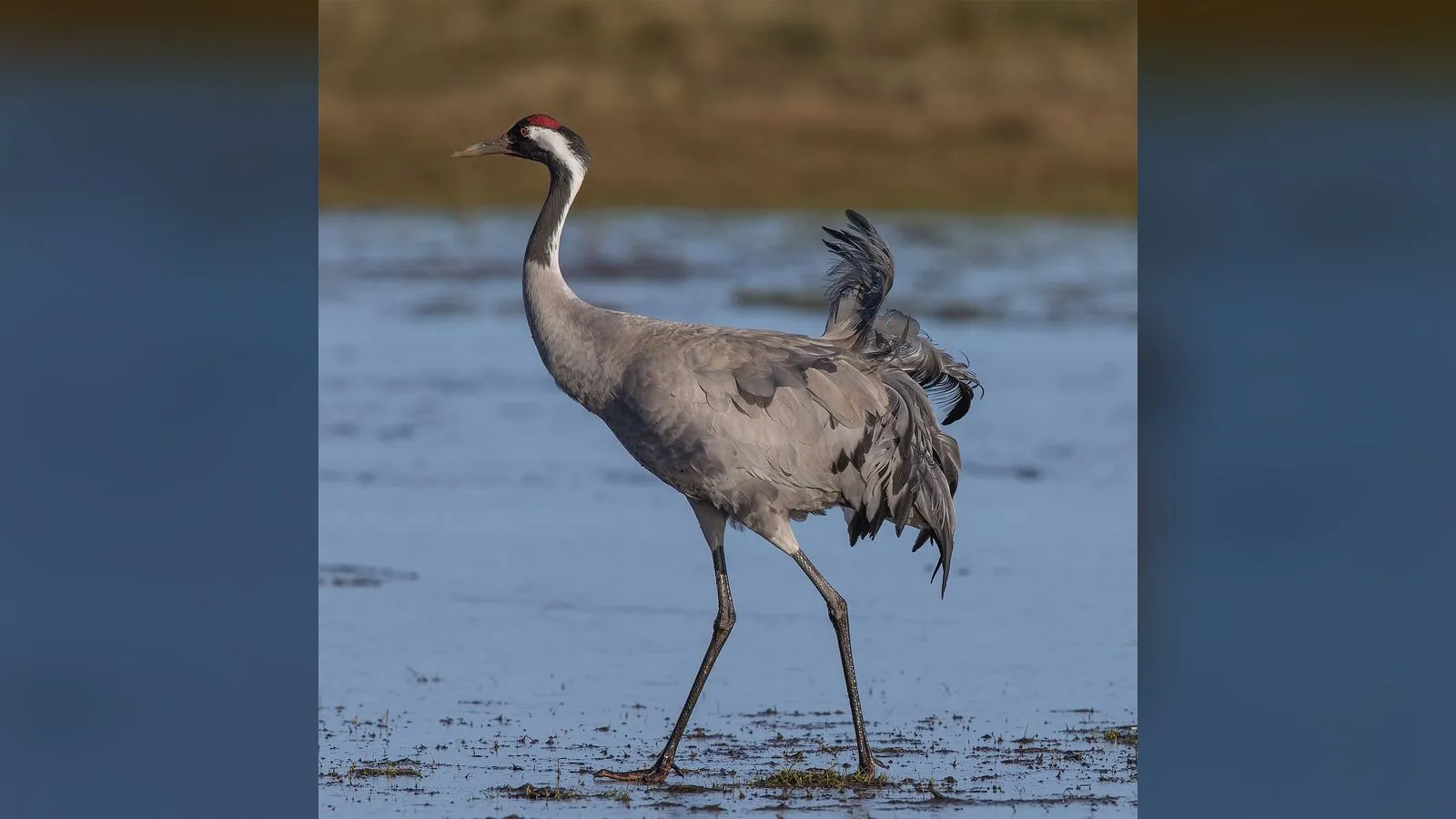

Common Crane (Grus grus)
Contents
TL;DR
- established Common cranes were lost as Scottish breeding birds through habitat loss and hunting, probably during or soon after the 16th century, and were absent as breeders for about 400 years before a pair successfully reproduced in Aberdeenshire in 2012 — the species' first confirmed Scottish breeding success in over four centuries. They did not vanish entirely: migrants were recorded from 1807 onwards and annually since 1969.
- established The Scottish Ornithologists' Club's The Birds of Scotland (2007) gathers the older evidence: crane bones from Bronze Age to Dark Age sites, including chick bones at Howe in Orkney that imply nesting; cranes in the accounts of King James V in the 1520s and 1530s; a price cap of five shillings set by the Scots Parliament in 1551; and 60 cranes seen on Skye by Martin Martin in the late 17th century, possibly the last flock.
- established This return was not achieved through deliberate human reintroduction but through genuine natural recolonisation, with cranes from mainland Europe settling in Norfolk in 1979, after a long recovery of the western European population from the 1960s, before gradually and independently establishing a breeding presence in Scotland decades later — a distinction this article states directly because it reflects real, unassisted range recovery rather than a managed conservation release.
- established Scotland's crane population reached a documented 400-year breeding record in 2025, with 10 breeding pairs fledging nine chicks, up from six pairs in 2024 — a specific, quantified recent achievement this article states with its real figures rather than a vague claim of recovery.
- established Across the UK as a whole, 87 pairs raised 37 chicks in 2025, with the total UK population estimated at around 250 birds — a figure that places Scotland's contribution within the context of a wider, ongoing British recovery rather than an isolated Scottish phenomenon.
- disputed Avian influenza has been estimated to have affected around 10% of the entire western flyway common crane population — roughly 40,000 of an estimated 400,000 birds across the migratory corridor — a serious documented continental-scale threat this article states directly, while noting that the specific, localised impact of this wider flyway mortality on Scotland's own small, recently re-established breeding population has not been separately and precisely quantified.
Key Facts
- Scientific name
- Grus grus
- Category
- Birds
- Extinct in Scotland
- As a breeder, probably by the 16th or 17th century; exact date unknown
- Years absent as a breeder
- About 400
- Gaelic name
- Corra-mhonaidh
- Scottish records to 2004
- About 272 records of 373 birds, mostly spring migrants
- Possible breeding attempt
- Killimster Moss, Caithness, 1997
- First confirmed Scottish breeding (modern era)
- 2012, Aberdeenshire
- Scottish breeding pairs (2025)
- 10 (fledging 9 chicks)
- UK breeding pairs (2025)
- 87 (fledging 37 chicks)
- Total UK population (estimated)
- ~250
A Note on Claims and Evidence
Current breeding figures and the recolonisation timeline are drawn from RSPB-reported survey data. The archaeological and documentary history, and the record of migrants up to 2004, come from the Scottish Ornithologists' Club's The Birds of Scotland (2007), whose crane account is by Mike Betts and Richard A. Schofield; it was written before cranes bred in Scotland again. Old Scottish records are complicated by possible confusion with the grey heron, so the exact date of extinction is treated as uncertain. The avian influenza flyway impact estimate is drawn from published research cited in RSPB reporting. This article treats the scale of wider flyway mortality as Established while noting that its specific, separately measured impact on Scotland's own breeding population remains Disputed in the sense of not being independently quantified in current reporting.
Timeline
Crane bones are left at Scottish sites including Tofts Ness in Orkney, Baleshare on North Uist, Roman Melrose and Edinburgh Castle. Chick bones at the Pictish site of Howe in Orkney imply nesting.
King Ethelbert II of Kent writes to Boniface asking for a pair of gyr falcons, the only falcon strong enough to take a crane.
George Neville's enthronement feast as Archbishop of York lists 204 cranes, already said to be more than England's fowlers could supply.
The first documentary mention of cranes in Scotland, at Dumfries.
King James V's household accounts include cranes from Coldstream, Edinburgh, Fife and Stirling.
Cupar Abbey in Fife buys cranes from a fowler.
A Scots Act of Parliament under Mary, Queen of Scots, caps the market price of a crane at five shillings.
Common cranes probably cease to breed in Scotland, driven out through habitat loss and hunting; across Britain as a whole the species may have died out as a breeder before 1600.
When Elizabeth I visits Kirtling in Cambridgeshire, only a single crane is served, against 70 bitterns, a sign of how scarce the bird had become.
John Leslie, Bishop of Ross, describes cranes as being as common as herons in Scotland, though some later writers suspect he meant herons.
Martin Martin sees 60 cranes on Skye, possibly the last Scottish flock.
A small flock feeding on grain at Tingwall, Shetland, in autumn is the first accepted modern Scottish record.
Only about 20 crane reports in Scotland.
The western European population, much of it lost by the 17th century, begins to recover.
Cranes become annual visitors to Scotland, missing only 1974.
One crane stays on the Ythan Estuary in Aberdeenshire from 26 April 1978 to 13 April 1979.
Cranes from mainland Europe settle in Norfolk.
In the Horsey and Hickling area of east Norfolk breeding begins, and in 1982 a pair rears a young male, the first proven crane breeding success in Britain for about three and a half centuries.
Two cranes spend the summer at Killimster Moss in Caithness, behaving as if they had a chick; breeding is not proven.
Two return to Killimster in April, but one is killed on power lines within a week.
A record 24 Scottish reports involve 42 birds.
A breeding pair successfully reproduces in Aberdeenshire, the first confirmed common crane breeding success in Scotland in over 400 years.
Scotland records six breeding pairs.
Scotland records 10 breeding pairs, fledging nine chicks — a documented 400-year breeding record — while the wider UK records 87 pairs raising 37 chicks, and the total UK population is estimated at around 250 birds.
Studies estimate that avian influenza has affected roughly 10% of the common crane's western flyway population, approximately 40,000 of an estimated 400,000 birds across the migratory corridor.
Details
An extinction and return stated with their real historical weight
This article names the Scottish common crane's history with its full, specific documented timeline: lost as a breeder, probably by the 16th century, through habitat loss and hunting, absent as a breeding bird for about 400 years, before a pair successfully reproduced in Aberdeenshire in 2012 — the first confirmed Scottish breeding success in over four centuries. This article states this timeline directly because the length of the species' absence underscores the genuine significance of its eventual, unassisted return.
Bones, royal accounts and a price cap
established The Birds of Scotland (2007) calls the crane "Scotland's most splendid lost bird" and pieces together its history. Crane bones have been found at archaeological sites from the early Bronze Age to the Dark Ages, at Tofts Ness in Orkney, Baleshare on North Uist, Roman Melrose and Edinburgh Castle. Juvenile bones at Howe in Orkney, from the Pictish period, imply that cranes nested there. The written record begins at Dumfries in 1503. The household accounts of King James V in 1525–33 include cranes from Coldstream (three times), Edinburgh (five), four places in Fife (seven) and Stirling (two), usually for feasts at Easter and Christmas. Cupar Abbey bought cranes from a fowler in the 1540s and 1550s, and in 1551 a Parliament of Mary, Queen of Scots, fixed the maximum market price at five shillings.
shared When the crane stopped breeding in Scotland is uncertain. John Leslie, Bishop of Ross, wrote in 1578 that cranes were as common as grey herons, and the traveller Martin Martin saw 60 on Skye in the late 17th century, perhaps the last flock. In the early 20th century Sir Hugh Gladstone argued that many old Scottish "cranes" were really herons. Writing in 1921, J. H. Gurney noted that James V's accounts list both birds separately, and the authors of The Birds of Scotland think people who paid swan prices for cranes were unlikely to confuse them with herons, so any confusion probably came after cranes had gone. The 16th-century date for extinction is therefore a reasonable estimate rather than a recorded event. Bones of a giant crane, Grus primigenia, from Bronze Age or Iron Age sites at Baleshare and on Jura add a further puzzle; it may have been a very large common crane or the Asian sarus crane.
Four centuries of visitors
established Cranes never vanished from Scottish skies entirely. The first accepted modern record is of a small flock feeding on grain at Tingwall in Shetland in autumn 1807. Shetland produced several more in the 19th century, and others were shot on the Dee in 1851, at Hawick in 1863 and near Stornoway in 1906. There were only about 20 reports by the end of the 1950s, reflecting the low point of the western European population. From 1969 cranes appeared every year except 1974, and by 2004 there had been about 272 Scottish records of 373 birds. Shetland, Orkney, North-east Scotland and Caithness accounted for half of them. Spring birds, peaking in late April and May, outnumbered autumn ones by about six to one. Some stayed for weeks, and one remained on the Ythan Estuary from April 1978 to April 1979.
established In 1997 two cranes spent the summer at Killimster Moss in Caithness, a large, almost impenetrable bog much like the birds' Scandinavian nesting habitat. One regularly flew out to feed and returned, and later the pair were seen walking with heads down as if tending a chick, but tall vegetation hid any young and breeding was never proven. They stayed until 29 November. Two returned in April 1998, but one was killed on power lines within a week. Writing in 2007, Betts and Schofield judged that Scottish numbers would probably keep rising as the European population recovered, and that breeding remained "a possibility for the future". Five years later it happened in Aberdeenshire.
The falconer's quarry and the banquet bird
established Mark Cocker and Richard Mabey, in Birds Britannica (2005), call the crane "a bird of superlatives": Britain's tallest breeding species, with a wingspan greater even than either eagle. Its bugling call, produced by a greatly lengthened windpipe, can carry about 6 km. In medieval Britain it was valued above all as the supreme quarry for falconry. Only the gyr falcon was strong enough to bring one down, and gyrs were reserved for royalty; King John kept them to fly at cranes and is said to have feasted 100 paupers after one good day's hunting.
established Crane was also a prestige roast, equal in cost to swan, bustard or peacock. A fifteenth-century recipe advises winding the neck about the spit and putting "the bill in his breast". The scale of demand is shown by George Neville's feast of 1465, with 204 cranes on the menu. Not everyone liked the meat: the sixteenth-century physician Dr Moffet thought it "hard, tough, gross, sinewy" unless the bird was young and well hung.
shared Drainage and hunting together finished the breeding population. The book suggests it may have gone from Britain even before 1600, which fits this article's date for Scotland, though the book itself gives no separate Scottish date. The "great flocks" Francis Willughby described in Cambridgeshire and Lincolnshire in the late seventeenth century were almost certainly migrants and winterers from northern Europe, not breeding birds.
shared Cranes left their mark on the map. Simon Boisseau and Derek Yalden listed nearly 300 crane place-names across more than 40 counties of Britain and Ireland, from Old English cran (Cranwell, Cranborne) and from the Norse trana (Tranmere in Cheshire). Some are uncertain, because once the crane had gone, the word seems to have been transferred to the grey heron; the Lancashire name "Johnny Crane" for the heron shows the same slippage. Birds Britannica does not discuss Scottish crane place-names, so none are claimed here.
A recovery achieved without deliberate reintroduction
This article states plainly that the species' Scottish return occurred through natural recolonisation rather than a managed conservation reintroduction programme: cranes from mainland Europe first recolonised the wider UK in Norfolk in 1979, gradually extending their range over subsequent decades until reaching Scotland. This article names this distinction directly because it represents a genuinely different conservation story from deliberately managed species reintroductions — this is unassisted range recovery, driven by the birds themselves rather than a human-led translocation programme.
established The Birds of Scotland (2007) explains the background. Much of the western European population had been lost by the 17th century, mainly through wetland drainage, and recovery began only in the 1960s with better protection and wetland restoration. By 2007 some 75,000 cranes used the western migration route from Sweden through northern Germany and France to wintering grounds in France and Spain, and the Scottish visitors were thought to be birds drifted across the North Sea from it. The Norfolk birds, by contrast, were essentially sedentary and still numbered only four breeding pairs in 2000. Later counts of the flyway, around 400,000 birds, show how far that recovery has since gone.
A record year, stated with its actual figures
This article presents Scotland's 2025 breeding record with its real, specific numbers: 10 breeding pairs fledging nine chicks, up from six pairs the previous year, representing the species' best Scottish breeding year in four centuries. This article states these figures directly because they represent genuine, measurable, recent progress rather than a vague assertion of recovery.
A Scottish achievement in its proper UK-wide context
This article situates Scotland's recovery within the wider British picture directly: 87 pairs raised 37 chicks across the UK as a whole in 2025, with the total UK population estimated at around 250 birds. This article states these wider figures because they clarify that Scotland's crane population, while achieving a genuine record, remains a relatively modest fraction of a larger, ongoing British recovery still centred more heavily elsewhere in the country.
A serious continental threat, honestly scoped to what is known
This article states directly the documented scale of avian influenza's impact on the species' western flyway population — an estimated 10% of roughly 400,000 birds across the migratory corridor, around 40,000 individuals — because this represents a genuine, serious, and specifically quantified threat at the continental population level. This article also states honestly that this flyway-wide figure has not been separately broken down to show its specific, localised impact on Scotland's own small, recently re-established breeding population, since asserting a precise Scottish-specific mortality figure would overstate what current reporting actually establishes.
Did You Know?
- Common cranes were extinct in Scotland for over 400 years before a pair successfully bred again in Aberdeenshire in 2012.
- Their return to Scotland was entirely natural, not a managed reintroduction — cranes first recolonised the wider UK in Norfolk in 1979.
- Scotland recorded a 400-year breeding record in 2025, with 10 pairs fledging nine chicks.
- The UK as a whole had 87 breeding pairs in 2025, raising 37 chicks, with a total population of around 250 birds.
- Common cranes are Britain's tallest bird species.
- An estimated 10% of the common crane's entire western flyway population — around 40,000 birds — has been affected by avian influenza.
- Scotland's breeding population, while recovering, remains a modest fraction of the wider UK total.
- A crane's bugling call can carry about 6 km, thanks to an unusually long windpipe.
- In 1465 one archbishop's feast at York served 204 cranes.
- In 1551 the Scots Parliament capped the price of a crane at five shillings.
- Chick bones from the Pictish site of Howe in Orkney show that cranes once nested there.
- King James V's household ate cranes from Coldstream, Edinburgh, Fife and Stirling in the 1520s and 1530s.
- A pair of cranes may have tried to breed at Killimster Moss in Caithness in 1997, 15 years before the first proven modern Scottish breeding.
- Homer compared the noise of migrating crane flocks to armies advancing into battle in the Iliad.
- The crane's wingspan is greater than that of either the golden eagle or the white-tailed eagle.
FAQ
1When did common cranes go extinct in Scotland?
As breeding birds, probably in or soon after the 16th century, driven out by habitat loss and hunting. The exact date is unknown, and cranes continued to appear as migrants: Martin Martin saw 60 on Skye in the late 17th century.
2What evidence is there that cranes once bred in Scotland?
Juvenile crane bones at the Pictish site of Howe in Orkney imply nesting, and cranes appear regularly in the royal accounts of James V and in a 1551 Act of Parliament fixing their price.
3Did cranes visit Scotland before they bred again?
Yes. The first accepted modern record was in Shetland in 1807, and cranes have been annual visitors since 1969, mostly in spring. A pair may have tried to breed in Caithness in 1997.
4How did they return to Scotland?
Naturally — through unassisted recolonisation from mainland Europe, not a deliberate reintroduction programme. The wider UK was first recolonised in Norfolk in 1979.
5When did cranes first breed again in Scotland?
In 2012, in Aberdeenshire — the first confirmed Scottish breeding success in over 400 years.
6How many breeding pairs does Scotland have now?
10 pairs in 2025, fledging nine chicks — a documented 400-year breeding record, up from six pairs in 2024.
7How does this compare to the rest of the UK?
The UK as a whole had 87 breeding pairs in 2025, raising 37 chicks, with a total population of around 250 birds — Scotland's recovery remains a smaller part of a larger British trend.
8Is avian flu a threat to cranes?
Yes — an estimated 10% of the species' western flyway population, around 40,000 birds, has been affected, though the specific impact on Scotland's own small population has not been separately quantified.
9What other threats do cranes face?
Vulnerability to extreme weather events, including drought and flooding, which threaten the wetland habitats they depend on.
10Is the common crane Britain's tallest bird?
Yes — it holds that distinction, standing taller than any other British bird species.
11Why did cranes die out in Britain?
Wetland drainage removed their breeding grounds, and they were heavily hunted, both by falconers and for the table. A crane was a luxury dish on a par with swan and peacock.
12Where did cranes first breed again in Britain?
In the Horsey and Hickling area of east Norfolk, where a pair reared a chick in 1982, the first proven success for about 350 years. Scotland followed in 2012.
13Are there place-names that remember cranes?
Yes, nearly 300 across Britain and Ireland, such as Cranwell and Tranmere. Some may refer to herons instead, because the word "crane" was later applied to the heron once cranes had gone.
Sources and Further Reading
Primary/Institutional
- Forrester, R. W., Andrews, I. J. et al. (eds), The Birds of Scotland (Scottish Ornithologists' Club, 2007), account by Mike Betts and Richard A. Schofield; historical chapters on Scotland's lost birds.
- Record year for Scotland's tallest bird after return from extinction — RSPB
- The occurrence and recolonisation of Common Cranes in Scotland — British Birds
Scholarly/Critical
- Mark Cocker and Richard Mabey, Birds Britannica (Chatto & Windus, 2005)
- The recovery of the Common Crane — Rare Breeding Birds Panel
- Record Crane Breeding in Scotland — Natural World Fund
General
Caveats: Myths and Disputed Claims
- Clarification: This article does not state a specific, separately measured avian influenza mortality figure for Scotland's own crane population; the 10%/40,000-bird figure describes the species' entire western flyway, not Scotland specifically.
- Note: This article does not present the species' Scottish return as a managed conservation reintroduction; it occurred through genuine, unassisted natural recolonisation.
- Do not say cranes were entirely absent from Scotland for 400 years; they were absent as breeders, but migrants were recorded from 1807 and every year since 1969.
- Do not give a precise year for the crane's Scottish extinction; the documentary record thins out in the 16th and 17th centuries and is clouded by possible confusion with the grey heron.
- Do not read every "Cran-" or "Tran-" place-name as proof of breeding cranes; some refer to migrants, and some may refer to the grey heron.
- Do not cite Willughby's seventeenth-century "great flocks" as evidence of a surviving breeding population; they were almost certainly winter visitors.
Card 034 · Wildlife