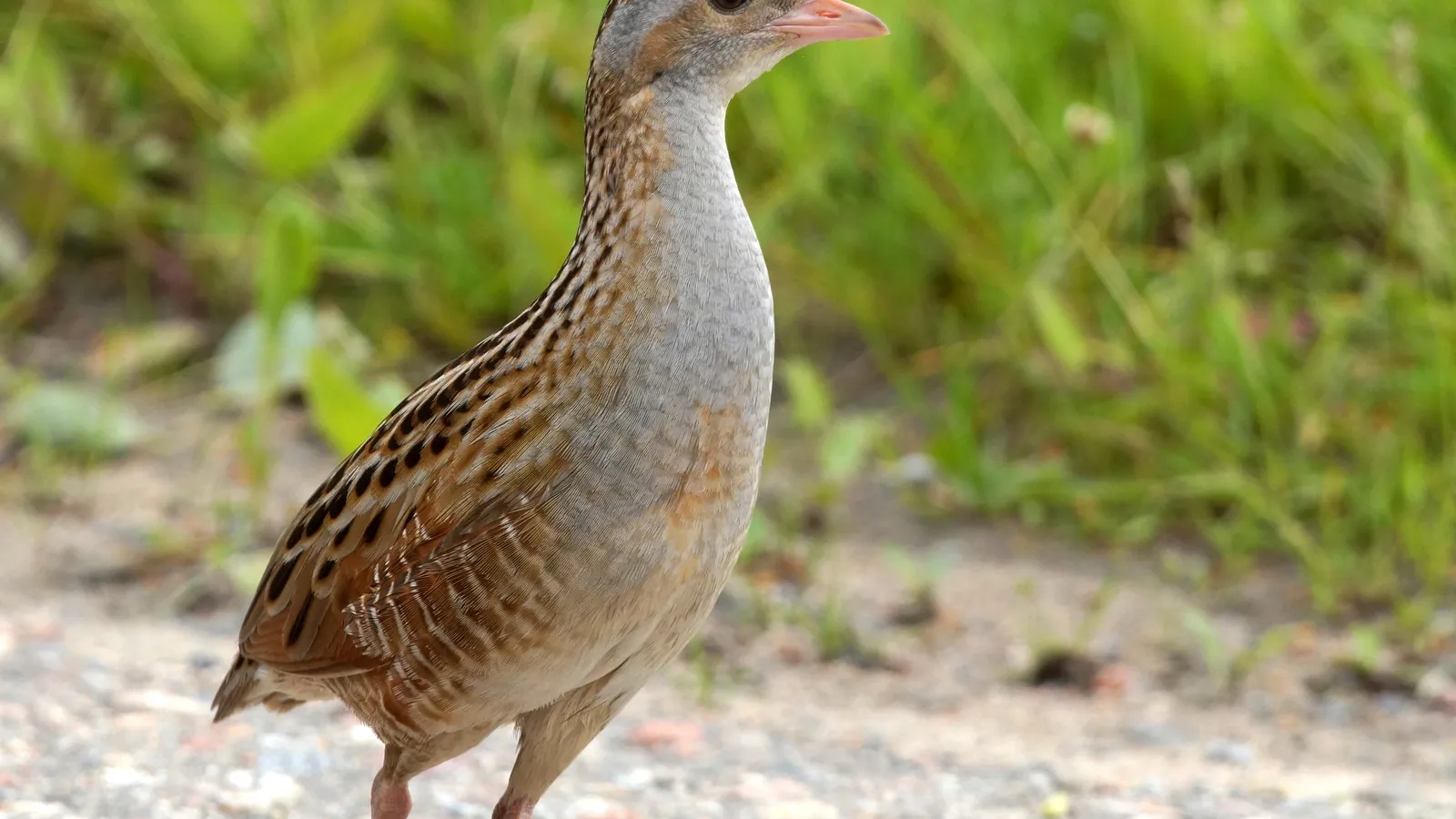

Corncrake (Crex crex)
Contents
TL;DR
- established Corncrakes were once widespread across the UK but collapsed dramatically during the 19th and 20th centuries as a direct result of changing agricultural practices, particularly mechanisation of grass cutting — a direct, documented human cause this article states plainly, with the species now surviving only in isolated pockets of Scotland's western and northern regions.
- established The species' continued Scottish presence is attributed largely to targeted conservation effort, centred on specific agricultural management practices — delayed mowing schedules, planting vegetation for cover, and mowing fields from the centre outward rather than from the edges inward, so birds can escape toward field margins rather than being trapped in a shrinking island of standing grass — a specific, mechanistic explanation this article states directly rather than a vague reference to "habitat management."
- established The Scottish Ornithologists' Club's The Birds of Scotland (2007) documents the earlier turnaround. About 800 calling males were found in 1978–79; numbers fell by about 3.4% a year to 1993, then rose by about 5.6% a year to 1,060 males in 2004, after the RSPB began its recovery programme with Scottish Natural Heritage and crofters in 1992. Delayed and corncrake-friendly mowing was estimated to raise productivity by 23% where applied, enough to explain the change.
- established Despite this conservation framework, Scotland's corncrake population has fallen by approximately one-third since 2014, from 1,289 calling males to 824 in the 2022 RSPB Scotland survey, including a 3% annual decline between 2021 and 2022 alone — a substantial, recent decline this article states directly rather than presenting the species' recovery as secure or complete.
- established This decline is not uniform: the Inner Hebrides recorded a 3.7% increase in the same survey period while the Outer Hebrides suffered a substantial 10.1% drop — a specific, documented regional divergence this article states precisely rather than averaging into a single misleading national trend.
- established RSPB Scotland has stated the situation is "really concerning" and has specifically flagged continued government funding for agri-environment support schemes as vital, particularly given a transition to new agricultural payment systems expected in 2026 — a specific, named policy dependency this article states directly rather than treating the species' future as settled.
Key Facts
- Scientific name
- Crex crex
- Category
- Birds
- Current strongholds
- Western and northern Scotland, including South Uist, Tiree
- Old English name
- Landrail
- Gaelic name
- Traon
- Legal status
- Schedule 1, Wildlife and Countryside Act
- Scottish share of UK population (2003)
- 99%
- Population trend, 1978–2004
- About 800 males (1978–79), falling 3.4% a year to 1993, then rising 5.6% a year to 1,060 (2004)
- Largest island populations (2003)
- Tiree 184, Coll 90, Lewis 105, South Uist 101, North Uist 77, Barra and Vatersay 72
- Breeding
- Arrives mid to late April; often two broods; young full-grown at about 45 days
- Winters
- Africa south of the equator
- Call
- A dry, rasping double note, echoed in the name Crex crex, audible up to about 1 mile (1.6 km) away
- 2014 population (calling males)
- 1,289
- 2022 population (calling males)
- 824
- Decline since 2014
- Approximately one-third
- 2021–2022 annual change
- -3% (national); Inner Hebrides +3.7%, Outer Hebrides -10.1%
Scottish Impact Index (SI Score)
- Scottish Significance
- 9/10
- Ecological Persistence
- 5/10
- Ecological Importance
- 8/10
- Biological Distinctiveness
- 9/10
- Conservation Significance
- 10/10
- Recognition
- 8/10
49/60
Ranked =26th of 42 in Wildlife
A Note on Claims and Evidence
Population figures and regional breakdowns are drawn from RSPB Scotland's own annual survey data. The historical decline cause and current conservation mechanisms (mowing direction, delayed cutting, cover vegetation) are drawn from NatureScot's published assessment. RSPB Scotland's statement on funding vulnerability is reported directly as the organisation's own stated position. The history of the range, the census results from 1978 to 2004, the effect of conservation mowing and the breeding biology come from the Scottish Ornithologists' Club's The Birds of Scotland (2007), whose corncrake account is by Rhys E. Green; those figures are dated history and sit before the later surveys.
Timeline
Corncrakes, once widespread across the UK, decline dramatically as agricultural mechanisation changes grass-cutting practices, eliminating much of the species' former range within a few decades.
Horse-drawn mowing machines begin to replace the hand scythe for cutting grass in Britain; the first signs of the corncrake's disappearance are noted around the middle of the century.
Roughly a quarter of all mown grass east of a line from the Humber to the Severn is cut by machine.
The machine-cut share in that region reaches about 90 per cent, coinciding almost exactly with the corncrake's virtual absence there as a breeding bird.
The corncrake breeds in every county in Britain and has one of the broadest distributions of any bird in Scotland.
The first major inquiry into the decline gathers evidence from correspondents across Britain and Ireland and confirms mechanical mowing as a chief cause.
The bird is most abundant in Orkney, Sutherland, Caithness and the Hebrides, but still common in parts of the Highlands and Central Lowlands.
Probable or confirmed breeding is recorded in 29% of Scotland's 10km squares, including mainland areas from Dumfries and Galloway to the southern Highlands.
A corncrake ringed as an adult on Canna is found in the Republic of the Congo in January, the only recovery from the wintering grounds.
The first comprehensive Scottish count finds about 725 calling males, about 800 after allowing for incomplete island surveys.
Numbers fall by an average of 3.4% a year.
Breeding is confined to northern and western Scotland, especially the Hebrides.
The RSPB launches a recovery programme with Scottish Natural Heritage and the Scottish Crofting Foundation, paying crofters and farmers to delay mowing until after the end of July and to mow from the centre outwards.
Numbers rise by an average of 5.6% a year, in every year except 1998.
Birds Britannica (2005) gives 799 calling males for the remaining population in western Ireland, Orkney and the Hebrides.
A full survey finds 99% of UK corncrakes in Scotland: 48% in the Outer Hebrides, 42% on the Argyll islands, with Tiree alone holding 184 males.
Scotland holds about 1,060 calling males; Tiree has 262 and Coll 134.
Targeted agri-environment schemes, including delayed mowing, cover vegetation planting, and centre-outward mowing patterns, are maintained with Scottish Government support.
RSPB Scotland's annual survey records 1,289 calling male corncrakes.
The survey records 850 calling males.
The survey records 824 calling males, a 3% annual decline from 2021 and a fall of approximately one-third since 2014; regional data shows the Inner Hebrides increasing by 3.7% while the Outer Hebrides falls by 10.1%.
RSPB Scotland identifies continued agri-environment funding as vital to the species' future, specifically flagging the planned transition to new agricultural payment systems expected in 2026 as a point of genuine uncertainty.
Details
A collapse with a direct, mechanised cause
This article states plainly that the corncrake's dramatic 19th–20th century decline was not a vague historical fade but a direct consequence of changing agricultural practices, particularly the mechanisation of grass cutting, which eliminated much of the species' former breeding habitat and directly killed birds and chicks unable to escape machinery moving through standing grass. This article names this cause because understanding the current conservation approach requires understanding the specific threat it was designed to counter.
The landrail, the scythe and the last refuge in the north-west
established Mark Cocker and Richard Mabey, in Birds Britannica (2005), record that in the mid-nineteenth century the corncrake was as widely distributed as any British bird. Mrs Beeton knew it as a table bird under its old name, landrail, and recommended four birds roasted on a skewer. Despite the name, it lived as much in hay meadows as in corn, and also in fields of potatoes, turnips, oats and even nettles.
established The book traces the collapse closely to the spread of the mowing machine. Grass was cut almost entirely by hand until the 1850s. By the First World War about 90 per cent of mown grass east of the Humber and Severn was cut by machine, and the corncrake had virtually gone from that region as a breeding bird. Its retreat then followed the technology's slow spread north and west. The problem was the pattern of the cut as well as the blade: mowers worked from the edge inwards, so escaping birds were trapped in the last stand of hay at the centre, whereas scything had given them time to slip into neighbouring fields. The book also notes that in silage meadows, cut in early summer, chick mortality reaches 95 per cent.
established It is no accident, the authors argue, that the bird's last refuge was the extreme north-west, where mechanisation arrived slowest and crops are harvested latest. That is why the Hebrides, and for a time Orkney, became the British stronghold, and why the centre-outward mowing described below matters so much there.
established The Birds of Scotland (2007) shows how recent much of the Scottish retreat was. In the late 19th and early 20th centuries the corncrake had one of the broadest distributions of any Scottish bird. By the mid-20th century it was most abundant in Orkney, Sutherland, Caithness and the Hebrides but still common in parts of the Highlands and Central Lowlands. As late as 1968–72 breeding was probable or confirmed in 29% of Scotland's 10km squares, including Dumfries and Galloway, Clyde, Argyll, the Borders and Perth and Kinross. By 2003, 98% of Scottish birds were on islands: 48% in the Outer Hebrides, 42% on the Argyll islands, 4% on Skye and the Small Isles and 4% in the Northern Isles, with only 2% on the mainland in Caithness, Sutherland and Wester Ross. Rhys Green found that numbers on each island depended more on the area of grassland managed for hay and silage, and on spring and autumn cover, than on the size of the island.
Cover, two broods and a flightless moult
established Grass in Scotland is usually too short to hide a corncrake when the birds arrive in mid to late April. They depend at first on tall vegetation such as yellow flag iris, nettles, cow parsley, hogweed and reed canary grass along ditches and wetland edges, moving into meadows once the grass passes about 10cm. These patches of cover matter again in late summer, after mowing. Males call at night to attract females and form pair bonds lasting about a week. When about half the first clutch is laid, the male leaves and starts calling again for another mate, and some males pair in turn with up to three females. The female incubates and rears the chicks alone. When her first brood is about 12 days old she usually leaves it, pairs again, often with a different male, and lays a second clutch within days. Most second broods hatch in late July, and some chicks not until late August, which is why late mowing matters so much. Young birds are full-grown at about 45 days.
established After breeding, adults moult all their wing and tail feathers at once and are flightless for three to four weeks. They fatten as they moult, weighing on average 30% more than in midsummer and some up to 60% more, and seem to leave for staging areas in western France soon afterwards. The only ringing recovery from the wintering grounds is of an adult ringed on Canna and found in the Republic of the Congo in January 1978. A chick ringed on Canna in 1980 was found the next June on Islay, more than 140km away, although about half of young males return to within about 10km of where they hatched.
established The corncrake's troubles do not end in Scotland. It winters in tropical Africa, and on passage it is caught in nets set for quail: the book reports about 9,000 taken in Egypt in 1993 and 14,000 the following year.
Living alongside the crofters
established The corncrake is a classic skulker, "more like a rat than a bird", which burrows into the grass at the slightest disturbance. Yet Birds Britannica gathers Hebridean stories of birds that lost their shyness. A woman on Tiree had a corncrake walk in through her front door to feed on kitchen scraps five summers in a row. In 1999 a bird wintered on Barra and took its turn at the chicken feed once the hens had finished.
established The bird is far easier to hear than to see. A calling male stands on a slight rise, stretches its neck skywards and repeats its rasping double note, which the scientific name Crex crex imitates. It can be heard about a mile away, may call for six hours with hardly a pause, and can repeat itself 20,000 times in a night, mostly between midnight and 3 a.m. Fieldworkers have long imitated it to count or lure birds: in the 1930s Bernard Tucker suggested drawing a ruler across the teeth of a comb, or better, across a notched strip of wood or bone, and modern surveyors have used a plastic card and a comb.
A recovery mechanism explained with genuine mechanistic precision
This article states the logic behind "corncrake-friendly mowing" specifically rather than vaguely: fields are mown from the centre outward, rather than from the edges inward, so that birds and chicks sheltering in standing grass can escape toward field margins and surrounding cover as the cut progresses, rather than being driven into a shrinking island of grass at the field's centre that is cut last, trapping them. This article names this specific technique, alongside delayed mowing schedules timed to protect the breeding season and planted cover vegetation, because these represent the concrete, documented mechanisms behind the species' conservation-dependent survival, not a general reference to "habitat management."
established The Birds of Scotland (2007) measures the effect. The RSPB began its recovery programme in 1992, building on research from the 1980s, in partnership with Scottish Natural Heritage and the Scottish Crofting Foundation. Crofters and farmers were paid to delay mowing until after the end of July and to mow from the centre outwards where corncrakes were present. Between 1993 and 2003 an average of 72% of males in the core areas were in 1km squares with land in such schemes. Green estimated that delayed mowing and corncrake-friendly mowing together raise productivity by 23% where applied, and by at least 11% across the core population, enough to turn a decline of 3.4% a year into a rise of 5.6% a year. Creating early and late cover proved harder outside nature reserves, and only 36% of males were in squares with a cover scheme. Nest success on Coll and in the Uists was exceptionally high for a ground-nesting bird, even where crows and introduced hedgehogs were common. Green warned that cutting the resources for these schemes would harm the bird, a warning that RSPB Scotland has repeated since.
A decline stated honestly, not glossed over by past success
This article does not let the corncrake's documented conservation-driven recovery history obscure its current, real decline: Scotland's population has fallen from 1,289 calling males in 2014 to 824 in 2022, a drop of approximately one-third, including a 3% annual fall between 2021 and 2022 alone. This article states these figures directly because presenting the species' status purely through its historical recovery narrative would misrepresent a genuine, recent, and substantial reversal.
A regional divergence too stark to average away
This article names the uneven geography of this recent decline specifically: the Inner Hebrides recorded a 3.7% increase over the same period that the Outer Hebrides suffered a 10.1% drop. This article states both figures because collapsing them into a single national percentage would obscure a genuinely divergent regional picture, with implications for where conservation attention and resources may be most urgently needed.
A future genuinely dependent on policy decisions still to be made
This article states RSPB Scotland's own position directly: the organisation has described the recent decline as "really concerning" and has specifically named continued agri-environment funding, and the uncertain transition to new agricultural payment systems expected in 2026, as a vital, unresolved factor in the species' future. This article names this policy dependency because it clarifies that the corncrake's Scottish survival is not a settled conservation achievement but remains actively contingent on future funding and policy decisions.
Did You Know?
- Corncrakes were once widespread across the UK before agricultural mechanisation drove them to the edge of extinction here.
- The species now survives in Scotland largely because of deliberate, specific farming practices, including mowing fields from the centre outward so birds can escape.
- Scotland's corncrake population fell from 1,289 calling males in 2014 to 824 in 2022, a decline of approximately one-third.
- The Inner Hebrides saw a 3.7% population increase in 2022, while the Outer Hebrides saw a 10.1% decline, in the same survey year.
- RSPB Scotland has called the recent decline "really concerning."
- The species' future is specifically tied to continued agri-environment funding, with a transition to new agricultural payment systems expected in 2026.
- South Uist and Tiree are among the species' key remaining Scottish strongholds.
- A calling male can repeat its rasping note 20,000 times in a single night, mostly between midnight and 3 a.m.
- Victorian cooks knew the bird as the landrail; Mrs Beeton recommended roasting four on a skewer.
- A corncrake on Tiree walked into one woman's house through the front door to eat kitchen scraps five summers running.
- Surveyors have coaxed males into calling by running a plastic card along a comb.
- As recently as 1968–72, corncrakes bred in nearly a third of Scotland's 10km squares.
- After breeding, corncrakes shed all their flight feathers at once and cannot fly for three to four weeks.
- A corncrake ringed on Canna was found in the Republic of the Congo in 1978.
- Female corncrakes often leave their first brood at about 12 days old to start a second family with a new mate.
FAQ
1Why did corncrakes decline so severely?
Agricultural mechanisation, particularly changes to grass-cutting methods, directly eliminated much of their breeding habitat and killed birds unable to escape machinery.
2How does "corncrake-friendly mowing" work?
Fields are mown from the centre outward rather than the edges inward, allowing birds and chicks to escape toward field margins rather than being trapped in a shrinking patch of grass.
3Has the species recovered?
Partially, and not currently — after historical conservation-driven recovery, the population has fallen by about a third since 2014, to 824 calling males in 2022.
4Is the decline the same everywhere in Scotland?
No — the Inner Hebrides saw a 3.7% increase in 2022 while the Outer Hebrides saw a 10.1% decline in the same year.
5Where are corncrakes found in Scotland today?
Primarily western and northern Scotland, including islands such as South Uist and Tiree.
6What does the species need to survive long-term?
Continued, specific agri-environment support for delayed mowing, cover vegetation, and corncrake-friendly mowing patterns.
7Is funding for this conservation approach secure?
No — RSPB Scotland has specifically flagged uncertainty around a transition to new agricultural payment systems expected in 2026 as a vital, unresolved issue.
8Why did the corncrake hold on in the Hebrides when it vanished elsewhere?
Mechanised mowing reached the far north-west last, and crops there are cut later in the season, giving chicks time to fledge. Small-scale crofting kept the mixed, late-cut grassland the bird needs.
9How did mowing machines kill so many birds?
Early mowers cut from the field edge inwards, so adults and chicks retreated into the last patch of standing grass at the centre and were caught there. Hand scything had been slower and let them escape.
10What does a corncrake sound like?
A dry, rasping double note, echoed in the name Crex crex, repeated for hours on end, mostly at night. It can carry about a mile.
11Is the corncrake protected by law?
Yes. It is listed on Schedule 1 of the Wildlife and Countryside Act, which protects it from disturbance at the nest, and it is the focus of targeted agricultural support schemes.
12How well did the conservation schemes work at first?
Very well. The Birds of Scotland (2007) records a decline of 3.4% a year from 1978 to 1993, then a rise of 5.6% a year to 1,060 males in 2004, after the recovery programme began in 1992.
13Where do Scottish corncrakes spend the winter?
In Africa south of the equator. A bird ringed on Canna was found in the Republic of the Congo in January 1978.
14Why is late mowing so important?
Many females raise a second brood, and some chicks do not hatch until late July or August. Mowing before then destroys nests and kills chicks that cannot yet fly.
Sources and Further Reading
Primary/Institutional
- Forrester, R. W., Andrews, I. J. et al. (eds), The Birds of Scotland (Scottish Ornithologists' Club, 2007), account by Rhys E. Green.
- Corncrake — NatureScot
- Decline in Scottish corncrake population branded 'concerning' by RSPB Scotland — STV News
Scholarly/Critical
- Mark Cocker and Richard Mabey, Birds Britannica (Chatto & Windus, 2005)
- Corncrake: Conservation — RSPB
- Scottish Corncrake project reaches milestone thanks to farmers' efforts — Farmers Guide
General
Caveats: Myths and Disputed Claims
- Clarification: This article does not present the corncrake's Scottish survival as a secured conservation achievement; its future depends on continued, specific agricultural funding currently facing genuine policy uncertainty.
- Note: This article does not describe the recent decline as uniform across Scotland; regional data shows a genuine divergence between the Inner and Outer Hebrides in the same survey year.
- Do not describe the corncrake as a naturally Hebridean bird: until the mid-nineteenth century it bred across almost all of Britain, and the islands are a last refuge, not its original home.
- Do not imply the corncrake vanished from mainland Scotland in the 19th century; it still bred widely on the mainland as late as 1968–72.
- Do not treat the 1998 figure of 799 calling males as a current count; it is a historical figure covering western Ireland as well as Scotland.
Card 032 · Wildlife