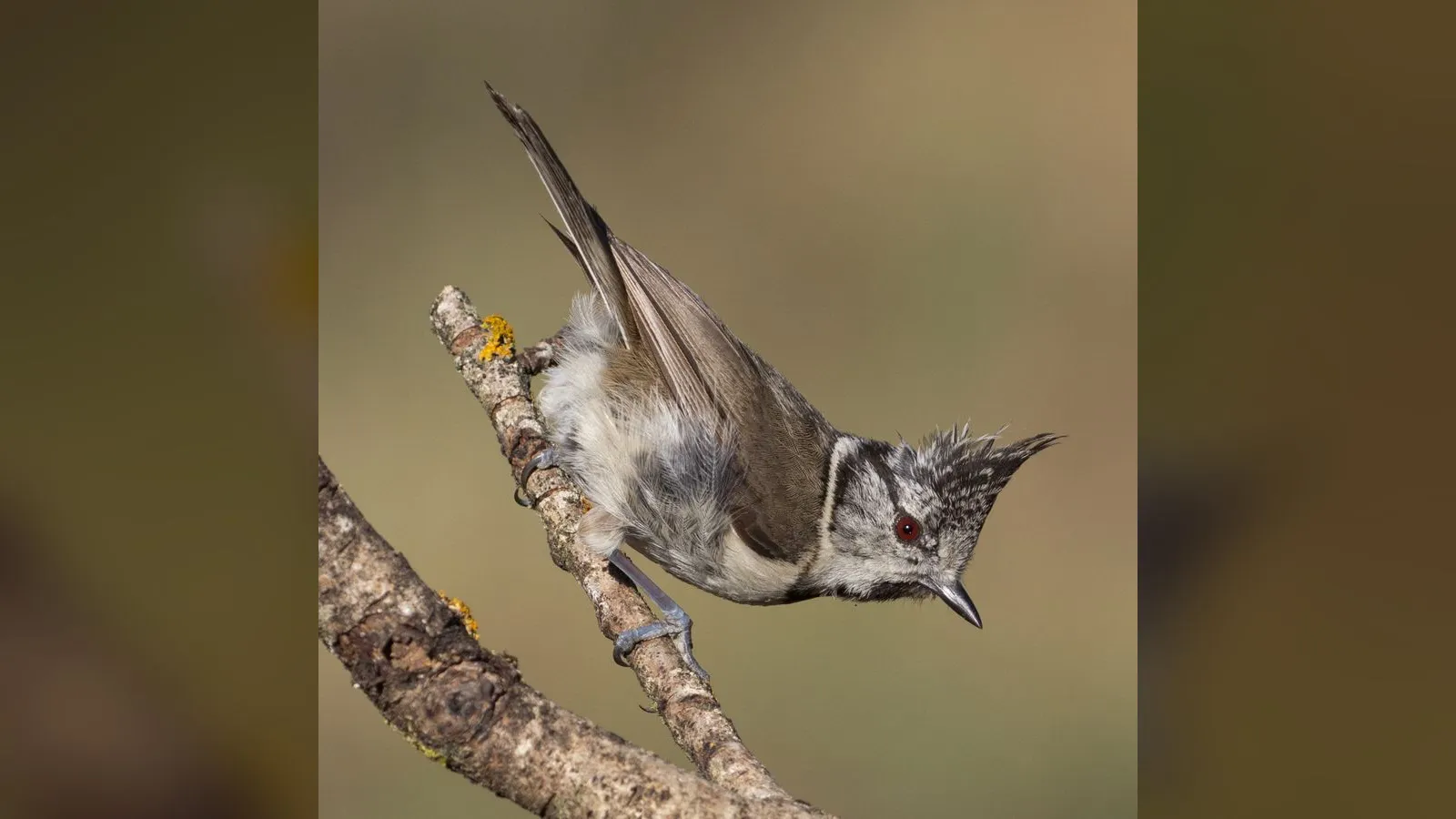

Crested Tit (Lophophanes cristatus)
Contents
TL;DR
- established The crested tit is confined within Britain entirely to Scotland's specialised pine forests, found nowhere else in the UK despite inhabiting large parts of continental Europe — a genuine, documented habitat restriction this article states directly rather than a general claim of Scottish rarity.
- established The species depends on a specific nesting requirement: the female excavates a chamber in soft, rotting wood. In a classic sample of 324 Scottish nests, 74% were in pine stumps and 14% in dead pines, and over 90% were less than 3m above the ground. Stumps or dead trees need to be at least about 20cm across.
- established The two familiar population figures measure different things and fit together. A 1992–95 survey estimated 5,600–7,900 birds in winter; the Scottish Ornithologists' Club's The Birds of Scotland (2007) converts this to roughly 1,700 breeding pairs the following spring and puts the population at 1,000–2,000 pairs. The British Trust for Ornithology's figure of about 1,000 pairs in 59 occupied 10km squares sits within that range.
- established Bird density in ancient native Caledonian pinewoods is roughly ten times higher than in commercial Scots pine plantations, even though plantations now hold the majority of individual birds — a specific, documented habitat-quality finding this article states precisely rather than treating all pine forest as equally valuable habitat.
- established The bird was a rarity in the 19th century. It was first recorded in Scotland in 1789, and by the late 1800s it apparently bred only along a 50km stretch of Strathspey. Pine planting since then has let it recolonise much of its former range.
- disputed The species remains notably absent from some areas of apparently suitable pine forest habitat, including Deeside and Rannoch, and researchers have not established a confirmed explanation for these specific absences — a genuinely open question this article presents as such, alongside the documented role of poor dispersal ability and treeless habitat gaps in limiting the species' overall range expansion.
Key Facts
- Scientific name
- Lophophanes cristatus
- Category
- Birds
- UK range
- Scotland only
- Population estimate (breeding pairs, BTO)
- Approximately 1,000
- Population estimate (individuals, winters 1992–95)
- 5,600–7,900
- Population range (The Birds of Scotland, 2007)
- 1,000–2,000 pairs
- Legal status
- Schedule 1, Wildlife and Countryside Act
- Breeding
- Laying from mid-April; about 6 eggs; incubation 13–16 days; fledging after 18–19 days
- Gaelic name
- Gulpag-stuic
- Density: native pinewood vs. plantation
- Roughly 10x higher in native pinewood
- UK conservation status
- Green-listed (least concern)
- Key nesting requirement
- Standing dead pine ("snag"), typically ~10 years dead
- Scottish subspecies
- scoticus, endemic to the Highlands
- Core areas
- Strathspey, Moray Firth coastal plain, Easter Ross, south-east Sutherland, glens west of the Great Glen
- Emblem
- Scottish Ornithologists' Club, since 1947
Scottish Impact Index (SI Score)
- Scottish Significance
- 9/10
- Ecological Persistence
- 8/10
- Ecological Importance
- 7/10
- Biological Distinctiveness
- 9/10
- Conservation Significance
- 8/10
- Recognition
- 7/10
48/60
Ranked =29th of 42 in Wildlife
A Note on Claims and Evidence
Population figures, density comparisons, and habitat requirements are drawn from the British Trust for Ornithology and Trees for Life published assessments. History, distribution, breeding biology and the reconciliation of the population figures come from the Scottish Ornithologists' Club's The Birds of Scotland (2007), whose crested tit account is by Martin Cook. Its figures date from the 1990s and early 2000s and are given as such. The cause of the species' absence from some apparently suitable habitat areas is treated as genuinely Disputed, reflecting researchers' own acknowledged uncertainty.
Timeline
Before large-scale clearance of the Caledonian Forest, crested tit numbers in Scotland are believed to have been substantially greater than today, reflecting the historically far larger extent of native pinewood habitat.
Large-scale clearance of Scotland's native Caledonian pine forest fragments the species' habitat into isolated patches separated by treeless ground the birds struggle to cross, geographically isolating the Scottish population.
John Walcott's Synopsis of British Birds gives the first Scottish record.
William MacGillivray calls the bird "extremely rare".
Breeding is apparently confined to a 50km stretch of Strathspey.
The species spreads down the Spey to Fochabers and along new dune plantations between Kingston and Nairn.
The Scottish Ornithologists' Club adopts the crested tit as its badge and emblem.
A baseline national bird atlas survey period against which later range changes are measured.
A party of 13 in Glen Quoich, Deeside, on 18 September raises hopes that it will colonise Deeside; it does not.
A dedicated survey maps the range and estimates about 885 pairs.
A national winter survey estimates 5,600–7,900 birds, equivalent to roughly 1,400–2,000 pairs the following spring.
The species is found in 114 occupied woods; it has gone from around Loch Laggan and Glen Spean.
Deep nestboxes packed with sawdust raise use in Lossie Forest from 1.5 to 6.3 pairs a year.
Birds Britannica gives a relict population of about 900 pairs, largely confined to Old Caledonian forest and mature Scots pine in the Spey valley, around the Moray Basin and along the Great Glen.
The Birds of Scotland puts the population at 1,000–2,000 pairs.
The species' occupied range expands by approximately 28.3%, though this figure may partly reflect increased birdwatcher observer coverage rather than genuine population growth.
The British Trust for Ornithology estimates approximately 1,000 breeding pairs across just 59 occupied 10km squares, with the species remaining UK Green-listed, while continuing to depend on both native pinewoods and commercial plantations, the former supporting roughly ten times the bird density of the latter.
Details
A restriction worth stating with its real cause
This article names the crested tit's confinement to Scotland directly rather than treating it as simple rarity: although the species inhabits large parts of continental Europe, its British range is restricted entirely to Scotland's specialised pine forests, which provide specific habitat conditions unavailable elsewhere in the UK. This article states this because understanding the species' vulnerability requires understanding that its entire British population depends on one specific, limited habitat type found in one part of the country.
A nesting requirement stated with genuine mechanistic precision
This article describes the crested tit's nesting ecology with its real, specific detail rather than a general reference to "tree cavities": birds excavate nest chambers in rotting pine, usually in wood long enough dead for fungal decay to soften the sapwood. Trees for Life gives a figure of around ten years dead. The point matters because a shortage of decaying wood, not simply a shortage of trees in general, can constrain the species' breeding capacity.
established The Birds of Scotland (2007) corrects the common picture of a nest high in a standing dead tree. In a survey of 324 nest sites by Desmond Nethersole-Thompson and Adam Watson, 74% were in pine stumps, 14% in dead pines and only 2.5% in living pines; others were in birch and alder stumps and rotten fence posts. Over 90% were below 3m, though the highest were over 13m up. The female digs into the soft sapwood and builds the nest between the heartwood and the bark, so only stumps more than about 20cm across can hold a chamber. Median cavities measured 18cm deep. At Abernethy birds avoided the south-west side of stumps, perhaps to keep out sun or driving rain. In Culbin and Lossie Forests the birds took to deep nestboxes packed with sawdust and shavings, which let them excavate a fresh, flea-free chamber each year.
established Laying usually begins in mid-April, though in coastal Lossie Forest it can start as early as 5 April. Clutches average about six eggs: 5.9 in a Strathspey sample of 151 and 5.7 in Lossie Forest. The female builds the nest of moss lined with fur and spider silk and incubates for 13–16 days. Both parents feed the young, which fledge after 18–19 days. Birds breed at one year old, often within a kilometre or two of where they hatched.
Two population figures, and how they fit
established The two figures most often quoted measure different things. The British Trust for Ornithology gives approximately 1,000 breeding pairs across 59 occupied 10km squares. A national survey over the winters of 1992–95 by Ron Summers and colleagues counted winter groups, averaging about 2.5 birds each, and estimated 5,600–7,900 individuals. The Birds of Scotland (2007) shows how to get from one to the other. Using Scandinavian survival rates, about 59% of winter groups end up as a breeding pair in spring, 24% as a lone male and 17% with no survivors. That gives around 1,700 pairs, in a range of 1,362–1,954 pairs for 1993–95, plus about 700 unmated birds. The account concludes that the population probably fluctuates between 1,000 and 2,000 pairs. An earlier estimate from a 1979–80 survey was about 885 pairs, close to the 900 pairs quoted in Birds Britannica.
A quality difference between habitats, stated precisely
This article names the documented difference in habitat quality directly: bird density in ancient native Caledonian pinewoods runs at roughly ten times the level found in commercial Scots pine plantations, even though plantations, which expanded significantly through the 20th century, now hold the majority of individual birds by sheer area. This article states this because it clarifies that not all pine forest is equally valuable to the species, a distinction relevant to habitat management and restoration priorities.
established The 1992–95 survey found that ancient native pinewoods held 35% of the winter population while making up only 4.7% of the woodland. The Birds of Scotland notes that the reason for the tenfold difference has not been satisfactorily explained: it may be food supply, the supply of large dead trees for nesting, or something else. Heather under the trees matters too, especially in winter, when birds may spend up to a quarter of their time foraging on the ground.
A bird that stays at home
established Adults are among the most sedentary of Scottish birds. At Abernethy, territories of about 0.13–0.15 square kilometres were held all year, and ringed adults were never found more than 2km away, even one retrapped nearly eight years after ringing. Young birds disperse a little further, up to about 7km in the few recorded cases, and occasionally turn up in reedbeds, willow scrub or village gardens while moving between woods. In winter birds live in small groups of up to six, usually the resident pair and young from other pairs. In autumn they store caterpillars of the bordered white moth among lichens or under bark flakes, and this cached food is thought to help them through the winter.
From rarity to recovery
established The crested tit probably once lived throughout the Caledonian forest, and its range shrank and broke up as the forest was cleared. It was first recorded in Scotland by John Walcott in 1789. Thomas Bewick thought it a rare visitor, and William MacGillivray in 1839 called it "extremely rare". In the late 19th century it apparently bred only along a 50km stretch of Strathspey and was much rarer than it is now. Planting of Scots pine from the end of the 18th century let it spread again. Between about 1860 and 1940 it moved down the Spey to Fochabers and then along the new dune plantations between Kingston and Nairn. By the 1990s it occupied 114 woods, from upper Strathspey, the Moray Firth coast, Easter Ross and south-east Sutherland to the west Highland glens from Strathconon to Glen Affric, Glen Moriston and Glen Garry.
Absences that remain genuinely unexplained
This article addresses directly, rather than passing over, a specific puzzle in the species' distribution: crested tits remain notably absent from some areas of apparently suitable pine forest habitat, including Deeside and Rannoch, and researchers have not established a confirmed reason for these particular gaps. This article presents this as an open question, alongside the better-understood general constraint that the species' poor dispersal ability means birds struggle to cross the large gaps of treeless ground separating Scotland's fragmented forest patches, limiting natural range expansion even where suitable habitat exists elsewhere.
established The Birds of Scotland (2007) calls the absence from Deeside "a puzzling gap". The Cairngorms block movement east from Strathspey, and the mainly Sitka spruce plantations of lower Banffshire and Donside offer little route in from the north. Birds were seen in Deeside in nine years between 1968 and 2004, including 13 in Glen Quoich in September 1973, but none stayed to breed. Perth and Kinross, which includes Rannoch, had only two sets of records, in 1932–33 and 1983. The account accepts that the species' sedentary habits could explain the gap but says there is no clear explanation.
A Highland endemic race and a national emblem
established Mark Cocker and Richard Mabey, in Birds Britannica (2005), describe the crested tit as a relict population, then about 900 pairs, largely confined to Old Caledonian forest and mature Scots pine in the Spey valley, around the Moray Basin and along the Great Glen. Its nearest neighbours are in southern Norway and in northern Belgium and France, and both belong to different races. The Highland birds are classed as a separate endemic subspecies, scoticus. That rarity and distinctiveness led the Scottish Ornithologists' Club to choose the crested tit as its badge and emblem in 1947. It is also the only small British bird with a tall, spiky crest, which makes it easy to identify within its narrow range.
established Like most sedentary small birds, the crested tit suffers in hard Highland winters, when it has been known to leave the woods for garden bird tables. The book adds two less dignified habits: it will feed on the gralloch, skin and fat of shot hinds, particularly carcasses that keepers have hung in trees, and it occasionally raids dustbins.
established The Birds of Scotland (2007) describes six subspecies across Europe, with scoticus confined to Scotland, mitratus in northern France and cristatus from Scandinavia eastwards. Continental birds have strayed to England about ten times, mostly in the 19th century, so a crested tit seen in Scotland outside the usual range should be checked carefully. The bird is protected under Schedule 1 of the Wildlife and Countryside Act. The account's main conservation advice is that Scots pine must remain a major plantation tree, with long rotations and dead trees and stumps left standing.
Did You Know?
- The crested tit is found nowhere else in the UK outside Scotland, despite being widespread across continental Europe.
- Most nests are dug into rotting pine stumps, usually less than 3m from the ground.
- In the late 19th century the bird apparently bred only along a 50km stretch of Strathspey.
- A ringed adult was retrapped nearly eight years later within 2km of where it was ringed.
- Population estimates range from around 1,000 breeding pairs to around 7,000 individuals in winter; they measure different things and are broadly consistent.
- Bird density in ancient native Caledonian pinewoods is roughly ten times higher than in commercial pine plantations.
- The species remains puzzlingly absent from some areas of seemingly suitable habitat, including Deeside and Rannoch.
- Crested tits have poor dispersal ability, struggling to cross treeless gaps between fragmented forest patches.
- The presence of crested tits is considered an indicator of a pine forest's ecological health.
- Scottish crested tits form their own endemic subspecies, scoticus.
- The crested tit has been the emblem of the Scottish Ornithologists' Club since 1947.
- In winter crested tits have been seen feeding on the fat of deer carcasses hung up by keepers.
FAQ
1Why is the crested tit only found in Scotland within the UK?
Its British range is restricted to Scotland's specialised pine forests, which provide specific habitat conditions unavailable elsewhere in the UK, even though the species is widespread in continental Europe.
2How many crested tits are there in Scotland?
The Birds of Scotland (2007) puts the population at 1,000–2,000 pairs. The British Trust for Ornithology gives about 1,000 pairs, and a 1992–95 winter survey estimated 5,600–7,900 birds, which converts to roughly 1,700 pairs in spring.
3What kind of tree do crested tits nest in?
Mostly rotting pine stumps, and sometimes dead standing pines, birch or alder stumps or old fence posts. The wood must be decayed enough for the female to excavate, and at least about 20cm across.
4When did crested tits first appear in Scottish records?
John Walcott recorded the species in Scotland in 1789. Through the 19th century it was considered very rare.
5Do crested tits use nestboxes?
Yes, especially deep boxes packed with sawdust and wood shavings, which let them dig out a chamber as they would in a stump. These have been used successfully in Culbin and Lossie Forests in Moray.
6Is native pinewood better habitat than plantation forest?
Yes — bird density in ancient native Caledonian pinewood is roughly ten times higher than in commercial Scots pine plantations.
7Why don't crested tits live in all suitable-looking pine forest?
This is genuinely unclear in some cases — the species remains absent from areas like Deeside and Rannoch for reasons researchers have not confirmed, while poor dispersal ability across treeless gaps limits range expansion more generally.
8Is the crested tit considered at risk?
No — it is currently UK Green-listed, reflecting least conservation concern, though it remains fully dependent on pinewood habitat availability and quality.
9Have crested tit numbers always been this low?
No — numbers are believed to have been substantially greater before large-scale historical clearance of the Caledonian Forest.
10Does plantation forest help the species?
Yes, to an extent — Scots pine plantation expansion has supported population growth, though at much lower bird densities than native pinewood.
11Are Scottish crested tits different from continental ones?
Yes. The Highland birds are classed as an endemic subspecies, scoticus; the nearest populations, in southern Norway and in northern Belgium and France, belong to other races.
12Why is it the emblem of the Scottish Ornithologists' Club?
The club chose this rare Highland speciality as its badge in 1947, reflecting the bird's close tie to Scotland's native pinewoods.
13Why is it sometimes called Parus cristatus?
Older works, including Birds Britannica (2005), place it in the genus Parus with other tits; most current lists use Lophophanes cristatus.
Sources and Further Reading
Primary/Institutional
- Forrester, R. W., Andrews, I. J. et al. (eds), The Birds of Scotland (Scottish Ornithologists' Club, 2007), account by Martin Cook.
- Crested Tit — British Trust for Ornithology
- Crested tit facts and information — Trees for Life
Scholarly/Critical
- Mark Cocker and Richard Mabey, Birds Britannica (Chatto & Windus, 2005)
- Our forgotten endemics — BirdGuides
- Crested tit wintering survey in the UK, 1992-1995 — NBN Atlas
General
Caveats: Myths and Disputed Claims
- Clarification: The winter count of 5,600–7,900 birds and the figure of about 1,000 pairs are not contradictory evidence of population change; one counts individuals in winter, the other breeding pairs.
- Note: This article does not offer a confirmed explanation for the species' absence from areas like Deeside and Rannoch; this remains a genuinely open question in the published research.
- Do not say crested tits nest mainly high in standing dead trees; most Scottish nests are in rotting stumps, less than 3m up.
- Do not imply the bird has always been as widespread as it is today; in the late 19th century it was confined to a short stretch of Strathspey.
Card 021 · Wildlife