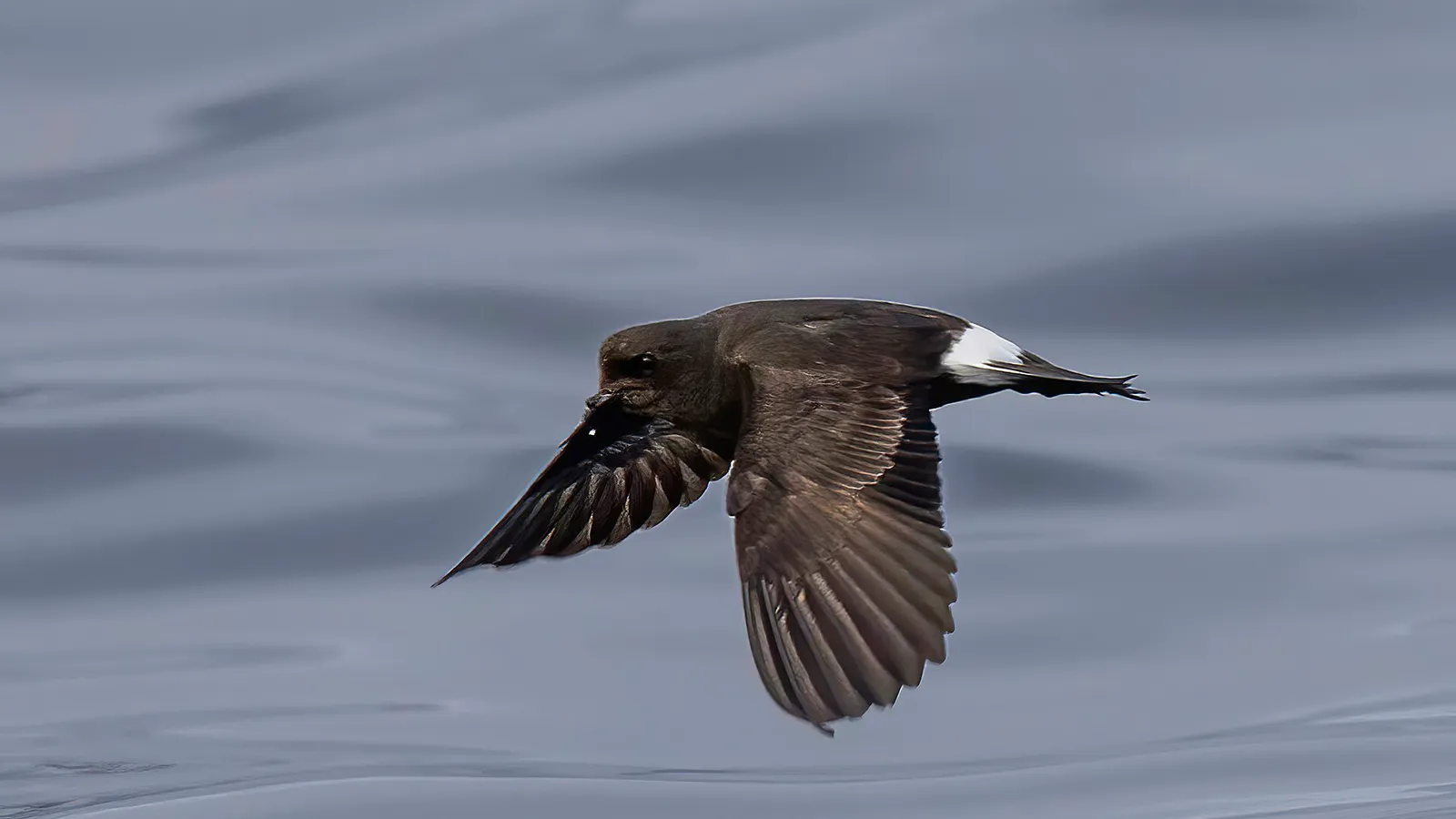

European Storm Petrel (Hydrobates pelagicus)
Contents
The European storm petrel is the world's smallest seabird, a sooty, sparrow-sized bird with a white rump that patters over the waves. It nests in crevices and walls on predator-free islands and comes ashore only at night, which has made it one of Scotland's hardest birds to count.
TL;DR
- established The European storm petrel spends almost its entire life at sea, returning to hidden burrows on remote islands only under cover of darkness to breed — a specific, documented behaviour this article states directly, because it is precisely this nocturnal, secretive habit that makes the species exceptionally difficult to monitor compared with more visible seabirds.
- established Mousa, Shetland, hosts the UK's largest colony, with approximately 11,000 breeding pairs representing around 2% of the entire global population — a specific, documented global significance this article states with its real figures rather than a vague claim of importance.
- established A resurvey of the Mousa colony found its population growth had become arrested rather than continuing to increase as earlier trends suggested — a specific, documented finding this article states directly rather than assuming the colony's historic growth trajectory has simply continued unchanged.
- established Pioneering GPS tracking of 42 individual Mousa birds across four breeding seasons revealed unexpected foraging patterns, with tagged birds concentrating on two specific areas rather than the continental shelf edge previously assumed, typically ranging up to 300km to feed, with one bird travelling nearly 400km to the Norwegian coast and back within 24 hours — a specific, documented research correction to prior assumptions this article states directly.
- established Individual storm petrels can live for over 30 years, a remarkable longevity for such a small seabird — a real, documented fact this article states plainly because it underscores why sustained, long-term monitoring, rather than occasional snapshots, is necessary to properly understand a population's actual trajectory.
- established The Scottish Ornithologists' Club's The Birds of Scotland (2007) gives a Scottish total of at least 31,570 apparently occupied sites, about 83% of the British population but only about 4% of the world's. Bernie Zonfrillo's account there notes that Mousa's apparent rise from 6,800 sites (1996) to 14,000 (2004) could be explained solely by differences in survey calculation.
- established In Orkney the bird was the alamotti or mootie, and in Shetland the ala mootie. Sailors knew it as Mother Carey's chicken and treated it as an omen of storms.
Key Facts
- Scientific name
- Hydrobates pelagicus
- Category
- Seabirds
- UK breeding population
- ~30,000 pairs
- Mousa, Shetland colony
- ~11,000 pairs (UK's largest; ~2% of global population)
- Maximum recorded lifespan
- 30+ years
- Typical foraging range
- Up to 300km
- Weight
- About 28g (1oz)
- Scottish names
- Alamotti, Mootie (Orkney); Ala Mootie (Shetland)
- Britain and Ireland estimate cited in 2005
- 160,000 pairs, described as "highly speculative"
- Scottish population (1999–2002, historical)
- At least 31,570 apparently occupied sites, about 4% of world (The Birds of Scotland)
- Other major Scottish colonies (c. 2000)
- Treshnish Isles about 5,000; Summer Isles about 4,400 (mostly Priest Island); St Kilda about 1,100; Auskerry 994
- Oldest Scottish bird
- A few days short of 32 years
- Wintering area
- South Atlantic off Namibia and South Africa
- Gaelic name
- Annlag-fairge
Scottish Impact Index (SI Score)
- Scottish Significance
- 8/10
- Ecological Persistence
- 7/10
- Ecological Importance
- 8/10
- Biological Distinctiveness
- 8/10
- Conservation Significance
- 9/10
- Recognition
- 6/10
46/60
Ranked =35th of 42 in Wildlife
A Note on Claims and Evidence
Behavioural, colony significance, and UK population figures are drawn from published Scottish and UK research reporting. The Mousa resurvey finding on arrested population growth, and the GPS tracking study findings on foraging patterns and range, are drawn from peer-reviewed research and contemporaneous research reporting on the Mousa colony specifically. Names, folklore and the older population estimate come from Mark Cocker and Richard Mabey's Birds Britannica (2005). That book's estimate covered Britain and Ireland together and predates modern survey methods, so it should not be compared directly with the UK figure above.
The historical colonies, the 1999–2002 survey, ringing results and breeding biology come from Bernie Zonfrillo's account in the Scottish Ornithologists' Club's The Birds of Scotland (2007). Its figures are history beside the later Mousa resurvey and tracking work.
Timeline
Martin Martin records the storm petrel on St Kilda, the first Scottish record; other old colonies are known around Skye, Canna, Rum, Eigg and Soa off Iona.
Storm petrels breed on Ailsa Craig, probably until brown rats reach the island in 1889.
Breeding sites are known in Shetland, Orkney, Islay, Mull and many islets of the north-west and the Outer Hebrides.
Lighthouse keepers find a bird on an egg on the Bass Rock, a rare Firth of Forth breeding record.
A storm-driven bird is found in Princes Street, Edinburgh.
Eddie Maguire discovers on Sanda that playing recorded calls lures storm petrels, opening up ringing and counting.
Mousa is estimated at 6,800 apparently occupied sites; the Treshnish Isles hold just over 5,000.
Seabird 2000 estimates 21,370 sites in Scotland, revised to at least 31,570 with extra Shetland counts.
A repeat Mousa survey gives 14,000 sites, but the difference may lie entirely in the calibration used.
The Mousa colony, the UK's largest, grows to approximately 11,000 breeding pairs, representing around 2% of the global population.
A follow-up survey of the Mousa colony finds that its earlier population growth has become arrested, rather than continuing along its previous trajectory.
Researchers deploy pioneering GPS tags on 42 individual Mousa birds, finding tagged birds concentrating foraging effort on two specific areas rather than the continental shelf edge previously assumed, typically ranging up to 300km, with one individual recorded travelling nearly 400km to the Norwegian coast and back within 24 hours.
New monitoring initiatives, including work at the Summer Isles near Ullapool, test innovative census techniques for this notoriously hard-to-monitor species, alongside biosecurity collaboration with local invasive-predator control groups.
The species remains one of the UK's most elusive seabirds, with researchers warning that Scotland's seabirds more broadly are already in trouble, placing continued monitoring and baseline data collection as essential to informing future marine protection and development decisions.
Details
A species defined by being almost impossible to see
This article names the European storm petrel's core behavioural trait directly, because it explains everything else about how the species must be studied: it spends almost its entire life at sea, returning to hidden burrows on remote islands only under cover of darkness to breed. This article states this plainly because conventional daytime seabird-counting methods simply do not work for a species that is, by its very nature, almost never visible at its breeding sites during daylight.
A global stronghold, stated with its real figures
This article presents Mousa's significance to the species with real numbers rather than a vague claim of importance: approximately 11,000 breeding pairs, representing around 2% of the entire global population, making it the UK's largest colony. This article states these figures directly because they establish Shetland's genuine, measurable weight in the species' global conservation picture.
A growth trend that resurvey found had stalled
This article states directly a specific, documented finding rather than assuming historic trends continued unchanged: a resurvey of the Mousa colony found its earlier population growth had become arrested. This article names this finding because it demonstrates precisely why repeated, dedicated resurveying — not a single historic count — is necessary to understand a colony's true current trajectory, particularly for a species this difficult to monitor by conventional means.
A tracking study that corrected a prior assumption
This article credits the GPS tracking research at Mousa with its real, specific findings: tagging 42 individual birds across four breeding seasons revealed that tagged birds concentrated foraging effort on two particular areas, rather than the continental shelf edge previously assumed, typically ranging up to 300km to feed, with one bird recorded travelling nearly 400km to the Norwegian coast and back within 24 hours. This article names this finding directly because it represents a genuine scientific correction to an earlier assumption about the species' foraging ecology, made possible only through dedicated tracking technology rather than inference from indirect evidence.
A longevity that demands patient, sustained monitoring
This article states the species' real documented lifespan — over 30 years for some individuals — directly because of what it implies for how population trends must be interpreted: a long-lived species can mask population-level problems for years behind the continued presence of ageing adults, meaning that only sustained, repeated monitoring, like the Mousa resurvey that identified arrested growth, can reveal a population's genuine current trajectory.
Mootie, Mother Carey's chicken and the stormy petrel
established Mark Cocker and Richard Mabey, in Birds Britannica (2005), give the Orkney names alamotti and mootie and the Shetland name ala mootie; birders call the bird a "stormy". Seafarers were less fond of it. Because storm petrels genuinely appear with rough seas, they were taken as signs of coming bad weather or general misfortune, and some held that they were the souls of lost sailors or of wicked captains doomed to roam the oceans. That lore gave English the phrase "a stormy petrel" for someone whose arrival means trouble.
shared The name "petrel" has long been linked to St Peter walking on the water, since the birds patter across the surface as they feed. The name scholar W. B. Lockwood argued instead that it comes from "pitteral", echoing the pitter-patter of the feet, and that the St Peter story came later. "Mother Carey's chicken" has three explanations: a witch of that name, a corruption of Mater cara (the Virgin Mary), or Lockwood's preferred theory, an unrecorded "Mother Mary's chicken" that superstitious sailors deliberately altered.
Counting a bird you cannot see
established Storm petrels weigh about an ounce and nest in rock crevices, holes in dry-stone walls and the burrows of rabbits, shearwaters and puffins, sometimes alongside the original tenant. On Mousa they nest in the walls of the Iron Age broch as well as in boulder beaches and stone dykes. Birds Britannica explains why counts were so uncertain: in 2005 the last estimate for Britain and Ireland, 160,000 pairs, was described as "highly speculative". Census workers had turned to playing recordings of the bird's song at nest holes and counting the replies, and to endoscopes for looking inside.
established That song is a long, harsh purring broken by a hiccup-like "chikka", which the naturalist Charles Oldham described as "like a fairy being sick". Oldham once counted an unbroken run of 983 chikkas. The book notes that north-west Scotland, along with western Ireland, is one of the few places where the birds are easy to see near their colonies on calm summer evenings.
The Scottish record to 2007
established Colonies. Bernie Zonfrillo's account in the Scottish Ornithologists' Club's The Birds of Scotland (2007) calls the storm petrel the world's smallest seabird, locally common at a few colonies in the north and west, with the precise distribution unknown. Mousa's boulder beaches, dykes and broch walls were the largest British colony. Elsewhere in Shetland almost 600 sites were found around Yell, while Fetlar, Foula and Fair Isle, each suspected of holding up to 1,000 pairs, went unsurveyed. Orkney had 14 colonies, the largest on Auskerry (994) and Sule Skerry (309). The Summer Isles held about 4,400, nearly all on Priest Island, St Kilda about 1,100 and the Treshnish Isles just over 5,000 in 1996. Sanda is the only certain colony in the Firth of Clyde.
shared How many? Seabird 2000 estimated 21,370 sites in Scotland, with 95% confidence limits of about 17,000 to 28,900; adding 10,200 more in Shetland gave at least 31,570. Hundreds of possible sites have never been checked, and tape counts depend on calibration of response rates that varies between colonies. The account's own summary is: "The size of the population is not known." Scotland's birds are in any case a small part of the whole, dwarfed by about 100,000 pairs in Ireland and over a quarter of a million in the Faroes.
established The tape-lure revolution. Before the mid-1970s storm petrels were thought to stay far offshore and to be absent from the North Sea except in autumn wrecks. In 1977 Eddie Maguire found on Sanda that recorded calls drew birds in, even at mainland sites with no previous sightings. Tape-luring has since shown storm petrels all round the Scottish coast in summer. Most birds caught this way are wandering non-breeders prospecting for nest sites. Mark-recapture work put the wandering population in Shetland waters at around 123,000 in late July, falling to about 20,000 in August.
established Movements. Over 10,000 ringing recoveries show remarkable speed. Birds have moved from Ailsa Craig to Fife Ness in eight days, to St Kilda in four and to Bardsey, 279 km, in under 24 hours. One bird caught at Noss Head in Caithness in 1989 was later caught at Tynemouth, Ailsa Craig, the Calf of Man and finally Cornwall in 1999. Most Scottish birds winter in the South Atlantic off Namibia and South Africa, and from January to March all appear to be in the southern hemisphere.
established Breeding. On Mousa birds usually return in the second week of May, lay in the first half of June and fledge chicks from the third week of September to mid-November. Eggs are often left unattended while both parents forage; one Mousa egg was left for 11 days and still hatched. Young birds do not return to Shetland waters until two or three years old and usually breed a few years later. The oldest Scottish bird was a few days short of 32 years.
established Threats. The account names introduced mammals, rats, American mink, ferrets and feral cats, as the main threat and says they should be removed from breeding islands. Natural predators such as gulls and skuas probably have little overall effect, though great black-backed gulls took significant numbers on Auskerry, where the colony had apparently declined, perhaps through soil erosion.
Did You Know?
- Orkney folk called the storm petrel the mootie or alamotti.
- The phrase "a stormy petrel", for a troublemaker, comes from sailors' superstitions about this bird.
- Its burrow song was described as sounding "like a fairy being sick".
- European storm petrels spend almost their entire lives at sea, returning to land only at night, and only to breed.
- Mousa, Shetland, hosts the UK's largest colony, with around 11,000 breeding pairs — about 2% of the entire global population.
- A resurvey of the Mousa colony found its earlier population growth had become arrested.
- GPS tracking of Mousa birds found them concentrating on two specific foraging areas rather than the continental shelf edge previously assumed.
- One tracked bird travelled nearly 400km to the Norwegian coast and back within 24 hours.
- Individual storm petrels can live for over 30 years, a remarkable lifespan for such a small seabird.
- New research initiatives, including at the Summer Isles, are testing innovative methods to monitor this notoriously elusive species.
- A storm petrel's egg can be left alone for days; one on Mousa survived 11 days of neglect and still hatched.
- One storm petrel flew from Ailsa Craig to Bardsey in Wales, 279 km, in under 24 hours.
- In October 1936 a storm-blown storm petrel was found in Princes Street, Edinburgh.
- Storm petrels nested on Ailsa Craig until brown rats arrived in 1889.
FAQ
1Why are storm petrels so hard to study?
Because they spend almost their entire lives at sea and visit their breeding burrows only at night, making conventional daytime seabird-counting methods ineffective.
2How significant is Shetland to this species?
Very — Mousa hosts the UK's largest colony, with around 11,000 breeding pairs, approximately 2% of the global population.
3Is the Mousa colony still growing?
A resurvey found its earlier population growth had become arrested, rather than continuing to increase.
4What did GPS tracking reveal about their foraging?
Tagged birds concentrated on two specific areas rather than the continental shelf edge previously assumed, typically ranging up to 300km, with one individual recorded travelling nearly 400km to Norway and back in a day.
5How long do storm petrels live?
Some individuals live for over 30 years, a notable lifespan for such a small seabird.
6Are there threats from fishing or energy industries at Mousa?
Researchers found no direct negative impacts identified from local fishing or energy industries at the time of the GPS tracking study, though baseline data collection continues to inform future decisions.
7What is being done to monitor the species better?
New research initiatives, including at the Summer Isles near Ullapool, are testing innovative census techniques alongside invasive-predator biosecurity work.
8Are Scotland's seabirds generally in trouble?
Researchers involved in this work have stated that Scotland's seabirds more broadly are already in trouble, underscoring the importance of continued monitoring for species like the storm petrel.
9What are the Orkney and Shetland names for the storm petrel?
Alamotti or mootie in Orkney, and ala mootie in Shetland.
10Why was it called Mother Carey's chicken?
Nobody knows for certain. Suggestions include a witch of that name, a corruption of Mater cara (the Virgin Mary), and W. B. Lockwood's theory of an altered "Mother Mary's chicken".
11Where do storm petrels nest?
In crevices, holes in dry-stone walls and old burrows; on Mousa many nest in the walls of the broch.
12What does a storm petrel sound like?
A long purring song from inside the burrow, broken by a "chikka" note famously described as "like a fairy being sick".
13How many storm petrels breed in Scotland?
The Birds of Scotland (2007) gives at least 31,570 apparently occupied sites, but says the true size of the population is not known because many possible sites have never been surveyed.
14Where do Scottish storm petrels spend the winter?
In the South Atlantic off Namibia and South Africa, with some reaching the Indian Ocean.
15What threatens storm petrels in Scotland?
Mainly introduced mammals on breeding islands, such as rats, mink, ferrets and cats.
Sources and Further Reading
Primary/Institutional
- Forrester, R. W., Andrews, I. J. et al. (eds), The Birds of Scotland (Scottish Ornithologists' Club, 2007), account by Bernie Zonfrillo
- Highland research project will study one of the UK's smallest and most elusive sea birds — The Scotsman
- New research reveals secrets of storm petrels — Shetland News
Scholarly/Critical
- Mark Cocker and Richard Mabey, Birds Britannica (Chatto & Windus, 2005)
- Resurvey reveals arrested population growth of the largest UK colony of European Storm-petrels, Mousa, Shetland — ResearchGate
- GPS tracking reveals highly consistent use of restricted foraging areas by European Storm-petrels breeding at the largest UK colony — Bird Conservation International (Cambridge)
General
Caveats: Myths and Disputed Claims
- Clarification: This article does not present the Mousa colony's historic population growth as having continued unchanged to the present; a resurvey specifically found this growth had become arrested.
- Do not compare the 160,000-pair estimate cited in Birds Britannica (2005) with modern UK counts; it covered Britain and Ireland and was described as highly speculative.
- Do not state the St Peter origin of "petrel" as fact; it is disputed.
- Do not cite the 1996 and 2004 Mousa estimates (6,800 and 14,000 sites) as proof of a doubling; The Birds of Scotland says the difference could come solely from the calibration used.
- Note: This article does not assume the species forages along the continental shelf edge, an earlier assumption that GPS tracking research found did not match tagged birds' actual recorded behaviour.
Card 044 · Wildlife