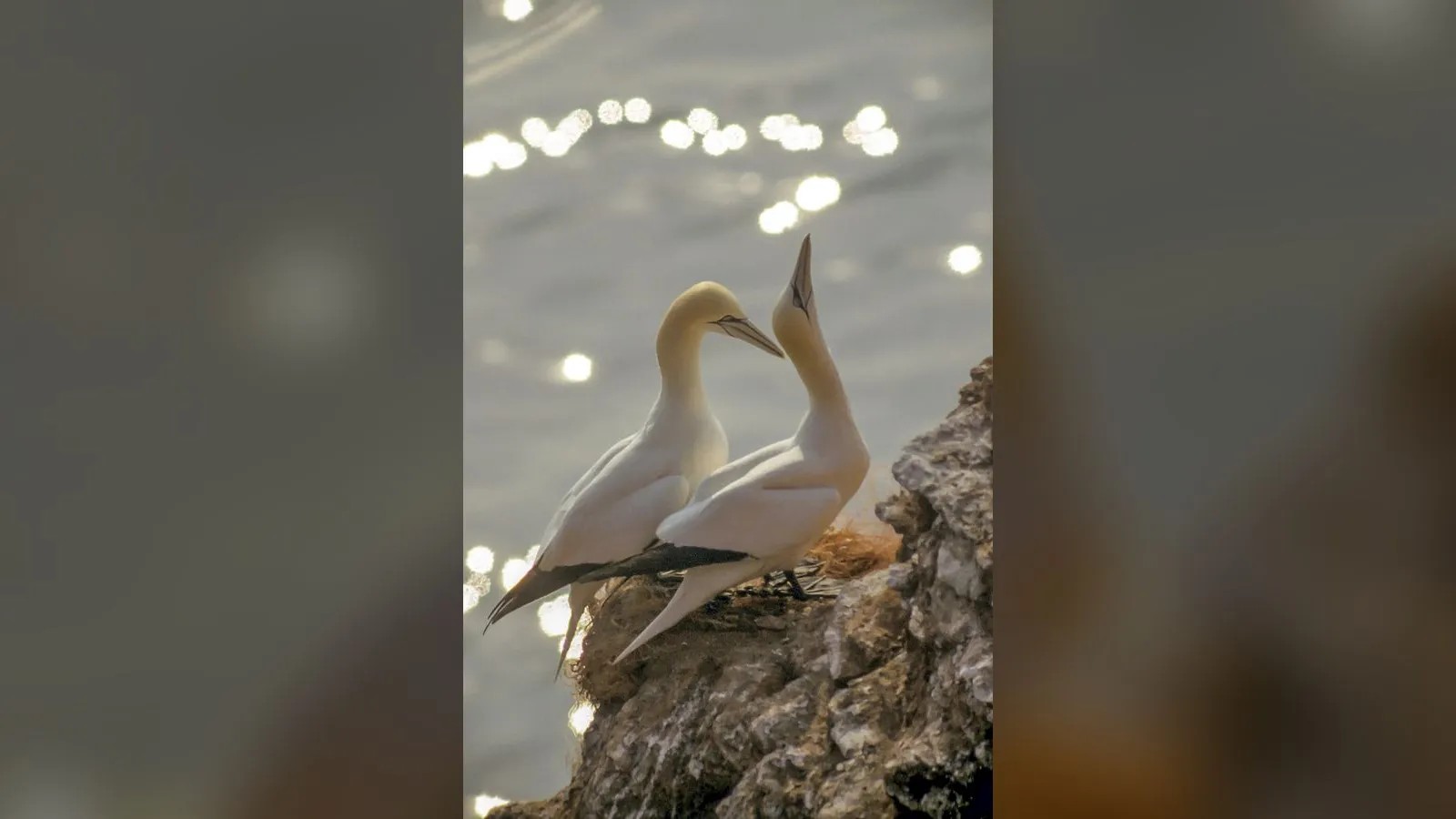

Gannet (Morus bassanus)
Contents
The northern gannet is the largest seabird of the North Atlantic, a plunge-diver that breeds in dense colonies on cliffs and stacks. Scotland holds almost half the world's gannets, and its colonies carry one of the longest written records of any British bird. This card covers that history, from the solan harvest to the avian flu outbreak of 2022.
TL;DR
- established Scotland's Bass Rock, in the Firth of Forth, is the largest Northern gannet colony on Earth, a status achieved by 2014 after more than a century of continuous population growth — a genuine, specific global distinction this article states directly rather than a general claim of importance.
- established Avian flu was confirmed at Bass Rock in June 2022 during peak breeding season, causing thousands of seabird deaths; annual mortality at the colony jumped from a 6% average (2011–2021) to 33% during 2022, resulting in a documented 26% population decline by 2023 — a severe, precisely quantified impact this article states with its real scale rather than a vague reference to "disease."
- established Pre-outbreak, Bass Rock held approximately 75,000 occupied sites; a 2023 drone-based survey recorded approximately 55,000 sites, a 25–30% reduction since the 2014 peak count — a specific, measured decline this article names directly, drawing on advanced survey methodology developed specifically to assess the outbreak's impact without disturbing the colony.
- disputed Population modelling published in Biological Conservation projects that Bass Rock and the Welsh Grassholm colony will not recover to pre-outbreak population sizes until 2041 — approximately 19 years after the outbreak began — but researchers themselves describe this as a best-case scenario, since the modelling does not fully account for compounding pressures including climate change, bycatch, and plastic pollution, meaning the true recovery timeline could be longer and remains genuinely uncertain.
- established The outbreak's severity reflected a specific, documented mechanism: the virus disproportionately killed adult breeding birds rather than younger or non-breeding individuals, a pattern that fundamentally undermines colony recovery speed since breeding adults are the population's reproductive core — this article states this mechanism directly because it explains why the projected recovery period runs to decades rather than a few seasons.
- established Scots ate gannets for centuries. The Bass Rock was harvested every year from at least 1510 until 1885, St Kilda until 1910, and the men of Ness on Lewis still took young birds, or gugas, from Sula Sgeir under licence when Birds Britannica was published in 2005.
- established The Scottish Ornithologists' Club's The Birds of Scotland (2007) counted 182,511 apparently occupied sites in Scotland in 2003–04, 43% of the world population, in 14 colonies. Bernie Zonfrillo's account there argues that the long twentieth-century rise was largely a recovery after centuries of harvesting ended, not a population explosion.
- established The old Scottish name is the solan or solan goose. It comes, like the islet name Sula Sgeir, from the Old Norse sula, while the scientific name bassanus comes from the Bass.
Key Facts
- Scientific name
- Morus bassanus
- Category
- Seabirds
- Status
- Largest Northern gannet colony on Earth (Bass Rock)
- World's-largest status achieved
- 2014
- Bass Rock occupied sites (2014, pre-flu)
- ~75,000
- Bass Rock occupied sites (2023)
- ~55,000
- 2022 annual mortality (vs. 6% baseline)
- 33%
- Projected recovery to pre-outbreak levels
- Not until 2041 (best-case estimate)
- Scottish names
- Solan, Soland or Solan Goose (northern Scotland, Orkney, Shetland); Crockak (Unst); Sula and Guga, mainly for young birds (Outer Hebrides)
- Bass Rock harvest
- From at least 1510 to 1885, averaging about 1,500 birds a year
- St Kilda harvest ended
- 1910
- Scottish population (2003–04, historical)
- 182,511 apparently occupied sites in 14 colonies, 43% of world (The Birds of Scotland)
- Bass Rock growth
- About 3,000 sites (1902–05) to 48,065 (2003–04)
- Gaelic name
- Sùlaire
- Longevity record
- 37 years 4 months (Bass Rock chick found on South Ronaldsay)
- Incubation and fledging
- About 43 days; chick fledges at about 91 days
Scottish Impact Index (SI Score)
- Scottish Significance
- 9/10
- Ecological Persistence
- 9/10
- Ecological Importance
- 10/10
- Biological Distinctiveness
- 8/10
- Conservation Significance
- 9/10
- Recognition
- 9/10
54/60
Ranked =7th of 42 in Wildlife
A Note on Claims and Evidence
Bass Rock's status, pre- and post-outbreak population figures, and 2022 mortality rates are drawn from Scottish Seabird Centre and University of Edinburgh drone survey research, developed specifically to quantify the outbreak's impact. The 2041 recovery projection is drawn from peer-reviewed population modelling published in Biological Conservation, and is treated as genuinely Disputed in the specific sense that the researchers themselves describe it as a best-case scenario subject to significant additional uncertainty from compounding, unmodelled pressures.
The historical material on names, harvests and folklore comes mainly from Mark Cocker and Richard Mabey's Birds Britannica (2005), which draws on older writers such as Martin Martin and on the gannet specialist Bryan Nelson. Where that book gives figures from before 2005, they are given here as history, not as current counts.
The colony histories, survey totals, ringing results and breeding biology come from Bernie Zonfrillo's species account in the Scottish Ornithologists' Club's The Birds of Scotland (2007). Its counts end in 2003–04 and are history beside the post-2014 Bass Rock figures above.
Timeline
Gannet remains on St Kilda show the birds were eaten there more than 2,100 years ago.
The Bass Rock gannetry is mentioned in the Scotichronicon, the first written record of the colony.
Records show an annual harvest of young gannets on the Bass from at least this date.
Hector Boece describes the colony on Ailsa Craig.
Donald Monro, Dean of the Isles, first mentions Sula Sgeir.
Robert Monteith names Sule Skerry in Orkney as a gannet haunt.
The Bass yields about a thousand young gannets a year.
Martin Martin visits St Kilda and describes gannet nests holding "a red coat, a brass sundial, an arrow and some Molucca beans".
In the years of potato blight, heavy hunting nearly ends the gannet as a Scottish breeder; it survives on the cliffs.
The Bass Rock harvest ends after more than three and a half centuries.
The Bass holds about 3,000 nests and Scotland as a whole about 30,000.
The St Kilda gannet harvest ends.
One pair nests on Noss, the first gannets to breed in Shetland; Hermaness follows in 1917.
Gannets colonise Big Scare in Luce Bay, Galloway.
Kenneth Williamson sees a gannet off Orkney taking bread thrown to gulls, possibly the first record of the species scavenging from ships.
A black-browed albatross summers among the Bass Rock gannets.
Troup Head becomes Scotland's only mainland gannetry.
A national survey counts 182,511 apparently occupied sites in Scotland; St Kilda, at about 60,000, is the world's largest colony and the Bass has 48,065.
Mean laying on the Bass is three weeks later than normal, possibly through a shortage of prey.
Bass Rock's Northern gannet colony grows continuously over more than a century.
Bass Rock's gannet colony reaches approximately 75,000 occupied sites, becoming the largest Northern gannet colony on Earth.
Average annual mortality at Bass Rock runs at approximately 6%, the baseline against which the subsequent outbreak's severity is measured.
Avian flu (H5N1) is confirmed at Bass Rock during peak breeding season, causing thousands of seabird deaths and severe breeding disruption; annual mortality for the year reaches 33%.
A dedicated drone-based survey, developed by the University of Edinburgh's Airborne Research and Innovation Facility with the Scottish Seabird Centre and UK Centre for Ecology & Hydrology, records approximately 55,000 occupied sites at Bass Rock — a 25–30% reduction since 2014 — while also finding no evidence of widespread further mortality that season, an encouraging sign.
Population modelling published in Biological Conservation projects that Bass Rock and Grassholm will not return to pre-outbreak population sizes until 2041, under best-case assumptions.
Details
A world-leading status, stated with its real specificity
This article names Bass Rock's distinction precisely: it is the largest Northern gannet colony on Earth, a status achieved in 2014 following more than a century of continuous population growth. This article states this directly because it establishes the colony's genuine global, not merely national or local, conservation significance, which in turn clarifies why the subsequent avian flu outbreak there attracted sustained international scientific attention.
An outbreak's severity, quantified precisely
This article presents the 2022 avian flu outbreak's documented impact with its actual figures rather than a general sense of crisis: annual mortality jumped from a 6% baseline (2011–2021 average) to 33% during 2022 alone, and the colony's occupied site count fell from approximately 75,000 in 2014 to approximately 55,000 by 2023, a 25–30% reduction. This article states these figures directly because they represent genuinely measured, severe losses at the world's largest colony of the species, not an impressionistic description of disease impact.
A novel survey method developed specifically to measure the damage
This article credits the drone-based survey methodology developed by the University of Edinburgh's Airborne Research and Innovation Facility, in partnership with the Scottish Seabird Centre and UK Centre for Ecology & Hydrology, with producing the precise population figures underpinning current understanding of the outbreak's scale. This article names this methodology directly because it combined drone imagery with machine learning to identify live, dead, nesting, and flying birds without disturbing the colony, representing a genuine methodological advance that made the quantified damage assessment possible.
A recovery projection honestly presented as a best case, not a guarantee
This article states the 2041 recovery projection directly, while presenting it with the same honesty the researchers themselves applied: this is explicitly described as a best-case scenario in the published modelling, since the projection does not fully account for compounding pressures gannets also face, including climate change, bycatch, and plastic pollution. This article names this uncertainty because asserting 2041 as a confident, fixed recovery date would overstate the modelling's actual precision, when the researchers' own position is that the true timeline could extend further.
The specific mechanism behind the slow recovery
This article names directly the specific biological reason recovery is projected to take decades rather than a few seasons: the virus disproportionately killed adult breeding birds, the reproductive core of the colony, rather than spreading its mortality evenly across all age classes. This article states this mechanism because it is the documented reason a population can suffer a severe mortality event and still take nearly two decades to recover numerically — losing breeding adults constrains the colony's reproductive capacity for years afterward, independent of any further mortality events.
Solan goose, guga and bassanus: the names
established Mark Cocker and Richard Mabey, in Birds Britannica (2005), record that for most of its history the gannet was known by names that now survive only in the north: solan, soland or solan goose in northern Scotland, Orkney and Shetland, crockak on Unst, and sula or guga, mainly for young birds, in the Outer Hebrides. They derive these from the Old Norse sula, meaning "cleft stick", which they link to the black wing-tips crossing over the bird's white back. The same word survives in Sula Sgeir, the uninhabited islet near North Rona that still holds an ancient gannetry. The species name bassanus commemorates the Bass Rock, a link the book says is documented back to the mid-fifteenth century. The older scientific name Sula bassana combined both.
shared The genus name Morus is usually explained as Greek for "foolish", from the birds' tameness at the nest. The Norse sula is also the source of Sula, the genus now used for the boobies.
traditional The naturalist James Fisher believed the Anglo-Saxon poem The Seafarer mentions gannets, and even placed the scene in East Lothian. That is an interpretation, not a record.
The Bass Rock harvest
established Records show an annual harvest of young gannets on the Bass from at least 1510, continuing for more than three and a half centuries. The cull averaged about 1,500 birds a year until it ended in 1885. Gannet was not always poor people's food: it appeared at Scottish royal banquets and fetched about 20d a bird in Edinburgh's poultry markets until at least the middle of the eighteenth century. Daniel Defoe, who tried it in Edinburgh, found it "a very coarse dish, rank, and ill relish'd". By 1876 as many as 800 birds a year were still being taken off the rock, wrapped in rhubarb leaves, partly cooked and sent to markets in Sheffield, Manchester and Newcastle.
established The colony announces itself before it is seen. One account quoted in Birds Britannica says the smell of the Bass gannetry carries so far offshore in an east-coast haar that it could serve "as an aid to navigation". Bryan Nelson, the leading modern authority on the species, lived on the Bass for three years while studying it.
St Kilda and the men of Ness
established The St Kilda harvest, maintained for centuries until 1910, was the most famous. The islanders climbed Stac Lee and Stac an Armin, the two highest sea stacks in Britain, to take adults in spring and gugas in August. Teams of about ten worked through the night and could kill some 1,100 birds in six hours, throwing them down to boats waiting below. The eggs were kept for up to eight months in peat ash. The breastbone was used in oil lamps, the fat as medicine, and the cured stomach as a storage bag; St Kildans also drained fulmar oil into dried gannet stomachs.
established A vestige of the tradition survives at Ness, at the northern tip of Lewis. Each year a team of ten men sails to Sula Sgeir, about 40 miles north-north-east of the Butt of Lewis, to take gugas under a licensed quota, which Birds Britannica gives as usually about 2,000 birds, set on advice from Scottish Natural Heritage (now NatureScot) to protect the colony. The birds are singed over a peat fire fed by their own oily offal, salted and split. Gaelic is spoken on the hunt, and the return to Stornoway draws a crowd. Each hunter's share, about 200 birds, is largely given away in the Ness community. Whether the hunt runs in a given year depends on that year's licence, so this article does not state its current status.
established Gannets were also taken on Ailsa Craig in the Firth of Clyde. In the Second World War gannets shot in Shetland were sold to London restaurants as "Highland goose".
Scavengers and nest-builders
established The gannet came late to scavenging from boats. Birds Britannica suggests July 1947 may be the first record, when Kenneth Williamson saw one off Orkney taking bread thrown to gulls. Ship waste has since been proposed as one cause of the bird's fourfold increase in the twentieth century. Gannets also gather odd objects for their nests: today that means nylon rope and fishing net, which can strangle the birds that use it.
established In 2005 the book named the gannetry on Boreray, St Kilda, at about 33,000 pairs, as the largest in the world, and called the Bass "one of Britain's largest". The Bass overtook it later as its numbers kept rising, which fits this article's 2014 date. The book also noted that more than two-thirds of the world population then nested in Britain and Ireland.
The Scottish record to 2007
established Old colonies and new. Bernie Zonfrillo's account in the Scottish Ornithologists' Club's The Birds of Scotland (2007) lists five traditional Scottish gannetries, each with an early written record: St Kilda, where Iron Age remains are more than 2,100 years old; the Bass, named in the Scotichronicon in 1447; Ailsa Craig, described by Hector Boece in 1526; Sula Sgeir, first mentioned by Dean Monro in 1549; and Sule Stack, named by Robert Monteith in 1633. Shetland had no gannets until a pair nested on Noss in 1914, with Hermaness following in 1917. Both now rival the old colonies. Later arrivals included Big Scare (1939), the Flannan Isles (1969), Fair Isle (1975), Foula (1980), Troup Head (1988), the only mainland site, and small colonies on Westray and Sule Skerry in 2003.
established A recovery, not an explosion. National counts have been made since the start of the twentieth century, when the world's 14 known colonies were first tallied, making this one of the longest data sets for any Scottish bird. Scotland held about 30,000 nests in 1902–05 and 182,511 apparently occupied sites in 2003–04. Following Bryan Nelson, the account treats the rise as "not so much a population explosion as a recovery" after prolonged human persecution ended. The ship-waste explanation in Birds Britannica is a complementary idea, not a rival one: discards are one of many food sources. In 2004 St Kilda, at about 60,000 pairs spread over several islands and stacks, was the largest colony in the world, followed by the Bass at about 48,000 and Ailsa Craig.
established Breeding. At Ailsa Craig the first birds arrive in the first week of January and thousands are present by March. Laying usually begins in early April and continues into July as young first-time breeders join. Gannets have no brood patch and warm the egg under the webs of their feet. The egg hatches after about 43 days and the chick fledges after an average of 91 days, most in mid- to late September. It cannot yet fly properly and is too fat to dive, so it swims south and learns both skills on its own. Up to 78% of pairs raise a chick in most years, and even in Shetland, where most seabirds have had poor seasons since the mid-1980s, gannet productivity stayed high, presumably because the birds take many kinds of prey at many depths.
established Ringing. About 7,000 Scottish-ringed gannets had been recovered by 2007, from Arctic Russia to Guinea-Bissau. Young birds travel furthest: one juvenile from Ailsa Craig reached Morocco, 2,700 km away, in 14 days, and one from Noss reached Portugal in 16. Older birds winter progressively further north. Breeding adults from the Bass have been tracked foraging up to 540 km from the colony. Chicks from Ailsa Craig and Hermaness helped found two Norwegian colonies after the 1960s. The longevity record is a Bass Rock chick found dead on South Ronaldsay 37 years and 4 months after ringing.
established The guga hunt and other threats. The account notes that Sula Sgeir, where about 2,000 chicks a year were taken under Scottish Executive licence, was one of the few colonies that did not increase between the last two surveys. Other threats listed were disturbance by low-flying military aircraft, discarded net and line built into nests, and evidence of a recent fall in adult survival. Oil is less of a hazard than for auks, because gannets spend less time on the water.
established Albert. The black-browed albatross that summered with the Bass Rock gannets in 1967, 1968 and 1969 was the first seen in Scotland. A bird of the same species, known as "Albert", then spent most summers from 1972 to 1995 on a gannet ledge at Hermaness, building nests but never laying. Many believed it was the Bass bird, which would have made it at least 32 years old. Another black-browed albatross joined the gannets on Sula Sgeir in August 2005.
Did You Know?
- The Bass Rock's smell, in a haar, was said to be a better guide to sailors than a foghorn.
- Gannet was a dish at Scottish royal banquets and sold for about 20d a bird in Edinburgh markets in the eighteenth century.
- In 1697 Martin Martin found a red coat, a brass sundial, an arrow and some Molucca beans in St Kilda gannet nests.
- A black-browed albatross lived among the Bass Rock gannets from 1967 to 1969 and is thought to be the same bird later seen for years at Hermaness, Shetland.
- Scotland's Bass Rock is the largest Northern gannet colony on Earth, a status it reached in 2014.
- Avian flu confirmed at Bass Rock in June 2022 caused annual mortality to spike from a 6% baseline to 33% that year.
- The colony's occupied site count fell from approximately 75,000 in 2014 to approximately 55,000 by 2023.
- Researchers used drone imagery and machine learning to assess the outbreak's impact without disturbing the colony.
- Population modelling projects Bass Rock will not recover to pre-outbreak numbers until 2041, under best-case assumptions.
- The outbreak disproportionately killed adult breeding birds, a key reason recovery is expected to take so long.
- By 2023, researchers found no evidence of widespread further mortality that season, an encouraging sign for the colony's trajectory.
- Gannets have no brood patch; they incubate the egg under the webs of their feet.
- Shetland had no gannets at all until a single pair nested on Noss in 1914.
- A gannet ringed as a chick on the Bass was found on South Ronaldsay more than 37 years later.
- Young gannets leave the colony too fat to dive and unable to fly properly, and begin their migration by swimming.
FAQ
1Is Bass Rock really the world's biggest gannet colony?
Yes — it achieved that status in 2014, following over a century of continuous growth.
2How bad was the 2022 avian flu outbreak at Bass Rock?
Severe — annual mortality jumped from a 6% baseline to 33% that year, and occupied sites fell by 25–30% from the 2014 peak by 2023.
3How were these figures measured without disturbing the colony?
Through a dedicated drone survey programme combining aerial imagery and machine learning, developed specifically to assess the outbreak's impact.
4Will the colony fully recover?
Population modelling projects recovery to pre-outbreak numbers by 2041 — but researchers describe this as a best-case scenario, with the actual timeline potentially longer due to other compounding pressures.
5Why is recovery expected to take so long?
Because the virus disproportionately killed adult breeding birds, the reproductive core of the colony, constraining its capacity to rebuild numbers for years afterward.
6What other threats do gannets face?
Climate change, bycatch in fishing gear, and plastic pollution, all identified as compounding pressures not fully captured in the recovery modelling.
7Has the situation improved since 2022?
The 2023 survey found no evidence of widespread further mortality that season, an encouraging sign, though the colony remains well below its pre-outbreak size.
8Is avian flu still a risk to gannets?
The outbreak's acute phase passed, but ongoing monitoring continues given the virus's documented capacity to cause severe seabird mortality.
9Why is the gannet called a solan goose in Scotland?
Solan is an old northern name, derived from the Old Norse sula, the same word found in Sula Sgeir. It survived in northern Scotland, Orkney and Shetland.
10Did people really eat gannets?
Yes. The Bass Rock was harvested every year from at least 1510 to 1885, St Kilda until 1910, and young gannets were sold in Edinburgh and later in northern English cities.
11What is a guga?
A young gannet, in the Gaelic usage of the Outer Hebrides. The men of Ness on Lewis have long taken gugas from Sula Sgeir under licence.
12Where does the name bassanus come from?
From the Bass Rock, whose gannetry is first mentioned in the Scotichronicon in 1447.
13How many gannets breed in Scotland?
The 2003–04 survey reported in The Birds of Scotland (2007) counted 182,511 apparently occupied sites, about 43% of the world population. Bass Rock figures since 2014 are given above.
14Was St Kilda ever bigger than the Bass?
Yes. In 2004 St Kilda, with about 60,000 pairs, was the largest gannetry in the world and the Bass, with about 48,000, was second. The Bass took the lead later as it kept growing.
15Where do Scottish gannets go in winter?
South along the Atlantic coast of Europe and Africa. Young birds travel furthest, many to West Africa, while older birds winter further north, often in the Bay of Biscay.
Sources and Further Reading
Primary/Institutional
- Forrester, R. W., Andrews, I. J. et al. (eds), The Birds of Scotland (Scottish Ornithologists' Club, 2007), account by Bernie Zonfrillo (Black-browed Albatross account by Mike Betts)
- New technologies help researchers to quantify the impact of Avian Flu on the World's largest Northern gannet colony — Scottish Seabird Centre
- Bass Rock Colony Counts — Scottish Seabird Centre
Scholarly/Critical
- Mark Cocker and Richard Mabey, Birds Britannica (Chatto & Windus, 2005)
- World's Gannet colonies may not recover from bird flu until 2041 — Oceanographic
- Bass Rock gannet colony hit by bird flu could take two decades to recover — The Scotsman
General
Caveats: Myths and Disputed Claims
- Clarification: This article does not present 2041 as a guaranteed recovery date; the published modelling explicitly describes this as a best-case scenario, with the actual recovery timeline potentially longer due to unmodelled compounding pressures.
- Note: This article does not suggest the 2022 outbreak has permanently ended avian flu risk to the colony; ongoing monitoring continues given the documented severity of what occurred.
- Do not say the Bass Rock has always been the world's largest gannetry; in 2005 Birds Britannica gave that title to Boreray, St Kilda, and the Bass reached it later.
- Do not present James Fisher's reading of The Seafarer as evidence of gannets on the Bass in Anglo-Saxon times; it is his interpretation.
- Do not describe the twentieth-century increase simply as a population explosion; The Birds of Scotland treats it largely as recovery after centuries of harvesting.
- Do not date Martin Martin's St Kilda visit to 1698, as the gannet account in The Birds of Scotland does; he visited in 1697 and his A Late Voyage to St Kilda appeared in 1698 (the same book's storm petrel account gives 1697).
Card 030 · Wildlife