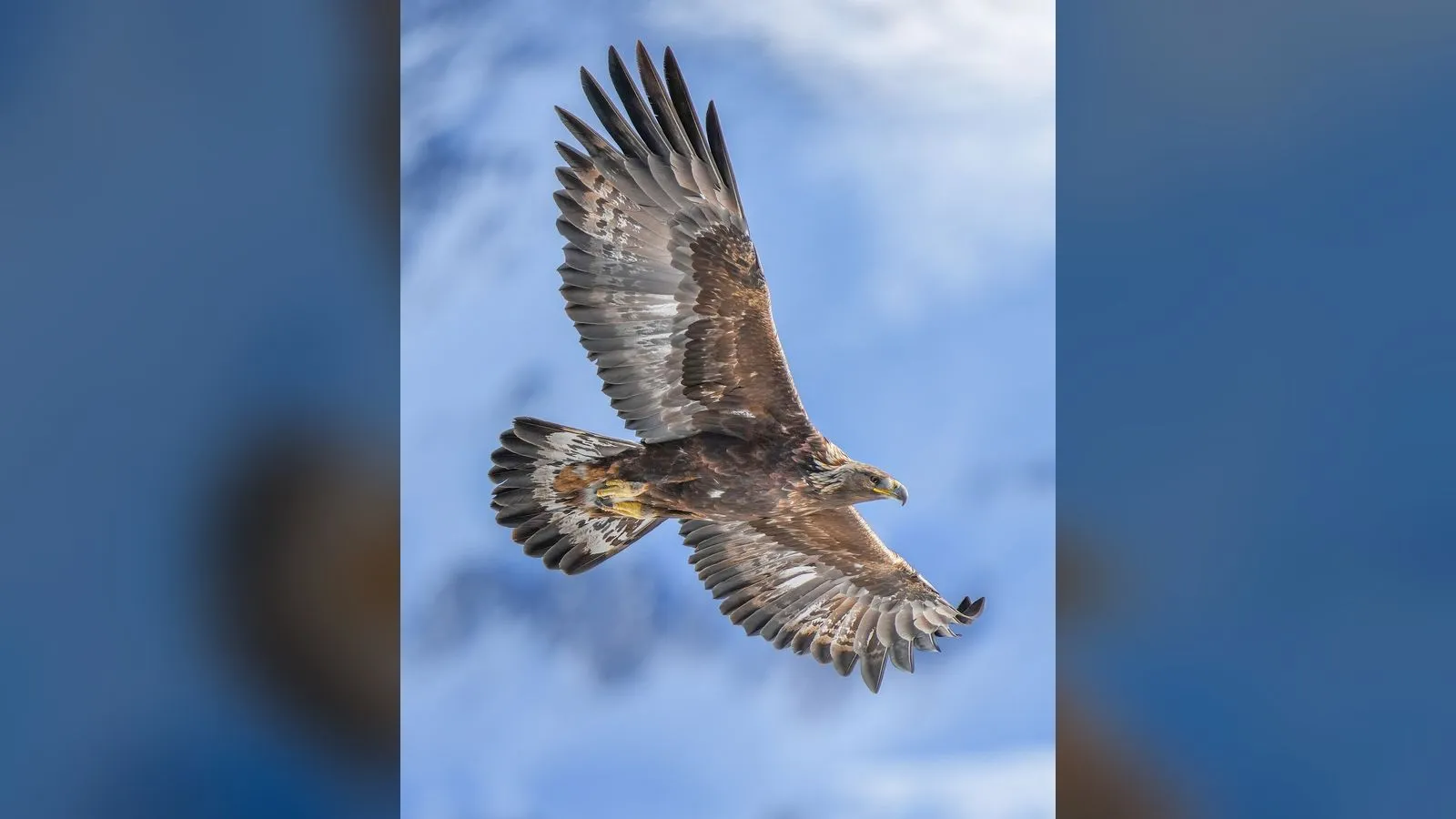

Golden Eagle (Aquila chrysaetos)
Contents
TL;DR
- established Scotland's 2015 national survey recorded 508 breeding pairs of golden eagles, a significant increase on the 2003 survey and a figure that exceeded the species' national conservation target — a genuine, measured recovery this article states with its specific documented scale.
- established That national recovery is uneven and incomplete: the Eastern Highlands continue to suffer ongoing illegal persecution, the Western Highlands are constrained by poor habitat quality and insufficient prey, and the Southern Uplands by limited recruitment of young birds — this article names these as three distinct, documented regional problems rather than treating "recovery" as a single, uniform national story.
- shared A Scottish Government-commissioned, peer-reviewed independent review of satellite-tagged golden eagles found that roughly a third of tagged birds studied had most likely been illegally killed, with disappearances concentrated on specific grouse moors with documented wildlife crime histories — a serious, documented finding this article states directly rather than softening into vague talk of "conflict with land management."
- established Golden eagles build and reuse eyries — nests on remote crags and cliffs — over many decades, with individual nest structures growing substantially through repeated use, a detail reflecting the species' genuine longevity and site fidelity.
- established Dedicated conservation efforts, including the South of Scotland Golden Eagle Project and NatureScot's Scottish Raptor Monitoring Scheme, represent an active, ongoing institutional response to the regional gaps in the species' recovery, rather than treating the national population milestone as the end of the conservation story.
Key Facts
- Scientific name
- Aquila chrysaetos
- Category
- Birds
- Scottish population (2015 survey)
- 508 breeding pairs
- Legal status
- Fully protected under UK and Scottish wildlife law
- Key habitat
- Remote Highland crags, cliffs, and open moorland
- Diet
- Hares, rabbits, grouse; young deer; carrion in winter
- Key conservation issue
- Illegal persecution, concentrated regionally
- Active recovery project
- South of Scotland Golden Eagle Project
- Earlier surveys
- About 420 pairs in 1982 and 1992; 442 pairs in 2003 (The Birds of Scotland, 2007)
- Gaelic name
- Iolaire-bhuidhe
- Breeding
- Usually two eggs, laid March to mid-April; incubation 41–45 days; young about 70 days in the nest
Scottish Impact Index (SI Score)
- Scottish Significance
- 10/10
- Ecological Persistence
- 9/10
- Ecological Importance
- 10/10
- Biological Distinctiveness
- 9/10
- Conservation Significance
- 10/10
- Recognition
- 10/10
58/60
Ranked #1 of 42 in Wildlife
A Note on Claims and Evidence
Population figures, legal protections, and the documented regional pattern of persecution are drawn from NatureScot's own published survey data and from a Scottish Government-commissioned, peer-reviewed independent review of satellite-tagged golden eagles. The specific finding that roughly a third of tagged birds studied were most likely illegally killed is treated as Disputed in the narrow sense that it concerns ongoing, unresolved criminal activity rather than a closed historical question — the review's methodology and findings are described as published and peer-reviewed, not as this article's own independent determination.
Timeline
Sustained persecution across many decades, driven by perceived conflict between golden eagles and upland land management (particularly grouse moor interests), substantially reduces the species' range and numbers.
Thomas Pennant finds a bounty of half a crown on the head of an eagle in Upper Deeside.
At least 295 white-tailed and golden eagles, with 60 eggs or young, are destroyed in Sutherland; a further 171 eagles and 53 young follow in 1831–34.
Keepers on the Glen Garry estate in the Highlands kill 15 golden eagles, alongside 27 sea eagles, 18 ospreys, 98 peregrines and 275 red kites, among other "vermin".
Persecution has made the golden eagle extinct in England and Wales and all but gone from Ireland, leaving the Scottish Highlands as its British stronghold.
Egg collectors take some 400 Scottish clutches.
The Scottish population falls to fewer than 100 pairs.
Golden eagles breed in Ireland for the last time (apart from a lone Rathlin Island pair in 1953–60).
The Protection of Birds Act gives golden eagles full legal protection.
DDT and then dieldrin from sheep dips thin eggshells and cut breeding success in western Scotland, until the dips are banned.
A single pair breeds on Hoy, Orkney, succeeding 11 times.
National surveys find about 420 pairs on territory.
42 Scottish fledglings are released in Donegal to reintroduce the species to Ireland.
A national survey records 442 pairs, little changed overall since 1992 but with losses in the eastern Cairngorms and parts of Tayside.
Mark Cocker and Richard Mabey put the Highland population at about 420 pairs, held in check for two decades by overgrazing and persecution.
A national survey records 508 breeding pairs, exceeding Scotland's national conservation target for the species.
A series of satellite-tagged golden eagles disappear in suspicious circumstances, concentrated on specific grouse moors, prompting public and governmental concern.
A peer-reviewed independent analysis of satellite-tagged eagle disappearances concludes that roughly a third of tagged birds studied had most likely been illegally killed.
The South of Scotland Golden Eagle Project works to support recruitment and establishment of eagles in the Southern Uplands, an area of historically low recovery.
Details
A genuine national recovery, measured precisely
This article states Scotland's golden eagle recovery with its real, documented scale rather than vague celebratory language: the 2015 national survey recorded 508 breeding pairs, a significant increase on the 2003 count and a figure that exceeded the species' national conservation target. This is presented as a substantive conservation achievement in its own right — the product of sustained legal protection and habitat management over decades — rather than an incidental statistic.
A recovery that is not evenly shared
This article deliberately resists treating "508 breeding pairs" as the whole story, since the national figure conceals genuinely different regional pictures. The Eastern Highlands continue to experience ongoing illegal persecution; the Western Highlands are limited by poor habitat quality and insufficient prey availability rather than by criminal activity; and the Southern Uplands suffer from limited recruitment of young birds into the breeding population. This article names these as three distinct, documented regional problems, each requiring a different conservation response, rather than collapsing them into a single undifferentiated account of "range expansion."
Persecution stated as a documented, ongoing problem
This article addresses directly, rather than euphemistically, the persistence of illegal persecution as a genuine and current threat to golden eagles in parts of Scotland. A Scottish Government-commissioned, peer-reviewed independent review of satellite-tagged golden eagles found that roughly a third of tagged birds studied had most likely been illegally killed, with disappearances concentrated on specific grouse moors with documented histories of wildlife crime. The pattern identified — tag transmissions ceasing abruptly with no prior technical fault, birds last recorded over grouse moors, and neither bird nor transmitter subsequently recovered — is presented in this article as the documented basis for that finding, consistent with treating credit and blame questions with precise, evidence-based language rather than either overstating or minimising a genuinely contested and still-unfolding issue.
A long-lived bird, built around long-lived nests
Golden eagles construct eyries on remote, largely inaccessible crags and cliffs, occasionally in trees, and these structures are reused and built upon over many years by the same breeding pair or their successors, growing substantially through repeated maintenance. This article notes this detail directly, since it reflects the species' genuine ecological requirement for long-term, undisturbed habitat — a requirement directly relevant to understanding why persecution and habitat disturbance have such a lasting effect on breeding success.
Active, ongoing institutional response
This article credits the conservation response to the species' regional gaps as a genuine, ongoing institutional effort rather than a completed project. The South of Scotland Golden Eagle Project specifically targets the Southern Uplands' recruitment problem, while NatureScot's Scottish Raptor Monitoring Scheme provides the continued population monitoring on which future conservation assessment depends — work this article presents as necessary precisely because the 2015 national milestone did not resolve every regional challenge facing the species.
The Victorian slaughter of predators: the historian's figures
Smout draws on the work of Richard Lovegrove to argue that most of the damage to Scotland's predators was done before about 1840, with Victorian gamekeepers after about 1870 mainly engaged in "mopping-up operations". The Dumfries fur market, held every February, shows the scale in the south-west: in 1831, 600 polecat and 226 otter skins were offered for sale; by 1869 there were none of either. In the Highlands the evidence comes from estate vermin returns. Smout accepts that bounty records can be inflated, but notes that owners usually demanded heads or wings as proof, so a figure such as 143 pine martens and 295 eagles killed at Langwell and Sandside in Sutherland between 1819 and 1826 should not be dismissed. As a result some predators became extinct in Scotland (polecat, red kite, osprey, sea eagle) and others were greatly reduced (wild cat, pine marten, otter, hen harrier, golden eagle). Only well into the second half of the twentieth century was there even limited recovery.
Lamb-killer, quarry and emblem
established Mark Cocker and Richard Mabey, in Birds Britannica (2005), record that there are really two golden eagles in Britain: the wild bird and the eagle as symbol in art, literature and commerce. In Scotland the two meet, because nearly all the British population breeds there and the bird is the image most often used to stand for the Highland peaks and glens. The book gives "goldie" as a vernacular name.
shared The book traces the eagle's loss from the rest of Britain to its reputation as a lamb-killer, and dates its extermination in Ireland, Wales and most of northern England to the mid-eighteenth century. The Scottish Ornithologists' Club's The Birds of Scotland (2007) puts its extinction in England, Wales and Ireland later, by the middle of the nineteenth century, and records the last Irish breeding in 1912, so the earlier date should not be relied on. Crofters long feared both native eagles for the same reason. Cocker and Mabey accept that eagles take sheep and deer carrion and that lambs are sometimes carried to the eyrie, but most of these lambs are stillborn, and the bird's contribution to overall lamb deaths in spring is "negligible".
established In the Highlands the main pressure in the nineteenth century came from grouse moors. On the Glen Garry estate keepers killed 15 golden eagles between 1837 and 1840, part of a list of 1,501 birds of prey. Even then the practice had critics. The naturalist Lord Lilford, himself a keen grouse shot, protested at "the extermination, of many of our most interesting native birds in favour of the Grouse", naming the golden eagle first. Writing in 2005, Cocker and Mabey put the Highland population at about 420 pairs and said it had been held in check for two decades by heavy overgrazing, which reduced its natural prey, and by persecution from game interests, sheep farmers and egg collectors.
established On the high tops the eagle is the main enemy of the ptarmigan. The ecologist Adam Watson found that ptarmigan take flight at a greater distance from an eagle than from a man, and twice saw a ptarmigan chased by an eagle dive to the ground and crouch among boulders a few metres from him and his companions.
The Scottish record: The Birds of Scotland (2007)
established Bounties, vermin lists and egg collectors. The Scottish Ornithologists' Club's The Birds of Scotland (2007), in the species account by John A. Love and Jeff Watson, sets out the scale of the nineteenth-century killing. It was on the eastern grouse moors, rather than the sheep walks, that the bird suffered most from gamekeepers. Between 1820 and 1826 at least 295 white-tailed and golden eagles were destroyed in Sutherland, with 60 eggs or young, and a further 171 eagles and 53 young followed in 1831–34. Egg collecting added to the pressure: some 400 clutches were taken between 1830 and 1950. W. R. P. Bourne's chapter on the early history of Scottish birds traces the bounties further back. In 1769 Pennant found half a crown on an eagle's head in Upper Deeside, and by 1825 the price in Mull had reached 10s 6d. The book's conservation chapter, by Paul Walton and Stuart Housden, says the population fell to fewer than 100 pairs in the late nineteenth century.
established Recovery and a steady population. Respite during the two World Wars and legal protection from 1954 let eagles survive in the remoter glens and then recover. In the 1950s observers first noticed that lone birds, or immature birds holding territory, were signs of persecution, and breeding success was found to be twice as high in deer forests, where eagles were tolerated, as on grouse moors. Estimates rose from at least 190 pairs in the 1950s to about 300, partly through better coverage. Full surveys in 1982 and 1992 found about 420 pairs on territory, and the 2003 survey found 442, which the account describes as virtually the entire British population and about 8% of Europe's.
established Where the eagles are. Nearly three-quarters of Scotland's pairs live on the west coast mainland and islands, and the Uists, parts of Lewis and Harris, and Mull hold some of the highest densities in Europe. On North Uist and in the Flow Country, where crags are scarce, some pairs nest on the ground among heather. Density is higher in the west, where persecution is lower and carrion plentiful, but breeding success is better in the east, where grouse and hares are abundant. Pairs in the eastern Highlands fledged 0.81 young a year against 0.33 to 0.59 on the west mainland. In the west the older chick often kills its sibling in the first weeks. Between 1992 and 2003 numbers rose in the Outer Hebrides, Caithness and Sutherland, but fell by a similar amount in the eastern Cairngorms and parts of Tayside, a loss the account attributes to persecution. The species has never nested in Shetland, where there had been nine records of vagrants.
established Pesticides, forestry and wind farms. In the 1960s DDT and then dieldrin, absorbed from sheep carrion contaminated with sheep dip, thinned eggshells and lowered breeding success on the west coast. Eastern eagles, which ate little carrion, were unaffected, and success recovered once the dips were banned. The account lists blanket forestry over open hunting ground, overgrazing and heavy burning that reduce wild prey, and wind farms as further pressures.
established Longevity and movement. Tradition says the golden eagle lives a century or more, but the account finds no evidence for it. A captive bird lived 46 years and a ringed Swedish bird was found dead at 32. Ten years of data from 30 territories on Skye suggested annual adult survival of about 97.5%. Young birds disperse up to 161 km in their first two years, while territorial adults are largely sedentary. Scottish eagles have also been exported: 42 fledglings from Scotland were released in Donegal between 2001 and 2005 to bring the species back to Ireland.
Did You Know?
- Scotland's 508 breeding pairs (2015 survey) exceeded the species' national conservation target.
- A government-commissioned, peer-reviewed review found that roughly a third of studied satellite-tagged golden eagles had most likely been illegally killed.
- Golden eagle eyries can be reused and built upon by successive breeding pairs for many decades.
- While adult deer are rarely targeted, some golden eagles regularly take young deer.
- The three regions of persistent lower recovery — Eastern Highlands, Western Highlands, and Southern Uplands — each face a different specific obstacle: persecution, poor habitat, and low recruitment respectively.
- The South of Scotland Golden Eagle Project is a dedicated, active reintroduction and recovery initiative distinct from the national monitoring programme.
- Disappearing satellite tags in suspicious cases have shown a consistent pattern: sudden loss of signal with no technical fault, over grouse moors, with no bird or transmitter recovered.
- Keepers on one Highland estate, Glen Garry, killed 15 golden eagles and 27 sea eagles in about three years, between 1837 and 1840.
- Ptarmigan fear eagles more than people: they flush at a greater distance from an eagle than from a man.
- The golden eagle had been wiped out in England and Wales by the mid-nineteenth century; its last Irish breeding was in 1912.
- The Uists, Lewis and Harris, and Mull hold some of the highest golden eagle densities in Europe.
- A pair bred on Hoy, Orkney, from 1966 to 1982, but golden eagles have never nested in Shetland.
FAQ
1How many golden eagles are in Scotland?
The most recent national survey (2015) recorded 508 breeding pairs, exceeding the species' conservation target.
2Are golden eagles legally protected in Scotland?
Yes — they receive full statutory protection as wild birds under UK and Scottish law.
3Is illegal persecution still a problem?
Yes — a peer-reviewed government-commissioned review found roughly a third of studied satellite-tagged birds had most likely been illegally killed, concentrated in specific areas.
4What do golden eagles eat?
Primarily hares, rabbits, and grouse, with some young deer taken and carrion forming a notable part of their winter diet.
5Is the species' recovery complete?
No — the national population milestone masks regional differences: ongoing persecution in the east, poor habitat in the west, and low recruitment in the Southern Uplands.
6What is the South of Scotland Golden Eagle Project?
An active, dedicated conservation initiative working to improve golden eagle recruitment and establishment in the Southern Uplands.
7Where do golden eagles nest?
In eyries on remote, largely inaccessible crags and cliffs, occasionally in trees, often reused and built upon across many years.
8Why are grouse moors specifically implicated in persecution cases?
Suspicious satellite tag disappearances have shown a documented concentration on grouse moors with established wildlife crime histories, according to the official peer-reviewed review.
9Do golden eagles kill lambs?
Rarely. They take sheep and deer carrion, and lambs are sometimes carried to the eyrie, but Cocker and Mabey note that most are stillborn and the eagle's share of lamb deaths is negligible.
10Why do almost all British golden eagles live in Scotland?
Persecution removed them from England and Wales by the mid-nineteenth century and from Ireland by 1912. The remote Scottish Highlands and islands were where the species held on.
11How long do golden eagles live?
Not the century of tradition. The Birds of Scotland (2007) cites a captive bird that lived 46 years and a wild ringed bird found dead at 32, with Skye data suggesting adults survive about 97.5% of years.
12Were golden eagles ever harmed by pesticides?
Yes. In the 1960s DDT and dieldrin from sheep dips, taken in through carrion, thinned eggshells in western Scotland. Breeding success recovered after those dips were banned.
13How many eagles did Victorian estates kill?
Records vary and some may be inflated, but they are large: 15 golden eagles on the Glen Garry estate in 1837–40, and 295 eagles of both species at Langwell and Sandside in Sutherland in 1819–26.
Sources and Further Reading
Primary/Institutional
- Forrester, R. W., Andrews, I. J. et al. (eds), The Birds of Scotland (Scottish Ornithologists' Club, 2007), account by John A. Love and Jeff Watson; also the chapters "The early history of Scottish birds" by W. R. P. Bourne and "Bird conservation in Scotland" by Paul Walton and Stuart Housden
- Golden eagle — NatureScot
- NatureScot Commissioned Report 982 — Analyses of the fates of satellite tracked golden eagles in Scotland
- Status and conservation of the golden eagle — Wikipedia
Scholarly/Critical
- T. C. Smout, "Land and Sea: The Environment", in T. M. Devine and Jenny Wormald (eds), The Oxford Handbook of Modern Scottish History (Oxford University Press, 2012)
- Mark Cocker and Richard Mabey, Birds Britannica (Chatto & Windus, 2005)
- Status of Golden Eagle Aquila chrysaetos in Britain in 2015 — British Birds
- Golden eagles: A persecuted species — ALAW
General
Caveats: Myths and Disputed Claims
- Clarification: The finding that roughly a third of studied satellite-tagged golden eagles were most likely illegally killed reflects a specific, peer-reviewed government-commissioned review of tagged birds; it should not be generalised into a precise kill-rate claim for the entire national population, which is not directly tracked by tag.
- Do not present the golden eagle as a significant killer of lambs; most lambs found at eyries were stillborn or taken as carrion.
- Do not compare the 2005 figure of about 420 pairs directly with the 2015 survey's 508 pairs as a measure of growth; it is a rounded book figure. The like-for-like comparison is between national surveys: about 439 pairs in 1992 (revised), 442 in 2003 and 508 in 2015.
- Do not say golden eagles live for a hundred years; there is no evidence for it.
- Do not date the eagle's extinction in Ireland to the eighteenth century; it last bred there in 1912.
- Note: This article does not name individual present-day estates or specific prosecutions (the estates named in the historical sections are cited from published nineteenth-century records); it reports the documented, published pattern and official conclusions rather than individual unresolved allegations.
Card 001 · Wildlife