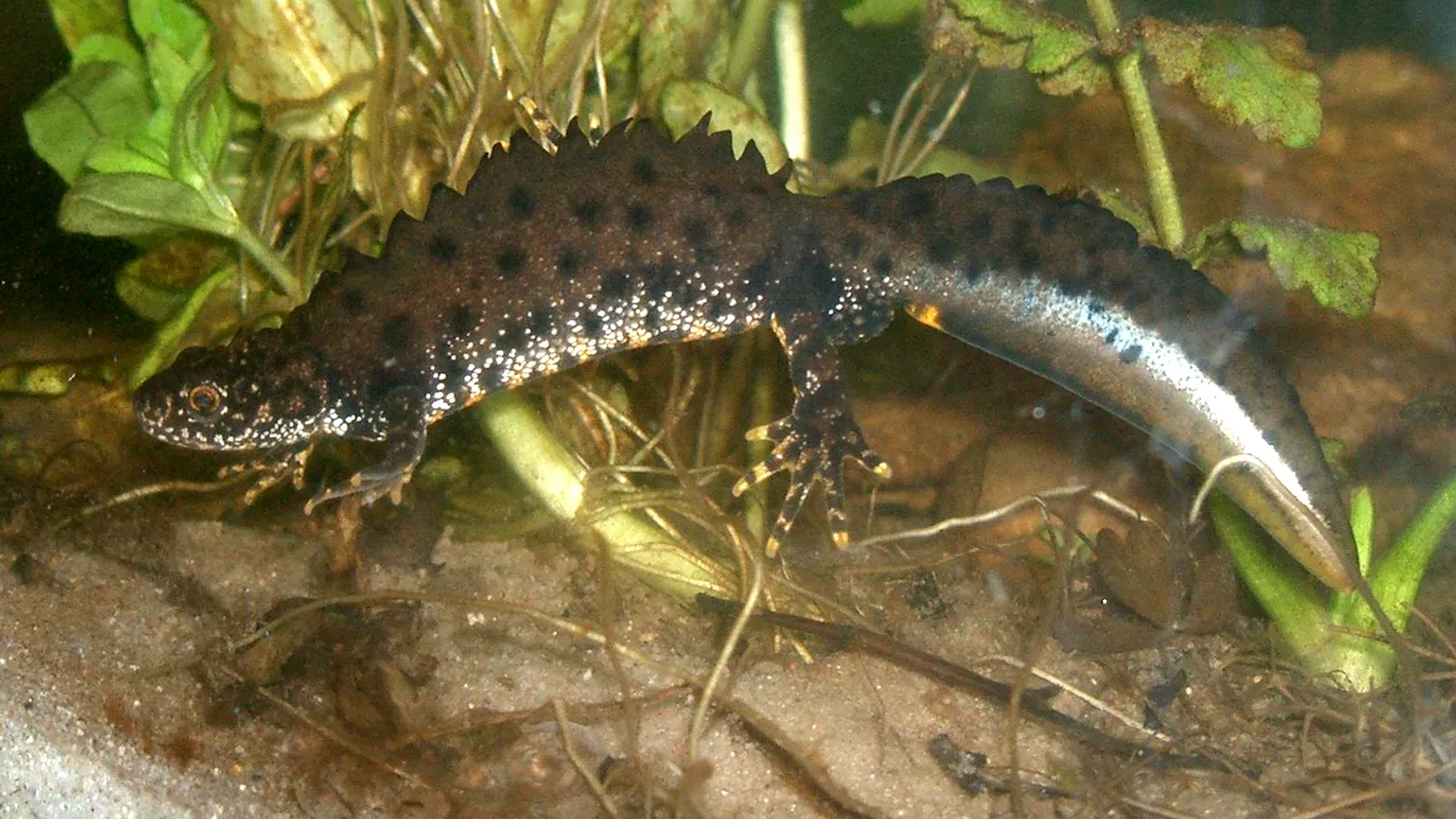

Great Crested Newt (Triturus cristatus)
Contents
TL;DR
- established Scotland's great crested newts occupy a restricted, fragmented range concentrated in two separate areas — a larger population across Dumfries and Galloway, the Borders and the central belt, and a smaller, geographically isolated population around Inverness in the Highlands, separated from the central population by more than 80km of unsuitable habitat — a specific, documented geographic split this article states directly.
- established This isolation once fuelled a genuine scientific debate: experts suspected the Highland population might have been introduced from elsewhere in the UK rather than being naturally occurring, given the scale of unsuitable terrain separating it from the species' main Scottish range — a real, documented uncertainty this article names directly rather than assuming the Highland newts' origin was always settled.
- established DNA fingerprinting research commissioned by Scottish Natural Heritage and conducted by Dr Robert Jehle of the University of Salford resolved this question: genetic analysis of eight Highland populations found them genetically distinct from central Scottish newts, consistent with natural isolation roughly 3,000 years ago rather than a recent human-mediated introduction — a specific, documented resolution this article states with its real evidential basis.
- established The species receives strong legal protection under European and UK law, making it illegal to injure, kill, disturb, capture, keep or sell great crested newts, with developers required to obtain a licence before undertaking work affecting known populations — a specific, documented protection regime this article states directly.
- established Despite this protection, studies in the 1980s documented an ongoing rate of colony loss of approximately 2% over five years, and the Highland population remains especially small and vulnerable, with surveys identifying only around 30 known Highland locations — a real, continuing vulnerability this article states plainly rather than presenting legal protection as having resolved the species' decline.
Key Facts
- Scientific name
- Triturus cristatus
- Category
- Amphibians
- Main Scottish range
- Dumfries and Galloway, the Borders, central belt
- Isolated Highland range
- Around Inverness, Moray Firth, ~30 known locations
- Separation between the two ranges
- Over 80km of unsuitable habitat
- Occupied ponds (1995–96 survey)
- 85, later rising to ~100
- Legal status
- Fully protected (European and UK law); licence required for development affecting known sites
A Note on Claims and Evidence
Distribution and survey figures are drawn from published Scottish conservation sources. The Highland population's native status is drawn from genetic research commissioned by Scottish Natural Heritage and conducted by Dr Robert Jehle (University of Salford), reported directly through SNH's own contemporaneous statement. Legal protection and threat details are drawn from published conservation literature.
Timeline
Great crested newts establish two geographically separate Scottish populations: a larger one across Dumfries and Galloway, the Borders and the central belt, and a smaller one isolated around Inverness in the Highlands.
Studies document an ongoing rate of colony loss of approximately 2% over five years.
A national survey records 85 occupied breeding ponds, a figure that later rises to approximately 100 through subsequent surveys.
Experts debate whether the isolated Highland population is natural or was introduced from elsewhere in the UK, given the scale of unsuitable habitat separating it from the species' main Scottish range.
Scottish Natural Heritage commissions Dr Robert Jehle of the University of Salford to conduct DNA fingerprinting analysis on eight Highland populations, comparing their genetic material against central Scottish reference populations.
The genetic analysis finds Highland newts genetically distinct from central Scottish populations, consistent with natural isolation approximately 3,000 years ago, resolving the native-versus-introduced debate in favour of native status.
Translocation projects, including at Gartcosh and across Highland farmland, relocate populations into newly created ponds as part of development mitigation and habitat restoration efforts.
The great crested newt remains fully protected under European and UK law, with its fragmented Scottish range, including the now-confirmed native Highland population, subject to ongoing conservation concern.
Details
A fragmented range split by real geography
This article states the great crested newt's Scottish distribution with its actual documented structure rather than describing a single continuous range: a larger population across Dumfries and Galloway, the Borders and the central belt, and a smaller, separate population isolated around Inverness in the Highlands, divided by more than 80km of habitat unsuitable for the species. This article names this specific separation because it is the geographic fact underlying the genuine scientific question that followed.
A real debate over Highland origins, not an assumed native status
This article states directly that the Highland great crested newt population's native status was not always settled: given the scale of unsuitable terrain separating it from the main Scottish range, experts genuinely suspected these isolated populations might have been introduced from elsewhere in the UK rather than occurring there naturally. This article names this historical uncertainty because treating the Highland population's native status as having always been obvious would misrepresent a real, documented scientific question that required dedicated research to resolve.
A resolution reached through named, specific research
This article credits the resolution of this debate with its real evidential basis: DNA fingerprinting research commissioned by Scottish Natural Heritage and conducted by Dr Robert Jehle of the University of Salford, examining eight Highland populations against central Scottish reference populations, found genetic distinctiveness consistent with natural isolation roughly 3,000 years ago rather than a recent introduction. This article names the specific researcher, institution, and methodology because it is this concrete evidential chain, not supposition, that settled the question in favour of native status.
A legal protection regime stated with real specificity
This article names the great crested newt's legal protection precisely: it is illegal under European and UK law to injure, kill, disturb, capture, keep or sell the species, and developers must obtain a licence before undertaking work that affects known populations. This article states this specific regime directly because it reflects the species' status as one of Scotland's most strongly legally protected amphibians.
A vulnerability that legal protection has not eliminated
This article states plainly that legal protection has not resolved the species' underlying decline: 1980s studies documented an ongoing colony loss rate of approximately 2% over five years, and the Highland population remains especially small, with only around 30 known locations identified across the region. This article names these figures directly because presenting legal protection as having secured the species' future would overstate what the documented evidence shows about its continuing fragility.
Did You Know?
- Scotland's great crested newts occupy two separate populations more than 80km apart, with no continuous range between them.
- Experts once suspected the isolated Highland population might have been introduced from elsewhere in the UK rather than occurring there naturally.
- Genetic research resolved this question, finding the Highland newts are native, having been naturally isolated for roughly 3,000 years.
- A 1995–96 survey recorded 85 occupied breeding ponds in Scotland, later rising to approximately 100.
- It is illegal to injure, kill, disturb, capture, keep or sell great crested newts under European and UK law.
- Only around 30 known locations hold the isolated Highland population.
- Translocation projects, including at Gartcosh, have successfully relocated populations into newly created ponds.
FAQ
1Where are great crested newts found in Scotland?
In two separate populations: a larger one across Dumfries and Galloway, the Borders and the central belt, and a smaller, isolated one around Inverness in the Highlands.
2Were the Highland newts introduced by people?
No — genetic research resolved an earlier debate, confirming they are native, naturally isolated from the main Scottish population for roughly 3,000 years.
3How was this resolved?
Through DNA fingerprinting research commissioned by Scottish Natural Heritage and conducted by Dr Robert Jehle of the University of Salford, comparing eight Highland populations against central Scottish reference populations.
4Is the great crested newt legally protected?
Yes, strongly — it is illegal to injure, kill, disturb, capture, keep or sell the species, and developers need a licence before work affecting known sites.
5Is the species still declining despite this protection?
Yes — 1980s studies documented ongoing colony loss, and the Highland population in particular remains small, with only around 30 known locations.
6What threats does the species face?
Habitat loss from urbanisation, agricultural change and industrial development, pond destruction, fragmentation, agricultural pollution, invasive fish predating eggs and larvae, and disease risk from chytrid fungus.
7What is being done to help the species?
Translocation projects, including at Gartcosh and across Highland farmland, have relocated populations into newly created ponds as part of development mitigation and habitat restoration.
8What do great crested newts need to breed?
Small freshwater ponds along with suitable terrestrial habitat within roughly 250 metres, making them vulnerable to habitat fragmentation.
Sources and Further Reading
Primary/Institutional
- Standing advice for planning consultations — Great Crested Newts — NatureScot
- Newts and toads: licences for development — NatureScot
Scholarly/Critical
- Amphibian and Reptile Conservation in Scotland: Focus on the Great Crested Newt Triturus cristatus and the European Adder Vipera berus — IntechOpen
- Great crested newts native to Scottish Highlands — The Scotsman
General
Caveats: Myths and Disputed Claims
- Clarification: This article does not present the Highland great crested newt population's native status as having always been assumed or obvious; it was a genuine, unresolved scientific question until dedicated genetic research settled it.
- Note: This article does not treat the species' strong legal protection as having resolved its underlying decline; documented colony loss and the small size of the Highland population indicate continuing vulnerability.
Card 037 · Wildlife