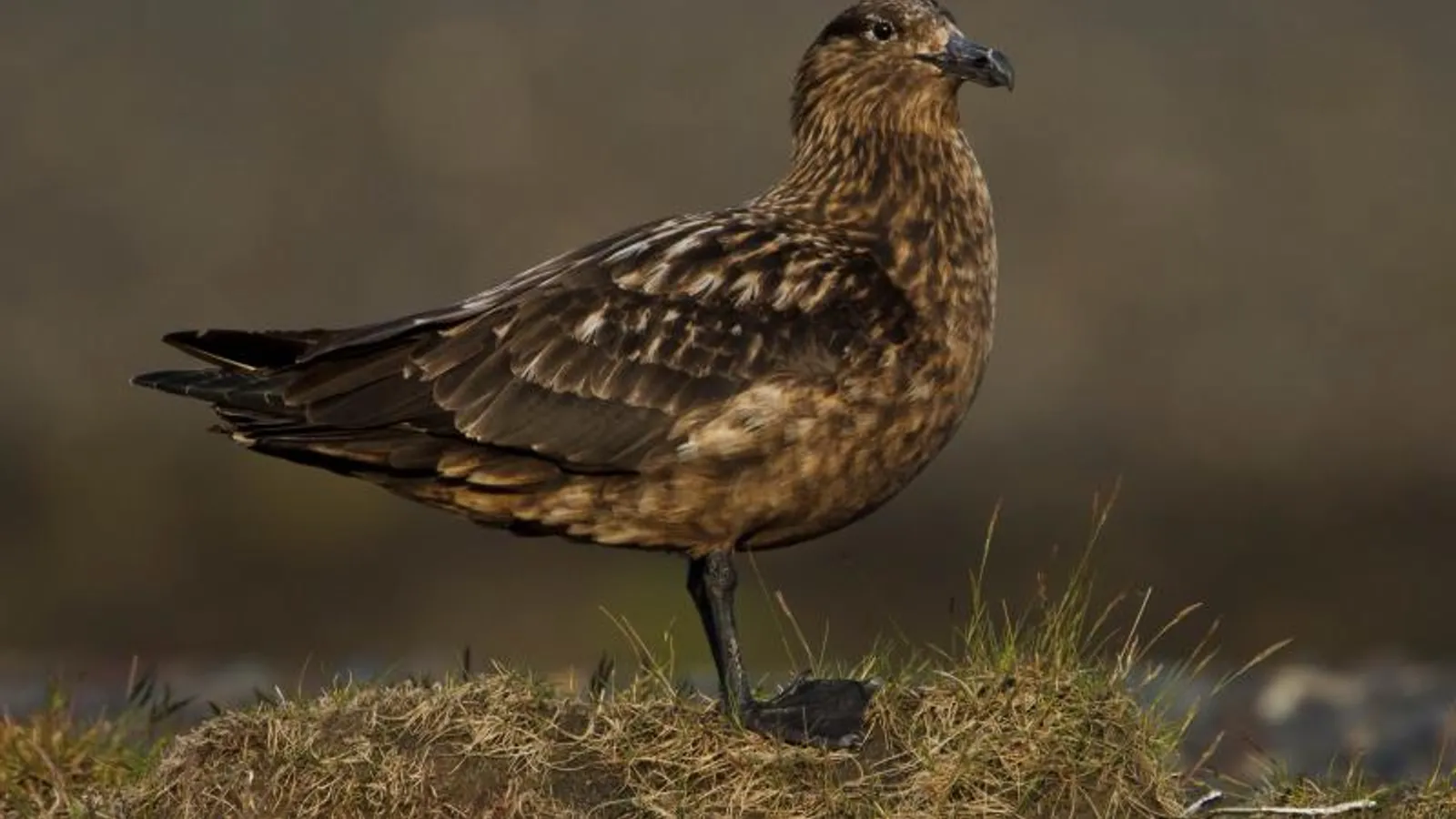

Great Skua (Stercorarius skua)
Contents
The great skua, or bonxie, is a heavy, brown, gull-sized seabird that feeds by robbing, scavenging and killing other birds. It is a recent Scottish success story: almost wiped out by 1900, it grew to some 9,650 pairs by 2000, most of them in Shetland and Orkney. Avian flu has since cut its numbers sharply.
TL;DR
- established The UK holds over half the world's great skua population, with breeding concentrated almost entirely in Scotland — particularly Shetland, Orkney, Handa, Sutherland, and St Kilda — a specific, globally significant concentration this article states directly, meaning conservation outcomes in Scotland carry disproportionate weight for the species' worldwide status.
- established An H5N1 avian flu outbreak beginning in summer 2021 caused catastrophic, precisely documented mortality: a comprehensive RSPB survey in May–July 2023 found breeding numbers at the colonies surveyed had collapsed from 9,088 to 2,160, which the RSPB describes as a 76% decline in breeding numbers across the species' Scottish range, with over 2,500 deaths recorded in 2022 alone and a substantial share of fatalities concentrated at a single colony on Foula, Shetland.
- established Great skuas, known locally as "bonxies," are genuinely aggressive predators and kleptoparasites, actively hunting small birds, rodents, and rabbits while also chasing other seabirds in flight to steal their caught food — a real, documented predatory ecology this article states directly rather than softening the species' behaviour into a gentler description.
- established Despite its current avian flu-driven crisis, the great skua's longer-term UK trend before the outbreak had been one of substantial range expansion — its breeding range grew by 111% since 1968–72 and its winter distribution by 138.2% since 1981–84 — a genuine prior conservation success story this article credits directly alongside, not instead of, the current severe decline.
- disputed The UK's Red List conservation status for great skua predates the full scale of the 2021–23 avian flu mortality event, and researchers have stated that the longer-term, population-level impacts of the outbreak remain genuinely unclear beyond the severe short-term collapse already measured — this article presents the confirmed 76% decline directly while noting that its longer-term trajectory and ultimate population-level consequences are not yet fully established.
- established The Scottish Ornithologists' Club's The Birds of Scotland (2007), in Robert Furness's account, records about 20 pairs in Scotland around 1900 and 9,650 apparently occupied territories by 2000, still increasing, with over 90% in Shetland and Orkney. Foula, the largest colony, held over 3,000 pairs in 1977 but 2,300 by 2003.
- established Bonxies are relatively recent arrivals. They were first described on Unst and Foula in 1774, were welcomed and then persecuted by Shetland crofters, came close to extinction, and recovered after legal protection in the early twentieth century.
Key Facts
- Scientific name
- Stercorarius skua
- Category
- Seabirds
- Global significance
- UK holds over half the world's population; almost all UK birds breed in Scotland
- Breeding numbers at surveyed sites, pre-outbreak
- 9,088
- Breeding numbers at surveyed sites, 2023
- 2,160
- Population decline
- 76%
- UK conservation status
- Red-listed
- Global (IUCN) status
- Least Concern
- Name
- Bonxie (Shetland, now widespread); older scientific name Catharacta skua
- First described in Scotland
- Unst and Foula, by the Rev. George Low, 1774
- Foula colony
- Over 3,000 pairs (1977), 2,300 pairs (2003), per The Birds of Scotland; Birds Britannica (2005) gave about 3,000 and called it the world's largest
- Scottish population (2000, historical)
- About 9,650 apparently occupied territories (Seabird 2000)
- Status in 2007
- UK Amber List; Scotland held 61% of the northern hemisphere population
- Gaelic name
- Fàsgadair-mòr
- Adult survival
- About 90% a year; first breeding at 4–12 years
Scottish Impact Index (SI Score)
- Scottish Significance
- 8/10
- Ecological Persistence
- 8/10
- Ecological Importance
- 9/10
- Biological Distinctiveness
- 8/10
- Conservation Significance
- 8/10
- Recognition
- 7/10
48/60
Ranked =29th of 42 in Wildlife
A Note on Claims and Evidence
Pre- and post-outbreak population figures are drawn from a comprehensive RSPB survey conducted in May–July 2023, compared against a prior major census spanning 2015–2021. Scotland's share of the UK and global population, range expansion figures, and predatory behaviour are drawn from the British Trust for Ornithology's published assessment. The longer-term, population-level consequences of the avian flu outbreak are treated as genuinely unresolved, reflecting researchers' own stated position that these remain unclear beyond the measured short-term collapse. The early history, the origin of the name and the 2005 population figures come from Mark Cocker and Richard Mabey's Birds Britannica (2005); its figures are given as history, not as current counts.
The spread of colonies, the survey totals, ringing and tracking results and the breeding biology come from Robert W. Furness's account in the Scottish Ornithologists' Club's The Birds of Scotland (2007). Those figures end in 2003 and are history beside the post-2021 avian flu counts. The 2023 figures of 9,088 and 2,160 refer to breeding numbers at the colonies surveyed, not to every great skua in the UK.
Timeline
Great skuas probably begin breeding in Shetland around this time.
The Rev. George Low describes "Bunxies" on Unst and Foula, cherished by crofters for driving off ravens and eagles.
Up to 75 pairs breed in Shetland, on Foula, Saxa Vord, Unst and Ronas Hill; the species is scarce elsewhere because of persecution.
Only about 20 pairs are left, all in Shetland.
After years of persecution and collecting brought the species close to extinction in Britain, legal protection allows a steady recovery, at up to 7% a year.
Great skuas nest in Orkney for the first time, on Hoy.
Foula grows from 300 pairs (1938) to 400–500 (1948) and about 900 (1963).
A pair at Dunnet Head gives the first mainland breeding record, in Caithness.
Breeding is first recorded in the Outer Hebrides (1959), on St Kilda (1963) and on Handa (1964).
96% of Scottish territories are in Shetland; Scotland holds about 3,079.
Foula holds over 3,000 pairs.
The great skua's UK breeding range expands by 111%, with winter distribution expanding by 138.2% since 1981–84, reflecting a substantial, documented long-term conservation success prior to the current crisis.
Illegal eating of bonxie eggs on Foula finally ends.
After the 1980s crash in sand-eels, Robert Furness estimates that British bonxies are killing around 200,000 kittiwakes, half of them adults.
Seabird 2000 counts about 9,650 apparently occupied territories in Scotland, almost the entire UK population, with over 90% in Shetland and Orkney and the main other colonies on St Kilda and Handa. Hoy has risen from 72 pairs in 1969 to 1,973.
Satellite tags fitted on Foula show breeding adults migrating through the North Sea and wintering from the Bay of Biscay to West Africa.
Foula has fallen to about 2,300 pairs.
A major seabird census establishes the baseline population figures against which the subsequent avian flu outbreak's impact is later measured.
An H5N1 avian influenza outbreak begins affecting Scottish seabird colonies, including great skuas.
Over 2,500 great skua deaths are recorded in a single year, with a substantial share concentrated at the Foula colony in Shetland.
A comprehensive RSPB survey finds great skua breeding numbers at the colonies surveyed have fallen to 2,160, down from 9,088, a 76% decline from the pre-outbreak baseline.
Researchers continue monitoring the population's trajectory, with the longer-term, population-level consequences of the outbreak described as not yet fully established.
Details
A global significance worth stating precisely
This article names Scotland's importance to the great skua with its real documented weight: the UK holds over half the world's population of the species, and almost the entire UK population breeds in Scotland, concentrated at specific named sites including Shetland, Orkney, Handa, Sutherland, and St Kilda. This article states this directly because it clarifies that the species' recent crisis in Scotland is not simply a national concern but one with genuine global conservation significance, given how disproportionately the world population depends on this single country's breeding colonies.
A collapse stated with its full, catastrophic scale
This article does not soften the documented impact of the 2021–23 avian flu outbreak: a comprehensive 2023 survey found breeding numbers at the colonies surveyed had fallen from 9,088 to 2,160, a 76% decline, with over 2,500 deaths recorded in 2022 alone and a substantial share concentrated at a single Shetland colony. This article states these figures directly because they represent one of the most severe documented single-event population collapses recorded for any Scottish seabird species, not a vague description of disease impact.
A predator, honestly described
This article names the great skua's predatory and kleptoparasitic behaviour directly rather than presenting the species in softer terms: bonxies actively hunt small birds, rodents, and rabbits, and are well known for chasing other seabirds in flight specifically to steal food they have already caught. This article states this because an honest ecological account of the species includes its genuine role as an aggressive coastal predator, not only its current status as a species of conservation concern.
A genuine prior success, credited alongside the current crisis
This article presents the great skua's substantial pre-outbreak range expansion — 111% growth in breeding range since 1968–72, and 138.2% growth in winter distribution since 1981–84 — as a real, documented conservation success story in its own right, stated directly alongside rather than displaced by the current avian flu crisis. This article names both facts together because an honest account of the species' recent history includes both its genuine prior expansion and its current severe, documented setback.
A decline whose longer-term consequences remain genuinely unresolved
This article states the confirmed 76% population collapse directly while noting honestly that researchers themselves describe the longer-term, population-level consequences of the outbreak as not yet fully established beyond this measured short-term figure. This article presents this distinction because asserting a confident long-term population trajectory — whether recovery, further decline, or stabilisation — would overstate what the current evidence, focused primarily on the severe initial collapse, actually supports.
Bunxie: a name from Shetland
established Mark Cocker and Richard Mabey, in Birds Britannica (2005), call "bonxie" the best example of a local name overtaking the official one across the country; few birdwatchers say "great skua" aloud. They trace it, probably, to the Old Norse bunki, which gave the Shetland word "bunksi" for a dumpy, untidy or heavily dressed person. The name fits the bird's barrel-chested build. The genus name Stercorarius comes from the Latin for dung, from an old belief that skuas chased other seabirds to eat their droppings, when in fact they are after the food. The book still used the older scientific name Catharacta skua.
Welcomed, eaten, then protected
established Bonxies are relatively recent colonists. The first colonies, on Unst and Foula, were described by the Rev. George Low in 1774 and probably did not predate the mid-eighteenth century. At first Shetland crofters valued them because they drove ravens and white-tailed eagles away from the sheep. Low wrote that the "Bunxies" were "cherished by them with the greatest veneration and kindness". The welcome faded when bonxies were found to take lambs. Islanders then caught young birds and tethered them round the croft to fatten for the table, and bonxies were eaten into the twentieth century; illegal egg-eating carried on on Foula until the 1970s.
established Together with taxidermists and trophy hunters, this pressure pushed the species to the edge of extinction in Britain. Legal protection in the early twentieth century began a steady recovery, with numbers doubling in some decades. In 2005 Birds Britannica put the British population at 8,500 pairs, almost two-thirds of the world total, with about 3,000 pairs on Foula, then the largest colony on earth.
shared Those figures were already slightly dated. The Birds of Scotland (2007) reports about 9,650 territories in Scotland in 2000, and Foula down from over 3,000 pairs in 1977 to about 2,300 by 2003.
Discards, sand-eels and kittiwakes
established Part of that increase was fuelled by fishing waste: between 1976 and 1986 trawlers dumped enough offal and unwanted fish to support around 200,000 seabirds. When sand-eel stocks crashed in the 1980s, bonxies, which had robbed sand-eels from other seabirds, turned to killing the seabirds themselves. Robert Furness estimated that by 1996 British bonxies were killing around 200,000 kittiwakes, half of them adults, and the book links this to a halving of Shetland's kittiwakes since 1981.
established The SOC account, written by Furness himself, puts the balance carefully. In Shetland bonxies feed mainly on sandeels and whitefish discards, and only to a much smaller extent on seabirds they kill. Bird-killing matters more where colonies are small or other food is scarce, as on St Kilda. Falling sandeel stocks and smaller discards in the north-western North Sea have pushed many birds towards predation.
The Scottish record to 2007
established Spread. Robert W. Furness's account in the Scottish Ornithologists' Club's The Birds of Scotland (2007) traces the recovery colony by colony. Up to 75 pairs bred in Shetland in the 1880s and only about 20 around 1900. Under protection numbers rose by about 7% a year until the 1970s, and more slowly after that. Orkney was colonised in 1914, the Outer Hebrides in 1959, St Kilda in 1963, Handa in 1964, the Summer Isles in 1980 and the Shiants in 1982, with new colonies in the 1990s on Canna, the Flannans, Barra, the Uists, Coll and the Treshnish Isles. Shetland's share fell from 96% of territories in 1969 to 71% in 2000 as Orkney grew; Hoy went from 72 pairs to 1,973 and became the second largest Scottish colony.
established A bird of the cool north. Scotland is the southern limit of the breeding range, and the account suggests that temperature may set it, since these cold-adapted birds find sunshine and warm days stressful while incubating. Most of the range expansion has been northwards into the Arctic. Chicks ringed on Foula have been found breeding in nearly all the new high-latitude colonies, including north Russia, and in the new western Scottish ones.
established Breeding. Birds gather at non-breeding "club" sites from two to eight years old and first breed at four to twelve. Adults survive at about 90% a year. They arrive in late March, lay in mid- to late May and fledge chicks around the end of July. Territories are usually 30–100 m apart. Off-duty birds stand on a favourite raised mound, which turns bright green from droppings and trampling. Breeding success reaches 1.3 chicks per pair in good years but has often been cut by food shortage in Shetland since the mid-1980s.
established Migration. Ringing recoveries of first-winter birds range from Russia and Norway to Tunisia, the Cape Verde Islands, New England and Brazil. Older birds move less, those over four years old wintering mostly off Iberia. Satellite tracking of Foula adults in 2002–03 showed most going south through the North Sea and English Channel to winter off north-west Africa. Some cross Scotland overland, from the Moray Firth and the Forth by the Great Glen and the Clyde.
established Threats in 2007. The account names human persecution, protection from exploitation and changes in food supply caused by fisheries as the main factors. Contaminants build up in the birds but showed no effect on survival. Some drown in nets and on long lines and some are shot on migration. Furness warned that falling discards could reduce numbers and noted that illegal persecution was clearly implicated in sudden drops on Fair Isle. Avian flu was not on the list; it arrived 14 years later.
Did You Know?
- "Bonxie" probably comes from a Shetland word for a dumpy, untidy person.
- Shetland crofters first welcomed bonxies for chasing ravens and sea eagles away from their sheep.
- Young bonxies were once tethered round Shetland crofts and fattened for the pot.
- The UK holds over half the world's great skua population, almost all of it breeding in Scotland.
- Great skuas are known locally as "bonxies" and are aggressive predators, hunting small birds, rodents, and rabbits.
- They are also kleptoparasites, chasing other seabirds in flight to steal their caught food.
- Great skua breeding numbers at the colonies surveyed fell by 76% between a pre-outbreak baseline and a 2023 survey, from 9,088 to 2,160.
- Around 1900 only about 20 pairs of great skuas bred in Scotland, all in Shetland.
- Great skuas are cold-adapted, and Scotland is the southern edge of their breeding range; incubating birds find sunshine and warm days stressful.
- Off-duty bonxies keep a favourite lookout mound in the territory, which turns bright green from their droppings and trampling.
- Over 2,500 great skua deaths were recorded in 2022 alone, with a substantial share at a single Shetland colony.
- Before the avian flu crisis, the species' UK breeding range had expanded by 111% since 1968–72.
- The great skua is globally classified as Least Concern despite being UK Red-listed, reflecting its concentrated but currently severely affected Scottish breeding population.
FAQ
1Why is Scotland so important to the great skua?
The UK holds over half the world's population, and almost all of it breeds in Scotland, at sites including Shetland, Orkney, Handa, Sutherland, and St Kilda.
2How severe was the avian flu impact?
Very severe. Breeding numbers at the colonies surveyed fell by 76%, from 9,088 to 2,160, between the pre-outbreak baseline and a 2023 survey.
3What is a "bonxie"?
The Shetland name for the great skua, now used across Britain. It probably comes from the Old Norse bunki, through the Shetland word "bunksi" for a dumpy, untidy or heavily dressed person, so it describes the bird's stocky build rather than its aggression.
4Do great skuas hunt other birds?
Yes — they actively hunt small birds, rodents, and rabbits, and also steal food from other seabirds in flight.
5Was the species doing well before the outbreak?
Yes — its UK breeding range had expanded 111% since 1968–72, a genuine prior conservation success.
6Has the population recovered since 2023?
This remains genuinely unclear — researchers have stated the longer-term, population-level consequences of the outbreak are not yet fully established beyond the measured short-term collapse.
7Is the great skua globally endangered?
No — the IUCN lists it as Least Concern globally, even though it is UK Red-listed, reflecting the concentrated and currently severely affected nature of its Scottish stronghold.
8What caused the mass mortality?
An H5N1 avian influenza outbreak beginning in summer 2021, which caused severe losses across multiple Scottish seabird species, great skuas among the worst affected.
9Can bonxies kill large birds?
Yes. Birds Britannica records them killing birds bigger than themselves, including gannets, great black-backed gulls and grey herons, as well as other gulls, terns and skuas.
10When did great skuas arrive in Scotland?
Probably in the mid-eighteenth century. The first colonies, on Unst and Foula, were described in 1774.
11Why did great skuas nearly die out in Britain?
Shetlanders killed them for taking lambs and ate the young and eggs, and collectors and trophy hunters took more. Legal protection in the early twentieth century let them recover.
12Where do Scottish bonxies spend the winter?
Mostly over the continental shelf from the Bay of Biscay to north-west Africa, according to satellite tracking of Foula adults. Young birds wander further, some reaching Brazil.
13How many great skuas bred in Scotland before avian flu?
About 9,650 territories in 2000, according to The Birds of Scotland (2007), against about 20 pairs around 1900.
Sources and Further Reading
Primary/Institutional
- Forrester, R. W., Andrews, I. J. et al. (eds), The Birds of Scotland (Scottish Ornithologists' Club, 2007), account by Robert W. Furness
- Seabird surveys project report — RSPB
- Great Skua — British Trust for Ornithology
- Great skua — Scottish Wildlife Trust
Scholarly/Critical
- Mark Cocker and Richard Mabey, Birds Britannica (Chatto & Windus, 2005)
- Severe Population Decline of Great Skua Following a HPAI Outbreak Reflected in Migration Counts — Marine Ecology (Wiley)
- Great skua in big decline after bird flu — Natural World Fund
General
Caveats: Myths and Disputed Claims
- Clarification: This article does not claim a confirmed longer-term population trajectory following the measured 76% decline; researchers describe the outbreak's longer-term, population-level consequences as not yet fully established.
- Do not say the name "bonxie" refers to the bird's aggression; it probably comes from a Shetland word for a dumpy, untidy person.
- Do not describe the 9,088 and 2,160 figures as counts of individual birds across the UK; they are breeding numbers at the colonies surveyed.
- Do not call Foula a 3,000-pair colony in the 2000s; it held over 3,000 pairs in 1977 and about 2,300 by 2003.
- Note: This article does not present the species' current crisis as its entire recent history; the substantial pre-outbreak range expansion represents a genuine, separate conservation success stated honestly alongside the current severe decline.
Card 031 · Wildlife