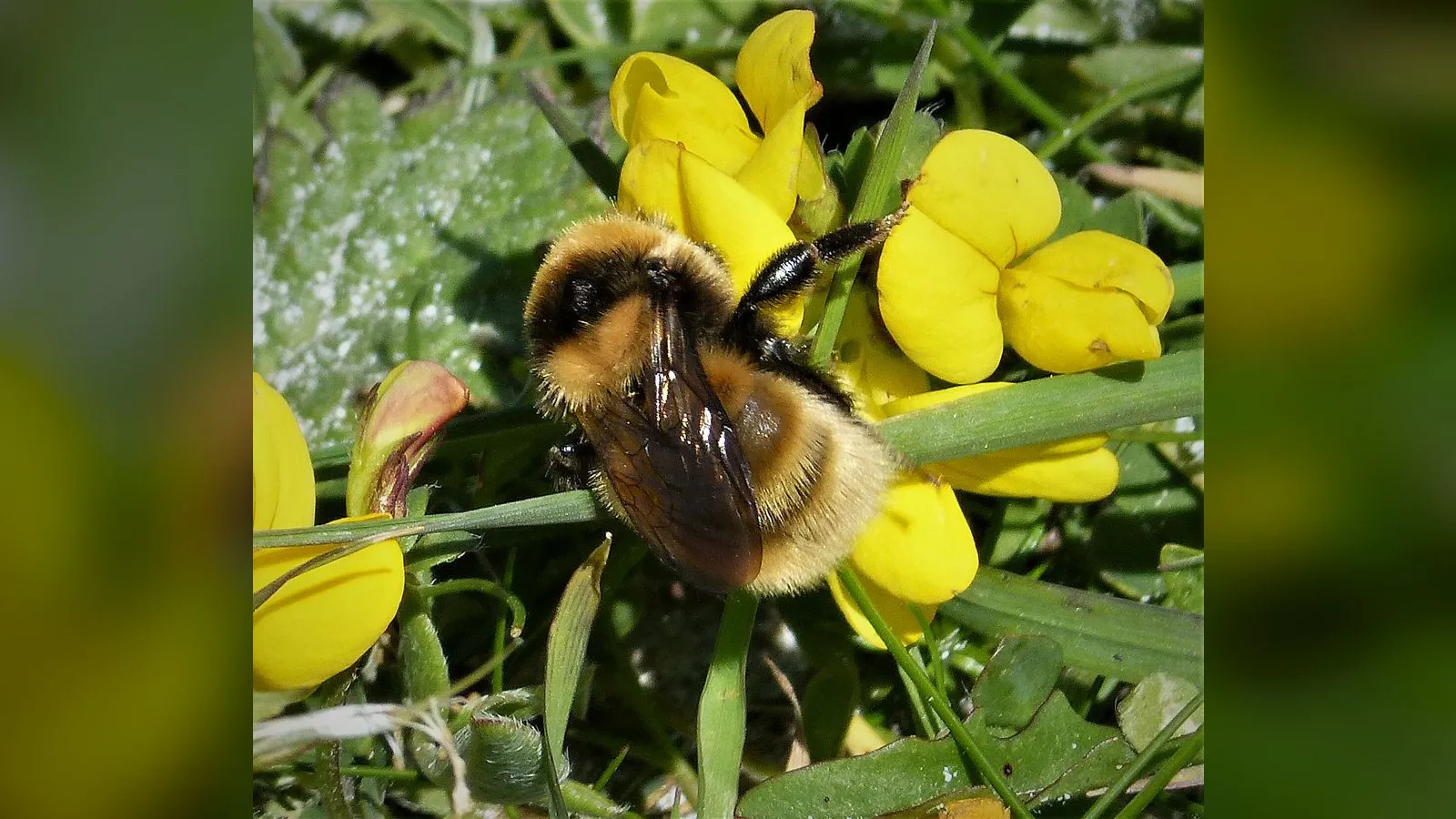

Great Yellow Bumblebee (Bombus distinguendus)
Contents
TL;DR
- established The great yellow bumblebee was once widespread across much of the UK but has suffered an 80% distribution decline over the past century, making it one of the UK's rarest bumblebee species — a specific, documented collapse this article states directly rather than a vague claim of rarity.
- established The species now survives in just five restricted locations, all machair and flower-rich coastal areas: Caithness, northwest Sutherland, Orkney, and the Inner and Outer Hebrides — a precise, documented current range this article names in full rather than a general reference to "northern Scotland."
- established Machair — herb-rich grassland lying inland of coastal fore-dunes — is itself a product of centuries of traditional human land management, shaped by wind-blown sand, seaweed deposits used as fertiliser, and low-intensity livestock grazing, meaning the bee's surviving habitat depends on the continuation of a specific traditional farming system rather than on land being left alone — a genuine, documented ecological paradox this article states directly.
- established Early-season food supply has been identified as a key limiting resource specifically for queen bees emerging from hibernation in spring, when continuous flowering from species including vetches, red clover, and knapweed through to September is required to sustain the colony — a specific, documented mechanistic vulnerability this article names directly rather than a vague reference to "food shortage."
- disputed The species is formally classified as Data Deficient, with its population trend stated plainly as "unknown but likely declining" — this article states this classification honestly rather than asserting a precise decline rate, since the available evidence supports confident concern but not a confirmed current trajectory.
Key Facts
- Scientific name
- Bombus distinguendus
- Category
- Invertebrates
- Historical range
- Once widespread across much of the UK
- Distribution decline (century)
- 80%
- Current strongholds
- Caithness, NW Sutherland, Orkney, Inner Hebrides, Outer Hebrides
- Core habitat
- Machair and flower-rich crofted grassland
- Conservation status
- Data Deficient; population trend "unknown but likely declining"
Scottish Impact Index (SI Score)
- Scottish Significance
- 9/10
- Ecological Persistence
- 5/10
- Ecological Importance
- 10/10
- Biological Distinctiveness
- 9/10
- Conservation Significance
- 10/10
- Recognition
- 7/10
50/60
Ranked =23rd of 42 in Wildlife
A Note on Claims and Evidence
Distribution decline figures and current stronghold locations are drawn from Buglife's and the Farm Advisory Service's published assessments. Machair's dependence on traditional crofting management, and the queen-bee early food supply mechanism, are drawn directly from the Farm Advisory Service's published Scottish National Priority Species guidance. The Data Deficient classification and uncertain population trend are reported as stated by conservation assessments, without this article asserting a more precise figure than the evidence supports.
Timeline
The great yellow bumblebee is widespread across much of the UK, before agricultural intensification begins eliminating much of its flower-rich grassland habitat across its former range.
The species' distribution declines by approximately 80%, as intensive farming and the loss of flower-rich meadows eliminate populations across most of its former UK range.
The species survives in just five restricted locations, all centred on machair and flower-rich areas maintaining traditional, low-intensity crofting management: Caithness, northwest Sutherland, Orkney, the Inner Hebrides, and the Outer Hebrides.
Conservation guidance promotes specific, documented management practices — winter cattle grazing followed by summer stock removal, continuous flowering from May to September, and avoidance of fertilisers, herbicides, and pesticides — to sustain the traditional machair system the species depends on.
The species remains formally classified Data Deficient, with its precise population trend stated as unknown but likely declining, while Buglife and the Bumblebee Conservation Trust continue recruiting public recording effort through initiatives including Species on the Edge.
Details
A collapse stated with its real documented scale
This article presents the great yellow bumblebee's historical decline with its actual figure: an 80% distribution decline over the past century, from a species once widespread across much of the UK to one of its rarest bumblebees today. This article states this specific percentage directly because it conveys the genuine severity of the species' historical range loss rather than a vague impression of decline.
A current range named in full, not generalised
This article states the species' entire surviving UK range with real geographic precision: five specific locations — Caithness, northwest Sutherland, Orkney, the Inner Hebrides, and the Outer Hebrides — rather than a general reference to "northern Scotland." This article names each location directly because it represents the complete extent of where this species now survives in Britain.
A habitat that depends on tradition continuing, not nature being left alone
This article states a genuine ecological paradox directly: machair, the herb-rich grassland the species depends on, is not a wild, untouched habitat but the product of centuries of specific traditional human land management — wind-blown sand, seaweed used as fertiliser, and low-intensity livestock grazing. This article names this dependency because it means the bee's conservation is inseparable from the continuation of traditional crofting itself; economic pressure on crofting communities is, by direct extension, a pressure on the species' remaining habitat, not a separate issue from habitat loss.
A specific limiting resource, not a vague food shortage
This article names the particular vulnerability threatening the species with real mechanistic precision: early-season food supply has been identified as a key limiting resource specifically for queen bees emerging from hibernation in spring, when continuous flowering from species including vetches, red clover, and knapweed through to September is required. This article states this mechanism directly because it clarifies precisely why continuous, not just abundant, flowering matters to the species' survival — a gap in the flowering calendar at the wrong moment can be as damaging as an overall shortage.
A status stated honestly, without inventing false precision
This article states the species' Data Deficient conservation classification and its "unknown but likely declining" population trend directly, rather than asserting a specific decline percentage the current evidence does not support. This article names this uncertainty plainly because an honest account of the species' current status requires distinguishing genuine historical decline, which is well documented, from its precise present trajectory, which is not.
Did You Know?
- The great yellow bumblebee has suffered an 80% distribution decline over the past century, once being widespread across much of the UK.
- It now survives in just five locations: Caithness, northwest Sutherland, Orkney, the Inner Hebrides, and the Outer Hebrides.
- Its core habitat, machair, is itself a product of centuries of traditional crofting, shaped by wind-blown sand, seaweed fertiliser, and low-intensity grazing.
- Early-season food supply for queen bees emerging from hibernation is a specifically identified limiting resource for the species.
- The species is formally classified Data Deficient, with its population trend described as "unknown but likely declining."
- Continuous flowering from May to September, including vetches, red clover, and knapweed, is required to sustain colonies through the season.
- The species' conservation is directly tied to the economic survival of traditional crofting communities.
FAQ
1How rare is the great yellow bumblebee?
Very — it has declined by 80% in distribution over the past century and is now one of the UK's rarest bumblebees.
2Where is it found today?
In just five locations: Caithness, northwest Sutherland, Orkney, the Inner Hebrides, and the Outer Hebrides.
3What habitat does it need?
Machair — herb-rich coastal grassland produced by traditional crofting management, including seaweed fertilisation and low-intensity grazing.
4Why does crofting matter to this species?
Machair habitat depends on traditional crofting continuing; economic pressure on crofting communities directly threatens the bee's remaining habitat.
5What specific resource is critical to its survival?
Early-season flowering is a key limiting resource for queen bees emerging from hibernation in spring.
6Is the species' decline continuing today?
This isn't precisely known — it's formally classified Data Deficient, with its trend described as "unknown but likely declining."
7What can be done to help the species?
Winter cattle grazing followed by summer stock removal, maintaining continuous flowering from May to September, and avoiding fertilisers, herbicides, and pesticides on machair land.
8Is the species protected by law?
It is recognised as a Scottish National Priority Species, with conservation guidance and monitoring support through organisations including Buglife and the Bumblebee Conservation Trust.
Sources and Further Reading
Caveats: Myths and Disputed Claims
- Clarification: This article does not assert a precise current population trend for the species beyond what its formal Data Deficient classification supports; the trend is honestly stated as unknown but likely declining.
- Note: This article does not treat machair as a naturally occurring wild habitat requiring protection from human activity; it is itself the product of specific traditional land management, and its continuation — not its removal from farming — is what the species depends on.
Card 042 · Wildlife