
Grey Seal (Halichoerus grypus)
Contents
TL;DR
- established Scotland holds a genuinely world-significant share of the global grey seal population — around a third of all grey seals on Earth live in Scottish waters, and roughly 90% of the UK's grey seals (itself around 40% of the world total) breed at Scottish colonies — a specific, quantified global significance this article states directly rather than as vague national pride.
- established Between 2011 and 2019, Scottish salmon farms legally shot 947 grey and common seals under government licence to protect farmed fish stocks, a documented practice this article states with its real historical scale rather than treating licensed seal shooting as a minor or hypothetical issue.
- established The Scottish Government banned seal shooting by the salmon farming industry through 2020 amendments taking effect by January 2022 — but this article states directly that the primary documented driver was a 2016 US law threatening to block Scottish salmon imports worth £179 million in 2019 to the US market, rather than welfare concerns being the principal cause, without this undermining the ban's practical protective effect.
- established Welfare concerns documented during the licensed-shooting era included seals being shot while pregnant or lactating, a specific, uncomfortable detail this article does not omit in favour of a more comfortable general description of "predator control."
- established Annual licensed seal shooting numbers had already declined substantially before the ban, from over 200 to approximately 50 by 2019, reflecting industry shift toward non-lethal deterrents even prior to the legal prohibition — a trend this article presents alongside the ban itself rather than crediting legislation alone with ending the practice.
Key Facts
- Scientific name
- Halichoerus grypus
- Category
- Marine Mammals
- Global significance
- Roughly one-third of the world's grey seals live in Scottish waters
- UK share of world population
- Approximately 40%, with ~90% breeding in Scotland
- Documented 2011–2019 licensed shooting toll
- 947 grey and common seals
- Industry shooting ban in effect
- By January 2022
- Primary documented driver of ban
- US Marine Mammal Protection Act import rules
- Other names
- Atlantic seal; selkie or selchie; ròn mòr (Gaelic); haaf-fish (obsolete, Shetland)
- British breeding population, c. 1990 (Handbook)
- About 99,500, including 44,500 in the Outer Hebrides and 32,500 in Orkney
- Pupping season in Scotland
- October–November in the west and north; November–December at the Isle of May
- Protection history
- First legislation 1914; close season under the Conservation of Seals Act 1970; Marine (Scotland) Act 2010
Scottish Impact Index (SI Score)
- Scottish Significance
- 9/10
- Ecological Persistence
- 9/10
- Ecological Importance
- 9/10
- Biological Distinctiveness
- 8/10
- Conservation Significance
- 9/10
- Recognition
- 9/10
53/60
Ranked =10th of 42 in Wildlife
A Note on Claims and Evidence
Global and Scottish population figures are drawn from NatureScot's own published data. The licensed shooting figures, the decline in annual numbers before the ban, the welfare concerns documented during that period, and the US trade law's role in driving the 2020–22 legislative ban are drawn from investigative reporting and Scottish Government legislative records. This article states the economic/trade driver of the ban directly rather than presenting it as a purely welfare-led policy change, since the documented evidence points to the US market as the primary catalyst.
Historical material on hunting, culls, legislation, breeding biology and the colony counts of around 1990 comes from S. S. Anderson's grey seal account in The Handbook of British Mammals (3rd edition, 1991). Those population figures are dated and are given as history, to show how the population has changed; they do not replace the current NatureScot and Sea Mammal Research Unit figures above.
Timeline
Grey seals are long-established around Scotland's coasts, exposed islands, and sandbanks, with Scotland home to a globally significant share of the species.
Grey seals are hunted extensively, perhaps enough to hold their numbers in check.
The Grey Seals (Protection) Act introduces the first legal protection for the species in Britain.
Exploitation is largely limited to commercial hunting of pups for their skins.
A pup cull is carried out in Orkney, followed by an annual pup quota there.
The Conservation of Seals Act sets a close season for grey seals in Great Britain from 1 September to 31 December, when seals may be killed only under licence.
The Scottish grey seal population grows by about 4 to 5% a year.
A plan to cut Scottish grey seal numbers back to early-1960s levels through adult and pup culls is not carried through after public protest. From then on, no licences are issued in Britain for commercial hunting or large-scale control.
The phocine distemper virus reaches British seals and is detected in grey seals on the Monach Isles; grey seals prove far less affected than common seals.
The Handbook of British Mammals puts the British breeding population at about 99,500, with 44,500 in the Outer Hebrides and 32,500 in Orkney.
Scottish salmon farming expands, and seal predation on farmed stock becomes a recurring source of conflict between the aquaculture industry and local seal populations.
The Marine (Scotland) Act 2010 replaces the 1970 Act in Scotland, making it an offence to kill or injure a seal except under licence.
Scottish salmon farms shoot 947 grey and common seals under government licence, with annual numbers declining from over 200 to approximately 50 by 2019 as deterrent alternatives develop.
The United States enacts import rules under the Marine Mammal Protection Act restricting fish imports from countries permitting intentional commercial seal killing.
The Scottish Government introduces amendments to the Animals and Wildlife Bill to outlaw seal shooting by the salmon farming industry, with a stated compliance deadline of 1 March 2021 to protect the US export market.
The industry seal-shooting ban is fully in effect, restricting licensing powers and increasing penalties for illegal killing.
Salmon farms rely on non-lethal deterrents, including specialised nets and acoustic devices, while NatureScot continues aerial population surveys to monitor Scotland's seal colonies.
Details
A global significance worth stating precisely
This article presents Scotland's importance to the grey seal not as a loose claim of national pride but with the actual figures NatureScot itself publishes: around a third of the world's grey seals live in Scottish waters, and roughly 90% of the UK's grey seal population — itself about 40% of the global total — breeds at Scottish colonies. This specific, layered figure is stated directly because it clarifies that decisions about Scottish seal colonies carry genuine global conservation weight, not merely a national or regional one.
A documented, substantial licensed killing toll
This article states the scale of licensed seal shooting by the Scottish salmon farming industry with its real historical numbers rather than treating the practice as marginal: 947 grey and common seals were legally shot between 2011 and 2019 under government licences intended to protect farmed fish stocks from predation. This figure is presented directly because understanding the subsequent ban requires understanding the actual scale of the practice it ended.
An uncomfortable welfare detail, not smoothed over
This article includes directly, rather than omitting in favour of a more comfortable general account, the documented welfare concern that some seals were shot while pregnant or lactating during the licensed-shooting era — a specific detail reported in investigative coverage of the practice, condemning unborn or newborn seals as a direct, if secondary, consequence of adult shooting. This article names this because evaluating the industry's practices and the case for banning them requires the real documented detail, not a sanitised summary.
A ban driven substantially by trade economics, stated honestly
This article states directly, rather than presenting the 2020–22 ban as a straightforward animal-welfare victory, that the documented primary driver was a 2016 US law threatening to block Scottish salmon imports — a market worth £179 million to the Scottish economy in 2019 — unless Scotland ended intentional seal killing in commercial fish farming. This article names the trade pressure honestly because the evidence supports it as the proximate legislative catalyst, while also noting that the ban's practical effect — ending legal seal shooting by the industry — genuinely benefits seal welfare regardless of the policy's underlying motivation.
A declining practice even before the legal change
This article notes that annual licensed shooting numbers had already fallen substantially, from over 200 to approximately 50 by 2019, before the ban took full legal effect — reflecting a genuine industry shift toward non-lethal deterrent methods, including specialised anti-predator nets and acoustic devices, ahead of outright prohibition. This article presents this trend alongside the legislative ban itself, rather than crediting the law alone with ending the practice, since the documented decline predates the ban's full implementation.
From hunted quarry to protected species
Hunting and the first laws. The licensed shooting of the 2010s was the last chapter of a much longer history. S. S. Anderson, writing in The Handbook of British Mammals (1991), records that grey seals were hunted extensively in the past, perhaps enough to keep their numbers in check. Legal protection began in 1914. For most of the 20th century, exploitation was largely confined to the commercial hunting of pups for their skins. The Conservation of Seals Act 1970 gave grey seals in Great Britain a close season from 1 September to 31 December, which covers the pupping season, during which they could be killed only under licence. In Scotland that Act was replaced by the Marine (Scotland) Act 2010, which makes it an offence to kill or injure a seal at any time of year except under licence.
Culls. Attempts were made to reduce seal numbers in the hope of reducing damage to fisheries. Pups were culled in Orkney in 1962, and an annual pup quota followed there. In the late 1970s a plan to bring Scottish grey seal stocks back down to the levels of the early 1960s, through a combination of adult and pup culls, was not carried through after protests by environmental campaigners. The Handbook records that from the late 1970s no licences were issued in Britain for commercial hunting or large-scale control. It also reports research suggesting that cutting seal numbers would be unlikely to have a direct effect on fish catches or on the level of seal damage.
Seals and the salmon nets. Long before fish farms, grey seals were in conflict with salmon netting stations, particularly on the east coast of Scotland. They took or damaged fish in fixed nets, and claw marks on salmon outside the nets reduced their market value; such damage affected 2.5 to 6% of the catch. Methods tried at the nets included sound and strychnine-baited fish, the latter now illegal, but by 1991 shooting was considered the only effective technique. Grey seals are also the final host of the codworm, a nematode whose larvae live in cod and other gadoid fish and reduce their market value, though the Handbook found infestation levels not obviously related to seal numbers.
Colonies and numbers around 1990
A growing population. Grey seal numbers in the British Isles increased markedly in the half-century before 1991. Growth depended on hunting and habitat: about 7% a year in undisturbed colonies, but 3 to 4% where pups were hunted regularly, as in Orkney after 1969. The Scottish population grew by about 4 to 5% a year between 1977 and 1984. Where seals bred on narrow beaches and in caves, as in Shetland, no increase was detected.
The breeding colonies. The Handbook's table of British breeding numbers, assessed annually by aerial photography and ground counts of pups, gives about 44,500 for the Outer Hebrides, 32,500 for Orkney, 9,000 for the Inner Hebrides and 3,500 for Shetland, out of a British total of about 99,500. The main Outer Hebridean colonies were the Monach Isles, Gasker, Shillay, Coppay, Haskeir, Causamul, Deasker and North Rona. In Orkney they included the Greenholms, Spurness Sound, the Westray Firth, the Gairsay area, the Pentland Firth and Auskerry; in the Inner Hebrides, Nave Island, Oronsay, the Treshnish Isles and Gunna. On uninhabited islands seals may spread across the whole island top, climbing as high as 80 m on North Rona. These figures are a 1990 snapshot; current figures from the Sea Mammal Research Unit are much higher.
Breeding on Scottish islands
A clockwise season. Around Britain the pupping season moves clockwise: September to October in the south-west, October to November in west and north Scotland, and November to December at the Isle of May, the Farne Islands and Donna Nook. Large females give birth earlier in the season than small ones.
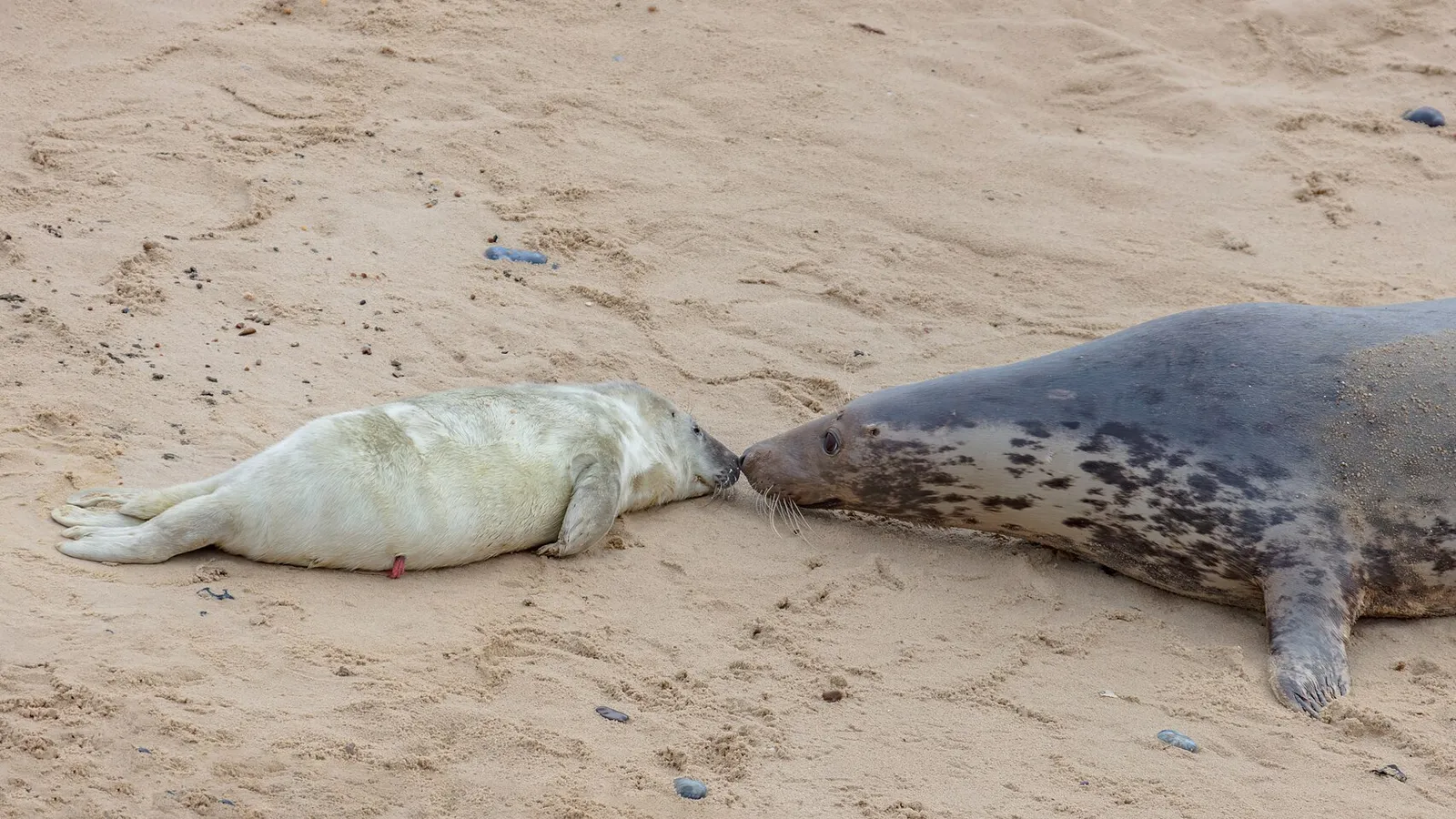
Pups. A single pup weighing about 14 kg is born in a white natal coat, shed within two to three weeks. It is suckled every five to six hours for 16 to 21 days and gains on average 1.7 kg a day, reaching about 45 kg at weaning. The milk is about 55% fat. Mothers do not feed during lactation and lose about 3.8 kg a day; bulls, which may stay ashore for up to eight weeks, lose about 2.2 kg a day. Females mate towards the end of lactation and then leave the colony abruptly, ending all parental care. Implantation of the embryo is delayed for about 125 days.
Bulls and harems. Grey seals form polygynous breeding groups whose size depends on the ground. Where access is restricted by narrow gullies, as on North Rona, a successful bull can exclude rivals and the ratio may reach one male to ten females. Bulls hold no fixed territory but compete to stay close to females.
Wandering and returning. Tagging showed that about 70% of pups stay within the general area where they were born, but some travel far: pups tagged at North Rona were recovered in Iceland, Ireland and Shetland. Branded seals at the Monach Isles and elsewhere showed adults returning to breed at or near their colony of birth, sometimes to within metres of the previous year's spot.
Lifespan. Females mature at three to five years; the oldest recorded female was 46, though few live beyond 35. Males mature at about six but rarely breed successfully before ten, and few survive beyond 20. Pup mortality on the breeding beaches was 14 to 23%, and could exceed 40% where the topography was poor.
Did You Know?
- Roughly a third of all grey seals in the world live in Scottish waters.
- About 90% of the UK's grey seal population — itself around 40% of the global total — breeds at Scottish colonies.
- Scottish salmon farms legally shot 947 grey and common seals between 2011 and 2019 under government licence.
- Some seals were documented as having been shot while pregnant or lactating during the licensed-shooting era.
- The industry ban on seal shooting, fully in effect by January 2022, was driven substantially by a 2016 US law threatening to block Scottish salmon imports worth £179 million in 2019.
- Annual licensed shooting numbers had already declined from over 200 to around 50 by 2019, before the ban's full implementation.
- Grey seal pups are born with white fur, moulted during their first three weeks at the breeding colony.
- The Gaelic name is ròn mòr, "great seal"; in old Shetland usage the grey seal was the haaf-fish.
- Grey seal milk is about 55% fat, and a pup can roughly triple its birth weight in under three weeks.
- On North Rona, grey seals haul themselves up to 80 m above the sea to breed.
- Grey seals first received legal protection in Britain in 1914.
FAQ
1How important is Scotland to the global grey seal population?
Extremely important — around a third of the world's grey seals live in Scottish waters, and about 90% of the UK's population breeds at Scottish colonies.
2Were seals legally killed in Scotland?
Yes — salmon farms shot 947 grey and common seals under government licence between 2011 and 2019, a practice now banned.
3Why was seal shooting banned?
Primarily because a 2016 US law threatened to block Scottish salmon imports to a market worth £179 million in 2019 unless the practice ended, though the ban also addressed welfare concerns.
4What welfare concerns were raised about licensed shooting?
Some seals were documented as having been shot while pregnant or lactating, resulting in the deaths of unborn or newborn seals.
5When did the ban take effect?
The Scottish Government introduced the relevant legislation in 2020, with the industry shooting ban fully in effect by January 2022.
6Had shooting numbers already been declining?
Yes — from over 200 annually to approximately 50 by 2019, reflecting industry adoption of non-lethal deterrents before the legal ban.
7What alternatives do salmon farms now use?
Specialised anti-predator nets and acoustic deterrent devices, in place of lethal control.
8What are the main natural threats to grey seals?
Competition for prey availability and predation by killer whales, alongside human-caused pressures including pollution, fishing net entanglement, and marine turbine collision risk.
9When were grey seals first protected?
Legislation began in 1914. The Conservation of Seals Act 1970 set a close season from 1 September to 31 December, and in Scotland the Marine (Scotland) Act 2010 now protects seals all year except under licence.
10Were grey seals culled in Scotland?
Yes. Pups were culled in Orkney from 1962 under an annual quota, and a larger cull planned for the late 1970s was abandoned after public protest.
11When do grey seals pup in Scotland?
Mostly October to November on the west and north coasts and November to December on the east coast at the Isle of May.
12Where are the biggest Scottish colonies?
Around 1990 the largest were in the Outer Hebrides, including the Monach Isles and North Rona, and in Orkney.
Sources and Further Reading
Primary/Institutional
- Seals — NatureScot
- SCOS Scientific Advice on Matters Related to the Management of Seal Populations 2025 — Sea Mammal Research Unit
- Grey Seal — State of The Coast
Scholarly/Critical
- G. B. Corbet and S. Harris (eds), The Handbook of British Mammals, 3rd edn (Blackwell Scientific, 1991), grey seal account by S. S. Anderson.
- Seal shooting by fish farms to be banned to save exports to US — The Ferret
- Salmon companies rapped for breaking rules on shooting seals — The Ferret
General
Caveats: Myths and Disputed Claims
- Clarification: This article does not present the 2020–22 industry shooting ban as motivated principally by animal welfare; the documented primary driver was a US trade law, though the ban's practical effect benefits seal welfare regardless of motive.
- Note: This article does not claim all seal-salmon farm conflict has ended; non-lethal deterrent use continues, and this article does not assess their comparative effectiveness in detail.
- Do not treat the Handbook's figure of about 99,500 British grey seals as current; it is a count from around 1990, given here to show change over time.
- Do not present licensed salmon-farm shooting as the only historical killing of grey seals; skin hunting, culls in Orkney and shooting at salmon netting stations all came earlier.
Card 010 · Wildlife