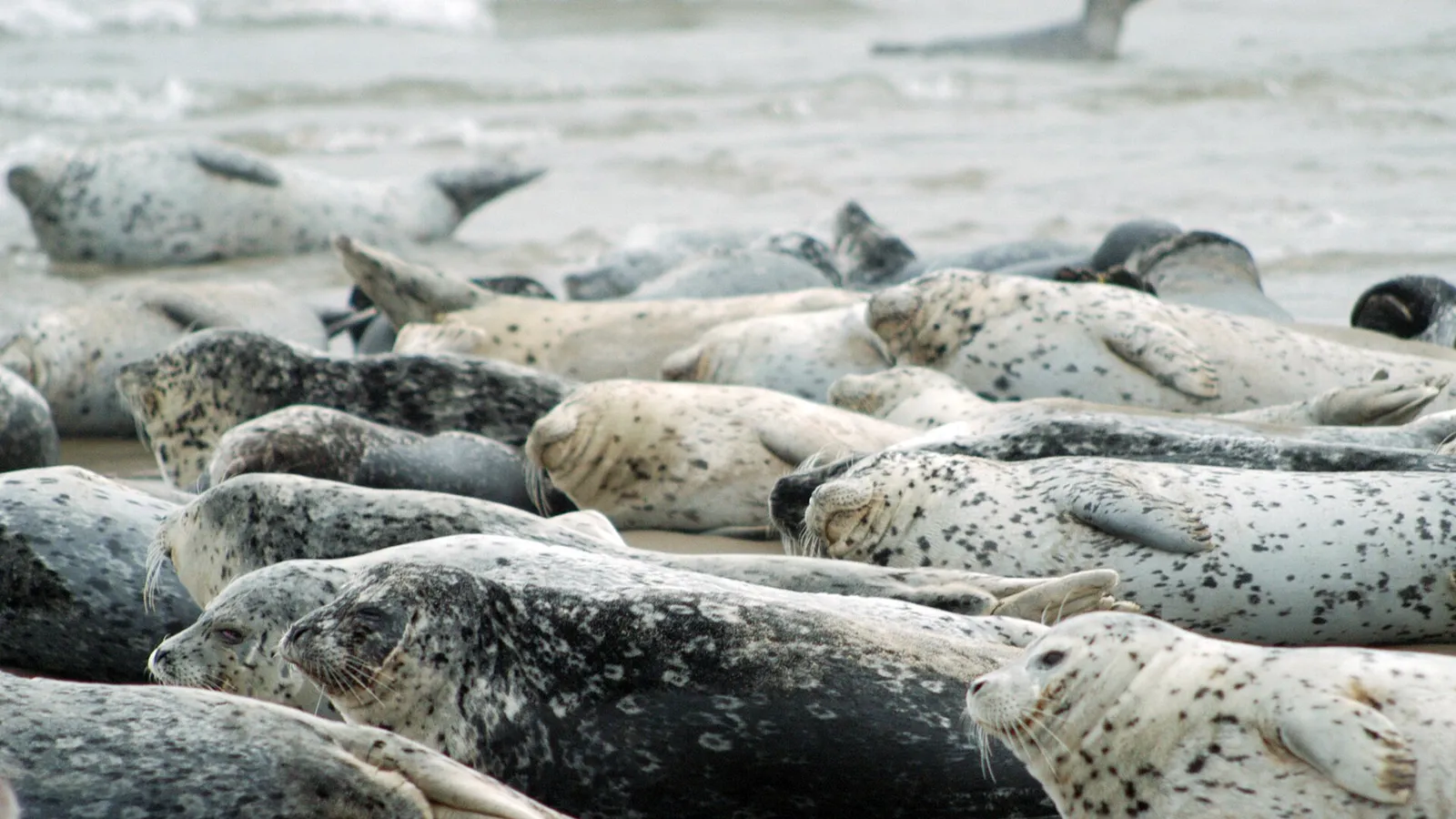

Harbour Seal (Phoca vitulina)
Contents
TL;DR
- established Scotland's harbour seal population has declined sharply overall, falling by roughly 25% between the last two national census periods to around 28,000 animals — the lowest level recorded in the 30-year survey time-series — a severe, precisely documented decline this article states directly rather than softening.
- established This decline is not uniform across Scotland: a stark east-west divide has emerged, with the west coast — now the species' stronghold — remaining comparatively stable or even increasing in places, while Orkney, Shetland, and east coast sites including the Firth of Tay have collapsed, with Orkney's abundance now around 90% lower than in the late 1990s and Shetland falling roughly 45% between 2019 and 2025 alone — this article states these regional figures with their real, divergent severity rather than averaging them into a single misleading national trend.
- disputed The underlying cause or causes of this collapse remain scientifically unresolved: researchers and NatureScot are investigating predation by orcas and grey seals, competition with grey seals, algal toxins, disease, and reduced prey availability potentially linked to environmental change, without having identified a definitive single cause — a genuinely open scientific question this article presents as such rather than asserting a confident explanation.
- established Scientific analysis has found that the scale of decline in affected areas cannot be explained by reduced birth rates or survival of young alone, indicating that elevated adult mortality is a necessary part of the explanation — a specific, documented analytical finding this article states directly, even though the cause of that adult mortality itself remains unresolved.
- established Despite regional collapse elsewhere, the west coast now holds more than three-quarters of Scotland's harbour seal population, a dramatic reversal from the 1990s pattern — a documented shift this article states with its specific scale rather than describing Scotland's harbour seals as uniformly declining or uniformly secure.
Key Facts
- Scientific name
- Phoca vitulina
- Category
- Marine Mammals
- Recent national decline
- Approximately 25% between the last two census periods
- Current estimated population
- Around 28,000 (lowest in 30-year time-series)
- Orkney decline since late 1990s
- Approximately 90%
- Shetland decline (2019–2025)
- Approximately 45%
- West coast share of population
- More than 75%
- Cause of decline
- Under active scientific investigation; not yet determined
- Other names
- Common seal; selkie or selchie (Northern Isles); black seal and tang fish (obsolete, Shetland)
- Minimum population, Great Britain and Ireland (Handbook, 1991)
- 25,000–26,000, from haul-out counts made 1973–1985
- Pupping
- June to early July, peak in mid-June; pups can swim from birth
- Protection history
- Close season 1 June–31 August (Conservation of Seals Act 1970); year-round in Shetland by special order; Marine (Scotland) Act 2010
Scottish Impact Index (SI Score)
- Scottish Significance
- 8/10
- Ecological Persistence
- 7/10
- Ecological Importance
- 8/10
- Biological Distinctiveness
- 7/10
- Conservation Significance
- 10/10
- Recognition
- 8/10
48/60
Ranked =29th of 42 in Wildlife
A Note on Claims and Evidence
Population figures, the east-west regional divide, and the scale of decline in Orkney and Shetland are drawn from NatureScot aerial survey data and Sea Mammal Research Unit census reporting. The cause of the decline is treated as genuinely Disputed, reflecting the explicit, current scientific position that researchers have identified several candidate explanations without yet establishing which is primarily responsible — this article presents that uncertainty directly rather than asserting a cause the evidence does not yet support.
Older history, biology and the regional counts of the 1970s and 1980s come from the common seal account by W. N. Bonner and P. M. Thompson in The Handbook of British Mammals (3rd edition, 1991), which uses the name "common seal". Those counts are dated, were made in different years by different methods, and are known to underestimate true numbers, so they are used here to show the historical distribution rather than as figures directly comparable with modern census results.
Timeline
An epidemic of unknown cause kills common seals in Shetland.
Hunting of pups for the skin trade, common in Shetland, Orkney and on the west coast of Scotland, causes a decline in Shetland; numbers there rise again after protection.
The Conservation of Seals Act gives common seals in Great Britain a close season from 1 June to 31 August; Shetland's seals are later protected all year round by a special order.
Haul-out counts give about 6,600 common seals in Orkney (1985), 4,700 in Shetland (1984), 4,500 in the Inner Hebrides and on the west coast (1977), 1,300 in the Outer Hebrides (1974) and 850–1,050 on the east coast of Scotland (1975).
The phocine distemper virus, which killed thousands of common seals in Scandinavia, Germany and the Netherlands, reaches the UK.
Harbour seals are more evenly distributed around Scotland's coasts than today, with Orkney and Shetland holding large numbers and the Moray Firth and Firth of Tay the main east coast sites.
Significant population reductions begin in northern and eastern regions, particularly around Orkney, Shetland, and the Firth of Tay and Eden Estuary.
National aerial survey counts 26,846 harbour seals, with population estimates suggesting approximately 37,300 individuals across Scottish waters at that time.
The west coast, now the species' stronghold, experiences an approximate 20% decline over this period despite remaining comparatively more stable than northern and eastern sites.
Shetland's harbour seal count falls by approximately 45%, following two decades of apparent broad stability.
The overall Scottish harbour seal population is found to have declined by approximately 25% between the two most recent census periods, reaching around 28,000 — the lowest level in the 30-year survey record.
NatureScot and partner researchers, including the Sea Mammal Research Unit, investigate candidate causes including orca and grey seal predation, grey seal competition, algal toxins, and disease, without yet reaching a definitive conclusion.
Details
A severe decline, stated with its real scale
This article states the scale of Scotland's recent harbour seal decline directly: a roughly 25% fall between the last two national census periods, bringing the population to around 28,000 — the lowest figure recorded across a 30-year survey time-series. This specific figure is presented without softening, since describing the trend merely as "a decline" would understate a genuinely severe and recently accelerating population loss.
A divide too stark to average away
This article deliberately avoids collapsing Scotland's harbour seal trend into a single national figure, because doing so would obscure a genuinely dramatic regional divide. The west coast, now the species' stronghold, has experienced comparatively modest decline — around 20% between 2018 and 2023 — and in places has remained stable or increasing. By contrast, Orkney's population now stands at roughly 90% below its late-1990s level, and Shetland's count fell by approximately 45% between 2019 and 2025 alone, despite two decades of apparent prior stability. This article states both figures precisely because the regional contrast is itself a central, documented feature of the species' current status in Scotland, not an incidental detail.
A genuinely unresolved scientific question, not a confident explanation
This article treats the cause of the harbour seal decline as what it actually is: an active, unresolved scientific investigation rather than a settled finding. NatureScot and allied researchers are examining several candidate explanations — predation by orcas and by grey seals, competition with grey seals for food and space, algal toxins, disease, and reduced prey availability potentially linked to environmental change — without having identified which factor, or combination of factors, is primarily responsible. This article presents this list of candidates directly, and resists the temptation to assert a single confident cause the current evidence does not yet support.
A specific analytical clue, honestly bounded
This article includes a specific, documented analytical finding that narrows — without resolving — the underlying question: researchers have determined that the scale of decline observed in affected areas cannot be explained by reduced birth rates or survival of young alone, meaning elevated adult mortality must be playing a significant role. This finding is presented directly because it represents real scientific progress in understanding the decline's mechanism, even as the ultimate cause of that elevated adult mortality remains under investigation.
A reversal of historical distribution, stated precisely
This article notes that the west coast now holds more than three-quarters of Scotland's harbour seal population, a dramatic reversal from the 1990s pattern when the species was more evenly distributed, including substantial northern and eastern strongholds. This specific, quantified shift is presented directly because it illustrates concretely how uneven the species' recent trajectory in Scotland has actually been, rather than leaving the national picture as a single ambiguous trend line.
Where the seals were: the picture in 1991
A northern stronghold. The claim sometimes made that the west coast was always the harbour seal's main Scottish stronghold is not borne out by the older counts. The Handbook of British Mammals (1991), in the account by W. N. Bonner and P. M. Thompson, gives about 6,600 common seals in Orkney (1985) and 4,700 in Shetland (1984), against 4,500 for the Inner Hebrides and west coast (1977) and 1,300 for the Outer Hebrides (1974). The east coast held only 850 to 1,050 (1975), in estuaries such as the Moray Firth, the Dornoch Firth and the Tay. The minimum estimate for Great Britain and Ireland was 25,000 to 26,000. The surveys were made in different years by different methods, and the west coast was the hardest to cover, so the comparison is approximate. Even so, the Northern Isles then held more harbour seals than the whole west coast and Hebrides together, which makes the later collapse there all the more striking.
Counts are minimums. The Handbook warned that haul-out counts miss the seals that are in the water. In the Wash, mark–recapture work implied an all-age population of about 6,575 against a maximum haul-out count of 1,722. This is one reason why population figures from different periods need care.
Typical sites. The common seal is the characteristic seal of sandbanks, mudbanks and estuaries, choosing banks with quick access to deep water. In Shetland, Orkney, the Western Isles and on the west coast it uses the shores of small islands, remote sea lochs and isolated skerries; the Handbook names the Holm of Elsness in Orkney, Harcosay in Shetland, Loch Teacuis in Argyll and the Ve Skerries in Shetland. Where left undisturbed, seals will haul out close to roads and piers. Individuals occasionally travel up inland waters, and the Handbook records them in Loch Ness.
Hunting, protection and disease before the modern decline
The skin trade. Hunting of pups for their skins was common in the 1960s in Shetland, Orkney, on the west coast of Scotland and in the Wash. In Shetland it caused a decline during the 1960s and 1970s, followed by an increase once the seals were protected. By 1991 the trade was minimal, although common seal skin remained a traditional covering for sporrans.
The law. The Conservation of Seals Act 1970 gave common seals in Great Britain a close season from 1 June to 31 August, covering pupping and lactation, when seals could be killed only under licence or near fishing nets to protect the catch. In Shetland they were protected all year round by a special order. In Scotland the 1970 Act has since been replaced by the Marine (Scotland) Act 2010, under which killing or injuring a seal at any time is an offence unless licensed.
Fisheries. By 1991 the old view of the common seal as a serious pest was largely confined to salmon fisheries, especially those using set nets, and the Handbook notes that some salmon fishing companies still paid bounties for seals killed near their nets. The spread of fish farms brought new complaints. Common seals were more often blamed than grey seals because most farms lay in sheltered waters, and the Handbook observed that the farms, and the waters around them from which seals were driven, amounted to a loss of habitat for the seals.
Disease. An epidemic killed common seals in Shetland in the 1920s, though its cause was never identified. In 1988 the phocine distemper virus, a morbillivirus related to canine distemper, killed several thousand common seals in Scandinavia, Germany and the Netherlands, with losses of up to 70% in some areas, and reached the UK in August of that year. Grey seals were much less affected.
Breeding and behaviour
Pupping. Females mature at three to four years and males at five to six. A single pup is born each year in June or early July, with the peak in mid-June and no clear regional difference in timing around Britain, unlike the grey seal. Pups are born on intertidal ground, already in their adult-type coat, and can swim and dive from birth. Lactation lasts three to four weeks; in Orkney most pups are weaned by mid-July. Mating follows around weaning and is thought normally to take place in the water.
Daily life. Seals travel up to about 50 km between haul-out sites and feeding areas. On sandbanks such as those of the Dornoch Firth, hauling out is usually limited to low tide, but on the rocky shores of the Northern Isles seals may be ashore at any state of the tide, and in Orkney some stay out for more than 24 hours. Dives normally last two to six minutes. Seals are usually solitary when feeding; in Scottish stomach samples, whiting, saithe and herring-type fish were the most common prey.
Did You Know?
- Scotland's harbour seal population has fallen to around 28,000, the lowest level recorded in a 30-year survey time-series.
- Orkney's harbour seal numbers are now roughly 90% lower than in the late 1990s.
- Shetland's count fell by approximately 45% between 2019 and 2025, despite appearing stable for the prior two decades.
- The west coast now holds more than three-quarters of the national harbour seal population; in the 1980s, Orkney and Shetland together held more common seals than the whole west coast and Hebrides.
- Scientists have ruled out reduced birth rates or pup survival alone as the explanation for the decline — elevated adult mortality appears to be a significant factor.
- Candidate causes under active investigation include orca predation, grey seal predation and competition, algal toxins, and disease — none yet confirmed as primary.
- Harbour seals and grey seals are often found at the same Scottish haul-out sites despite their different population trajectories.
- In Britain the harbour seal was long known as the common seal; in Shetland it was once called the tang fish.
- Harbour seal pups can swim and dive within hours of birth, unlike grey seal pups, which stay ashore until weaned.
- Common seal skin was still a traditional covering for sporrans in 1991.
- A harbour seal has been recorded in Loch Ness.
FAQ
1How badly has Scotland's harbour seal population declined?
Severely — approximately 25% between the last two census periods, to around 28,000, the lowest level in 30 years of surveying.
2Is the decline the same everywhere in Scotland?
No — the west coast has fared comparatively well, while Orkney (down ~90% since the late 1990s) and Shetland (down ~45% since 2019) have experienced severe collapse.
3What is causing the decline?
This remains scientifically unresolved. Researchers are investigating orca predation, grey seal predation and competition, algal toxins, disease, and reduced prey availability, without a confirmed primary cause.
4Is it a birth-rate problem?
No — analysis indicates the scale of decline cannot be explained by reduced births or pup survival alone, pointing to elevated adult mortality as a key factor.
5Where are most of Scotland's harbour seals now?
On the west coast, which holds more than three-quarters of the national population, a reversal from the more even 1990s distribution.
6Could grey seals be responsible for the decline?
Grey seal predation and competition are among the candidate explanations under investigation, but this has not been established as the definitive cause.
7Is the decline continuing?
Yes — Shetland's sharp recent fall (2019–2025) shows the decline is an active, ongoing trend in affected regions, not a historical event.
8Are harbour seals protected in Scotland?
Yes — they receive legal protection, with population monitoring and research continuing through NatureScot and the Sea Mammal Research Unit. Protection grew from a summer close season under the Conservation of Seals Act 1970, with year-round protection in Shetland, to the Marine (Scotland) Act 2010, which makes killing or injuring a seal an offence except under licence.
9Is the harbour seal the same as the common seal?
Yes. "Common seal" was the usual British name, used by The Handbook of British Mammals in 1991; "harbour seal" is the North American name and is now standard in Scotland too.
10Was the west coast always the main stronghold?
Probably not. Counts from the 1970s and 1980s put more seals in Orkney and Shetland combined than on the whole west coast and in the Hebrides, though those surveys were not strictly comparable.
11Were harbour seals hunted in Scotland?
Yes. Pups were hunted for their skins in Shetland, Orkney and on the west coast, especially in the 1960s, and the trade caused a decline in Shetland before protection.
12When are harbour seal pups born?
In June and early July, with a peak in mid-June, several months earlier than grey seal pups.
Sources and Further Reading
Primary/Institutional
- Harbour seal census confirms east-west divide — NatureScot
- Harbour Seal (Phoca vitulina) — State of The Coast
- Surveys show geographical divide in harbour seal numbers — NatureScot Press Centre
Scholarly/Critical
- G. B. Corbet and S. Harris (eds), The Handbook of British Mammals, 3rd edn (Blackwell Scientific, 1991), common seal account by W. N. Bonner and P. M. Thompson.
- New data shows drop in Scotland's harbour seal numbers and sparks concern for grey seal population — University of St Andrews
- Reduced Adult Survival Estimated in Areas of Decline of Harbour Seal Populations in Scotland — Ecology and Evolution (Wiley)
General
Caveats: Myths and Disputed Claims
- Clarification: This article does not assert a confirmed cause for the harbour seal decline; the scientific investigation remains genuinely open, with several candidate explanations under active research rather than one established answer.
- Note: This article does not claim harbour seals are declining uniformly across Scotland; the west coast's comparative stability is a documented, significant part of the current picture, not a minor exception.
- Do not call the west coast the harbour seal's traditional or historical stronghold; counts from the 1970s and 1980s put the largest numbers in Orkney and Shetland.
- Do not compare the Handbook's 1991 minimum of 25,000–26,000 for Great Britain and Ireland directly with modern Scottish census figures; the area, methods and correction factors differ.
Card 011 · Wildlife