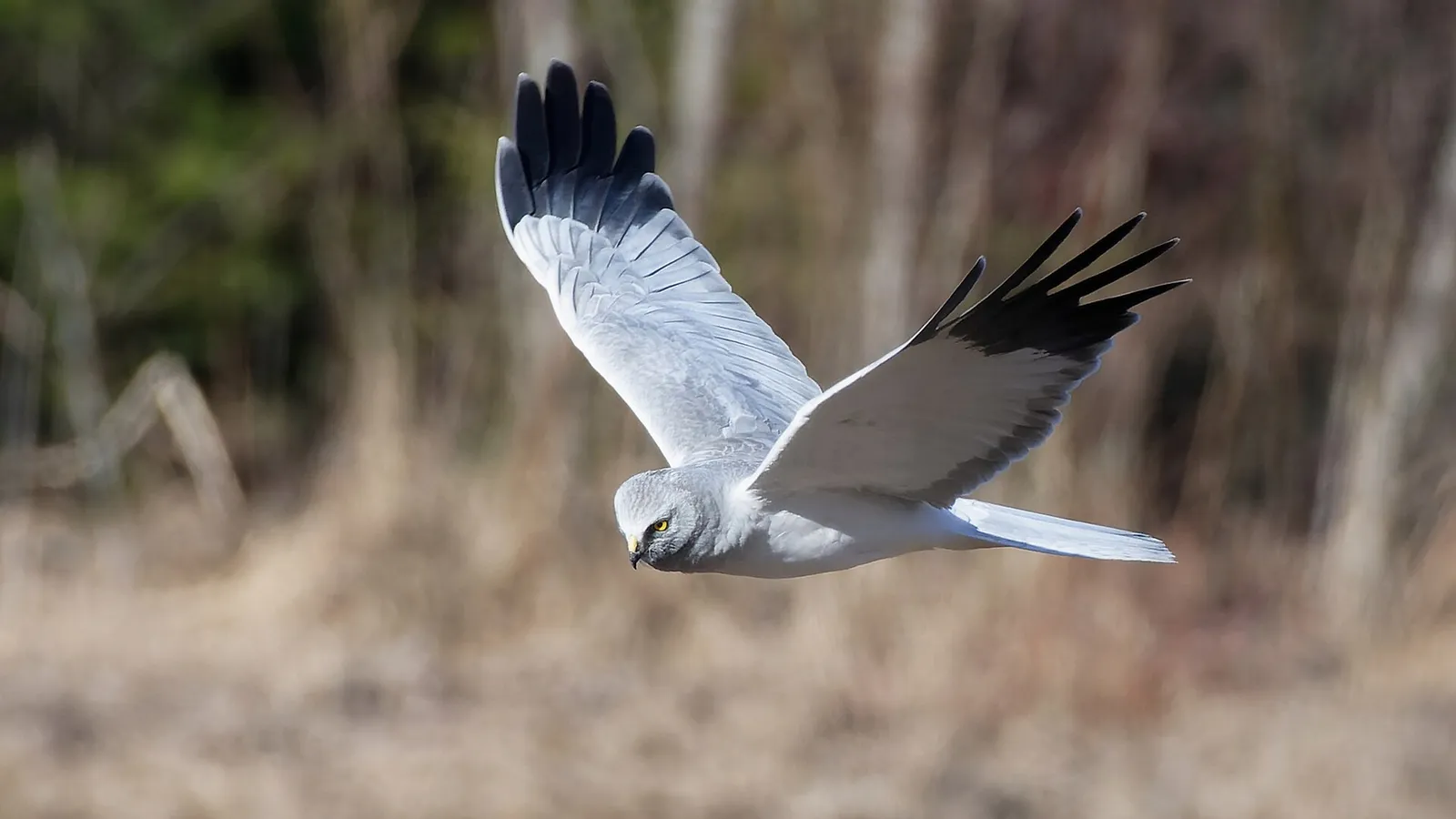

Hen Harrier (Circus cyaneus)
Contents
TL;DR
- established Scotland's overall hen harrier population has grown by 15% since 2016, reaching an estimated 529 territorial pairs — but this article states directly that this national aggregate figure masks sharply divergent regional trends rather than reflecting uniform recovery, and that the overall population remains at less than a third of its estimated potential.
- established Regional figures reveal a stark, documented split: the Hebrides saw a 125% increase (reaching 110 pairs) and the East Highlands a 69% increase, while the Southern Uplands suffered a 32% decline — the most severe regional fall — and the West Highlands declined by 5%, a specific pattern this article states precisely rather than averaging into a single misleading national trend.
- established This regional pattern is directly linked by RSPB Scotland to land management type: areas without intensive driven grouse shooting, including the Hebrides and rewilded estates, show genuine population recovery, while hen harrier numbers breeding specifically on grouse moors continue to decline — a documented correlation this article states directly, reflecting RSPB Scotland's own stated position.
- established Satellite-tagged hen harriers continue to disappear in Scotland, predominantly in areas managed for grouse shooting, including a documented case in the Angus Glens — RSPB Scotland has stated plainly that "the illegal killing associated with intensive grouse moor management must stop," language this article reports directly as the organisation's own stated position rather than softening it.
- established Scotland introduced grouse moor licensing in 2024, a measure explicitly designed to penalise shooting estates where wildlife crimes are committed, implemented specifically in response to the documented pattern of raptor persecution linked to grouse moor management — a genuine, specific regulatory response this article names directly.
Key Facts
- Scientific name
- Circus cyaneus
- Category
- Birds
- Scottish population (2016–present)
- 529 territorial pairs; 15% national increase
- Hebrides trend
- +125% (110 pairs)
- Southern Uplands trend
- -32% (most severe regional decline)
- Population vs. potential
- Less than one-third of estimated potential
- Key legislation
- Scottish grouse moor licensing, introduced 2024
- Earlier national surveys
- 408–594 pairs (1988–89); 436 (1998); 633 (2004)
- Gaelic name
- Clamhan-nan-cearc
- Breeding
- Ground nest in long heather; 4–6 eggs; incubation about 30 days; fledging at 30–35 days
Scottish Impact Index (SI Score)
- Scottish Significance
- 8/10
- Ecological Persistence
- 6/10
- Ecological Importance
- 9/10
- Biological Distinctiveness
- 8/10
- Conservation Significance
- 10/10
- Recognition
- 8/10
49/60
Ranked =26th of 42 in Wildlife
A Note on Claims and Evidence
Population figures and regional breakdowns are drawn from national hen harrier survey data as reported by RSPB Scotland. The correlation between grouse moor management and continued decline/persecution, and the characterisation of illegal killing, reflect RSPB Scotland's own stated position, drawn from documented satellite tagging data and survey findings; this article presents this as the documented position of a specific conservation organisation rather than an independently adjudicated finding, though it is supported by the consistent regional pattern in the underlying survey data.
Timeline
William Turner records the bird as native and explains that it is called "hen-harrier" for killing domestic fowls.
George Montagu separates Montagu's harrier from the hen harrier, ending confusion over the grey males and brown "ringtail" females.
Keepers on the Glen Garry estate in the Highlands kill 68 harriers among more than 1,500 birds of prey.
The hen harrier is a common bird of Scotland's moors, bogs and mires.
Keepering has made the hen harrier virtually extinct on the British and Irish mainlands. In Scotland only tiny populations survive, in Orkney, the Outer Hebrides and possibly Kintyre and Arran, where driven grouse moors did not pay.
A parliamentary grouse inquiry, for which Edward Wilson dissects 2,000 Scottish grouse, blames grouse crashes on a threadworm, not on hooded crows or hen harriers.
As keepers are called up in two world wars, harriers re-establish themselves on mainland Scotland; the greatest gains come in 1939–45, and by 1946 they breed widely, though in small numbers.
The Protection of Birds Act gives the hen harrier special protection.
Over 300 young harriers are reared in Carradale Forest, Argyll, one of the new conifer plantations the species colonises; 18 pairs nest there in 1961.
Scotland holds an estimated 377–451 pairs.
The first RSPB national survey finds 408–594 pairs.
On moorland managed for grouse, 80% of harrier nests fail, mostly through human action.
A national survey finds 436 pairs, 76% of the UK population.
The Joint Raptor Study in south-west Scotland concludes raptors are very unlikely to explain the long-term fall in red grouse, but can take a large share of grouse locally.
Police launch Operation Artemis to remind landowners of the hen harrier's protected status. The national survey finds 633 pairs in Scotland, 79% of the British population, but numbers in the grouse-moor regions of the East Highlands and Southern Uplands fall from about 199 pairs in 1998 to 129.
A national hen harrier survey establishes a baseline population figure for Scotland, against which subsequent regional and national trends are measured.
Scotland's overall territorial pair count rises by 15% to an estimated 529 pairs, while regional trends diverge sharply: the Hebrides rises 125% to 110 pairs, the East Highlands rises 69%, the West Highlands falls 5%, and the Southern Uplands falls 32%, the most severe regional decline recorded.
Satellite tagging data continues to document hen harriers disappearing predominantly in areas managed for grouse shooting, including a documented disappearance in the Angus Glens.
Scotland introduces grouse moor licensing, a measure specifically designed to penalise shooting estates where wildlife crimes, including illegal raptor persecution, are found to have occurred.
RSPB Scotland maintains that Scotland's overall hen harrier population remains at less than a third of its estimated potential, with continued decline specifically on grouse moors offsetting genuine recovery in areas without intensive driven grouse shooting.
Details
A national figure that conceals a sharp regional divide
This article does not present Scotland's 15% hen harrier population increase since 2016 as evidence of uniform recovery: this national aggregate obscures a genuinely stark regional split. The Hebrides recorded a 125% increase, reaching 110 pairs, and the East Highlands a 69% increase, while the Southern Uplands suffered a 32% decline — the most severe regional fall recorded — and the West Highlands declined by 5%. This article states these regional figures precisely because the national trend alone would misrepresent a genuinely divided picture as a straightforward, uncomplicated success story.
A documented correlation with land management type
This article states directly, rather than presenting the regional divide as unexplained, RSPB Scotland's documented position linking these contrasting trends to land management: areas without intensive driven grouse shooting, including the Hebrides and rewilded estates, show genuine recovery, while hen harrier numbers breeding specifically on grouse moors continue to decline. This article names this correlation because it represents the documented pattern underlying the organisation's stated conclusions, drawn from consistent survey and satellite tagging evidence across multiple regions.
Strong language, reported as the organisation's own stated position
This article reports RSPB Scotland's own characterisation of the situation directly rather than softening it for neutrality's sake: the organisation has stated plainly that "the illegal killing associated with intensive grouse moor management must stop," following continued documented disappearances of satellite-tagged birds in areas managed for grouse shooting, including a specific case in the Angus Glens. This article presents this as RSPB Scotland's own documented position, attributed clearly to the organisation, rather than as an independently adjudicated finding this article asserts in its own voice.
A substantial, specific legislative response
This article names Scotland's 2024 grouse moor licensing introduction as a genuine, specific regulatory response rather than a symbolic gesture: the measure was designed specifically to penalise shooting estates where wildlife crimes, including illegal raptor persecution, are found to have occurred, directly addressing the documented pattern linking grouse moor management to hen harrier disappearance and decline. This article states this directly because it represents a concrete policy response grounded in the preceding evidence, whose long-term effectiveness as a deterrent remains to be demonstrated.
An honest statement of distance still to travel
This article states plainly RSPB Scotland's own assessment that the overall Scottish hen harrier population remains at less than a third of its estimated potential, even after the recorded 15% national increase. This article includes this figure directly because it demonstrates that, notwithstanding genuine regional recovery in some areas, the species' overall Scottish recovery remains substantially incomplete by the conservation sector's own measure.
Grouse moors and raptors: the historical background
Smout draws on the work of Richard Lovegrove to argue that most of the damage to Scotland's predators was done before about 1840, with Victorian gamekeepers after about 1870 mainly engaged in "mopping-up operations". The Dumfries fur market, held every February, shows the scale in the south-west: in 1831, 600 polecat and 226 otter skins were offered for sale; by 1869 there were none of either. In the Highlands the evidence comes from estate vermin returns. Smout accepts that bounty records can be inflated, but notes that owners usually demanded heads or wings as proof, so a figure such as 143 pine martens and 295 eagles killed at Langwell and Sandside in Sutherland between 1819 and 1826 should not be dismissed. As a result some predators became extinct in Scotland (polecat, red kite, osprey, sea eagle) and others were greatly reduced (wild cat, pine marten, otter, hen harrier, golden eagle). Only well into the second half of the twentieth century was there even limited recovery.
Smout notes that on estates run mainly for grouse or salmon the main ecological impact was the destruction of raptors. On grouse moors this might bring a short-term surge in birds to shoot, but it was "invariably checked" by outbreaks of disease and by longer-term deterioration of habitat where the moors were also grazed by sheep. He identifies the illegal persecution of raptors and the decline of grouse numbers as linked problems with a history spanning much of the twentieth century.
Keeper and harrier: the older story
established Mark Cocker and Richard Mabey, in Birds Britannica (2005), call the hen harrier "one of the most reviled, most persecuted and controversial of our raptors". The name itself records an old grievance: in the sixteenth century William Turner wrote that it was called hen-harrier "from butchering their fowls". In the nineteenth and early twentieth centuries the bird faced keepers who shot, trapped and poisoned adults and collectors who took eggs and nests. The book cites two grouse estates in south-west Scotland said to have killed 351 harriers in four years; identification of raptors was loose then, so the figure may be too high, but no bird of prey could withstand such a cull. On the Glen Garry estate keepers killed 68 harriers between 1837 and 1840.
established The killing was sometimes given a quasi-judicial form. The Marquess of Bute made his keepers swear to "use my best endeavours to destroy all Birds of Prey" with their nests. Because harriers nest on the ground and defend their young closely, they were easy to shoot. One old method was to kill all the chicks but one and tether it to a post; it could not leave even after fledging, so the parents kept returning to feed it until they too could be shot.
established The harrier's fortunes ran opposite to those of the keepers. By about 1900, at the height of game shooting, it was virtually extinct on the British and Irish mainlands. When keepering declined during and between the two world wars, harriers re-established themselves on mainland Scotland and spread south. Science had already cleared the bird of one charge: the 1907 parliamentary grouse inquiry, for which the Antarctic explorer Edward Wilson visited almost every major grouse moor in Scotland and dissected 2,000 birds, found that grouse crashes were caused by a threadworm, not by hooded crows or hen harriers.
The Joint Raptor Study and diversionary feeding
established Between 1992 and 1997 the Joint Raptor Study in south-west Scotland, with representatives of both sides of the argument, examined the effect of raptors on grouse moors. It concluded that raptors were very unlikely to be responsible for the long-term decline in red grouse: bags had been falling since the 1930s, when harriers were absent, and kept falling while harrier numbers were stable. But it also found that birds of prey can take a substantial share of a local grouse population. Cocker and Mabey note that environmentalists are sometimes less willing to face that fact.
established The study found that harriers settle where there are plenty of meadow pipits and voles, which depend on grassland within the heather; better heather management therefore discourages both harriers and their prey. Trials of diversionary feeding, giving nesting harriers day-old chicks and laboratory mice, cut grouse predation by 86 per cent. The book observed in 2005 that "bearing gifts to the old enemy" had so far found little favour with keepers. At that time, they wrote, Britain held about 670 pairs, thought to be well under half the potential, and up to one in six Scottish hen harriers was believed to be killed each year. The British figure looks low against the 2004 national survey, which found 633 pairs in Scotland alone.
The Scottish record: The Birds of Scotland (2007)
established Loss and return. The Scottish Ornithologists' Club's The Birds of Scotland (2007), in the species account by Brian Etheridge, describes the hen harrier as common on Scotland's moors, bogs and mires in the eighteenth and early nineteenth centuries, before the rise of sporting estates, especially grouse moors, wiped it out on the mainland. By the start of the twentieth century it survived only in Orkney, the Outer Hebrides and perhaps Kintyre and Arran. The First World War gave a brief respite, but the real gains came in 1939–45, and by 1946 the bird was breeding widely again. Many grouse moors and their keepers never returned after the war. From the late 1940s to the 1970s, the planting of conifers across Argyll, Clyde, Upper Forth and Dumfries & Galloway gave harriers young forest to nest in, and foresters protected them. In Carradale Forest in Argyll over 300 young were reared in 1957–64.
established Where harriers breed. Orkney has long been the stronghold, though its adult population fell by 70% from the late 1970s, through intensive grazing, poor spring weather and fewer Orkney voles, before recovering after 2002. Orkney males were notably polygynous: in 1967–81, 75% of breeding males had more than one mate, falling to 17% by 1998–2000. The Uists, Benbecula, Mull, Islay, Bute and Arran also hold important numbers. The bird is absent from Shetland, from the Lewis peatlands, probably for lack of voles, and largely from the deer forests of the North-west Highlands. On the intensively managed heather moors of Lothian and the Borders it was "all but absent". The account concludes that large areas of suitable moorland still had no harriers.
established Surveys and the grouse-moor gap. Successive national surveys found 377 to 451 pairs in the early 1980s, 408 to 594 in 1988–89, 436 in 1998 and 633 in 2004. The 2004 rise was all in the north, west and islands. In the East Highlands and Southern Uplands, where grouse moors dominate, numbers fell from about 199 to 129 pairs between 1998 and 2004, a 45% fall in the Southern Uplands since 1998 and 40% in the east since 1988–89. In 1988–95, 80% of nests on grouse moors failed, mostly because of people, against annual fox predation of 5 to 10% of broods in an unkeepered Highland study area. Etheridge's earlier research found that persecution on grouse moors was heavy enough to cut the female population there by 46% a year, were it not for young birds moving in from elsewhere. The national increase of a little over 6% a year between 1998 and 2004 was less than half the 13% expected without persecution of nesting females. Persecution also produces a tell-tale sign: first-year brown males rarely breed, under 1% elsewhere, but 6% or more on grouse moors, where adult males have been removed.
established The killing described. Etheridge calls the deliberate killing of breeding birds and destruction of nests on grouse moors the only serious threat to the species at the start of the twenty-first century. Some estates continued it into autumn and winter, shooting birds at dusk as they came in to communal roosts or "lamping" them at night. Despite 50 years of special protection since the Protection of Birds Act 1954, he found no sign of a reduction. The book's conservation chapter, by Paul Walton and Stuart Housden, says the population had stalled at around 600 pairs, less than half an estimated natural level of 1,660 breeding females, and that an estimated 11 to 15% of mainland breeding females were illegally killed each year. Its chapter on habitats, by Stuart Benn and Andy Douse, names the hen harrier first among the grouse-moor raptors that are "much rarer than they should be".
established Breeding and movements. Males perform their sky-dance from late March, and most do not breed until they have grey adult plumage at two years or more, while many females breed at one. Nests are on the ground in long heather, soft rush or bog myrtle, with four to six eggs laid from late April in the south and mid-May in the north. Breeding sites produced about 1.75 young each in both 2003 and 2004. Wing-tagging of nestlings in 1989–95 showed that about half of young males leave Scotland in autumn for southern England, Ireland, France or Iberia, while some 65% of young females stay, wintering on eastern moors or in Ayrshire and Dumfries & Galloway. Galloway roosts have held up to 30 birds. The account estimates 1,050 to 1,540 hen harriers in Scotland in winter, against about 400 in the early 1980s.
established Reading today's figures against 2004. The 2004 survey's 633 pairs is higher than the 529 territorial pairs of the most recent survey, so the 15% rise since 2016 follows a period of decline and has not yet regained the 2004 level. Survey estimates carry wide confidence limits, so the comparison shows direction rather than an exact loss.
Did You Know?
- Scotland's hen harrier population rose 15% since 2016, to an estimated 529 territorial pairs — but this masks sharply divergent regional trends.
- The Hebrides saw a 125% population increase over the same period, reaching 110 pairs.
- The Southern Uplands suffered a 32% decline, the most severe regional fall recorded.
- Hen harrier numbers breeding specifically on grouse moors continue to decline, even as numbers rise elsewhere.
- Satellite-tagged hen harriers continue to disappear predominantly in areas managed for grouse shooting, including a documented case in the Angus Glens.
- Scotland's overall hen harrier population remains at less than a third of its estimated potential, according to RSPB Scotland.
- Scotland introduced grouse moor licensing in 2024, specifically designed to penalise estates where wildlife crimes occur.
- The name "hen-harrier" goes back at least to the sixteenth century, when it was given for the bird's raids on domestic fowls.
- Until 1802 grey male hen and Montagu's harriers were thought to be one species, and the brown females of both were treated as another bird, the "ringtail".
- Trials in south-west Scotland found that feeding nesting harriers day-old chicks and laboratory mice cut their predation of grouse by 86 per cent.
- Hen harriers recolonised mainland Scotland when gamekeepers were away fighting in the two world wars.
FAQ
1Is the hen harrier population in Scotland recovering?
Partially — the national figure has risen 15% since 2016, but this conceals a sharp regional divide, with some areas recovering strongly and others, particularly the Southern Uplands, declining severely.
2Where are hen harriers doing well?
The Hebrides (+125%) and East Highlands (+69%), both areas without intensive driven grouse shooting.
3Where are they doing badly?
The Southern Uplands (-32%) and West Highlands (-5%), both linked by RSPB Scotland to continued persecution associated with grouse moor management.
4Are satellite-tagged hen harriers really disappearing on grouse moors?
Yes — this has been documented repeatedly, including a recent case in the Angus Glens, and RSPB Scotland attributes this pattern to illegal killing.
5What has Scotland done about this?
Introduced grouse moor licensing in 2024, designed to penalise shooting estates where wildlife crimes are found to have occurred.
6Has the problem been solved?
No — RSPB Scotland states the overall population remains at less than a third of its estimated potential, and the licensing scheme's long-term deterrent effect has not yet been demonstrated.
7Is this RSPB Scotland's view, or an independently confirmed fact?
This article reports RSPB Scotland's own documented position, which is grounded in consistent survey and satellite tagging data showing the same regional pattern repeatedly.
8Do hen harriers really eat grouse?
Yes. The Joint Raptor Study (1992–97) found they can take a large share of grouse locally, but also that raptors are very unlikely to explain the long-term decline in grouse numbers, which began in the 1930s when harriers were absent.
9Why is it called a hen harrier?
Because it was thought to kill domestic fowls. William Turner recorded the name in the sixteenth century.
10How close did the hen harrier come to disappearing from mainland Britain?
By about 1900 it was virtually extinct on the British and Irish mainlands. It returned to mainland Scotland only when keepering declined during the world wars.
11What is diversionary feeding?
Providing nesting harriers with alternative food, such as day-old chicks and laboratory mice, near the nest. Trials in Scotland cut grouse predation by 86 per cent.
12Were there more hen harriers in Scotland in the past?
Yes. They were common in the eighteenth and early nineteenth centuries, and the 2004 national survey found 633 pairs, more than the 529 territorial pairs recorded most recently.
13How did conifer forestry affect hen harriers?
It helped them for a time. The Birds of Scotland (2007) records that young plantations from the late 1940s to the 1970s gave harriers new nesting cover, protected by foresters; over 300 young were reared in Carradale Forest, Argyll, in 1957–64.
14Do Scottish hen harriers migrate?
Partly. Most adults stay in Scotland, but wing-tagging showed about half of young males leave in autumn for southern England, Ireland, France or Iberia.
15What is a "territorial pair"?
A pair of hen harriers holding and defending a breeding territory, the standard unit used in national population surveys.
Sources and Further Reading
Primary/Institutional
- Forrester, R. W., Andrews, I. J. et al. (eds), The Birds of Scotland (Scottish Ornithologists' Club, 2007), account by Brian Etheridge; also the chapters "Bird conservation in Scotland" by Paul Walton and Stuart Housden and "Scotland's geography and habitats" by Stuart Benn and Andy Douse
- Breeding Hen Harriers continue to decline on Scottish grouse moors — Raptor Persecution UK
- Yet more Hen Harrier persecution on grouse moors in 2025 — RSPB
Scholarly/Critical
- T. C. Smout, "Land and Sea: The Environment", in T. M. Devine and Jenny Wormald (eds), The Oxford Handbook of Modern Scottish History (Oxford University Press, 2012)
- Mark Cocker and Richard Mabey, Birds Britannica (Chatto & Windus, 2005)
- Update: Hen Harrier Conservation Licence 2025 — Moorland Association
- Four more satellite-tagged hen harriers have 'gone missing' since January 2025 — Raptor Persecution UK
General
Caveats: Myths and Disputed Claims
- Clarification: This article does not present Scotland's 15% national population increase as evidence of uniform recovery; the underlying regional data shows a sharply divided picture, with continued severe decline in grouse moor-dominated areas.
- Do not claim hen harriers never take significant numbers of grouse; they can locally. The evidence is that they do not explain the long-term decline of grouse.
- Do not treat nineteenth-century kill tallies, such as 351 harriers on two estates in four years, as exact; raptors were often misidentified.
- Do not describe the 529 pairs of the latest survey as a record high; the 2004 national survey found 633 pairs.
- Do not use Birds Britannica's figure of about 670 pairs as the British total for 2004; that year's survey found 633 in Scotland alone, 79% of the British population.
- Note: This article attributes the "illegal killing...must stop" characterisation and the land-management correlation explicitly to RSPB Scotland's own stated position, grounded in documented survey and tagging data, rather than presenting it as an independently adjudicated finding in the article's own voice.
Card 027 · Wildlife