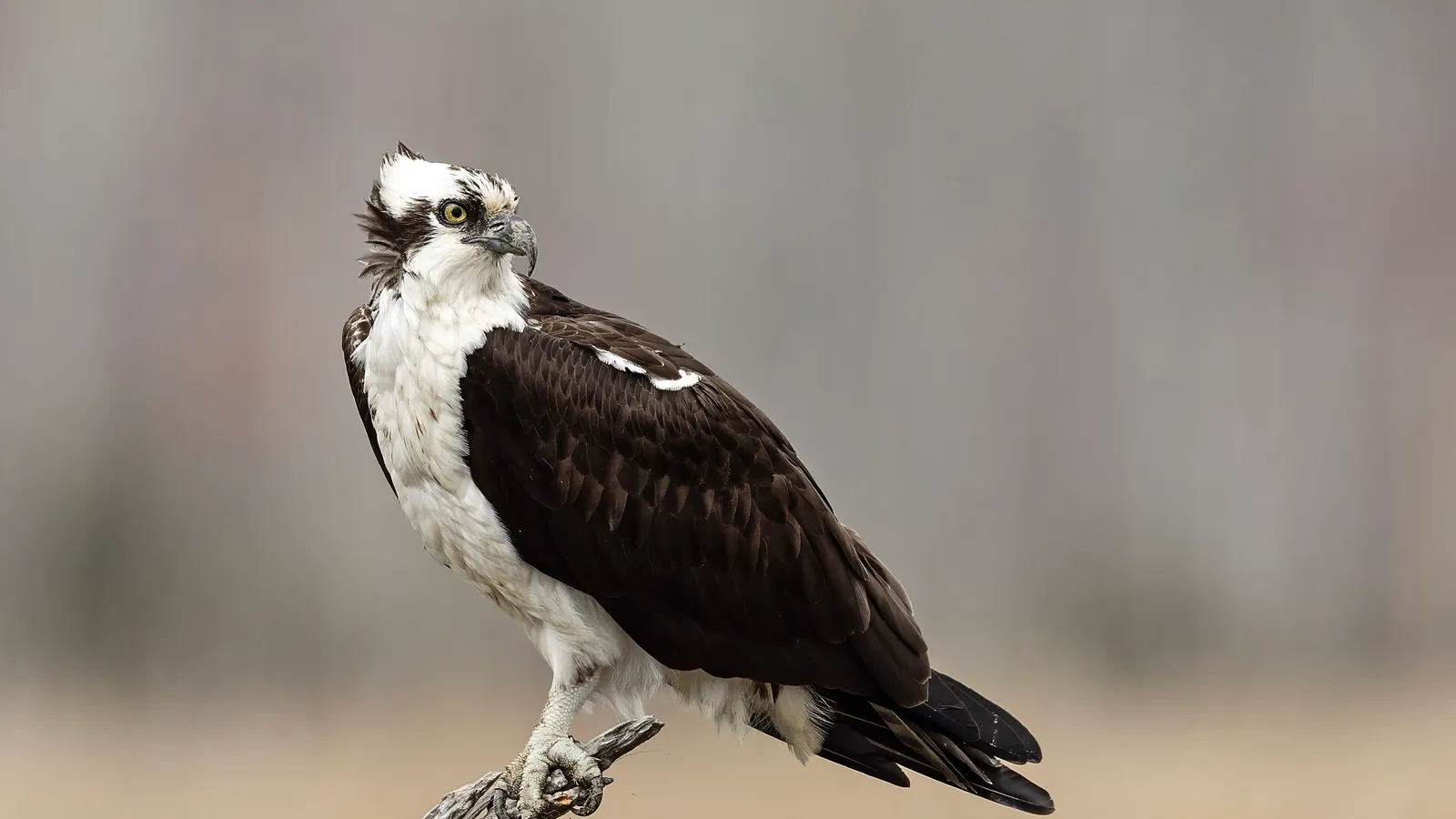

Osprey (Pandion haliaetus)
Contents
TL;DR
- shared Ospreys were driven to the edge of extinction in Britain by 1916, the last recorded breeding year, though Roy Dennis's re-examination of old records, summarised in The Birds of Scotland (2007), concludes that a few pairs went on breeding in secret and the species never quite vanished from Scotland. The cause was a combination of direct persecution by those resenting their fishing success and sustained Victorian-era egg collecting and taxidermy targeting the species' distinctive brown-blotched eggs and skins — a direct, documented human cause this article states plainly rather than a vague historical decline.
- established Even after ospreys began naturally recolonising Scotland around Loch Garten from 1954, round-the-clock volunteer protection failed to stop egg thieves raiding the nest in 1958, who removed the real eggs and replaced them with chicken eggs daubed in boot polish — a specific, documented act of continued criminal persecution this article states directly rather than presenting the species' return as a smooth, uncontested recovery.
- established Following that 1958 theft, ospreys built a second nest at what is now the Loch Garten site, and in 1959 three chicks successfully hatched — a breakthrough that led the RSPB, at the urging of its Scottish director George Waterston, to make the deliberate strategic decision to open the nest to public viewing rather than keep it secret, drawing 14,000 visitors in seven weeks and beginning the species' transformation into a celebrated conservation symbol.
- established Scotland now hosts between 250 and 300 breeding pairs of ospreys, with numbers continuing to increase, particularly in Argyll, southern Scotland, and northern regions — a substantial, quantified recovery this article states with its real current scale.
- established Ospreys have since spread beyond Scotland. Some sites, such as the Lake District (2001), were colonised by birds from the north, helped by artificial nests; at Rutland Water a translocation programme managed by the Scottish ecologist Roy Dennis released young Scottish birds from 1996, and breeding followed from 2001.
Key Facts
- Scientific name
- Pandion haliaetus
- Category
- Birds
- Last recorded breeding (old population)
- Loch Arkaig 1908, Loch Loyne 1916 (occasional secret nesting continued)
- Recolonisation publicly known
- 1954, Loch Garten
- Population in 2004
- 182 pairs recorded, probably close to 200 (The Birds of Scotland, 2007)
- Gaelic name
- Iolaire-iasgaich
- Winter range
- Mainly West Africa (Senegal, Gambia, Guinea, Mali, Mauritania); a few in Spain and Portugal
- First successful chicks (Loch Garten)
- 1959
- Current Scottish population
- 250–300 breeding pairs
- Trend
- Increasing
Scottish Impact Index (SI Score)
- Scottish Significance
- 10/10
- Ecological Persistence
- 8/10
- Ecological Importance
- 10/10
- Biological Distinctiveness
- 9/10
- Conservation Significance
- 10/10
- Recognition
- 10/10
57/60
Ranked =2nd of 42 in Wildlife
A Note on Claims and Evidence
Extinction cause, the 1958 egg theft, and the 1959 breakthrough are drawn from RSPB historical accounts and contemporary journalism covering Operation Osprey. Current Scottish population figures are drawn from NatureScot's published assessment. This article treats the species' recovery as a genuine, well-documented conservation success while stating the historical persecution record, including its persistence after initial protection efforts began, with full honesty.
Timeline
Ospreys are present as a breeding species across parts of Britain, including Scotland.
Keepers on the Glen Garry estate in the Highlands kill 18 ospreys among more than 1,500 birds of prey.
Ospreys breed for the last time south of the northern uplands for more than 150 years.
Some 40–50 Scottish pairs remain; demand for museum specimens grows, with an osprey egg worth 7s 6d.
The egg collector Lewis Dunbar swims out in a snowstorm to the osprey eyrie on the castle in Loch an Eilein and takes its eggs.
The last recorded breeding of the old population, at Loch Arkaig and Loch Loyne in Lochaber.
Four young ospreys from New York are released at Loch Arkaig.
shared According to Roy Dennis's 2007 re-examination of records and eyewitness accounts, occasional breeding continues in secret, mostly at Loch Garten, where young were in the nest in 1947.
Ospreys are publicly known to be nesting again, near Loch Garten in the Cairngorms.
The Strathspey pair's nests are robbed every year.
Despite round-the-clock volunteer protection from a makeshift hide, egg thieves raid the Loch Garten nest, stealing the real eggs and replacing them with chicken eggs daubed in boot polish; the perpetrators are never caught.
Ospreys build a second nest at the modern Loch Garten site, and three chicks successfully hatch, the first publicly recorded successful osprey breeding in Britain in over four decades.
A second nest is established near Loch Garten (1963), ospreys colonise Moray & Nairn (1966) and inland Perthshire (1968).
Ringing of Scottish ospreys begins; nearly 2,000, almost all chicks, are ringed over the next four decades.
At George Waterston's urging, the RSPB opens the Loch Garten nest to public viewing rather than protect it in secrecy, drawing 14,000 visitors in seven weeks and launching "Operation Osprey" as a model combining public engagement with active protection.
Vandals try to cut down the nest tree; the RSPB straps it with iron bars.
The Loch Garten eggs are stolen again.
Vandals cut down the eyrie; RSPB staff rebuild it.
Egg theft peaks: 25.6% of Scottish nests are robbed.
Ospreys colonise the Borders, especially around Peebles.
Roy Dennis manages the translocation of young Scottish ospreys to Rutland Water in the English Midlands.
Ospreys breed at Dodd Wood, near Keswick, on an artificial eyrie: the first in the Lake District for at least 150 years. Breeding also begins at Rutland Water.
Scotland has about 160 occupied eyries, and two Rutland pairs rear five young.
182 pairs are recorded in Scotland, probably close to 200 in all, from Caithness to Dumfries & Galloway.
Ospreys spread further, to mid-Wales (2004) and Kielder Forest, Northumberland (2009), and a further translocation establishes them at Poole Harbour, Dorset (2017).
Scotland hosts an estimated 250–300 breeding pairs, with numbers continuing to increase, particularly in Argyll, southern Scotland, and northern regions.
Details
Extinction with a direct, documented human cause
This article states plainly that osprey extinction in Britain by 1916 was not a natural decline but the direct result of human persecution: birds were killed by those resenting their fishing success, while Victorian-era collectors and taxidermists sustained demand for the species' distinctive brown-blotched eggs and skins. This article names both drivers directly because understanding the scale of the species' eventual recovery requires understanding the deliberate, human-caused nature of its original loss.
A recovery that was not smooth or uncontested
This article does not present the species' Scottish return as an easy or straightforward success story: even after ospreys began naturally recolonising Loch Garten from 1954, and even with round-the-clock volunteer protection already in place, egg thieves successfully raided the nest in 1958, stealing the real eggs and leaving chicken eggs daubed in boot polish in their place. This article states this specific, documented act directly because it demonstrates that illegal persecution continued to actively threaten the species even during its earliest, most carefully guarded recovery attempts, and that the perpetrators were never identified or held accountable.
A breakthrough that changed conservation strategy
This article credits the 1959 hatching of three chicks at Loch Garten, following the previous year's theft, as the genuine breakthrough it was — and names the specific strategic decision that followed: rather than continuing to protect the nest in secrecy, the RSPB, led in Scotland by George Waterston, chose to open it to public viewing, drawing 14,000 visitors in seven weeks. This article states this directly because it represents a deliberate, documented shift in conservation approach — using public engagement and visibility as a protective strategy — that became a model later applied to other species recovery projects.
A current recovery stated with its real scale
This article presents Scotland's current osprey population with its actual documented figures rather than general celebration: an estimated 250–300 breeding pairs, with numbers continuing to increase, particularly in Argyll, southern Scotland, and northern regions. This article states this range directly because it demonstrates a substantial, ongoing recovery from a starting point of national extinction, while the NatureScot source's continued inclusion of protected species licensing guidance indicates genuine legal protections remain actively relevant to the species' ongoing management.
A recovery extended deliberately beyond Scotland
This article names the role of deliberate human intervention in extending the species' recovery beyond its original Scottish recolonisation point, while separating the two methods used. The first was artificial nests. Borrowing from North America, where ospreys nest on cartwheels fixed to quayside poles, conservationists in Scotland built natural-looking eyries to tempt birds to new sites. One such nest, built by the Forestry Commission and the Lake District National Park Authority at Dodd Wood near Keswick, held the first Lake District breeding pair for at least 150 years in 2001; artificial nests also helped ospreys settle in mid-Wales and at Kielder Forest. The second was translocation. Between 1996 and 2001 Roy Dennis's Highland Foundation for Wildlife, working with Anglian Water and the reserve staff, released 64 young Highland ospreys at Rutland Water in the English Midlands. Breeding began there in 2001, and the site had fledged 250 chicks by 2023. A later translocation established ospreys at Poole Harbour in Dorset. This article states this directly because it clarifies that the species' wider British recovery, while rooted in Scotland's natural recolonisation, substantially depended on continued, active, deliberate conservation effort rather than unaided natural spread alone.
The Victorian slaughter of predators: the historian's figures
Smout draws on the work of Richard Lovegrove to argue that most of the damage to Scotland's predators was done before about 1840, with Victorian gamekeepers after about 1870 mainly engaged in "mopping-up operations". The Dumfries fur market, held every February, shows the scale in the south-west: in 1831, 600 polecat and 226 otter skins were offered for sale; by 1869 there were none of either. In the Highlands the evidence comes from estate vermin returns. Smout accepts that bounty records can be inflated, but notes that owners usually demanded heads or wings as proof, so a figure such as 143 pine martens and 295 eagles killed at Langwell and Sandside in Sutherland between 1819 and 1826 should not be dismissed. As a result some predators became extinct in Scotland (polecat, red kite, osprey, sea eagle) and others were greatly reduced (wild cat, pine marten, otter, hen harrier, golden eagle). Only well into the second half of the twentieth century was there even limited recovery.
Lewis Dunbar and the Loch an Eilein eggs
established Mark Cocker and Richard Mabey, in Birds Britannica (2005), describe the nineteenth-century trade in osprey eggs and skins as a chain of supply and demand, in which local collectors risked their lives for trophies sold to wealthy buyers. Their best-known example is Lewis Dunbar. In May 1851 he walked overnight to the osprey eyrie on the ruined castle in the middle of Loch an Eilein, a few miles from Loch Garten. At three in the morning, in a snowstorm, he stripped and swam out to the island. He took two eggs, then found he had nothing to carry them in. He tried holding one in his mouth, could not breathe, and swam back on his back with an egg in each hand. He blew the eggs at once, washed them out with whisky and sold them to the English collector John Wolley. On the Glen Garry estate, keepers killed 18 ospreys between 1837 and 1840. By 1916 Scottish ospreys were considered extinct, though the book notes that they may have continued to nest occasionally through their "exile".
Operation Osprey
established When ospreys returned to Strathspey in the 1950s, the persecution resumed. The pair's nests were robbed every year from 1955 to 1958. In 1958 the RSPB's director, Philip Brown, was himself on the round-the-clock guard when thieves raided the nest; the stolen eggs were smashed in the chase, but the thieves had already swapped in two hens' eggs daubed with boot polish. The next season the new nest tree was wrapped in barbed wire, its lower branches cut off and simple electric alarms fitted round the base. George Waterston then made the birds public. Vandals tried to fell the nest tree in 1964, the eggs were stolen again in 1971, and the eyrie was cut down in 1986 and rebuilt by RSPB staff.
established Mike Everett, who helped run the early operation, recalled recruiting about 140 volunteer wardens a season in the early 1960s, nine a week for some sixteen weeks, and living in tents around a mess caravan. He described the volunteers as running "from grandmothers to raving Marxist students". By 2005 Loch Garten had drawn about two million visitors, and the neighbouring village of Boat of Garten called itself "The Osprey Village". Cocker and Mabey add a less obvious point: by presenting the Loch Garten birds as if they were the only pair in Britain, the publicity drew attention away from other Highland pairs quietly breeding elsewhere. Most Scottish pairs now nest on private estates, with the support of landowners and gamekeepers.
Scottish ospreys on migration
established Radio tracking of migrating Scottish and Rutland birds showed that adults tend to fly south-east, following the European and west African coasts to wintering grounds in Senegal, Mali and Guinea. Some young Scottish ospreys take a riskier westerly route. One adult female from Scotland wintered at the same Senegalese wetland as her own offspring, a few miles apart, even though the young bird had reached it by a completely different route across the Sahara.
The Scottish record: The Birds of Scotland (2007)
established Persecution and loss. The Scottish Ornithologists' Club's The Birds of Scotland (2007), in the species account by Roy Dennis, records that the osprey was once widespread in Scotland, with most nests in the western half of the country. It suffered severe persecution early in the nineteenth century, probably for raiding fish ponds. By 1850 about 40 to 50 pairs remained, and then collecting for museums took over, with a single egg worth 7s 6d. The last recorded nests of the old population were at Loch Arkaig in 1908 and Loch Loyne in 1916. The book's conservation chapter, by Paul Walton and Stuart Housden, notes the change in attitude since: a bird "once vilified as game fish predators" is now "a major asset", and more than two million people had visited Loch Garten since viewing began in 1959.
shared Never quite gone? For many years the 1954 Loch Garten pair was treated as the first return. Dennis's re-examination of old records, with interviews of eyewitnesses, concluded that occasional breeding continued in Scotland between 1916 and 1954, sometimes kept going by a single adult returning to an eyrie and pairing with a Scandinavian newcomer or a Scottish-bred bird. On this evidence the osprey was never entirely extirpated in Scotland. Breeding probably took place in four areas, most of all at Loch Garten, where there were young in the nest in 1947, breeding in 1935 and 1952, and almost certainly in 1933, 1934, 1938, 1951 and 1953. Four young ospreys from New York were also released at Loch Arkaig in 1929. This is one researcher's reconstruction, so the article treats the gap as uncertain rather than as a clean extinction.
established A slow spread. From one known pair in the 1950s and early 1960s the population reached 182 recorded pairs in 2004, and probably close to 200. Ospreys colonised Moray & Nairn in 1966, inland Perthshire in 1968 and the Borders from 1995, and by 2004 nested from Caithness to Dumfries & Galloway and west to Argyll and Loch Lomond. The range grew by only about 3.4 km a year over 40 years, partly because males tend to breed close to where they hatched: 17 of 29 males settled within 25 km of their natal nest, against two of 34 females. Dennis doubts the bird will regain its old numbers in places such as the North-west Highlands because the fisheries there have declined, and notes that Rainbow Trout fisheries support many pairs in Badenoch & Strathspey.
established Breeding. Most adults arrive in the last week of March and the first half of April and return to the same nest and mate year after year; annual adult mortality is about 9%. The usual clutch is three eggs, laid from about 10 April, and incubation takes five weeks. Over 50 years and 2,369 pair-years, pairs with a nest raised 1.35 young on average, and heavy rain in late June and July is the main cause of chick deaths. The female leaves about three weeks after the young fledge; the male goes on feeding them for five to six weeks, and the family departs one by one, the male last.
established Migration and ringing. Nearly 2,000 ospreys, almost all chicks, were ringed in Scotland from 1966, giving about 80 recoveries by 2002, mainly on the route to West Africa but also from Poland, Croatia, Iceland and the Faroes. Thirteen birds were satellite-tracked from 1999. The fastest adult flew 5,741 km in 27 days to Guinea-Bissau, while one female wintered in Extremadura, Spain. One juvenile flew 1,008 km non-stop from Ireland to Spain in under 36 hours; another, swept into the Atlantic off Devon, flew 3,000 km over the sea in 60 hours before reaching land south of Lisbon. Dennis suggests young Scottish birds may inherit a tendency to head further south-west than their parents, which could raise losses at sea.
established Threats since the return. Since the 1950s people have been the osprey's main predator in Scotland, mostly by stealing eggs and occasionally by shooting. Egg theft was worst from the mid-1980s to the early 1990s, peaking in 1989, when 25.6% of nests were robbed. By 2007 overhead power lines were reported as a cause of death more often than shooting, pine martens took some clutches, and fishing line carried to the nest killed some chicks and adults. The greatest losses, Dennis judges, come from bad weather on migration and from the state of fish stocks in West Africa.
established In 2003 there were 160 occupied eyries. Birds Britannica quoted an estimate of 400 pairs by 2025 as realistic, and Roy Dennis's view that Britain and Ireland could eventually hold 1,500 pairs.
Did You Know?
- Ospreys were driven to the brink of extinction in Britain by 1916, through persecution and Victorian-era egg collecting.
- Scotland's ospreys began recolonising naturally from 1954, with the first pair settling near Loch Garten.
- In 1958, egg thieves stole real osprey eggs from the Loch Garten nest and replaced them with chicken eggs daubed in boot polish, despite round-the-clock volunteer protection.
- The first publicly recorded successful chicks hatched at Loch Garten in 1959, more than four decades after the last recorded breeding of the old population.
- The RSPB's decision to open the Loch Garten nest to public viewing drew 14,000 visitors in seven weeks.
- Scotland now hosts an estimated 250–300 breeding osprey pairs, with numbers still increasing.
- Ospreys have spread to England and Wales, partly by natural colonisation helped by artificial nests and partly by translocation to Rutland Water and Poole Harbour.
- In 1851 the egg collector Lewis Dunbar swam back from the Loch an Eilein eyrie on his back, an osprey egg in each hand, then washed the eggs out with whisky.
- Boat of Garten, next to Loch Garten, is known as "The Osprey Village".
- A satellite-tracked Scottish adult flew 5,741 km to Guinea-Bissau in 27 days.
- Four young ospreys from New York were released at Loch Arkaig in 1929, decades before the famous Loch Garten pair.
- In 1989 a quarter of Scotland's osprey nests were robbed by egg thieves.
- An adult female from Scotland and her own offspring were found wintering at the same wetland in Senegal, having flown there by different routes.
FAQ
1Why did ospreys go extinct in Britain?
Persecution early in the nineteenth century, probably for raiding fish ponds, then Victorian egg collecting and taxidermy demand, reduced them from 40–50 Scottish pairs around 1850 to none recorded after 1916.
2When did ospreys return to Scotland?
Naturally, from 1954, with the first pair settling near Loch Garten in the Cairngorms.
3Did protection efforts work immediately?
No — despite round-the-clock volunteer guarding, egg thieves successfully raided the nest in 1958, stealing the eggs and leaving fakes in their place.
4When did successful breeding finally occur?
In 1959, when three chicks hatched at the Loch Garten nest, the first publicly recorded success since 1916. Roy Dennis's later research suggests some secret, unrecorded breeding had taken place in the intervening decades.
5Why did the RSPB open the nest to the public?
As a deliberate conservation strategy following the 1958 theft, pioneered by George Waterston, then head of the RSPB in Scotland. Public visibility and engagement were judged to offer better protection than continued secrecy, and drew 14,000 visitors in seven weeks.
6How many ospreys are in Scotland today?
An estimated 250–300 breeding pairs, with numbers continuing to increase.
7Are ospreys found elsewhere in Britain now?
Yes. Birds spreading from Scotland, helped by artificial nests, colonised the Lake District, mid-Wales and Kielder Forest, while translocation programmes established ospreys at Rutland Water and Poole Harbour, Dorset.
8Who was Lewis Dunbar?
A nineteenth-century egg collector who, in May 1851, swam out in a snowstorm to the osprey eyrie on the castle in Loch an Eilein, took the eggs and sold them to the English collector John Wolley.
9Were ospreys completely absent between 1916 and the 1950s?
They were long considered extinct, but Roy Dennis's re-examination of records, summarised in The Birds of Scotland (2007), concludes that occasional breeding continued, mainly at Loch Garten, where young were in the nest in 1947.
10What threatens ospreys in Scotland now?
Egg theft was the main danger from the 1950s to the early 1990s. The Birds of Scotland (2007) lists power lines, fishing line, pine martens, bad weather on migration and fish stocks in West Africa as the main pressures since.
11Where do Scottish ospreys spend the winter?
Mainly in west Africa: tracking has followed Scottish birds to Senegal, Mali and Guinea.
12Are ospreys still protected today?
Yes — they remain a protected species in Scotland, with specific legal guidance in place for developers and licensing requirements.
Sources and Further Reading
Primary/Institutional
- Forrester, R. W., Andrews, I. J. et al. (eds), The Birds of Scotland (Scottish Ornithologists' Club, 2007), account by Roy Dennis; also the chapter "Bird conservation in Scotland" by Paul Walton and Stuart Housden
- Osprey — NatureScot
- Osprey Fact File — Scottish Wildlife Trust
Scholarly/Critical
- T. C. Smout, "Land and Sea: The Environment", in T. M. Devine and Jenny Wormald (eds), The Oxford Handbook of Modern Scottish History (Oxford University Press, 2012)
- Mark Cocker and Richard Mabey, Birds Britannica (Chatto & Windus, 2005)
- Ospreys: The bird that went extinct in Britain for 40 years, and its journey to conservation success story — Country Life
- The remarkable return of ospreys — The Ecologist
General
Caveats: Myths and Disputed Claims
- Clarification: This article does not present the osprey's Scottish return as an uninterrupted success story; illegal egg theft continued to threaten the species even during its earliest, most carefully guarded recovery attempts in the late 1950s.
- Note: This article credits deliberate conservation work, not natural spread alone, with establishing osprey breeding populations beyond Scotland in England and Wales.
- Do not say the Lake District ospreys were translocated or date them to 1999; they were natural colonists that first bred on an artificial eyrie at Dodd Wood in 2001. Translocation was used at Rutland Water (releases 1996–2001) and later at Poole Harbour.
- Do not describe Rutland Water as a "staging site"; it was the release site of the first osprey translocation in England.
- Do not state as certain that no osprey bred in Scotland between 1916 and 1954; Roy Dennis's re-examination of the records (2007) concludes that occasional breeding continued, and that 1954 was a rediscovery rather than a first return.
- Do not call the 1959 Loch Garten chicks the first osprey young in Britain since 1916 without qualification; on Dennis's evidence young were in the same eyrie in 1947.
Card 026 · Wildlife