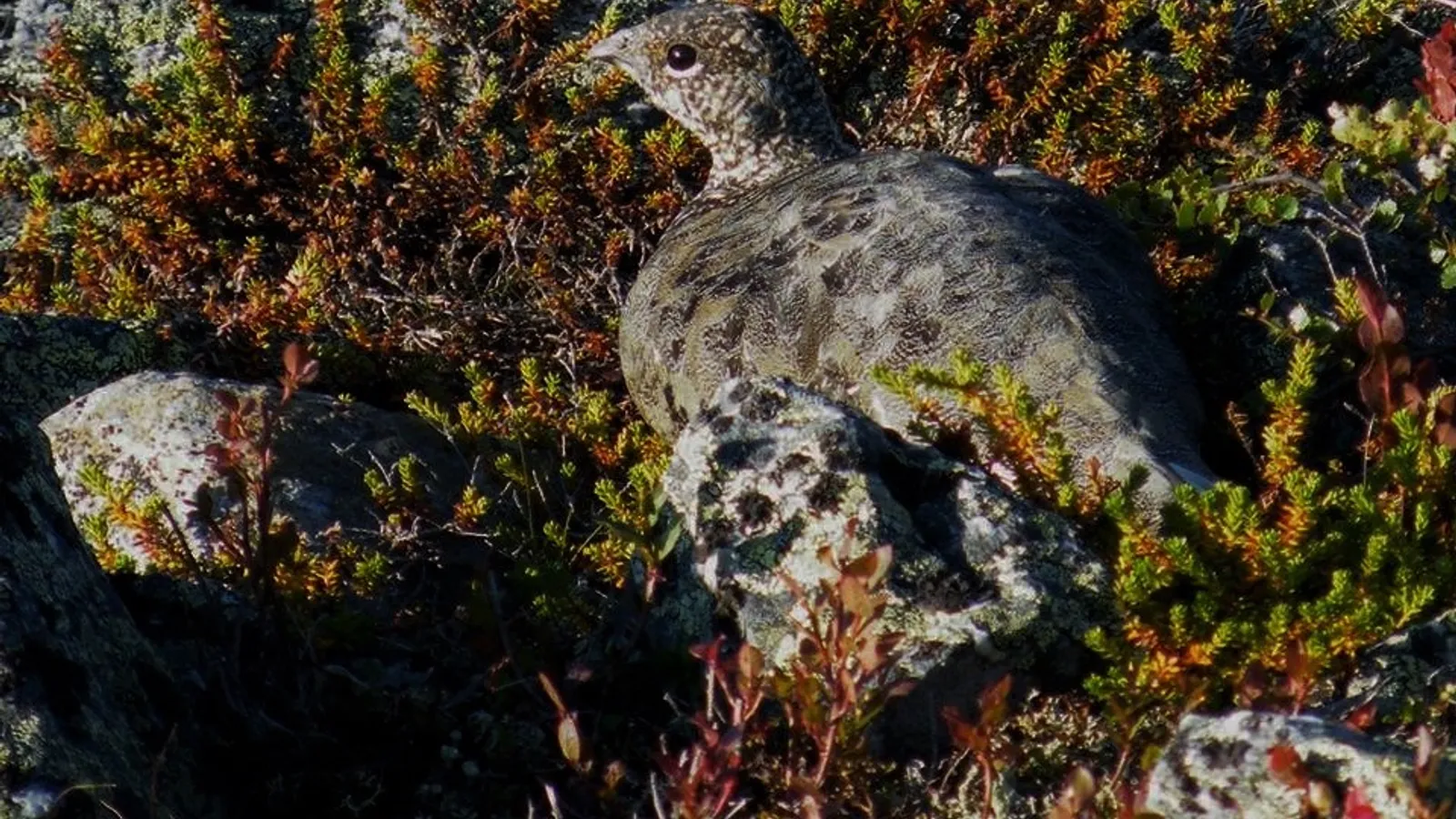

Ptarmigan (Lagopus muta)
Contents
TL;DR
- established Ptarmigan are confined in Britain entirely to Scotland's mountains, and the UK breeding population — estimated at 2,000–15,000 pairs, a range published in 2007 that reflects the bird's large natural cycles rather than a single survey — is Red-listed as a Bird of Conservation Concern due to a documented severe decline in breeding numbers, even though the species remains globally classified as Least Concern by the IUCN.
- established The species' breeding distribution has contracted by 11.3% since the 1968–72 baseline survey period, with losses concentrated at lower elevations and in northwestern areas — a specific, quantified range contraction this article states directly rather than a general sense of decline.
- established Ptarmigan are physically adapted to extreme mountain conditions, with thick feathering on their feet functioning as natural snowshoes, and undergo a seasonal plumage change from mottled brown and grey in summer to pure white in winter — a camouflage adaptation closely tied to reliable snow cover.
- disputed Research on willow ptarmigan, a closely related species, in Finland has found that each additional snow-free day in April is associated with approximately a 3.1% population decline, attributed to a camouflage mismatch leaving white-plumaged birds exposed against snow-free ground during the vulnerable spring nesting period — this article presents this specific, quantified Finnish finding as directly relevant comparative evidence for a closely related species, while noting it has not been established as a confirmed, separately measured mechanism for Scottish rock ptarmigan populations specifically.
- established The Scottish Ornithologists' Club's The Birds of Scotland (2007) explains the range: local numbers rise and fall in cycles of roughly ten years, so the Scottish total might be about 2,000 pairs if every population were low at once and about 15,000 if all were high. The often-quoted 10,000 pairs is a round figure "not derived from empirical study".
- established The same account documents a long retreat. Ptarmigan were lost from the Galloway hills by about 1825, from Hoy in Orkney by 1831 and from Islay and Jura in the 1930s, mainly as sheep grazing removed their food plants.
- established Despite its documented conservation concern status, the ptarmigan remains legally hunted in the UK during an open season running from 12 August to 10 December each year — a specific, potentially uncomfortable regulatory detail this article states directly rather than omitting.
Key Facts
- Scientific name
- Lagopus muta
- Category
- Birds
- UK range
- Scottish high mountain tops only
- UK breeding population (2007 estimate)
- 2,000–15,000 pairs, depending on the stage of population cycles
- Winter population (2007 estimate)
- 5,000–40,000 birds
- Population cycle
- Roughly 10 years (6–11), varying between massifs
- Breeding
- Laying early May to early June; clutch about 7 eggs (4–10)
- Main predator
- Golden eagle
- UK conservation status
- Red-listed
- Global (IUCN) status
- Least Concern
- Range contraction since 1968–72
- 11.3%
- Legal hunting season
- 12 August – 10 December
- British race
- millaisi, named after the artist John Guille Millais
- Gaelic name
- Tàrmachan, "croaker"
- Altitude
- Rarely breeds below 700m in the east; as low as 200m in the Outer Hebrides and north-west Sutherland
Scottish Impact Index (SI Score)
- Scottish Significance
- 9/10
- Ecological Persistence
- 9/10
- Ecological Importance
- 7/10
- Biological Distinctiveness
- 10/10
- Conservation Significance
- 8/10
- Recognition
- 9/10
52/60
Ranked =15th of 42 in Wildlife
A Note on Claims and Evidence
Range contraction percentages and UK conservation status are drawn from the British Trust for Ornithology's published assessment. The population range of 2,000–15,000 pairs, the history of the Scottish range, breeding biology and threats come from the Scottish Ornithologists' Club's The Birds of Scotland (2007), whose ptarmigan account is by Stuart Rae; the same 2007 range is still used in the UK's official population estimates published in 2020. The camouflage mismatch finding and its quantified 3.1% per snow-free-day effect are drawn from peer-reviewed Finnish research on willow ptarmigan, a closely related but distinct species; this article treats this as Disputed in the specific sense that the mechanism, while well-documented for willow ptarmigan, has not been independently confirmed as operating identically in Scottish rock ptarmigan populations, and is presented as relevant comparative evidence rather than a directly measured Scottish finding.
Timeline
The physician and antiquary Sir Robert Sibbald turns the Gaelic tàrmachan into "ptarmigan", adding a pseudo-Greek silent "p".
Ptarmigan live on Borders hills such as Broad Law.
Ptarmigan still occur as far south as the Lake District; they later become confined to Scotland. They are recorded on Rum.
The Galloway population, on the Lowther Hills, Hart Fell and the hills of Minnigaff, Kells and Carsphairn, is considered extinct.
The last ptarmigan on Hoy, Orkney, are apparently shot, as sheep are introduced to the uplands in large numbers.
A ptarmigan is recorded on St Kilda one winter.
A record driven bag of 122 ptarmigan is set.
The last records on Islay and Jura.
Adam Watson and colleagues track ptarmigan numbers in the Cairngorms, revealing cycles of roughly ten years.
A male turns up on sea cliffs south of Cove Bay, near Aberdeen, on 22 November.
Ptarmigan from the Braemar area are released near Leadhills.
A baseline national bird atlas survey establishes the reference period against which later Scottish ptarmigan range changes are measured.
Descendants of the Leadhills birds peak at about 20 in the Tweedsmuir Hills; many are shot in 1978.
The last Tweedsmuir bird is reported, on 20 April.
Scottish ptarmigan breeding distribution contracts by 11.3%, with losses concentrated at lower elevations and in northwestern areas of the species' mountain range.
A ptarmigan is seen on Sron a' Sgaoth, Harris, in April, long after the species was thought extinct in the Outer Hebrides.
The Birds of Scotland estimates 2,000–15,000 breeding pairs, the range reflecting population cycles. This is still the UK's official estimate.
A 21-year analysis of census data, predator abundance, and snow depth finds that population decline is strongest at sites and in years when the preceding April was most snow-free, quantifying the effect at approximately 3.1% population decline per snow-free April day, with documented evidence of increased predation by goshawks during snow-free years.
Swiss Alps research on related alpine ptarmigan populations documents an uphill range shift over 30 years, consistent with a cold-adapted species responding to rising temperatures by moving to higher, cooler ground where available.
Ptarmigan remain legally hunted in the UK during an annual open season from 12 August to 10 December, alongside their Red-listed conservation status and documented range contraction.
Details
A species confined to the highest ground, in genuine decline
This article states Scotland's ptarmigan population with its real documented figures: an estimated 2,000–15,000 breeding pairs, confined entirely to Scotland's mountains, and Red-listed due to a severe documented decline in breeding numbers — even though the species remains of Least Concern globally. This article presents both the UK-specific severity and the reassuring global picture together, since treating either figure alone would misrepresent the species' actual, two-level conservation status.
established The width of that range is deliberate. Stuart Rae, writing in The Birds of Scotland (2007), explains that ptarmigan numbers fluctuate in cycles of about ten years, varying from 6 to 11 years and differing between massifs; on the Cairnwell there is no regular cycle at all. Peaks tend to follow a year or two after cyclically high June temperatures. There is therefore no fixed Scottish population. If every local population peaked together the total might reach about 15,000 pairs, and if all were low together it would be about 2,000. The round figure of 10,000 pairs often given as an average is not based on fieldwork. A figure of "2,000 pairs" sometimes quoted for 2007 is the low end of this range, not a survey result.
established The bird is also hard to count. It moves slowly, crouches when disturbed and is easily overlooked, and most hillwalkers follow ridges rather than the slopes where ptarmigan feed. Males are most obvious in spring, when they call in display flights, and flocks of up to hundreds gather in autumn, when their white wings catch the eye.
Where ptarmigan live
established The greatest concentrations are in the eastern Highlands, especially the Cairngorms and the Mounth, where wide plateaux carry extensive montane heath. Western hills hold fewer birds because their tops are smaller. In the east ptarmigan seldom breed below 700m, but in the Outer Hebrides and north-west Sutherland, where wind keeps vegetation short, they live as low as 200m. In Caithness they are confined to Morven and the Scarabens, and the southernmost Highland birds are on Ben Lomond. Small numbers also live on Arran, Skye, Mull, Rum and Jura, and stragglers appear in the Southern Uplands. The diet is mainly blaeberry, crowberry and heather, with heath bedstraw and alpine lady's-mantle. Ptarmigan and red grouse rarely compete: ptarmigan use short heaths, where their camouflage works best, and red grouse the taller heather below.
Two hundred years of retreat
established The Birds of Scotland describes a genuine decline and contraction of range over the last 200 years, especially in the Southern Uplands and the north-west. The main cause was overgrazing by sheep, which climb screes and ledges after food plants more readily than red deer. Ptarmigan lived on Borders hills such as Broad Law in the 17th century, and in Galloway on the Lowther Hills, Hart Fell and the hills of Minnigaff, Kells and Carsphairn until about 1825. A population on Hoy in Orkney lasted until 1831, when the last birds were apparently shot. They were recorded on Rum in the 18th century and in 1888, and on Islay and Jura until the 1930s. In the Outer Hebrides they were thought extinct in the early 20th century, but stragglers were reported on South Uist possibly into the 1950s, a pair was on Eaval, North Uist, in July 1977 and a bird on Harris in April 2001. Rae suggests a tiny population may have survived there unnoticed.
established People have tried to put ptarmigan back. Birds from the Braemar area were released near Leadhills in the late 1960s and early 1970s. They seemed to fail locally, but some moved into the Tweedsmuir Hills and apparently bred in two years in the late 1970s, peaking at about 20 birds in the winter of 1977/78. Many were shot in 1978 and the last was reported on 20 April 1984. Several introductions have also been made to Arran, whose small area of habitat could probably hold no more than about 20 pairs.
Nesting and the eagle's-eye view
established Cocks defend territories from early spring, holding food for the hen while she lays and incubates. Laying coincides with the first growth of food-plant buds, typically early May on lower or south-facing slopes and early June on higher ground. Nests are usually in short heath beside a lichen-covered rock, which breaks up the outline of the sitting hen when seen from above by the golden eagle, the ptarmigan's main predator. Clutches average seven eggs, with larger clutches when numbers are rising and smaller ones when they are falling. Heavy, prolonged snow or rain when chicks are small is the main cause of breeding failure. Because hens seldom live more than two years, a run of bad summers can quickly reduce numbers. After hatching, hens rear broods largely alone and cocks gather in groups to moult.
A range contraction stated with its real scale
This article names the extent of the species' breeding range contraction precisely: an 11.3% decline since the 1968–72 baseline survey period, concentrated specifically at lower elevations and in northwestern parts of the range. This article states this figure directly because it demonstrates a measurable, geographically patterned retreat rather than a uniform or vaguely described decline.
A genuine physical adaptation, tied to a vulnerability
This article credits the ptarmigan's specific physical adaptations to extreme mountain conditions directly: thick feathering on the feet functions as natural snowshoes, and the species undergoes a seasonal plumage change from mottled brown and grey in summer to pure white in winter. This article names this adaptation because it is the same mechanism underlying the species' documented vulnerability to climate-driven snow cover loss — camouflage evolved for a reliably snowy environment becomes a liability when that reliability breaks down.
A quantified finding from a related species, honestly scoped
This article presents a specific, quantified research finding on camouflage mismatch — each additional snow-free day in April associated with approximately a 3.1% population decline in willow ptarmigan, driven by increased predation during the vulnerable spring nesting period when females are less mobile and white plumage stands out against snow-free ground — while stating plainly that this research concerns willow ptarmigan in Finland, a closely related but distinct species, rather than Scottish rock ptarmigan specifically. This article presents the finding as genuinely relevant comparative evidence for understanding a documented mechanism likely to affect related cold-adapted grouse species, without overstating it as directly measured Scottish data. The relationship is closer than it might seem: Britain's red grouse is itself a race of the willow ptarmigan.
shared Scottish ptarmigan may be less exposed to this mismatch than many populations. The Birds of Scotland (2007) notes that the Scottish race keeps its grey autumn plumage longer and more completely than most, and that some birds keep grey feathers through the winter, probably as an adaptation to the patchy snow of an oceanic climate. In late winter and spring, mostly white birds tend to sit on snow and those already in brown plumage on bare ground. Rae lists as open questions whether this grey plumage will give enough cover on less snowy ground, whether alpine food plants will decline with warming, and whether stronger winds might keep heath short on lower ground and open new habitat.
Tàrmachan: the name and the bird
established Mark Cocker and Richard Mabey, in Birds Britannica (2005), record that the English name comes from the Gaelic tàrmachan, "croaker", after the dry rattling call, said to be "not unlike the winding of a clock". The silent "p" is a pseudo-classical flourish added in the 17th century by the Scottish physician and antiquary Sir Robert Sibbald. British birds form their own race, millaisi, named after the wildlife artist John Guille Millais; they are slightly smaller and greyer in autumn than continental birds. In the 18th century ptarmigan still lived as far south as the Lake District; they are now confined to the Scottish Highlands, with the main concentrations in the Grampians and the Cairngorms.
shared Birds Britannica describes the ptarmigan as the only British bird in which the male has four distinct seasonal plumages, the female three. The Birds of Scotland (2007) puts it more simply: ptarmigan moult their body feathers three times a year, from white in winter to mottled brown in summer and grey in autumn, a habit shared by only a few other birds.
established In summer the wings stay white while the body turns a lichen-grey that blends with the boulder fields, where moving birds are said to look like "running stones". The feathered feet give about four times the load-bearing surface of a bare foot. The ecologist Adam Watson saw ptarmigan in storms roost on ridges where a person could barely stand, each bird tucked into a hole on the lee side of a rock. They share the arctic-alpine heath with only a handful of other breeding birds, such as dotterel and snow bunting, and are the only one to stay there through the winter.
White game, eagles and ski lifts
established Sportsmen once called ptarmigan "white grouse" or "white game", and they were sometimes driven; the record bag of 122 dates from 1866. By 2005 they were shot at only a handful of places, because of low numbers and the climb needed to reach them. Golden eagles are a more frequent enemy, and Watson recorded ptarmigan diving towards people to escape a pursuing eagle. The Scottish naturalist Seton Gordon told of a stalker who found he had been dropping crumbs from his lunch on to a brooding hen hidden beneath his seat. Cocker and Mabey linked declines to overgrazing by sheep and habitat damage, and noted that on Cairngorm birds collided with ski-lift wires while litter drew in egg-eating hooded crows. The same birds grew used to people, nesting near chairlift pylons and disputing territories outside the Ptarmigan Restaurant near the summit.
established The Birds of Scotland (2007) confirms that hooded and carrion crows drawn to scraps at ski areas reduce local breeding success, and that adults die in collisions with ski-lift wires. It warns that crows attracted by the growing number of hillwalkers could have similar local effects. On shooting, Rae notes that bags of over a hundred birds have been taken in a day, but that remoteness and the few clear days limit large shoots. He judges shooting unlikely to threaten the national population unless combined with environmental pressures, while doubting that small isolated populations such as Arran's can sustain much, if any, shooting.
An uncomfortable regulatory detail, not omitted
This article states plainly, rather than leaving out, that ptarmigan remain legally hunted in the UK during an annual open season running from 12 August to 10 December, despite the species' Red List conservation status reflecting a severe documented decline. This article names this directly because evaluating the species' conservation picture honestly requires including this detail rather than presenting hunting and conservation concern as mutually exclusive facts.
Did You Know?
- Ptarmigan are confined entirely to Scotland's high mountain tops within the UK.
- The UK breeding population is estimated at 2,000–15,000 pairs, because numbers rise and fall in cycles of about ten years.
- Ptarmigan lived on Hoy in Orkney until 1831 and on Islay and Jura until the 1930s.
- A ptarmigan was once recorded on St Kilda, in a winter before 1841.
- Ptarmigan hens seldom live more than two years.
- Their breeding range has contracted by 11.3% since the 1968–72 baseline survey.
- Ptarmigan have thick feathering on their feet that functions as natural snowshoes.
- They change plumage seasonally from mottled brown and grey in summer to pure white in winter.
- Research on the closely related willow ptarmigan in Finland found each snow-free April day associated with roughly a 3.1% population decline, linked to camouflage mismatch and increased predation.
- Despite Red List conservation status, ptarmigan remain legally hunted in the UK from 12 August to 10 December each year.
- Related alpine ptarmigan populations in the Swiss Alps have been documented shifting their range uphill over 30 years.
- The silent "p" in ptarmigan was added in the 17th century by Sir Robert Sibbald; the Gaelic original, tàrmachan, means "croaker".
- Ptarmigan moult their body feathers three times a year, into winter white, summer brown and autumn grey.
- Ptarmigan lived as far south as the Lake District in the 18th century.
- British ptarmigan are a distinct race, millaisi, named after the artist John Guille Millais.
FAQ
1Where are Scottish ptarmigan found?
Exclusively on Scotland's mountains, mainly the Cairngorms and the Mounth, with smaller numbers on western hills and some islands; they are not found in Britain outside Scotland.
2How many ptarmigan are left in the UK?
The official estimate, first published in The Birds of Scotland (2007), is 2,000–15,000 breeding pairs. The range reflects natural cycles in numbers rather than uncertainty alone. The species is Red-listed in the UK due to severe decline.
3Why do ptarmigan numbers go up and down?
Many local populations follow cycles of roughly ten years, with peaks a year or two after warm Junes. The cycles differ between mountain ranges and are absent in some places.
4Have ptarmigan been reintroduced anywhere in Scotland?
Yes. Birds from Braemar were released near Leadhills in the late 1960s and early 1970s and briefly bred in the Tweedsmuir Hills, and there have been several introductions to Arran.
5Has their range shrunk?
Yes — by 11.3% since the 1968–72 baseline survey, with losses concentrated at lower elevations and in northwestern areas.
6Why does climate change threaten ptarmigan?
As a cold-adapted species relying on reliable snow cover for both habitat and seasonal white camouflage, reduced snow cover creates documented vulnerabilities, including camouflage mismatch exposing birds to predators.
7Has camouflage mismatch been proven in Scottish ptarmigan specifically?
Not directly — the clearest quantified evidence comes from research on willow ptarmigan in Finland, a closely related species; this is presented as relevant comparative evidence rather than confirmed Scottish-specific data.
8Can ptarmigan still legally be hunted?
Yes — despite their Red List status, they remain legally hunted in the UK during an open season from 12 August to 10 December.
9Are ptarmigan globally endangered?
No — the IUCN lists the species as Least Concern globally, even though its UK population is in documented severe decline.
10What physical adaptations help ptarmigan survive mountain conditions?
Thick foot feathering acting as snowshoes, and seasonal plumage changes providing camouflage against both snow and bare ground.
11Why is there a "p" in ptarmigan?
The Gaelic name is tàrmachan, "croaker". The 17th-century Scottish antiquary Sir Robert Sibbald added the silent "p" to give it a Greek look.
12Did ptarmigan ever live in England?
Yes. Birds Britannica (2005) records them as far south as the Lake District in the 18th century; they are now confined to the Scottish Highlands.
13What are the main threats on Scotland's ski hills?
Collisions with ski-lift wires, and hooded crows drawn in by litter, which take eggs; both were documented on Cairngorm.
Sources and Further Reading
Primary/Institutional
- Forrester, R. W., Andrews, I. J. et al. (eds), The Birds of Scotland (Scottish Ornithologists' Club, 2007), account by Stuart Rae.
- Ptarmigan — British Trust for Ornithology
- Population estimates of birds in Great Britain and the United Kingdom (APEP4, 2020) — British Trust for Ornithology
- Scotland's Nature on Red Alert: Climate change impacts on biodiversity — WWF/Scottish Environment LINK
Scholarly/Critical
- Mark Cocker and Richard Mabey, Birds Britannica (Chatto & Windus, 2005)
- Climate change creates camouflage confusion in winter-adapted wildlife — EHN
- Climate Change and Human Disturbance Can Lead to Local Extinction of Alpine Rock Ptarmigan — PLOS ONE
General
Caveats: Myths and Disputed Claims
- Clarification: This article does not claim the camouflage mismatch mechanism quantified in Finnish willow ptarmigan research has been separately confirmed and measured in Scottish rock ptarmigan populations; it is presented as relevant comparative evidence for a closely related species.
- Do not describe "2,000 pairs" as the result of a 2007 survey; it is the low end of a 2,000–15,000 pair estimate published in 2007.
- Do not quote 10,000 pairs as a measured average; The Birds of Scotland (2007) says it is not based on empirical study.
- Do not say ptarmigan never live below 600m; in the Outer Hebrides and north-west Sutherland they occur down to about 200m.
- Note: This article does not treat the species' Least Concern global IUCN status as evidence against UK-specific conservation concern; the UK Red List status reflects a genuine, separately documented severe national decline.
Card 023 · Wildlife