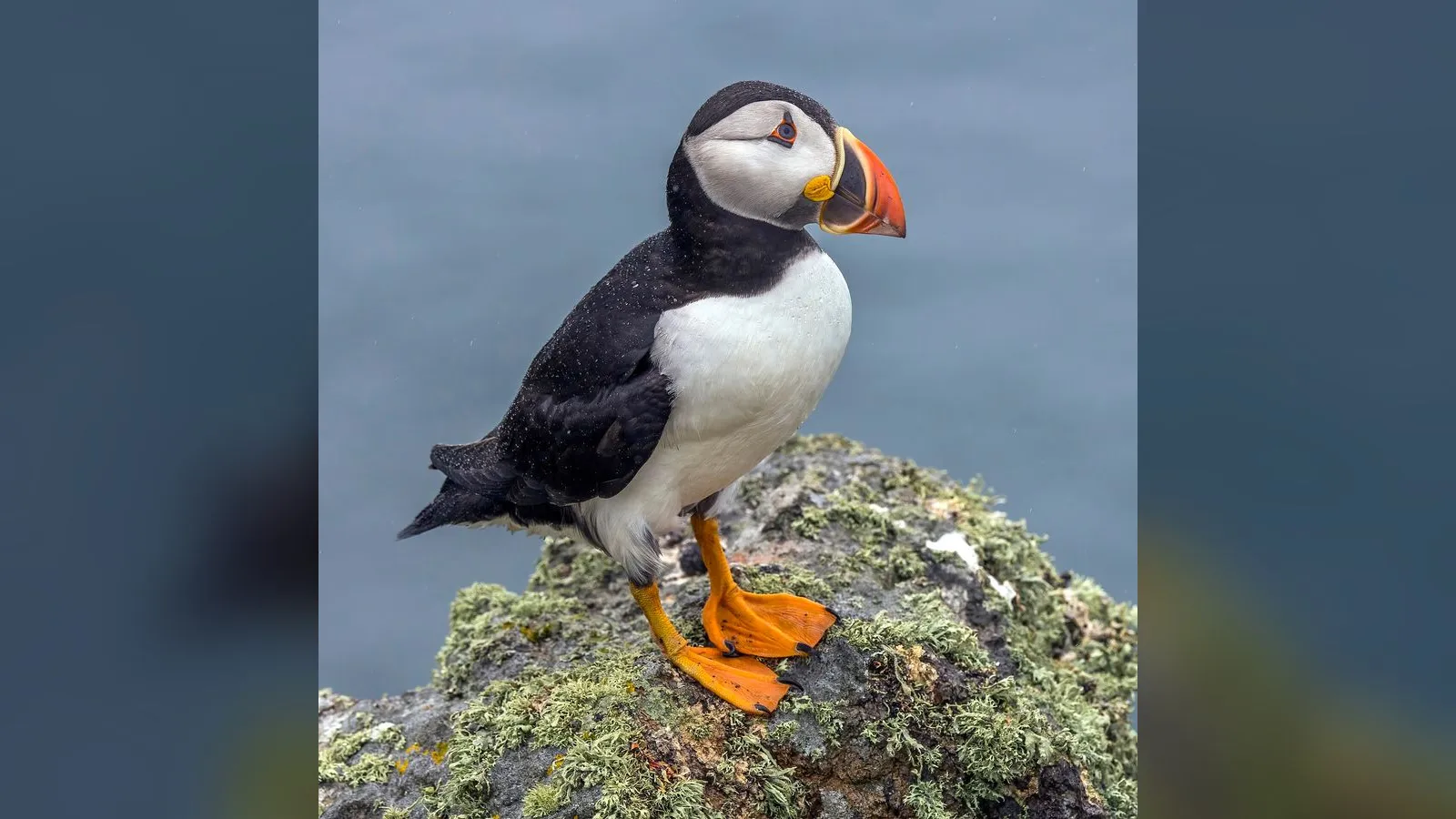

Puffin (Fratercula arctica)
Contents
The Atlantic puffin is a small auk that comes ashore only to breed, nesting in burrows on islands free of ground predators. Scotland holds the great majority of the puffins of Britain and Ireland, from St Kilda and the Shiants to Fair Isle and the Isle of May. This card sets the recent, sharp declines against the longer Scottish record.
TL;DR
- established Approximately one in four puffins has been lost from UK populations over the past 20 years, and without intervention, projections suggest the UK puffin population could decline by as much as 90% by 2050 if current climate trends continue unchecked — a stark, documented projection this article states directly rather than softening.
- established The Isle of May colony in the Firth of Forth, one of Scotland's most closely monitored puffin sites, recorded 36,500 occupied burrows in 2026, down approximately 30% from 52,000 in 2024 — a severe, recent, precisely documented single-colony decline this article states with its real scale rather than folding it into a vaguer national trend.
- established NatureScot's Isle of May Reserve Manager has attributed this decline to a combination of ongoing pressure on seabird food supplies, poor winter survival, and increasingly extreme weather, with UK Centre for Ecology & Hydrology researchers specifically identifying marine heatwaves and intense storms affecting survival in three of the last five winters — a named, specific set of causes this article states directly rather than a vague reference to "changing conditions."
- established Sandeels, puffins' primary food source for themselves and their chicks, have declined due to a combination of climate-driven ocean warming and historical overfishing pressure, prompting the permanent closure of industrial sandeel fishing across all Scottish waters and the English North Sea from 26 March 2024 — a substantial, specific regulatory response this article names directly.
- established Officials and conservation organisations have explicitly stated that the sandeel fishing closure represents only one step addressing a single pressure among several, with climate change, bycatch, habitat loss, and bird flu all identified as continuing, compounding threats — this article presents the closure as genuine progress without overstating it as a complete solution.
- established The Scottish Ornithologists' Club's The Birds of Scotland (2007) gives a Scottish population of 493,000 pairs in 1998–2002, 83% of the British and Irish total and 9% of the world's. The Isle of May then held 69,000 occupied burrows (2003), the largest single colony in Britain; the 2026 count of 36,500 is little more than half of that.
- established Puffins were once a staple of the St Kilda fowling economy: islanders caught them in their thousands with horsehair snares for meat and feathers, and in 1847 each family's rent was paid largely in seabird feathers, puffins' among them.
Key Facts
- Scientific name
- Fratercula arctica
- Category
- Seabirds
- UK population loss (past 20 years)
- Approximately 1 in 4
- Isle of May burrows (2024)
- 52,000
- Isle of May burrows (2026)
- 36,500 (down ~30%)
- Projected UK decline by 2050 (unchecked)
- Up to 90%
- Key conservation measure
- Sandeel fishing closure (Scottish waters, from 26 March 2024)
- Northern Scottish names
- Tammy Norie, Norie, Sea Parrot
- Britain and Ireland population (c. 2005, historical)
- Fewer than one million pairs (Birds Britannica)
- Scottish population (1998–2002, historical)
- 493,000 pairs, 83% of Britain and Ireland, 9% of world (The Birds of Scotland)
- Largest colonies (2000–2003)
- St Kilda 142,000 burrows; Fair Isle 80,000 adults; Isle of May 69,000 burrows; Shiant Isles 65,200 burrows
- Gaelic name
- Buthaid
- Fledging period in Scotland
- Usually 38–44 days; up to 50–55 when food is short
Scottish Impact Index (SI Score)
- Scottish Significance
- 10/10
- Ecological Persistence
- 8/10
- Ecological Importance
- 9/10
- Biological Distinctiveness
- 8/10
- Conservation Significance
- 10/10
- Recognition
- 10/10
55/60
Ranked #6 of 42 in Wildlife
A Note on Claims and Evidence
Isle of May population figures are drawn from NatureScot's own published reserve monitoring data, with named causal factors attributed directly to the Reserve Manager and UK Centre for Ecology & Hydrology researchers. The sandeel fishing closure details and its rationale are drawn from RSPB published reporting. The 90%-by-2050 figure is presented as a conditional climate projection, not a certainty, reflecting its status as a modelled outcome dependent on continued unchecked global warming.
The longer Scottish record, including the national survey totals, colony sizes, breeding timetable, ringing recoveries and threats up to about 2005, comes from the species account by Mike Harris and Sarah Wanless in the Scottish Ornithologists' Club's The Birds of Scotland (2007). Those figures are dated history; the NatureScot counts above are the current picture.
Timeline
Each St Kilda family's annual rent is about seven St Kildan stone (168 lb) of fulmar, gannet and puffin feathers.
Puffins decline on Ailsa Craig, where brown rats later exclude them until the rats are removed.
St Kilda's last islanders leave, ending the island's centuries-old seabird harvest, including the puffin catch.
A decline is recorded on St Kilda.
At least 8,000 chicks four to six weeks old die on St Kilda, blamed on a dearth of sprats and sandeels.
Puffins are first recorded ashore on Inchkeith in the Firth of Forth, now a thriving colony.
Operation Seafarer counts about 410,000 puffin burrows or birds in Scotland; the Forth colonies hold only about 4,000 burrows.
About 34,000 auks are found dead on the east coast of Britain in an exceptional winter wreck.
Seabird 2000 estimates 493,000 pairs in Scotland; the colonies between the Moray Firth and St Abb's Head have grown to about 75,000 burrows, an increase of about 10% a year.
The Prestige oil spill off Portugal kills 3,584 puffins, including breeding adults ringed on Sule Skerry and Lunga.
The Isle of May holds 69,000 occupied burrows, the largest single colony in Britain.
UK puffin populations decline by approximately one-quarter overall, reflecting sustained pressure from multiple compounding factors.
Isle of May monitoring records 39,000 occupied burrows.
Isle of May monitoring records a peak of 52,000 occupied burrows.
Industrial sandeel fishing is permanently closed across all Scottish waters and the English North Sea, a measure specifically intended to protect sandeel populations and, in turn, the seabird species including puffins that depend on them as a primary food source.
Marine heatwaves and intense storms are documented as affecting puffin survival at the Isle of May colony.
Isle of May monitoring records 36,500 occupied burrows, a roughly 30% decline from the 2024 count, attributed to a combination of food supply pressure, poor winter survival, and extreme weather.
Details
A projection stated with its real, stark scale
This article presents the long-term outlook for UK puffin populations directly: approximately one in four puffins has already been lost over the past 20 years, and modelling suggests the UK population could decline by as much as 90% by 2050 if current climate trends continue unchecked. This article states this figure as the conditional projection it is — dependent on continued climate trends rather than an inevitability — while naming its full severity rather than softening it into vague concern.
A single-colony decline too severe to generalise away
This article does not fold the Isle of May's recent decline into a vaguer national narrative: occupied burrow counts fell from 52,000 in 2024 to 36,500 in 2026, a roughly 30% drop at one of Scotland's most closely monitored colonies. This article states this specific, recent figure directly because it demonstrates a severe, measurable decline occurring within a short, recent timeframe at a single, well-studied site, rather than a slow, abstract, long-term trend.
established Why the Isle of May is so well watched. The island's long record has deep roots. The Birds of Scotland (2007), in a chapter on pioneers of Scottish ornithology by Bob McGowan and David Clugston, records that Evelyn Baxter and Leonora Rintoul of Largo began regular spring and autumn visits in September 1907 to study migration, and kept them up for 26 years. Their 1918 paper argued that wind drift explains much of birds' deviation from direct routes, at a time when wind was thought to matter little. A year after their last visit, George Waterston and friends built a Heligoland trap there in October 1934 and turned the coastguard hut into an observatory, the first co-operatively run bird migration centre in Britain. Baxter and Waterston sent out the invitations to the meeting that founded the Scottish Ornithologists' Club in March 1936, and Waterston went on to found the Fair Isle Bird Observatory in 1948. When the book was published, the Isle of May observatory was still run by volunteers.
Named, specific causes rather than a vague reference to "changing conditions"
This article states the documented causes behind the Isle of May decline specifically: NatureScot's own Reserve Manager has named ongoing pressure on seabird food supplies, poor winter survival, and increasingly extreme weather, while UK Centre for Ecology & Hydrology researchers have specifically identified marine heatwaves and intense storms affecting survival in three of the last five winters. This article names these causes directly because they represent the actual, documented explanations offered by the researchers and reserve managers monitoring the colony, not a generic gesture toward environmental change.
A substantial, specific regulatory response
This article names the sandeel fishing closure with its real specificity: the permanent closure of industrial sandeel fishing across all Scottish waters and the English North Sea, effective 26 March 2024, directly targeting the decline of sandeels — puffins' primary food source — caused by a combination of climate-driven warming and historical overfishing. This article states this measure directly because it represents a substantial, concrete regulatory intervention grounded in the documented link between sandeel decline and puffin survival.
Genuine progress, honestly scoped
This article presents the sandeel closure as real but partial progress, consistent with how officials and conservation organisations themselves have characterised it: addressing one significant pressure among several continuing, compounding threats, including climate change more broadly, bycatch, habitat loss, and bird flu. This article states this scoping directly because treating the closure as a complete solution would overstate what a single regulatory measure can achieve against a genuinely multi-factor crisis.
Tammy Norie: names and character
established Mark Cocker and Richard Mabey, in Birds Britannica (2005), record the northern Scottish names Tammy Norie, Norie and Sea Parrot. The scientific name Fratercula means "little friar", a nod to the white front that resembles a cleric's surplice. The Norse name for the bird, lunde, survives in place names such as Lundy, "puffin island".
established Scottish writers have shaped how the bird is seen. The poet Norman MacCaig wrote of its "mad, clever clown's beak" and of an adult arriving with "a six-fold whisker of tiny fishes". Six is modest: a puffin can hold 4 to 12 fish, and the recorded maximum is 61 sandeels and a rockling in one beakful. The Scottish naturalist Kenny Taylor described old puffin slopes as a "gigantic flight of grassy stairs", each step a row of burrows, and counted 131 such "floors" on one slope of a Hebridean colony.
established The single chick is fed in the burrow on sandeels and other small fish caught within about 15–20 km of the colony. The Birds of Scotland gives a fledging period in Scotland of usually 38–44 days, stretching to 50–55 days when food is short. The young bird then goes to sea alone, usually at night, already able to fly and independent of its parents.
The St Kilda puffin harvest
established Cocker and Mabey describe St Kilda as Britain's last bastion of the hunter-gatherer life and the place where puffin-catching was most advanced. The birds' tameness made them easy to take. The usual tool was the puffin-gin or snare: about a fathom of stout cord laid across a boulder, with horsehair nooses tied along it every few inches. Restless puffins landing on the stone caught their feet, and a trapped bird often attacked its neighbour, which then caught itself too. One eye-witness reckoned a fowler working four or five snares could take several hundred birds on a good day.
shared Some estimates put the St Kilda catch at around 90,000 puffins a year, eaten through the summer, with about 4,800 lb (2,177 kg) of feathers sent to the mainland for mattresses and pillows. These are historical estimates, not counts. Puffin feathers, with those of fulmars and gannets, paid the rent: in 1847 each family owed about seven St Kildan stone (168 lb) of feathers. The book records that the harvest barely dented the colony. Richard Kearton compared the noise of the wheeling flocks to "a whirlwind whipping up a great bed of dead rushes", and one author's estimate of three million puffins on St Kilda was accepted by James Fisher.
shared Cocker and Mabey add that puffins had since "declined dramatically", with fewer than one million pairs in Britain and Ireland by the early 2000s, possibly because warming seas do not suit this cold-water species. That 2005 figure is historical context only; the recent figures above are the current picture.
The Scottish record to 2007
established Numbers and colonies. The Scottish Ornithologists' Club's The Birds of Scotland (2007), in an account by Mike Harris and Sarah Wanless, describes the puffin as numerous but localised, with most colonies in the north and west and a distinct south-eastern group in the Firth of Forth. In 2000–2003 the largest were St Kilda (142,000 burrows across Hirta, Dun, Soay and Boreray), the Shiant Isles (65,200 burrows), Fair Isle (80,000 breeding adults) and the Isle of May (69,000 burrows). The largest mainland colonies were at Clò Mòr in Sutherland and Duncansby Head in Caithness. Three national surveys gave Scottish totals of about 410,000 (1969–70), 438,000 (1985–88) and 493,000 (1998–2002).
established The Forth boom and its limits. The rise of the late twentieth century was far from uniform. Colonies between the Moray Firth and St Abb's Head grew from 4,000 burrows in 1969–70 to 75,000 in 1998–2002, about 10% a year, while numbers elsewhere changed little and Caithness fell sharply between 1969–70 and 1985–88 for reasons never explained. Older accounts of vast puffin numbers were often exaggerated, but real declines did occur, on Ailsa Craig in 1910–34 and on St Kilda in 1947–57. Set against the 2003 peak of 69,000 burrows, the Isle of May's 36,500 in 2026 is a fall of almost half.
established East and west. Puffins in the east return at the end of February or early March and lay from the first week of April. The west runs two or three weeks later: birds reach St Kilda between 4 and 20 April and most young fledge in August, with Shetland in between. Western adults leave soon after their chicks fledge, while eastern birds keep visiting for some weeks, so the season ends at about the same time everywhere. Incubation takes about six weeks. Breeding success is normally 0.7–0.8 chicks per pair, but colonies can fail outright through food shortage or flooded burrows.
established Where Scottish puffins go. Ringing shows that birds from the south-east mostly stay in the North Sea, though a few have passed through the English Channel to the Bay of Biscay. Birds from the north and west head into the open Atlantic; a few first-winter birds have reached Newfoundland, and others the Azores and the Mediterranean. Norwegian puffins winter at the southern fringe of their range in Scotland: 13 ringed in northern Norway were found dead on Scottish coasts between 1959 and 1998. Very few winter close inshore. The account's verdict is blunt: "Virtually nothing is known about this species away from the breeding colonies."
established Threats before the current crisis. Harris and Wanless thought changes in ocean conditions the most likely cause of earlier falls. Chick weights on the Isle of May had declined along with the size of young sandeels, Shetland colonies had failed in many years since 1985, and the weights of St Kilda fledglings had fallen between 1973 and 2002. Brown rats are a serious predator: puffins recolonised Ailsa Craig once the rats were removed, though they coexist with the smaller black rat on the Shiants. On Craigleith in the Forth, the spread of tree-mallow formed a canopy the birds could not burrow through and numbers dropped. Oil rarely kills many puffins in Scottish waters, but the Prestige spill off Portugal in November 2002 killed 3,584, including 16 breeding-age birds ringed on Sule Skerry and two from Lunga.
Did You Know?
- Approximately one in four UK puffins has been lost over the past 20 years.
- Modelling suggests the UK puffin population could fall by up to 90% by 2050 if current climate trends continue unchecked.
- The Isle of May colony's occupied burrow count fell by roughly 30% between 2024 and 2026 alone.
- Marine heatwaves and intense storms have affected puffin survival in three of the last five winters at the Isle of May.
- Industrial sandeel fishing has been permanently closed across all Scottish waters since 26 March 2024, to protect puffins' primary food source.
- Sandeels also support numerous other seabirds, fish species, and sea mammals, making the closure a wider marine conservation measure.
- Officials have stated the sandeel closure addresses only one of several compounding threats facing puffins, including bird flu and habitat loss.
- In northern Scotland the puffin was known as Tammy Norie or simply Norie.
- St Kilda fowlers caught puffins with horsehair snares, and one person with four or five snares could take several hundred birds in a day.
- The record beakful is 61 sandeels and a three-bearded rockling.
- The chick is raised in the dark of the burrow and leaves for the sea alone, usually at night.
- A puffin ringed in Norway was found dead on Inchkeith in 1959, two years before puffins were first seen ashore on the island.
- An exceptional 4,200 puffins flew east past Kinghorn in Fife in 30 minutes on 4 January 1997, after easterly gales.
- One puffin turned up in a peregrine's eyrie near Laggan Bridge, far inland, in June 1968.
FAQ
1How severe is the UK puffin decline?
Severe — about one in four has already been lost in the past 20 years, with projections suggesting up to a 90% decline by 2050 if climate trends continue unchecked.
2How bad is the recent decline at the Isle of May specifically?
Very significant — occupied burrows fell roughly 30%, from 52,000 in 2024 to 36,500 in 2026.
3What is causing the decline?
A combination of ongoing food supply pressure (reduced sandeel availability), poor winter survival, and increasingly extreme weather, including marine heatwaves and storms.
4Why are sandeels so important to puffins?
They are puffins' primary food source for both adults and chicks; sandeel decline directly threatens puffin breeding success and survival.
5What has been done to help?
Industrial sandeel fishing has been permanently closed across all Scottish waters and the English North Sea since 26 March 2024.
6Does this closure solve the problem?
No — officials have been explicit that it addresses one pressure among several continuing threats, including broader climate change, bycatch, habitat loss, and bird flu.
7Is the 90%-by-2050 figure a certainty?
No — it is a conditional projection dependent on continued unchecked climate trends, not a guaranteed outcome.
8Are puffins found elsewhere in Scotland besides the Isle of May?
Yes. In 2000–2003 the biggest were St Kilda, Fair Isle, the Shiant Isles and the Isle of May, with smaller colonies scattered from Shetland and Orkney to the Inner Hebrides; the largest mainland colonies are at Clò Mòr and Duncansby Head.
9How many puffins does Scotland hold?
The last full national survey reported in The Birds of Scotland (2007) gave 493,000 pairs in 1998–2002, 83% of the British and Irish population. Later counts at individual colonies, such as the Isle of May, show steep falls since then.
10Where do Scottish puffins spend the winter?
Mostly far out at sea and thinly spread. Birds from the Forth tend to stay in the North Sea, while those from the north and west move into the Atlantic, some as far as Newfoundland or the Mediterranean.
11Why did puffins come back to Ailsa Craig?
Because brown rats, which take eggs and chicks, were removed from the island; puffins then returned.
12What is a Tammy Norie?
A northern Scottish name for the puffin, recorded with Norie and Sea Parrot in Birds Britannica (2005).
13Did people in Scotland eat puffins?
Yes. On St Kilda puffins were caught in large numbers with horsehair snares and eaten through the summer, and their feathers helped pay the islanders' rent.
14How many puffins did the St Kildans take?
Some estimates suggest around 90,000 a year. These are historical estimates rather than counts, and the harvest ended when the islanders left in 1930.
Sources and Further Reading
Primary/Institutional
- Forrester, R. W., Andrews, I. J. et al. (eds), The Birds of Scotland (Scottish Ornithologists' Club, 2007), account by Mike Harris and Sarah Wanless; chapter "Pioneers in Scottish ornithology" by Bob McGowan and David Clugston
- Concern over drop in puffin numbers on the Isle of May — NatureScot
- New hope for Puffins returning to UK shores following Sandeel fishing closure — RSPB
Scholarly/Critical
- Mark Cocker and Richard Mabey, Birds Britannica (Chatto & Windus, 2005)
- UK Puffin Numbers Fall 25% Since 2000 — Natural World Fund
- Warming seas drive steep puffin decline on Isle of May — Streamline Feed
General
Caveats: Myths and Disputed Claims
- Clarification: This article does not present the 90%-by-2050 figure as a certainty; it is a conditional modelled projection dependent on continued unchecked climate trends, not an inevitable outcome.
- Note: This article does not present the sandeel fishing closure as a complete solution to puffin decline; officials have stated explicitly that it addresses only one pressure among several continuing, compounding threats.
- Do not present the 90,000-a-year St Kilda catch or the three-million St Kilda population as counts; both are historical estimates.
- Do not say puffin parents abandon the chick to starve before it leaves; The Birds of Scotland describes the fledgling as already able to fly and independent when it goes to sea.
- Do not use subspecies names such as grabae as settled; the BOU treats the puffin as a single species without subspecies, despite the smaller size of St Kilda birds.
Card 029 · Wildlife