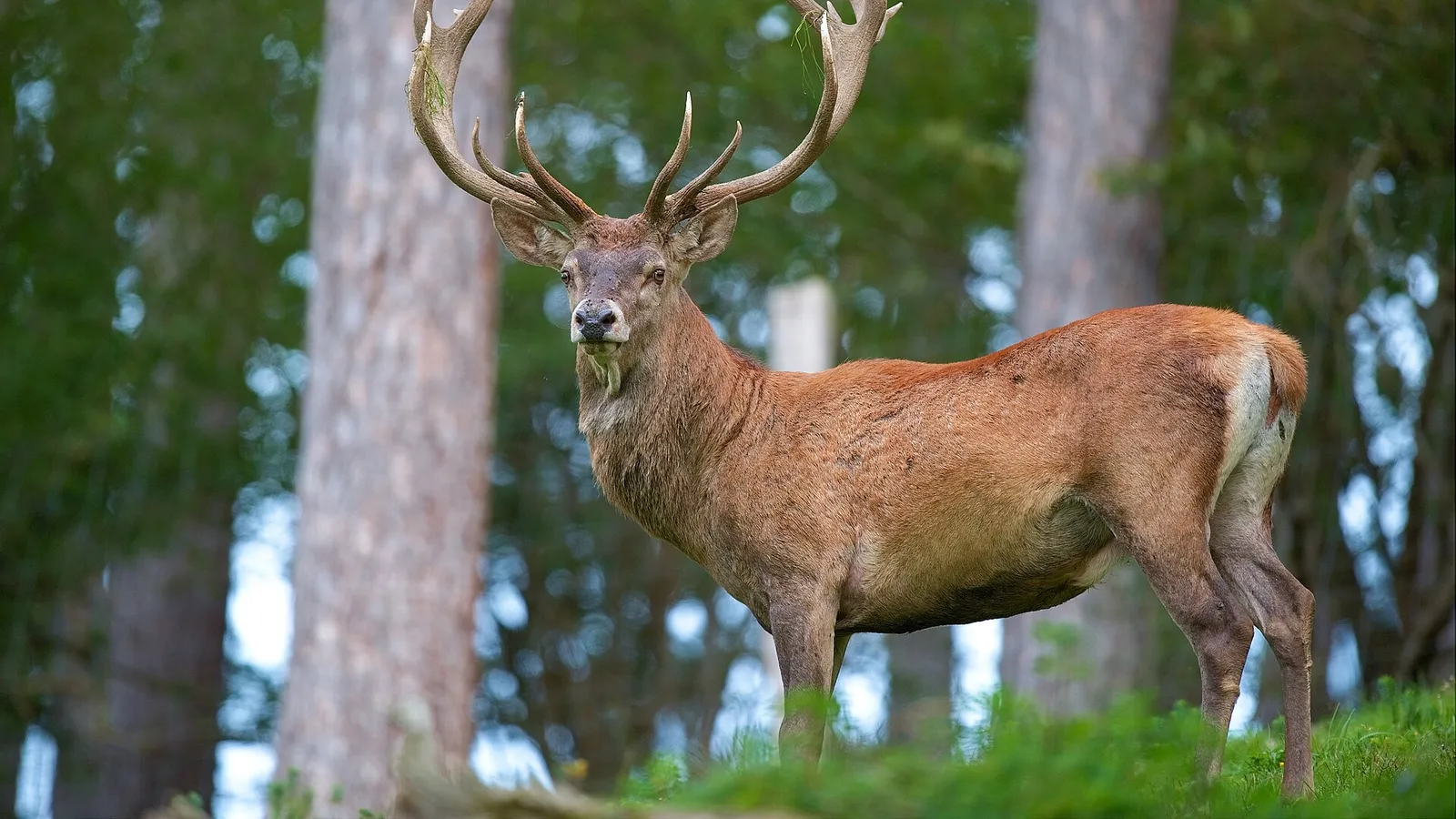

Red Deer (Cervus elaphus)
Contents
TL;DR
- established Red deer first arrived in Great Britain from continental Europe during the Stone Age, making Scotland's population genuinely native rather than a later introduction. Scottish hill deer are much smaller than continental red deer, but The Handbook of British Mammals (1991) puts this down mainly to poor, exposed hill habitat after forest loss: Scottish stags living in conifer plantations can be half as heavy again as hill stags.
- established Scotland's Highlands now hold an estimated 400,000 red deer with no natural predators, and despite roughly 100,000 animals being culled annually, a 2017 Scottish Parliament report concluded that population management efforts were not succeeding — a specific, documented policy failure this article states directly.
- established Forestry Commission research has identified rising deer numbers as the primary threat to the regeneration of Scotland's native ancient woodland, with over 90% of the original Caledonian forest already lost — a severe, quantified ecological cost this article presents with its full weight rather than treating overgrazing as a minor side effect.
- disputed The appropriate response to deer overpopulation is a genuinely contested, multi-sided dispute: rewilding advocates support intensive culling to restore native woodland, while sporting estates and crofting communities resist it, with some crofting voices describing large-scale rewilding projects as "a contemporary reincarnation of the Clearances" — language this article reports directly as evidence of how deeply the dispute is bound up with land ownership history, not merely wildlife management technique.
- established A 45-year scientific study on the Isle of Rum has documented a measurable evolutionary response to climate change: warmer temperatures have caused red deer to give birth on average three days earlier per decade, with the underlying gene for earlier births increasing in frequency across the population — a rare, directly observed instance of evolution in action.
Key Facts
- Scientific name
- Cervus elaphus
- Category
- Mammals
- Status
- Native; Britain's largest native land mammal
- Estimated Highland population
- Around 400,000
- Annual cull (approx.)
- 100,000
- Key threat/impact
- Overgrazing preventing native woodland regeneration
- Key ongoing debate
- Culling scale and rewilding versus estate/crofting interests
Scottish Impact Index (SI Score)
- Scottish Significance
- 10/10
- Ecological Persistence
- 10/10
- Ecological Importance
- 10/10
- Biological Distinctiveness
- 8/10
- Conservation Significance
- 8/10
- Recognition
- 10/10
56/60
Ranked =4th of 42 in Wildlife
A Note on Claims and Evidence
Population figures, woodland impact assessments, and the documented findings of the 2017 Scottish Parliament report are drawn from Forestry Commission research and official parliamentary and NatureScot sources. The appropriate policy response to deer overpopulation is treated as genuinely Disputed, reflecting an active, unresolved disagreement among rewilding advocates, sporting estates, and crofting communities that this article presents from multiple documented positions rather than adjudicating a correct answer.
Timeline
Red deer arrive in Great Britain from continental Europe, establishing the species as genuinely native.
Red deer are the commonest wild mammal in middens, eaten by early people, with antler and bone used for tools.
Red deer are extinct in much of England, Wales and the Scottish Lowlands, surviving mainly in the Highlands.
Einar Lönnberg names the British race Cervus elaphus scoticus from a specimen from Glenquoich Forest, Inverness-shire.
Highland estates develop a sustained sporting stalking culture around red deer, alongside the historical institution of deer forests reserved for hunting.
Sporting deer forests cover about 1.98 million acres of Scotland (McConnochie).
The Pairc Deer Raid on Lewis: crofters kill deer in a new deer forest in protest.
Deer forest covers 3.6 million acres of the Highlands, including at least 40% of Ross and Cromarty and of Inverness-shire.
The Highland red deer population is reckoned at about 250,000.
The Deer (Scotland) Act sets up the Red Deer Commission to advise on the conservation and control of red deer.
The red deer population on Scottish open hill is estimated at over 290,000, with possibly 27,000 to 50,000 more in woodland.
The estimated population has risen to about 347,000.
The UK red deer population begins a sustained long-term increase.
The UK's red deer population approximately doubles over fifty years, with more than half the national total found in Scotland.
Forestry Commission research identifies rising deer populations as the primary threat to the regeneration of Scotland's native ancient woodlands.
A Scottish Parliament report concludes that deer population management efforts have not been successful, despite an annual cull of around 100,000 animals.
Long-term research on the Isle of Rum documents red deer giving birth progressively earlier in response to rising temperatures, with the relevant gene increasing in population frequency.
Rewilding initiatives such as the Glenfeshie Estate project pursue more intensive deer culling to support native woodland restoration, generating active, continuing dispute with sporting estate and crofting interests.
Details
A genuinely native species, but a documented population crisis
This article states directly that red deer are truly native to Scotland, having arrived from continental Europe during the Stone Age — a fact worth establishing clearly, since the scale of today's population is sometimes mistaken for evidence the species does not belong. The real issue is numbers, not nativeness: an estimated 400,000 red deer now occupy the Highlands with no natural predators, and despite an annual cull of roughly 100,000 animals, a 2017 Scottish Parliament report concluded that management efforts were not succeeding in bringing the population to a sustainable level — a specific, documented policy failure this article names plainly.
A measured, severe ecological cost
This article presents the ecological consequence of deer overpopulation with its full documented scale rather than softening it into a vague "environmental concern." Forestry Commission research identifies rising deer numbers as the primary current threat to the regeneration of Scotland's native ancient woodland, compounding a historical loss in which over 90% of the original Caledonian forest has already been destroyed. This figure is presented directly because it establishes the real ecological stakes underlying the subsequent management debate, rather than treating that debate as merely a matter of competing lifestyle preferences.
A dispute that is not really about deer at all
This article presents the controversy over deer culling as a genuinely multi-sided, unresolved dispute rather than a simple question with an obvious correct answer. Rewilding advocates support intensive culling specifically to allow native woodland regeneration, pointing to projects such as the Glenfeshie Estate initiative as evidence of what sustained culling can achieve. Sporting estates, while acknowledging some need for population management, resist intensive culling and emphasise what they describe as the economic, cultural, and environmental value of maintaining deer at current or near-current numbers. Crofting communities, meanwhile, have voiced particular scepticism toward large-scale rewilding projects, with some describing them directly as "a contemporary reincarnation of the Clearances" — language this article reports verbatim because it reveals that the underlying dispute is substantially about land ownership, historical dispossession, and competing claims to belonging on the land, not merely about the correct ecological carrying capacity for deer. This article presents these positions honestly, without adjudicating which side holds the single correct policy answer, consistent with not resolving disputes beyond what has actually been settled.
Evolution observed directly, not inferred
This article treats a remarkable, well-documented scientific finding from the long-running Isle of Rum red deer study with its full significance: across 45 years of sustained observation, researchers have recorded red deer giving birth on average three days earlier per decade as temperatures have risen, and have further documented that the underlying genetic variant associated with earlier births has increased in frequency within the population. This is presented directly as a rare, directly observed case of evolution occurring in real time in response to climate change, rather than a generalised or inferred claim.
From scarce to abundant: deer forests and the Victorian boom
Red deer were not always as numerous as they are now. T. C. Smout notes that in the well-populated landscape of the eighteenth century the red deer was a "comparatively scarce animal". Sporting estates as a main land use began only in the early nineteenth century. They spread with the shotgun and cartridge in early Victorian times, and multiplied after 1870 when sheep farming fell into depression. Most deer forests had therefore been sheep runs first, and both regimes used fire to control vegetation.
By 1912, 3.6 million acres were deer forest, including at least 40 per cent of Ross and Cromarty and of Inverness-shire. By 1940 there were reckoned to be 250,000 red deer in the Highlands, and 347,000 by 1990. Frank Fraser Darling reckoned that 60,000 was the most the land could carry without damage. From early in the nineteenth century, deer were already numerous enough to hinder the natural regeneration of Scots pine on Deeside and elsewhere.
What the 1991 Handbook recorded
Who wrote it. The red deer account in G. B. Corbet and S. Harris (eds), The Handbook of British Mammals (3rd edn, 1991) was written by Brian Staines of the Institute of Terrestrial Ecology, whose own research was on Scottish hill and forest deer. It gives a detailed picture of the species just before the modern culling debate.
Names. The Handbook gives the Scottish Gaelic fiadh for the deer, damh for the stag and eilid for the hind. A hind with a calf at foot is a milk hind; one without is a yeld or eild hind. Mature stags that never grow antlers are called hummels in Scotland.
Why Scottish deer are small. Body size has fallen across Europe since prehistoric times. In Britain, Staines attributes this first to post-glacial climate change, then to forest clearance and disturbance that pushed red deer onto treeless, poor and exposed hill land. The British race, C. e. scoticus, was described from skull shape but, he notes, is not clearly distinguishable from continental animals. His carcase-weight table makes the point: mature stags on the Isle of Scarba, at very high density on open ground, averaged about 65 to 74 kg, while those in Galloway's conifer plantations averaged over 100 kg. Hill stags usually carry about eight points, against up to 16 in native stock elsewhere and up to 47 recorded in deer parks.
Where they lived. In 1991 the main concentrations were in the Highlands and Islands and in south-west Scotland. The Handbook lists red deer on Arran, Bute, Islay, Jura, Mull, Pabbay, Raasay, Rum, Scalpay, Scarba, Seil, Skye, North and South Uist, North Harris and South Lewis. The Scottish numbers had risen through the nineteenth century with the fashion for stalking, and the rise had been sustained over the previous 50 years "through under-culling of females" and the colonisation of new forestry plantations.
Densities. Over some 30,000 km² of open hill, density averaged nine deer per km². The Handbook's table runs from fewer than two per km² in Argyll and Skye to about 14 in the Cairngorms and Grampians, 27 at Glenartney in Perthshire and over 20 on Scalpay. Woodland densities ranged from eight per km² in Galloway to 40 at Glencripesdale in north Argyll. High density meant slower growth, more winter deaths among calves and yearlings, fewer calves and poorer antlers.
The year on the hill. Stags and hinds live apart for most of the year, the hinds usually on richer, grassier ground. The rut runs from late September into November; stags rarely hold harems before five or six years old, and lose about 14% of their body weight over the rut. On the hill, harems of 10 to 15 hinds are usual and more than 70 have been recorded. Calves are born from mid-May, peaking in the first or second week of June in northern areas. In poor hill areas about 35% of adult hinds fail to breed each year. On Rum, a hind typically rears four calves in her lifetime and a stag sires six, though the most successful stag recorded sired 24. Overwinter deaths among calves vary from 5% to 65% between years, and golden eagles take some very young calves.
Food. In Britain grasses, sedges and rushes make up most of the diet. In winter, heather, blaeberry and other dwarf shrubs become very important. Coastal deer eat seaweed, especially kelp, and Scottish deer often chew cast antlers, probably for phosphorus.
Deer and people in 1991. Red deer were the commonest animal in Mesolithic and Neolithic middens. By 1991 there were more than 200 deer farms in Britain, and around 40,000 carcasses a year were exported from Scotland. The Handbook already describes red deer as having a major impact on commercial forestry and on native plants and woodland, which is the same concern that drives today's culling debate.
Deer forests, rents and protest
established The sociologist Grant Jarvie, in his chapter "Royal games, sport and the politics of the environment" in Scottish Sport in the Making of the Nation (1994), assembles figures on the Victorian deer forest. Citing Alexander McConnochie's The Deer and Deer Forests of Scotland (1923), he gives 1,975,209 acres under sporting estates in 1884 and 3,432,385 acres under deer by 1920. Drawing on Willie Orr's study Deer Forests, Landlords and Crofters (1982), he shows the formation of new deer forests peaking after about 1870, and rents rising fast: the Strathconon forest let for £1,500 in 1875, £2,500 in 1880 and £2,900 by the mid-1880s. Orr concluded that the sporting Highlands added little to the local economy and contributed to its under-development.
shared The acreage figures differ between sources and dates (3.6 million acres in 1912 in Smout, about 3.4 million in 1920 in McConnochie), partly because "deer forest" was defined differently and land moved in and out of sporting use. Treat them as orders of magnitude.
established Deer forests were resented. Deer needed large tracts of land and raided crops on neighbouring holdings. A Gaelic poem by John MacRae, recited at Lochcarron schoolhouse on 11 March 1866, threatens to drive gamekeepers and deer back into the forest because they consumed arable land. In the Pairc Deer Raid of 1887 on Lewis, crofters and cottars killed deer in a newly created deer forest. As late as 1905 the Edinburgh Evening News called for the "scandal" of the deer forests to be exposed.
shared Jarvie also records that by the early 1990s conservationists were arguing that the environmental damage done by deer cost more than the income sporting estates earned from them, the same argument that runs through today's culling debate.
Did You Know?
- In 1912 deer forest covered 3.6 million acres of Scotland, at least 40% of Ross and Cromarty and of Inverness-shire.
- Ecologist Frank Fraser Darling reckoned the Highlands could carry about 60,000 red deer without damage; by 1940 there were an estimated 250,000.
- Red deer are genuinely native to Scotland, having arrived from continental Europe during the Stone Age.
- Scotland's hill red deer are much smaller than continental red deer, mainly because of poor, exposed habitat; stags in Galloway's conifer forests average well over 100 kg carcase weight, against about 65 to 74 kg on the Isle of Scarba.
- A stag that never grows antlers is called a hummel in Scotland.
- Scottish red deer often chew cast antlers, probably for phosphorus.
- Scotland's Highlands now hold an estimated 400,000 red deer despite an annual cull of around 100,000.
- A 2017 Scottish Parliament report found that deer population management was not achieving its goals.
- Over 90% of Scotland's original Caledonian forest has already been lost, a loss deer overgrazing continues to compound.
- Some crofting communities have described large-scale rewilding and deer-culling projects as a "contemporary reincarnation of the Clearances."
- Around 6,000 red deer-related traffic collisions occur across the UK each year.
- A 45-year Isle of Rum study has documented red deer evolving to give birth earlier in direct response to rising temperatures.
FAQ
1Are red deer native to Scotland?
Yes — they arrived from continental Europe during the Stone Age, making them a genuinely native species.
2How many red deer live in Scotland?
An estimated 400,000 occupy the Highlands, with no natural predators to limit numbers.
3Is deer culling controversial?
Yes — it is a genuinely multi-sided, unresolved dispute between rewilding advocates, sporting estates, and crofting communities.
4What ecological damage do deer cause?
Overgrazing that prevents the regeneration of Scotland's native ancient woodland, already reduced by over 90% from its original Caledonian extent.
5Has culling solved the population problem?
No — a 2017 Scottish Parliament report found management efforts, including an annual cull of around 100,000 animals, had not succeeded.
6Why do some crofters oppose rewilding projects?
Some view large-scale rewilding as echoing the historical Clearances, disregarding local communities' connection to the land.
7Is there scientific evidence of deer responding to climate change?
Yes — a 45-year Isle of Rum study has documented deer giving birth progressively earlier as temperatures rise, with the relevant gene becoming more common.
8How much of Scotland was deer forest at its peak?
About 3.4 to 3.6 million acres in the early twentieth century, depending on the source and year.
9Did people protest against deer forests?
Yes. Crofters complained that deer ate their crops, and in the Pairc Deer Raid of 1887 on Lewis they killed deer in a new deer forest.
10Are Scottish red deer a separate subspecies?
They were named Cervus elaphus scoticus in 1907, but the 1991 Handbook of British Mammals notes they are not clearly distinguishable from continental red deer. Their small size is mostly a response to poor hill habitat.
11When are red deer calves born?
From mid-May, with a peak in the first or second week of June in the north. The calf lies hidden for the first week or so while the hind feeds nearby.
12What do red deer eat?
Mostly grasses, sedges and rushes in summer. In winter, heather, blaeberry and other dwarf shrubs matter much more, and coastal deer eat seaweed.
13What is a "deer forest"?
A historical term for Highland estate land managed specifically for deer stalking rather than conventional forestry.
Sources and Further Reading
Primary/Institutional
- Scottish red deer — Wikipedia
- Deer management in Scotland — Frequently Asked Questions — NatureScot
- Deer management: Your questions answered — John Muir Trust
Scholarly/Critical
- T. C. Smout, "Land and Sea: The Environment", in T. M. Devine and Jenny Wormald (eds), The Oxford Handbook of Modern Scottish History (Oxford University Press, 2012)
- Grant Jarvie, "Royal games, sport and the politics of the environment", in Grant Jarvie and Graham Walker (eds), Scottish Sport in the Making of the Nation (Leicester University Press, 1994)
- G. B. Corbet and S. Harris (eds), The Handbook of British Mammals, 3rd edn (Blackwell Scientific, 1991), account by B. W. Staines
- Cull: Scotland's Deer Dilemma — Sustainable Food Trust
- The Impact and Management of Deer in Scotland — Reforesting Scotland
General
Caveats: Myths and Disputed Claims
- Clarification: This article does not take a position on whether rewilding-driven culling, estate-led management, or another approach represents the correct policy response to deer overpopulation; it presents the genuinely contested positions of rewilding advocates, sporting estates, and crofting communities directly, without adjudicating between them.
- Do not describe Scottish red deer as a clear case of insular dwarfism; the 1991 Handbook attributes their small size mainly to poor hill habitat, and deer moved to better ground grow much larger.
- Do not compare population figures from different dates without checking what they count; the 1987 estimate of over 290,000 covered open hill only, with up to 50,000 more thought to live in woodland.
- Note: The comparison some crofting voices draw between rewilding projects and the historical Clearances is reported as a documented position within the debate, not as this article's own historical judgment equating the two episodes.
Card 004 · Wildlife