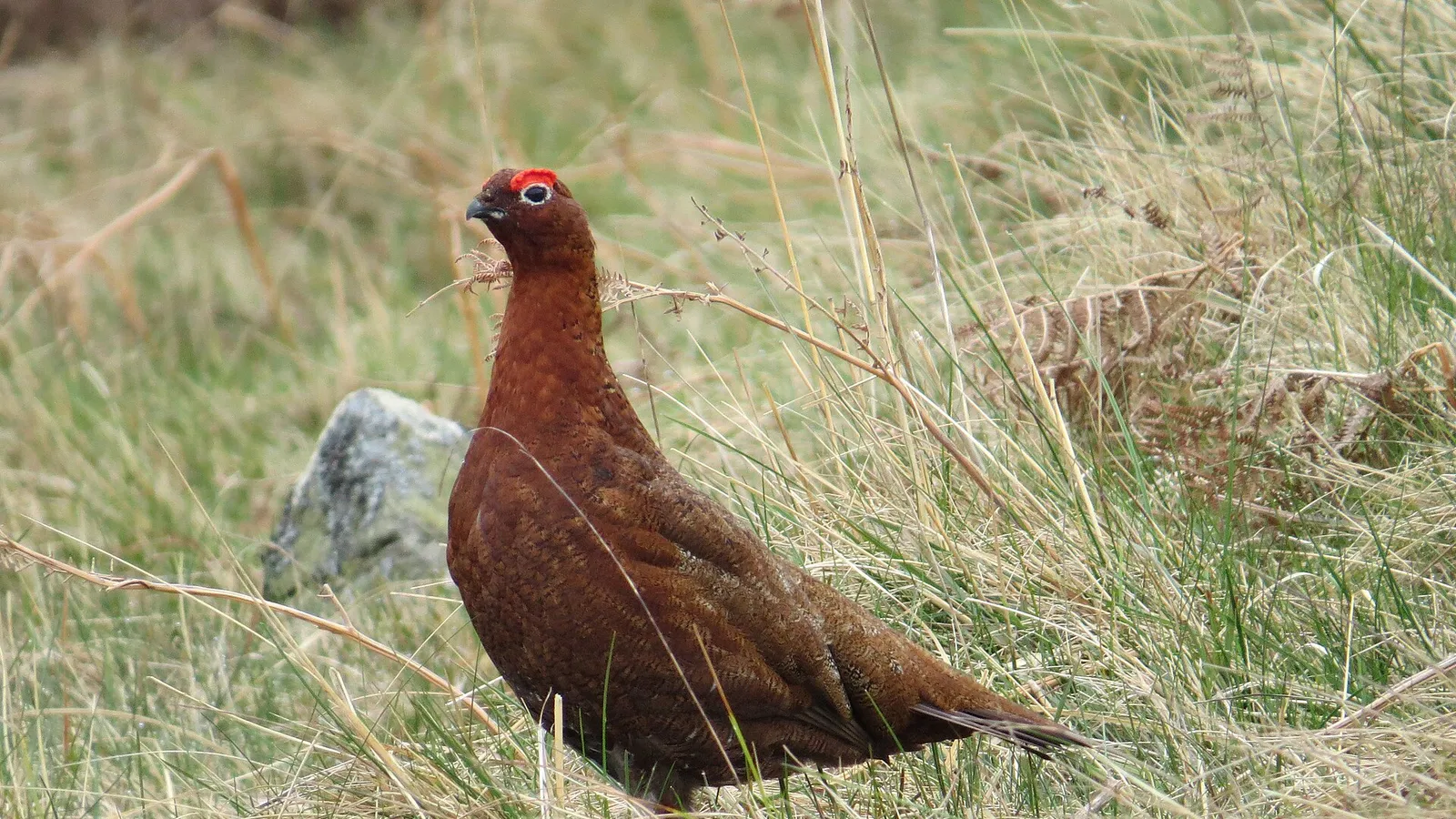

Red Grouse (Lagopus lagopus scotica)
Contents
TL;DR
- established The RSPB documented 488 confirmed incidents of bird-of-prey persecution linked to grouse moor management in Scotland between 2007 and 2022, with golden eagles and hen harriers among the species targeted — illegal killing intended to protect red grouse populations from natural predation ahead of shooting season — a specific, documented scale of illegal activity this article states directly rather than treating persecution as a vague allegation.
- established In response, the Wildlife Management and Muirburn (Scotland) Act 2024 introduced mandatory licensing for Scottish grouse moors for the first time, with operators risking licence loss if illegal raptor killing occurs on their land, alongside new restrictions on muirburn (controlled heather burning) and bans on glue traps and snares — a substantial, specific regulatory change this article names directly.
- disputed The grouse shooting industry has strongly opposed aspects of the 2024 Act, with industry bodies describing new muirburn licensing rules as risking "ruinous" harm to the rural economy and introducing offences industry representatives say are unrelated to raptor protection, while conservation organisations including the RSPB have called the legislation "a huge win for nature" — a genuine, unresolved policy disagreement this article presents from both documented positions rather than declaring a winner.
- established Red grouse shooting is also credited with substantial, specifically quantified economic contribution to the rural Scottish economy, with industry figures citing a value in the billions of pounds and significant rural employment — a genuine economic dimension this article states directly alongside, not instead of, the documented persecution record.
- established The Scottish Ornithologists' Club's The Birds of Scotland (2007) put the Scottish population at about 130,000 pairs in spring 2003, within a range of 100,000–150,000 pairs. Numbers indexed by shooting bags fell through the 20th century, with wide swings, and the range shrank by 138 10km squares between 1968–72 and 1988–91, mostly in the south and east.
- established The same account, by Robert Moss, notes that the worst outbreaks of "grouse disease" occur on moors where nearly all predators are killed year after year, and quotes a Victorian writer who called falcons "sanitary commissioners" for taking the sickest birds.
- disputed Muirburn (controlled heather burning), traditionally used to manage moorland for grouse by promoting young heather growth, remains a genuinely contested practice, with debate continuing over its effects on peatland carbon storage, wildfire risk, and biodiversity — a scientific and policy question this article presents as actively unresolved rather than settled in either direction.
Key Facts
- Scientific name
- Lagopus lagopus scotica
- Category
- Birds
- Status
- Native subspecies of Britain and Ireland (of the circumpolar willow grouse); game bird
- Old names
- Moorcock, moorfowl, muir-fowl; muir-hen (Orkney)
- Gaelic name
- Cearc-fhraoich, "heather hen"
- Season
- 12 August, the "Glorious Twelfth", to 10 December
- Scottish population (spring 2003)
- About 130,000 pairs (range 100,000–150,000)
- Breeding
- Laying from mid-April; clutch usually 7–9 (5–12); incubation about 21 days; hatching late May
- Density needed for driven shooting
- At least 65 birds per square kilometre in early August
- Scottish grouse moors, 1910
- 3,157, with rents of £789,250 (George Malcolm)
- Documented persecution incidents (2007–2022)
- 488 (RSPB)
- Key legislation
- Wildlife Management and Muirburn (Scotland) Act 2024
- New requirements
- Grouse moor licensing; muirburn licensing; snare/glue trap bans
- Economic claim (industry)
- Billions of pounds to rural Scottish economy
A Note on Claims and Evidence
Persecution incident figures are drawn from RSPB's own documented casework. The 2024 Act's provisions are drawn from the legislation itself and specialist legal reporting. The bird's biology, population, distribution and the science of grouse cycles and disease come from the Scottish Ornithologists' Club's The Birds of Scotland (2007), whose red grouse account is by Robert Moss; its population figures date from 2003. Industry and conservation positions on the Act, and the broader muirburn and economic value debates, are treated as genuinely Disputed, reflecting an active, unresolved policy disagreement this article presents from multiple documented sides without adjudicating.
Timeline
As the land bridge to Europe is lost, British willow grouse begin to evolve the dark plumage of the red grouse.
The spread of hill sheep probably brings louping-ill, a tick-borne virus to which red grouse have little immunity, into the uplands.
Samuel Johnson finds that "moorgame is everywhere to be had" in the Hebrides; in Edinburgh, James Boswell serves him "Scotch muir-fowl".
According to Brian Martin's history The Glorious Grouse, there is no earlier record of a grouse moor being let.
Keepers on the Duchess of Sutherland's estates kill 1,055 birds of prey.
Just eight Scottish grouse moors are available to rent; by the end of Victoria's reign there are several thousand.
Keepers on the Glengarry estate kill 1,501 birds of prey, along with 198 wild cats and hundreds of other mammals.
A French breech-loading shotgun speeds up loading, paving the way for driven shooting.
The railway reaches Inverness, bringing the remotest Highland moors within a day of London.
The Maharajah Duleep Singh shoots a record 220 brace in a day at Grandtully in the Tay valley.
The writer Dougall blames grouse disease on overstocking and on keepers killing the falcons.
Edward Wilson, later of Scott's last Antarctic expedition, visits almost every major Scottish grouse moor for a government inquiry into grouse disease and dissects 2,000 birds; British Birds adopts the red grouse as its emblem.
George Malcolm puts the rents of Scotland's 3,157 grouse moors at £789,250. On the 1,200ha Carron Moor in Moray, 946 brace (1,892 birds) are shot on the first day's driving.
The grouse disease inquiry reports, identifying the threadworm; Lord Lovat notes in the same report that some declines happen without disease.
Red grouse are lost from 138 10km squares, mainly on the eastern and southern edges of the range, as heather gives way to grass and plantations.
Red grouse die out on Coll.
Lord Lovat steers a bill through the Lords to open the season on 5 August; the Commons rejects it amid shouts of "We want to shoot Germans, not grouse."
The Joint Raptor Study in south-west Scotland concludes that raptors are very unlikely to explain the long-term fall in red grouse bags, which had begun in the 1930s.
The Scottish spring population is estimated at about 130,000 pairs.
Red grouse are reintroduced to Colonsay.
Red grouse moorland management, including muirburn to promote young heather growth favoured by grouse, becomes an established and economically significant Scottish rural land-use practice, alongside driven grouse shooting as a commercial activity.
The RSPB documents 488 confirmed incidents of illegal bird-of-prey persecution associated with grouse moor management in Scotland, including golden eagles and hen harriers, prompting sustained conservation campaigning for regulatory reform.
The Scottish Parliament passes the Wildlife Management and Muirburn (Scotland) Act, introducing mandatory grouse moor licensing for the first time, new year-round muirburn licensing with severe restrictions on peatland burning, and bans on glue traps and snares, alongside new training requirements for other trapping methods.
Conservation organisations including the RSPB welcome the legislation as a significant step toward deterring raptor persecution, while shooting industry bodies, including the British Association for Shooting and Conservation and Scottish Land & Estates, warn of economic harm to rural communities and argue some provisions extend beyond raptor protection's original aims.
Debate over muirburn's net effects on peatland carbon storage, wildfire risk, and biodiversity continues within the scientific and policy community, alongside continued disagreement over the balance between grouse shooting's economic contribution and its documented environmental and wildlife crime costs.
Details
A documented scale of illegal persecution, not a vague allegation
This article states the record of illegal bird-of-prey persecution linked to grouse moor management with its actual documented figure: 488 confirmed incidents recorded by the RSPB in Scotland between 2007 and 2022, with golden eagles and hen harriers among the species targeted, intended to protect red grouse from natural predation ahead of the shooting season. This article names this figure directly because it represents genuine, recorded casework rather than an unverified or impressionistic claim of wrongdoing.
A substantial, specific legislative response
This article presents the Wildlife Management and Muirburn (Scotland) Act 2024 with its real, specific provisions: mandatory grouse moor licensing for the first time, with the threat of licence loss tied directly to illegal raptor killing on an operator's land; new year-round muirburn licensing with severe restrictions on peatland burning; and outright bans on glue traps and snares. This article states these provisions directly because the Act represents a genuine, substantial regulatory shift rather than a symbolic gesture.
A genuine, unresolved industry-conservation dispute
This article treats directly, rather than resolving in either direction, the real disagreement the 2024 Act has provoked. Conservation organisations including the RSPB have welcomed it as "a huge win for nature," hoping licensing provides a meaningful deterrent against persecution. Shooting industry bodies, by contrast, have warned the new muirburn rules risk being "ruinous" to the rural economy, with some representatives arguing the legislation introduces offences unrelated to its stated raptor protection aims. This article presents both documented positions because the underlying disagreement over the Act's net costs and benefits remains genuinely contested policy territory, not a settled question this article should adjudicate.
A real economic dimension, stated alongside the persecution record
This article names the grouse shooting industry's claimed economic contribution to rural Scotland directly, citing a value described by industry figures as running into the billions of pounds alongside significant rural employment, rather than omitting this dimension in favour of a purely environmental framing. This article presents this economic claim alongside, not instead of, the documented persecution record, since an honest account of the controversy requires holding both the genuine economic stakes and the genuine wildlife crime record in view simultaneously.
Muirburn's net effects, left genuinely open
This article states plainly that muirburn — the traditional practice of controlled heather burning used to promote young growth favoured by grouse — remains a genuinely contested practice in its own right, separate from the raptor persecution debate. Questions over its effects on peatland carbon storage, wildfire risk, and broader moorland biodiversity remain actively debated within the scientific and policy community, and this article presents this as an open question rather than asserting a settled consensus on either side.
Sporting moors in environmental history
Sporting estates as a primary land use only began in the early nineteenth century, according to environmental historian T. C. Smout. They spread with the shotgun and the cartridge in early Victorian times and multiplied after 1870, when sheep farming ran into depression, so most grouse moors had already been altered as sheep runs before they were managed for shooting. Both regimes used fire to control vegetation.
On grouse estates the main ecological impact was the destruction of raptors. Smout argues that killing predators might bring a short-term surge in the number of grouse to shoot, but this was "invariably checked" by outbreaks of disease and by longer-term deterioration of habitat where moors were also grazed by sheep. On the Buccleuch estates in the south of Scotland, he notes, grouse decline appears connected to habitat damage from overgrazing when owners tried to make the most of both sheep and grouse. He adds that acid rain from industrial smoke, from mid-Victorian times onwards, seems likely to have played a part in the decline of heather moorland, especially in the west.
Muir-fowl to "King of Game Birds"
established Mark Cocker and Richard Mabey, in Birds Britannica (2005), call the red grouse the only member of its family widely shot in Britain and Ireland whose entire game stock is wild; there is no satisfactory way of hand-rearing it. Before the 19th century the moorcock or muir-fowl was a bird for the pot, taken mostly with snares and traps, and particularly common in parts of Scotland. Shooting was done "over dogs", with pointers and setters, or by walking up birds. Driven shooting, with beaters, flankers and a line of butts, became popular only in the second quarter of the 19th century. The breech-loading shotgun of 1847 and the arrival of the railway at Inverness in 1863 made the August journey north practical, and letting moors to southern guns became a business. The authors note that grouse has been a major quarry for fewer than 200 years, yet has gathered a richer social history than almost any other British bird. They put the population in 2005 at about a quarter of a million pairs, against a summer peak of up to five million in its heyday, and the area of grouse moor in Scotland at about two million acres (810,000ha), twice that of England and Wales.
established Victorian and Edwardian bags were enormous. In 1872 the Maharajah Duleep Singh shot 220 brace in a day at Grandtully in the Tay valley, riding between drives with several guns and loaders. Writing in 1910, George Malcolm counted 3,157 Scottish grouse moors and put their rents alone at £789,250, besides wages for keepers, beaters and staff and a trade in tweed, guns, whisky and smoked salmon. Not everyone admired the new style: in 1877 Lewis Clement, founder of Shooting Times, complained that "the poetry of shooting is going, and going very fast".
The Glorious Twelfth
shared The season opens on 12 August. Birds Britannica explains the odd date as a by-product of calendar reform: grouse shooting once began on 1 August, but after Britain adopted the Gregorian calendar in 1752 the old 1 August fell on what had been 21 July, close to or within the breeding season, so a date matching the old 1 August was chosen. Legal histories instead point to statute: an Act of 1773 barred the sale of grouse before 12 August, and the Game Act 1831, which covers England and Wales, fixed the season from 12 August. Scotland has its own game laws. Both accounts agree on the date; the calendar explanation should be treated as plausible rather than proven. In 1915, with Gallipoli at its height, Lord Lovat's bill to bring the opening forward to 5 August passed the Lords but was thrown out by the Commons.
Keepers and "vermin"
established Maximising bags meant killing anything thought to threaten grouse. Between 1837 and 1840 keepers on the Glengarry estate killed 11 foxes, 198 wild cats, 352 pine martens and polecats, 67 badgers, 48 otters and 1,501 birds of prey, among them 98 peregrines, 15 golden eagles, 27 sea eagles, 18 ospreys and 275 red kites. On the Duchess of Sutherland's estates 1,055 raptors were killed between 1831 and 1834. Cocker and Mabey conclude that this pattern, repeated across almost all Scottish sporting estates, drove the red kite, osprey and sea eagle to extinction in Scotland and severely reduced the rest. Even then there were critics: the naturalist Lord Lilford, himself a grouse shooter, protested at the "extermination" of eagles, peregrines, merlins and buzzards.
established The modern question of raptors and grouse was tested in the Joint Raptor Study in south-west Scotland (1992–1997), which brought both sides together. It found that birds of prey, especially hen harriers, can take a large share of a local grouse population, but were very unlikely to explain the long-term decline, since grouse bags had been falling since the 1930s, when harriers were absent.
Grouse disease and the 1907 inquiry
established Grouse numbers rise and crash in cycles. Victorians blamed poachers and "vermin", but a parliamentary committee of inquiry found the main culprit in a threadworm, Trichostrongylus tenuis, picked up from heather shoots; a single bird can carry 10,000. The committee's field worker was Dr Edward Wilson, who in 1907 visited almost every major grouse moor in Scotland and dissected 2,000 birds before dying with Scott on the return from the South Pole in 1912. High densities tend to trigger outbreaks, so record bags are often followed by crashes. Modern moor management rests on rotational burning of a tenth to a fifteenth of the heather each year; base-rich rocks give the best grouse densities, granite and deep peat the poorest.
established The Birds of Scotland (2007) adds two qualifications. First, Lord Lovat pointed out in the same 1911 report that some declines happen without disease. Second, the worst known outbreaks of threadworm disease are on moors where almost all predators are killed year after year. As early as 1875 the writer Dougall blamed outbreaks on overstocking and on keepers killing falcons, which took the most heavily infected birds. Modern work shows that disease is more likely in wet areas and wet years, because damp conditions help the worms pass between birds, so high densities in wet years are likely to be followed by crashes. Moss concludes that illegal killing of raptors "might be counter-productive".
Why numbers cycle
shared Red grouse numbers rise and fall in cycles, and The Birds of Scotland describes two main explanations. One rests on the threadworm: as grouse multiply, worm burdens rise until breeding fails. The other, developed by Adam Watson, Robert Moss and colleagues in north-east Scotland, rests on behaviour. While numbers rise, related males cluster in tolerant family enclaves; at peak density tolerance breaks down, aggression rises and young males leave, causing the decline and explaining old sporting accounts of "grouse migration". DNA work has confirmed many predictions of this view, which also fits cycles in ptarmigan, where the threadworm does not matter. An experiment on Rickarton Moor, near Stonehaven, in which males were removed in spring, held the population in its increase phase until frost damaged the heather. It also showed that female numbers followed the males', so males govern female numbers.
Territory, nest and family
established Cocks compete for territories each autumn, and the spring breeding population is largely set then; birds without a territory mostly die over the winter. Unmated territorial males are commonest on infertile moors and during declines. Hens lay from mid-April in a shallow scrape, usually hidden in tall heather. Clutches averaged about seven on poor granite moors in north-east Scotland in the 1950s–1980s and about nine in more recent studies in Strathspey, with a usual range of 5–12. Only the hen incubates, for about 21 days, and chicks usually hatch in late May. Cock red grouse are unusually attentive for grouse: they stand guard near the nest and help rear the brood, and either parent can raise it alone. Chicks take insects such as craneflies and spittlebugs for their first two or three weeks and are full-grown at 11–12 weeks. Young males tend to settle near their fathers, while young females move away.
Range, density and threats
established Red grouse live on heather moorland throughout Scotland, from sea level to about 750m in the east and up to 900m in North-east Scotland. The boundary with ptarmigan is set by vegetation, not altitude, and falls to about 200m in windy north-west Sutherland. Spring densities range from 1–2 pairs per square kilometre on poor western ground to over 100 at the peak of cycles on well-drained eastern moors. Driven shooting needs at least 65 birds per square kilometre in early August, which is why moors are burned in patches to give tall heather for nesting and short heather for feeding. Scotland has about 70% of the UK's grouse habitat, some 12,000 square kilometres of heathery ground, but on average lower densities than English moors.
established Much habitat was lost in the 20th century, especially in the Southern Uplands and Borders, as sheep and deer turned heather to grass and moorland was planted with trees. Between 1968–72 and 1988–91 the bird was lost from 138 10km squares. Red grouse were naturalised in Shetland and are still common in parts of Orkney; they died out on Coll in 1983 and were reintroduced to Colonsay in 2004. Moss lists further threats: nitrogen pollution, which favours grass and may make heather more vulnerable to heather beetle, and louping-ill, a tick-borne virus probably brought in with hill sheep. Louping-ill was spreading in 2007, perhaps helped by milder winters and more red deer. To reduce ticks, some estates were culling mountain hares, a practice that has since become controversial in its own right.
Wanderers and grouse in Scottish culture
established Red grouse are sedentary, and ringing shows almost 90% move less than 1.6km. Yet the Scottish naturalist John Harvie-Brown watched grouse crossing the Moray Firth, a flock was seen crossing the Pentland Firth from Hoy to the mainland, and in December 1917 a covey landed on the destroyer HMS Ophelia some 50km off Shetland. Grouse were released successfully in Shetland and the Outer Hebrides in the 19th century. The bird also became a commercial emblem: Archibald Thorburn's paintings sold to sporting clients, Victorian bangles were made from a grouse foot mounted in silver with a cairngorm stone, and The Famous Grouse whisky still carries the bird on its label.
Did You Know?
- The RSPB documented 488 confirmed incidents of illegal bird-of-prey persecution linked to grouse moor management in Scotland between 2007 and 2022.
- The Wildlife Management and Muirburn (Scotland) Act 2024 introduced mandatory grouse moor licensing in Scotland for the first time.
- Operators can lose their grouse moor licence if illegal raptor killing is found to have occurred on their land.
- Glue traps and snares are now banned under the 2024 Act, with new training requirements for other trapping methods.
- Muirburn now requires year-round licensing and faces severe restrictions on peatland under the new law.
- Industry bodies have described the new rules as risking "ruinous" harm to the rural economy, while the RSPB has called the Act "a huge win for nature."
- The red grouse is a subspecies of the circumpolar willow grouse (willow ptarmigan), found in Britain and Ireland; it was once celebrated as Britain's only endemic bird species.
- The journal British Birds chose the red grouse as its emblem in 1907.
- In 1872 the Maharajah Duleep Singh shot 220 brace in a single day at Grandtully in Perthshire.
- Cock red grouse help rear their chicks, unusually for a member of the grouse family.
- In 1910, 946 brace were shot on the first day's driving on Carron Moor in Moray.
- The Gaelic name, cearc-fhraoich, means "heather hen".
- A covey of red grouse once landed on the deck of a Royal Navy destroyer 50km off Shetland, in December 1917.
- Keepers on one Highland estate, Glengarry, killed 1,501 birds of prey in about three years from 1837.
FAQ
1Is illegal raptor persecution really linked to grouse moors?
Yes — the RSPB has documented 488 confirmed incidents in Scotland between 2007 and 2022, including golden eagles and hen harriers.
2What did the 2024 Act change?
It introduced mandatory grouse moor licensing for the first time, new muirburn licensing restrictions, and bans on glue traps and snares.
3What happens if illegal persecution occurs on a licensed moor?
The operator risks losing their grouse moor licence.
4Does the shooting industry support this law?
No — industry bodies have opposed aspects of it, particularly the new muirburn rules, warning of economic harm to rural communities.
5Do conservation groups support the law?
Yes — the RSPB has called it "a huge win for nature," hoping licensing deters future persecution.
6Is grouse shooting economically significant?
Yes — industry figures cite a contribution running into the billions of pounds and significant rural employment, a genuine economic dimension alongside the documented persecution record.
7Is muirburn itself controversial?
Yes — its effects on peatland carbon storage, wildfire risk, and moorland biodiversity remain genuinely debated among scientists and policymakers.
8Has the new law resolved the raptor persecution problem?
This remains to be seen — the Act is a recent, substantial regulatory change, but its long-term effectiveness as a deterrent has not yet been established.
9Is the red grouse a uniquely Scottish bird?
No. It is a subspecies of the willow grouse found across Britain and Ireland, though Scotland holds the largest area of grouse moor. It was long celebrated as Britain's only endemic species until it was reclassified as a subspecies.
10Why does the season open on 12 August?
The date is fixed in game law. Birds Britannica (2005) traces it to the 1752 calendar change, which moved an older 1 August opening; that explanation is plausible but not proven.
11When did driven grouse shooting begin?
It became popular in the second quarter of the 19th century, helped by breech-loading guns from 1847 and the railway, which reached Inverness in 1863.
12What causes grouse numbers to boom and crash?
Two explanations compete. One is the parasitic threadworm Trichostrongylus tenuis, identified by a government inquiry for which Edward Wilson dissected 2,000 Scottish grouse in 1907. The other, supported by DNA studies, explains cycles through changing tolerance and aggression among related males. Both may play a part.
13How many red grouse are there in Scotland?
The Birds of Scotland (2007) estimated about 130,000 pairs in spring 2003, within a range of 100,000–150,000 pairs.
14Does killing predators help grouse?
It can raise numbers for shooting in the short term, but The Birds of Scotland notes that the worst outbreaks of grouse disease are on moors where almost all predators are killed, and the Joint Raptor Study found raptors did not explain the long-term decline.
15What is louping-ill?
A viral disease carried by sheep ticks that can kill many grouse chicks. It probably arrived with the spread of hill sheep, and some estates have culled mountain hares, which also carry ticks, to control it.
Sources and Further Reading
Primary/Institutional
- Forrester, R. W., Andrews, I. J. et al. (eds), The Birds of Scotland (Scottish Ornithologists' Club, 2007), account by Robert Moss.
- Red grouse and licensing — NatureScot
- Licence to kill: The Wildlife Management and Muirburn (Scotland) Act 2024 — Shepherd and Wedderburn
Scholarly/Critical
- Mark Cocker and Richard Mabey, Birds Britannica (Chatto & Windus, 2005)
- Glorious Twelfth — Wikipedia
- Game Act 1831 — Wikipedia
- T. C. Smout, "Land and Sea: The Environment", in T. M. Devine and Jenny Wormald (eds), The Oxford Handbook of Modern Scottish History (Oxford University Press, 2012)
- Grouse shooting: 'Seismic' changes set for industry as new Scottish law aims to tackle raptor persecution — Discover Wildlife
- Grouse shooting delivers for Scotland, but muirburn rules risk gains — BASC
General
Caveats: Myths and Disputed Claims
- Clarification: This article does not claim the 2024 Act has been proven to reduce raptor persecution; it is a recent regulatory change whose long-term deterrent effect has not yet been established.
- Note: This article does not adjudicate the broader dispute over grouse moor management's net ecological and economic value to Scotland; it presents the documented persecution record, the industry's economic claims, and the 2024 Act's provisions without declaring a resolution to that wider debate.
- Do not call the red grouse a Scottish subspecies or Britain's only endemic bird: it occurs across Britain and Ireland and is now classed as a race of the willow grouse.
- Do not treat the threadworm as the settled explanation of grouse cycles; a behavioural explanation based on competition among related males has strong support too.
- Do not describe the pale grouse of the Outer Hebrides and Ireland as a separate subspecies; DNA work has not supported that split.
- Do not present the 1752 calendar change as the proven origin of the Twelfth; it is the explanation given in Birds Britannica, while the date's legal basis lies in game statutes.
Card 025 · Wildlife