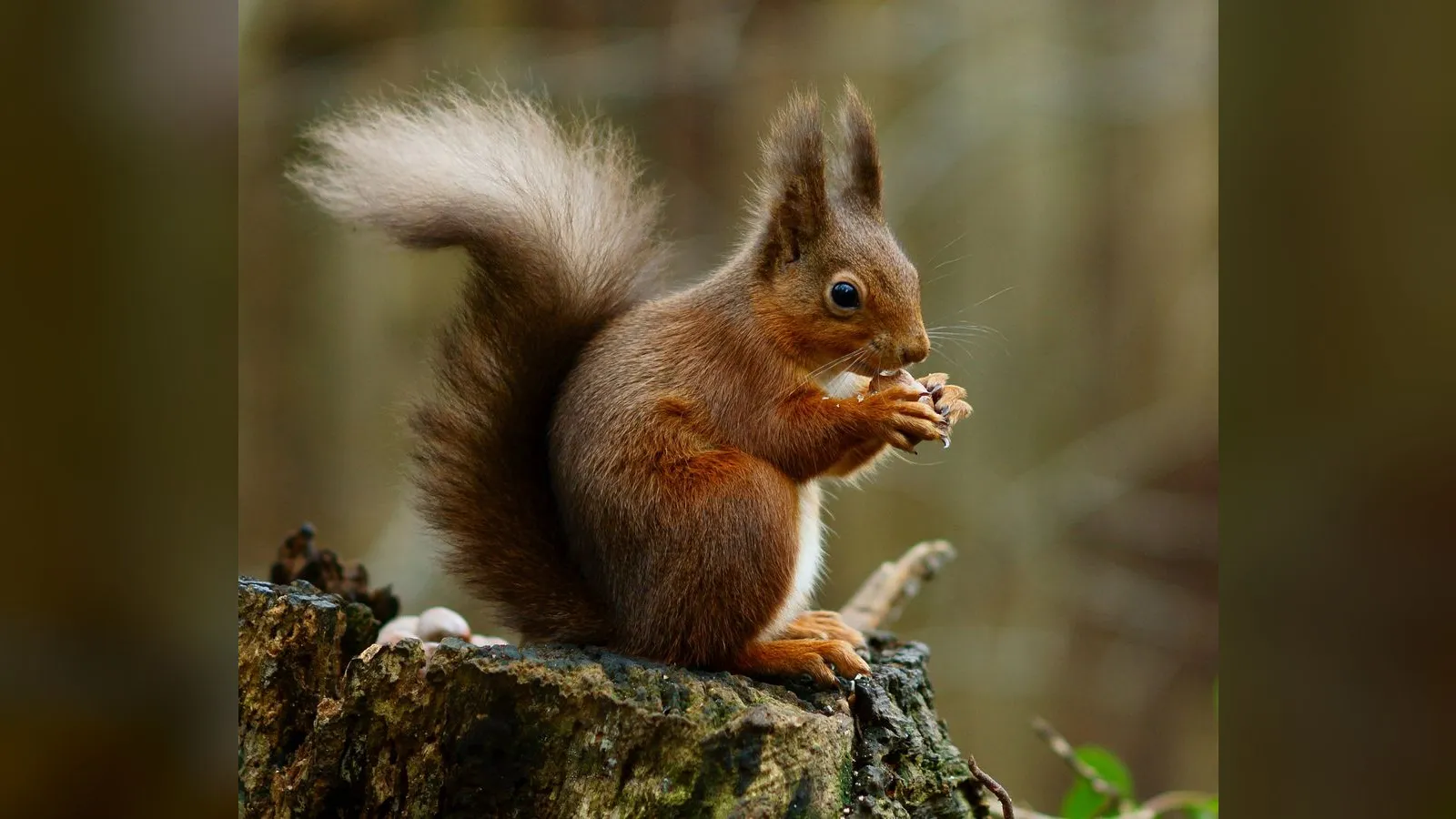

Red Squirrel (Sciurus vulgaris)
Contents
TL;DR
- established Scotland is Britain's principal stronghold for the red squirrel, holding roughly 80% of the UK's estimated 287,000 native red squirrels — a specific, quantified concentration this article states directly rather than vaguely describing Scotland as merely "important" to the species.
- established Grey squirrels, introduced from North America in the late 19th and early 20th centuries, out-compete red squirrels across much of their shared range and have already driven the native species from most of England and Wales — a documented, direct causal mechanism of decline, not a coincidental parallel decline.
- established Squirrelpox virus, carried without harm by grey squirrels but fatal to red squirrels, is described by NatureScot as possibly the single greatest risk to the future of red squirrels in Scotland, and remains genuinely difficult to contain within its current south Scotland range — a serious, specific, and ongoing threat this article names directly.
- established Peer-reviewed research has demonstrated a genuinely elegant and significant ecological finding: recovering pine marten populations preferentially suppress grey squirrels while leaving red squirrels comparatively unaffected, reversing the competitive advantage grey squirrels normally hold — a documented case of native predator recovery providing a biological check on an invasive species, not folk belief or anecdote.
- established Active, coordinated conservation effort continues through the Saving Scotland's Red Squirrels project, including designated stronghold forests, targeted grey squirrel control, and public engagement — a sustained institutional response rather than a historical, closed chapter.
Key Facts
- Scientific name
- Sciurus vulgaris
- Category
- Mammals
- UK population
- Approximately 287,000
- Scottish share of UK population
- Roughly 80%
- Status in Scotland
- Native; principal UK stronghold
- Primary threats
- Grey squirrel competition; squirrelpox virus
- Documented natural ally
- Pine marten (suppresses grey squirrels)
- Key project
- Saving Scotland's Red Squirrels (SSRS)
Scottish Impact Index (SI Score)
- Scottish Significance
- 9/10
- Ecological Persistence
- 7/10
- Ecological Importance
- 8/10
- Biological Distinctiveness
- 8/10
- Conservation Significance
- 10/10
- Recognition
- 10/10
52/60
Ranked =15th of 42 in Wildlife
A Note on Claims and Evidence
Population figures, the squirrelpox threat assessment, and conservation stronghold designations are drawn from NatureScot's own published data. The pine marten–grey squirrel suppression mechanism is drawn from peer-reviewed spatial capture-recapture research and is treated as Established, reflecting a published, methodologically documented scientific finding rather than an anecdotal or folk claim.
Timeline
Red squirrels are native to Britain and widespread in its woodland, though no datable fossil record exists.
Red squirrels are extinct in southern Scotland after centuries of woodland clearance, and are rare in the Highlands into the early 19th century.
Red squirrels, mainly from England, are released at about ten sites in Scotland.
Squirrels of the Scandinavian race are introduced to Perthshire, bringing with them a continental flea still found locally in north-east Scotland in 1991.
Squirrels of a western European race are probably released in the Lothians.
Red squirrels become very abundant throughout the British Isles, then decline sharply and become scarce in many places by the 1920s, before grey squirrels had spread widely.
Grey squirrels are introduced to Britain from North America, beginning a sustained process of displacing red squirrels through direct competition.
Grey squirrels drive red squirrels to local extinction across most of England and Wales, while Scotland remains a comparative stronghold.
Squirrelpox virus, lethal to red squirrels but harmless to the grey squirrels that carry it, becomes established in south Scotland and remains difficult to contain.
The Saving Scotland's Red Squirrels project coordinates grey squirrel control and monitoring across 18 designated public and private forest stronghold sites, plus the Isle of Arran.
Dr Emma Sheehy and colleagues publish spatial capture-recapture research across Britain demonstrating that recovering pine marten populations preferentially suppress grey squirrels while red squirrels benefit indirectly.
Red Squirrel Week, held each September, supports ongoing public awareness and engagement.
Details
Scotland's real, quantified significance to the species
This article states Scotland's importance to red squirrel conservation with precise figures rather than general enthusiasm: of Britain's estimated 287,000 native red squirrels, roughly 80% live in Scotland. This concentration reflects the species' genuine national stronghold status, and this article treats it as the essential starting fact for understanding why conservation decisions made in Scotland carry disproportionate weight for the species' UK-wide survival.
A direct, documented mechanism of decline — not mere coincidence
This article names the cause of red squirrel decline specifically rather than leaving it vague: grey squirrels, introduced from North America in the late 19th and early 20th centuries, out-compete red squirrels for food and habitat across shared range, a documented process that has already eliminated red squirrels from most of England and Wales. This is presented as a direct causal mechanism, not a parallel or coincidental decline alongside grey squirrel spread.
shared How the explanation changed. The mechanism was not always this clear. Writing in The Handbook of British Mammals (1991), John Gurnell noted that the red squirrel's decline between 1910 and 1930 happened before greys had spread, and that a direct influence of grey squirrels was then thought unlikely. He called for research on indirect effects instead. That research, together with the identification of squirrelpox, is what produced today's account: greys win mainly by eating seed, especially acorns, more efficiently, and by carrying a virus that kills reds. The Handbook already recorded a pathogenic parapoxvirus in red squirrels in East Anglia, without yet linking it to greys.
Scotland's squirrels before the grey: extinction and restocking
A native that nearly vanished. Gurnell's account shows that the red squirrel's Scottish history was precarious long before the grey squirrel arrived. Woodland clearance left it extinct in southern Scotland by the early 18th century and rare in the Highlands in the late 18th and early 19th centuries.
Restocked from England and Scandinavia. Between 1772 and 1782 red squirrels, mainly from England, were released at about ten sites in Scotland. In 1793 squirrels of the Scandinavian race were introduced to Perthshire, and around 1860 a western European race was probably released in the Lothians. Many of Scotland's squirrels may therefore descend at least partly from these introductions. One trace survives: a flea, Tarsopsylla octodecimdentata, found locally in north-east Scotland and probably brought in with the 1793 squirrels.
Boom and bust. Numbers fluctuated widely between years. Red squirrels became very abundant across the British Isles between 1890 and 1910, crashed in the 1910s and 1920s, partly recovered by 1930, and then disappeared from large areas of England and Wales as greys spread.
The British race. The endemic British race, Sciurus vulgaris leucourus, was described in 1792 and is marked by ear tufts and tail that bleach to cream or white in summer. Because of the introductions, some Scottish squirrels bleach and others do not.
Biology recorded in 1991
Habitat. In Britain, red squirrel populations were most stable in large blocks of conifer forest, over about 100 hectares and more than 25 years old. Typical densities were 0.3 to 0.8 squirrels per hectare in Scottish conifer forests. In Scots pine forest in eastern Scotland, conifer seed dominated the diet for much of the year, with buds, shoots, flowers and fungi filling the gaps.
Breeding. Females can have two litters a year, one born February to April and one May to August, averaging about three young. Breeding is delayed or missed when the seed crop fails. Between 75% and 85% of juveniles disappear in their first winter.
Predators and forestry. Pine martens, wildcats, owls and goshawks take red squirrels, but the Handbook judged that predators did not significantly affect their numbers. Starvation and cold were the main killers. Red squirrels could also damage conifer plantations by stripping bark in May to July, especially at densities near two per hectare, and foresters could control them under licence by cage trapping. The Scottish Gaelic name is feòrag.
A named, serious viral threat
This article states directly, rather than minimising, that squirrelpox virus represents what NatureScot itself describes as possibly the single greatest risk to the future of red squirrels in Scotland. The virus is carried without apparent harm by grey squirrels but is fatal to red squirrels, and its presence, currently concentrated in south Scotland, has proven genuinely difficult to contain. This article presents the threat with this specific institutional characterisation rather than listing it as one generic pressure among several.
An elegant, genuinely significant scientific finding
This article credits a specific, peer-reviewed ecological finding with its full significance: research led by Dr Emma Sheehy, using spatial capture-recapture methods across Britain, demonstrated that recovering pine marten populations preferentially and negatively affect grey squirrels while red squirrels experience a comparative indirect benefit. This reverses the competitive advantage grey squirrels normally hold over red squirrels, and represents a documented case of a recovering native predator providing genuine biological resistance against an invasive species — a finding this article presents as methodologically robust science with real conservation policy implications across Britain and Ireland, not informal field observation.
An active, ongoing institutional effort, not a finished story
This article notes that red squirrel conservation in Scotland continues as a live, coordinated programme rather than a settled historical achievement. The Saving Scotland's Red Squirrels project maintains 18 designated forest stronghold sites plus the Isle of Arran, conducts targeted grey squirrel control in priority areas, and sustains public engagement through initiatives such as the annual September Red Squirrel Week — a sustained, multi-pronged response reflecting the continuing, unresolved nature of the underlying threats.
Did You Know?
- Roughly 80% of Britain's estimated 287,000 native red squirrels live in Scotland.
- Grey squirrels carry squirrelpox virus without apparent harm to themselves, but the virus is fatal to red squirrels.
- NatureScot has described squirrelpox as possibly the single greatest risk to red squirrels' future in Scotland.
- Grey squirrels have already eliminated red squirrels from most of England and Wales through direct competition.
- Peer-reviewed research has shown that recovering pine marten populations preferentially suppress grey squirrels, indirectly benefiting red squirrels.
- Scotland maintains 18 designated forest stronghold sites for red squirrel conservation, plus the Isle of Arran.
- Red Squirrel Week is held annually each September to support public awareness.
- Red squirrels were extinct in southern Scotland by the early 18th century and were restocked from England at about ten Scottish sites between 1772 and 1782.
- Squirrels of the Scandinavian race were released in Perthshire in 1793.
- British red squirrels' ear tufts and tail often bleach to cream or white by summer.
- Most young red squirrels, 75% to 85%, do not survive their first winter.
FAQ
1Why is Scotland so important for red squirrels?
It holds roughly 80% of Britain's native red squirrel population, making it the species' principal UK stronghold.
2Why are grey squirrels a threat?
They out-compete red squirrels for food and habitat and carry squirrelpox virus, which is fatal to red squirrels but harmless to greys.
3What is squirrelpox virus?
A virus carried without harm by grey squirrels but lethal to red squirrels, currently established in south Scotland and considered possibly the greatest single risk to the species' future there.
4Do pine martens really help red squirrels?
Yes — peer-reviewed research has shown recovering pine marten populations preferentially suppress grey squirrels, indirectly benefiting red squirrels.
5What conservation efforts are underway?
The Saving Scotland's Red Squirrels project coordinates grey squirrel control and monitoring across designated stronghold forests and the Isle of Arran.
6Have grey squirrels eliminated red squirrels elsewhere in Britain?
Yes — they have driven red squirrels to local extinction across most of England and Wales.
7Is this conservation effort ongoing or complete?
Ongoing — active control, monitoring, and public engagement continue, reflecting the unresolved nature of the squirrelpox and grey squirrel competition threats.
8Where in Scotland are red squirrels most secure?
Within the 18 designated forest stronghold sites and on the Isle of Arran, which remains free of grey squirrels.
9Are Scotland's red squirrels all native stock?
Not entirely. They are a native species, but after near-extinction they were restocked from England in 1772–82, and continental squirrels were introduced to Perthshire in 1793 and probably the Lothians around 1860.
10Did the grey squirrel cause the early twentieth-century decline?
No. Red squirrels crashed between about 1910 and 1930, before greys had spread widely. Greys were responsible for the later, lasting losses across England and Wales.
11How many young does a red squirrel have?
Usually about three per litter, with up to two litters a year when tree seed is plentiful. Breeding is reduced or skipped after a poor seed year.
Sources and Further Reading
Primary/Institutional
- Red squirrel — NatureScot
- Scottish Strategy for Red Squirrel Conservation
- Saving Scotland's Red Squirrels — Scottish Wildlife Trust
Scholarly/Critical
- G. B. Corbet and S. Harris (eds), The Handbook of British Mammals, 3rd edn (Blackwell Scientific, 1991), account by J. Gurnell
- Native pine marten recovery reverses decline of the red squirrel by suppressing grey squirrel populations — Dr Emma Sheehy
- Natural strongholds for red squirrel conservation in Scotland — ScienceDirect
General
Caveats: Myths and Disputed Claims
- Clarification: The pine marten's beneficial effect on red squirrels is an indirect consequence of its preferential predation on grey squirrels, not evidence that pine martens avoid preying on red squirrels specifically or protect them directly.
- Do not say Scotland's red squirrels have survived untouched since prehistory; they were lost from much of Scotland by the 18th century and restocked from England and Scandinavia.
- Do not blame the grey squirrel for every red squirrel decline; the 1910–1930 crash came before greys had spread.
- Note: This article does not claim squirrelpox or grey squirrel competition have been resolved; both remain active, documented threats under ongoing management rather than historical problems.
Card 005 · Wildlife