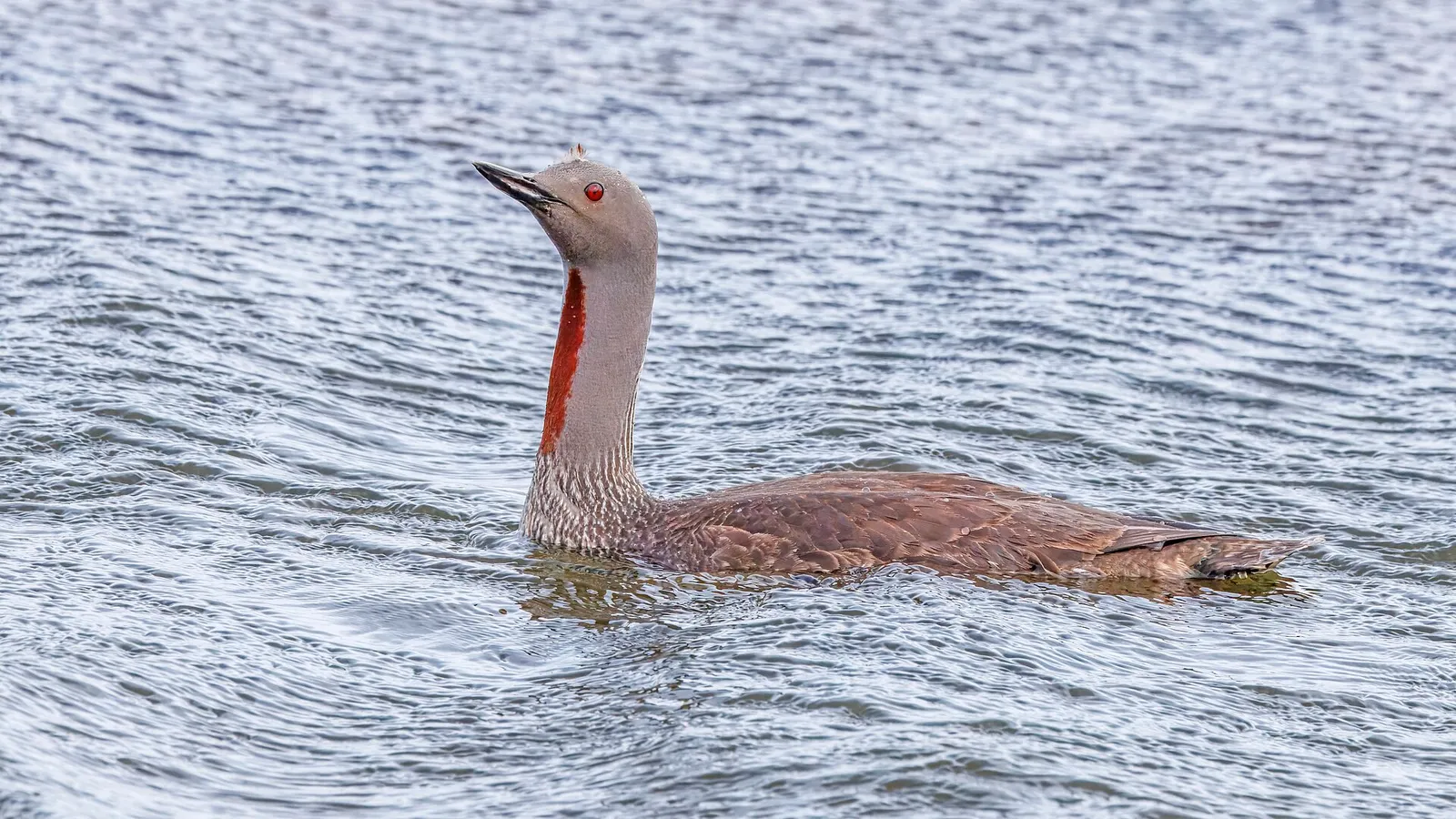

Red-throated Diver (Gavia stellata)
Contents
TL;DR
- established Red-throated divers nest on small lochs and lochans close to the sea across northern and western Scotland, but depend critically on nearby marine waters for food, since chicks are fed largely on fish brought from the sea rather than the nesting loch itself — a specific, documented two-habitat dependency this article states directly rather than describing the species as simply a "loch bird."
- established Shetland has long been the species' most important UK stronghold, accounting for 46% of the national breeding total in 1994, though this share fell to 33% by 2006 as the population expanded across the Hebrides and Scottish mainland — a specific, documented shift in distribution this article states precisely rather than treating Shetland's historical dominance as unchanged.
- established Sandeel shortages have been specifically documented as a major factor depressing breeding success in Shetland, directly linking the species' reproductive performance to the availability of a particular marine prey species whose own population has been pressured by climate-driven warming and historical overfishing.
- disputed Red-throated divers are considered among the species most sensitive to offshore wind farm development, facing displacement risk in coastal waters they depend on for feeding, while onshore wind development in peatland breeding habitat, including a proposal in the Flow Country that RSPB Scotland described as "one of the most worrying" it had assessed, has also drawn significant conservation concern — this article states both documented concerns directly while noting that the renewable energy sector's own position on mitigating these specific risks remains an active, unresolved area of policy debate.
- established Conservation measures including artificial floating nest islands have been used at specific sites, including near onshore wind developments, to offset disturbance and water-level fluctuation risks to nesting birds — a concrete, documented mitigation measure this article names directly.
Key Facts
- Scientific name
- Gavia stellata
- Category
- Seabirds
- UK breeding population (2006)
- ~1,250 pairs
- UK wintering population (2011–15)
- ~22,000 birds
- UK breeding population (1994)
- 934 pairs (historical figure)
- Shetland's share of UK breeding total
- 46% (1994, BTO) or "more than half" (1994, Birds Britannica) → 33% (2006)
- Scottish breeding estimates (SOC, 2007)
- Over 750 pairs (1968–72); 1,425 (1988–91); 935, possibly up to 1,500 (1994)
- Scottish wintering estimate (2007)
- About 2,270 birds
- Orkney and Shetland names
- Loon; rain goose
- Gaelic name
- Learga-ruadh
- Key threats
- Sandeel shortage, disturbance, water-level change, wind farm development (on- and offshore)
Scottish Impact Index (SI Score)
- Scottish Significance
- 8/10
- Ecological Persistence
- 8/10
- Ecological Importance
- 7/10
- Biological Distinctiveness
- 8/10
- Conservation Significance
- 8/10
- Recognition
- 7/10
46/60
Ranked =35th of 42 in Wildlife
A Note on Claims and Evidence
Population figures and Shetland's changing share of the UK breeding population are drawn from the British Trust for Ornithology's published assessment. Sandeel-linked breeding success findings and current threats (disturbance, water-level change, non-native predation) are drawn from NatureScot's published assessment. Historical range, the run of Scottish population estimates to 2007, ringing results and breeding biology come from J. D. Okill's account in The Birds of Scotland (2007); its figures are dated history and do not replace the later 2006 and 2011–15 estimates. The relative weight and resolution of wind farm-related risk to the species remains treated as genuinely Disputed, reflecting ongoing, unresolved debate between conservation organisations and the renewable energy development sector over mitigation adequacy.
Timeline
Diver remains are left in Pictish middens just south of Kirkwall, Orkney; divers stay in the Scottish diet until at least the eighteenth century.
The largest numbers are thought to breed on the north-west mainland and in the Outer Hebrides; in Orkney the species nests only on Hoy (Buckley and Harvie-Brown, 1891).
Red-throated and black-throated divers are heavily persecuted in Scotland by egg collectors, taxidermists and fishermen, before gradually reclaiming old breeding haunts.
Shetland's population grows from the early 1900s until it becomes the species' main British stronghold.
A single pair nests in Ayrshire, the only breeding record from southern Scotland.
The first national breeding atlas records the species in 312 ten-kilometre squares and estimates over 750 Scottish pairs, probably an underestimate.
About 1,500 red-throated divers gather in the Moray Firth, including 1,000 off the Culbin Bar, one of the largest east-coast concentrations recorded.
A complete survey of Shetland, probably at the population's peak, finds just over 700 pairs.
First breeding in Moray and Nairn.
The second breeding atlas estimates 1,425 pairs in Scotland.
A national survey finds 934–935 breeding pairs (the SOC gives 935 and an upper limit of 1,500), with Shetland holding the largest share (46% in the BTO's figure; "more than half" in Birds Britannica) and Orkney about 10%. Shetland's total of about 430 pairs is some 40% below 1983.
Only 56 pairs remain on Hoy, Orkney's former stronghold; west Mainland Orkney holds 30–35 pairs.
A follow-up national survey records the UK breeding population at approximately 1,250 pairs, with Shetland's share of the national total having fallen to 33% as the species' distribution expands across the Hebrides and Scottish mainland.
The Scottish wintering population is estimated at about 2,270 birds (O'Brien and others, cited in The Birds of Scotland), as aerial surveys begin to reveal large numbers offshore.
The UK wintering population is estimated at approximately 22,000 birds.
Studies document sandeel shortages as a major factor depressing breeding success specifically in Shetland.
RSPB Scotland raises significant concern over a proposed Flow Country wind farm development, describing it as "one of the most worrying" it had assessed, reflecting the sensitivity of breeding red-throated divers and other species to peatland habitat disturbance.
Artificial floating nest rafts are installed at the Freasdail Wind Farm site specifically to support red-throated diver nesting amid water-level fluctuation and disturbance risks.
Conservation measures, including floating nest islands, continue to be used at specific sites to support breeding success, while offshore and onshore wind development continues to raise documented, unresolved concern for the species.
Details
A two-habitat dependency, stated with its real mechanism
This article names the red-throated diver's breeding ecology with its real specificity rather than describing it simply as a "loch bird": the species nests on small lochs and lochans close to the sea, but chicks are fed largely on fish brought in from nearby marine waters rather than food from the nesting loch itself. This article states this dual dependency directly because it clarifies why the species is vulnerable to pressures on both freshwater nesting sites and adjacent marine feeding grounds simultaneously, rather than being protected by safeguarding either habitat alone.
Loon and rain goose: the diver in Northern Isles speech and lore
established Mark Cocker and Richard Mabey, in Birds Britannica (2005), record two names still in use for the red-throated diver in Orkney and Shetland: "loon" and "rain goose". Loon comes from the Old Norse lómr, "moaning bird", a nod to the species' wailing calls, and it is the family name still used in North America. The word is fixed in the landscape too. "Looma Chun", meaning "lochan of the divers", is found on Rousay, on Hoy and in both West and East Mainland Orkney, and the book notes that all of these sites still had breeding divers. In Shetland, "Loomi Shun" (divers' tarn) is widespread.
traditional The folklore scholar Edward Armstrong argued that "rain goose" is the last British trace of a body of diver mythology that once stretched right around the northern world, in which the diver foretold storms and acted as a helper in shamanic journeys. Northernmost Scotland lay at the very edge of that belief, and it survived there in the name itself and in the idea that the bird foretold storms. The weather lore is folk tradition, not observation.
established Divers were known to the islands' earliest people: their remains have been found in Pictish middens just south of Kirkwall. The book records that divers featured in the Scottish diet until at least the eighteenth century. An old East Lothian name for divers, "spratoon", reflects their taste for sprats.
established In the nineteenth and early twentieth centuries red-throated and black-throated divers were heavily persecuted in Scotland by egg collectors, taxidermists and fishermen. Both species have since steadily reclaimed old breeding haunts. In 1994, outside Orkney and Shetland, red-throats nested mainly north and west of a line between Glasgow and Moray.
A stronghold's changing share, stated precisely
shared Sources differ on Shetland's exact share in 1994. The BTO's assessment, used in this article, gives 46%; Birds Britannica says "more than half" of the 934 pairs then counted were in Shetland. Both agree that Shetland was by far the most important area at that time.
This article presents Shetland's historical importance to the species with its real, changing figures: accounting for 46% of the UK breeding total in 1994, falling to 33% by 2006 as the population expanded into the Hebrides and Scottish mainland. This article states both figures directly because treating Shetland's dominance as fixed and unchanging would misrepresent a genuinely documented shift in the species' UK distribution over this period.
The Scottish record, from The Birds of Scotland
established Range and history. The Scottish Ornithologists' Club's The Birds of Scotland (2007), in an account by J. D. Okill, places Scotland at the extreme southern edge of a circumpolar breeding range. Divers nest north and west of a line ending at the Mull of Kintyre, with most in Shetland and Orkney, many in the Outer Hebrides, and a scatter inland, especially in the Flow Country. The range has changed little since the nineteenth century, but its centre has moved. Victorian writers thought the largest numbers bred on the north-west mainland and in the Outer Hebrides, and in Orkney the bird nested only on Hoy. Shetland's numbers grew from the early 1900s, and Okill judges that the population at the end of the nineteenth century was probably smaller than today's.
established Counting a secretive bird. The Scottish estimates rose and fell partly with survey effort. The 1968–72 atlas suggested over 750 pairs. Extrapolation from a 1983 Shetland survey gave 1,200–1,500. The 1988–91 atlas gave 1,425, and the 1994 national survey found 935 pairs, with an upper limit of 1,500 because the species is hard to census. About 3,010 individuals were in Scotland that summer, many of them non-breeding immatures in the Northern Isles. Shetland fell from just over 700 pairs in 1983 to about 430 in 1994, a decline of about 40%, before stabilising. On the edges of the range, breeding stopped in North-east Scotland after the 1980s, began in Moray and Nairn in 1986, and has involved 3–4 pairs in Strathspey and 2–3 in Perth and Kinross. Okill suggests that the need to carry fish from the sea may limit colonisation of many inland areas.
established Breeding. Birds in summer plumage reach Shetland's fresh waters in March. Males return to nest close to where they hatched, while females disperse more widely, and established adults reuse the same site year after year. The clutch is almost always two eggs, laid from early May into June, and Shetland chicks usually fledge in the first days of August, with Orkney about a week ahead. Studies in Shetland and Orkney found that pairs on small lochans usually do better than those on larger lochs, because small waters suffer less flooding, wave action and disturbance by anglers. Part-grown chicks sometimes walk from one loch to a larger one, usually downhill. Floating rafts are used where they are provided.
established Ringing and winter. Ringing in Shetland and Orkney shows Scottish birds spreading around the coasts of Britain and Ireland in winter, with first-winter birds reaching the Netherlands and the Atlantic coast of France. Young birds drift back north over their first summers and do not breed until at least five years old. Of ringed birds recovered, 53% had drowned in fishing nets and 21% were victims of pollution. Winter flocks of hundreds gather in the Firth of Forth, St Andrews Bay, off Angus, between the Don and the Ythan, and in the Moray Firth; 1,470 were counted off North-east Scotland on 14 October 1979. Okill notes that the size of the wintering population was poorly known in 2007, with aerial surveys beginning to show many birds offshore. The later UK estimate of about 22,000 birds reflects that improved coverage.
A specific prey-dependency, not a vague "food shortage"
This article names sandeel shortage specifically as a documented factor depressing breeding success in Shetland, rather than a general reference to "reduced food availability." This article states this directly because it links the species' reproductive performance to the same broader sandeel population pressures — driven by ocean warming and historical overfishing — that have also affected other Scottish seabirds, situating the diver's challenges within a wider, documented marine food web pattern rather than treating it as an isolated species-specific mystery.
A genuinely unresolved tension with renewable energy development
This article treats directly, rather than resolving in either direction, the real tension between red-throated diver conservation and wind farm development. The species is considered among the most sensitive to offshore wind farms, facing displacement risk in coastal feeding waters, while onshore development in peatland breeding habitat has also drawn serious documented concern, including RSPB Scotland's description of a proposed Flow Country development as "one of the most worrying" it had assessed. This article states both concerns directly while noting that how adequately these specific risks can be mitigated within a continuing renewable energy expansion remains an active, unresolved policy question, not one this article resolves on the conservation organisation's behalf.
A concrete mitigation measure, named specifically
This article credits the use of artificial floating nest rafts, installed at specific sites including near the Freasdail Wind Farm from 2017, as a genuine, documented conservation response to water-level fluctuation and disturbance risks facing nesting birds. This article names this measure directly because it represents a concrete, already-implemented mitigation approach rather than a purely theoretical proposal.
Did You Know?
- Red-throated divers nest on small freshwater lochs but feed their chicks largely with fish caught at sea nearby.
- Shetland accounted for 46% of the UK's breeding red-throated divers in 1994, falling to 33% by 2006 as the species expanded elsewhere in Scotland.
- The UK breeding population is estimated at around 1,250 pairs, with a much larger wintering population of around 22,000 birds.
- Sandeel shortages have been specifically documented as reducing breeding success in Shetland.
- The species is considered among the most sensitive to offshore wind farm development due to displacement risk in coastal feeding waters.
- RSPB Scotland described a proposed Flow Country wind farm development as "one of the most worrying" it had ever assessed.
- Artificial floating nest rafts have been installed at specific Scottish sites to help red-throated divers breed successfully.
- In Orkney and Shetland the bird is still called the "loon" or "rain goose".
- Orkney place-names such as "Looma Chun", on Rousay and Hoy, mean "lochan of the divers".
- Diver bones have been found in Pictish middens near Kirkwall.
- About 1,500 red-throated divers gathered in the Moray Firth in October 1982.
- A red-throated diver does not breed until it is at least five years old.
- More than half of ringed red-throated divers recovered had drowned in fishing nets.
- The only breeding record from southern Scotland is a single Ayrshire pair in 1957–58.
FAQ
1Where do red-throated divers nest?
On small lochs and lochans close to the sea in northern and western Scotland, though they feed their chicks largely with fish caught at sea nearby.
2How important is Shetland to the species?
Historically very important — it held 46% of the UK breeding population in 1994, though this fell to 33% by 2006 as the species spread to other parts of Scotland.
3What is the current UK population?
Around 1,250 breeding pairs, with a much larger wintering population of around 22,000 birds.
4Why does sandeel availability matter to this species?
Sandeel shortages have been specifically documented as reducing breeding success in Shetland, linking the diver's reproduction to broader marine food web pressures.
5Are wind farms a real threat to this species?
Yes — it's considered among the most sensitive species to offshore wind development, and onshore peatland wind proposals have also drawn significant documented conservation concern.
6Has a Scottish wind farm proposal specifically worried conservationists?
Yes — RSPB Scotland described a proposed Flow Country development as "one of the most worrying" it had assessed.
7What conservation measures are being used to help the species?
Artificial floating nest rafts have been installed at specific sites to reduce disturbance and water-level fluctuation risks.
8Why is it called the "rain goose"?
The Orkney and Shetland name reflects an old belief that the bird foretold storms and wet weather. Folklorist Edward Armstrong saw it as the last British trace of diver myths found right across the northern world.
9Where does the word "loon" come from?
From the Old Norse lómr, "moaning bird", after the diver's wailing calls. It survives in Orkney and Shetland speech and place-names, and is the standard name in North America.
10Were divers persecuted in Scotland?
Yes. In the nineteenth and early twentieth centuries egg collectors, taxidermists and fishermen all took a heavy toll. Divers were also eaten in Scotland until at least the eighteenth century.
11Was Shetland always the stronghold?
No. Victorian writers thought the largest numbers bred on the north-west mainland and in the Outer Hebrides. Shetland's population grew from the early twentieth century.
12Where do Scottish red-throated divers go in winter?
Ringing shows they spread around the coasts of Britain and Ireland, and young birds reach the Netherlands and western France. Many birds from further north also winter in Scottish waters.
13Why do nests on small lochans do better?
Small waters suffer less flooding and wave action, chicks are less exposed to predators, and anglers have no interest in them.
14Is the wind farm issue resolved?
No — how adequately wind farm risks to this species can be mitigated remains an active, unresolved policy question.
Sources and Further Reading
Primary/Institutional
- Forrester, R. W., Andrews, I. J. et al. (eds), The Birds of Scotland (Scottish Ornithologists' Club, 2007), account by J. D. Okill
- Red-throated diver — NatureScot
- Red-throated Diver — British Trust for Ornithology
Scholarly/Critical
- Mark Cocker and Richard Mabey, Birds Britannica (Chatto & Windus, 2005)
- Flow country wind farm "one of the most worrying we've ever seen" — RSPB
- Status of Red-throated Divers Gavia stellata in Britain in 2006 — Bird Study (Taylor & Francis)
General
Caveats: Myths and Disputed Claims
- Clarification: This article does not claim offshore and onshore wind farm risk to red-throated divers has been resolved through current mitigation measures; this remains an active, documented area of conservation concern and policy debate.
- Note: This article does not treat Shetland's historical dominance of the UK breeding population as unchanged; the documented decline in its proportional share reflects genuine distributional change, not necessarily an absolute population decline in Shetland itself.
- Do not attribute the Gaelic name Bun a' Bhuachaille or Martin Martin's sciatica cure to the red-throated diver; both belong to the great northern diver.
- Do not present the "rain goose" weather belief as a reliable forecast; it is folklore.
- Do not say Shetland has always been the species' Scottish stronghold; its rise dates from the early twentieth century.
- Do not read the rise from 750 to 1,425 pairs between the two breeding atlases as a doubling of the population; much of it reflects better survey coverage.
Card 033 · Wildlife