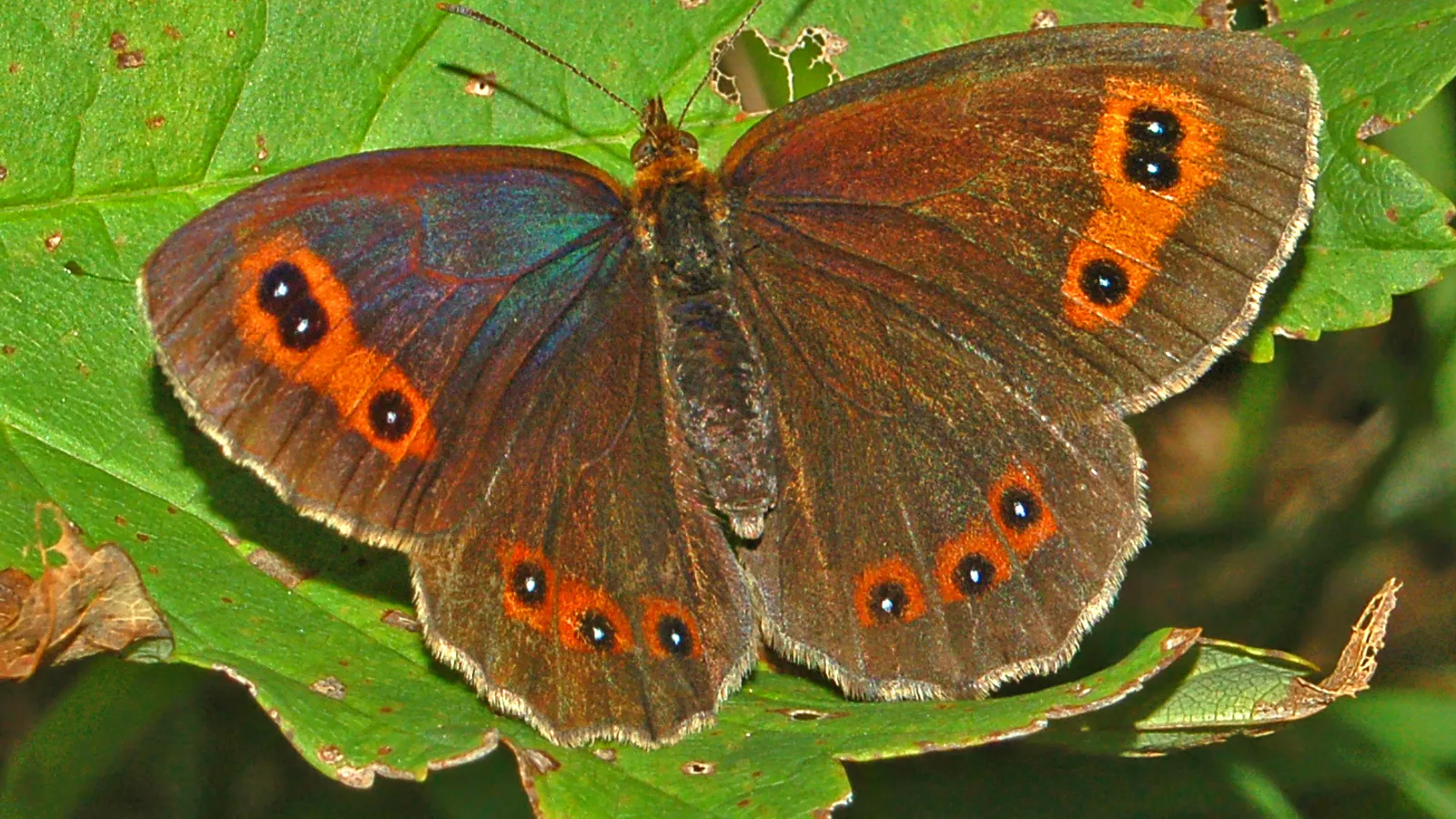

Scotch Argus (Erebia aethiops)
Contents
TL;DR
- established The Scotch Argus is found predominantly in Scotland, where it remains common and widespread, inhabiting damp, acid or neutral grassland up to 500m in mountainous and hilly terrain, as well as bog fringes, woodland clearings, and young plantations — a specific, documented Scottish stronghold this article states directly rather than treating the species as uniformly common across Britain.
- established The species has declined sharply at the southern edge of its British range: in England it is now reduced to just two isolated sites, down from a formerly wider southern presence — a specific, documented contraction this article states plainly rather than letting Scotland's relative abundance obscure the English picture.
- disputed Butterfly Conservation's own distribution data records a 20% decline between 1991 and 2019, supporting a Vulnerable GB Red List classification (2022), while separate UK Butterfly Monitoring Scheme abundance-transect data describes the species' population and range as broadly stable overall — this article states both findings directly rather than resolving them into a single trend, since distribution range and site-level abundance are measuring different things and the two data sources are not straightforwardly reconciled.
- established Male Scotch Argus butterflies show weather-dependent behaviour: in sunshine they fly continuously, weaving low through grass in search of a mate, while in poor weather they instead perch on grass clumps, flying out only to investigate passing brown butterflies — a specific, documented behavioural adaptation this article names directly rather than a vague reference to "weather sensitivity."
- established Despite its Vulnerable Red List status and Near Threatened European status, Butterfly Conservation itself rates the species as a low domestic conservation priority — a specific, documented prioritisation tension this article states directly, since a formally Vulnerable species being treated as lower priority reflects a genuine resourcing and triage judgement, not an oversight.
Key Facts
- Scientific name
- Erebia aethiops
- Category
- Invertebrates
- Scottish status
- Common and widespread
- English sites remaining
- 2
- Distribution change (1991–2019)
- -20% (Butterfly Conservation)
- GB Red List status (2022)
- Vulnerable
- European status
- Near Threatened
- Primary foodplant (Scotland)
- Purple Moor Grass
A Note on Claims and Evidence
Scottish and English distribution, habitat, and threat details are drawn from Butterfly Conservation's published species assessment, including its GB Red List classification. Population and range stability claims are drawn from UK Butterfly Monitoring Scheme abundance-transect data. This article treats the apparent tension between a documented 20% distribution decline and separately reported overall population/range stability as genuinely Disputed, since these draw on different measurement approaches (range mapping versus site-level abundance monitoring) that are not reconciled in the sources used here.
Timeline
The Scotch Argus establishes itself as a common, widespread species across Scotland's damp, acid grasslands and moorland fringes, with a more limited presence extending into northern England.
The species' southern English range contracts substantially, leaving it confined to just two isolated sites in northern England.
UK Butterfly Monitoring Scheme transect data begins tracking the species' abundance across monitored sites.
Butterfly Conservation's distribution data records a 20% decline in the species' recorded range over this period.
The species is classified Vulnerable on the GB Red List, reflecting this documented distribution decline, while separately holding Near Threatened status across its wider European range.
The Scotch Argus remains common and widespread within Scotland, with UK Butterfly Monitoring Scheme abundance data describing overall population and range as broadly stable, even as Butterfly Conservation treats the species as a lower domestic conservation priority despite its Vulnerable classification.
Details
A Scottish stronghold stated with its real habitat specificity
This article names the Scotch Argus's core Scottish range directly: damp, acid or neutral grassland up to 500m in mountainous and hilly terrain, alongside bog fringes, woodland clearings, and young plantations, with Purple Moor Grass as its primary Scottish foodplant. This article states this specific habitat profile because it clarifies precisely where and why the species remains common in Scotland even as its range contracts elsewhere in Britain.
An English contraction stated honestly, not softened by Scottish abundance
This article states plainly that the species' southern British range has contracted severely: England now holds just two isolated Scotch Argus sites. This article names this specific figure directly because allowing Scotland's relative abundance to stand as the species' overall British story would understate a genuine, substantial loss at its southern range margin.
A genuine tension between two measures of status, left unresolved
This article treats directly, rather than picking a side, a real discrepancy between two documented data sources. Butterfly Conservation's own distribution data shows a 20% decline between 1991 and 2019, underpinning the species' Vulnerable GB Red List classification; separately, UK Butterfly Monitoring Scheme abundance-transect data, tracking population levels at monitored sites since 1976, describes the species' population and range as broadly stable overall. This article states both findings because distribution range (how much area a species occupies) and site-level abundance (how many individuals are found where it persists) are different measurements that can genuinely diverge — a species can lose ground at its margins while remaining locally abundant at its core — and this article does not assert that either data source resolves the other.
A specific, documented weather-dependent behaviour
This article names the Scotch Argus's behavioural response to weather with real specificity rather than a vague reference to sensitivity: in sunshine, males fly continuously, weaving low through grass in search of a mate, while in poor weather they instead perch on grass clumps, flying out only to investigate passing brown butterflies, with females remaining largely inconspicuous and spending much of their time basking. This article states this specific behavioural pattern because it is a genuine, documented ecological adaptation, not an incidental detail.
A prioritisation judgement stated without softening its tension
This article names directly a genuine tension in how the species is currently treated: despite holding Vulnerable status on the GB Red List and Near Threatened status across Europe, Butterfly Conservation itself rates the Scotch Argus as a low domestic conservation priority. This article states this plainly because it reflects a real, documented triage judgement — likely reflecting the species' continued relative abundance within its Scottish stronghold — rather than an inconsistency this article should paper over or resolve on the organisation's behalf.
Did You Know?
- The Scotch Argus remains common and widespread across much of Scotland, even as it has become one of Britain's most range-restricted butterflies in England, with just two sites remaining there.
- Butterfly Conservation's own data shows a 20% distribution decline between 1991 and 2019, earning the species Vulnerable status on the 2022 GB Red List.
- Separately, UK Butterfly Monitoring Scheme abundance data describes the species' population and range as broadly stable overall — a genuine tension between two different ways of measuring status.
- Male Scotch Argus butterflies fly continuously in sunshine but switch to a perch-and-investigate strategy in poor weather.
- Despite its Vulnerable Red List status, Butterfly Conservation rates the species as a low domestic conservation priority.
- Purple Moor Grass is the species' primary foodplant in Scotland; English populations instead rely mainly on Blue Moor Grass.
- The species can be found up to 500m in Scottish mountainous and hilly terrain.
FAQ
1Is the Scotch Argus common in Scotland?
Yes — it remains common and widespread across much of Scotland's damp grassland and moorland habitats.
2Is it declining?
This depends on which measure is used — distribution data shows a 20% decline between 1991 and 2019 (Vulnerable Red List status), while separate abundance-transect data describes overall population and range as broadly stable.
3Where is it found in England?
Only at two isolated sites, following a substantial historical contraction of its southern British range.
4How does weather affect its behaviour?
Males fly continuously in sunshine but perch on grass clumps in poor weather, flying out only to investigate passing brown butterflies.
5Is it a conservation priority?
Formally it holds Vulnerable GB Red List status, but Butterfly Conservation itself treats it as a low domestic priority, reflecting its continued relative abundance within Scotland.
6What does it eat?
Purple Moor Grass is its main foodplant in Scotland; English populations rely mainly on Blue Moor Grass in drier limestone grassland.
7When can it be seen?
Sightings are recorded across monitored transects roughly between late summer months, with the species flying as an adult for a defined seasonal period.
8Why the difference between Scottish and English populations?
English populations occupy drier limestone grassland mosaics with scrub and woodland, distinct from the damp, acid grassland and moorland fringe habitat typical of its Scottish range.
Sources and Further Reading
Primary/Institutional
- Scotch Argus — Butterfly Conservation
- Scotch Argus (Erebia aethiops) — UK Butterfly Monitoring Scheme
Scholarly/Critical
- Scotland's Indicators — Terrestrial Insect Abundance: Butterflies — NatureScot
- Genetic population structure of the Scotch argus butterfly — Lancaster University
General
Caveats: Myths and Disputed Claims
- Clarification: This article does not resolve the apparent tension between a documented 20% distribution decline (1991–2019) and separately reported overall population/range stability; these reflect different measurement approaches that are not reconciled in the sources used here.
- Note: This article does not treat the species' Vulnerable Red List status and its low domestic conservation priority rating as contradictory; both are directly documented and reflect a genuine triage judgement given its continued relative Scottish abundance.
Card 041 · Wildlife