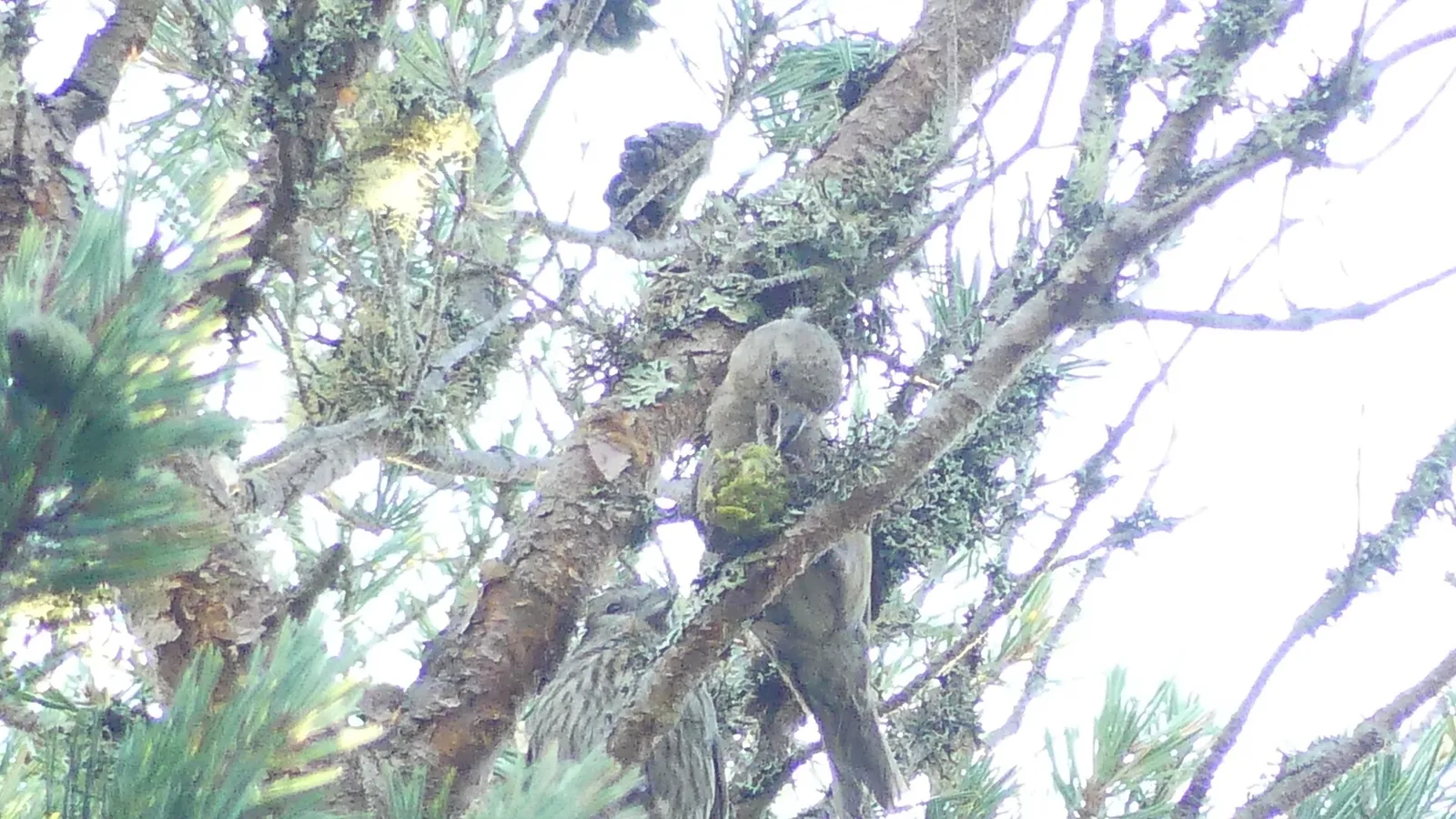

Scottish Crossbill (Loxia scotica)
Contents
TL;DR
- established The Scottish crossbill is widely described as the UK's only endemic bird species, found nowhere else in the world, with a breeding range restricted to coniferous forests in northeast Scotland — but this article states directly that this claim rests on a species classification that was genuinely disputed by scientists for decades, not an uncontroversial, long-settled fact.
- disputed Although the British Ornithologists' Union formally recognised the Scottish crossbill as a distinct species in 1980, many researchers, including RSPB scientists, continued to question whether the evidence actually supported separate species status, given its close genetic similarity to the common crossbill and parrot crossbill — a genuine, multi-decade scientific uncertainty this article states plainly rather than treating the species designation as having always been secure.
- established The three crossbill species found in Scottish conifer forests cannot be reliably told apart in the field using bill size alone, since small morphological differences adapted to different seed extraction needs overlap too much between species for consistent visual identification — a specific, documented identification difficulty this article names directly rather than suggesting Scottish crossbills are easily distinguished by sight.
- established The scientific case for the Scottish crossbill's distinct species status was substantially strengthened by sonographic analysis of its calls, which found a distinctive vocal "accent" indicating reproductive isolation from common crossbills despite genetic similarity and the physical opportunity for interbreeding — a specific, documented form of evidence this article credits directly as the basis for current scientific confidence in the species' distinctness.
- established The Scottish Ornithologists' Club's The Birds of Scotland (2007) records the turn in the debate: a 2001 DNA study found no genetic difference between the three crossbills, but captive breeding and studies of wild pairs then showed that bill size is inherited and that birds mostly pair with their own type. The account concludes that the three are best treated as separate species with a small amount of interbreeding.
- established Before the 2008 survey, every population figure was an informed guess: fewer than 100 pairs in the 1960s, about 320 pairs in the 1970s, and 300–1,300 pairs as late as 2007, all extrapolated from one study published in 1975.
- established Approximately 6,800 pairs are estimated to breed in the UK, based on a 2008 survey that itself relied on call-based identification — the same vocal evidence underpinning the species' taxonomic status — reflecting a population estimate genuinely dependent on the accuracy of that identification method.
Key Facts
- Scientific name
- Loxia scotica
- Category
- Birds
- Range
- Northern and north-eastern Scotland only; core in Strathspey, Deeside and Easter Ross
- Population estimate
- Approximately 6,800 pairs (2008 survey)
- Earlier estimates
- About 320 pairs (1970s); 300–1,300 pairs (2007, extrapolated)
- Type specimen
- Male collected in Easter Ross on 26 December 1870, now in National Museums Scotland
- Breeding
- February to June; clutch about 4 eggs; incubation 13–15 days; fledging 17–25 days
- UK conservation status
- Amber-listed
- Global (IUCN) status
- Least Concern
- Legal protection
- Schedule 1 licence required to disturb; EU Birds Directive Annex 1
- Species status basis
- Vocal/call differences indicating reproductive isolation
- First described
- 1904, by Ernst Hartert (as a crossbill form)
- Genus name
- Loxia, from Greek loxos, "crosswise"
Scottish Impact Index (SI Score)
- Scottish Significance
- 10/10
- Ecological Persistence
- 6/10
- Ecological Importance
- 8/10
- Biological Distinctiveness
- 10/10
- Conservation Significance
- 10/10
- Recognition
- 8/10
52/60
Ranked =15th of 42 in Wildlife
A Note on Claims and Evidence
The species' formal recognition date, population estimate, and conservation status are drawn from the British Trust for Ornithology and RSPB published records. The historical scientific dispute over the Scottish crossbill's species status, and the vocal/sonographic evidence that substantially resolved it, are drawn from RSPB research reporting. The taxonomic history, distribution, breeding biology and earlier population estimates are checked against the Scottish Ornithologists' Club's The Birds of Scotland (2007), whose Scottish crossbill account is by Ron Summers; its status listings and figures date from 2007 and are given as history. This article treats the species' distinct status as the current scientific position, supported by specific documented evidence, while stating honestly that this was a genuinely contested question for decades rather than always settled.
Timeline
Alexander Macdonald collects a male crossbill in Easter Ross, probably on the Balnagown estate. It later becomes the type specimen of the Scottish crossbill.
The German ornithologist Ernst Hartert describes the Scottish birds as Loxia curvirostra scotica, a subspecies of the common crossbill with a larger bill and longer wings. Some later writers treat it instead as a race of the parrot crossbill.
Three crossbill types — common, Scottish, and parrot crossbill — are recognised as occurring in Scottish conifer forests, each adapted with subtly different bill shapes suited to different conifer seed types, but with overlapping morphology that makes reliable field identification by bill size alone impossible.
Desmond Nethersole-Thompson's studies suggest fewer than 100 pairs in the 1960s, building to about 320 pairs and some 1,500 adults by the 1970s.
Alan Knox argues that the Scottish birds keep their intermediate bills despite repeated invasions of common crossbills, and so must be reproductively isolated.
The British Ornithologists' Union formally recognises the Scottish crossbill as a distinct species, Loxia scotica.
Parrot crossbills arrive in Scotland in some numbers, probably after an invasion, and some stay to breed.
Knox presents evidence of long-term overlap between common and Scottish crossbills without apparent interbreeding.
Call-based mapping from January to April finds Scottish crossbills in 94 woods in 83 10km squares, from Caithness to Fife and Upper Forth.
A study of neutral DNA finds no genetic differences among Scottish, common and parrot crossbills, reopening the debate.
Ron Summers and colleagues describe the Scottish crossbill's characteristic calls; sonographic analysis becomes the basis for identifying it in the field.
Captive breeding shows that bill depth is inherited, and studies of wild pairs show that birds mostly mate with their own type. The Birds of Scotland gives 300–1,300 pairs and lists the species as data deficient on the IUCN Red List.
The RSPB and Scottish Natural Heritage carry out the first full survey of distribution and numbers.
A dedicated national survey, using call-based identification to distinguish Scottish crossbills from similar species, estimates the UK breeding population at approximately 6,800 pairs.
The Scottish crossbill remains UK Amber-listed and legally protected, restricted to coniferous forests across northeast Scotland, including areas such as Nairn, Moray, Deeside, Sutherland, Easter Ross, and eastern Inverness-shire.
Details
A famous claim built on a genuinely contested foundation
This article states directly, rather than repeating uncritically, that the widely made claim that the Scottish crossbill is the UK's only endemic bird species rests on a species classification that was genuinely disputed by scientists for decades. Although the British Ornithologists' Union formally recognised it as a distinct species in 1980, researchers — including scientists at the RSPB itself — continued to question whether the underlying evidence actually supported separate species status, given its close genetic similarity to the common and parrot crossbills found in the same forests. This article names this history because presenting the "only endemic bird" claim without this context would understate how recently and substantially the scientific basis for it was actually secured.
established The Birds of Scotland (2007) sets out how the argument developed. The 1980 decision rested on Alan Knox's work showing that the Scottish birds kept their intermediate bills despite repeated invasions of common crossbills. That view held until 2001, when Stuart Piertney and colleagues compared microsatellite and mitochondrial DNA and found no genetic difference among the three crossbills. Summers lists four possible explanations: bill size is shaped by diet during growth; the three are morphs of one species; they are separate species that occasionally interbreed; or they split too recently for neutral DNA to diverge. Captive-bred Scottish crossbills grew bills like their parents', ruling out the first. In the wild, birds paired with mates of similar bill size and with the same flight and excitement calls, ruling out the second. A few pairs were mismatched: 2 of 46 for bill size and 5 of 93 for excitement calls. That small amount of interbreeding rules out the fourth. The account concludes that the three crossbills largely act as separate species, and that if the calls are treated as diagnostic all three are best treated as different species.
An identification difficulty stated honestly
This article states plainly that the three crossbill types found in Scottish conifer forests cannot be reliably distinguished in the field using bill size alone: although each type has bill proportions subtly adapted to different conifer seed extraction needs, the morphological differences overlap too much between individuals for consistent visual identification by ornithologists. This article names this difficulty directly because it clarifies why the species debate persisted as long as it did, and why alternative forms of evidence were ultimately needed to resolve it.
The specific evidence that shifted scientific confidence
This article credits the evidence that substantially strengthened the case for the Scottish crossbill's distinct status with its real specificity: sonographic analysis of recorded calls identified a distinctive vocal "accent" unique to Scottish crossbills, interpreted as evidence of reproductive isolation from common crossbills despite close genetic similarity and the physical opportunity for interbreeding in shared habitat. This article names this vocal evidence directly because it represents the specific, documented basis for current scientific confidence in the species' distinctness, rather than treating the 1980 formal classification alone as having settled the matter.
A population figure resting on the same contested evidence base
This article states that the current population estimate of approximately 6,800 pairs, from a 2008 national survey, itself relied on call-based identification — the same vocal evidence underpinning the species' taxonomic status. This article names this connection directly because it means the accuracy of the population estimate is tied to the accuracy and consistency of call-based field identification, not an independent confirmation of the species' numbers using unrelated methodology.
established The earlier figures were much weaker. The Birds of Scotland (2007) notes there had never been a comprehensive census. Desmond Nethersole-Thompson thought there were fewer than 100 pairs in the 1960s and about 320 pairs, or 1,500 adults, in the 1970s. Later estimates of 300–400 pairs (1986) and 300–1,300 pairs were extrapolated from his 1975 figures. Earlier atlases were also unreliable, since they relied on observers telling the crossbills apart by bill size; Knox himself called the 1988–91 atlas map "inaccurate". The 2008 figure of about 6,800 pairs is therefore not evidence of a twentyfold increase. It is mostly the result of counting properly for the first time, although numbers probably did rise during the 20th century with the planting of conifers.
Where it lives, and what it eats
established Call-based mapping in 1995–2003 confirmed the importance of Strathspey, Deeside and Easter Ross, and extended the known range north to Caithness, south to Upper Forth and Fife, west to Glen Garry and east to Stonehaven. The Fife record was of three birds at Devilla Forest on 10 December 2001. Earlier records from the west coast were called into question, because only common crossbills were found there. The same work showed that Scottish crossbills feed in plantations of lodgepole pine, Sitka spruce and larch as well as in Scots pine and native pinewood, though in late winter and early spring crossbills in Scots pine are more likely to be Scottish than common. Numbers in Strathspey rise and fall with the Scots pine cone crop, and colour-ringed birds have moved up to 23km between Deeside woods and between Deeside and Strathspey. At Abernethy, crossbills preferred larger, widely spaced trees with smaller cones, while red squirrels fed on larger cones in denser stands.
shared The usual view is that the Scottish crossbill evolved in isolation in Scotland's pine forests after the last glaciation, as a specialist on Scots pine, the only large-coned conifer in post-glacial Britain. Its wide use of non-native conifers led Mick Marquiss and Robert Rae to suggest in 2002 that it may instead have evolved much more recently, in response to large-scale planting. The Birds of Scotland reports both ideas without choosing.
Nesting in the snow
established Breeding runs from February to June, unusually early for a British songbird. Nests are built by the female near the ends of side branches or near the tops of Scots pines, often in open stands of 50–60 trees per hectare, perhaps to reduce raids by red squirrels and pine martens. Nest building takes 9–12 days. Nethersole-Thompson found that full clutches in Strathspey were laid between mid-March and late April, averaging 3.8 eggs. Incubation takes 13–15 days, while the male feeds the sitting female 7–10 times a day. The young leave the nest after 17–25 days, and their bills are not yet crossed: they depend on their parents for several weeks until the bill crosses and they can extract seeds. An incubating female can sit out heavy snow, leaving the nest from beneath its covering of snow. In 41 nests studied, 152 eggs produced 71 fledged young, with losses to bad weather and to red squirrels.
Three crossbills in one forest
established Mark Cocker and Richard Mabey, in Birds Britannica (2005), call crossbills "the Galapagos finches of Europe", because different populations have evolved different bill sizes to suit different cones. All three British types occur in Scotland. The common crossbill is the generalist; the spread of lodgepole pine and Sitka spruce plantations carried it across south-west Scotland, Wales and Ireland. The parrot crossbill, with the heaviest bill, can open even closed pine cones; it is mainly an irruptive visitor from Scandinavia and Russia, but a small breeding colony had settled in Abernethy Forest on the slopes of the Cairngorms by 2005. The Scottish crossbill sits between them, with a bill just a little smaller than the parrot crossbill's. It feeds largely on pine seed and stays year-round in and around the remaining fragments of Old Caledonian forest, though later call-based work showed it uses plantations of other conifers too. The book calls its exact status "one of the most intractable ornithological puzzles in Britain".
shared The book dates its upgrade from race to species, and so to "Britain's only endemic species", to 1997. The British Ornithologists' Union first treated it as a separate species in 1980, as this article states, so the 1997 date in Birds Britannica appears to be a slip or to refer to a later review. Either way, the title of Britain's endemic bird passed to the crossbill from the red grouse, which had long held it before being reclassified as a race of the circumpolar willow grouse.
Crossed bills and the Cross
traditional The scientific name Loxia, from the Greek loxos, "crosswise", was coined by the 16th-century Swiss naturalist Conrad Gesner. In central Europe the crossed bill and the male's red plumage drew the crossbill into Crucifixion legend: it was said to have twisted its bill trying to pull the nails from Christ's hands and feet, staining its feathers with his blood. The authors note that little of this religious lore took root in Britain. The crossed mandibles are in fact a tool for prising apart cone scales, and a feeding flock is often betrayed by falling seed-wings and the thump of dropped cones.
Did You Know?
- The Scottish crossbill is widely described as the UK's only endemic bird species, found nowhere else in the world.
- Scientists debated its status as a genuinely distinct species for decades after its formal 1980 recognition, due to close genetic similarity to the common crossbill.
- The three Scottish crossbill types cannot be reliably told apart by bill size alone in the field.
- A distinctive vocal "accent," detected through sonographic call analysis, provided key evidence of the species' reproductive isolation.
- Approximately 6,800 pairs are estimated to breed in the UK, based on a 2008 call-identification survey.
- The species is restricted to coniferous forests in northeast Scotland, including Deeside, Moray, and Easter Ross.
- It remains UK Amber-listed and requires a Schedule 1 licence to legally disturb.
- Before the Scottish crossbill, the red grouse was celebrated as Britain's only endemic bird, until it was reclassified as a race of the willow grouse.
- The type specimen, a male collected in Easter Ross in 1870, is held by National Museums Scotland.
- Young Scottish crossbills leave the nest with uncrossed bills.
- Before 2008 nobody had properly counted the species; estimates ranged from 300 to 1,300 pairs.
- Medieval legend said crossbills twisted their bills trying to pull the nails from the Cross.
- Parrot crossbills, normally visitors from Scandinavia and Russia, have bred in Abernethy Forest in the Cairngorms.
FAQ
1Is the Scottish crossbill really the UK's only endemic bird?
This is the widely stated claim, and it reflects the current scientific position — but that position rests on a species classification that was genuinely disputed by scientists for decades.
2Why was its species status disputed?
Because of its close genetic similarity to the common crossbill and parrot crossbill, and because bill size — the main physical distinguishing feature — overlaps too much between the species for reliable field identification.
3What evidence resolved the debate?
Sonographic analysis of bird calls found a distinctive vocal "accent" unique to Scottish crossbills, interpreted as evidence of reproductive isolation from common crossbills.
4How many Scottish crossbills are there?
Approximately 6,800 pairs, based on a 2008 survey using call-based identification.
5Can you tell a Scottish crossbill apart from other crossbills by looking at it?
Not reliably — bill size differences are too subtle and overlapping for consistent visual field identification.
6Where in Scotland is it found?
Coniferous forests in northern and north-eastern Scotland, including Strathspey, Nairn, Moray, Deeside, Sutherland, Easter Ross, and eastern Inverness-shire. Call-based mapping in 1995–2003 also found birds as far as Caithness, Fife and Upper Forth.
7Is the species protected?
Yes — it is UK Amber-listed, requires a Schedule 1 licence to disturb, and is listed under the EU Birds Directive Annex 1.
8Is it considered globally threatened?
No — the IUCN lists it as Least Concern globally, reflecting its restricted but currently stable range within Scotland.
9When was the Scottish crossbill first described?
In 1904, by the German ornithologist Ernst Hartert, who named it Loxia scotica; for decades it was treated as a race of another crossbill.
10What does it eat?
Mainly the seeds of Scots pine, which it extracts from cones with its crossed bill. Its bill is intermediate in size between those of the common and parrot crossbills.
11Did DNA prove the Scottish crossbill is not a species?
No. A 2001 study found no difference in neutral DNA, which reopened the question. Later work showed that bill size is inherited and that birds mostly mate with their own type and call type, and The Birds of Scotland (2007) concluded that the three crossbills are best treated as separate species with a little interbreeding.
12Does the Scottish crossbill only use native pinewood?
No. Call-based surveys found it in plantations of lodgepole pine, Sitka spruce and larch as well as Scots pine, though it is most likely to be the crossbill in Scots pine in late winter and spring.
13Has the population grown from a few hundred pairs to nearly 7,000?
Probably not on that scale. Earlier estimates were extrapolations from one 1970s study, and the 2008 survey was the first full count.
14Why does Birds Britannica give 1997 for its recognition?
The book says the bird was upgraded to a species in 1997, but the British Ornithologists' Union first recognised it as a species in 1980. The 1980 date is the one generally cited.
Sources and Further Reading
Primary/Institutional
- Forrester, R. W., Andrews, I. J. et al. (eds), The Birds of Scotland (Scottish Ornithologists' Club, 2007), account by Ron Summers.
- Scottish Crossbill — British Trust for Ornithology
- Scottish Crossbill Bird Facts — RSPB
Scholarly/Critical
- Mark Cocker and Richard Mabey, Birds Britannica (Chatto & Windus, 2005)
- Scottish crossbill — Wikipedia
- RSPB uncrosses the Scottish Crossbill debate — BirdGuides
- Crossbills: the species puzzle — BirdGuides
General
Caveats: Myths and Disputed Claims
- Clarification: This article does not present the Scottish crossbill's status as the UK's only endemic bird species as an uncontroversial, long-settled fact; it reflects a classification that was genuinely scientifically disputed for decades and substantially rests on vocal rather than purely physical evidence.
- Note: This article does not suggest Scottish crossbills can be reliably identified by sight alone; field identification of the three Scottish crossbill types remains genuinely difficult using bill size.
- Do not compare the 2008 figure of about 6,800 pairs with earlier estimates of a few hundred pairs as if it showed a real increase; the earlier figures were not based on a census.
- Do not say the Scottish crossbill lives only in native Caledonian pinewood; it also uses plantations of non-native conifers.
- Do not say DNA has disproved the species; neutral DNA shows no difference, but inheritance, mating and call studies support separate species.
- Do not date the Scottish crossbill's recognition as a species to 1997, as Birds Britannica (2005) does; the British Ornithologists' Union first recognised it in 1980.
Card 022 · Wildlife