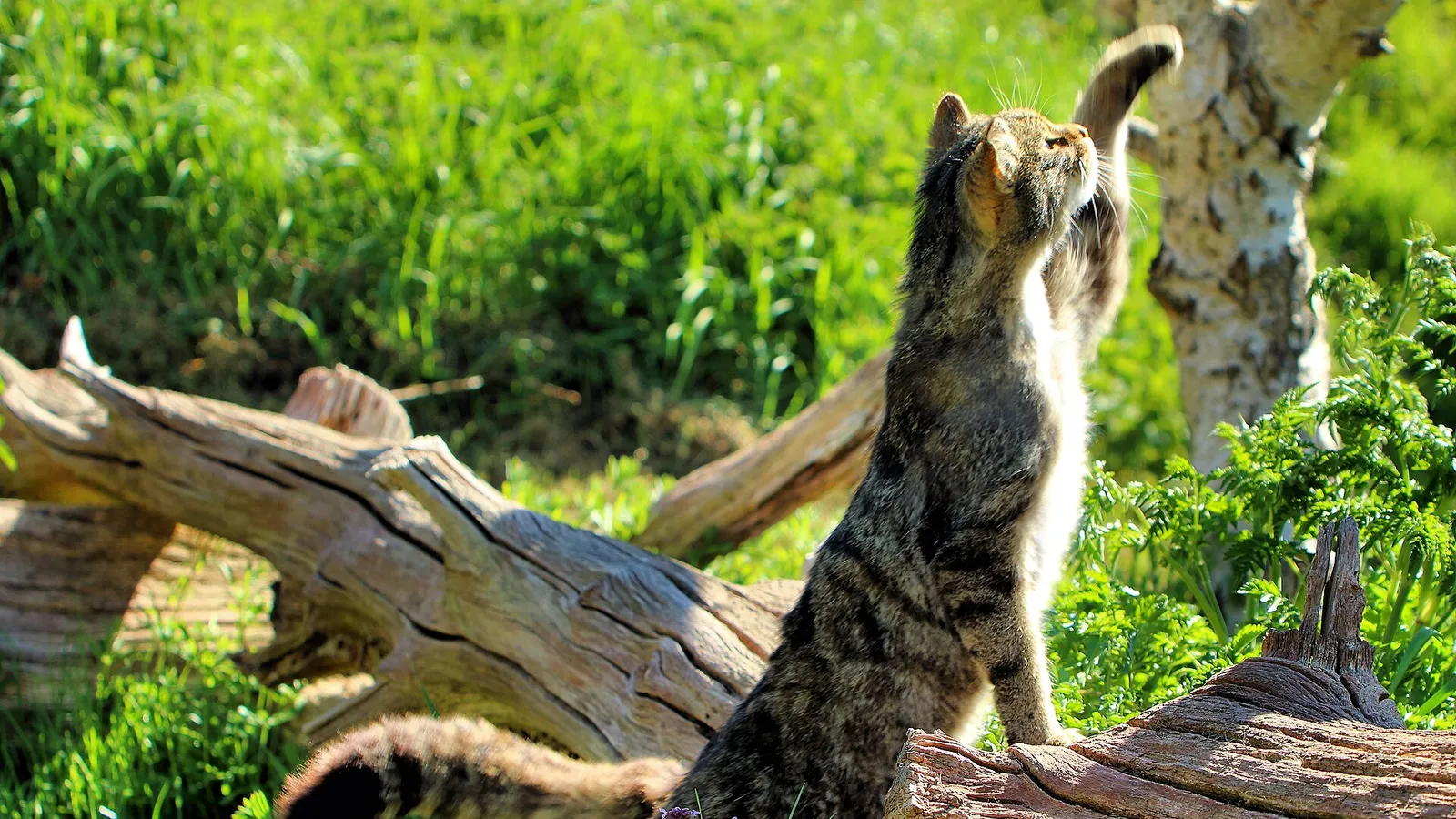
_(18989583708).jpg)
Scottish Wildcat (Felis silvestris silvestris)
Contents
TL;DR
- established Camera-trapping surveys conducted between 2010 and 2013 found hybridisation with domestic cats so pervasive that scientists concluded the genetically "pure" Scottish wildcat population is functionally extinct in the wild — a stark, documented scientific finding this article states directly rather than softening with hopeful language.
- established Hybridisation with domestic cats is the primary, documented existential threat to the species, compounded by disease transmission from unvaccinated domestic cats, including feline calicivirus, coronavirus, immunodeficiency virus, and leukaemia virus — genuine, specific pathogen risks, not a generalised vulnerability.
- disputed The Scottish wildcat's taxonomic status as a distinct subspecies is itself genuinely contested: since 2017, the Cat Classification Task Force has treated the traditional "Scottish wildcat" designation as a synonym for the wider European wildcat subspecies, arguing it is doubtful the population is sufficiently distinct to warrant separate subspecific status — a scientific debate this article presents honestly rather than asserting a settled classification.
- established In response to this crisis, the Saving Wildcats project released 19 captive-bred wildcats into the Cairngorms National Park in June 2023 — a genuine, landmark conservation intervention, with the project expanding to 35 released cats and documented wild-born kittens by August 2025.
- established This article treats the Saving Wildcats programme's early breeding successes honestly alongside its genuine, acknowledged risks: one released cat has already died of peritonitis, and project leaders themselves have stated that "further releases and many more years of conservation action will be required" — this is presented as a long, uncertain conservation effort, not a solved problem.
- established The wildcat once lived across Britain. It was gone from southern England probably by the 16th century and from northern England, Wales and southern Scotland by about 1880, and reached its low point around 1914 in the north-west Highlands (Handbook of British Mammals, 1991).
Key Facts
- Scientific name
- Felis silvestris silvestris (formerly classified as F. s. grampia)
- Category
- Mammals
- Conservation status
- Critically Endangered (UK)
- Primary threat
- Hybridisation with domestic cats
- Wild population status
- Functionally extinct (pervasive hybridisation)
- Key programme
- Saving Wildcats, breeding-for-release, launched 2023
- Release site
- Cairngorms National Park
Scottish Impact Index (SI Score)
- Scottish Significance
- 10/10
- Ecological Persistence
- 5/10
- Ecological Importance
- 8/10
- Biological Distinctiveness
- 10/10
- Conservation Significance
- 10/10
- Recognition
- 10/10
53/60
Ranked =10th of 42 in Wildlife
A Note on Claims and Evidence
The hybridisation crisis, the "functionally extinct in the wild" conclusion, and the details of the Saving Wildcats release programme are drawn from NatureScot, Scottish Wildcat Action, and the Saving Wildcats project's own published research and monitoring data, and are treated as Established. The taxonomic subspecies question is treated as genuinely Disputed among scientific classification authorities, reflecting an active, unresolved scientific debate rather than settled fact in either direction.
Timeline
Wildcat bones at the Mesolithic site at Thatcham, Berkshire, show the species was part of Britain's post-glacial fauna.
The wildcat probably disappears from southern England after centuries of hunting and habitat loss.
The wildcat is lost from northern England and Wales, and is last heard of in southern Scotland at about the same time.
G. S. Miller describes Scottish wildcats as a separate species, Felis grampia, from a type specimen taken at Invermoriston, Inverness-shire.
The population reaches its minimum, confined to Inverness-shire, Ross-shire, Sutherland and parts of Argyll.
Freedom from persecution during the First World War, lower persecution afterwards and new conifer planting allow the wildcat to spread back into northern and eastern Scotland.
A Nature Conservancy Council survey led by Nick Easterbee finds no evidence of wildcats south of the Central Belt.
The wildcat is added to Schedule 5 of the Wildlife and Countryside Act 1981, giving it full legal protection.
The Handbook of British Mammals (3rd edn) warns that the species' survival in Britain "may be threatened by hybridisation with domestic cats".
The species becomes a UK Biodiversity Action Plan priority species.
Camera-trapping surveys document the scale of hybridisation with domestic cats across the wildcat's range.
The Cat Classification Task Force reclassifies the Scottish wildcat as a synonym of the wider European wildcat subspecies, disputing its distinct subspecific status.
Scottish Wildcat Action is established to coordinate conservation efforts across five priority landscape areas.
The wild population is formally assessed as "no longer viable and at the verge of extinction."
The Saving Wildcats project releases 19 captive-bred wildcats into the Cairngorms National Park, using a soft-release method with GPS-radio collar monitoring.
13 kittens are born at the project's breeding centre, intended for future release.
At least two released cats produce kittens in the wild.
The total number of released cats reaches 35, with seven wild births recorded in 2024 and five more in 2025.
Scotland's Wildcat Strategy 2025–2045 is published, setting out the long-term conservation plan.
Details
A decline driven by habitat loss and persecution, then compounded by a quieter threat
This article presents the wildcat's historical decline plainly: habitat loss and direct human persecution contracted its range from across Great Britain to a remnant population confined to northwestern Scotland by 1915. A post-war reduction in gamekeeping and increased forestry allowed some range recovery — but this article states directly that this recovery did not solve the species' underlying crisis, since a far less visible threat was by then already well underway.
Hybridisation: the threat that cannot be hunted or fenced out
This article names hybridisation with domestic cats as the Scottish wildcat's primary, documented existential threat, rather than treating it as one factor among several equally weighted causes. Camera-trapping surveys conducted between 2010 and 2013 found hybridisation rates so pervasive across the species' range that researchers concluded genetically pure wildcats are now functionally extinct in the wild, even though living animals bearing the species' outward characteristics remain. This article states this finding with its full weight, since softening it into vague language about "declining purity" would understate a genuinely stark scientific conclusion. Disease transmission from unvaccinated domestic and feral cats compounds the threat directly, introducing specific pathogens — feline calicivirus, coronavirus, immunodeficiency virus, and leukaemia virus — into a population already genetically compromised.
A genuinely contested scientific classification
This article addresses directly, rather than glossing over, an active scientific dispute about the Scottish wildcat's very taxonomic identity. Since 2017, the Cat Classification Task Force has treated the traditional "Scottish wildcat" subspecies designation as a synonym for the broader European wildcat subspecies, arguing it is doubtful the Scottish population is genetically distinct enough to merit separate subspecific status. This article presents this reclassification honestly as a genuine, unresolved scientific debate rather than asserting that either the traditional or the revised classification is simply correct — a case where "accuracy over patriotism" cuts specifically against treating a culturally beloved "distinct Scottish species" framing as settled zoological fact.
A landmark, genuinely risky conservation intervention
The Saving Wildcats project's 2023 release of 19 captive-bred wildcats into the Cairngorms National Park represents a direct, documented institutional response to the hybridisation crisis, using carefully screened breeding stock certified to carry less than 5% domestic cat ancestry and a soft-release method allowing acclimatisation before full release. This article presents the programme's subsequent growth — 35 cats released and a dozen wild-born kittens recorded by August 2025 — as genuine, measurable early success, while stating with equal directness the risks and setbacks project leaders themselves have acknowledged: one released cat has already died of peritonitis, and declining winter prey availability remains a significant ongoing survival risk. Project scientists have themselves stated that "further releases and many more years of conservation action will be required," language this article preserves directly rather than implying the crisis has been resolved.
What the 1991 Handbook recorded
Who wrote it. The wildcat account in G. B. Corbet and S. Harris (eds), The Handbook of British Mammals (3rd edn, 1991) was written by N. Easterbee of the Nature Conservancy Council, who had led the 1983–87 national survey. It is a useful snapshot of what was known a generation before the Saving Wildcats releases.
How to tell a wildcat. Easterbee describes an animal like a large, robust tabby with seven to 11 dark body stripes and no substantial white or ginger patches. The tail is thick, blunt and club-like, with three to five distinct rings and a black tip. Domestic and hybrid cats, he notes, "invariably have more tapering tails". The skull separates the two: wildcats have a cranial volume above 35 cm³, domestic cats below 32 cm³. Gut length differs too. The account says hybrids can look very like wildcats, but could usually be identified with some confidence from skull measurements. Melanistic (black) cats had been reported in Scotland, but whether they were wildcats, domestic cats or hybrids was unresolved.
A doubted subspecies, even then. The Handbook kept F. s. grampia for Scottish cats on the basis of their darker colour and bolder markings, but added that there was considerable variation in Scotland and that a distinction from mainland European wildcats "may not be justified". The 2017 taxonomic revision described above therefore continued a doubt that was already in print in 1991.
Range in 1991. Wildcats were confined to central and northern Scotland and were absent from all Scottish islands. The national survey found no evidence of them south of the Central Belt, which the account suggests was acting as a physical barrier to any southward spread. Reports further south were thought to be feral cats.
Habitat and home range. Wildcats used upland forest, woodland, moorland and hill ground, usually below 500 m, though they were recorded above 800 m. Bad winter weather pushed them off open hill into woodland and scrub. Young forestry plantations mattered a great deal, giving cover and plenty of voles and rabbits. In north-east Scotland, radio-tracked adults held ranges averaging about 175 hectares, with density estimated at one cat per 3.3 km², probably much lower in the poorer ground of the north-west.
Breeding. Females usually come into season in March in Scotland and have a single litter, normally in May, though kittens can be born as late as August. Gestation is about 66 days. Litters in the wild averaged 3.7 kittens, ranging from two to six. The family breaks up at about five months and the young then roam in search of a range of their own.
Food. Diet followed availability: rabbits and hares, small rodents and birds, with amphibians, reptiles and insects taken too. Carrion such as dead sheep and deer was rarely eaten.
Deaths in 1991. Persecution was named as the major cause of death in many parts of Scotland, with starvation in hard winters and road accidents also recorded. Golden eagles and foxes might take kittens. Easterbee noted that gamekeeping interests still regarded the wildcat as vermin and that many were killed every year, despite the cats eating large numbers of rabbits and voles that damage forestry and farming. His conservation advice was to safeguard every local and isolated population to protect the species' genetic integrity.
Before hybridisation: the persecution era
Smout draws on the work of Richard Lovegrove to argue that most of the damage to Scotland's predators was done before about 1840, with Victorian gamekeepers after about 1870 mainly engaged in "mopping-up operations". The Dumfries fur market, held every February, shows the scale in the south-west: in 1831, 600 polecat and 226 otter skins were offered for sale; by 1869 there were none of either. In the Highlands the evidence comes from estate vermin returns. Smout accepts that bounty records can be inflated, but notes that owners usually demanded heads or wings as proof, so a figure such as 143 pine martens and 295 eagles killed at Langwell and Sandside in Sutherland between 1819 and 1826 should not be dismissed. As a result some predators became extinct in Scotland (polecat, red kite, osprey, sea eagle) and others were greatly reduced (wild cat, pine marten, otter, hen harrier, golden eagle). Only well into the second half of the twentieth century was there even limited recovery.
Did You Know?
- Camera-trap surveys from 2010–2013 led scientists to conclude the genetically pure Scottish wildcat is functionally extinct in the wild.
- The Scottish wildcat's status as a distinct subspecies is itself scientifically disputed, not settled fact.
- The 2023 Saving Wildcats release used GPS-radio collars to monitor 19 captive-bred cats released into the Cairngorms.
- Candidate breeding cats must test below 5% domestic cat ancestry to qualify for the release programme.
- By August 2025, released wildcats had produced a dozen wild-born kittens across two breeding seasons.
- Disease from unvaccinated domestic cats, not just interbreeding, poses a direct additional threat to the species.
- Participating institutions in the breeding programme include Chester Zoo, Highland Wildlife Park, and the British Wildlife Centre.
- Project leaders have stated openly that recovery will require many more years of sustained conservation effort.
- A true wildcat's tail is blunt and club-like with three to five black rings; domestic and hybrid cats usually have a tapering tail.
- The type specimen of Felis grampia, the name once used for Scottish wildcats, came from Invermoriston on Loch Ness.
- The Scottish Gaelic name is cat-fiadhaich, "wild cat".
- In 1991 the wildcat was absent from every Scottish island, and the Central Belt appeared to block any spread south.
FAQ
1Is the Scottish wildcat extinct?
Not entirely, but scientists consider the genetically pure population functionally extinct in the wild due to pervasive hybridisation with domestic cats.
2What is the biggest threat to the species?
Hybridisation with domestic cats, compounded by disease transmission from unvaccinated cats.
3Is the Scottish wildcat really a distinct subspecies?
This is genuinely disputed — since 2017, some scientific authorities classify it as the same subspecies as the wider European wildcat.
4What is the Saving Wildcats project?
A breeding-for-release conservation programme that released its first captive-bred wildcats into the Cairngorms National Park in June 2023.
5Has the release programme worked so far?
Early signs are genuinely positive — wild-born kittens have been recorded — but project leaders describe it as a long-term effort requiring many more years, not a solved problem.
6What qualifies a cat for the breeding programme?
Candidates must pass genetic and morphological tests showing less than 5% domestic cat ancestry.
7Where can released wildcats be found?
Primarily in and around the Cairngorms National Park and Cairngorms Connect landscape.
8What is the species' legal protection status?
Critically Endangered in the UK, protected under the Wildlife and Countryside Act 1981, and a UK Biodiversity Action Plan priority species since 2007.
9How can you tell a wildcat from a tabby?
Look at the tail first: thick, blunt and club-like, with three to five distinct black rings and a black tip. Wildcats also have seven to 11 dark body stripes and no white paws or ginger patches. Hybrids blur these features, which is why genetic testing is now used.
10Where did wildcats live when the species was at its lowest?
Around 1914 they were confined to Inverness-shire, Ross-shire, Sutherland and parts of Argyll, according to The Handbook of British Mammals (1991). They had gone from southern England probably in the 16th century and from northern England and Wales by about 1880.
11What did wildcats die of in the late twentieth century?
The 1991 Handbook named persecution as the major cause of death in many areas, followed by winter starvation and road accidents.
12Do wildcats live on any Scottish islands?
No. The 1991 Handbook recorded them as absent from all Scottish islands, and none of the modern release work involves islands.
Sources and Further Reading
Primary/Institutional
- Scottish wildcat — Wikipedia
- Conservation of the wildcat (Felis silvestris) in Scotland — NatureScot
- Scotland's Wildcat Strategy 2025–2045 — NatureScot
Scholarly/Critical
- T. C. Smout, "Land and Sea: The Environment", in T. M. Devine and Jenny Wormald (eds), The Oxford Handbook of Modern Scottish History (Oxford University Press, 2012)
- G. B. Corbet and S. Harris (eds), The Handbook of British Mammals, 3rd edn (Blackwell Scientific, 1991), account by N. Easterbee
- Critically endangered wildcats now call the Cairngorms National Park home — Saving Wildcats
- House Cats Are Overpowering Scottish Wildcats In The Battle For Survival — Forbes
General
Caveats: Myths and Disputed Claims
- Correction: The Scottish wildcat should not be presented as a straightforwardly thriving, recovered native species; the genetically pure population is considered functionally extinct in the wild, and the Saving Wildcats release programme remains an early-stage, long-term effort rather than a completed recovery.
- Clarification: This article does not assert that the Scottish wildcat definitively is or is not a distinct subspecies; this remains a genuinely contested scientific classification question.
- Do not treat the 1991 density figure (one cat per 3.3 km² in north-east Scotland) as a current estimate; it predates the modern genetic work and many of the cats counted then would now be classed as hybrids.
- Do not assume the "functionally extinct" finding came out of nowhere; the 1991 Handbook already flagged hybridisation as the main threat to the species' survival.
- Note: This article does not catalogue every historical conservation intervention for the species (such as the earlier Scottish Wildcat Action programme from 2018); it focuses on the best-documented current efforts and the central hybridisation crisis.
Card 003 · Wildlife