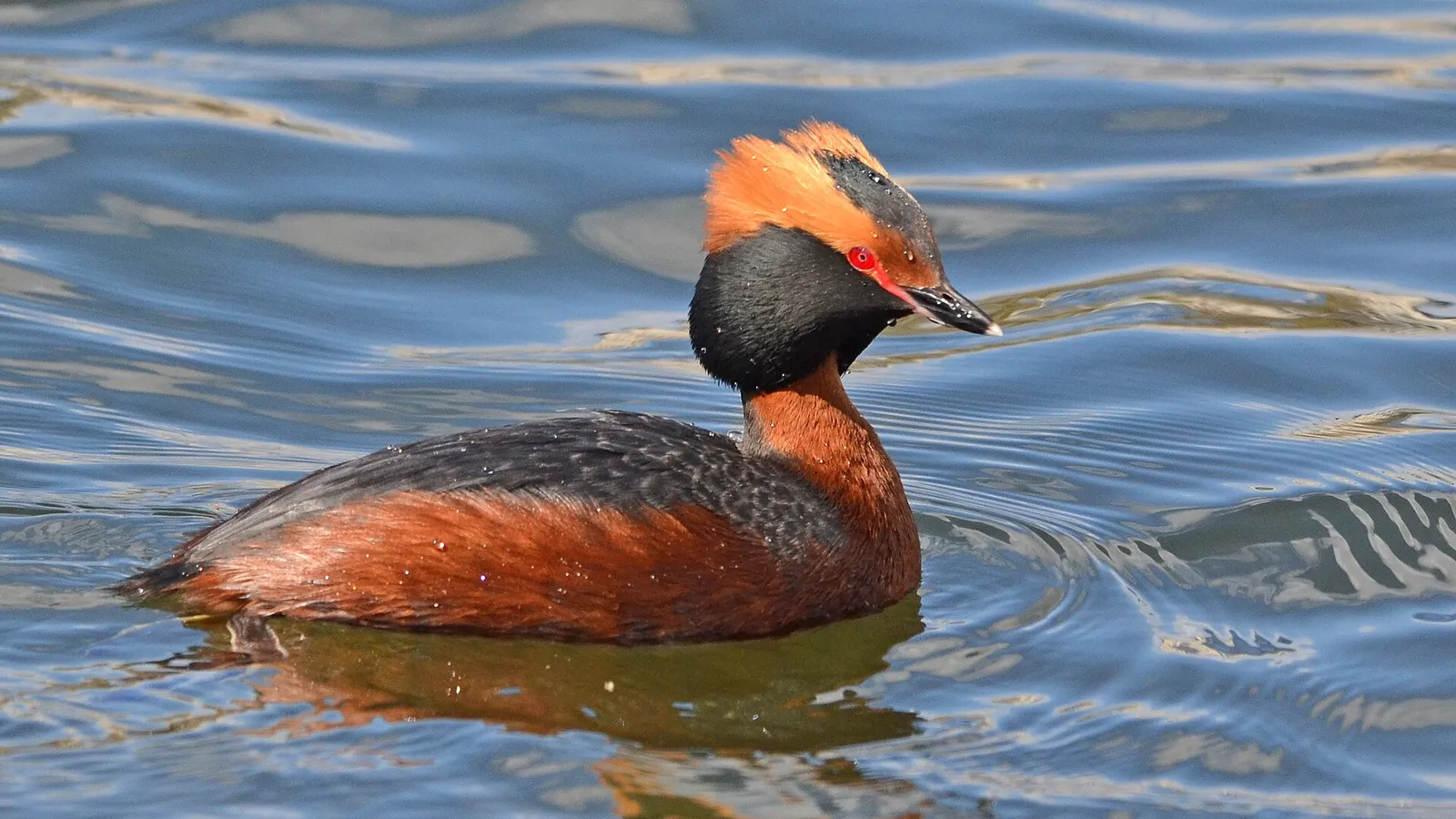

Slavonian Grebe (Podiceps auritus)
Contents
TL;DR
- established Slavonian grebes colonised Scottish lochs in the early 1900s, with monitoring (dated by the Rare Breeding Birds Panel to the 1950s, and by The Birds of Scotland to systematic counts from 1971) producing what researchers describe as the longest-running and most complete census of any British breeding bird — a specific, documented scientific record this article states directly rather than a vague claim of long-term interest.
- established The Scottish breeding population peaked at 80 pairs in 1980 before declining to just 20 pairs by 2021, with the UK population reaching its lowest point since 1971 and only seven chicks fledging in 2022 from those 20 pairs — a severe, specific, and recent collapse this article states at its full documented scale.
- disputed Successful breeding has been recorded at 66 different Scottish lochs over the monitoring period, a flexibility in site selection that researchers themselves point to as evidence that breeding-habitat availability is not the limiting factor behind the decline — instead, researchers have found that Slavonian grebe productivity on Scottish lochs is low, and that immigration of birds from Iceland appears necessary to maintain the Scottish population at all, meaning the decline's underlying cause may lie substantially outside Scotland's own breeding lochs — this article states this finding directly rather than assuming the decline simply reflects local habitat loss or disturbance.
- established At Loch Ruthven near Inverness, one of the species' key remaining Scottish sites, watersports activities including canoeing, paddleboarding, and swimming have been identified by RSPB Scotland as an increasing disturbance threat to breeding success, with just three breeding pairs nesting there in 2024 — a specific, documented local pressure this article states directly, distinct from the wider population-level question of Icelandic immigration.
- established Intentionally disturbing breeding Slavonian grebes is already illegal under the Wildlife and Countryside (Scotland) Act 1981, and Highland Council has separately consulted on advisory guidance to discourage watersports at Loch Ruthven's breeding end during the March-to-August season — a specific, documented policy response this article names directly.
Key Facts
- Scientific name
- Podiceps auritus
- Category
- Birds
- Peak Scottish population (1980)
- 80 pairs
- Scottish population (2021)
- 20 pairs
- Chicks fledged UK-wide (2022)
- 7 (from 20 pairs)
- Lochs with recorded successful breeding
- 66
- Loch Ruthven breeding pairs (2024)
- 3
- First confirmed Scottish breeding
- 1909, Loch Laide, Inverness-shire
- Scottish pairs, 1971–2004 (SOC, 2007)
- 49 (1971); 60–80 (late 1970s to 1993); 31 (2000); 52 (2004)
- Scottish winter mean, 1990s
- 339 birds (maximum 499)
- Gaelic name
- Gobhachan-mara
- Legal protection
- Wildlife and Countryside (Scotland) Act 1981
Scottish Impact Index (SI Score)
- Scottish Significance
- 8/10
- Ecological Persistence
- 5/10
- Ecological Importance
- 6/10
- Biological Distinctiveness
- 9/10
- Conservation Significance
- 10/10
- Recognition
- 7/10
45/60
Ranked #39 of 42 in Wildlife
A Note on Claims and Evidence
Population history, the 66-loch breeding flexibility finding, and the low-productivity/Icelandic-immigration hypothesis are drawn from the Rare Breeding Birds Panel's published 60-year monitoring summary. Loch Ruthven-specific disturbance details, the 2024 pair count, and the Highland Council consultation are drawn from contemporaneous reporting on RSPB Scotland's management of the site. Early records, the 1909 first breeding, the counts from 1971 to 2004 and the breeding and winter details come from Ron Summers's account in The Birds of Scotland (2007); these are dated history and do not replace the more recent RBBP figures.
Timeline
The species is first noted in Scotland, at a loch near Penicuik and at Luss, in the (Old) Statistical Account.
Mostly a winter visitor, seen in moderate numbers on the east coast, especially the Firth of Forth.
A male is shot on Loch Laide, Inverness-shire; this was later misreported as the first nesting.
Breeding is first confirmed at Loch Laide, where the collector Major William Stirling takes eggs; three survive in Inverness Museum and Art Gallery.
One to four pairs breed in Sutherland.
The species breeds in Caithness, with a peak of 21 birds on Loch Olginey in 1968.
Breeding begins in Moray and Nairn. The Rare Breeding Birds Panel dates the start of monitoring to this period; The Birds of Scotland dates systematic counts from 1971.
Annual counts record 49 pairs; Strathspey is colonised the same year.
The population holds at 60–80 pairs.
An oil spill at the Sullom Voe terminal kills 8–16% of the 50–100 Slavonian grebes wintering in Shetland.
The Scottish breeding population reaches its documented peak of 80 pairs.
Many adults fail to return after a late-winter seabird wreck, and a long decline begins.
The population falls to 31 pairs, then recovers to 52 pairs by 2004.
Successful breeding is recorded across 66 different Scottish lochs over the monitoring period, demonstrating flexibility in site selection.
Birds Britannica (2005) describes a Highland population of 40–70 pairs, already in decline, and a wintering population of about 400 birds around British coasts.
The Scottish population has declined to 20 pairs.
Only seven chicks fledge UK-wide from these 20 pairs, with the UK population reaching its lowest point since 1971.
RSPB Scotland employs rangers at Loch Ruthven to monitor bird activity and disturbance incidents, responding to increasing watersports-related pressure at the site.
Only three breeding pairs nest at Loch Ruthven, one of the species' key remaining Scottish sites.
Highland Council consults on advisory guidance to discourage watersports use at Loch Ruthven's breeding end from March through August, alongside the pre-existing illegality of intentional disturbance under the Wildlife and Countryside (Scotland) Act 1981.
Details
A scientific record stated with its real documented standing
This article names the Slavonian grebe monitoring programme's achievement directly: beginning in the 1950s and sustained for over 60 years, it represents the longest-running and most complete census of any British breeding bird.
shared When counting began. The Rare Breeding Birds Panel dates monitoring to the 1950s. The Birds of Scotland (2007) states that the breeding population has been counted since 1971, with all lochs in the main range surveyed every three years until 1992. The difference may lie between earlier site watching and the start of systematic national counts. This article states this distinction because it reflects a genuinely exceptional scientific record, built through decades of dedicated professional and volunteer effort, underpinning the reliability of the population figures this article reports.
A Highland breeder, a coastal winter visitor
established Mark Cocker and Richard Mabey, in Birds Britannica (2005), give the species only a short entry, but it fixes two useful points. They date the first proved breeding in the Scottish Highlands to 1910; The Birds of Scotland (2007) corrects this to 1909 (see below). For most of the century since, a tiny population "has held its own" there. At the time of writing they put it at 40–70 pairs, with a recent decline already noted. Most people in Britain know the bird not as a Highland breeder but as a winter visitor: about 400 birds then wintered in sheltered coastal waters. Birders know it simply as the "Slav". The book records no older Scottish vernacular name, which fits a bird that only arrived as a breeder in the twentieth century. Its Gaelic name is Gobhachan-mara.
The Scottish record, from The Birds of Scotland
established First records and first breeding. The Scottish Ornithologists' Club's The Birds of Scotland (2007), in an account by Ron Summers, traces the first Scottish mention to 1796, near Penicuik and at Luss, in the (Old) Statistical Account. Through the nineteenth century it was mostly a winter visitor to the east coast. Summers dates the first confirmed breeding to 1909 at Loch Laide, Inverness-shire, citing McGhie (1994). A report of nesting there in 1908 rested on a male shot on the loch that June. In 1909 one or two pairs were present and a private collector, Major William Stirling, took the eggs; three are now in Inverness Museum and Art Gallery. Earlier claims from Gairloch in the 1880s were thought to refer to little grebes.
established Where it has bred. Inverness-shire has always held most of the population, but pairs have nested elsewhere. The species bred in Sutherland from 1929 to the early 1960s and in Caithness from 1932 to 1975. It has nested in Moray and Nairn since the 1950s, colonised Strathspey from 1971, and bred briefly at Loch of Lowes in Perthshire between 1973 and 1983. Most lochs hold a single territorial pair. Loch Ruthven has long been the main site, with 9 to 27 pairs and regularly 40–50% of the Scottish total. Summers notes that 104 lochs had been used since 1971 and young reared on 55, so breeding habitat as a whole did not appear to be limiting, a point that matches the later RBBP finding. Even so, only 15 lochs were used in 2003, the lowest on record.
established Breeding cycle. Birds return in early April but usually lay only in early June, which Summers links to the slow spring growth of bottle sedge, the main plant used for nests. Pairs nesting in reeds or trailing willow branches lay earlier. The mean clutch is 3.9 eggs, and repeat clutches follow failures. Wave damage, flooding and predators, including crows, gulls, coots, otters and stoats, destroy many nests. Between 1971 and 2004 the average was 0.58 young per pair, from a low of 0.2 in 1976 to a high of 1.06 in 2000. After breeding, many adults gather to moult at Lochs Ruthven and Ashie before moving to the coast.
established Numbers before the recent collapse. Counts rose from 49 pairs in 1971 to 60–80 by the late 1970s and held there until 1994, when many adults failed to return. Summers notes that the decline coincided with a long spell of easterly winds in late winter that killed many coastal fish-eating seabirds, and suggests the grebes may have been part of that wreck. Numbers reached a low of 31 pairs in 2000 before rising to 52 in 2004. The later fall to 20 pairs by 2021 therefore followed a partial recovery.
established Winter and migration. In the 1990s a mean of 339 birds wintered in Scotland, with a maximum of 499. That is more than the local breeding population, so birds from elsewhere must be present. Scapa Flow, the Loch of Harray, the Moray Firth and the Firth of Forth are the main haunts, and since the 1990s up to 61 have wintered off Ardmore Point on the Clyde. Museum measurements show that birds from Iceland, Scotland and north Norway have longer, broader bills than those from further east. A Scottish breeder recovered in the Mediterranean off Italy was therefore a surprise, since that sea is part of the small-billed birds' winter range.
A collapse stated at its full recent severity
This article presents the species' Scottish decline with its real figures rather than softening the scale of loss: from a peak of 80 pairs in 1980 to just 20 pairs by 2021, with only seven chicks fledging UK-wide in 2022 and the UK population reaching its lowest point since 1971. This article states these specific numbers directly because they represent a severe, well-documented, and recent collapse, not a slow historical fade.
A genuinely counterintuitive finding about where the problem lies
This article treats directly, rather than assuming the more obvious explanation, a real and documented research finding: successful breeding has occurred at 66 different Scottish lochs, a flexibility researchers themselves cite as evidence that breeding-habitat availability is not the limiting factor. Instead, breeding productivity on Scottish lochs is low, and immigration of birds from Iceland appears necessary simply to maintain the existing Scottish population. This article states this finding plainly because it means the decline's underlying driver may lie substantially outside Scotland's own lochs, in wintering conditions, migration, or the health of the wider northeast Atlantic population, rather than being explained by local habitat loss alone — a genuinely more complex picture than a simple habitat-loss narrative would suggest.
A specific, local pressure at a key remaining site
This article names the disturbance threat at Loch Ruthven with real specificity rather than a vague reference to "recreational pressure": watersports activities including canoeing, paddleboarding, and swimming, identified directly by RSPB Scotland as threatening breeding success, with just three pairs nesting at the site in 2024. This article states this local pressure separately from the wider Icelandic-immigration finding because the two represent genuinely different scales and types of threat — one local and manageable through site-specific measures, the other a population-level question not resolved by protecting any single loch alone.
A protection already in force, with further measures proposed
This article states plainly that intentionally disturbing breeding Slavonian grebes is already illegal under the Wildlife and Countryside (Scotland) Act 1981, with Highland Council separately consulting on advisory, non-statutory guidance to discourage watersports at Loch Ruthven's breeding end during the breeding season. This article names both the existing legal protection and the additional advisory proposal because they represent genuinely different levels of intervention, not a single unified measure.
Did You Know?
- Slavonian grebe monitoring in Scotland, begun in the 1950s, is the longest-running and most complete census of any British breeding bird.
- The Scottish population peaked at 80 pairs in 1980 but had fallen to just 20 pairs by 2021.
- Only seven chicks fledged UK-wide in 2022, with the UK population at its lowest since 1971.
- Successful breeding has been recorded at 66 different Scottish lochs, suggesting habitat availability isn't the main limiting factor.
- Researchers believe immigration of birds from Iceland may be necessary just to maintain the existing Scottish population.
- Just three breeding pairs nested at Loch Ruthven, a key Scottish site, in 2024.
- Disturbing breeding Slavonian grebes is already illegal under the Wildlife and Countryside (Scotland) Act 1981.
- Breeding in Scotland was first confirmed in 1909, at Loch Laide in Inverness-shire, making the Slavonian grebe a twentieth-century addition to Britain's breeding birds.
- Three eggs from that first nest, taken by a collector, are now in Inverness Museum and Art Gallery.
- In winter several hundred Slavonian grebes can be found around British coasts, far more than the Highland breeding population.
- Nesting is often delayed until June, waiting for bottle sedge to grow tall enough to hide the nest.
- Loch Ruthven has regularly held 40–50% of all the Slavonian grebes breeding in Britain.
FAQ
1Is Scotland the only place in the UK where Slavonian grebes breed?
Yes — Scotland holds the UK's entire breeding population.
2How severe has the decline been?
Very — from a peak of 80 pairs in 1980 to just 20 pairs by 2021, with the UK population at its lowest since 1971 by 2022.
3Is habitat loss the main cause of the decline?
Not according to current research — successful breeding has occurred at 66 different Scottish lochs, suggesting habitat availability isn't the limiting factor; low breeding productivity and dependence on immigration from Iceland appear more significant.
4What's happening at Loch Ruthven specifically?
Watersports disturbance, including canoeing, paddleboarding, and swimming, has been identified as threatening breeding success there, with just three pairs nesting in 2024.
5Is it illegal to disturb breeding Slavonian grebes?
Yes — intentional disturbance during breeding season is already illegal under the Wildlife and Countryside (Scotland) Act 1981.
6What additional measures have been proposed?
Highland Council has consulted on advisory guidance to discourage watersports at Loch Ruthven's breeding end from March through August.
7Why might Iceland matter to the Scottish population?
Research suggests Scottish breeding productivity alone is too low to sustain the population, meaning immigration from the wider northeast Atlantic population, including Iceland, may be necessary.
8When did Slavonian grebes first breed in Scotland?
Breeding was first confirmed in 1909 at Loch Laide, Inverness-shire. Some older books give 1908 or 1910; The Birds of Scotland (2007) explains that the 1908 report rested only on a male shot on the loch.
9Where else in Scotland have they bred?
Besides Inverness-shire, in Sutherland, Caithness, Moray and Nairn, Strathspey, North-east Scotland and, briefly, at Loch of Lowes in Perthshire.
10Where do the wintering birds come from?
Bill measurements suggest birds from Iceland, Scotland and north Norway, but the origin of Scotland's winter visitors is not certain.
11Can I see Slavonian grebes outside the breeding season?
Yes. In winter the species is found mainly in sheltered coastal waters around Britain; Birds Britannica (2005) put the wintering total at about 400 birds.
12How long has this population been monitored?
Since the 1950s — over 60 years, making it the longest-running census of any British breeding bird.
Sources and Further Reading
Primary/Institutional
- Forrester, R. W., Andrews, I. J. et al. (eds), The Birds of Scotland (Scottish Ornithologists' Club, 2007), account by Ron Summers
- 60 years of Slavonian Grebe monitoring — Rare Breeding Birds Panel
- Slavonian Grebe — British Trust for Ornithology
Scholarly/Critical
- Mark Cocker and Richard Mabey, Birds Britannica (Chatto & Windus, 2005)
- Breeding persistence of Slavonian Grebe at long-term monitoring sites: predictors of a steep decline at the northern European range limit — Journal of Ornithology (Springer)
- Possible watersports ban at loch to help Slavonian Grebe — BirdGuides
General
Caveats: Myths and Disputed Claims
- Clarification: This article does not attribute the Slavonian grebe's Scottish decline primarily to breeding habitat loss; researchers have specifically found breeding occurring successfully across 66 different lochs, pointing instead to low productivity and dependence on Icelandic immigration as more significant factors.
- Do not give 1908 or 1910 as the date of first Scottish breeding; it was confirmed at Loch Laide in 1909.
- Do not present the 1994–2000 fall and the later fall to 2021 as one unbroken decline; numbers recovered to 52 pairs in 2004 in between.
- Note: This article treats Loch Ruthven's watersports disturbance problem as a distinct, local issue from the wider population-level immigration question; addressing one does not resolve the other.
Card 050 · Wildlife