Discoveries · No. 49 of 50 · Earth Science
Oceanography & the Challenger Expedition
A Royal Navy corvette stripped of its guns, four years and 68,890 nautical miles at sea, and a Canadian-born Scot who turned the haul into the classification system that still describes the ocean floor today.
Sir John Murray · 1841–1914Voyage · 1872–1876Reading time · 34 minUpdated 16 August 2026
TL;DR
- HMS Challenger's 1872–1876 voyage was a large Royal Navy and Royal Society expedition, scientifically led by Charles Wyville Thomson, that founded modern oceanography by disproving the belief that the deep sea was lifeless and cataloguing over 4,700 new species.
- Sir John Murray, born in Canada to Scottish parents but raised and trained in Edinburgh, sailed as one of several naturalists aboard — appointed almost at the last moment — and went on to make his own genuinely original contribution: the first systematic classification of deep-sea sediments, including manganese nodules and red clay.
- After Wyville Thomson's death in 1882, Murray took over and completed the monumental 50-volume Challenger Report, writing seven volumes largely himself — an editorial and scientific achievement that is the real basis of his lasting reputation as a founder of oceanography.
Scottish Impact Index (SI Score)
- Global Impact
- 8/10
- Longevity
- 9/10
- Economic / Material Impact
- 5/10
- Originality / Distinctiveness
- 9/10
- Legacy (Built Upon)
- 8/10
- Recognition
- 4/10
Key Findings
- HMS Challenger's voyage (1872–1876) was the true birth of oceanography, disproving the mainstream belief — Edward Forbes's 'azoic hypothesis' — that the deep sea below about 300 fathoms was lifeless.
- The expedition was scientifically led by Charles Wyville Thomson, with Murray one of several naturalists aboard, appointed almost at the last moment.
- Murray's sediment classification — naming radiolarian, diatom and pteropod oozes and red clay — is his most systematic and enduring personal scientific achievement.
- He identified, with Alphonse Renard, manganese nodules, now called polymetallic nodules and central to a global deep-sea-mining controversy.
- After Wyville Thomson's death in 1882, Murray completed the greatest editorial project in the history of science: the 50-volume Challenger Report.
- He was a driving force behind renewed Antarctic exploration and a pioneer of Scottish freshwater science, surveying 562 lochs.
Quick Facts
- Discovery
- Modern oceanography — the systematic scientific survey and classification of the world's deep ocean floor, biology and circulation
- Year
- 1872–1876 — voyage of HMS Challenger; findings published 1880–1895
- Key figure
- Sir John Murray (1841–1914)
- Murray's role on the voyage
- Junior naturalist, appointed almost at the last moment; later director of the Challenger Office and editor-in-chief of the Report
- Claim status
- SHARED — a large multi-scientist Royal Navy / Royal Society expedition led scientifically by Charles Wyville Thomson; Murray was one of several naturalists aboard who rose to prominence afterwards by completing and largely authoring the published results
- Chief scientist
- Charles Wyville Thomson (1830–1882), born at Bonsyde, Linlithgow, West Lothian, Scotland
- Ship
- HMS Challenger, a Pearl-class Royal Navy corvette converted into the world's first purpose-built oceanographic research vessel
- Voyage distance
- 68,890 nautical miles (about 127,580 km), Portsmouth to Spithead, December 1872 to May 1876
- Species catalogued
- More than 4,700 new species of marine life — more than all previous ocean science combined
- Murray's genuine originality
- First systematic classification of deep-sea sediments; description of manganese nodules; among the first to note the Mid-Atlantic Ridge and ocean trenches
- Editorial achievement
- Completed the 50-volume, roughly 30,000-page Report on the Scientific Results of the Voyage of H.M.S. Challenger (1880–1895) after Wyville Thomson's death in 1882
- Born
- 3 March 1841, Cobourg, Canada West (now Ontario) — to Scottish parents; raised, educated and made a scientist in Scotland from age 17
- Died
- 16 March 1914, near Kirkliston, West Lothian, in a car accident, aged 73
- Modern legacy
- Challenger Deep (Mariana Trench), Murray Ridge, John Murray Laboratories, and the founding of Britain's first marine laboratory at Granton
Before Challenger
It is a common assumption that by the mid-nineteenth century the oceans had already given up most of their secrets. This article is glad to correct that assumption, because the truth is more interesting: as late as the 1860s, the deep sea was, for scientific purposes, the last great unexplored environment on Earth, and the dominant scientific opinion about it was flatly wrong.
That wrong opinion belonged to Edward Forbes (1815–1854), a brilliant Manx naturalist who dredged the Aegean Sea aboard HMS Beacon in the 1840s. Forbes observed, correctly, that marine life thinned out as he sampled deeper water, and in his 1843 "Report on the Mollusca and Radiata of the Aegean Sea" to the British Association he extrapolated a striking conclusion: that below roughly 300 fathoms (about 1,800 feet, or 550 metres), the ocean was essentially azoic — devoid of life altogether. It was a reasonable inference from his data, but it was wrong on two counts. His dredge allowed smaller and more delicate creatures to escape before it reached the surface, and the Aegean itself is an unusually barren sea by global standards, poor in oxygen at depth and low in the nutrients that support abundant deep life elsewhere. Nonetheless, the "azoic hypothesis" became scientific orthodoxy for nearly a quarter of a century, shaping how an entire generation of naturalists thought about the sea.
A second major figure, the American naval officer Matthew Fontaine Maury (1806–1873), contributed something different but equally important: the first attempt at a comprehensive oceanographic textbook, The Physical Geography of the Sea (1855). Maury compiled wind and current data from thousands of ships' logs, produced the first rough profile of the Atlantic seabed, and even inferred the existence of a mid-ocean rise as early as 1850. But Maury's focus was overwhelmingly the sea surface — winds, currents and the practical business of navigation — rather than the biology and geology of the deep. The abyss itself remained, in every meaningful sense, terra incognita.
The first real cracks in Forbes's orthodoxy appeared in the late 1860s. Charles Wyville Thomson and William Benjamin Carpenter persuaded the Royal Society and the Admiralty to lend them Royal Navy vessels — HMS Lightning in 1868 and HMS Porcupine in 1869–1870 — for a series of deep-sea dredging expeditions off Scotland, the Faroe Islands and beyond. The results were decisive: they hauled up abundant, diverse animal life from depths of 2,345 fathoms, far beyond Forbes's supposed azoic boundary, and they found that deep-sea temperatures varied systematically with depth and location, hinting at large-scale ocean circulation patterns that no one had yet mapped. Forbes's azoic zone was, scientifically speaking, dead. What the Lightning and Porcupine surveys had not done, however, was mount a truly global, systematic, long-duration survey of the world's oceans. That ambition required a much larger undertaking — and it is where the Challenger expedition begins.
A Canadian-Born Scot
John Murray was born on 3 March 1841 at Cobourg, on the north shore of Lake Ontario, in what was then Canada West. He was the second son of Robert Murray, an accountant, and Elizabeth Macfarlane, both of Scottish stock, who had crossed the Atlantic to Canada around 1834. Young John attended school in London, Ontario, and then Cobourg College — a thoroughly Canadian upbringing, and this article does not pretend otherwise.
Honesty matters here: Murray was Canadian by birth, not Scottish. But, like Peter Higgs (born in Newcastle) or Charlotte Auerbach (born in Germany) elsewhere in this collection, his life and scientific work belong to Scotland. In 1858, aged 17, he crossed the Atlantic again to live with his grandfather, John Macfarlane, in Stirling, completing his schooling at Stirling High School. He would later recall that his first sight of the tide rising and falling along the Scottish coast marked the beginning of his lifelong fascination with the sea.
In 1864 Murray enrolled at the University of Edinburgh, initially intending to study medicine, but he proved a restless and unconventional student and never completed a degree. In 1868 he shipped out as surgeon aboard the Arctic whaler Jan Mayen, spending seven months around Spitsbergen and Jan Mayen Island, collecting marine specimens and recording ice, currents and weather — his first real taste of ocean science. Back in Edinburgh, he studied geology under Sir Archibald Geikie and natural philosophy (physics) under Peter Guthrie Tait, even helping to design an electrical deep-sea thermometer. It was Tait who introduced Murray to Charles Wyville Thomson — the connection that would define the rest of his life.
The Voyage, 1872–1876
HMS Challenger was a steam-assisted Royal Navy Pearl-class corvette, launched in 1858 at Woolwich. For her new scientific mission, she was stripped of all but two of her guns and fitted out with laboratories, a dedicated dredging platform, microscopes, sounding lines and thousands of specimen jars — becoming, in effect, the world's first purpose-built oceanographic research vessel.
She departed Portsmouth on 21 December 1872 and returned to Spithead on 24 May 1876. In Wyville Thomson's own account of the voyage, "Between our departure from Sheerness on December 7th, 1872, and our arrival at Spithead on May 24th, 1876, we traversed a distance of 68,890 nautical miles" — about 127,580 kilometres — the ship having first moved from Sheerness dockyard before the scientific voyage proper began from Portsmouth. Scientific supervision was in the hands of Charles Wyville Thomson, a Scot born at Bonsyde, Linlithgow, West Lothian, on 5 March 1830 (not, as is sometimes mistakenly stated, in Derbyshire). His scientific team included Henry Nottidge Moseley, the German naturalist Rudolf von Willemoes-Suhm — who died during the voyage — the chemist John Young Buchanan, and Murray himself. Herbert Swire served as a navigating officer and John James Wild as secretary and artist. Command of the ship passed from Captain George Nares to Captain Frank Tourle Thomson during the voyage.
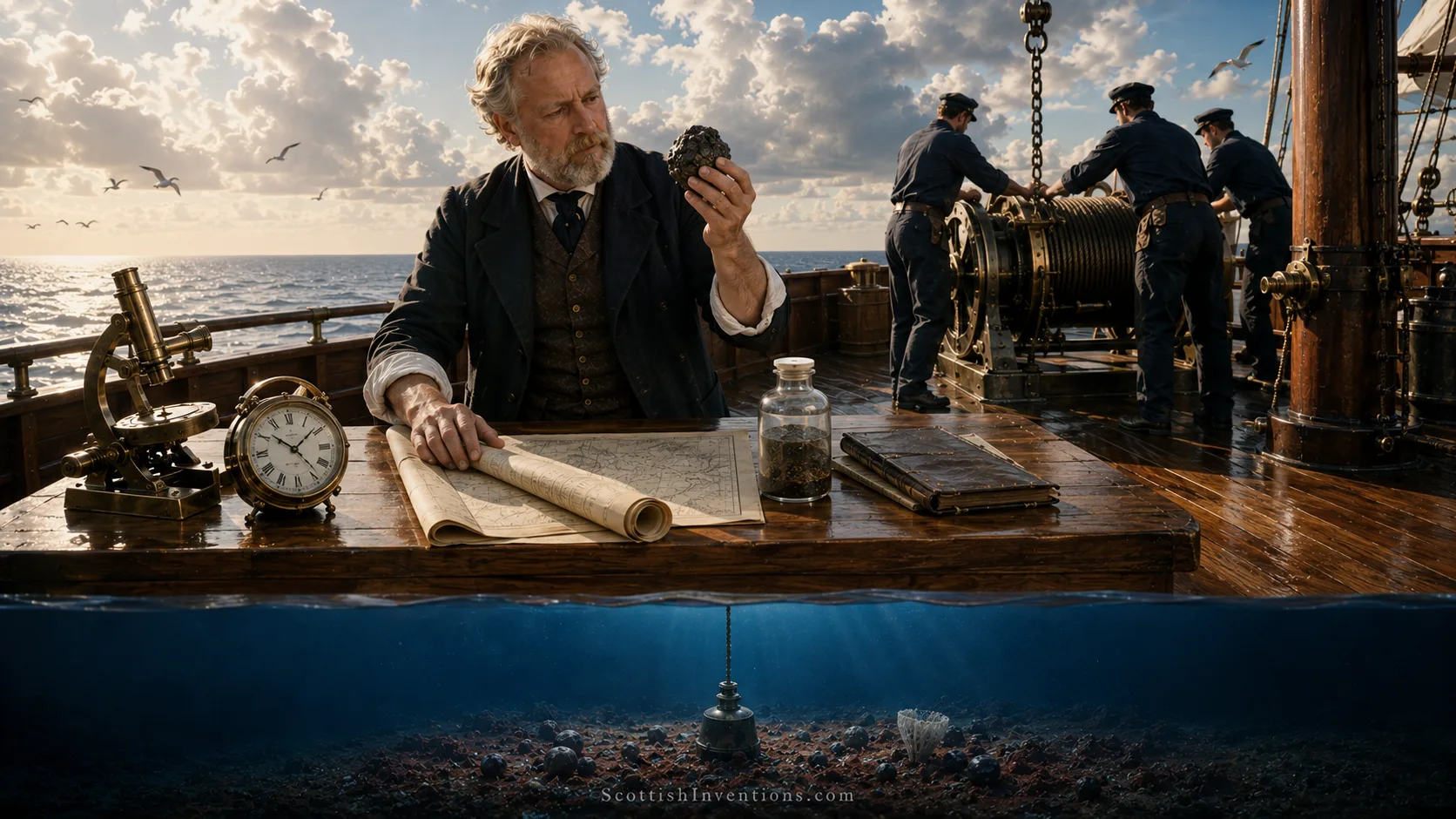
Murray was appointed one of the naturalists almost at the last moment, and it would be misleading to present him as the expedition's intellectual architect — that role belonged to Wyville Thomson. What Murray did demonstrate, from the outset, was an unusual capacity for systematic work: aboard ship he took charge of the biological specimens and the sea-floor sediments, helped improve the scientific instruments, and proved himself the most methodical and driven member of the scientific staff.
The working method was painstaking and repetitive by design. Roughly every 200 miles, the ship would heave to for the better part of a day to work a "station": lowering weighted lines to sound the depth and retrieve sediment samples from the bottom; dredging and trawling for living creatures; measuring water temperature at a series of depths; and drawing water samples for chemical analysis. According to a standard summary of the voyage, the expedition gathered observations from 362 stations, made 492 deep soundings and 133 dredgings, alongside 151 open-water trawls. The scientific haul was staggering: the voyage is credited with cataloguing more than 4,700 new species of marine animals — more ocean life described in four years than in all of previous science combined.
Sediment Classification
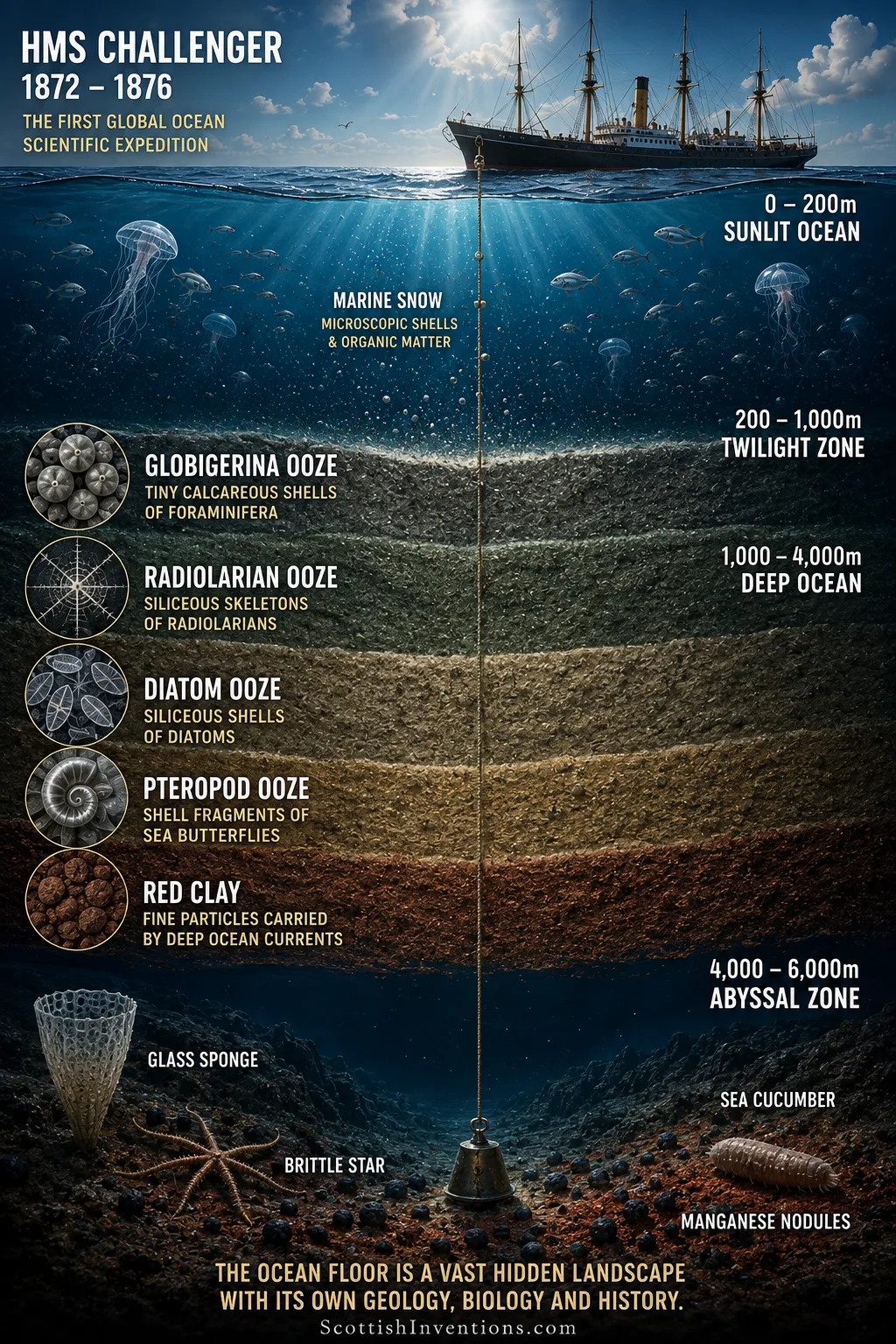
This is where Murray's personal scientific originality shines most clearly, independent of any question about the expedition's shared leadership. Working with the Belgian geologist Alphonse Renard, Murray produced the Report on Deep-Sea Deposits (1891), the first systematic account of the geology of the entire ocean floor. Before this work, only "globigerina ooze" — a calcareous sediment named earlier — had been formally described. Murray, by carefully towing fine-mesh nets to catch living surface plankton, proved that these calcareous oozes originated from the shells of surface-dwelling organisms that rained down onto the seabed after death. He went on to name the other great sediment types: radiolarian ooze, diatom ooze and pteropod ooze, each dominated by the remains of a different group of tiny organisms.
Most significant of all was his identification and naming of "red clay" — the fine, brownish sediment that blankets the deepest and most remote parts of the ocean floor, far from any continental source of sediment. It is essential to be precise about how this material forms, because it is easily misunderstood: red clay is not simply material "carried in" and deposited by deep ocean currents, as a casual glance at a simplified seabed diagram might suggest. Murray's own explanation, which still stands more than a century later, was that this sediment forms because the calcium-carbonate shells of surface-dwelling plankton dissolve before they can reach the ocean floor at these extreme depths — a boundary that oceanographers now call the carbonate compensation depth. Below it, seawater is corrosive enough that calcareous material simply does not survive the long fall to the bottom. What accumulates instead, extremely slowly, is chiefly fine volcanic ash and dust that has blown out over the ocean from land and from volcanic activity, along with a small quantity of extraterrestrial dust — not calcareous material swept along by currents, but the residue left behind once the calcareous fraction has quietly dissolved away. Murray was effectively the first to identify what is now formally termed the carbonate compensation depth, decades before the chemistry of ocean-water carbonate saturation was properly understood.
This body of work — patient, comparative, built on carefully controlled sampling rather than speculation — is arguably a better guide to what made Murray a great scientist than his more famous role editing the Report. It is original, it is his, and it has proved durable.
The Ridge and the Nodules
From the pattern of Challenger's soundings, Murray was among the first scientists to recognise that the floor of the Atlantic was not a featureless bowl, as had generally been assumed, but rose along its centre into a great submarine ridge, while elsewhere the sea floor plunged into deep trenches. He is widely credited as the first to note the existence of what is now called the Mid-Atlantic Ridge. It is important to state the limits of this claim precisely: its full significance — that mid-ocean ridges are the sites where new ocean floor is continuously created — was not understood until the theory of seafloor spreading and plate tectonics emerged in the 1960s, more than 80 years after Murray's observations. What Murray had done was glimpse the outline of a living, moving planet, without yet possessing the theoretical framework to explain what he was seeing.
Challenger's dredges also brought up curious dark, rounded lumps, ranging from marble to potato size, scattered across the deep ocean floor, especially in the red-clay regions of the Pacific. Murray and Renard analysed these as concretions of manganese and iron oxides, laced with copper, nickel and cobalt. John Young Buchanan, the expedition's chemist, spotted their possible commercial value as early as 1874. Today these polymetallic nodules sit at the centre of a fierce global argument over deep-sea mining, prized for the very battery and electronics metals they contain. In fairness to the historical record, shallow-water manganese nodules had already been dredged by a Swedish expedition in the Kara Sea in 1868; it was Murray and Renard's Challenger description, though, that made the phenomenon known to the wider scientific world.
Antarctica and Scotland's Lochs
Murray became a passionate advocate for polar science, even though he never travelled south himself. On 27 November 1893 he delivered a landmark address to the Royal Geographical Society titled "The Renewal of Antarctic Exploration." A contemporary report of the lecture recorded Murray's argument that "the probability is that around the South Pole a land area of about 4,000,000 square miles actually exists," and his call for a full British expedition to investigate it. That lecture, subsequently published in the Geographical Journal in 1894, is widely credited as a spark for the "Heroic Age" of Antarctic exploration that followed over the next two decades.
Murray never neglected home waters either. In 1884 he established the Marine Laboratory at Granton on the Firth of Forth — the first marine laboratory of its kind in the United Kingdom — which later moved to Millport and became a forerunner of today's Scottish Association for Marine Science.
Perhaps his most quietly monumental achievement, and one that receives less popular attention than Challenger, is the Bathymetrical Survey of the Fresh-Water Lochs of Scotland, published in six volumes in 1910, the fruit of a survey conducted between 1897 and 1909. According to the National Library of Scotland's Bartholomew Archive, the survey involved taking "60,000 soundings of 562 major Scottish lakes." The work was funded with £10,000 from Laurence Pullar, whose son and Murray's collaborator, Frederick Pullar, had drowned in an ice-skating accident in January 1901; its 223 coloured maps were drafted by the great Edinburgh cartographer John George Bartholomew. It stands, on its own terms, as a monumental achievement of Scottish natural science, entirely independent of the Challenger story.
The 50-Volume Report
Charles Wyville Thomson, worn down by the crushing labour of organising Challenger's vast results, died on 10 March 1882. It is at this point in the story that Murray's role shifts decisively from junior naturalist to central figure. Pressed forward by the Royal Society, Murray took over as director of the Challenger Office in Edinburgh and editor of the reports.
The result was the Report on the Scientific Results of the Voyage of H.M.S. Challenger, published between 1880 and 1895: 50 immense volumes, each reportedly as thick as a family Bible, running to some 30,000 pages, drawing on the labour of a large international body of scientists — over 75 report authors from Britain, Europe and the United States, part of a wider group of more than a hundred scientists who examined the collected material. Murray did not merely edit; he remained an active working scientist throughout, writing seven of the volumes largely or entirely himself, including the Deep-Sea Deposits volume and the two-volume Summary of 1895. When the Treasury attempted to end funding for the project in 1889, Murray fought to save it and completed some of the later work partly at his own expense. He described the whole enterprise, with justified pride, as "the greatest advance in the knowledge of our planet since the celebrated discoveries of the fifteenth and sixteenth centuries."
The Report was extraordinarily costly to produce, funded by repeated five-year Treasury grants stretched over nearly two decades. A figure of £68,000 is sometimes quoted for its total cost, and it is often claimed that the Report cost more than the voyage itself; this article treats both specific claims with appropriate caution, since they could not be verified against authoritative primary sources, and the expedition itself — with a parliamentary allocation on the order of £200,000 — was already a very substantial undertaking in its own right.
Later Life and Death
In 1910 Murray organised one last great scientific cruise. He persuaded the Norwegian government to lend their fisheries research steamer Michael Sars for a four-month North Atlantic expedition, under the scientific command of the Norwegian marine biologist Johan Hjort (1869–1948), with Murray personally paying all the expenses. From it came The Depths of the Ocean (Macmillan, London, 1912), an 821-page synthesis of the whole science of oceanography as it then stood. It became the standard textbook of the field for a generation, and it reaffirmed, decisively, that the ocean floor teems with life — the final burial of Edward Forbes's long-dead azoic hypothesis.
Murray was showered with honours across his later career. He received the Royal Society's Royal Medal in 1895, was elected a Fellow of the Royal Society in June 1896, and was made a Knight Commander of the Order of the Bath (KCB) in 1898. He served as president of the Royal Scottish Geographical Society (1898–1904) and received its Livingstone Medal in 1910, along with a string of foreign honours. His personal fortune — made largely from phosphate mining on Christmas Island, whose deposits he had predicted from Challenger specimens decades earlier — helped fund much of his later independent research.
He lived at Challenger Lodge in Edinburgh, now St Columba's Hospice. On 16 March 1914 he was killed when his car overturned about ten miles west of his home, at Kirkliston, West Lothian. He had just turned 73, and he was buried in Dean Cemetery, Edinburgh — a sudden, poignant end for a man who had devoted his entire life to peaceful scientific discovery, just months before the outbreak of the First World War.
Modern Legacy
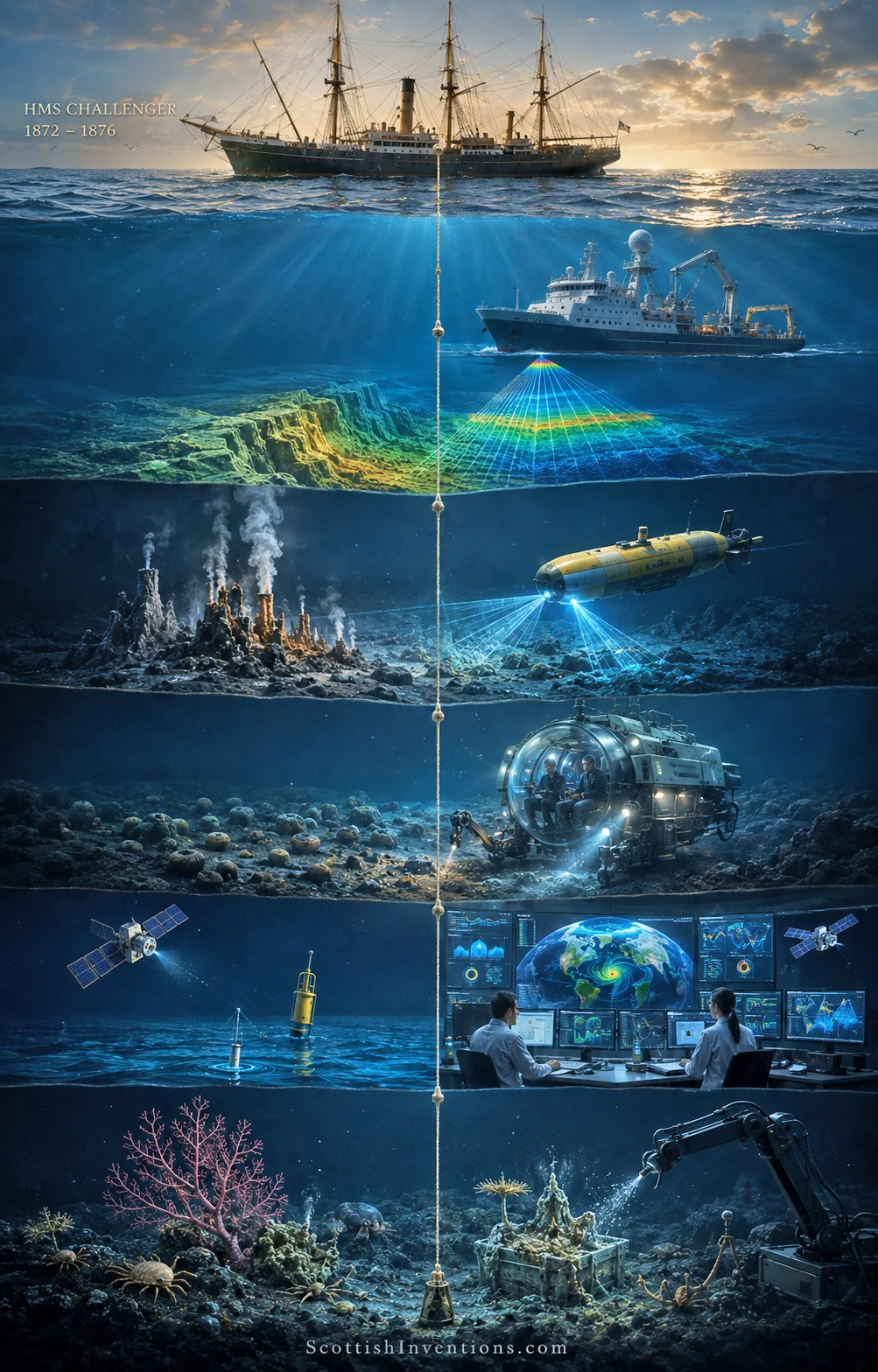
HMS Challenger's reach still echoes clearly today. Its deepest sounding — 4,475 fathoms, about 8,184 metres, taken on 23 March 1875 south-west of the Mariana Islands — first hinted at what we now know as the deepest place on Earth's oceans, the Challenger Deep, named after the ship and now measured at nearly 11,000 metres. Murray himself drew the map that first labelled it. The manganese nodules he and Renard described are now the subject of intense commercial and environmental argument over deep-sea mining. His early, tentative recognition of the Mid-Atlantic Ridge foreshadowed the plate-tectonic revolution of the 1960s by more than eighty years. The ship's name even carried into space: NASA's Space Shuttle Challenger was named directly after HMS Challenger.
A submarine ridge in the northern Arabian Sea, the Murray Ridge — discovered on the 1933–34 John Murray Expedition, endowed by his estate — bears his name, as do the John Murray Laboratories at the University of Edinburgh and a blind deep-sea octopus, Cirrothauma murrayi. Above all, though, Murray's most durable legacy is methodological: he established oceanography as a rigorous, classificatory science, with systematic sampling methods and naming conventions that endure in modern research, even as hand-hauled dredges have given way to sonar seabed mapping, submersibles capable of visiting hydrothermal vents, and satellites that monitor the entire planet's oceans continuously from orbit.
Timeline
1841
John Murray born at Cobourg, Canada West, to Scottish emigrant parents
He was Canadian by birth, not Scottish — an honest point this article does not obscure
1843
Edward Forbes proposes the 'azoic hypothesis'
Argues deep-sea life ceases below about 300 fathoms — later shown to be wrong, but scientific orthodoxy for a generation
1855
Matthew Fontaine Maury publishes The Physical Geography of the Sea
The first modern oceanographic textbook, but focused on surface currents and winds, not the deep sea
1858
Murray, aged 17, emigrates to Scotland to live with his grandfather in Stirling
The beginning of a scientific life spent entirely in Scotland
1864
Murray enrols at the University of Edinburgh to study medicine
He never completed a degree, but studied geology under Archibald Geikie and physics under Peter Guthrie Tait
1868
Murray sails as ship's surgeon on the Arctic whaler Jan Mayen
Seven months collecting marine specimens near Spitsbergen — his first taste of ocean science
1868–1870
HMS Lightning and HMS Porcupine dredge the deep sea off Scotland
Wyville Thomson and William Carpenter disprove Forbes's azoic zone, finding abundant life far below his supposed limit
21 December 1872
HMS Challenger departs Portsmouth
The start of the four-year voyage that founded oceanography as a systematic science
1872
Murray is appointed a Challenger naturalist almost at the last moment
One of several scientists aboard under chief scientist Charles Wyville Thomson
23 March 1875
Challenger records its deepest sounding, 4,475 fathoms south-west of the Mariana Islands
The first hint of what is now known as the Challenger Deep, named after the ship
24 May 1876
HMS Challenger returns to Spithead
68,890 nautical miles sailed; over 4,700 new species catalogued from 362 stations
1880–1895
The 50-volume Challenger Report is published
Murray takes over as editor after Wyville Thomson's death in 1882, writing seven volumes largely himself
1882
Charles Wyville Thomson dies
Murray becomes director of the Challenger Office in Edinburgh and editor-in-chief of the Report
1884
Murray founds the Marine Laboratory at Granton
The first marine laboratory in the United Kingdom, forerunner of the Scottish Association for Marine Science
1891
Murray and Alphonse Renard publish Report on Deep-Sea Deposits
The first systematic geological classification of the entire sea bed, naming radiolarian, diatom, pteropod ooze and red clay
1893
Murray addresses the Royal Geographical Society on Antarctic exploration
Widely credited as a spark for the 'Heroic Age' of Antarctic exploration that followed
1895
Murray receives the Royal Society's Royal Medal
Recognition of his contribution to the completed Challenger Report
1896
Murray elected Fellow of the Royal Society
Formal scientific recognition
1897–1909
Murray conducts the Bathymetrical Survey of the Fresh-Water Lochs of Scotland
60,000 soundings of 562 Scottish lochs, published in six volumes in 1910
1898
Murray made Knight Commander of the Order of the Bath (KCB)
National honour for his scientific work
1910
Murray funds and organises the Michael Sars North Atlantic expedition
Under Norwegian scientist Johan Hjort; results published as The Depths of the Ocean, 1912
16 March 1914
Murray dies near Kirkliston, West Lothian, aged 73
Killed when his car overturned, months before the outbreak of the First World War
1933–34
The John Murray Expedition, endowed by his estate, discovers a submarine ridge in the Arabian Sea
Named the Murray Ridge in his honour
1960s
Plate tectonics and seafloor spreading theory emerge
Confirms the significance of features like the Mid-Atlantic Ridge that Murray had been among the first to note, 80 years earlier
Myths & Facts
Myth: Sir John Murray led the Challenger expedition and founded oceanography alone.
Fact: The expedition was led scientifically by Charles Wyville Thomson, a Scot born at Bonsyde, West Lothian, with a scientific team that included Murray among several others. Murray was appointed a naturalist almost at the last moment. His outstanding reputation rests substantially on what he achieved after the voyage: original sediment classification work and completing the 50-volume Report following Wyville Thomson's death in 1882.
Myth: The deep ocean was already well understood before Challenger sailed.
Fact: Edward Forbes's 1843 'azoic hypothesis' — that life ceased below about 300 fathoms — was the dominant view for a generation, even though it was based on a flawed dredge and unusually barren waters. It took HMS Lightning and HMS Porcupine's 1868–1870 dredging, and then Challenger's four-year voyage, to finally disprove it and reveal abundant life at great depth.
Myth: The on-image label describing red clay as 'carried by deep ocean currents' is the accepted mechanism.
Fact: It is not. Murray's own explanation, which still stands, is that red clay accumulates because calcareous shells from surface organisms dissolve before they reach the ocean floor at extreme depth — a boundary now known as the carbonate compensation depth — leaving mainly volcanic ash and wind-blown continental dust behind. Currents are not the primary mechanism that produces this sediment type.
Myth: Murray was born in Scotland.
Fact: He was born in Cobourg, Canada West (now Ontario), in 1841, to Scottish emigrant parents, and did not move to Scotland until he was 17. His entire scientific career, however, was built in Edinburgh and on Scottish waters.
Myth: Manganese nodules were discovered by Murray.
Fact: Shallow-water manganese nodules had already been dredged by a Swedish expedition in the Kara Sea in 1868. Murray and the Belgian geologist Alphonse Renard's description of Challenger's deep-sea specimens is the scientifically foundational account that made the nodules widely known, not the first sighting of the phenomenon.
Myth: The Mid-Atlantic Ridge's significance was understood as soon as Murray noted it.
Fact: Murray was among the first to recognise that the Atlantic floor rose to a mid-ocean ridge, but its true significance — that new ocean floor is created there — was not understood until the theory of seafloor spreading and plate tectonics emerged in the 1960s, more than 80 years later.
Did You Know?
- Murray was born in Canada but returned to Scotland as a teenager and gave his entire scientific life to Edinburgh and the sea — a Scot by upbringing, not by birth.
- The Challenger expedition described over 4,700 new species in four years — more marine life than had been catalogued in all previous ocean science combined.
- The Challenger Report Murray completed after Wyville Thomson's death ran to 50 volumes and around 30,000 pages, an editorial marathon lasting to 1895.
- Murray was killed in a car accident in 1914, aged 73, just months before the First World War — a poignant end for a man devoted to peaceful discovery.
- The deepest point in the ocean, the Challenger Deep in the Mariana Trench, is named after his ship, and NASA's Space Shuttle Challenger was named after it in turn.
- The manganese nodules Murray described in the 1870s are now at the centre of a global controversy over deep-sea mining.
- Between 1897 and 1909, Murray also took 60,000 soundings of 562 Scottish freshwater lochs — a monumental survey largely separate from his ocean work.
Honest Caveats
The Challenger expedition's scientific leadership belongs to Charles Wyville Thomson, not Murray. Murray was one of several naturalists aboard, appointed almost at the last moment. Presenting him as the expedition's founder or leader would misstate the historical record.
"Father of oceanography" is an honorific, not a precise title. It is widely repeated and defensible given Murray's later contributions, but oceanography was built by many hands, including Maury, Forbes, Carpenter and Wyville Thomson.
Sources disagree on minor numbers. The Challenger's crew complement is variously given as 237, 243 or roughly 250; and, depending on how one counts, Murray was 72 or 73 at his death (born 3 March 1841, died 16 March 1914 — so he had just turned 73).
Priority for manganese nodules is contested. Shallow-water nodules had already been dredged by a Swedish expedition in the Kara Sea in 1868, though Murray and Renard's Challenger description is the scientifically foundational one.
The £68,000 Report-cost figure, and the claim that it exceeded the voyage's cost, could not be confirmed against authoritative primary sources and should be treated with caution; the expedition's own parliamentary allocation is cited at roughly £200,000.
The voyage's departure and return dates require care. The voyage is properly dated from Portsmouth (21 December 1872) to Spithead (24 May 1876); the frequently seen "Sheerness, 7 December 1872" refers to the ship's initial move out of dockyard before the scientific voyage proper began.
Frequently Asked Questions
Did Sir John Murray discover oceanography single-handedly?
No, and this article states that plainly. HMS Challenger's expedition (1872–1876) was a large Royal Navy and Royal Society undertaking, scientifically led by Charles Wyville Thomson, with a scientific staff that also included Henry Nottidge Moseley, Rudolf von Willemoes-Suhm, the chemist John Young Buchanan, and Murray himself, appointed a naturalist almost at the last moment. Murray's own standing rests chiefly on what he did after the voyage: his original sediment classification work, and his completion — after Wyville Thomson's death in 1882 — of the monumental 50-volume Challenger Report. The claim on oceanography's founding is properly shared between the expedition's whole scientific team, with Wyville Thomson as its scientific leader and Murray as the figure who carried the project to completion and built much of its most original science.
So why is Murray so often called the 'father of oceanography'?
Because, over four decades after the voyage, he did more than anyone else to turn Challenger's raw data into a coherent science. He personally classified the deep-sea sediments, described manganese nodules, was among the first to recognise the Mid-Atlantic Ridge, founded Britain's first marine laboratory, and — critically — took over the Challenger Office after Wyville Thomson died and drove the Report to completion across 50 volumes, writing seven of them largely or entirely himself. The title is honorific and widely repeated, and this article treats it as defensible, but not as meaning Murray worked alone or led the original expedition.
Was Murray Scottish?
By upbringing and career, unambiguously yes; by birth, no. He was born in Cobourg, Canada West (now Ontario), in 1841, to Scottish emigrant parents. He moved to Stirling aged 17 in 1858, was educated in Edinburgh, and his entire scientific life — the Challenger work, the Marine Laboratory at Granton, the survey of Scotland's lochs — unfolded there. This site treats him the same way it treats other Canadian-, English- or German-born figures whose careers were made in Scotland: honestly, as Scottish by adoption rather than birth.
Who was Charles Wyville Thomson, and why does he matter to this story?
Wyville Thomson (1830–1882), born at Bonsyde, Linlithgow, West Lothian, was the Challenger expedition's chief scientist and its scientific driving force before the voyage even began — he and William Benjamin Carpenter had already used HMS Lightning and HMS Porcupine in 1868–1870 to disprove the idea that the deep sea was lifeless. He led the scientific programme throughout the voyage and began organising the results afterwards, but the crushing labour of the project wore him down, and he died in 1882 before the Report was finished. Murray then took over. Properly told, this is a story with two central Scottish figures, not one.
What exactly did Murray discover that was genuinely his own?
His clearest personal achievement is the first systematic classification of deep-sea sediments, published with the Belgian geologist Alphonse Renard in the 1891 Report on Deep-Sea Deposits. He named and defined radiolarian, diatom and pteropod oozes, and identified and named 'red clay', correctly explaining that it forms in the deepest abyss where calcareous shells dissolve before reaching the bottom — effectively identifying what is now called the carbonate compensation depth. He also co-described manganese (polymetallic) nodules with Renard, and was among the first to recognise the outline of the Mid-Atlantic Ridge and deep ocean trenches, though the full significance of mid-ocean ridges was not understood until plate tectonics emerged in the 1960s.
Did Murray coin the word 'oceanography'?
This is often claimed for Murray, but it is an honorific simplification rather than a precisely documented fact, and the discipline's vocabulary and foundations were built by many hands — Maury, Forbes, Carpenter and Wyville Thomson among them, well before and alongside Murray's own contributions. This article presents Murray as the person who did more than anyone to establish oceanography as a systematic, classificatory science through the completed Challenger Report, without asserting he single-handedly named the field.
What does 'red clay' actually consist of, and how did Murray explain it?
Red clay is the fine brownish sediment that blankets the deepest parts of the ocean floor, far from land and below the depth at which calcareous shells survive. Murray correctly deduced that it forms not because currents carry it in from elsewhere, but because the calcium-carbonate shells of surface plankton dissolve in the highly corrosive deep water before they can settle — a boundary now called the carbonate compensation depth. What is left behind and accumulates on the bottom is mostly volcanic ash and dust blown in from continents, plus a small amount of extraterrestrial material. His explanation, worked out in the 1880s, still stands.
Are manganese nodules important today?
Very much so. The potato-to-marble-sized concretions of manganese and iron oxide, laced with copper, nickel and cobalt, that Murray and Renard described from Challenger's dredges are now called polymetallic nodules, and they sit at the centre of a fierce international debate over deep-sea mining, because they are rich in metals used in batteries and electronics. It should be noted that shallow-water nodules had already been dredged by a Swedish expedition in the Kara Sea in 1868; Murray and Renard's Challenger work is the scientifically foundational description that made them known to the wider scientific world.
How large was the Challenger Report, and did Murray really write much of it himself?
The Report on the Scientific Results of the Voyage of H.M.S. Challenger ran to 50 volumes and roughly 30,000 pages, published between 1880 and 1895, drawing on the work of more than 75 report authors and over a hundred scientists internationally. Murray took over as director of the Challenger Office and editor after Wyville Thomson's death in 1882, and beyond editing, he personally wrote seven of the volumes largely or entirely himself, including the Deep-Sea Deposits volume and the two-volume 1895 Summary. When Treasury funding was threatened in 1889, he fought to keep the project alive and completed some of the later work partly at his own expense.
Did Murray contribute to Antarctic exploration?
Indirectly but significantly. He never sailed to Antarctica himself, but in a landmark 1893 address to the Royal Geographical Society, 'The Renewal of Antarctic Exploration', he argued that a substantial southern land mass existed and called for a full British expedition. That lecture, published in 1894, is widely credited with helping spark the 'Heroic Age' of Antarctic exploration that followed in the early twentieth century.
What did Murray do for Scotland's own waters?
A great deal. In 1884 he founded the Marine Laboratory at Granton on the Firth of Forth, the first marine laboratory in the United Kingdom, which later became a forerunner of the Scottish Association for Marine Science. Between 1897 and 1909 he led the Bathymetrical Survey of the Fresh-Water Lochs of Scotland, taking some 60,000 soundings of 562 lochs, published in six volumes with 223 coloured maps in 1910 — a monumental and largely self-contained work of Scottish natural science, funded in part by Laurence Pullar in memory of his son Frederick, Murray's collaborator, who had drowned in 1901.
How did Murray die?
He was killed on 16 March 1914 when his car overturned near Kirkliston, West Lothian, about ten miles from his home at Challenger Lodge in Edinburgh. He had just turned 73 and was buried in Dean Cemetery, Edinburgh — a sudden end for a man who had devoted his life to peaceful scientific discovery, just months before the outbreak of the First World War.
What is the Challenger's most famous modern legacy?
The deepest known point on Earth's oceans, the Challenger Deep in the Mariana Trench, is named after HMS Challenger and was first hinted at by a Challenger sounding on 23 March 1875. NASA's Space Shuttle Challenger was in turn named after the ship. More broadly, the systematic survey methods Murray helped establish — sounding, dredging, sampling and classifying at regular stations — remain the conceptual basis of oceanographic fieldwork today, now carried out with sonar, submersibles and satellites rather than hand-hauled dredges.
Sources & Further Reading
Tier 1 · Primary
- Thomson, C. Wyville — narrative of the voyage of HMS Challenger, published account of distance and dates, 1872–1876.
- Murray, J. and Renard, A. — Report on Deep-Sea Deposits, 1891.
- Murray, J. and Hjort, J. — The Depths of the Ocean, Macmillan, London, 1912.
- Murray, J. — Bathymetrical Survey of the Fresh-Water Lochs of Scotland, six volumes, 1910.
- Report on the Scientific Results of the Voyage of H.M.S. Challenger, 50 volumes, 1880–1895.
Tier 2 · Scholarly and institutional
- Encyclopaedia Britannica — summary of Challenger expedition stations, soundings and dredgings.
- National Oceanography Centre — records of species catalogued during the Challenger voyage.
- National Library of Scotland, Bartholomew Archive — records of the Bathymetrical Survey of Scottish lochs.
- Nature, 30 November 1893 — report of Murray's Royal Geographical Society address on Antarctic exploration.
- Royal Society and Royal Scottish Geographical Society — records of Murray's medals and offices held.
Tier 3 · Site source document
docs/sources/discoveries/challenger-expedition.md— the commissioned source document underlying this article.