Discoveries · No. 28 of 50 · Neuroscience
Robert Whytt and the Discovery of the Spinal Reflex
An Edinburgh professor, a decapitated frog, and the proof that the spinal cord can act without the brain — a discovery that was empirically right decades before anyone had the words or the theory to describe it properly.
Robert Whytt · 1714–1766Essay published · 1751Reading time · 16 minUpdated 16 August 2026

TL;DR
- In 1751, the Edinburgh physician Robert Whytt published experiments on decapitated frogs proving that the spinal cord alone, without the brain, could organise a reproducible, involuntary withdrawal response to a pinch or a prick.
- Whytt never used the word "reflex". He called the phenomenon "sympathy", produced by an unconscious "sentient principle" spread through the nerves — a vitalist theory, not the modern mechanism.
- The term "reflex action" and the reflex-arc concept came from Marshall Hall in 1832–33; the fully modern, synaptic explanation came from Sir Charles Sherrington, recognised with a share of the 1932 Nobel Prize. Whytt was empirically right decades before anyone had the right theory.
Scottish Impact Index (SI Score)
- Global Impact
- 6/10
- Longevity
- 8/10
- Economic / Material Impact
- 3/10
- Originality / Distinctiveness
- 8/10
- Legacy (Built Upon)
- 7/10
- Recognition
- 2/10
Key Findings
- Whytt (1714–1766), Professor of the Institutes of Medicine at Edinburgh, published An Essay on the Vital and Other Involuntary Motions of Animals in 1751, describing systematic experiments on decapitated and pithed frogs.
- His central design compared a frog with its brain destroyed but spinal cord intact — which still withdrew its limb from a pinch — against a frog with both brain and spinal cord destroyed, which did not respond at all.
- Whytt's own explanation invoked "sympathy" between body parts, mediated by a "sentient principle" distributed through the nerves — a vitalist middle ground between Cartesian mechanism and full consciousness.
- He was not the first to notice movement after decapitation: Boyle (vipers, 17th century) and Hales (frogs, early 1730s) came before him.
- Marshall Hall coined "reflex action" and the reflex-arc concept in 1832–33, replacing Whytt's vitalist vocabulary with an anatomically specific mechanism.
- Sherrington's synapse-based physiology, culminating in his 1906 book and his share of the 1932 Nobel Prize, gave the modern, cellular explanation of how reflexes actually work.
Quick Facts
- Discovery
- The spinal cord alone, without the brain, can organise a reproducible involuntary motor response to a sensory stimulus
- Year
- 1751 — An Essay on the Vital and Other Involuntary Motions of Animals
- Key figure
- Robert Whytt (1714–1766)
- Role
- Professor of the Institutes of Medicine, University of Edinburgh
- Method
- Decapitated and pithed frogs: brain destroyed vs brain-and-cord destroyed, comparing limb withdrawal
- Whytt's own term
- 'Sympathy', produced by a diffused 'sentient principle' — not 'reflex'
- Predecessors
- Robert Boyle (vipers, 17th century) and Stephen Hales (frogs, early 1730s) observed movement after decapitation first
- Whytt's real contribution
- Systematic comparative design and the theoretical claim that the spinal cord independently mediates the response
- Theoretical framework
- A vitalist middle position between Descartes' pure mechanism and full consciousness
- Modern term coined
- 'Reflex action' and the reflex arc — Marshall Hall, 1832/1833
- Modern synaptic account
- Sir Charles Sherrington, Integrative Action of the Nervous System, 1906
- Recognition
- Sherrington shared the Nobel Prize in Physiology or Medicine, 1932, for work on neuron function
- Claim status
- Established as the founding empirical demonstration; not the origin of the word 'reflex' or the modern mechanism
- Clinical descendant
- The knee-jerk (patellar) reflex test used in routine neurological examination
An Edinburgh Physician
Robert Whytt was born in Edinburgh in 1714 and belonged to the golden generation of physicians who built the Edinburgh Medical School into a European centre of medical learning. He trained at Edinburgh, and then, as was common for ambitious Scottish physicians of the period, travelled to study further in London, Paris and Leiden before returning home. In 1747 he was appointed Professor of the Institutes of Medicine at the University of Edinburgh — a chair devoted to the theoretical foundations of medicine rather than bedside practice, and one that gave him the freedom and the platform to pursue sustained physiological research.
Whytt's scientific interests sat at the intersection of physiology and philosophy of mind, a boundary that was intensely contested in the eighteenth century. The dominant mechanistic tradition, associated above all with Descartes, treated animal bodies — and much of human physiology besides — as elaborate machines whose movements, including apparently purposeful ones, could in principle be explained by mechanical cause and effect alone, with no sensitivity or awareness required. Whytt was uneasy with this picture. He believed that some of the body's involuntary movements were too well co-ordinated, too adaptively suited to their circumstances, to be explained by blind mechanism, and he set out to test that conviction experimentally rather than simply argue it philosophically.
That commitment to experiment over pure argument is what makes Whytt's 1751 work matter historically. He did not merely assert that the body possessed some form of unconscious sensitivity; he designed comparative experiments intended to locate, physically, where in the nervous system that sensitivity resided. The result was the first systematic demonstration that the spinal cord, quite apart from the brain, was capable of organising a coherent bodily response.
Before Whytt
It would be dishonest to present Whytt as the first person ever to notice that a body without a working brain can still move. The observation itself long predates him. In the seventeenth century, Robert Boyle recorded that decapitated vipers continued to move — a striking and unsettling fact that circulated in natural-philosophical circles well before Whytt's birth. Closer to Whytt's own time, Stephen Hales carried out decapitation experiments on frogs in the early 1730s, chiefly as part of his pioneering work on blood pressure and the circulatory system, and in the course of that work he too noted that movement and responsiveness persisted after the brain was removed.
What Whytt added was not the underlying observation but a deliberate, systematic method for interrogating it, and a serious theoretical attempt to explain it. Where Hales's decapitation work was incidental to a different research question, Whytt made the phenomenon itself the object of study, designed a clean comparative experiment to isolate its cause, and built an explicit physiological and philosophical argument around the result. That shift — from noticing an odd fact in passing to interrogating it as a phenomenon worth explaining in its own right — is the real basis of his claim to have founded the study of the spinal reflex, even though he was not first to see a headless body move.
The 1751 Experiments
Whytt set out his findings in An Essay on the Vital and Other Involuntary Motions of Animals, published in 1751. The centrepiece of the work was a comparative experiment on frogs, chosen because their tissues remain responsive for a considerable time after death, making them well suited to this kind of investigation. In one condition, Whytt destroyed the frog's brain but left its spinal cord intact; in the other, he destroyed both the brain and the spinal cord.
The results were consistent and striking. With the brain destroyed but the spinal cord intact, pinching or pricking the frog's skin reliably produced withdrawal of the limb — an organised, repeatable motor response, even though the animal could not, by any reasonable definition, be conscious of what was happening to it. With the spinal cord also destroyed, that same stimulus produced no response at all. The comparison was the whole point: it isolated the spinal cord, specifically, as the structure responsible for generating the response, ruling out both the brain (already removed in both conditions) and simple passive mechanical reflex of the tissue itself (since destroying the cord abolished the effect entirely).
This was, for its time, a genuinely rigorous piece of comparative experimental physiology. Whytt was not simply observing an odd phenomenon; he was testing a specific hypothesis about where in the body it originated, using a controlled manipulation designed to isolate the variable that mattered. The conclusion he drew was equally specific: some property of the spinal cord itself, independent of the brain, was capable of converting a sensory stimulus into an organised motor response.
Sympathy and the Sentient Principle
Having established the phenomenon experimentally, Whytt needed to explain it theoretically, and this is where his account diverges most sharply from the modern one. He did not describe the frog's response as a "reflex" — that word was not yet in use for this purpose. Instead, he described it as an instance of "sympathy" between different parts of the body: a stimulus in one location producing an effect in another, connected, location, without the intervention of conscious will.
To explain how such sympathy was possible, Whytt proposed the existence of a "sentient principle" — a form of unconscious sensitivity distributed through the nervous system and concentrated particularly in the brain and spinal cord. This was a deliberate philosophical position, staked out between two extremes. On one side stood the strict Cartesian mechanists, who held that involuntary bodily movements required no sensitivity whatsoever, only mechanical cause and effect. On the other stood the possibility that any organised response implied genuine consciousness. Whytt rejected both: he argued that some intermediate form of sensitivity, present but not conscious, was necessary to explain the adaptive, purposeful character of the responses he had observed.
It is worth being precise about what this theory was and was not. It was not a mechanism in the modern sense — it did not specify particular nerve pathways, particular cell types, or a particular physical process by which the "sentient principle" did its work. It was closer to a philosophical postulate, introduced because Whytt's experimental results seemed, to him, to demand something beyond pure mechanism, without yet having the biological knowledge available to say precisely what that something was. That gap between accurate observation and adequate explanation is the central tension running through Whytt's whole contribution, and it is why his empirical demonstration long outlived his own theory of it.
What Whytt Actually Established
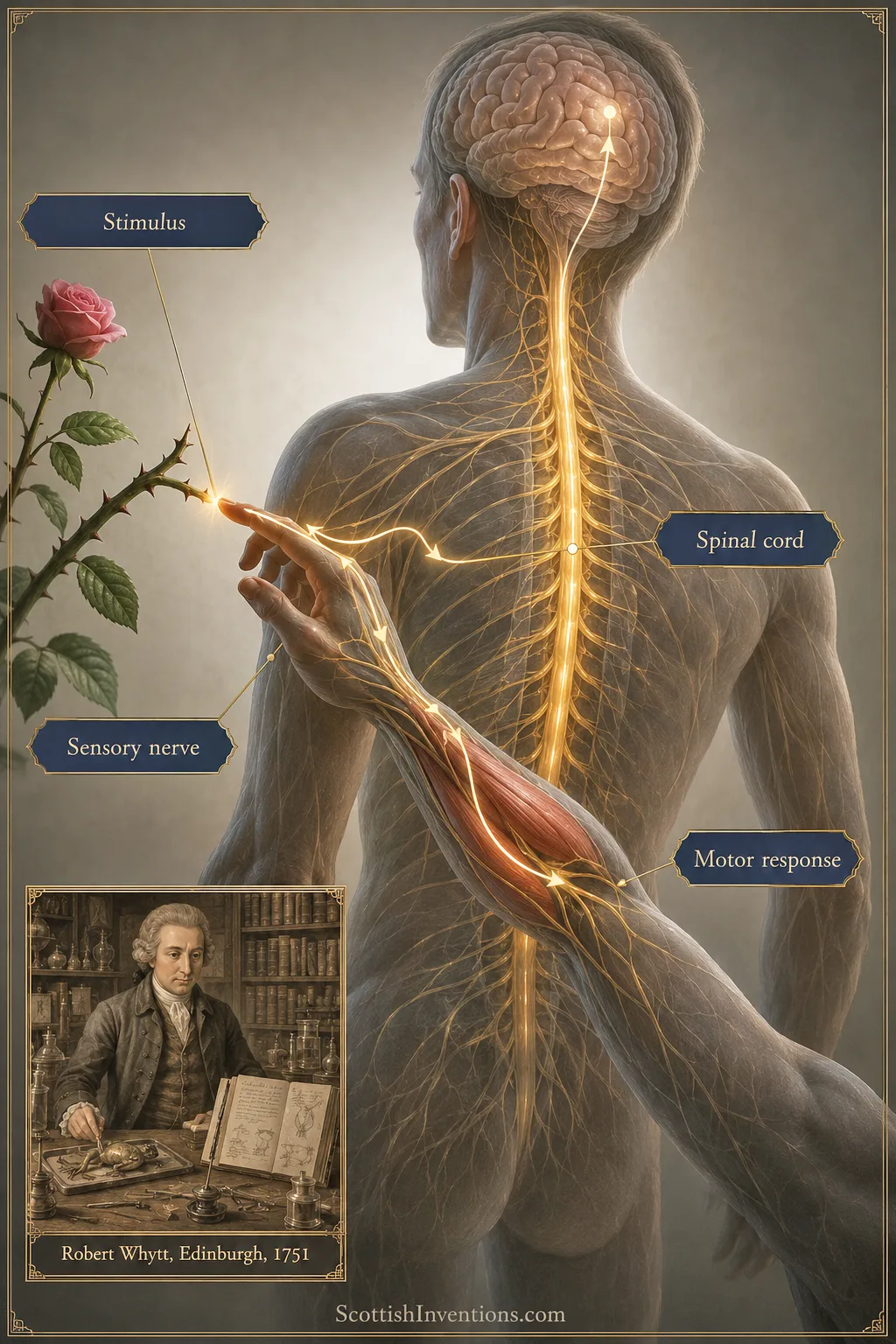
It is useful to separate, as cleanly as possible, what Whytt's experiments actually demonstrated from what later physiology added on top of them. Whytt's genuine, lasting empirical contribution is this: the spinal cord is capable, on its own, of converting a sensory stimulus into a coherent motor response, without requiring the brain and without requiring consciousness. That is the essential content of what we now call a spinal reflex, and it is what Whytt's decapitated-frog comparison proved.
What Whytt did not have — and could not have had, given the state of anatomy and physiology in 1751 — was any precise account of the pathway involved. The distinction between separate sensory and motor nerve roots was not established until decades later. The concept of the neuron as a discrete cell, and of the synapse as the specific junction between neurons, did not exist yet at all. Whytt's "sentient principle" was, in effect, a placeholder for a mechanism he could observe the effects of but could not describe in physical or anatomical terms.
The diagram above shows the modern reflex arc — stimulus, sensory nerve, spinal cord, motor nerve, response — which is the vocabulary of Marshall Hall and the physiology of Sherrington, not of Whytt himself. It is included here deliberately to make the distinction visible: the underlying principle is Whytt's; the precise anatomical and physiological account illustrated is later.
Marshall Hall and 'Reflex Action'
More than eighty years after Whytt's essay, the English physician Marshall Hall took up the same basic phenomenon and gave it a new theoretical foundation and a new name. Publishing in 1832 and 1833, Hall proposed the existence of a distinct "diastaltic" nervous system: a set of pathways operating through the spinal cord that produced organised responses to stimuli independently of both sensation and voluntary control. It was Hall who introduced the term "reflex action", and with it the concept of the reflex arc — a defined pathway running from a sensory nerve, through the spinal cord, to a motor nerve.
The significance of Hall's contribution is not merely terminological. Where Whytt's "sentient principle" was a vitalist postulate, invoked to explain a phenomenon without specifying its physical basis, Hall's reflex arc was explicitly anatomical: a claim about defined nerve pathways doing defined jobs, with no appeal to sensitivity or sentience of any kind required. Hall's account was, in that sense, closer to the modern mechanistic understanding of reflexes than Whytt's had ever been, even though it still lacked the cellular detail that would come later. It is Hall's vocabulary — "reflex", "reflex action", "reflex arc" — that survives in ordinary and clinical usage today, not Whytt's language of sympathy and sentient principle.
Sherrington and the Synapse
The final, decisive step came from Sir Charles Sherrington, whose work spanned the 1890s through the early twentieth century and culminated in his landmark 1906 book, The Integrative Action of the Nervous System. Sherrington gave physiology something neither Whytt nor Hall had possessed: a cellular account of how reflexes actually work. He introduced the concept of the synapse — the specific junction between one nerve cell and the next, across which a signal must pass — and described phenomena such as reciprocal innervation, in which the contraction of one muscle is automatically accompanied by the relaxation of its opposing muscle, allowing smooth, co-ordinated movement rather than the two muscles fighting each other.
Sherrington also showed how the spinal cord integrates multiple reflexes into coherent overall behaviour, rather than simply firing off isolated, independent responses — a level of physiological sophistication far beyond anything available to Whytt or even to Hall. For this body of work on the functions of neurons, Sherrington shared the 1932 Nobel Prize in Physiology or Medicine with Edgar Adrian. With Sherrington's synaptic physiology, the phenomenon Whytt had first isolated experimentally in 1751 finally had a complete, mechanistic, cellular explanation — one hundred and fifty-five years after Whytt's essay first appeared.
From Frog Leg to Robotics

The most familiar living descendant of Whytt's experiment is one that most people have experienced personally: the knee-jerk (patellar) reflex test, first described by Erb and Westphal in 1875 and still a routine part of every standard neurological examination. When a doctor taps the tendon below the kneecap and the leg kicks without any conscious effort, the underlying principle is exactly the one Whytt demonstrated in his frogs: a stimulus producing an organised motor response through the spinal cord alone, without requiring the brain to make a decision.
This same principle underlies modern assessment of spinal cord injury. Because different reflexes depend on specific, well-mapped spinal levels, testing which reflexes are present, diminished or exaggerated allows clinicians to localise damage along the spinal cord with real precision — a diagnostic use that would not be possible without the basic understanding that the cord itself, not just the brain, actively generates these responses.
More loosely, the logic of the spinal reflex — a fast, localised response that acts on a stimulus without first routing a decision through a central controller — has been a source of conceptual inspiration in robotics and neuroprosthetics, where engineers sometimes design feedback loops that react locally and rapidly rather than waiting on a central processor for every decision. This is best understood as an analogy that has proved useful to engineers, not a direct scientific lineage from Whytt's laboratory to a modern robotics lab.
Timeline
17th c.
Robert Boyle records that decapitated vipers continue to move
The earliest clear observation that a body without a functioning brain can still act
Early 1730s
Stephen Hales performs decapitation experiments on frogs
Chiefly in the context of his circulatory and blood-pressure work, but the movements after decapitation are noted
1714
Robert Whytt born in Edinburgh
Son of a lawyer; educated at Edinburgh, London, Paris and Leiden
1747
Whytt appointed Professor of the Institutes of Medicine at Edinburgh
The post gave him the platform for his physiological research
c. 1745–50
Whytt begins systematic experiments on decapitated and pithed frogs
Comparing responses with the brain destroyed against responses with brain and spinal cord destroyed
1751
Whytt publishes An Essay on the Vital and Other Involuntary Motions of Animals
Sets out the frog experiments and the theory of 'sympathy' mediated by a 'sentient principle'
1751 onward
Whytt's work becomes a reference point in debates on mechanism versus vitalism
Opposing strict Cartesian mechanism while stopping short of claiming full consciousness in the spinal cord
1763
Whytt publishes further work on nervous and hypochondriac disorders
Extending his physiological ideas into clinical medicine
1766
Robert Whytt dies in Edinburgh
He does not live to see his empirical findings reframed in modern terms
1811–22
Bell and Magendie establish sensory and motor nerve roots
Provides the anatomical basis later needed for a precise reflex-arc description
1832
Marshall Hall begins publishing on the 'diastaltic' nervous system
Argues for a spinal mechanism operating independently of sensation or volition
1833
Marshall Hall coins 'reflex action'
Introduces the term and the reflex-arc concept that replaces Whytt's 'sentient principle' vocabulary
1875
Erb and Westphal independently describe the patellar (knee-jerk) reflex
Becomes a routine test in clinical neurology, the most familiar living descendant of Whytt's original demonstration
1890s–1900s
Charles Sherrington investigates reflex physiology at Liverpool and Oxford
Introduces the concept of the synapse and reciprocal innervation of muscles
1906
Sherrington publishes The Integrative Action of the Nervous System
Gives the first fully modern account of how reflexes are generated and combined
1932
Sherrington shares the Nobel Prize in Physiology or Medicine with Edgar Adrian
Awarded for discoveries regarding the functions of neurons, including reflex and synaptic physiology
20th century
The Babinski sign, deep tendon reflex grading and spinal-level reflex testing become standard neurological tools
Direct clinical uses of the principle Whytt first demonstrated
Present
Reflex-based assessment remains central to diagnosing spinal cord injury
Modern feedback-control concepts in neuroprosthetics and robotics take conceptual inspiration from spinal reflex circuits
Myths & Facts
Myth: Robert Whytt discovered the reflex and even coined the word.
Fact: He gave the first systematic experimental demonstration of spinal reflex behaviour, in 1751, but he never used the word 'reflex'. That term, and the concept of a distinct reflex arc, were introduced by Marshall Hall in 1832–1833, more than sixty years after Whytt's essay.
Myth: Whytt was the first person to notice that a headless animal could still move.
Fact: He was not. Robert Boyle recorded continued movement in decapitated vipers in the seventeenth century, and Stephen Hales performed decapitation experiments on frogs in the early 1730s. Whytt's contribution was the systematic comparative design and the theoretical account, not the initial observation.
Myth: Whytt believed the spinal cord acted like a simple machine, exactly as we understand reflexes today.
Fact: Whytt explicitly rejected pure mechanism. He proposed a 'sentient principle' — a form of unconscious sensitivity distributed through the nervous system — to explain how the spinal cord produced co-ordinated responses. This vitalist framework was later replaced by Marshall Hall's non-vitalist reflex-arc theory and, still later, by Sherrington's synaptic physiology.
Myth: The modern reflex arc concept is essentially what Whytt described, just renamed.
Fact: The modern reflex arc is an anatomically and physiologically specific model — an afferent nerve, a spinal cord centre, and an efferent nerve, later understood through synapses — developed by Marshall Hall and then Sherrington. Whytt's own account, built around 'sympathy' and a diffused sentient principle, is a different and looser theoretical framework, even though it targets the same underlying phenomenon.
Myth: Sherrington discovered the spinal reflex.
Fact: Sherrington did not discover that the spinal cord mediates involuntary responses; that foundational demonstration belongs to Whytt in 1751. Sherrington's achievement, recognised by the 1932 Nobel Prize, was working out the cellular, synaptic mechanism by which such reflexes actually operate and are integrated — a different and later contribution built on more than a century of prior work.
Myth: Whytt's frog experiments would be considered rigorous, well-controlled science by modern standards.
Fact: They were genuinely systematic for their period and represented a real methodological advance over earlier casual observations, but they lacked the anatomical precision (distinct sensory and motor nerve roots were not established until Bell and Magendie's work decades later) and the physiological concepts (such as the synapse) that later made the reflex arc a precise, testable model.
Did You Know?
- Robert Whytt never used the word 'reflex' — he wrote of 'sympathy' between body parts, caused by an unconscious 'sentient principle'.
- Whytt was not the first to notice that a decapitated animal could still move: Robert Boyle recorded the same in vipers in the seventeenth century, and Stephen Hales worked on decapitated frogs in the early 1730s.
- The term 'reflex action' was coined by Marshall Hall in 1832–33, more than eighty years after Whytt's original 1751 essay.
- The modern, cellular explanation of reflexes — the synapse — came from Sir Charles Sherrington, who shared the 1932 Nobel Prize in Physiology or Medicine for the work.
- The familiar knee-jerk test performed in every neurological check-up rests on exactly the same principle Whytt demonstrated in frogs in 1751.
- Whytt held the Chair of the Institutes of Medicine at Edinburgh, a post devoted to medical theory rather than clinical practice.
- The distinction between separate sensory and motor nerve pathways, essential to a precise reflex arc, was only established decades after Whytt's death.
Honest Caveats
Whytt did not invent the observation of movement after decapitation. Robert Boyle (vipers) and Stephen Hales (frogs, early 1730s) predate him. His contribution was the systematic, comparative experimental design and the theoretical account built around it, not the raw phenomenon.
Whytt's own theory did not survive. His "sentient principle" and "sympathy" were a vitalist explanation, not the modern reflex-arc mechanism. Readers should not assume Whytt's terminology matches modern physiology.
The word "reflex" is not Whytt's. It belongs to Marshall Hall, 1832–33, roughly eighty years after Whytt's essay.
The full mechanistic account is Sherrington's, dependent on the concept of the synapse, which did not exist as a physiological idea in Whytt's lifetime.
Links to modern robotics and prosthetics are conceptual, not direct. This article presents them as a loose analogy that has been useful to some engineers, not as a scientific lineage.
Frequently Asked Questions
Did Robert Whytt discover the reflex?
He gave the first systematic experimental demonstration of what we now call a spinal reflex — showing in 1751 that a decapitated frog's spinal cord alone, without the brain, could organise a reproducible withdrawal response to a pinch or a prick. But he did not discover the phenomenon of movement after decapitation (Boyle and Hales had already observed it), he never used the word 'reflex', and his theoretical explanation for what he saw was later replaced. His is the founding systematic demonstration, not the origin of either the term or the modern mechanism.
What exactly did Whytt's experiments show?
Working mainly with frogs, Whytt compared two conditions: an animal with its brain destroyed but its spinal cord intact, and the same animal with its spinal cord destroyed as well. In the first case, pinching or pricking the skin produced a repeatable withdrawal of the limb. In the second, that response disappeared entirely. The clean, comparative design was the crucial innovation: it isolated the spinal cord as the structure responsible for the response, independent of the brain.
Did Whytt use the word 'reflex'?
No. Whytt described the phenomena as instances of 'sympathy' between parts of the body, produced by what he called a 'sentient principle' distributed through the nervous system. The word 'reflex' and the specific concept of a 'reflex arc' were introduced later, by Marshall Hall in 1832–1833. This is one of the more commonly blurred points in popular accounts of Whytt, and this article keeps the distinction clear.
Was Whytt really first to notice decapitated animals could still move?
No, and this article will not claim that he was. Robert Boyle had recorded in the seventeenth century that decapitated vipers continued to move, and Stephen Hales carried out decapitation experiments on frogs in the early 1730s, chiefly in connection with his blood-pressure research, noting persistence of movement afterward. What Whytt contributed was not the raw observation but a deliberate, systematic, comparative experimental design and a considered theoretical account of what the spinal cord was doing.
What was Whytt's theory, if not 'reflex'?
Whytt proposed a 'sentient principle' — a form of unconscious sensitivity distributed through the nerves and concentrated in the brain and spinal cord — as the thing that made co-ordinated involuntary responses possible. This was a deliberate middle position in an ongoing philosophical debate: it rejected the strict mechanistic view, associated with Descartes, that animal bodies (and their involuntary movements) were simply complex machines with no sensitivity involved, but it also stopped well short of claiming that the spinal cord was consciously aware. It is best understood as a vitalist compromise, not a modern physiological theory.
Who actually coined the term 'reflex action'?
Marshall Hall, an English physician, in 1832–1833. Hall proposed a distinct 'diastaltic' nervous system operating through defined reflex arcs — a sensory nerve carrying a signal to the spinal cord, and a motor nerve carrying a response back out — explicitly independent of sensation, volition or any form of 'sentience'. Hall's anatomically precise, non-vitalist account, and his terminology, are what became standard in physiology, superseding Whytt's language of sympathy and sentient principle.
What did Sherrington add that Whytt and Hall did not have?
The modern synaptic mechanism. Working from the 1890s through the early 1900s and publishing The Integrative Action of the Nervous System in 1906, Charles Sherrington introduced the concept of the synapse as the junction between neurons, described reciprocal innervation (the co-ordinated relaxation of an opposing muscle when another contracts), and explained how the spinal cord integrates multiple reflexes into coherent behaviour. This is the fully modern account of the spinal reflex, built on a cellular and synaptic physiology that did not exist in either Whytt's or Hall's time. Sherrington shared the 1932 Nobel Prize in Physiology or Medicine for this body of work.
So was Whytt right or wrong?
Both, in different senses, and this article treats that as the honest summary rather than a problem to be smoothed over. Empirically, Whytt was right: the spinal cord genuinely does organise reproducible involuntary responses independent of the brain, and his experiments proved it convincingly for his time. Theoretically, his explanation — a diffused 'sentient principle' producing 'sympathy' between body parts — did not survive; it was replaced first by Marshall Hall's non-vitalist reflex-arc concept and then by Sherrington's synaptic physiology. Whytt's status is best described as empirically foundational but theoretically superseded.
Why does the knee-jerk test trace back to Whytt?
The patellar reflex, first described by Erb and Westphal in 1875 and still used in every routine neurological examination, works on exactly the principle Whytt demonstrated in 1751: a stimulus applied to the body can produce a reproducible motor response mediated by the spinal cord alone, without conscious involvement of the brain. The clinical test is a direct practical descendant of that founding demonstration, even though the underlying nerve pathway is now described in Marshall Hall's and Sherrington's terms rather than Whytt's.
Does spinal reflex testing matter for diagnosing spinal cord injury?
Yes. Because reflexes at different spinal levels depend on specific, known nerve pathways, testing which reflexes are present, absent or exaggerated allows clinicians to localise damage along the spinal cord. This diagnostic use rests on the same basic principle Whytt's experiments first isolated: that the spinal cord can produce organised responses on its own, at a specific level, independent of the brain.
Is there a link to modern robotics and prosthetics?
Only a conceptual one, and this article does not overstate it. The idea of a fast, localised feedback loop that reacts to a stimulus without needing to route a decision through a central controller — the core logic of a spinal reflex — has been an inspiration for some approaches to robotic control and neuroprosthetic feedback systems. This is a loose analogy and a source of engineering inspiration, not a claim that modern robotics is built directly on Whytt's science.
What should modern readers take away from Whytt's story?
That major scientific credit is often layered rather than singular. Whytt gets deserved credit for the founding experimental demonstration; Boyle and Hales came before him with the raw observation; Marshall Hall gave the phenomenon its name and its modern anatomical framework; Sherrington supplied the cellular mechanism and was recognised with a Nobel Prize for it. Whytt's place in the story is real and important, but it is one link in a chain, not the whole chain.
Sources & Further Reading
Tier 1 · Primary
- Whytt, R. — An Essay on the Vital and Other Involuntary Motions of Animals, Edinburgh, 1751.
- Hall, M. — papers on the "diastaltic" nervous system and reflex action, 1832–1833.
- Sherrington, C. S. — The Integrative Action of the Nervous System, 1906.
Tier 2 · Scholarly and institutional
- Nobel Prize in Physiology or Medicine, 1932 — Sherrington and Adrian, citation on the functions of neurons.
- Erb, W. and Westphal, C. — independent descriptions of the patellar reflex, 1875.
- History-of-medicine scholarship on Robert Whytt, the Edinburgh Medical School and eighteenth-century vitalism versus mechanism debates.
Tier 3 · Site source document
docs/sources/discoveries/spinal-reflex.md— the commissioned source document underlying this article.