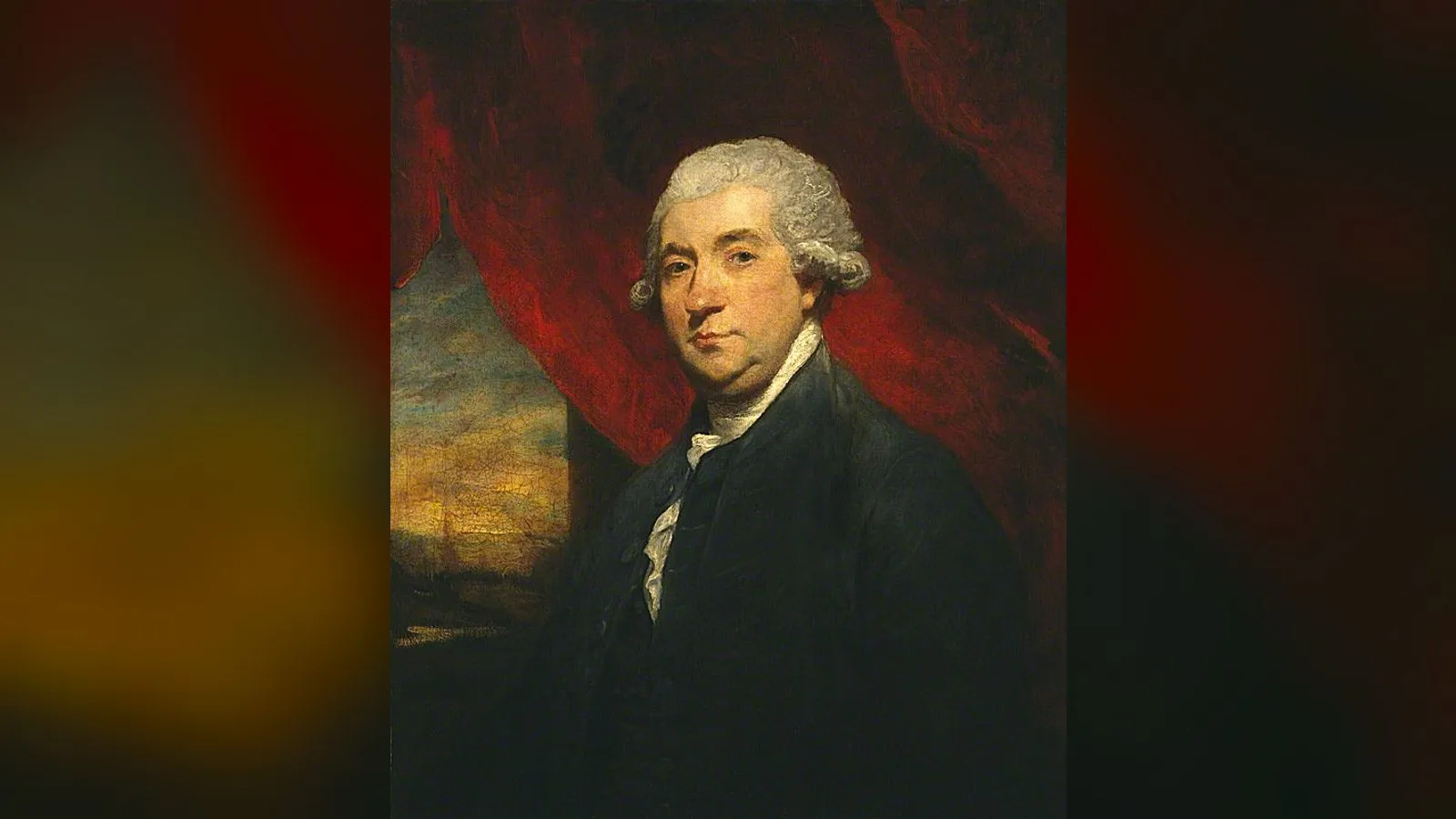

James Boswell: Advocate, Diarist and the Greatest Biographer in English
Contents
TL;DR
James Boswell (1740–1795) was an Edinburgh advocate, heir to the Ayrshire estate of Auchinleck, and the author of The Life of Samuel Johnson (1791), often called the greatest biography in the English language. He was also far more than Johnson's shadow.
At twenty-seven he became famous across Europe as "Corsica Boswell", the champion of Pasquale Paoli's island republic. He was a working Scottish lawyer who pleaded nearly a hundred civil causes in a single year and defended men on trial for their lives. He was the most energetic propagandist in the Douglas Cause, the great legal sensation of eighteenth-century Scotland. And he kept, for most of his life, a private journal of astonishing candour about his ambitions, his love affairs, his drinking and his depressions. Lost for over a century, it was rediscovered in the twentieth century in an Irish castle and a Scottish country house.
This card also records the less flattering side: his debts, his infidelities and, in 1791, his published defence of slavery and the slave trade.
Key Findings
- He became an advocate on 29 July 1766 after studying law at Edinburgh, Glasgow and Utrecht. In 1767 alone his records list 86 civil causes.
- He made his name with Corsica. An Account of Corsica (1768) sold out its first edition of 3,500 copies in six weeks and was read in five languages. For years he was known as "Corsica Boswell".
- He fought the Douglas Cause by pen. He was never counsel in the case, but his pamphlets Dorando (1767), The Essence of the Douglas Cause (1767) and Letters of Lady Jane Douglas (1767) helped turn public opinion. When the House of Lords decided for Douglas in 1769, Edinburgh rioted in celebration, and Boswell seems to have been in the thick of it.
- He met Johnson in 1763 in Tom Davies's bookshop in London. The friendship produced The Journal of a Tour to the Hebrides (1785) and The Life of Samuel Johnson (1791).
- His feelings about Scotland were divided. In emotional moments he cursed the Union of 1707 and longed for "another battle of Bannockburn". In calmer writing he accepted it, and he spent his last decade trying to make a career in London.
- He defended slavery. In the Life and in a poem, No Abolition of Slavery (1791), he argued for slavery and the slave trade. His close friend Sir William Forbes, the Edinburgh banker, was at the same time leading the Edinburgh campaign against the trade.
- His papers were found by chance. Huge caches of journals and letters turned up at Malahide Castle near Dublin from the 1920s, and at Fettercairn House in Kincardineshire in 1930. Yale acquired them in 1949, and Boswell's London Journal, 1762–1763 became an international best-seller in 1950.
Key Facts
- Born
- 29 October 1740, Edinburgh
- Died
- 19 May 1795, London, of renal failure, aged 54
- Buried
- Family vault, Auchinleck, Ayrshire
- Father
- Alexander Boswell, Lord Auchinleck (1707–82), judge of the Court of Session
- Education
- Edinburgh University (Arts, 1753–58); civil law at Edinburgh and Glasgow (1758–60); Utrecht (1763–64)
- Admitted advocate
- 29 July 1766
- Married
- Margaret Montgomerie, his first cousin, 25 November 1769; she died in 1789
- Children
- Veronica, Euphemia, Alexander, James and Elizabeth, plus at least two children born outside marriage
- Laird of Auchinleck
- From 1782
- Major works
- An Account of Corsica (1768); The Hypochondriack essays (1777–83); Journal of a Tour to the Hebrides (1785); The Life of Samuel Johnson (1791)
- Papers
- Malahide Castle (1920s–40s) and Fettercairn House (1930); now at Yale
Scottish Impact Index (SI Score)
- Global Influence
- 6/10
- Enduring Relevance
- 8/10
- Material Contribution
- 2/10
- Exceptional Achievement
- 7/10
- Lasting Legacy
- 6/10
- Recognition
- 4/10
33/60
Ranked =74th of 200 in Great Scots
Claim Status
established
- his legal career, publications and dates, all documented in his own papers and edited in the Yale research editions;
- the sales and fame of Corsica;
- his role in the Douglas Cause;
- his friendship with Johnson;
- the discovery of his papers;
- his 1791 defence of slavery.
shared
- the accuracy of his recorded conversations. They were reconstructed from notes, often days later, and shaped for effect. They are not transcripts. Scholars generally regard them as faithful in substance, but they are Boswell's versions.
disputed
- whether his support for Corsica reflected hostility to the Union and a wish for Scottish independence. Hugh Milne, editor of the 1766–69 journals, argues that Boswell's anti-Union outbursts were "spur-of-the-moment effusions" and that his more considered view leaned towards accepting the Union.
traditional
- the image of Boswell as a mere toady, Johnson's "shadow" with no gifts of his own. The rediscovered journals have overturned it.
An Advocate's Son
Boswell was born on 29 October 1740 into the Scottish legal establishment. His father, Alexander Boswell, had been admitted advocate in 1729 and was raised to the Court of Session bench as Lord Auchinleck in 1754. He expected his eldest son to follow him, and his own father before him, into the law. The family lived in a flat in Parliament Close, behind St Giles', and spent the vacations at Auchinleck in Ayrshire.
Boswell studied Arts at Edinburgh University from 1753 to 1758, then civil (Roman) law at Edinburgh and Glasgow. He had no wish to be a lawyer. In February 1763, in London, he wrote in his journal that the life of an advocate would be "a labyrinth of care", and that he would "find it very irksom to sit for hours hearing a heavy agent explain a heavy cause". He wanted London, literature, society and, if possible, a seat in Parliament.
Father and son struck a bargain. Boswell would study civil law at Utrecht, where the Dutch were regarded as the masters of Roman law, and then travel in Europe, provided he came home to the Scottish bar. At Utrecht in the winter of 1763–64 he found he was the only British student. His grand tour took him through Germany, Switzerland, Italy, Corsica and France. Along the way he talked his way into the company of Rousseau and Voltaire.
The Young Advocate
Back in Scotland in March 1766, Boswell studied Scots law under his father at Auchinleck and found, to his surprise, that he enjoyed it: "I have studied Scots Law with a good deal of care under as good a Professor as ever lived[,] My Worthy Father." He passed his examination in Scots law on 11 July. He then had to defend a Latin thesis on a title of the Pandects. His was De supellectile legata, on legacies of household furniture. He was admitted advocate on 29 July 1766, and in the last two weeks of the summer session he took instructions in ten cases and earned eight guineas.
For the next few years he threw himself into the work. In September 1766 he took his first criminal case at Glasgow, defending John Reid, a flesher accused of sheep-stealing. He kept his papers on the criminal cases he fought, and they form one of the most moving parts of his archive. In the words of the Boswell scholar Frederick Pottle, they relate to "clients of his who were tried for their lives... Most of these clients were hanged in spite of all his efforts." In February 1768 he visited his client John Raybould, condemned for forgery, in Edinburgh's Tolbooth:
The clanking of the iron-room door was terrible. I found him very composed. I sat by him an hour & a half by the light of a dim farthing candle.
Most of his practice was civil. The Court of Session was, as he put it, "a court of papers", where cases were won with the pen:
We may be compared to the Highlanders in 1745. Our [oral] pleading is like their firing their musketry, which did little execution. We do not fall heartily to work till we take to our pens, as they to their broadswords.
His Consultation Book lists 86 civil causes in 1767 alone. He wrote to his friend William Johnson Temple: "My Clerk comes to me every morning at Six, & I have dictated to him 40 folio pages in one day." Sir John Pringle, his father's friend, told him he had "the advantage of possessing the English language and the accent in a greater degree than any of your rivals". It is a revealing compliment for an Edinburgh advocate of the 1760s, when sounding English was an advantage at the bar.
Corsica Boswell
The idea of going to Corsica came from Rousseau. In December 1764 Rousseau told Boswell he had been invited to draw up laws for the island, which was in armed revolt against Genoa under its general, Pasquale Paoli. No British gentleman was known to have travelled into the interior. In October 1765 Boswell landed there, met Paoli and came away an enthusiast. As he wrote later, Corsica offered "a people actually fighting for liberty, and forming themselves from a poor inconsiderable oppressed nation, into a flourishing and independent state."
He wrote An Account of Corsica in Edinburgh and at Auchinleck through 1766 and 1767, fitting it around his legal work. The title page quoted, in Latin, the Declaration of Arbroath of 1320: "We fight... for the sake of liberty alone." To drum up interest he planted dozens of items about Corsica in the London Chronicle, many of them, Pottle notes, "complete inventions". The book was printed by the Foulis brothers in Glasgow and published in London by Edward and Charles Dilly on 18 February 1768.
It was a sensation. The first edition of 3,500 copies sold out in six weeks, and a second edition of the same size followed at once. Translations appeared across Europe. Johnson told him the history could be found in other books, but that the Tour "entertains every body". At a York coffee-house, Boswell drew a stranger into praising the book without revealing who he was, and recorded the scene with delight. Pottle's verdict was that by the publication of Corsica Boswell "became at twenty-seven a literary figure of international reputation", and that though he would write two greater books, "he was never again to be so admired".
The Douglas Cause
The other great passion of these years was the Douglas Cause, the most celebrated lawsuit in eighteenth-century Scotland. At stake were the vast estates of the late Duke of Douglas. The question was whether his sister, Lady Jane Douglas, had really given birth to twin sons in Paris in July 1748, at the age of fifty, or whether the boys had been bought from poor Parisian families. The Duke of Hamilton's guardians claimed that the surviving twin, Archibald Douglas, was the son of a glass-grinder named Mignon.
Most intellectuals backed Hamilton. Boswell, in Pottle's phrase, "sided with the mob". He was never engaged as counsel, but he became the Douglas side's most energetic volunteer. He wrote and sang a mocking song about the Hamilton case in Parliament House. He produced Dorando, A Spanish Tale (1767), a thinly disguised allegory of the case. He condensed thousands of pages of evidence into The Essence of the Douglas Cause. And he edited Letters of the Right Honourable Lady Jane Douglas, abridging them, Pottle notes, "not very scrupulously" to heighten their pathos. Pottle believed that book did more than all the legal papers to win the verdict.
In July 1767 the fifteen judges of the Court of Session split seven to seven, and the Lord President's casting vote went to Hamilton. On appeal, the House of Lords reversed the decision on 27 February 1769. When the news reached Edinburgh on 2 March, the city erupted. Windows that were not lit in celebration were smashed, including those of the Lord President and of Lord Auchinleck himself. Milne writes that Boswell appears to have taken a leading part, and that he was probably the wit who remarked, as stones flew at the Lord President's windows, that the mob were giving their casting votes.
Love, Folly and Marriage
The journals of 1766–69 are also a record of Boswell's search for a wife, carried on alongside a passionate affair and repeated visits to prostitutes. He considered the Dutch writer Belle de Zuylen ("Zélide"), the Yorkshire beauty Elizabeth Bosville and the Ayrshire heiress Catherine Blair. Meanwhile he kept a mistress in Edinburgh, a married woman named Mrs Dodds, who bore him a daughter, Sally, in December 1767. Sally probably died in infancy, and Pottle called her fate "the prime mystery of his biography". An earlier son, Charles, born in 1762 to Peggy Doig, had died in 1764. Boswell suffered repeated bouts of venereal disease, which he recorded with the same candour as everything else.
Belle de Zuylen's reply to his belated proposal is one of the sharpest letters he ever received:
You waited to fall in love with me until you were in the island of Corsica; and to tell me so, you waited until you were in love with another woman and had spoken to her of marriage.
In the end he married someone he had known all his life: his first cousin, Margaret Montgomerie of Lainshaw. She travelled with him to Ireland in 1769 to visit yet another prospective bride, and on the journey he realised she was the woman he loved. He wrote to Temple: "I find her both by sea & Land, the best companion I ever saw." His father objected, because she brought neither money nor connections. They married on 25 November 1769. Margaret proved patient, shrewd and strong, and Boswell's biographers regard her as the steadying force of his life. She died in June 1789, aged fifty-one, while he was away in London.
Boswell and Johnson
Boswell had met Samuel Johnson on 16 May 1763, in Tom Davies's bookshop in Russell Street, Covent Garden. In the Life, he recalled that he begged Davies not to say where he came from. Davies said it anyway, and Boswell pleaded, "I do indeed come from Scotland, but I cannot help it." Johnson replied: "That, Sir, I find, is what a very great many of your countrymen cannot help."
From that unpromising start grew a friendship of twenty-one years. Boswell recorded Johnson's talk in notes and journal entries and gathered his letters and anecdotes from friends. In 1773 he persuaded the sixty-three-year-old Johnson to tour the Highlands and the Hebrides with him, through Skye, Raasay, Coll, Mull and Iona. Johnson published his own Journey to the Western Islands of Scotland in 1775. Boswell held his account back until after Johnson's death in December 1784. The Journal of a Tour to the Hebrides appeared in 1785, and its frankness upset several Scots who appeared in it, including the blind poet Thomas Blacklock and the advocate Alexander Fraser Tytler, both of whom protested.
The Life of Samuel Johnson was published on 16 May 1791, the anniversary of their first meeting. It blended letters, documents, anecdotes and, above all, dramatised conversation into a portrait of unprecedented life and detail. Boswell spent part of the profits on buying the estate of Knockroon, once part of the barony of Auchinleck, for £2,500, instead of paying off his debts as he had promised his banker.
Johnson, Boswell and Gaelic
The Hebridean tour of 1773 took the two men through a Gaelic-speaking world, and Johnson's account of it became one of the best-known descriptions of where the Highlands began: "At Nairn we may fix the verge of the Highlands; for here I first saw peat fires, and first heard the Erse language." Seven years earlier Johnson had backed the SSPCK's Gaelic New Testament, arguing for a "monument of their mother-tongue" at a time when the Society was still debating whether to allow Gaelic in its schools. The historical geographer Charles Withers, in Gaelic in Scotland 1698–1981 (1984), counts Johnson's support as an important factor in the translation's success.
A Scot Between Two Countries
Boswell's feelings about Scotland were contradictory, and the journals show both sides. He also had to put up with Johnson's teasing. When a Scottish guest at dinner in 1763 praised Scotland's "noble wild prospects", Johnson replied that Norway and Lapland had those too: "But, Sir, let me tell you, the noblest prospect which a Scotchman ever sees, is the high road that leads him to England!" Boswell recorded it, as he recorded everything, and noted that it "produced a roar of applause".
In London in 1762, after seeing two Scottish soldiers insulted by the audience at the Covent Garden Theatre, he wrote: "I hated the English, I wished from my Soul that the Union was broke & that we might give them another battle of Bannockburn." In Leipzig in 1764 he read the Declaration of Arbroath to German friends and lamented "the shamefull union". As late as 1790 he "attacked the Union and said the nation was gone".
Yet in 1785 he wrote that an exchange of officials between Scotland and England "would make a beneficial mixture of manners, and render our union more complete". His whole career pulled south. He was called to the English bar in 1786 and moved his family to London. In his journal he confessed "a restless wish for distinction in England, in short on a great scale". Milne concludes that his anti-Union feeling was usually a romantic, backward-looking impulse of the moment, and that his considered position leaned towards accepting the Union.
The Last Decade
Boswell became laird of Auchinleck on his father's death in 1782. The move to London was not a success. His English legal practice never flourished, and his hopes of a seat in Parliament or a government post came to nothing despite years of courting William Pitt, Henry Dundas and the Lord Chancellor. He suffered from what he called hypochondria, a recurring depression that he had explored in seventy essays published in the London Magazine between 1777 and 1783 under the name "The Hypochondriack".
His most faithful correspondent in these years was Sir William Forbes of Pitsligo (1739–1806), an Edinburgh banker of strict piety and good sense. Forbes held Boswell's mortgage on Auchinleck, drew up budgets for him, and urged him again and again to give up London and come home. Their surviving correspondence, seventy-nine letters exchanged between 1772 and 1794, is unusually complete. It is the best record of a decade in which Boswell's journal grew thin and, for long stretches, stopped altogether.
The two friends differed on one great question. So did Boswell and Johnson. In 1777 Johnson dictated to Boswell an argument for Joseph Knight, an African man enslaved in Jamaica, who was suing for his freedom in the Court of Session. Boswell printed it in the Life:
The sum of the argument is this: No man is by nature the property of another: The defendant is, therefore, by nature free.
Knight won his case in 1778. Johnson had always been, as Boswell put it, "very zealous against slavery in every form". At Oxford he once shocked "some very grave men" with the toast "Here's to the next insurrection of the negroes in the West Indies."
Boswell recorded Johnson's argument "fairly", then entered what he called "my most solemn protest against his general doctrine with respect to the Slave Trade". He blamed Johnson's views on "prejudice, and imperfect or false information", attacked the abolitionists, and wrote:
To abolish a status, which in all ages GOD has sanctioned, and man has continued, would not only be robbery to an innumerable class of our fellow-subjects; but it would be extreme cruelty to the African Savages... To abolish that trade would be to 'shut the gates of mercy on mankind.'
He repeated the argument in an anonymous poem, No Abolition of Slavery (1791). One week after the Life was published, Forbes chaired a meeting of the Edinburgh society for the abolition of the African slave trade, which condemned "that horrid and disgraceful Commerce". As far as their letters show, the two men never discussed it.
Boswell died in London on 19 May 1795, aged fifty-four, of renal failure. His editors suggest it was probably worsened by years of venereal disease and the lingering effects of malaria caught on his way to Corsica. He was buried in the family vault at Auchinleck. Forbes travelled to Ayrshire for the funeral. With Edmond Malone and Temple, Forbes was one of the literary executors of Boswell's unpublished papers, and that role would have consequences more than a century later.
The Papers in the Croquet Box
For more than a century after his death Boswell's private papers were thought lost or destroyed. In fact much of the archive had passed to his descendants at Malahide Castle near Dublin, where it was found from the 1920s onwards, bought by the American collector Ralph Isham, and published privately. Further finds there included a croquet box full of manuscripts.
The second great find came by accident. In October 1930 Claude Colleer Abbott, a lecturer at Aberdeen, visited Fettercairn House in Kincardineshire looking for papers of the poet James Beattie among Sir William Forbes's family records. Instead he found a mass of Boswell material, which had apparently come to Forbes as literary executor. It included the London journal of 1762–63, more than 120 letters by Johnson, almost 300 drafts of Boswell's letters, more than 1,000 letters to Boswell and the complete Boswell–Forbes correspondence. Abbott was so excited that he carried Boswell's letters to his room to read them, against all the rules. He announced the find in The Times in 1936.
Yale University acquired the Malahide and Fettercairn papers in 1949. Boswell's London Journal, 1762–1763, edited by Frederick Pottle, was published in 1950 and became an international best-seller. It revealed a young Scot in London who was vain, lustful, anxious, funny and acutely observant. The trade edition of the journals ran to thirteen volumes (1950–89), and the scholarly research edition continues. The papers transformed Boswell from Johnson's biographer into one of the great diarists in the language.
Timeline
Born in Edinburgh —
Arts at Edinburgh University —
Civil law at Edinburgh and Glasgow —
Passes Faculty of Advocates' civil-law examination —
Meets Samuel Johnson in London — Tom Davies's bookshop
Studies at Utrecht — The only British student there
Meets Rousseau at Môtiers — Idea of Corsica
Visits Corsica; meets Paoli —
Admitted advocate — Thesis on legacies of furniture
86 civil causes; Dorando; Essence of the Douglas Cause — "Annus mirabilis"
An Account of Corsica published — 3,500 copies sold in six weeks
House of Lords decides the Douglas Cause for Douglas — Edinburgh riots on 2 March
Marries Margaret Montgomerie —
Hebridean tour with Johnson —
The Hypochondriack essays — Seventy papers
Becomes laird of Auchinleck —
Journal of a Tour to the Hebrides —
Called to the English bar; moves to London —
Death of Margaret Boswell —
The Life of Samuel Johnson published —
No Abolition of Slavery —
Dies in London — Buried at Auchinleck
Papers found at Malahide Castle —
Papers found at Fettercairn House — Announced 1936
Yale acquires the papers —
Boswell's London Journal published —
Did You Know?
- In his Tour to the Hebrides (1785), Boswell recounted with some pride how he wept bitterly on meeting a veteran of Culloden. The historian Fredrik Albritton Jonsson calls this Jacobitism turned into "sentimental tourism".
- Boswell's Latin thesis for the Scottish bar was on legacies of household furniture.
- Boswell believed in Highland second sight. When he told the Literary Club he was "filled with belief", George Colman replied: "then cork it up."
- He planted invented news stories about Corsica in the London papers to publicise his book.
- During the Edinburgh riot over the Douglas Cause, the windows of his own father, Lord Auchinleck, were among those broken.
- He used the profits of the Life of Johnson to buy back a piece of the old Auchinleck barony, not to pay his debts.
- Sir William Forbes, who saved his letters, kept everything, according to the man who found them: "not even visiting-cards" were thrown away.
Honest Caveats
- Reconstructed dialogue. Boswell's conversations were written up from notes, sometimes days later. They are faithful in substance but shaped. Quotations from the Life here are checked against the Oxford Standard Authors text.
- A self-portrait. Much of what we know comes from his own journals. They are unusually candid, but they are still his version.
- Corsica was propaganda as well as reportage. He idealised Paoli, invented newspaper items, and wrote partly to change British policy.
- The Douglas pamphlets were partisan. He admitted himself that he wrote to "touch the heart", and his edition of Lady Jane's letters was selectively abridged.
- Slavery. His 1791 defence of slavery is part of the record and is quoted, not softened, here.
FAQ
1Why is Boswell famous?
For The Life of Samuel Johnson (1791), widely regarded as the greatest biography in English, and for his private journals, rediscovered in the twentieth century.
2Was Boswell a lawyer?
Yes. He was admitted to the Scottish bar in 1766 and practised for many years in the Court of Session and the criminal courts, and later at the English bar.
3What was "Corsica Boswell"?
His nickname after An Account of Corsica (1768) made him famous across Europe as the champion of Pasquale Paoli.
4What was the Douglas Cause?
A huge Scottish inheritance case over whether Archibald Douglas was truly Lady Jane Douglas's son. Boswell campaigned for Douglas, who won on appeal in 1769.
5How did Boswell meet Johnson?
In Tom Davies's bookshop in London on 16 May 1763.
6Where were his papers found?
At Malahide Castle near Dublin and at Fettercairn House in Kincardineshire. They are now at Yale.
7Did Boswell support slavery?
Yes. In the Life he printed Johnson's argument that "no man is by nature the property of another", then entered his own "most solemn protest" in favour of the slave trade. He repeated the argument in a poem, No Abolition of Slavery (1791).
Related
- Samuel Johnson in Scotland
- The Scottish Enlightenment
- Robert Fergusson
- Isle of Skye
- Scotland's Supreme Courts
- The Faculty of Advocates
Sources
Primary/Institutional
- Hugh M. Milne (ed.), James Boswell: The Journals in Scotland, England and Ireland, 1766–1769 (Yale Boswell Editions Research Edition; Edinburgh University Press, 2023). The introduction covers the law, Corsica, the Douglas Cause, his love affairs and the Union.
- The Correspondence of James Boswell and Sir William Forbes of Pitsligo (Yale Boswell Editions Research Edition; Edinburgh University Press). The introduction covers the Fettercairn discovery, the last decade, slavery and his death.
- Yale Editions of the Private Papers of James Boswell. https://boswell.yale.edu/
- Fredrik Albritton Jonsson, Enlightenment's Frontier: The Scottish Highlands and the Origins of Environmentalism (Yale University Press, 2013)
Scholarly/Critical
- Frederick A. Pottle (ed.), Boswell's London Journal, 1762–1763 (1950).
- James Boswell, The Life of Samuel Johnson (1791), Oxford Standard Authors edition, ed. R. W. Chapman; and The Journal of a Tour to the Hebrides (1785).
- Claude Colleer Abbott, A Catalogue of Papers relating to Boswell, Johnson and Sir William Forbes found at Fettercairn House (Oxford, 1936).
- Charles W. J. Withers, Gaelic in Scotland 1698–1981: The Geographical History of a Language (John Donald, 1984; ebook Birlinn, 2021)
Further reading
- Frederick A. Pottle, James Boswell: The Earlier Years, 1740–1769 (McGraw-Hill, 1966).
Card 030 · Great Scots