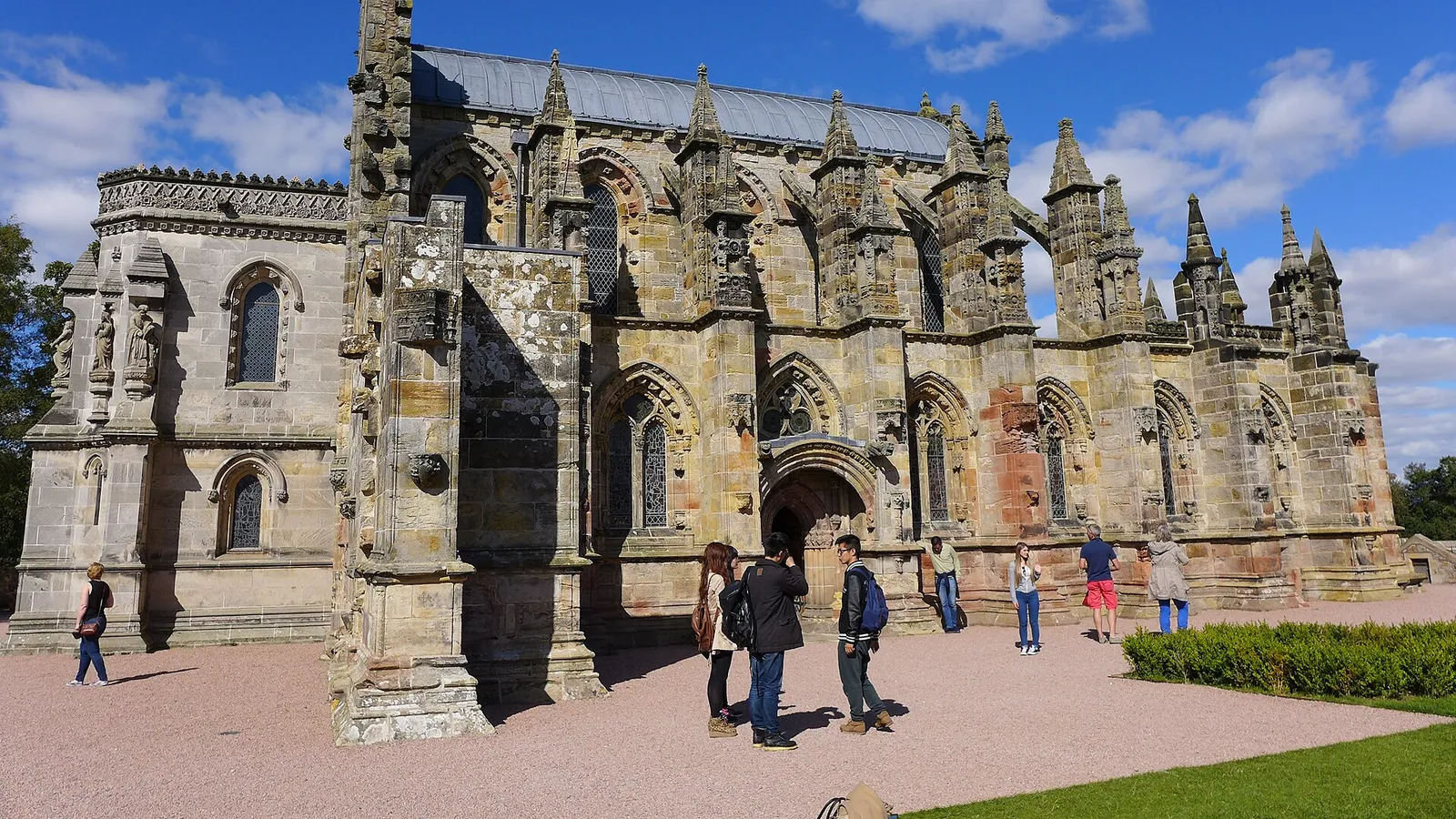

Rosslyn Chapel: Stone, Story and the Making of a Legend
Contents
TL;DR
Rosslyn Chapel stands above Roslin Glen, about eight miles south of Edinburgh. It was founded in 1446 by William Sinclair, third Earl of Orkney, as the Collegiate Church of St Matthew, a church endowed so that priests would pray for ever for the souls of its founder and his family. Only the choir of a planned cross-shaped church was built, but it holds some of the densest and most inventive stone carving in Britain: well over a hundred Green Men, angels playing musical instruments, biblical scenes and the spiralling Apprentice Pillar.
Its later history is almost as remarkable. It was attacked by Reformation mobs, used as a stable by Cromwellian troops, nearly lost to ruin, and admired by the Wordsworths and Queen Victoria. It was restored and rededicated in 1862. From the eighteenth century onwards it gathered a vast cloud of legend about Templars, Freemasons, the Holy Grail and even the bloodline of Christ, culminating in Dan Brown's The Da Vinci Code (2003). This card tells both stories, the chapel as historians know it and the chapel as storytellers have imagined it, and keeps them clearly apart.
Key Findings
- It was founded in 1446 by William Sinclair, Earl of Orkney. By 1456 it was already known as a "College Kirk". Building continued until the founder's death in 1484, and his son Oliver finished the work in a reduced form, traditionally by 1487.
- It is a fragment. What stands is the choir, the east end, of a much larger planned church. Scotland had about forty-five collegiate churches, and several were never finished.
- The carving was made with care. According to the seventeenth-century family historian Father Richard Hay, designs were first carved in wood and approved before the masons copied them in stone. The master mason was paid £40 a year and the others £10.
- A scholar was close to the project. Sir Gilbert Hay, a St Andrews graduate who had served in France, translated works on chivalry and statecraft for Earl William at Roslin in 1456.
- It survived the Reformation, narrowly. Mobs smashed its statues and, in 1592, its altars. Cromwellian troops under General Monck stabled their horses there in 1650, and a Protestant mob attacked it again in 1688.
- It was rescued in the nineteenth century. It was restored by the architect David Bryce and rededicated as an Episcopal church in 1862, and it is a working church today.
- The legends are modern or folk inventions. The Templars were suppressed in 1312, more than a century before the chapel was founded. The Apprentice Pillar murder story is told of several other churches. No evidence links the chapel to the Grail.
Key Facts
- Founded
- 1446
- Founder
- William Sinclair (St Clair), 3rd Earl of Orkney (died 1484)
- Dedication
- Collegiate Church of St Matthew
- Location
- Roslin, Midlothian, above Roslin Glen
- Completed form
- The choir (east end) only of a planned cruciform church
- Key early source
- Father Richard Hay, family historian (17th century)
- Famous features
- The Apprentice Pillar; more than 100 Green Men; musical angels
- Reformation damage
- 1560s statues; 1592 altars destroyed; 1688 mob attack
- Cromwellian use
- Stable for General Monck's horses, 1650
- Restored and rededicated
- 1862, by David Bryce; baptistery added 1880–81
- Today
- A working Scottish Episcopal church; visitor centre opened 2011
Scottish Impact Index (SI Score)
- National Significance
- 8/10
- Historical Continuity
- 10/10
- Human & Economic Importance
- 6/10
- Landscape / Architectural Distinctiveness
- 10/10
- Cultural & Historical Legacy
- 9/10
- Recognition
- 10/10
53/60
Ranked =26th of 43 in Locations
Claim Status
established
- the 1446 foundation by Earl William Sinclair;
- the collegiate status by 1456;
- the incomplete plan;
- the carving programme;
- Gilbert Hay's work at Roslin;
- the Reformation and Cromwellian damage;
- the 1862 rededication;
- the chapel's role in The Da Vinci Code.
shared
- what the carvings mean. Identifying individual figures as Moses, the Three Kings, St Veronica, the Seven Deadly Sins or the Dance of Death is well grounded in medieval iconography. Elaborate symbolic readings are not.
- whether the chapel was always meant to be unfinished. Most historians think money ran out. Some writers argue the design was deliberate.
disputed
- that certain carvings show New World maize or aloe, and so prove contact with America before Columbus. Botanists and historians generally see stylised wheat, strawberries or foliage.
- that patterns on the Lady Chapel's cubes encode music based on sound-wave "Chladni" figures. A composition, The Rosslyn Motet, has been written from them, but there is no evidence that the masons intended any such thing.
- that the chapel was aligned so that a small red window would catch the equinox sun.
Traditional (and legendary):
- the Apprentice Pillar murder;
- Templar treasure;
- the Holy Grail sealed inside a pillar;
- that the chapel stands on a Roman temple of Mithras;
- that pilgrims' cockle shells were ground into its mortar;
- that a carved face is Robert the Bruce's death mask.
None of these has historical support.
The Sinclairs of Roslin
The St Clairs, or Sinclairs, claimed descent from Norman knights of Saint-Clair-sur-Epte. Family tradition says one William "the Seemly" was part of the escort of the Saxon princess Margaret when she came to marry Malcolm III, and that Malcolm and Margaret's son, David I, granted the family the barony of Roslin. The details are tradition, but the Sinclairs were certainly one of Scotland's great noble families. A Sir William Sinclair of Roslin was among the knights who rode with Sir James Douglas in 1330 carrying the heart of Robert the Bruce on crusade, and he died with Douglas fighting the Moors at Teba in Spain.
The founder of the chapel, William Sinclair, succeeded as Earl of Orkney as a child in about 1417 and became one of the richest and most powerful men in Scotland, holding Orkney under the king of Norway and vast lands in Scotland. Father Richard Hay, whose widowed mother married into the Sinclairs of Rosslyn and who studied the family's documents in the seventeenth century, recorded why the old earl began his church:
His age creeping on him... made him consider how he had spent his time past, and how to spend that which was to come... [It] came into his minde to build a house for God's service, of most curious worke.
Hay gives 1446 as the year the work began, near Roslin Castle.
Building the Chapel
Hay describes a carefully run workshop. Designs were first carved in wood and shown to the earl for approval before the masons copied them in stone and set them into the building. The earl, Hay wrote:
rewarded the massones according to their degree, as to the master massone he gave forty pounds yearly, and to everyone of the rest ten pounds, and accordingly did he reward the others, as the smiths and the carpenters with others.
Two other people seem to have shaped the project. One was the earl's first wife, Elizabeth Douglas, whose arms appear with his in the crypt. She died in 1451, soon after work began. The other was Sir Gilbert Hay, a scholar educated at St Andrews who had served the French king. In 1456, at Roslin, he translated works on the law of arms, knighthood and the government of princes for Earl William. They are among the earliest surviving prose works in Scots. By the same year the building was already called a "College Kirk".
The plan was a large cross-shaped church. Only the choir was built. The founder's fortunes suffered in the 1460s: Orkney was pledged to Scotland in 1468, and in 1470 he resigned the earldom to the Crown. Earl William died in 1484, and his son Oliver completed the structure as it stood rather than carrying out the full design. Its plan closely resembles the choir of Glasgow Cathedral, on a smaller scale, but Glasgow has nothing like Rosslyn's carving.
A Forest of Carving
Inside, almost every surface is carved. Biblical scenes run across the arches and capitals: the expulsion from Eden, Abraham and Isaac, Moses, the Three Kings, the crucifixion and St Veronica's veil. Angels play bagpipes, lutes and other instruments, and there is a Dance of Death and a series of Virtues and Deadly Sins. Above all there are Green Men, faces sprouting foliage, more than a hundred of them inside and out, more than in any other medieval building. Some writers have noticed that the faces seem to age as one moves around the chapel, from youthful to skull-like. Whether that was intended is a matter of interpretation.
The most famous carving is the Apprentice Pillar, at the south-east corner of the Lady Chapel, wound about with spiralling bands of foliage and resting on a base of intertwined dragons. Its neighbours, the Master's Pillar and the Journeyman's Pillar, are plainer.
The Reformation and After
After the Reformation of 1560 the chapel was a target. In the 1560s John Knox complained that Mary, Queen of Scots, heard mass at Rosslyn or Woodhouselee, and a mob marched on the chapel, calling it "a house and monument of idolatrie", and smashed statues from their niches. Local tradition credits a farmer, Thomas Cochrane, with saving worse damage by telling the crowd that the castle cellars were full of wine. The provost and prebendaries, whose endowments had been seized, resigned in 1571. In August 1592 the stone altars were torn out and broken down to "one stane or tua hight". The Sinclairs clung to Catholicism, and the laird of the day, accused of keeping a miller's daughter as his mistress, offered to sit on the penitents' "creepie stool" only if he was given a quart of wine to pass the time. He eventually left for Ireland.
In 1650 General Monck, besieging Roslin Castle for Cromwell, stabled his horses in the chapel. In the same year another Sir William Sinclair, killed at the Battle of Dunbar, was the last of the family to be buried in armour in the vault. A Protestant mob attacked the chapel again in 1688. General James Sinclair glazed the windows, mended the roof and relaid the floor after 1736, but by September 1803, when William and Dorothy Wordsworth visited on their Scottish tour, it was close to ruin. Dorothy wrote:
The architecture within is exquisitely beautiful. The stone, both of the roof and walls, is sculptured with leaves and flowers, so delicately wrought that I could have admired them for hours... three or four leaves of a small fern... grew round a cluster of them at the top of a pillar, and the natural product and the artificial were so intermingled that, at first, it was not easy to distinguish the living plant from the other.
Restoration
Queen Victoria visited in 1842 and hoped that "so unique a gem should be preserved to the country". In 1861 the idea of restoring the chapel to worship took hold, and the third Earl of Rosslyn commissioned the architect David Bryce. The chapel was rededicated in 1862. Bryce, himself a Freemason, added some new carvings in the Lady Chapel. In 1880–81 the fourth Earl added a baptistery with an organ loft above. Rosslyn became, once again, the Collegiate Church of St Matthew, now within the Scottish Episcopal Church.
In the twentieth century, water penetration threatened the carvings. A free-standing steel canopy was built over the chapel to let the stone dry out, and visitors could climb a walkway to see the roof up close. After it was removed, a major conservation programme and a new visitor centre (2011) were funded largely by the flood of visitors drawn by The Da Vinci Code.
How the Legends Grew
The chapel's legends began with its guides. In the early nineteenth century an old guide, Annie Wilson, showed visitors the Apprentice Pillar with a long rod and a well-practised story:
The maister had gane awa to Rome to get a plan for it, and while he was awa his 'prentice made a plan himself and finished it. And when the maister cam back and fand the pillar finished, he was sae enraged that he took a hammer and killed the 'prentice. There you see the 'prentice's face — up there in ae corner, wi' a red gash in the brow, and his mother greeting for him in the corner opposite.
Later tellings named the apprentice Tam Nimmo from Orkney and had him dream the design. The same tale of a jealous master and a murdered apprentice is told of a window at Melrose Abbey, of Rouen and Lincoln cathedrals and of Huish Episcopi church in Somerset. That alone shows it is a travelling legend of the building trade, not a record of an event at Roslin.
Freemasonry added another layer. The Sinclairs of Roslin had genuine links with Scottish masonry in the seventeenth and eighteenth centuries, and a Sinclair became the first Grand Master Mason of Scotland in 1736. Masonic writers read their own symbolism back into the medieval carving and linked the chapel to the Temple of Solomon and to the Knights Templar. The Templars, though, were suppressed in 1312, 134 years before the chapel was begun.
The twentieth century brought the Grail. The writer Trevor Ravenscroft became convinced that the cup of the Last Supper lay sealed in lead inside the Apprentice Pillar and campaigned to have it opened, which the chapel understandably refused. The Holy Blood and the Holy Grail (1982) tied the Sinclairs to a supposed "Priory of Sion" guarding the bloodline of Jesus and Mary Magdalene. Its claims have been comprehensively discredited, and the Priory of Sion has been shown to be a twentieth-century hoax. Dan Brown borrowed the idea for the climax of The Da Vinci Code (2003), and the 2006 film was partly shot at Rosslyn. Visitor numbers rose to levels never seen in the chapel's history.
Other recent theories include the claim that the chapel stands on a Roman temple of Mithras, that pilgrims' cockle shells were ground into its mortar, that a battered carved face is Robert the Bruce's death mask, that the "maize" carvings prove contact with America before Columbus, and that its cubes encode a musical score. These are good stories. None rests on historical evidence.
Timeline
Sir William Sinclair of Roslin dies at Teba carrying the Bruce's heart with Douglas —
William Sinclair succeeds as Earl of Orkney, aged about six or seven —
Building of the chapel begins — Per Father Richard Hay
Death of Elizabeth Douglas, the earl's first wife —
Known as a "College Kirk"; Gilbert Hay translates for the earl at Roslin —
Orkney pledged to Scotland; earl resigns the earldom —
Death of Earl William —
Work ends under his son Oliver — Choir only
Reformation mob smashes statues —
Provost and prebendaries resign —
Altars destroyed —
Monck's horses stabled in the chapel —
Protestant mob attacks the chapel —
Repairs by General James Sinclair —
William and Dorothy Wordsworth visit — Dorothy's Recollections
Queen Victoria visits —
Restored by David Bryce and rededicated —
Baptistery and organ loft added —
The Holy Blood and the Holy Grail —
The Da Vinci Code novel / film —
New visitor centre opens —
Did You Know?
- The masons' designs were first carved in wood and approved by the earl before being cut in stone.
- In 1592 the chapel's altars were destroyed down to "one stane or tua hight".
- Dorothy Wordsworth found living ferns growing among the carved stone leaves, so alike she could hardly tell them apart.
- The Apprentice Pillar murder story is also told of Melrose Abbey, Lincoln, Rouen and a church in Somerset.
- Sir Gilbert Hay's translations, made at Roslin in 1456, are among the earliest surviving prose works in Scots.
Honest Caveats
- Father Hay wrote two centuries later. His account draws on family papers but is not a contemporary record.
- Family traditions. The early Sinclair stories, such as William "the Seemly" and Margaret's escort, are family tradition.
- The source used here is credulous. A Rosslyn Treasury is a collection of legends with a strongly esoteric outlook. This card uses its historical narrative and quotations, not its symbolic interpretations.
- Recent conservation. Details of the conservation programme are summarised from general sources.
FAQ
1Who built Rosslyn Chapel?
William Sinclair, Earl of Orkney, who began it in 1446.
2Why is it unfinished?
Only the choir of a planned cross-shaped church was built. Most historians think the money ran out after the earl lost Orkney and then died in 1484.
3Is the Holy Grail at Rosslyn?
No. There is no evidence for it. The idea comes from twentieth-century writers and The Da Vinci Code.
4Were the Templars involved?
No. The order was suppressed in 1312, more than a century before the chapel was founded.
5Is the Apprentice Pillar story true?
No. It is a travelling legend told of several churches.
6Is it still a church?
Yes. It is a working Scottish Episcopal church, as well as a visitor attraction.
Related
- Freemasonry's Scottish Origins
- Saints, Shrines & Pilgrimage
- The Heart of Robert the Bruce
- Orkney Islands
- Udal Law in Orkney & Shetland
Sources
Primary/Institutional
- Richard Fawcett, Scottish Architecture from the Accession of the Stewarts to the Reformation, 1371–1560 (Edinburgh University Press, 1994).
- Rosslyn Chapel Trust, "History". https://www.rosslynchapel.com/
General
- Historic Environment Scotland, listed building record for Rosslyn Chapel.
Further reading
- Father Richard Augustine Hay, Genealogie of the Saintclaires of Rosslyn (17th century; printed Edinburgh, 1835). Quoted in Snow, below.
- P. L. Snow, A Rosslyn Treasury: Stories and Legends from Rosslyn Chapel (Floris Books, 2017). History chapter, Wordsworth and Annie Wilson accounts, the Reformation and restoration. Its symbolic interpretations are not adopted here.
- Dorothy Wordsworth, Recollections of a Tour Made in Scotland, A.D. 1803 (written 1803–05; published 1874). Snow dates the visit to 1807, but the Recollections place it on the 1803 tour.
Card 047 · Locations