
Piper Alpha, 1988: The World's Deadliest Offshore Oil Disaster
Contents
- TL;DR
- Key Findings
- Quick Facts
- Claim Status
- The Platform
- A Fatal Handover
- 6 July 1988: The First Explosion
- The Risers
- The Accommodation Block
- Escape and Rescue
- The Dead
- The Cullen Inquiry
- Why No One Was Prosecuted
- The Safety Case Revolution
- Remembering the 167
- Legacy
- Timeline
- Did You Know?
- Honest Caveats
- FAQ
- Related
- Sources
TL;DR
On the night of 6 July 1988, a leak of gas condensate ignited on Occidental's Piper Alpha platform, about 120 miles north-east of Aberdeen. Oil and gas from connected pipelines then fed fires that destroyed the platform within hours. Of the 226 men on board, 165 died. Two rescuers from the standby vessel Sandhaven were also killed, giving the accepted total of 167.
Lord Cullen's 1990 report made 106 recommendations, all accepted by the government. They replaced the old rule-book system with operator-written "safety cases" overseen by the Health and Safety Executive. In 1991 the Lord Advocate decided there was not enough evidence to prosecute anyone.
Key Findings
- 167 died. That is 165 men from the platform and two crew of the Sandhaven's fast rescue craft. The official survivor figure is 61: 55 contractors and 6 Occidental staff.
- The trigger was small. The inquiry's most probable cause was the release of "as little as 30 kg of condensate", mainly propane. It leaked through an untested blind flange that had been fitted in place of a pressure safety valve, removed from condensate pump A for maintenance.
- Design and connections made it a catastrophe. A gas plant retrofitted in the late 1970s sat beside the control room. The firewalls were built to resist fire, not blast. The Tartan and Claymore platforms kept pumping oil into a shared line for about an hour, feeding the fire.
- Most of the dead were in the accommodation block. Men gathered there waiting for instructions that never came, and 109 died of smoke inhalation. Survivors mostly escaped by ropes, ladders or by jumping, some from the helideck about 175 ft (more than 50 m) above the sea.
- Cullen found deep management failures. Occidental's senior management were "too easily satisfied" that safety was being maintained. Department of Energy inspections were "superficial to the point of being of little use".
- No one was prosecuted. On 24 July 1991 the Lord Advocate announced that there was insufficient evidence to establish criminal liability.
- The reforms became a model for offshore regulation worldwide. They included HSE regulation from 1991, the Safety Case Regulations of 1992, the PFEER Regulations of 1995 and the industry's Step Change in Safety initiative of 1997.
Quick Facts
- Date
- Wednesday 6 July 1988; first explosion about 22:00
- Location
- Piper field, UK North Sea, about 120 miles (193 km) north-east of Aberdeen
- Operator
- Occidental Petroleum (Caledonia) Ltd
- Production began
- December 1976
- People on board
- 226
- Deaths
- 167 (165 on the platform plus 2 Sandhaven rescue crew)
- Survivors
- 61 (some sources say 62)
- Bodies never recovered
- 30
- Causes of death
- 109 smoke inhalation, 13 drowning, 11 burns or injuries, 4 undetermined
- Public inquiry
- Lord Cullen; 180 days of hearings in Aberdeen, November 1988 to February 1990
- Report
- Cm 1310, November 1990; 106 recommendations, all accepted
- Prosecution
- None (Lord Advocate's decision, 24 July 1991)
- Key civil case
- Caledonia North Sea Ltd v British Telecommunications plc [2002] UKHL 4
- Replacement platform
- Piper Bravo, producing from February 1993
- Memorial
- Sue Jane Taylor bronze, Hazlehead Park, Aberdeen (1991); Category B listed in 2023
Claim Status
established
- the death toll of 167;
- the 106 recommendations and their acceptance;
- the first explosion in the gas compression module;
- the most probable cause, a condensate leak from the blind flange;
- the failures of the permit-to-work system and the shift handover;
- the firewater pumps being on manual control;
- the transfer of regulation to the HSE;
- the decision not to prosecute.
shared
- the riser rupture times (about 22:20, 22:50 and 23:20);
- the 30 kg figure;
- the 175 ft helideck jumps.
All three are consistent across technical summaries of the inquiry.
disputed
- whether there were 61 or 62 survivors;
- whether 30 or 32 bodies were never recovered;
- the immediate human cause: a 1997 civil judgment reportedly blamed two workers who died, which Cullen had avoided and campaigners contest;
- total compensation figures.
Myth:
- that Claymore kept pumping only because its manager was waiting for head-office permission. That is a simplification of a wider failure of communication and preparedness.
- that a working deluge system would have saved the platform. That is unknown.
The Platform
The Piper field was discovered in January 1973, and oil production began in December 1976. A 30-inch pipeline carried the oil 128 miles to the Flotta terminal in Orkney.
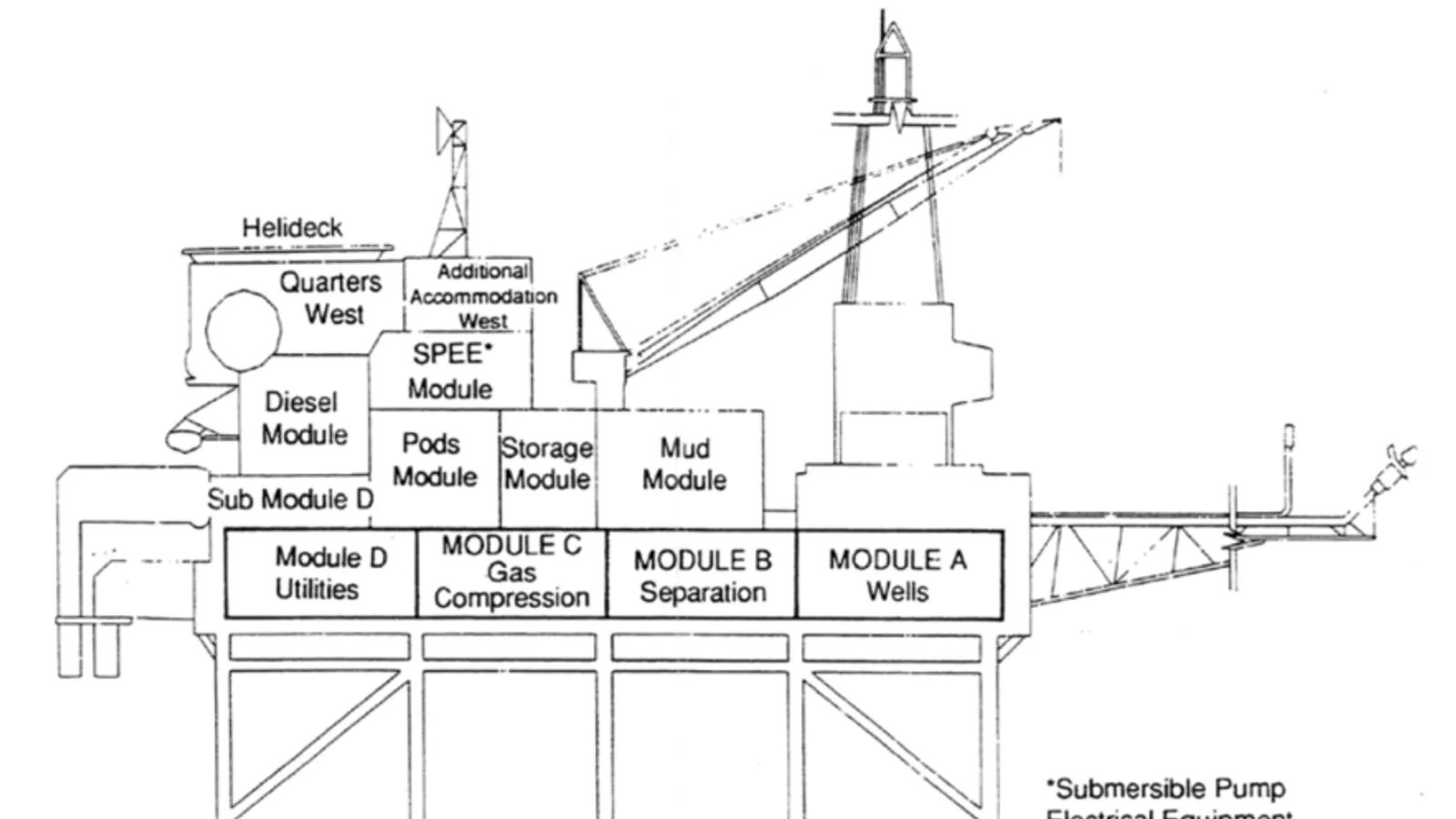
Piper Alpha was designed as an oil producer. Its layout kept the most hazardous operations away from the control room and accommodation. That logic was compromised when a gas treatment and compression plant was retrofitted: gas export began in 1978 (some accounts date the gas module to 1980). The new plant sat beside the control room and beneath the accommodation. A review in the Institution of Chemical Engineers' Loss Prevention Bulletin notes that fire, the worst case the platform was designed for, "was not revisited effectively when the platform was modified to treat gas with additional risk of explosion."
Piper also became a hub. Gas lines connected it to Texaco's Tartan platform, Occidental's Claymore platform and the MCP-01 compression platform, and oil from Tartan and Claymore joined Piper's line to Flotta. On 7 July 1988 the Energy Secretary, Cecil Parkinson, described Piper as "a major producer, producing about 120,000 barrels of oil a day."
A Fatal Handover
During the day shift on 6 July, condensate pump A was taken out of service for maintenance. Separately, its pressure safety valve (PSV 504) was removed for recertification under a different permit. A blind flange was fitted in its place, almost certainly not fully tightened and not leak-tested.
This is where the permit-to-work system failed. Suspended permits were kept in the safety office rather than the control room, and they were filed by trade rather than by location. At the shift handover, the night shift was not told that the valve was missing. Cullen later wrote: "Unknown to them a relief valve had been removed from the pump's delivery pipe and in its place was a blind flange which was not leak tight."
There had been warnings. A contract rigger was killed on Piper Alpha in September 1987 in an accident that exposed weaknesses in the same systems.
6 July 1988: The First Explosion
At about 21:45, condensate pump B tripped. Without a condensate pump, power and production were at risk. The night shift knew pump A was waiting for maintenance, but not that its relief valve was gone, so they moved to restart it.
Gas alarms followed. At about 22:00 an explosion tore through Module C, the gas compression module. The firewalls were not built to withstand blast, and they failed. A condensate line ruptured, starting a large crude oil fire in Module B. The control room was badly damaged and the radio room disabled. Within about a minute, dense smoke had covered the helideck, so evacuation by helicopter, the method the emergency plans assumed, became impossible.
The Risers
The oil fire might have burned itself out. It did not, because the connected platforms kept supplying fuel. Oil flowing back from Tartan and Claymore formed a pool fire beneath Piper's high-pressure gas risers, the pipes carrying gas up from the seabed lines:
- About 22:20: the 18-inch Tartan gas riser failed, releasing gas at roughly three tonnes per second. From that point, the IChemE review says, "Piper Alpha was doomed."
- About 22:50: the MCP-01 riser ruptured.
- About 23:20: the Claymore gas line followed.
Communications with Piper had been lost, and Cullen found that the managers on Tartan and Claymore were ill-prepared for an emergency on a connected platform. Tartan began shutting down oil production at about 22:40 and Claymore at about 23:00, roughly an hour after the first explosion.
The firewater system gave no protection. Piper's diesel fire pumps were switched to manual start whenever divers were in the water, so that divers would not be drawn towards the intakes. Diving was frequent, so the pumps were on manual most of the time. After the explosion they could only be started by hand, and the men who tried to reach them were driven back. No water was ever applied from Piper Alpha's own systems.
The Accommodation Block
Most of the men on board were off duty, and most gathered in the fire-protected accommodation module expecting instructions or a helicopter. No systematic attempt was made to lead them out. The module was not smoke-proof, and smoke and carbon monoxide overcame the men inside. On publication of the report, the Energy Secretary, John Wakeham, told the Commons: "The death toll among those in the accommodation might have been significantly reduced if instructions had been given for personnel to escape from the accommodation by whatever means they could."
As the structure failed, the accommodation module slid into the sea. By the early hours of 7 July most of the topsides lay in wreckage about 140 metres down. The well fires burned for about three weeks before Red Adair's team brought them under control.
Escape and Rescue
Most of those who survived either left the accommodation or never reached it. They climbed down ropes and ladders or jumped from successive decks, some from the helideck more than 50 metres above the sea. No lifeboats were launched successfully.
Andy Mochan, a superintendent, told reporters the next day: "it was jump or fry ... so we jumped." Ed Punchard, the diving inspection controller, lowered a rope towards the sea and led colleagues down to be picked up by the Silver Pit. He later wrote Piper Alpha: A Survivor's Story (1989). Geoff Bollands, the control room operator, gave evidence that helped reconstruct the alarms before the first explosion.
The fast rescue craft of the Silver Pit and the Sandhaven pulled men from burning water close to the platform. At about 22:50, when the MCP-01 riser ruptured, the Sandhaven's craft was destroyed. Two of its three crew and the six men they had just rescued were killed. The firefighting vessel Tharos was nearby, but its response was hampered by lost communications and a power failure.
The Dead
The official toll is 167: 165 of the men on Piper Alpha and two Sandhaven crewmen. Early figures differed. On 7 July, Parkinson reported 229 on board and 65 known survivors, which explains some of the conflicting counts still in circulation.
The recorded causes of death were 109 from smoke inhalation, 13 from drowning, 11 from burns or injuries and 4 undetermined. Thirty bodies were never recovered. The accommodation wreckage was raised in October 1988 and many bodies were recovered from it.
The dead came mostly from Aberdeen and the north-east of Scotland, but also from across Scotland and England. Many worked for contractors rather than Occidental: claims later involved 24 different contracting firms.
The Cullen Inquiry
Lord Cullen, a Court of Session judge, was appointed on 13 July 1988. His inquiry sat in Aberdeen for 180 days between November 1988 and February 1990. Because the physical evidence lay on the seabed, the account had to be rebuilt largely from testimony. The report (Cm 1310) was published in two volumes in November 1990, the first on causes and the second on the future regime.
On Occidental, as summarised by Wakeham, Cullen found "significant flaws in the way in which safety was managed... Senior management were too easily satisfied that safety was being maintained. Workers and management on the platform were not adequately trained and prepared for a major emergency."
On the regulator, Cullen wrote of the June 1988 Department of Energy inspection that it "was superficial to the point of being of little use as a test of safety on the platform." He found the inspectors under-resourced, with just eight full-time field inspectors for 217 installations. Critics argued that a department responsible both for maximising production and for policing safety had a built-in conflict of interest.
The recommendations. Cullen made 106. The central one was that every operator must submit a safety case: a formal demonstration that major hazards were identified and controlled, that a temporary safe refuge existed, and that safe evacuation was possible. The government accepted all of them on the day of publication.
Why No One Was Prosecuted
On 24 July 1991 the Lord Advocate, Lord Fraser of Carmyllie, announced that there would be no criminal proceedings. He found insufficient evidence to establish criminal liability, noting that most of the key personnel on duty had died.
Several factors lay behind the decision:
- Scots law at the time required corporate culpable homicide to be tied to the guilt of an identifiable "controlling mind".
- Cullen's inquiry established facts and deliberately did not assign individual blame.
- By then, Occidental had sold its North Sea interests.
The sense of injustice lasted, and it was one of the arguments made for the Corporate Manslaughter and Corporate Homicide Act 2007.
Compensation and litigation. Settlements with families were reached relatively fast, with an average of about £600,000 per family reported in 1988. Insurers then pursued contractors under contract indemnities in what became Scotland's longest civil proof, 391 days before Lord Caplan. That litigation ended in the House of Lords in 2002. Lord Bingham noted that "the claims made by and on behalf of the victims were fully settled years ago."
The Safety Case Revolution
- 1991: offshore safety moved from the Department of Energy to a new Offshore Safety Division within the HSE.
- 1992: the Offshore Installations (Safety Case) Regulations required every installation to have an accepted safety case. By November 1995 every installation in UK waters had one.
- 1995: the Prevention of Fire and Explosion, and Emergency Response (PFEER) Regulations set goal-based duties directly addressing the failures of 6 July 1988.
- 1997: the industry launched Step Change in Safety, aiming for a 50% improvement in safety performance.
The principle Cullen set out is still in place: those who create risks must show how they control them.
Remembering the 167
The Piper Alpha Families and Survivors Association was formed by bereaved families and survivors. With the Piper Alpha Memorial Fund, it commissioned the memorial in the North Sea Memorial Rose Garden at Hazlehead Park, Aberdeen. The memorial has three bronze figures by Sue Jane Taylor on a granite plinth inscribed with the names and ages of the 167. Queen Elizabeth the Queen Mother unveiled it on 6 July 1991, and it was listed at Category B in 2023.
Every year on 6 July the names are read aloud at Hazlehead. At the 35th anniversary in 2023, North Sea installations fell silent. The disaster is recorded in Stephen McGinty's book Fire in the Night (2008) and in the BAFTA Scotland-winning documentary of the same name (2013).
Legacy
Piper Alpha belongs in Scotland's "Shadow" history because it shows the human cost of the North Sea oil boom, which made Aberdeen Europe's energy capital. It was the worst of a series of offshore disasters: the Alexander L. Kielland (1980, 123 dead), the Ocean Ranger (1982, 84 dead) and the Chinook crash off Sumburgh (1986, 45 dead). By death toll it remains the deadliest offshore oil disaster in the world.
Engineering bodies worldwide teach it as the standard case study in managing change, permits-to-work, handovers, interconnected installations and emergency response. The lesson Cullen pressed hardest was that audit must test "what is actually done and not just what is meant to be done."
Timeline
Piper field discovered —
Oil production begins — Exported to Flotta, Orkney
Gas plant retrofitted — Beside the control room
Contract rigger killed — Permit-to-work weaknesses exposed
Department of Energy inspection — "Superficial" (Cullen)
PSV removed from pump A; blind flange fitted —
Pump B trips — Night shift moves to restart pump A
First explosion in Module C — Oil fire follows
Tartan gas riser ruptures — Escalation beyond control
Tartan / Claymore begin shutting down — About an hour after the first explosion
MCP-01 riser ruptures — Sandhaven rescue craft destroyed
Claymore gas line ruptures —
Accommodation and most topsides in the sea —
Lord Cullen appointed —
Inquiry sits for 180 days — Aberdeen
Cullen Report published — 106 recommendations accepted
Hazlehead memorial unveiled —
No prosecution announced —
Safety Case Regulations; Piper Bravo installed —
PFEER Regulations —
Step Change in Safety launched —
House of Lords ends indemnity litigation —
Memorial listed; 35th anniversary —
Did You Know?
- The fuel for the first explosion was probably only about 30 kg of condensate, released over about thirty seconds.
- At their peak, the fires consumed energy at about three times the rate of the whole UK's energy use.
- On the memorial, the two Sandhaven crewmen are named slightly apart from the 165 platform dead.
- The Cullen Report was made free to download from the HSE in 2018, after lobbying by the Institution of Chemical Engineers.
Honest Caveats
- Quotations. The full Cullen Report was not checked paragraph by paragraph. Its quotations here come from Hansard or reputable technical summaries.
- Timings of the riser ruptures are approximate.
- Conflicting figures. Survivor numbers (61 or 62), bodies never recovered (30 or 32) and bodies recovered from the accommodation differ between sources.
- Compensation totals in circulation (from about £66 million to over $200 million) could not be confirmed from a primary source.
- The "waiting for permission" story about Claymore is widespread but simplifies a more complicated failure.
FAQ
1How many people died on Piper Alpha?
167: 165 men from the platform and two crew of the Sandhaven's rescue craft.
2How many survived?
61 is the official figure. Some reports say 62.
3What caused it?
The night shift restarted a pump without knowing its safety valve had been removed. Condensate leaked through an untested flange and ignited. Behind that lay failures of the permit-to-work system, the shift handover, the platform's design and safety management.
4Why did so many die in the accommodation?
Men gathered there waiting for instructions that never came. The module was not smoke-proof, and most died of smoke and carbon monoxide.
5Was anyone prosecuted?
No. In 1991 the Lord Advocate found insufficient evidence of criminal liability.
6Is it really the world's deadliest offshore oil disaster?
Yes, by death toll.
7What changed afterwards?
Regulation moved to the HSE. Every installation now needs an accepted safety case, and fire and emergency response duties became law.
Related
Sources
Primary/Institutional
- Hansard, House of Commons, 7 July 1988, "Piper Alpha Platform". https://api.parliament.uk/historic-hansard/commons/1988/jul/07/piper-alpha-platform
- Hansard, House of Commons, 12 November 1990, "Piper Alpha" (statement on the Cullen Report). https://api.parliament.uk/historic-hansard/commons/1990/nov/12/piper-alpha
- Hansard, House of Commons, 7 March 1991, "Piper Alpha (Cullen Report)". https://api.parliament.uk/historic-hansard/commons/1991/mar/07/piper-alpha-cullen-report
- Hansard, House of Commons, 2 July 2008, "Piper Alpha Disaster (20th Anniversary)". https://hansard.parliament.uk/Commons/2008-07-02/debates/08070259000001/PiperAlphaDisaster(20ThAnniversary)
- Hansard, House of Commons, 11 July 2013, "Piper Alpha Disaster". https://hansard.parliament.uk/Commons/2013-07-11/debates/13071159000003/PiperAlphaDisaster
- House of Lords, Caledonia North Sea Ltd v British Telecommunications plc [2002] UKHL 4. https://publications.parliament.uk/pa/ld200102/ldjudgmt/jd020207/caledo-1.htm
- UPI, "No criminal action taken over Piper Alpha oil disaster", 24 July 1991. https://www.upi.com/Archives/1991/07/24/No-criminal-action-taken-over-Piper-Alpha-oil-disaster/8953680328000/
- Offshore Installations (Safety Case) Regulations 1992, SI 1992/2885. https://www.legislation.gov.uk/id/uksi/1992/2885
- HSE, evaluation of the offshore safety regulations. https://www.hse.gov.uk/PUBNS/priced/evaluation-offshore-regs.pdf
- Historic Environment Scotland, Piper Alpha Memorial listing (LB52621). https://portal.historicenvironment.scot/apex/f?p=1505:300:::::VIEWTYPE,VIEWREF:designation,LB52621
- Lord Cullen, The Public Inquiry into the Piper Alpha Disaster, Cm 1310 (HMSO, 1990); free download announced by IChemE. https://www.icheme.org/knowledge-networks/knowledge-resources/safety-centre/news/cullen-report/
Scholarly/Critical
- SPE Journal of Petroleum Technology, "Process safety thirty years after Piper Alpha". https://jpt.spe.org/process-safety-thirty-years-after-piper-alpha-disaster
General
- F. Macleod and S. Richardson, "Piper Alpha: the disaster in detail", The Chemical Engineer (IChemE, 2018). https://www.thechemicalengineer.com/features/piper-alpha-the-disaster-in-detail/
- Step Change in Safety, "Our story" and "Remembering Piper Alpha". https://www.stepchangeinsafety.com/our-story/
- Sue Jane Taylor, "Piper Alpha Memorial". https://suejanetaylor.co.uk/piper-alpha-memorial/
- FABIG, "Piper Alpha, UK". https://www.fabig.com/industrial-accidents/piper-alpha-uk/
Further reading
- E. Punchard and S. Higgins, Piper Alpha: A Survivor's Story (1989); S. McGinty, Fire in the Night (2008).
Card 004 · Shadow