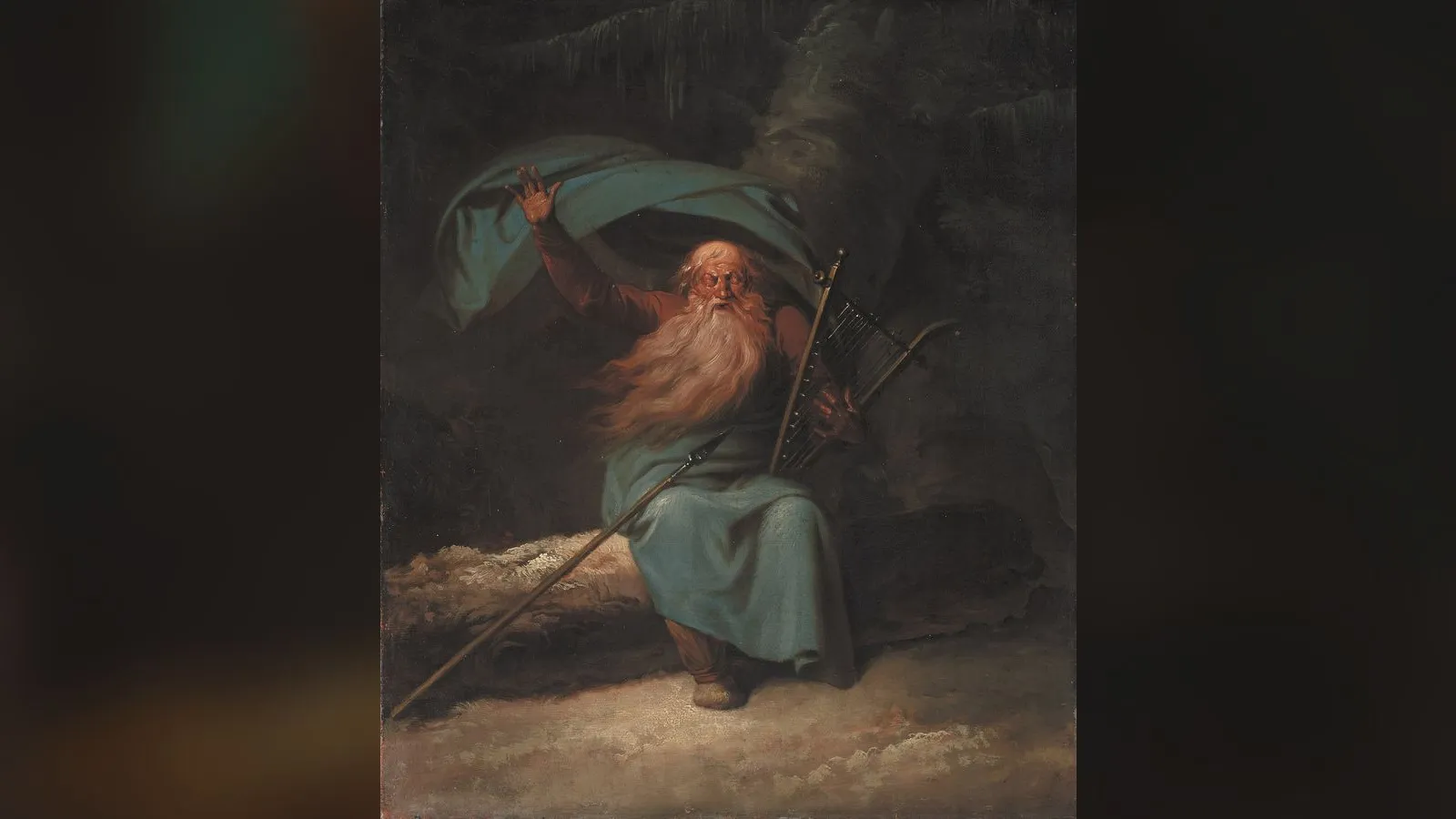

Ossian
Contents
TL;DR
In the 1760s James Macpherson, a young Highland schoolmaster, published what he claimed were translations of ancient Gaelic epics by a third-century bard, Ossian. Fingal and Temora became a European sensation, read by Napoleon and Goethe and a foundation of Romanticism. Samuel Johnson denounced them as a fraud. The truth is in between: Macpherson drew on genuine Gaelic ballads but heavily reshaped and invented much of what he published.
Key Findings
- He published in quick succession: Fragments of Ancient Poetry (1760), Fingal (1761–62) and Temora (1763).
- It was a European phenomenon. The poems were translated widely and admired by Napoleon, Goethe and many others.
- Johnson attacked it. Samuel Johnson called the poems a fake and challenged Macpherson to produce the manuscripts. He never did, convincingly.
- There was a verdict of sorts. A Highland Society inquiry in 1805 concluded that Macpherson had used genuine Gaelic ballad material but had freely edited, combined and added to it.
- It helped invent European romantic nationalism. Historians of the Continent, from Franco Venturi to Anne-Marie Thiesse, place Ossian at the start of the search for national epics that ran from Italy and Poland to Russia and Finland.
- The two epics differ. In Colin Kidd and James Coleman's assessment, Fingal drew on genuine Gaelic poetry of the fifteenth and sixteenth centuries, while Temora was "largely Macpherson's own concoction".
- America read it too. Thomas Jefferson called Ossian the greatest poet that ever existed in 1773, and after the first American edition (Philadelphia, 1790) the poems were reprinted, imitated and staged across the United States, as the literary historian Andrew Hook showed in Scotland and America (1975).
- It shaped how the world saw the Highlands. Ossian helped create a romantic, misty image of the Highlands and fed the cult of the "noble" Celtic past.
Key Facts
- Author
- James Macpherson (1736–1796)
- Works
- Fragments of Ancient Poetry (1760); Fingal (1761–62); Temora (1763)
- Claimed source
- Ossian, a 3rd-century bard
- Critic
- Samuel Johnson
- Inquiry
- Highland Society of Scotland report, 1805 (committee chaired by Henry Mackenzie)
- First American edition
- Philadelphia, 1790, with Blair's Critical Dissertation
- Famous American admirer
- Thomas Jefferson (letter of 25 February 1773)
- Macpherson buried
- Westminster Abbey
Scottish Impact Index (SI Score)
- Cultural Impact
- 10/10
- Enduring Relevance
- 9/10
- Artistic / Cultural Contribution
- 10/10
- Artistic Originality
- 10/10
- Artistic Legacy
- 10/10
- Recognition
- 9/10
58/60
Ranked #16 of 50 in Arts
Claim Status
established The publication history, Johnson's attack and the 1805 inquiry.
shared Macpherson's use of genuine Gaelic ballads, alongside substantial invention; and the judgement that Fingal rests on more genuine material than Temora.
traditional That Ossian was a real historical poet whose works survived intact. There is no evidence of such a single ancient epic.
Before Ossian: a Nation Without a Myth
Ossian arrived at a moment when Scotland had just lost its old origin story. Since the sixteenth century, Hector Boece and George Buchanan had told of a line of forty-odd kings stretching back to a Fergus son of Ferquhard in 330 BC. In 1729 Father Thomas Innes, a Jacobite priest at the Scots College in Paris, demolished it. In his Critical Account of the Ancient Inhabitants of North Britain, he compared the medieval king-lists and traced how copying errors had turned Gaelic names into new ones: Forco became Forgo and eventually Fergus. He concluded that the first forty kings were an invention, probably made to serve the propaganda needs of the Wars of Independence. Kidd and Coleman describe mid-eighteenth-century Scotland, after Innes, as "for a brief period an under-mythologized nation". Ossian filled the gap.
The Sensation
Macpherson's prose-poems, full of mist, heroes and melancholy, captured the mood of the age. Edinburgh literati including Hugh Blair championed them as evidence of an ancient Scottish epic to rival Homer. Macpherson came to the project from Aberdeen, where he had studied under Thomas Blackwell, a scholar of Homer who argued that great epic grew out of heroic, primitive societies. At first, Kidd and Coleman suggest, Macpherson seems to have believed he was reconstructing a real lost epic.
The timing gave the poems extra force. They appeared within twenty years of Culloden, as Highland society was being dismantled. The literary historian Cairns Craig points out that Ossian turned the Highlands from a byword for backwardness into the home of a noble, lost spirituality. Adam Ferguson's Essay on the History of Civil Society (1767) worried about what commercial society lost as it advanced; Ossian seemed to show what had been lost. The poems are, in Craig's phrase, "doubly poems of memory": an old bard calling up the dead heroes of a still older world. That haunted, backward-looking voice became a recurring note in Scottish writing, from James Beattie's The Minstrel (1771–74) to Walter Scott.
Ossian and the Nations of Europe
Ossian's greatest impact was abroad. Melchiorre Cesarotti's Italian translation appeared in 1763, and the Italian historian Franco Venturi argued that Ossian's "extraordinary diffusion" fed the patriotism of the Enlightenment. Goethe quoted it at length in The Sorrows of Young Werther (1774). The French scholar Anne-Marie Thiesse has given Ossian, and later Walter Scott, a central place in the making of Europe's national identities.
The poems set off a hunt for national epics. Kidd and Coleman note that every nation, or would-be nation, seemed to want its own Ossian:
- Russia: in the 1790s Count Musin-Pushkin produced a twelfth-century epic, The Song of Igor's Campaign, published in 1800. The original manuscript burned in the Moscow fire of 1812.
- Finland: Elias Lönnrot, a medical student, collected folk poetry in Karelia and published it as the Kalevala in 1835.
- Poland: by the 1790s, the decade of the final partition, Ossian was a major force in Polish literary and historical circles.
- Ireland: Irish scholars complained from the start that Macpherson had stolen their antiquity. In the nineteenth century the effort to reclaim the Fenian heroes as Irish helped inspire W. B. Yeats and the Irish Revival.
There is an irony here. Ossian came out of a loyal, unionist Edinburgh culture, yet it gave Europe a template for nationalism that sat uneasily with that culture.
Fraud or Folklore?
Gaelic heroic ballads about Fionn (Fingal) and his son Oisean (Ossian) genuinely circulated in the Highlands and Ireland. Macpherson collected some, but he reshaped them into epics in a style of his own. Irish scholars also objected that he had claimed shared Gaelic heroes as purely Scottish.
"Many men, many women, and many children"
Boswell's Life of Johnson shows how fierce the quarrel became. In 1763, with the controversy "at its height", the Edinburgh professor Hugh Blair asked Johnson whether he thought any man of a modern age could have written such poems. Johnson replied: "Yes, Sir, many men, many women, and many children." Blair, it turned out, had just published a Critical Dissertation ranking Ossian with Homer and Virgil.
Johnson's challenge was always about evidence. In a letter to Boswell after the Hebridean tour he wrote: "If there are manuscripts, let them be shewn, with some proof that they are not forged for the occasion." He dismissed one Gaelic manuscript he had heard of as "probably not fifty years old", and thought the passages that Highlanders recited from memory were probably retranslations of Macpherson's English. Some of that was unfair. Gaelic manuscripts of Fenian ballads, such as the sixteenth-century Book of the Dean of Lismore, did exist. But his demand for proof was exactly the test Macpherson never met.
Losing Its Grip at Home
Inside Britain the poems lost their standing quickly. David Hume at first supported Macpherson, but his scepticism won out: he said he could not believe in Ossian even if "fifty bare-arsed Highlanders" swore to it. The Highland Society's report of 1805 was balanced. It found that Macpherson had used genuine Gaelic sources, though not from the third century, and had filled the gaps with his own inventions. By the early nineteenth century, Kidd and Coleman conclude, Ossian was "no longer a shibboleth of Scottish patriotism".
The Gaelic text took even longer. In 1807, eleven years after Macpherson's death, the Highland Society of London finally published in London the supposed Gaelic "originals" of the poems, after a long struggle to get the material out of Macpherson and then into print. Donald Meek, writing in The Edinburgh History of the Book in Scotland, calls that struggle "an epic in itself". Ossian also became a staple of the Gaelic press at home: volumes of Ossianic poetry were printed chiefly in Edinburgh, notably by Charles Stewart, and the Inverness printer John Young issued the Poems of Ossian in 1804. Yet in the Gaelic book trade Ossian never rivalled the Bible, published complete in 1801. Meek estimates that some 75 per cent of Gaelic books published between 1800 and 1880 were religious.
The romantic Highlands that Ossian had helped create survived without it. The ban on Highland dress was repealed in 1782. Sentimental Jacobitism became safe, and George IV's tartan-clad visit to Edinburgh in 1822, stage-managed by Walter Scott, put the establishment's seal on it. Because this later "Highlandism" did not depend on any one ancient text, it could not be exposed the way Ossian had been, and it lasted far longer.
Ossian and the Gaelic Language
established Ossian made Gaelic fashionable in polite society without doing much for the people who spoke it. In 1778 the Gaelic grammarian William Shaw wrote that "Antiquity being the taste of the age, some acquaintance with the Gaelic begins justly to be deemed a part of the Belles Lettres". The historical geographer Charles Withers, in Gaelic in Scotland 1698–1981 (1984), points out that the same decades saw the SSPCK forbidding children to speak Gaelic in its schools. He also notes that after Macpherson, writers increasingly called the language "Gaelic" rather than "Irish" or "Erse".
shared Withers argues that the craze did harm as well as good. It encouraged further spurious "Ossianic" collections, such as those of John Clark (1778) and John Smith (1780 and 1787), and the fascination with an imagined ancient epic drew attention away from the genuine Gaelic poetry of the time. The minister of Kilmadock in Perthshire caught the double standard in 1798: true Gaelic was "a noble language, worthy of the fire of Ossian", but the Gaelic actually spoken near Callander was, he wrote, "quite incapable of communicating a noble idea".
Ossian in America
Jefferson's "greatest Poet". established Ossian reached America early. The Philadelphia bookseller David Hall advertised Fingal and Temora in 1766, and Thomas Jefferson was an ardent reader by 1773. On 25 February that year he wrote to Charles McPherson in Edinburgh that he thought "this rude bard of the North the greatest Poet that has ever existed", and asked for a Gaelic grammar and dictionary so that he could read the originals (as quoted by the literary historian Andrew Hook in Scotland and America, 1975). Jefferson's library later held Alexander MacDonald's Gaelic poems (1751) and John Macpherson's Critical Dissertations on the ancient Caledonians (1768).
A vogue of the 1790s. established Hook finds that the wider American fashion came later. John Trumbull's satire M'Fingal (1775) borrowed little more than the title. The first versified extracts appeared in the Charleston Columbian Herald in 1785, by the young poet Joseph Brown Ladd, followed by imitations and parodies from William Munford, J. M. Sewall, J. L. Arnold, Paul Allen and others. The first American edition, with Hugh Blair's Critical Dissertation, was published at Philadelphia in 1790. A stage spectacle, Oscar and Malvina; or, the Hall of Fingal, billed as "A grand Scottish Heroic Spectacle" taken from the poems, was published at Boston and Charleston in the mid-1790s. By 1801 a contributor to the Philadelphia Port Folio could print a versified extract without notes, because Ossian was "in every library". Further editions followed at New York (1801, 1806, 1810), Philadelphia (1802), New Haven (1806) and Morristown, New Jersey (1813, 1815, 1823).
The authenticity debate crosses the Atlantic. established American readers followed the controversy closely. Henry Mackenzie's Mirror, reprinted at Boston (1792) and Philadelphia (1793), carried an essay that read the poems' few, sublime images as signs of antiquity. The New York clergyman Samuel Miller, in his Brief Retrospect of the Eighteenth Century (1803), called them a work of "true and uncommon genius" whatever their origin. In 1805 Charles Brockden Brown's Literary Magazine echoed almost word for word the Edinburgh Review's verdict on the Highland Society report, produced by a committee chaired by Henry Mackenzie: Fingal had not lived nor Ossian sung, but a remote corner of the Highlands had produced a bard who gave a new tone to poetry throughout Europe. In 1806 the Port Folio answered with the highest American praise the poems ever received.
A Pennsylvania disciple. established The Philadelphia minister and poet John Blair Linn (1777–1804) held Ossian, his brother-in-law Charles Brockden Brown wrote, "in higher estimation than any other poet". Linn wrote an Ossianic ode on the death of Washington, praised "Sublimest Ossian" in The Powers of Genius (1801), and insisted in its appendix that the poems were genuine because he had met people in America who could recite them in Gaelic.
In Virginia. established Ossian also had a place in Southern literary life. The historian Richard Beale Davis, cited by Hook, describes William Wirt's circle in Richmond around 1800 discussing Ossian, Scott and the Edinburgh Review over bowls of punch, and argued that Virginians had been prepared for Scott by Ossian, Sterne and Jane Porter's Scottish Chiefs.
Why Americans liked it. shared Hook offers two explanations. One is the rise of a romantic taste that found in Ossian a challenge to a dying English neo-classicism. The other is political: a newly independent people responded to a cultural nationalism remote from polite English culture, yet one that was safely backward-looking, inviting regret for the past rather than revolution in the present. Both are his interpretation. Hook also urges readers not to dismiss the poems simply as a successful fraud, and, following the historian George Pratt Insh, reads their elegiac note as a lament for Highland society after Culloden. Macpherson, born at Ruthven near Kingussie in 1736, was a boy of about ten when the remnants of the Jacobite army regrouped at Ruthven after the battle, and Hook thinks he probably saw them arrive.
American pilgrims to "Ossian's country". established By the 1820s Americans in Scotland went looking for Ossian's landscape. In 1825 the New York journalist Nathaniel Carter passed Belleville near Kingussie, home of Macpherson's son, heard Gaelic songs ascribed to Ossian at an inn near Ballachulish, and found in Glencoe "the originals of those rocks, solitudes, clouds, mists, storms and torrents" of the poems (as quoted by Hook). In 1832 Calvin Colton of the New York Observer visited the Hermitage on the River Braan near Dunkeld, where a painting of Ossian singing was drawn aside to reveal the waterfall, with a ceiling mirror that made the falls seem to pour overhead.
Legacy
Ossian influenced painters, composers and poets across Europe. The name Fingal's Cave on Staffa reflects the Ossianic craze. The poems remain a classic case study in authenticity and national myth-making.
Timeline
Thomas Innes demolishes the legend of the forty early kings — Prepares the ground
Fragments of Ancient Poetry —
Fingal —
Temora; Cesarotti's Italian translation —
David Hall offers Fingal and Temora for sale in Philadelphia — First known American sale
Jefferson calls Ossian "the greatest Poet that has ever existed" — Letter to Charles McPherson
Ferguson's Essay on the History of Civil Society —
Goethe's Werther quotes Ossian —
Johnson's Journey to the Western Islands attacks the poems —
Joseph Brown Ladd's versified extracts in the Charleston Columbian Herald — Earliest American verse versions
First American edition, Philadelphia, with Blair's Dissertation — Start of the American vogue
Macpherson dies —
John Blair Linn's The Powers of Genius hails "Sublimest Ossian" — Philadelphia
Highland Society report —
Gaelic "originals" published in London by the Highland Society of London —
Nathaniel Carter tours Glencoe as Ossian's country — American literary tourism
George IV's visit to Edinburgh — Highlandism without Ossian
Lönnrot's Kalevala — One of the national epics Ossian inspired
Did You Know?
- Ossian had powerful backers among the improvers. Lord Kames and David Dalrymple sponsored Macpherson's manuscript-collecting tour, and the naturalist John Walker reported in 1764 that Hebrideans lived "in almost the same Situation as in the Days of Oscian". Joseph Banks hunted for Ossianic landmarks on his 1772 Hebridean voyage (Jonsson, 2013).
- Despite championing Gaelic epic, James Macpherson believed his own clan was Germanic in origin, descended from the Catti of Tacitus. His obituary in the Scots Magazine (1796) repeated the claim. His fiercest critic, John Pinkerton, made the Picts "Goths" partly to deny Scotland an ancient Gaelic literature (Colin Kidd, 2002).
- Napoleon reportedly carried Ossian on campaign.
- Goethe included passages of Ossian in The Sorrows of Young Werther.
- Macpherson was buried in Westminster Abbey.
- David Hume said he would not believe in Ossian even if "fifty bare-arsed Highlanders" vouched for it.
- Finland's national epic, the Kalevala (1835), belongs to the wave of epic-hunting that Ossian set off.
- Thomas Jefferson asked an Edinburgh correspondent for a Gaelic grammar and dictionary so that he could read Ossian in the original.
- A Philadelphia poet, John Blair Linn, wrote an ode on the death of George Washington in imitation of Ossian's style.
- At the Hermitage near Dunkeld, an American visitor in 1832 watched a painting of Ossian drawn aside to reveal a roaring waterfall.
Honest Caveats
- The exact proportion of genuine ballad material in Macpherson's text is debated.
- Influence is hard to measure. Claims that Ossian "founded" European nationalism are an interpretation that Continental historians broadly share, not a measurable fact.
- Do not date the American Ossian craze to the 1760s. Jefferson and a few others read the poems early, but Hook shows that American imitations begin only in 1785 and the general vogue in the 1790s.
- Hook's political reading is an interpretation. His suggestion that post-Revolutionary Americans liked Ossian as a safe, backward-looking nationalism is argument, not evidence of what readers felt.
- Small slips in the sources: Cairns Craig's chapter in the Oxford Handbook gives "Tamora" for Temora and dates both epics to 1762–63. Fingal in fact appeared in December 1761, with 1762 on its title page.
FAQ
1Was Ossian real?
There was a legendary hero-poet Oisean in Gaelic tradition, but Macpherson's epics were largely his own creation.
2Was it a hoax?
Partly. Macpherson used real Gaelic ballads but invented and reshaped much.
3Why was Ossian so popular in Europe?
It offered a native, non-classical heroic past at the moment when nations across Europe were looking for one, and it inspired imitators and rival national epics.
4Why does it matter?
It helped launch European Romanticism and shaped the romantic image of the Highlands.
5Was Ossian read in America?
Widely. Copies were on sale in Philadelphia by 1766, Jefferson was an enthusiast by 1773, and after the first American edition in 1790 the poems were reprinted at least eight more times by 1823 and imitated by many American poets.
6What did Jefferson think of Ossian?
In 1773 he wrote that he thought this "rude bard of the North" the greatest poet that had ever existed, and he asked for Gaelic books so that he could learn the original language.
7Did Americans believe the poems were genuine?
Opinions divided as in Britain. Some, like the poet John Blair Linn, insisted they were authentic; American magazines also reprinted the Edinburgh Review's 1805 conclusion that Ossian had never sung, while still admiring Macpherson's achievement.
8Who led the 1805 inquiry?
A committee of the Highland Society of Scotland chaired by the novelist Henry Mackenzie. It found genuine Gaelic ballad material behind the poems but no original of Macpherson's epics.
Related
- Staffa & Fingal's Cave
- Fionn mac Cumhaill in Scotland
- Walter Scott & the Historical Novel
- Invented Tradition & Romantic Nationhood
Sources
Primary/Institutional
- National Library of Scotland, Ossian collections. https://www.nls.uk/
- Howard Gaskill (ed.), The Poems of Ossian and Related Works (Edinburgh University Press, 1996).
- Colin Kidd and James Coleman, "Mythical Scotland", in T. M. Devine and Jenny Wormald (eds), The Oxford Handbook of Modern Scottish History (Oxford: Oxford University Press, 2012).
- Colin Kidd, "The Ideological Uses of the Picts, 1707–c.1990", in Edward J. Cowan and Richard J. Finlay (eds), Scottish History: The Power of the Past (Edinburgh University Press, 2002)
- Fredrik Albritton Jonsson, Enlightenment's Frontier: The Scottish Highlands and the Origins of Environmentalism (Yale University Press, 2013)
- Donald E. Meek, "Gaelic Printing and Publishing", and Iain Beavan, "Bookselling", in Bill Bell (ed.), The Edinburgh History of the Book in Scotland, Volume 3: Ambition and Industry 1800–1880 (Edinburgh University Press, 2007)
Scholarly/Critical
- Oxford Dictionary of National Biography, "Macpherson, James".
- Andrew Hook, Scotland and America: A Study of Cultural Relations, 1750–1835 (Blackie, 1975)
- James Boswell, The Life of Samuel Johnson (1791), Oxford Standard Authors edition, ed. R. W. Chapman: Blair and Johnson (1763) and Johnson's letters to Boswell on Ossian.
- Cairns Craig, "The Literary Tradition", in Devine and Wormald (eds), The Oxford Handbook of Modern Scottish History (2012).
- Charles W. J. Withers, Gaelic in Scotland 1698–1981: The Geographical History of a Language (John Donald, 1984; ebook Birlinn, 2021)
General
- Wikipedia, "Ossian". https://en.wikipedia.org/wiki/Ossian
Card 005 · Arts