Discoveries · Medicine
Joseph Lister & Antiseptic Surgery: Glasgow's Gift to Every Operating Theatre on Earth
On the afternoon of 12 August 1865, an eleven-year-old boy with a broken leg was carried into Ward 24 of Glasgow Royal Infirmary. What his surgeon did next — wrapping the wound in carbolic acid rather than reaching for the amputation saw — is the single moment from which modern, safe surgery descends.
Joseph Lister · 1827–1912Glasgow · EdinburghReading time · 18 minUpdated 9 August 2026
In Brief
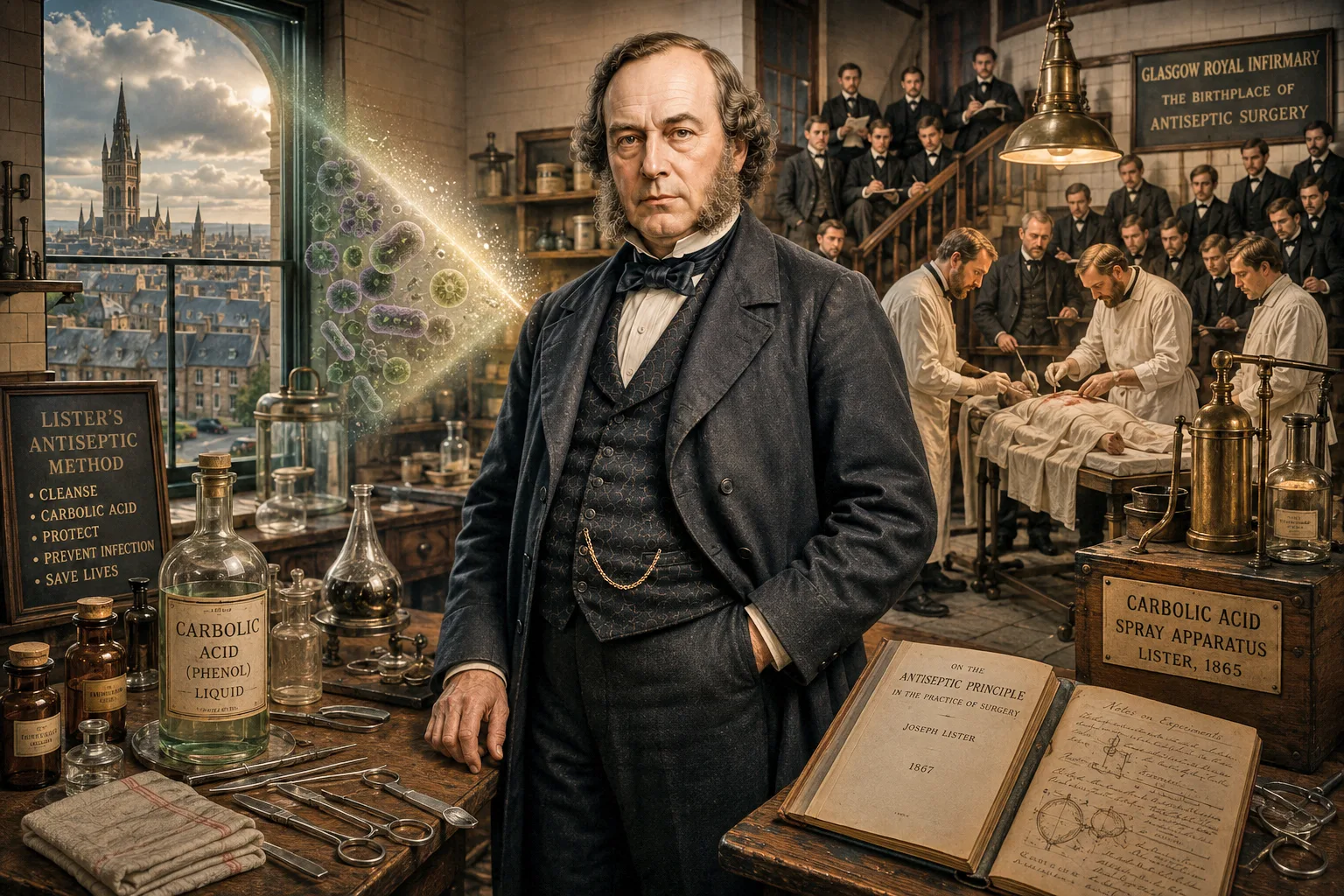
Joseph Lister, an English-born surgeon working as Regius Professor of Surgery at the University of Glasgow, carried out the first successful antiseptic operation on 12 August 1865, treating an eleven-year-old boy's compound leg fracture with carbolic acid instead of amputating. Applying Louis Pasteur's germ theory, Lister showed that wound infection was caused by living microbes, not chemical decay, and that killing those microbes with carbolic acid on wounds, dressings and instruments could cut post-operative mortality dramatically. He refined and taught the method at the University of Edinburgh from 1869. Lister was not the first to link hygiene with survival — the Hungarian physician Ignaz Semmelweis had shown as much in a Viennese obstetric ward in 1847 — but it was Lister, in Glasgow, who built the scientifically grounded, published and internationally adopted system that founded modern surgery.
Scottish Impact Index (SI Score)
- Global Impact
- 10/10
- Longevity
- 10/10
- Economic / Material Impact
- 9/10
- Originality / Distinctiveness
- 9/10
- Legacy (Built Upon)
- 10/10
- Recognition
- 7/10
Key Facts
- Discovery
- Antiseptic surgery — the use of carbolic acid, guided by Pasteur's germ theory, to prevent wound infection
- Key figure
- Joseph Lister (1827–1912), surgeon
- Born
- 5 April 1827, Upton, Essex, England
- Died
- 10 February 1912, Walmer, Kent, England, aged 84
- Where the discovery was made
- Glasgow Royal Infirmary, Scotland — refined at the Royal Infirmary of Edinburgh
- Scottish posts
- Surgeon, Edinburgh Royal Infirmary (1854–1860); Regius Professor of Surgery, University of Glasgow (1860–1869); Professor of Clinical Surgery, University of Edinburgh (1869–1877)
- First antiseptic operation
- James Greenlees, aged 11, compound leg fracture, Glasgow Royal Infirmary, 12 August 1865
- Published
- ‘On a New Method of Treating Compound Fracture, Abscess, etc.’ and ‘On the Antiseptic Principle in the Practice of Surgery’, The Lancet, 1867
- Field
- Medicine · Surgery · Microbiology
- Result in Glasgow wards
- Post-operative mortality fell from roughly 46% to roughly 15%
- Claim status
- Established that Lister founded antiseptic surgery as a system in Glasgow in 1865, building directly on Pasteur's germ theory. Not the first to link hand or instrument hygiene with mortality — Ignaz Semmelweis showed this in Vienna in 1847, in a different clinical context. Lister was English by birth; his defining work was done in Scotland.
An Englishman, Made in Scotland
Joseph Lister was born in Upton, Essex, on 5 April 1827, into a prosperous Quaker family. His father, Joseph Jackson Lister, was a wine merchant and a self-taught optical scientist whose work on achromatic, colour-corrected lenses had transformed the microscope. The son grew up among lenses and specimens, and with the Quaker conviction that scientific rigour was close to a moral duty. He took his medical degree at University College London in 1852.
What happened next made his career, and it happened in Scotland. On the advice of his teachers Lister travelled to Edinburgh to study under James Syme, then the most respected clinical surgeon in the English-speaking world. He meant to stay a month. He stayed seven years. He became Syme's house surgeon, then his assistant, married his daughter Agnes, and in 1855 was elected a Fellow of the Royal College of Surgeons of Edinburgh. In 1860 he was elected to the Regius Chair of Surgery at the University of Glasgow, with a corresponding post as surgeon at Glasgow Royal Infirmary.
It is worth stating this plainly rather than glossing over it: Lister was not Scottish by birth, and he did not become Scottish by naturalisation. He was English, educated in London, and would eventually return south to King's College London in 1877 and die at Walmer in Kent in 1912. What belongs to Scotland is not his nationality but his defining professional achievement — the antiseptic principle, worked out, tested and proven in the wards of Glasgow Royal Infirmary and refined in the lecture theatres of the University of Edinburgh.
Surgery Before Lister
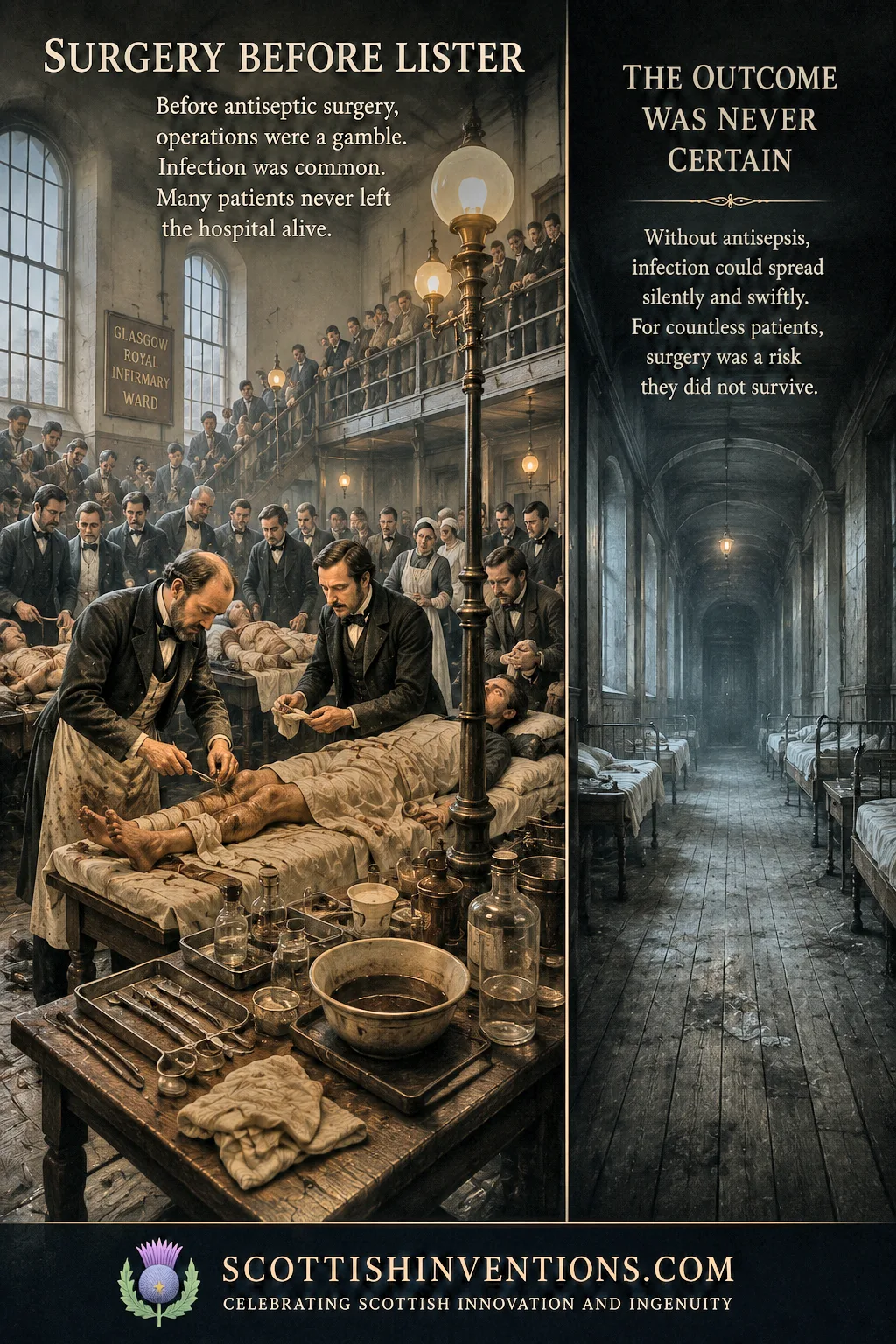
Before Lister, an operation was a gamble with death that had nothing to do with the surgeon's skill with a knife. Anaesthesia, introduced by the Edinburgh obstetrician James Young Simpson with chloroform in 1847, had abolished the agony of surgery. It had not made surgery safe. In the great Victorian hospitals of London, Paris, Vienna and Glasgow, between a third and a half of all major operations ended in the patient's death — not from the knife, but from what followed: gangrene, erysipelas, pyaemia, septicaemia, the catch-all “hospital diseases” that surgeons accepted as the unavoidable price of their craft.
Surgeons operated in frock coats stiffened with old blood; dried pus on the lapels was, absurdly, a badge of experience. Instruments were wiped between patients on the same cloth apron. Ligatures were sometimes held in the surgeon's own mouth. Wards stank of putrefaction, and the presence of “ laudable pus” around a wound was held, in an inversion that seems horrifying now, to be a healthy sign. At Glasgow Royal Infirmary, where Lister took up his Regius chair in 1860, mortality after compound fractures and amputations sometimes ran above 60 per cent.
Nobody had a workable explanation. The dominant theory blamed “miasma” — foul air rising from decaying matter. Others whispered of contagion, without being able to say how it spread. Even James Syme, Lister's own father-in-law and the most admired operator in Britain, confessed that surgeons were essentially powerless against it. Surgery, in the grim phrase of the day, had run into a wall of putrefaction.
Pasteur's Germ Theory, and the Debt Lister Owed
The answer arrived from Paris, and Lister said so, repeatedly and without embarrassment. In 1864 Thomas Anderson, a colleague at the University of Glasgow's chemistry department, drew his attention to the recent work of Louis Pasteur. Pasteur had shown that fermentation and putrefaction were not spontaneous chemical processes in dead tissue, as had been almost universally assumed, but the work of living microscopic organisms carried through the air. Sterilise the environment, and decay stopped.
Lister read Pasteur's papers in the original French, repeated the key experiments at his own bench in Glasgow, and saw what no other surgeon had yet seen: if Pasteur was right, the suppuration that killed his patients was not chemical inevitability but infection — a biological attack on the wound by organisms that could, in principle, be destroyed. This is the intellectual debt at the heart of the discovery, and it should be stated as clearly as any Scottish contribution: without Pasteur's germ theory, there is no Listerian antisepsis.
The remaining problem was practical — with what could a wound be sterilised without poisoning the patient? Lister had read that the town council of Carlisle had successfully treated its sewage with carbolic acid, a coal-tar distillate that killed the smell and, it was suspected, the organisms producing it. If carbolic could sterilise sewage, he reasoned, it might sterilise a wound.
James Greenlees, 12 August 1865
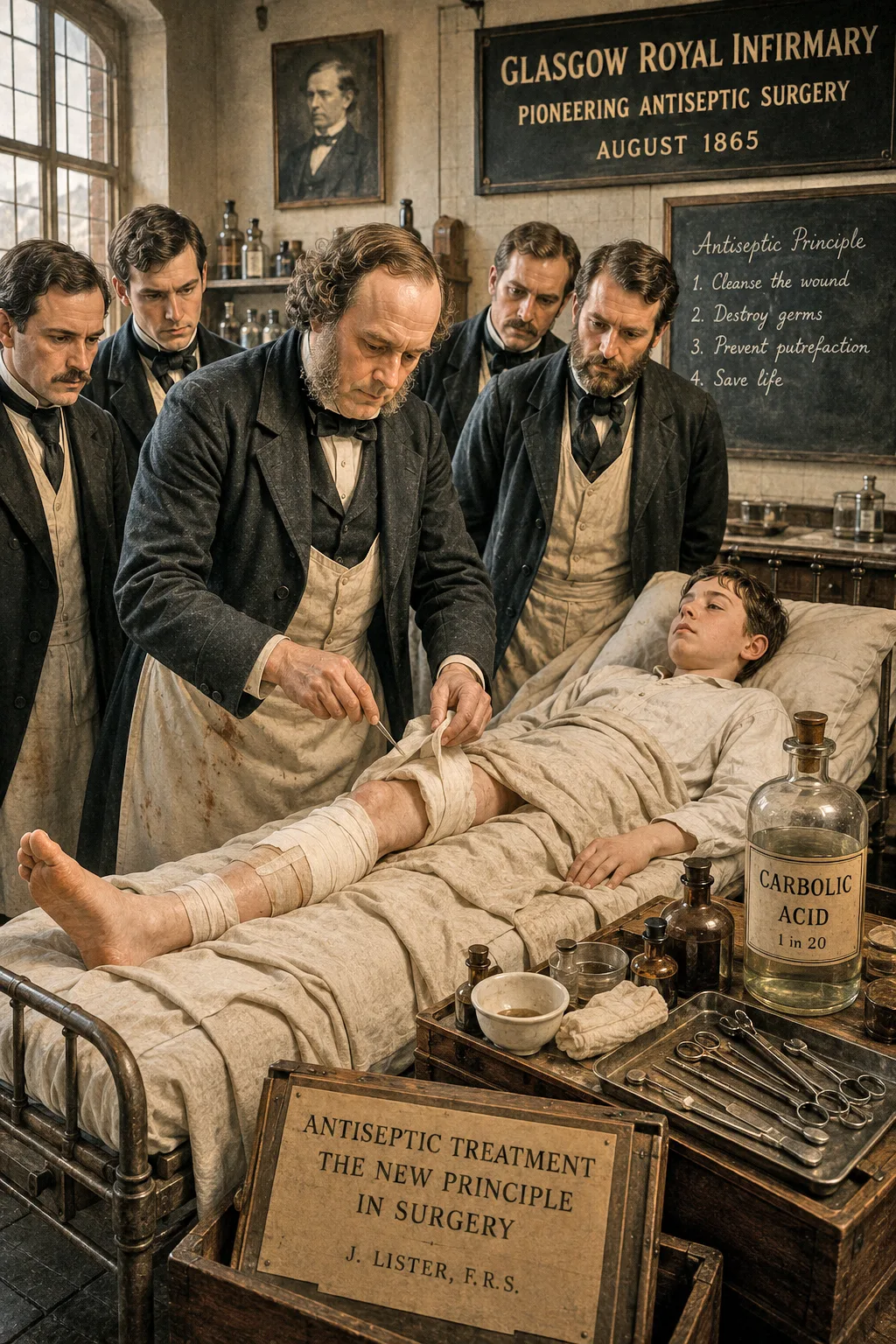
On the afternoon of 12 August 1865, an eleven-year-old boy was brought into Ward 24 of Glasgow Royal Infirmary with a compound fracture of the left tibia. James Greenlees had been run over by the wheel of a cart in the city's High Street. The bone had punctured the skin, and in 1865 a compound fracture was close to a death sentence: the conventional response was immediate amputation, and even then perhaps half of such patients died of infection within weeks.
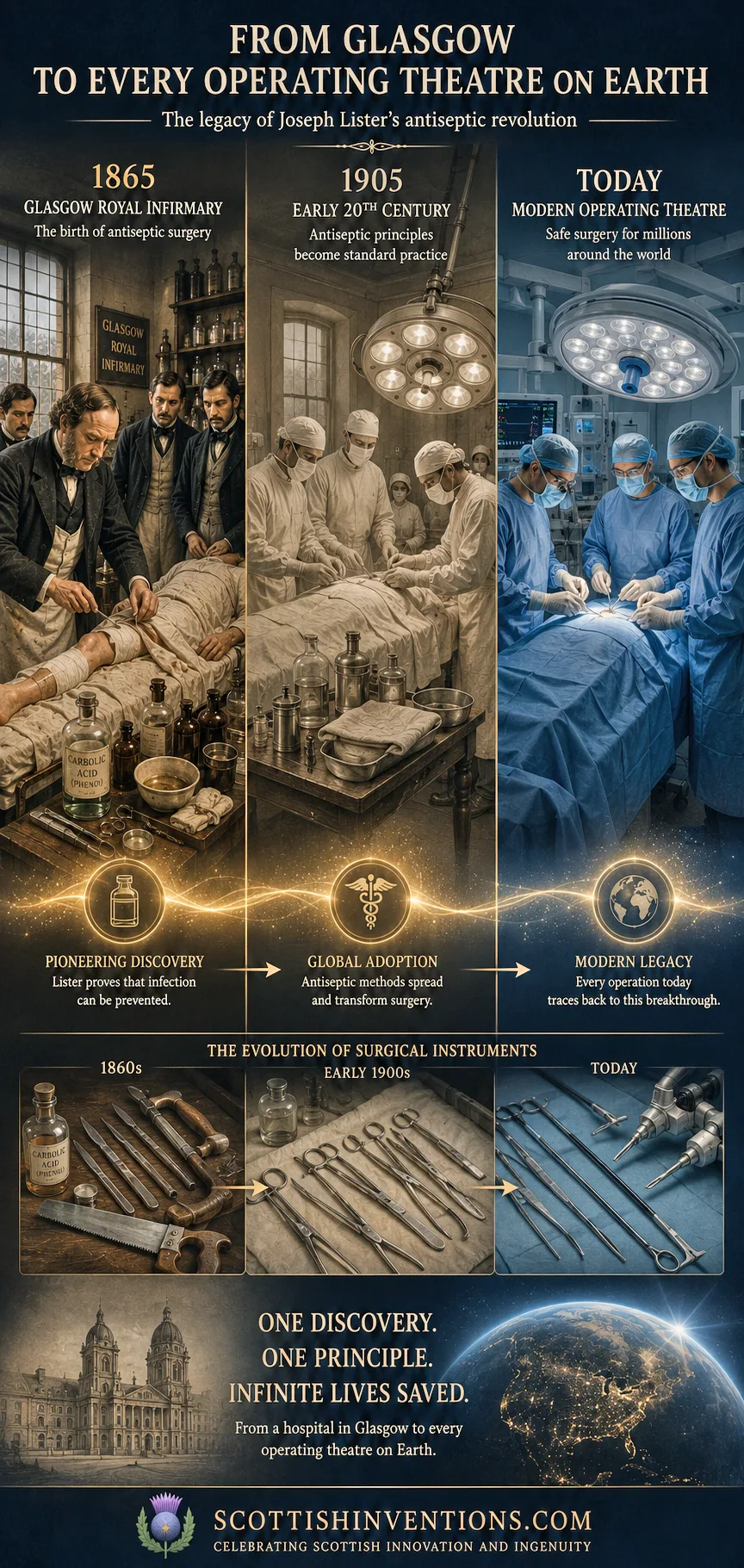
Lister did something no surgeon had done before. He cleaned the wound with carbolic acid. He wrapped it in lint soaked in carbolic, covered the lint with tinfoil to prevent evaporation, splinted the leg, and changed the dressing at intervals. Then he waited.
The wound did not suppurate. There was no gangrene, no fever, no blood-poisoning. After six weeks the bone had united cleanly, and the boy walked out of Glasgow Royal Infirmary alive. Lister, with the caution of the scientist he was, went on to treat ten further compound fractures over the following two years. Nine survived; the one death was caused by haemorrhage, not infection. On the ordinary Glasgow figures of the day, those eleven patients would have produced six or seven corpses.
In March 1867 Lister published the case of James Greenlees and his successors in The Lancet, under the title “On a New Method of Treating Compound Fracture, Abscess, etc., with Observations on the Conditions of Suppuration”. Months later came the great theoretical statement, “On the Antiseptic Principle in the Practice of Surgery”. Together these are the founding documents of modern surgery — and they report work carried out not in London, Paris or Vienna, but in Glasgow. Across his Glasgow wards as a whole, Lister documented a fall in post-operative mortality from roughly 46 per cent before antisepsis to roughly 15 per cent after it: the largest single improvement in surgical safety yet recorded.
How Antiseptic Surgery Worked
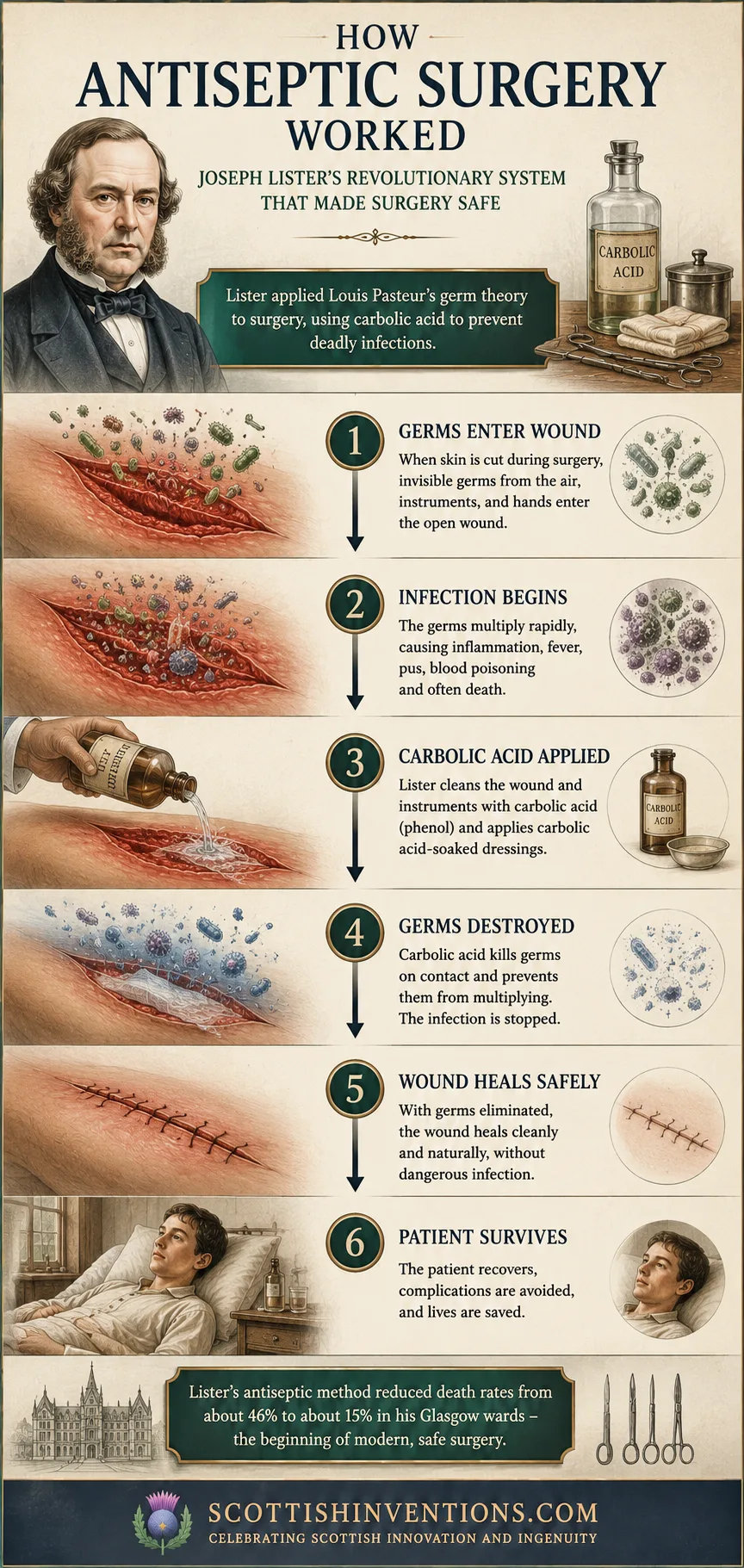
Lister's system rested on a single, almost philosophical insight: the surgeon's enemy is invisible. If Pasteur's microbes caused putrefaction, the wound had to be sealed against them, in three layered ways. First, the wound itself was cleansed with a solution of carbolic acid. Second, every instrument, ligature and dressing that came near it was soaked in carbolic. Third — and most controversially — the air above the operating field was filled with a fine carbolic spray, generated by a hand-pumped brass apparatus that became, for a generation, the visual symbol of Listerian surgery.
The carbolic spray was eventually abandoned, since it poisoned the surgeons more reliably than the germs it was meant to kill, but the underlying principle survived intact: sterilise the wound, sterilise everything that touches it, keep the microbes out, and let the body's own capacity to heal do the rest. In time the chemical antisepsis of carbolic gave way to the steam-sterilised, white-tiled, white-gowned asepsis of the twentieth-century operating theatre — but every gown, every glove, every autoclave descends in a direct line from Lister's Glasgow ward.
Myth vs Evidence: Semmelweis and the Question of Priority
Popular myth
Lister was the first person in medicine to connect hygiene with survival.
Evidence
Ignaz Semmelweis, at the Vienna General Hospital's obstetric clinic, showed in 1847 that chlorinated hand-washing between autopsy work and childbirth deliveries sharply reduced fatal puerperal fever — eighteen years before Lister's Glasgow operation.
This is not a case that should be papered over for patriotic comfort, and it is worth setting out with the same care given to the shared credit between Frederick Banting, Charles Best and John Macleod for insulin. Semmelweis worked in one of Vienna's two maternity clinics, where mortality from puerperal fever was far higher than in the other; he correctly reasoned that doctors and students were carrying infectious material from autopsies to delivering mothers on unwashed hands, and instituted a strict regime of hand-washing in chlorinated lime. Mortality in his clinic fell dramatically. This is a real, independently verified, and earlier demonstration that a form of antisepsis could save lives.
It is not, however, straightforwardly the same discovery as Lister's, for several reasons that matter to an honest account. Semmelweis worked in obstetrics, treating the transmission of infection between individuals through contaminated hands, rather than in general surgery, where Lister addressed infection of an open surgical wound by microbes in the air, on instruments and on dressings. Semmelweis had no germ theory available to him — he attributed the effect to vague “cadaverous particles” rather than living organisms, and could not explain his own results in terms later science would vindicate. His findings met fierce resistance from the medical establishment of his day, were never systematised into a generalisable surgical method, and were essentially unknown to Lister when he began his own work; Semmelweis himself died, largely unrecognised, in 1865, the same year as the Greenlees operation. Lister's achievement, by contrast, rested explicitly on Pasteur's germ theory, was documented in a published case series, was accepted and adopted by the international surgical profession within two decades, and directly founded the discipline that followed.
The fair and accurate summary, then, is this: Semmelweis showed, years earlier and in a specific obstetric context, that a form of antisepsis worked, without being able to explain why or persuade his peers. Lister showed why it worked, generalised it into a scientific surgical system grounded in germ theory, and persuaded the world. Both deserve their place in the history of medicine; neither claim should crowd out the other.
Return to Edinburgh — Teaching a Generation
In 1869, on the retirement of his old teacher and father-in-law James Syme, Lister was appointed Professor of Clinical Surgery at the University of Edinburgh and took charge of the surgical wards of the Royal Infirmary of Edinburgh. For eight years he taught antiseptic surgery to crowded classes of medical students drawn from across the British Empire and beyond. Edinburgh, already the most famous medical school in the world, became the school of antiseptic surgery, and through its graduates the method born in Glasgow spread to every continent.
His Edinburgh students included figures who would themselves shape the future of surgery: Sir Hector Cameron, Sir William Macewen — who succeeded Lister at Glasgow and pioneered brain surgery — and John Stewart, who carried Listerian method to Canada. When Lister finally moved south to King's College London in 1877, he left behind in Scotland a doctrine, a method and a generation of disciples. By the end of the 1880s no respectable surgeon anywhere in the world operated without some form of antisepsis.
Legacy — From Glasgow to Every Operating Theatre on Earth
Lister's legacy is the modern operating theatre itself. Every sterile field, every autoclaved instrument, every gloved hand and masked face, every drape of green cloth around a surgical site is the working-out of the principle he established in Glasgow in 1865. The discipline of surgical asepsis, perfected at the end of the nineteenth century by surgeons such as Ernst von Bergmann in Berlin and William Halsted in Baltimore, did not replace Lister's antisepsis — it grew directly out of it.
His personal honours were unprecedented for a surgeon. He was created a Baronet in 1883 and, in 1897, Baron Lister of Lyme Regis — the first British medical practitioner ever raised to the peerage. He served as President of the Royal Society from 1895 to 1900 and was a founder member of the Order of Merit at its creation in 1902. The Lister Institute of Preventive Medicine in London, the bacterial genus Listeria, and the antiseptic mouthwash Listerine all carry his name.
But the truest monument is statistical. Before 1865, perhaps a third to a half of all major surgical patients died of infection. Today, the post-operative infection rate in a modern hospital is well under one per cent. Every one of the hundreds of millions of operations performed in the world each year is carried out under sterile conditions descended from what Joseph Lister, an Englishman working at Glasgow Royal Infirmary and the University of Edinburgh, established in a single Scottish ward in the summer of 1865.
Did You Know?
- The mouthwash Listerine and the bacterial genus Listeria are both named after Joseph Lister — though he had no hand in either.
- Lister's carbolic spray was eventually abandoned because it poisoned the surgeons more reliably than it killed the germs, but the principle behind it survived.
- Lister was the first British medical practitioner ever raised to the peerage, becoming Baron Lister of Lyme Regis in 1897.
- His father-in-law and teacher, James Syme, held the same Edinburgh chair Lister would later occupy, and was the most admired operating surgeon in Britain.
- Sir William Macewen, Lister's Glasgow disciple, went on to pioneer brain surgery — a further Scottish first that grew directly out of the Listerian school.
- Lister's father, Joseph Jackson Lister, was an amateur optician whose work on achromatic microscope lenses helped make possible the very science of cell biology that underlay germ theory.
Timeline
Ignaz Semmelweis institutes chlorinated hand-washing at the Vienna General Hospital's obstetric clinic
Cuts maternal mortality from puerperal fever dramatically — but the underlying cause (living microbes) is not yet demonstrated, and his ideas are largely rejected in his lifetime
Joseph Lister born in Upton, Essex
Son of Joseph Jackson Lister, wine merchant and pioneer of the achromatic microscope
Takes his medical degree at University College London
Travels north to Edinburgh soon after to study under James Syme
Surgeon at the Edinburgh Royal Infirmary; marries Agnes Syme
Elected FRCS Edinburgh, 1855
Appointed Regius Professor of Surgery, University of Glasgow
Inherits the new surgical wards of Glasgow Royal Infirmary's Donaldson Building — and their high mortality
Thomas Anderson draws Lister's attention to Louis Pasteur's papers on fermentation and putrefaction
Pasteur's germ theory supplies the missing cause
First successful antiseptic operation: James Greenlees's compound leg fracture dressed with carbolic acid at Glasgow Royal Infirmary
The boy survives and walks out of hospital
Lister treats eleven compound fractures with carbolic antisepsis
Nine survive; the sole death is from haemorrhage, not infection
‘On a New Method of Treating Compound Fracture, Abscess, etc.’ published in The Lancet
Reports the Glasgow case series
‘On the Antiseptic Principle in the Practice of Surgery’ published in The Lancet
The founding theoretical statement of antiseptic surgery
Appointed Professor of Clinical Surgery, University of Edinburgh, succeeding James Syme
Teaches antisepsis to students from across the world for eight years
Moves to King's College London as Professor of Clinical Surgery
Leaves behind, in Scotland, a doctrine and a generation of disciples
Created a Baronet
Recognition for the transformation of surgery
President of the Royal Society
The senior office of British science
Created Baron Lister of Lyme Regis
The first British medical practitioner ever raised to the peerage
Founder member of the Order of Merit
Established the same year
Lister dies at Walmer, Kent
By this date antiseptic and aseptic surgery are standard worldwide
Notes on the Evidence
This article treats Lister's 1865–1867 Glasgow work as the founding demonstration of antiseptic surgery as a generalisable, scientifically grounded system, on the strength of his published case series in The Lancet and its rapid international adoption. It treats Semmelweis's 1847 Viennese hand-washing regime as a genuinely earlier and independently verified reduction in fatal infection, in a different clinical context and without an accompanying germ theory, and states this plainly rather than minimising it. Mortality figures for Lister's Glasgow wards (approximately 46 per cent falling to approximately 15 per cent) are those reported in his own published accounts and repeated in subsequent medical-historical scholarship; as with most nineteenth-century hospital statistics, exact denominators vary between sources, and the figures should be read as Lister's own documented record rather than an independently audited modern dataset. Lister's birthplace, dates, appointments and honours are drawn from standard biographical and Royal Society sources.
Frequently Asked Questions
Was Joseph Lister Scottish?
No. Lister was born in Upton, Essex, on 5 April 1827 and died in Walmer, Kent, on 10 February 1912 — an Englishman by birth and death. But the discovery that made him one of the most consequential figures in medical history was conceived, tested and proven in Scotland: as Regius Professor of Surgery at the University of Glasgow (1860–1869) and, later, as Professor of Clinical Surgery at the University of Edinburgh (1869–1877). He had been a Fellow of the Royal College of Surgeons of Edinburgh since 1855 and trained under the Edinburgh surgeon James Syme, whose daughter he married.
What did Joseph Lister actually do on 12 August 1865?
At Glasgow Royal Infirmary he treated the compound leg fracture of an eleven-year-old boy, James Greenlees, by cleaning the wound with carbolic acid, dressing it in carbolic-soaked lint covered with tinfoil, and changing the dressing at intervals rather than amputating, which was the standard response to compound fractures at the time. The wound healed without suppuration, gangrene or fever, and the boy walked out of hospital alive — the first documented antiseptic operation.
Did Lister invent antiseptic surgery from nothing?
No, and it would be inaccurate to claim otherwise. Lister's direct scientific debt was to the French chemist Louis Pasteur, whose work on fermentation and putrefaction showed that living microorganisms, not spontaneous chemical decay, caused rotting — the germ theory that Lister applied to the operating theatre. He also drew on the practical precedent of carbolic acid being used to treat sewage in Carlisle. Lister's achievement was to turn this into a systematic, tested, published surgical method — not to originate the underlying science of microbes.
What about Ignaz Semmelweis — didn't he get there first?
Semmelweis deserves to be stated plainly and fairly. In 1847, working at the Vienna General Hospital's obstetric clinic, the Hungarian physician Ignaz Semmelweis observed that doctors moving from autopsies to deliveries without washing their hands were causing fatal cases of puerperal (childbed) fever, and he instituted chlorinated hand-washing that cut maternal mortality sharply. This predates Lister's Glasgow work by nearly two decades and is a genuinely earlier demonstration that hygiene at the point of contact could prevent fatal infection. It is not, however, a straightforward priority dispute with Lister: Semmelweis worked in obstetrics, not surgery; he had no germ theory to explain why his method worked, attributing it instead to vague ‘cadaverous particles’; his findings were largely rejected and ridiculed by his contemporaries, and he died in 1865, the same year as Lister's Glasgow operation, without his ideas gaining acceptance. Lister's system, by contrast, was grounded in Pasteur's germ theory, was published, was adopted internationally within a generation, and directly founded the discipline of antiseptic and later aseptic surgery. The fair statement is that Semmelweis showed hand hygiene could save lives in one clinical setting years before Lister, but it was Lister who built the scientifically grounded, generalisable system that transformed surgery worldwide.
Who was James Greenlees?
An eleven-year-old boy from Glasgow, run over by a cart on the city's High Street and admitted to Glasgow Royal Infirmary on 12 August 1865 with a compound fracture of the left tibia. He was the first patient treated with Lister's carbolic acid antiseptic method, and his survival without infection is generally regarded as the founding case of modern surgery.
How much did antiseptic surgery reduce mortality?
In his Glasgow surgical wards, Lister documented a fall in post-operative mortality from roughly 46 per cent before antisepsis to roughly 15 per cent afterwards — one of the largest measured improvements in the history of surgical safety. In a modern hospital, the post-operative infection rate is well under one per cent, the cumulative result of Lister's antisepsis evolving into twentieth-century aseptic technique.
What is the difference between antisepsis and asepsis?
Antisepsis, as Lister practised it, means killing microbes already present on a wound, on instruments or in the air using a chemical agent — in his case, carbolic acid (phenol). Asepsis, developed later by surgeons such as Ernst von Bergmann in Berlin and William Halsted in Baltimore, means preventing microbes from ever reaching the wound in the first place, through steam sterilisation, sterile gowns and gloves, and strict operating-theatre discipline. Asepsis did not replace Lister's principle; it is its direct descendant.
Why is Glasgow, not Vienna or Paris, called the birthplace of modern surgery?
Because it was in the surgical wards of Glasgow Royal Infirmary, between 1865 and 1867, that a demonstrably effective, theoretically grounded and internationally adopted system of infection prevention was first developed, tested on a documented case series, and published. Pasteur supplied the science in Paris; Semmelweis had shown a related but unexplained and unadopted effect in Vienna in 1847; it was Glasgow, and afterwards Edinburgh, where the pieces were joined into the method that surgeons everywhere went on to use.
What happened to the carbolic spray?
Lister's operating-theatre spray, which filled the air above the wound with a fine mist of carbolic acid from a hand-pumped brass device, became the visual symbol of Listerian surgery in the 1870s and 1880s. It was eventually abandoned because it irritated and, over time, poisoned the surgeons and assistants who breathed it more reliably than it killed airborne germs. The underlying antiseptic principle — keeping microbes away from the wound — survived and evolved into aseptic technique.
Sources
Tier 1 · Primary
- Lister, J., “On a New Method of Treating Compound Fracture, Abscess, etc., with Observations on the Conditions of Suppuration”, The Lancet, 1867.
- Lister, J., “On the Antiseptic Principle in the Practice of Surgery”, The Lancet, 1867.
- Pasteur, L., papers on fermentation and putrefaction, 1857–1864.
- Semmelweis, I., Die Aetiologie, der Begriff und die Prophylaxis des Kindbettfiebers, 1861 (retrospective account of the 1847 Vienna findings).
- Fisher, R. B., Joseph Lister, 1827–1912, Macdonald & Jane's, 1977.
- The Royal Society, Presidential records, 1895–1900.
Tier 2 · Scholarly and institutional
- Royal College of Surgeons of Edinburgh, biographical records of Fellows, including James Syme and Joseph Lister.
- University of Glasgow and University of Edinburgh, historical records of the Regius and Clinical Chairs of Surgery.