Discoveries · No. 16 of 50 · Medicine
The Son of the Manse Who Helped Conquer Diabetes
The Scottish physiologist J.J.R. Macleod shared the 1923 Nobel Prize for the discovery of insulin — then spent decades being written out of its story. A century later, the evidence reveals a far more remarkable team achievement.
John James Rickard Macleod · 1876–1935Medicine · InsulinScotland / CanadaReading time · 18 minUpdated 6 August 2026
J.J.R. Macleod and insulin — in brief
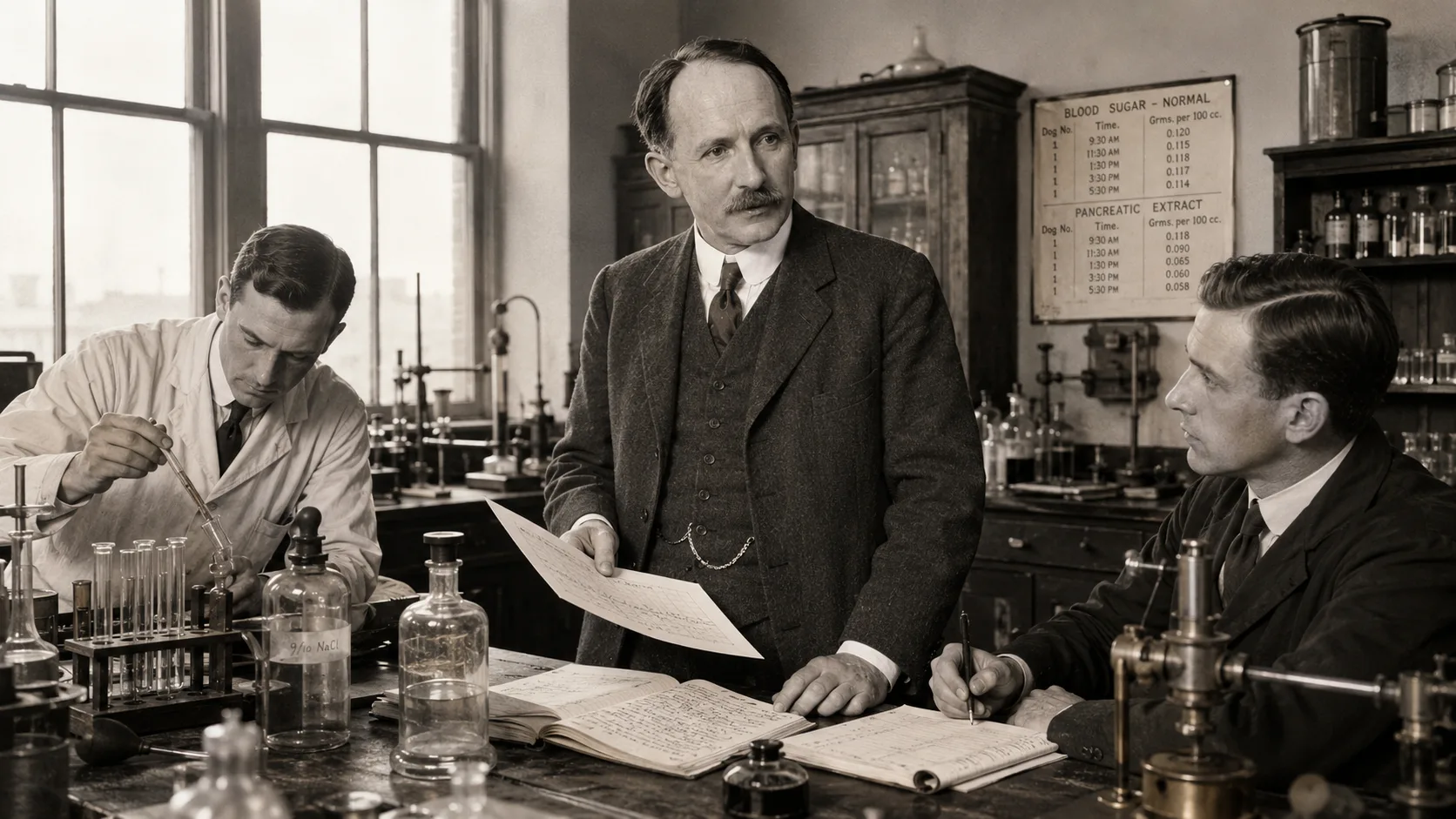
John James Rickard Macleod (1876–1935) was a Scottish physiologist and expert in carbohydrate metabolism who directed the University of Toronto laboratory in which insulin was developed in 1921–22. He provided Frederick Banting and Charles Best with laboratory space, experimental animals, technical guidance and scientific oversight, recruited the biochemist James Collip, and helped turn experimental pancreatic extracts into a scientifically validated treatment. Banting and Macleod shared the 1923 Nobel Prize in Physiology or Medicine, while both divided their prize money with Best and Collip respectively. Insulin was not the achievement of a lone genius: it was the work of four men whose contributions were different and complementary.
Scottish Impact Index (SI Score)
- Global Impact
- 10/10
- Longevity
- 10/10
- Economic / Material Impact
- 9/10
- Originality / Distinctiveness
- 9/10
- Legacy (Built Upon)
- 10/10
- Recognition
- 7/10
J.J.R. Macleod — Key Facts
- Full name
- John James Rickard Macleod
- Born
- 6 September 1876
- Birthplace
- Clunie, near Dunkeld, Perthshire, Scotland
- Died
- 16 March 1935, near Aberdeen, aged 58
- Education
- Aberdeen Grammar School; Marischal College, University of Aberdeen (M.B., Ch.B., 1898); Leipzig
- Field
- Physiology · carbohydrate metabolism
- Known for
- Discovery and development of insulin
- Nobel Prize
- Physiology or Medicine, 1923
- Shared with
- Frederick Grant Banting
- Research team
- Banting, Best, Collip and Macleod
- Returned to Scotland
- 1928
- Later position
- Regius Professor of Physiology, University of Aberdeen
- Claim status
- Disputed priority — credit for insulin is genuinely shared, and was contested for a century
A Death Sentence Written in Sugar
For most of recorded history, a diagnosis of what we now call type 1 diabetes was a sentence of death, usually carried out within months. The body, unable to convert sugar into energy, consumed itself. Children were the most common victims. In the second decade of the twentieth century, the only treatment that offered even a reprieve was starvation.
The regime was pioneered by the American physician Frederick Madison Allen and championed by Boston's Elliott Joslin. Allen's patients were restricted to as little as 400–500 calories a day — fats and minimal carbohydrate, sometimes supplemented with whisky for calories without sugar. Hospital wards became known as "starvation rooms", heavy with the acetone smell of bodies burning their own tissue. Joslin later recalled the grim arithmetic: "We literally starved the child and adult with the faint hope that something new in treatment would appear… It was no fun to starve a child to let him live."
The diet bought time, not life. Elizabeth Hughes, daughter of the US Secretary of State Charles Evans Hughes, was diagnosed in 1919 at the age of eleven; under Allen's care she wasted from a healthy child to roughly 45 pounds, barely able to walk. This was the world insulin would overturn — and the Scot at the centre of that overturning was a minister's son from Perthshire.
A Son of the Manse
John James Rickard Macleod (J.J.R. Macleod) was born on 6 September 1876 in the Free Church manse at Clunie, near Dunkeld in Perthshire, the first child of the Reverend Robert Macleod and his wife Jane Guthrie McWalter. "Jack", as he was known, moved north as a small boy when his father was called to Keith in Banffshire, and in late 1883 the family settled in Aberdeen, where Robert Macleod served as minister of the John Knox Free Church on Gerrard Street for over thirty years.
It was in the Granite City that Macleod's intellect took shape. He attended Aberdeen Grammar School, then entered Marischal College at the University of Aberdeen to study medicine, graduating with honours (M.B., Ch.B.) in 1898 and winning the Anderson Travelling Fellowship, which carried him to the Institute of Physiology at the University of Leipzig for a year of postgraduate study in physiological chemistry.
At Aberdeen he had been shaped by Professor John James MacWilliam, whose emphasis on critical thinking and experimental rigour set the pattern for Macleod's career. Historians have traced Macleod's "deep conservatism as a scientist" — his insistence on controls, repetition and proof — directly to this Scottish education. In Toronto, twenty years later, that inheritance would prove decisive, and would also make him an enemy.
"I Scarcely Know Where to Begin": Banting Meets Macleod
In late 1920, Frederick Grant Banting was a struggling young surgeon in London, Ontario, with no research experience, no publications and not yet even a doctorate. After reading an article on the pancreas, he scribbled a late-night note: "Ligate pancreatic ducts of dog. Keep dogs alive till acini degenerate leaving islets. Try to isolate the internal secretion of these to relieve glycosuria." The idea was that tying off the pancreatic ducts would destroy the cells producing digestive enzymes — which Banting believed were destroying the elusive anti-diabetic secretion before it could be isolated — leaving the islets of Langerhans intact.
Banting brought the idea to Macleod in November 1920. Macleod was, by most accounts, unimpressed; the hypothesis was neither especially original nor, as it turned out, physiologically sound. But he recognised that even a negative result could be useful, and he had a mandate to build Toronto's research capacity.
What Macleod then supplied was not a room. It was laboratory space in a properly funded department, a supply of experimental dogs, the equipment, instruction in the necessary surgery — Macleod personally taught the surgeon Banting how to perform a canine pancreatectomy — and the services of a student assistant. Two recent honours graduates, Charles Best and Clark Noble, were to share the summer's work; they tossed a coin, and Best won the first turn. He never gave it up.
The Summer of 1921 — and the Absent Professor
Banting and Best performed their first operation on 17 May 1921. Macleod worked alongside them for roughly a month before leaving in mid-June for his planned summer in Scotland, partly to represent Toronto at a conference of Empire universities at Oxford. This holiday is the hinge on which the entire controversy turns — and it needs stating precisely. Macleod was absent for part of the summer's dog experiments. He was not absent from the discovery of insulin, which took another eighteen months and a great deal more than those experiments.
Through the sweltering Toronto summer, amid heavy losses of dogs and many setbacks, Banting and Best injected extracts from duct-ligated dog pancreas into diabetic dogs and saw blood sugar fall. Excited, they wrote to Macleod in Scotland: "I have so much to tell you," Banting's letter began, "that I scarcely know where to begin."
When Macleod returned in September, he did what any rigorous scientist would: he pointed out that the results were inconsistent and lacked proper controls, and urged them to repeat and refine the work. To Banting — raw, insecure and broke — this was not scientific caution but theft. He stormed out, reportedly raging, "I'll show that little son of a bitch that he is not the University of Toronto."
It is worth being exact about what the summer achieved. As the historian Michael Bliss concluded, Banting and Best's crude, impure extract barely matched what Georg Zülzer had achieved in Berlin some fifteen years earlier, and their duct-ligation method was soon abandoned in favour of extracts from fresh whole beef and pork pancreas. The "great idea" had been useful chiefly to start the work. The discovery still had to be made.
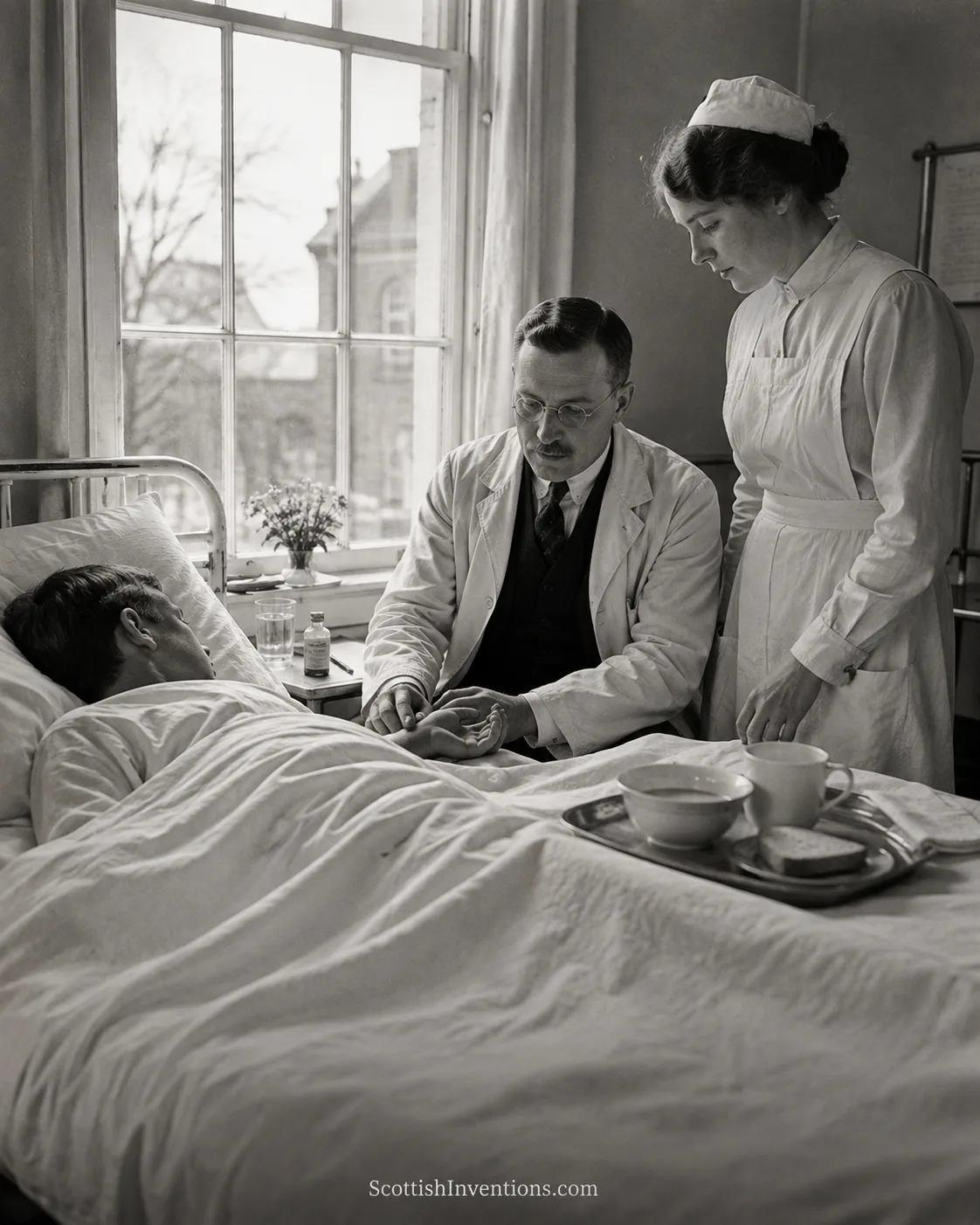
Leonard Thompson was fourteen years old and weighed about 65 pounds. He was close to death in a Toronto ward of the kind described at the start of this article: a boy being starved in the faint hope that something new in treatment would appear.
Something new did appear, twice. The first attempt failed. The second changed medicine. The difference between them was a biochemist Macleod had recruited six weeks earlier.
Collip and the Breakthrough
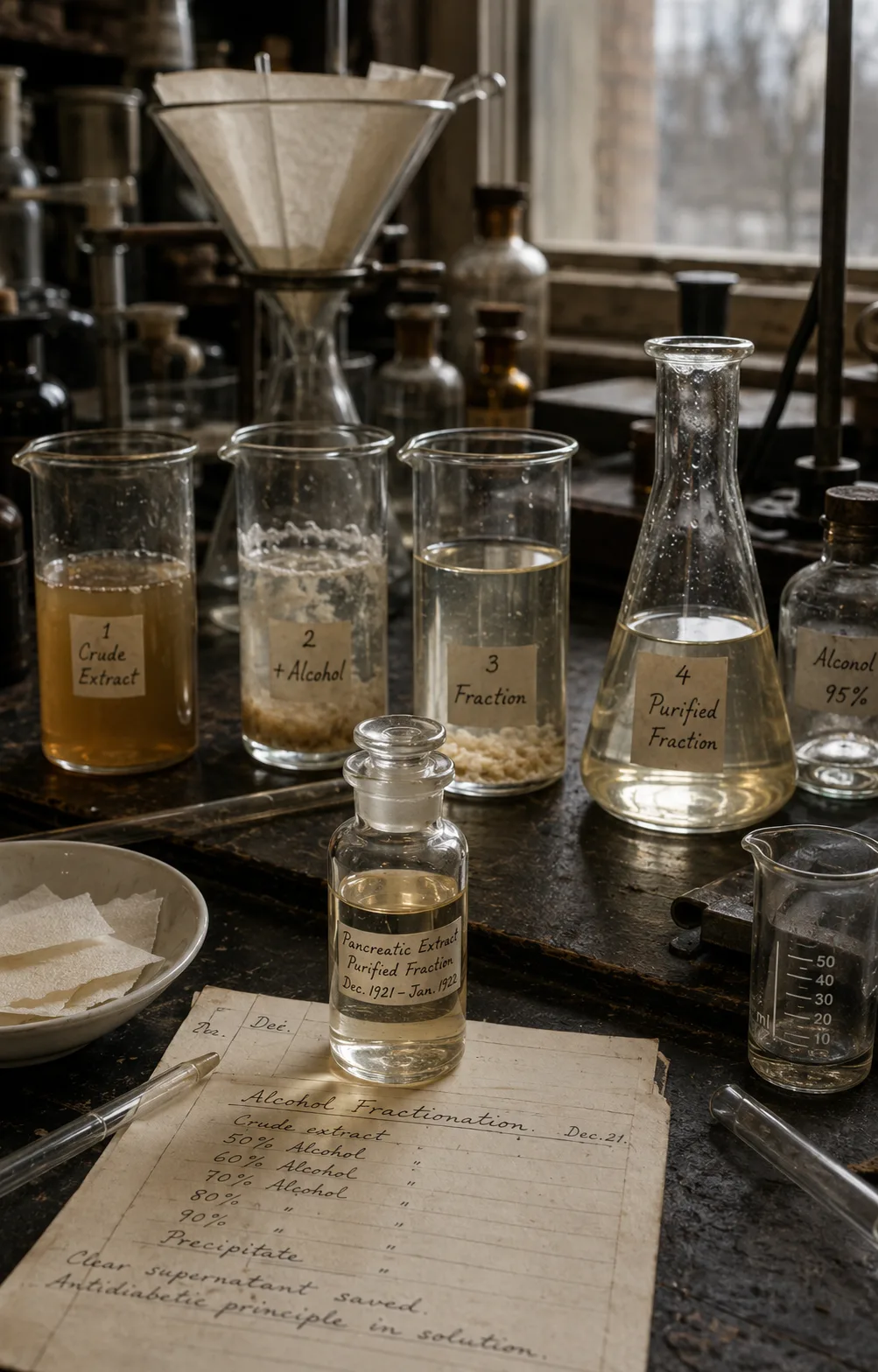
Recognising that turning a promising extract into a safe, reliable medicine required chemical expertise neither he nor Banting and Best possessed, Macleod brought in James Bertram Collip, a biochemist from the University of Alberta on sabbatical in Toronto, in December 1921. It was Collip who, working at a feverish pace, found a way to purify the extract — gradually increasing the alcohol concentration of the solution to precipitate out the active principle and leave the toxic contaminants behind.
The stakes became human on 11 January 1922, when Banting and Best's extract was injected into Leonard Thompson at Toronto General Hospital. The result was a disappointment: blood sugar fell only slightly, the ketoacidosis was untouched, and a sterile abscess formed at the injection site.
Then, on 23 January 1922, Thompson received Collip's purified extract. The results were dramatic: his blood glucose fell from 520 mg/dL (28.8 mmol/L) to 120 mg/dL (6.7 mmol/L) — a decline of roughly 75% — and the sugar and ketones vanished from his urine. The boy revived. Leonard Thompson lived another thirteen years on insulin.
The word for the new substance was settled by Macleod, who suggested "insulin" — after the insular tissue, the islets of Langerhans — later acknowledging that earlier researchers had proposed a similar name. And it was Macleod who took the discovery to the world, announcing it on 3 May 1922 to the Association of American Physicians in Washington.
The patient who became the symbol of the miracle was Elizabeth Hughes. She arrived in Toronto in August 1922 weighing 45 pounds and left transformed, her weight climbing to 79 pounds and her diet rising past 2,500 calories a day. She lived to 73, raised a family, and concealed her diabetes for the rest of her life.
The Discovery of Insulin: 1920–1923
November 1920
Banting approaches Macleod in Toronto
A young London, Ontario surgeon with no research record brings an idea about ligating pancreatic ducts.
17 May 1921
Banting and Best begin experimental work
Macleod supplies the laboratory, dogs, equipment and surgical instruction, and works alongside them for roughly a month.
Summer 1921
Pancreatic extracts lower blood glucose in diabetic dogs
Macleod is in Scotland for a planned summer, partly representing Toronto at a conference of Empire universities at Oxford.
September 1921
Macleod returns and demands stronger controls
He points out that the results are inconsistent and asks for repetition and refinement. Banting takes it as an attack.
December 1921
James Collip joins the team
Macleod recruits the Alberta biochemist whose purification work would prove decisive.
11 January 1922
First human treatment disappoints
Leonard Thompson, 14, receives Banting and Best's extract at Toronto General Hospital. Blood sugar falls only slightly; a sterile abscess forms.
23 January 1922
Collip's purified extract transforms Thompson
Blood glucose falls from 520 mg/dL to 120 mg/dL — roughly 75% — and sugar and ketones almost vanish from his urine.
3 May 1922
Macleod presents the discovery in Washington
The announcement to the Association of American Physicians takes insulin to the scientific world.
1923
Nobel Prize in Physiology or Medicine
Awarded jointly to Banting and Macleod. Banting shares his money with Best; Macleod shares his with Collip.
Who Actually Discovered Insulin?
Frederick Banting, Charles Best, James Collip and J.J.R. Macleod formed the core Toronto team responsible for turning pancreatic extract into clinically useful insulin. That is the historically responsible answer, and it is now the standard formulation among scholars. Their contributions were different and complementary; there is no single winner to name.
Frederick Banting
The original experimental impetus and hands-on surgical research. His idea was neither wholly original nor physiologically sound, but it started the work.
Charles Best
Experimental collaboration through the summer of 1921 and the biochemical and physiological measurements that tracked falling blood sugar in diabetic dogs.
James Collip
Purification. By gradually raising the alcohol concentration of the solution he precipitated out the active principle and left the toxic contaminants behind, turning an extract into a medicine.
J.J.R. Macleod
Scientific direction, facilities, expertise in carbohydrate metabolism, insistence on controls and repetition, recruitment of Collip, naming of insulin, presentation to the scientific world, and the institutional leadership that carried the work through clinical trials to worldwide manufacture.
Weighed honestly
Macleod was demonstrably absent for the headline-grabbing summer dog experiments — the single fact his detractors leaned on for a century. But the discovery of insulin was not the summer of 1921. It was the long passage from a crude extract that lowered a dog's blood sugar, to a purified medicine that saved a dying child, to a product that could be manufactured for the world. Across that passage Macleod provided the laboratory and its funding, the expertise, the experimental design and corrections, the recruitment of Collip, the naming, the announcement, the chairmanship of the University of Toronto Insulin Committee, and the work with Connaught Laboratories, Eli Lilly and later the League of Nations that secured standardisation and worldwide supply. His own later experiments on teleost fish — which have anatomically separate islet and acinar tissue — definitively proved that insulin came from the islets.
Macleod himself, in his Nobel lecture, described the chain of work in the first person, noting that "under my direction" Banting and Best had shown the extracts reduced hyperglycaemia and glycosuria in depancreatized dogs. Asked by a Toronto Star reporter in November 1923 why he had said nothing of his own share, he replied with a laugh: "Oh, I was only the impresario — the managing director." It was self-deprecating, and also exactly accurate.
Why Was Macleod's Nobel Prize So Controversial?
The 1923 Nobel Prize in Physiology or Medicine was awarded jointly to Banting and Macleod. The decisive nomination came from the Danish laureate August Krogh, who, after visiting Toronto, concluded that while the credit for the idea went undoubtedly to Banting, "he would definitely not have been able to carry out the investigations, which from the start and during all stages, have been supervised by Professor Macleod."
Banting was incandescent. He believed Best, not Macleod, deserved the honour, and initially considered refusing the prize altogether; only the intervention of trusted colleagues persuaded him to accept. He then publicly announced that he would split his half of the prize money with Best, telegraphing him: "Nobel trustees have conferred prize on Macleod and me. You are with me in my share always." Macleod, in turn, announced on 7 November 1923 that he would share his half with Collip, emphasising how difficult the insulin work was to divide and how much it had been a team effort.
The award did lasting damage to Macleod's reputation, because Banting, Best, their allies and to a degree the university promoted what scholars call the "Banting and Best myth": a fairy tale in which two young Canadians made the discovery on their own, with the foreign professor either irrelevant or obstructive. Banting maligned Macleod for the rest of his life, and the two men never spoke again once the bitterness set in.
The injustice cut both ways. Best and Collip, who had genuinely done crucial work, went unrecognised by the committee, and in 1972 the Nobel Foundation officially conceded that omitting Best had been a mistake. Nobel recognition simply did not map cleanly onto a four-person contribution.
How History Reconsidered J.J.R. Macleod
Was Macleod unfairly forgotten? Yes — and the correction came from Canada. In 1982 the Toronto historian Michael Bliss published The Discovery of Insulin, reconstructing the research "day by day, dog by dog" from the original notebooks and documents. Bliss concluded that the discovery was the work of a team of four — Banting, Best, Collip and Macleod — and that history had been "particularly unfair to Macleod".
Bliss noted wryly how the myth had taken hold: "The notion got about that Macleod had not really deserved to share in the prize awarded for the research of those men with such alliterative, assonant and Canadian names, Banting and Best." In the decades since, the more accurate formulation — Banting, Best, Collip and Macleod — has become standard among scholars. Bliss spent more than three decades arguing the case, calling Macleod "Scotland's insulin laureate" in a 2013 lecture and article.
Home to Aberdeen
In 1928, weary of Banting's enmity, troubled by the early signs of the rheumatoid arthritis that would cripple him, and drawn back to his homeland, Macleod resigned from Toronto and returned to Scotland as Regius Professor of Physiology at the University of Aberdeen — succeeding his own former teacher, John Alexander MacWilliam. The return of a Nobel laureate to his old university was celebrated in the local press.
At Aberdeen he revitalised the physiology department, served as Dean of the Faculty of Medicine, sat on the Medical Research Council from 1929 to 1933, and acted as Consultant Physiologist to the Rowett Institute for Animal Nutrition. His students included Hans Kosterlitz, who would go on to pioneer the discovery of endorphins.
Though arthritis increasingly confined him — by 1933 he needed a wheelchair — he kept working, teaching and writing almost to the end, and devoted his spare hours to golf, motorcycling and painting. John James Rickard Macleod died at his home near Aberdeen on 16 March 1935, aged 58, and was buried in Allenvale Cemetery overlooking the River Dee. He and Mary had no children.
Scotland's Claim
For most of the century after his death, Macleod was better remembered in Canada — where even the myth that diminished him at least kept his name in circulation — than in the country of his birth. His Allenvale gravestone modestly omits any mention of the Nobel Prize.
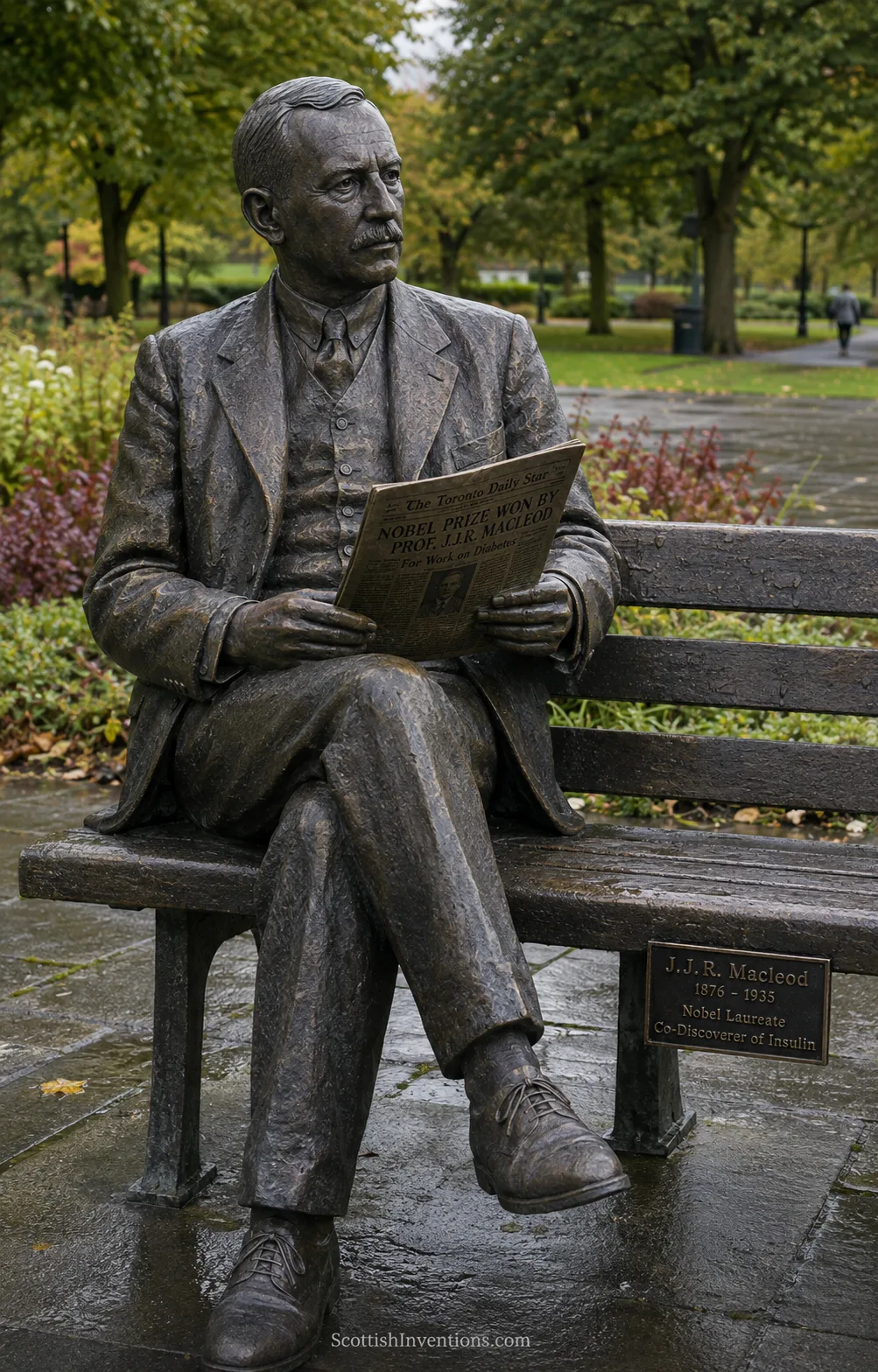
Scotland's belated reckoning came on 12 October 2023, when the world's first monument to him was unveiled in Aberdeen's Duthie Park before a crowd of 300 guests, the ceremonial ribbon cut by the Lord Provost of Aberdeen, Dr David Cameron. The memorial is a life-size bronze by the Ayrshire sculptor John McKenna, depicting "Jack" Macleod seated on a Royal Parks bench with a newspaper at his side carrying a headline referring to his 1923 Nobel Prize. Billed as Scotland's first "storytelling statue", it lets visitors scan a QR code to hear his life story narrated by the Aberdeen-born actor David Rintoul.
The unveiling featured a personal letter from Queen Camilla, who wrote that the statue was "a fitting tribute both to [Macleod's] achievements and to his deep connection to this beautiful city". The campaign was led by John Otto, Founder and Chairman of the JJR Macleod Memorial Statue Society, co-founded with the author Kimberlie Hamilton. "As someone who has been dependent on daily injections of insulin for the past 50 years," Otto told STV News, "it has been a surreal but gratifying experience to watch this long-held dream become a reality."
Why the Discovery of Insulin Changed the World
Before insulin, type 1 diabetes usually meant death within months. After insulin, it became a treatable chronic condition. That is the whole of it, and it is difficult to overstate.
The drug reached the world with extraordinary speed. The University of Toronto sold the patent for one dollar — Banting's principle that "insulin does not belong to me, it belongs to the world" — and Eli Lilly began commercial production in 1923. No Nobel Prize has ever been awarded faster after the breakthrough it honoured: less than two years separated Leonard Thompson's successful injection from the award.
A century on, the scale of the legacy is staggering. According to the International Diabetes Federation's 11th-edition Diabetes Atlas (2025), 589 million adults aged 20–79 — one in nine — now live with diabetes. More than 9.5 million people globally live with type 1 diabetes and depend on insulin to stay alive. Every one of those lives traces back, in part, to a laboratory in Toronto directed by a minister's son from Perthshire.
Myth vs Evidence
Myth
Banting and Best discovered insulin entirely on their own.
Evidence
The successful development of insulin depended on the four-person Toronto team of Banting, Best, Collip and Macleod. Each contributed something the others could not.
Myth
Macleod merely lent Banting a laboratory.
Evidence
Macleod supplied facilities, experimental animals, expertise in carbohydrate metabolism, scientific direction and institutional support, corrected the experimental programme, and recruited Collip.
Myth
The first insulin injection was immediately successful.
Evidence
The treatment of 11 January 1922 was disappointing. The clinical breakthrough came on 23 January 1922 using Collip's purified extract.
Myth
The Nobel Prize settled who deserved credit.
Evidence
The 1923 prize went to Banting and Macleod; Best and Collip were omitted. Both laureates then shared their prize money with those colleagues, and in 1972 the Nobel Foundation conceded that omitting Best had been a mistake.
The Impresario
Macleod's importance lies not in replacing Banting as the hero of insulin, but in understanding that great scientific discoveries are often collective achievements. Banting initiated the experimental programme, Best worked beside him, Collip made the extract clinically usable, and Macleod supplied the scientific leadership, expertise and institutional framework that turned promising research into one of medicine's greatest breakthroughs. Correcting one myth is not a licence to build another.
A minister's son born in a Perthshire manse, schooled and graduated in Aberdeen, directed the Toronto laboratory that transformed diabetes; came home to Scotland; was largely forgotten by the country of his birth; and, a century later, was finally given a bench in a public park in the city that made him. It is a quieter kind of greatness than the myth allows, and it is the kind that most often makes medicine work.
Frequently Asked Questions
Who was J.J.R. Macleod?
John James Rickard Macleod (1876–1935) was a Scottish physiologist, born in Perthshire and educated in Aberdeen, who was Professor of Physiology at the University of Toronto when insulin was developed there in 1921–22. He was one of the leading authorities of his generation on carbohydrate metabolism and diabetes, and shared the 1923 Nobel Prize in Physiology or Medicine with Frederick Banting.
Was J.J.R. Macleod Scottish?
Yes. Macleod was born in Scotland, schooled in Scotland, took his medical degree at the University of Aberdeen, and returned to Scotland in 1928 as Regius Professor of Physiology at Aberdeen, where he died in 1935.
Where was J.J.R. Macleod born?
In the Free Church manse at Clunie, near Dunkeld in Perthshire, on 6 September 1876. His father, the Reverend Robert Macleod, later moved the family to Keith in Banffshire and then, in late 1883, to Aberdeen.
What did J.J.R. Macleod contribute to the discovery of insulin?
Macleod provided the scientific leadership, laboratory resources, experimental animals and expertise in carbohydrate metabolism that allowed Banting and Best's work to develop into a validated research programme. He designed and corrected the experimental plan, insisted on the controls and repetition that turned suggestive results into proof, recruited James Collip whose purification made human treatment possible, named insulin, presented the discovery to the scientific community, and steered the team through clinical trials and the negotiations that put insulin into worldwide production.
Who discovered insulin?
Insulin was discovered by a four-person team at the University of Toronto in 1921–22: Frederick Banting, Charles Best, James Collip and J.J.R. Macleod. Banting initiated the experimental programme, Best worked beside him, Collip purified the extract into a clinically usable preparation, and Macleod supplied the scientific direction, expertise and institutional framework.
Did Banting and Best discover insulin alone?
No. The "Banting and Best" formulation is a simplification that took hold after the 1923 Nobel Prize. Their summer 1921 extract was crude and impure, and their duct-ligation method was soon abandoned in favour of extracts from fresh whole beef and pork pancreas. Successful human treatment required Collip's purification and Macleod's direction and validation.
What did James Collip contribute to insulin?
Collip, a biochemist from the University of Alberta on sabbatical in Toronto, was recruited by Macleod in December 1921. He worked out how to purify the pancreatic extract by gradually increasing the alcohol concentration of the solution, precipitating the active principle away from toxic contaminants. His purified extract produced the dramatic clinical result of 23 January 1922.
Who received the Nobel Prize for insulin?
The 1923 Nobel Prize in Physiology or Medicine was awarded jointly to Frederick Banting and J.J.R. Macleod. Charles Best and James Collip were not included. Banting shared his half of the prize money with Best, and Macleod shared his half with Collip.
Why did Banting dislike Macleod?
When Macleod returned from Scotland in September 1921 and told Banting the summer's results were inconsistent and needed proper controls and repetition, Banting — inexperienced, insecure and financially precarious — read scientific caution as an attempt to steal his credit. The resentment hardened when the Nobel Prize went to Macleod rather than Best, and the two men never repaired the relationship.
Did Macleod deserve the Nobel Prize?
The Nobel committee thought so, and modern scholarship broadly agrees. The decisive nomination came from the Danish laureate August Krogh, who visited Toronto and concluded that while the credit for the original idea belonged to Banting, he could not have carried out the investigations, which at every stage were supervised by Macleod. The fairer criticism of the 1923 award is not that Macleod was included but that Best and Collip were left out.
When was insulin first successfully used on a human?
On 23 January 1922, at Toronto General Hospital, when Leonard Thompson received James Collip's purified extract. An earlier attempt on 11 January 1922, using Banting and Best's less refined preparation, had produced only a slight fall in blood sugar and a sterile abscess at the injection site.
Who was Leonard Thompson?
Leonard Thompson was a 14-year-old boy weighing about 65 pounds and close to death from type 1 diabetes in Toronto General Hospital. He was the first person treated with insulin. After the successful injection of 23 January 1922 his blood glucose fell by roughly 75% and his glycosuria and ketonuria almost disappeared. He lived a further thirteen years on insulin.
When did Macleod return to Scotland?
In 1928, when he resigned from Toronto and took up the Regius Chair of Physiology at the University of Aberdeen, succeeding his own former teacher. He remained there until his death in 1935.
Where is the J.J.R. Macleod monument?
In Duthie Park, Aberdeen. The world's first monument to Macleod — a life-size bronze by the Ayrshire sculptor John McKenna, showing him seated on a bench with a newspaper — was unveiled on 12 October 2023.
Sources & Further Reading
Tier 1 · Primary
- Macleod, J.J.R. — Nobel Lecture, "The Physiology of Insulin and its Source in the Animal Body", 1925; Nobel Prize in Physiology or Medicine 1923 award records, The Nobel Foundation.
- Macleod, J.J.R. — Diabetes: Its Pathological Physiology, 1913; "Studies in Experimental Glycosuria", Journal of Physiology.
- Banting, F.G., Best, C.H., Collip, J.B., Campbell, W.R. & Fletcher, A.A. — "Pancreatic Extracts in the Treatment of Diabetes Mellitus", Canadian Medical Association Journal, 1922.
- "The discovery of insulin revisited" — review of the 1921–22 Toronto work and the Leonard Thompson case. Bibliographic details incomplete in the supplied research; to be completed before print use.
- University of Toronto Libraries — Discovery and Early Development of Insulin digital collection (notebooks and correspondence).
- University of Aberdeen — biographical and departmental records for J.J.R. Macleod, Regius Professor of Physiology, 1928–1935.
Tier 2 · Scholarly and institutional
- Bliss, M. — The Discovery of Insulin, University of Chicago Press / McClelland & Stewart, 1982.
- Bliss, M. — "Scotland's insulin laureate", lecture and article, 2013.
- Rutty, C. — Defining Moments Canada, insulin centenary historical materials.
- International Diabetes Federation — IDF Diabetes Atlas, 11th edition, 2025.
- World Health Organization — global estimates on diabetes and insulin access.
- STV News and Aberdeen City Council — reporting on the unveiling of the J.J.R. Macleod statue, Duthie Park, 12 October 2023.