Discoveries · No. 47 of 50 · Physics
Polarisation of Light & Brewster's Law
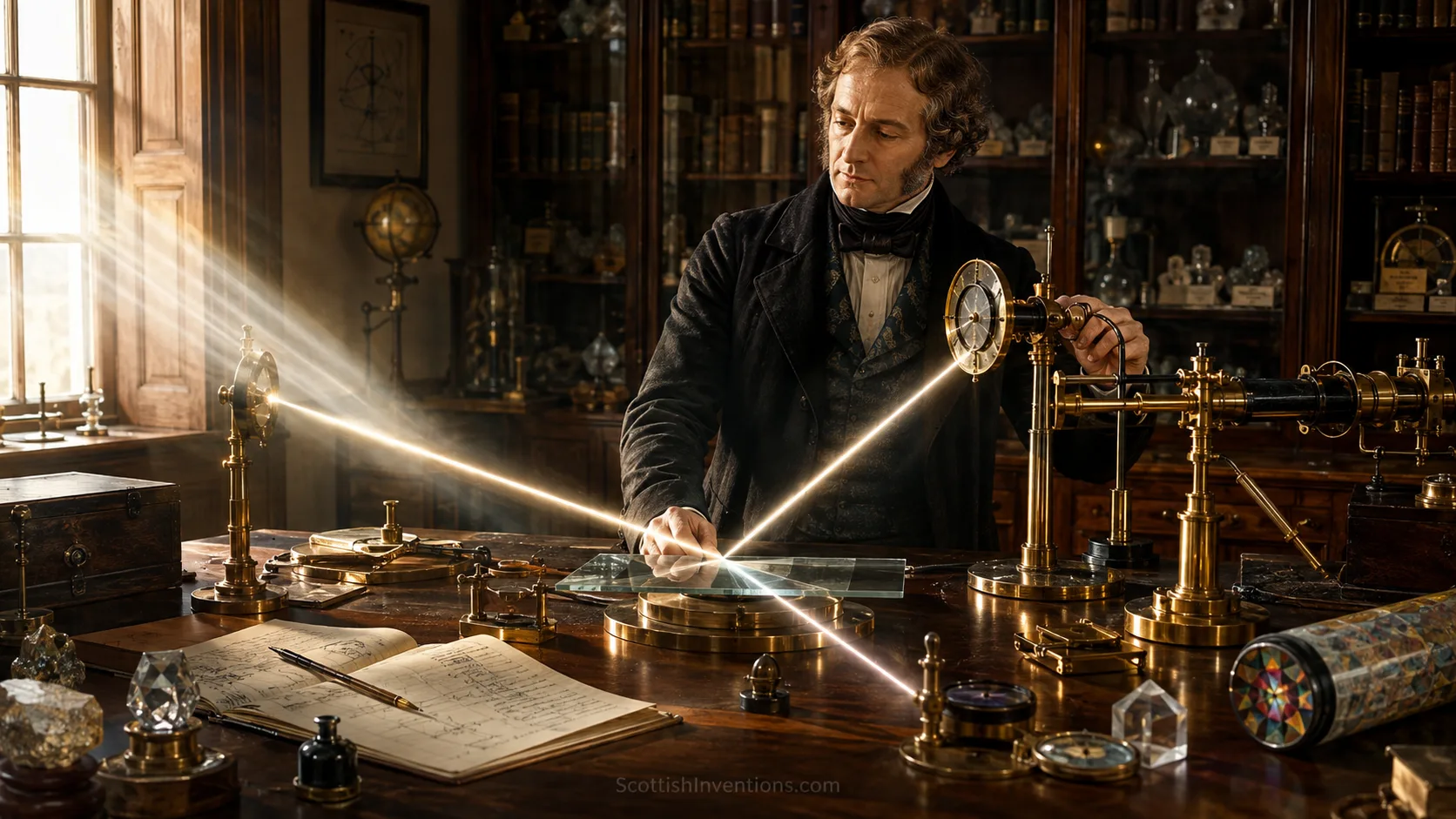
A Jedburgh minister-turned-physicist measured, with painstaking precision, the exact angle at which reflected light becomes completely polarised — quantifying, in 1815, a phenomenon a Frenchman had discovered seven years earlier but could not pin down mathematically.
Sir David Brewster · 1781–1868Law published · 1815Reading time · 20 minUpdated 16 August 2026
TL;DR
- Sir David Brewster (1781–1868), born in Jedburgh, discovered Brewster's Law in 1815 — the precise rule that the tangent of the polarising angle of reflected light equals a material's refractive index (tan θB = n).
- He did not discover polarisation itself. That was the Frenchman Étienne-Louis Malus, in 1808, who observed light extinguished through a rotated crystal and coined the word "polarisation". Brewster quantified the phenomenon Malus had already found.
- Brewster also discovered biaxial crystals and the photoelastic effect, founded optical mineralogy — yet stubbornly resisted the wave theory of light his whole career, even though Fresnel's waves ultimately explain why his own law works.
Scottish Impact Index (SI Score)
- Global Impact
- 8/10
- Longevity
- 9/10
- Economic / Material Impact
- 5/10
- Originality / Distinctiveness
- 9/10
- Legacy (Built Upon)
- 8/10
- Recognition
- 4/10
Key Findings
- David Brewster (1781–1868), born in Jedburgh, published Brewster's Law in 1815: tan θB = n, where θB is the polarising angle of light reflected from a surface and n is the refractive index of that surface's material.
- The law was read to the Royal Society on 16 March 1815 and published in Philosophical Transactions, Volume 105 — not 1811, a date that circulates on some popular sites but lacks primary-source support.
- Polarisation itself was discovered by Étienne-Louis Malus in 1808, in Paris, when he noticed light reflected from glass windows was extinguished at certain angles when viewed through rotated Iceland spar. Malus coined the term "polarisation".
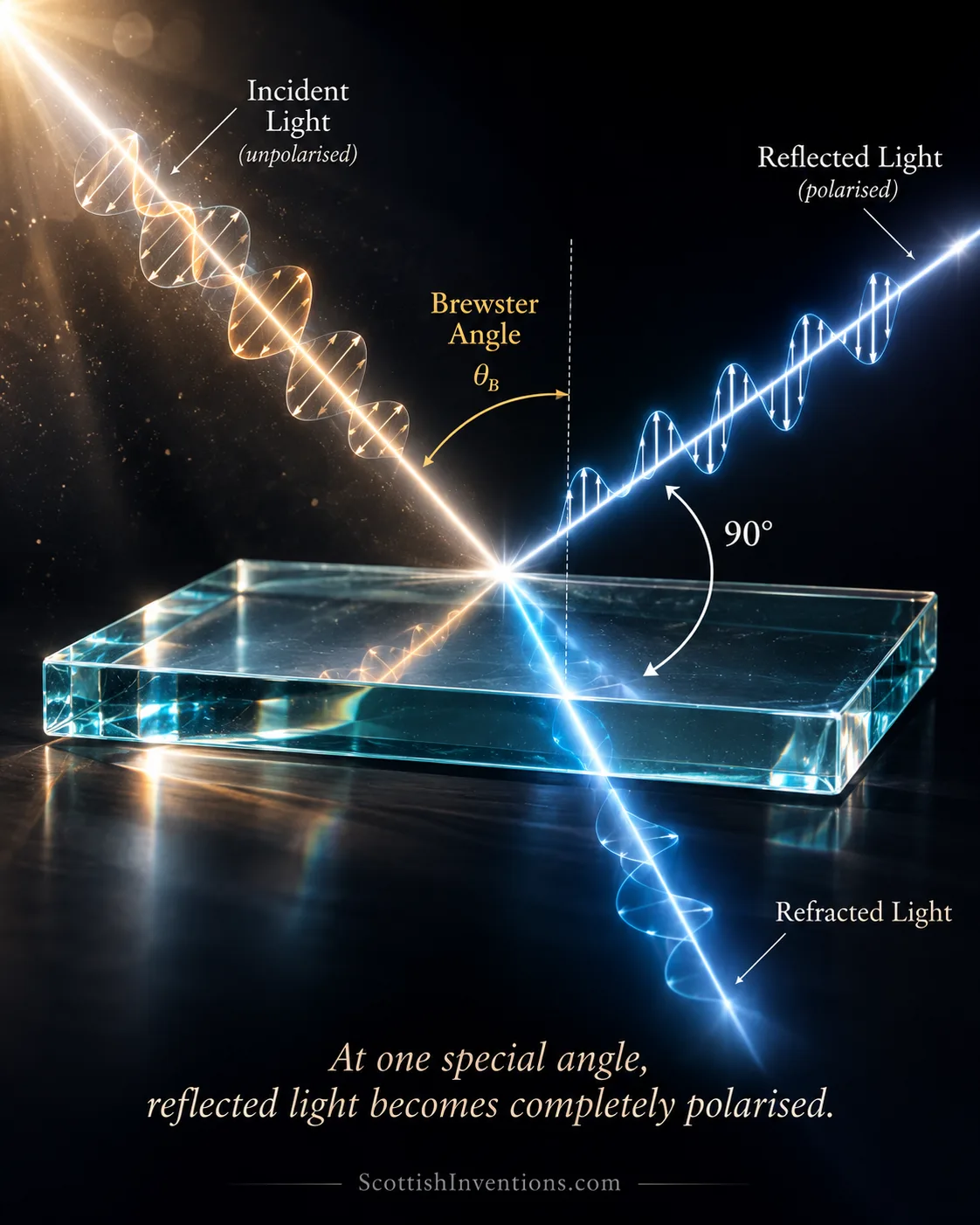
- Brewster's law also implies that at the polarising angle, the reflected and refracted rays are exactly perpendicular — 90° apart — a geometric fact provable via Snell's law.
- Brewster additionally discovered biaxial crystals (c. 1818) and the photoelastic effect (1816), founding the science of optical mineralogy.
- Despite his own law being fully explained by the wave theory of light, Brewster resisted that theory his entire career, remaining a committed empiricist.
Quick Facts
- Discovery
- Brewster's Law: tan θB = n — the tangent of the polarising angle of reflected light equals the refractive index of the reflecting medium
- Year
- 1815 — read to the Royal Society on 16 March 1815, published in Philosophical Transactions, Vol. 105
- Key figure
- Sir David Brewster (1781–1868), born Jedburgh, Roxburghshire
- Claim status
- Established, with one critical distinction: Brewster discovered the LAW of the polarising angle, not polarisation itself. Polarisation was discovered by Étienne-Louis Malus (France) in 1808
- What Malus found
- That light reflected from glass could be extinguished when viewed through a rotated calcite crystal — the phenomenon of polarisation by reflection, and the word 'polarisation' itself
- What Brewster found
- The exact mathematical relationship between the polarising angle and refractive index, and that reflected and refracted rays are perpendicular at that angle
- Typical angles
- Crown glass (n≈1.5): θB≈56°19′. Water (n≈1.33): θB≈53°
- Other Brewster discoveries
- Biaxial crystals (c.1818), the photoelastic effect / stress birefringence (1816), founder of optical mineralogy
- Honours
- FRS 1815; Copley Medal 1815; Rumford Medal 1818; Royal Medal 1830; knighted 1832 (Royal Guelphic Order 1831)
- Institutional roles
- Co-founder, British Association for the Advancement of Science (1831); founder, Royal Scottish Society of Arts (1821); Principal, United College, St Andrews (1838); Principal, University of Edinburgh (1859)
- Myth to retire
- Brewster did NOT found the Royal Scottish Academy (fine art, 1826) — he founded the Royal Scottish Society of Arts (science and useful arts, 1821)
- Theoretical irony
- Brewster resisted the wave theory of light his entire life, yet his own empirical law is fully explained by Fresnel's wave equations
- Died
- 10 February 1868, Allerly, near Melrose, in the Scottish Borders
A Jedburgh Boyhood
David Brewster was born on 11 December 1781 in the Canongate of Jedburgh, a small country town in the Scottish Borders. He was the third of six children born to Margaret Key and James Brewster, the highly regarded rector of Jedburgh Grammar School. A local self-taught astronomer and mathematician, James Veitch, gave the boy his first lessons in science, and Brewster is said to have built his first telescope at the age of ten — an early sign of the practical, hands-on curiosity that would define his entire career.
At just twelve years old, in 1794, Brewster matriculated at the University of Edinburgh, intending like his father to enter the ministry. He was awarded an honorary MA in 1800 and was duly licensed to preach in the Church of Scotland in 1804. But the pulpit did not suit him. His colleague James Hogg later recorded that Brewster "was licensed, but the first day he mounted the pulpit was the last," because "he had then… a nervous something about him that made him swither when he heard his own voice and saw a congregation eyeing him." It is one of the more charming footnotes in the history of science that a crippling case of stage fright is what redirected David Brewster permanently away from theology and towards the study of light.
Freed from clerical ambitions, Brewster turned to editing and to science. He became editor of the Edinburgh Magazine in 1802 and, from 1808, editor of the Edinburgh Encyclopaedia, a role that kept him immersed in the scientific literature of his day even before his own experimental career took off. Honours followed later in life in quick succession: election as a Fellow of the Royal Society in 1815 (the same year as his great discovery); the Royal Guelphic Order in 1831 and formal knighthood on 8 March 1832; the Principalship of the United College of St Salvator and St Leonard at the University of St Andrews from 1838; and, finally, the Principalship of the University of Edinburgh from 1859 until his death. He died on 10 February 1868 at Allerly, near Melrose, in the Borders country where his story had begun.
Light Before Brewster
To understand what Brewster achieved, it helps to understand how contested the very nature of light was in the early nineteenth century. Isaac Newton's corpuscular theory, which pictured light as a stream of tiny particles, dominated scientific opinion through much of the eighteenth century. It was challenged by a rival wave theory, first proposed by Christiaan Huygens in the seventeenth century and revived in Brewster's own lifetime by Thomas Young, before being placed on a rigorous mathematical footing by the French engineer Augustin-Jean Fresnel. The argument between these two camps — whether light was made of particles or waves — was one of the liveliest and most consequential disputes in the physical sciences of the period.
A separate but related puzzle concerned double refraction. In the seventeenth century, Huygens had observed that a single ray of light entering a crystal of Iceland spar (a transparent form of calcite) emerged as two separate rays — a phenomenon neither the particle theory nor the simple wave theory of the time could satisfactorily explain. This odd behaviour of calcite would turn out to be closely bound up with polarisation, the very property Brewster would spend his career investigating, though the connection was not yet understood when Huygens first observed it.
Malus and Polarisation
The decisive breakthrough that set the stage for Brewster's own discovery came in 1808, from the French physicist and military engineer Étienne-Louis Malus. Looking through a rotated crystal of Iceland spar at sunlight reflected off the windows of the Luxembourg Palace in Paris, Malus noticed something strange: depending on the crystal's orientation, the reflected light could be made to disappear almost entirely. He had discovered that light could be polarised by reflection — and it was Malus, not Brewster, who coined the very word "polarisation" to describe what he had found. As a committed follower of Newton's particle theory, Malus imagined light corpuscles possessing "poles" or sides, hence his choice of term; the modern wave picture, in which polarisation describes the direction in which an electromagnetic field oscillates, came only later.
This is the point at which honesty about credit becomes essential, and it cannot be stated too plainly: Malus discovered the phenomenon; Brewster discovered the law. In ordinary, unpolarised light — sunlight, say, or the light from a candle — the electric field oscillates in every direction perpendicular to the direction the light is travelling. In polarised light, that oscillation is confined to a single plane. Malus's experiment showed that reflection from an ordinary transparent surface, at the right angle, could produce this restriction — and that discovery alone would have secured his place in the history of optics.
Malus did not stop there. He went further and attempted to find a quantitative relationship between the angle at which this polarising effect was strongest and the refractive index of the reflecting material — precisely the relationship that would eventually bear Brewster's name. He succeeded for water. But he was defeated for glass, hampered by the inconsistent quality of the glass specimens available to him, whose refractive index varied unpredictably between the surface and the interior of a given sample, making reliable measurement impossible. Malus himself recorded his frustration in a passage that Brewster would later quote, with evident respect, in his own 1815 paper: "The polarising angle neither follows the order of the refractive powers, nor that of the dispersive forces. It is a property of bodies independent of the other modes of action which they exercise upon light." That precise quantitative link — the one Malus suspected existed but could not pin down — was left for David Brewster to find, seven years after Malus's own discovery, and four years before Malus's early death in 1812.
Brewster's Law
Brewster's great strength, unlike many of the theorists of his day, was patient, exhaustive, systematic experiment. Where Malus had been limited by the poor-quality glass available to him, Brewster measured the polarising angle across a remarkably wide range of materials — water, numerous kinds of glass, diamond, various crystals, precious stones, and even unusual substances such as mother-of-pearl and birdlime — using higher-quality specimens and far more careful technique than his predecessor had been able to command.
Out of this exhaustive programme of measurement came two results of real elegance. The first was geometric: Brewster found that at the special polarising angle, the reflected ray and the refracted ray inside the material are exactly perpendicular to one another — separated by precisely 90°. The second was the law itself, the result now known as Brewster's Law: the tangent of the polarising angle equals the refractive index of the reflecting medium, expressed as tan θB = n. Because the reflected and refracted rays are perpendicular, it follows directly from Snell's law of refraction — a short piece of algebra — that θB + θr = 90°, which in turn yields n = tan θB immediately.
The predicted numbers are easy to verify and match observation closely. For ordinary crown glass, with a refractive index of roughly 1.5, tan θB = 1.5 gives a polarising angle of about 56°19′ — as the Encyclopaedia Britannica puts it, "for a light wave passing from air (n1 = 1.00) to glass (n2 = 1.50), the polarizing angle, p, is calculated to be 56°19′." For water, with a refractive index of about 1.33, the corresponding angle works out at roughly 53°.
Brewster published the law in a paper titled "On the laws which regulate the polarisation of light by reflection from transparent bodies," which appeared in the Philosophical Transactions of the Royal Society of London, Volume 105 (1815), pages 125–159. The manuscript itself is dated 11 February 1815, and the paper was read to the Society on 16 March 1815. It is worth noting, for the sake of precision, that some popular websites date the law to 1811 — a claim this article does not repeat, since it appears unsupported by primary sources; Brewster's documented Royal Society work on light instead begins with an earlier 1813 paper, "On some properties of Light," with the law itself following two years later in 1815. The significance of the 1815 result was profound: it was the first precise, quantitative bridge ever drawn between an optical behaviour — the angle at which polarisation by reflection is complete — and a fundamental material property, the refractive index.
Why the Law Works
Brewster established that his law held true, exhaustively and reliably, across a great range of materials. What he could not do — and, as an empiricist deeply sceptical of the wave theory, had little interest in attempting — was explain why nature should behave this way. That explanation came later, and from precisely the theoretical tradition Brewster spent his career resisting.
The modern account runs as follows. When a beam of light strikes the surface of a transparent material, it sets the electrons within that material oscillating, rather like a great many tiny dipole radio antennas being driven by an external signal. These oscillating electrons then re-radiate light of their own, and it is this re-radiated light that constitutes the reflected beam. A fundamental property of such a dipole, however, is that it cannot radiate energy directly along its own axis of oscillation — it radiates strongly to the sides, but not along the line in which it is vibrating.
At the Brewster angle, the geometry of reflection and refraction works out so that the direction the reflected ray would have to travel lies exactly along the oscillation axis of the dipoles responsible for one of the two polarisation components of the incident light. That component, therefore, simply cannot be reflected at all — there is no direction available for it to radiate into. Only the other polarisation component, oscillating in a different direction, can be reflected, and so the reflected beam at the Brewster angle ends up completely polarised. This elegant result falls directly and naturally out of Fresnel's equations describing the reflection and transmission of light waves at an interface.
Biaxial Crystals & Optical Mineralogy
Brewster's contributions to optics did not stop with the law that bears his name. It had long been known that crystals such as calcite were "uniaxial" — possessing a single optic axis along which light could pass through the crystal without splitting into two separate rays. Around 1818, Brewster discovered that many other crystals, including topaz and mica, instead possess two optic axes rather than one. These became known as biaxial crystals, and modern crystallography confirms that crystals belonging to the orthorhombic, monoclinic and triclinic systems are all biaxial.
This discovery was foundational for an entirely new discipline: optical mineralogy, the science of identifying minerals by studying their optical behaviour under polarised light. Combined with the polarising prism invented by Brewster's contemporary William Nicol of Edinburgh, Brewster's work launched a field still practised by geologists today, in which thin, carefully cut wafers of rock are examined under a petrographic (polarising) microscope, and individual minerals are identified by characteristic optical properties such as birefringence and the angle between their optic axes. Augustin Fresnel, working independently, developed the mathematical theory describing precisely how light propagates through biaxial crystals — theory and observation converging, once again, on ground Brewster himself had first mapped out experimentally. Brewster's contemporary William Whewell, in his 1859 History of the Inductive Sciences, dubbed him the "Father of modern experimental optics" and "the Johannes Kepler of optics" — a fitting comparison to another great empirical measurer of nature's hidden regularities.
The Photoelastic Effect
In 1816, a year after publishing his law, Brewster discovered another remarkable optical effect. He found that ordinary glass, when mechanically stressed — squeezed, bent, or heated unevenly — becomes birefringent: it splits light and rotates the plane of polarisation in direct proportion to the mechanical stress applied. When such stressed, transparent material is viewed through polarising filters, striking coloured fringe patterns appear, tracing out the internal stress distribution within the material. Brewster correctly interpreted these fringes as evidence of stress-induced birefringence, rather than treating them as some unrelated curiosity.
This discovery is the direct basis of photoelastic stress analysis, a technique still used by engineers today to visualise where mechanical stresses concentrate within a component. By building transparent scale models of parts, or applying photoelastic coatings to opaque ones, engineers can view the resulting fringe patterns under polarised light and identify exactly where a design is likely to fail under load — a direct, practical descendant of an observation Brewster made with simple glass in his own laboratory in 1816. In recognition of this work, the unit used to describe a material's stress-optic coefficient — the brewster — is named after him.
Priority for this discovery is, in fact, shared, and honesty demands saying so. Birefringence appearing in stressed or heated glass had also been separately observed by François Arago in 1811 and Thomas Seebeck in 1813. Brewster's distinct contribution in 1816 was to conduct the thorough, independent investigation of the effect and to supply the correct physical interpretation of what was being observed — a pattern strikingly similar to his relationship with Malus over polarisation itself: others glimpsed the phenomenon first, and Brewster supplied the rigorous, systematic understanding of it.
Brewster versus the Wave Theory
For all his brilliance as an experimentalist, Brewster ended up on the losing side of the great theoretical debate of his age, and an honest account of his career has to say so plainly. A committed empiricist by temperament and by method, Brewster distrusted the abstract theoretical apparatus behind the wave theory of light — the invisible, all-pervading "luminiferous ether" that waves were supposed to travel through, and the idea of transverse vibrations perpendicular to the direction of travel. He preferred, as one historian later put it, "a simpler induction from known facts," and he resisted Fresnel's transverse-wave theory of light even as it swept through the physics community during the 1830s and came to be accepted almost universally.
Historians of science have been candid about the real limits of Brewster's method. The 1911 Encyclopædia Britannica's article on Brewster observed that "his method was empirical, and the laws that he established were generally the result of repeated experiment. To the ultimate explanation of the phenomena with which he dealt he contributed nothing." The same source adds that "although he did not maintain to the end of his life the corpuscular theory he never explicitly adopted the undulatory theory of light." Brewster occupied an uncomfortable middle position: unable to fully defend Newton's old particle theory in the face of mounting evidence against it, yet never quite willing to embrace the wave theory that was steadily replacing it.
The irony here is genuinely delicious, and it is worth stating without softening it: Brewster's own empirical law is perfectly explained by the very wave equations he refused to embrace. He found the law through relentless, careful measurement; Fresnel's mathematics, built on the theory Brewster distrusted, explained precisely why the law had to be true. Few episodes in the history of physics illustrate more clearly the difference between discovering a regularity in nature and understanding why that regularity exists.
Modern Applications of Brewster's Law
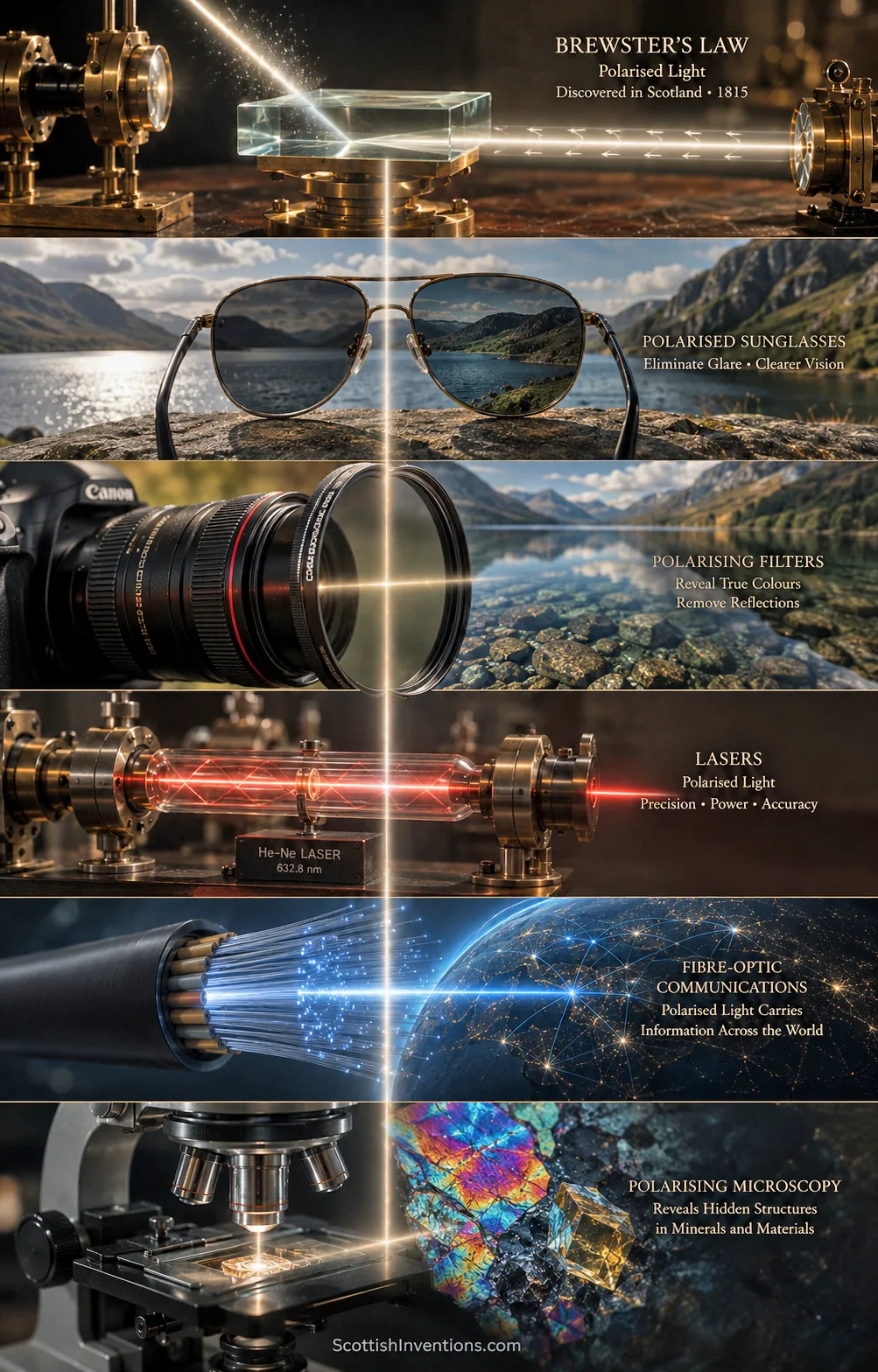
More than two centuries after Brewster first quantified the polarising angle, his law remains in everyday, practical use across a surprising range of technologies.
- Polarised sunglasses. Light glaring off wet roads, car bonnets and water surfaces is predominantly horizontally polarised — precisely because it has reflected at close to the Brewster angle. Polarised lenses are designed to block that horizontal component, cutting glare dramatically. Every pair of polarised sunglasses in the world works on the principle Brewster first quantified.
- Photographic polarising filters. Photographers use the identical trick, rotating a polarising filter in front of a camera lens to cut reflections from water or glass and reveal what lies beneath the surface — a fish in a stream, or the interior of a shop window.
- Brewster windows in lasers. An optical window angled precisely at the Brewster angle transmits one polarisation of light with almost no loss at all, while reflecting away the other. In low-gain gas lasers, such as helium-neon and carbon-dioxide lasers, where even a small percentage of optical loss can prevent laser action altogether, Brewster windows both minimise those losses and force the laser to produce a cleanly, linearly polarised output. Helium-neon lasers built around Brewster windows were once used by the hundreds of thousands in supermarket barcode scanners, and closely related laser technology underpins DVD players and laser printers.
- Liquid-crystal displays. LCD screens work by rotating the polarisation of light passing through liquid-crystal cells — the entire display technology rests on the manipulation of polarised light that Brewster's law helped make quantifiable.
- Optical-fibre communications. Careful management of light's polarisation state is important to the performance of high-capacity fibre-optic communication systems.
- Geology and mineralogy. Polarised-light, or petrographic, microscopy remains the standard tool geologists use to identify minerals in thin rock sections, a discipline that traces directly back to Brewster's discovery of biaxial crystals.
- Anti-reflection optics. The Brewster angle — the specific angle at which reflection of one polarisation drops to zero — is the conceptual cousin of modern anti-reflection coating design, and Brewster-angle components can outperform conventional anti-reflection coatings when only a single polarisation needs to be transmitted without loss.
Institution-Builder
Alongside his scientific work, Brewster was a formidable builder of institutions, driven partly by a genuine alarm at what he perceived as the decline of British science relative to its continental rivals. Together with Charles Babbage and Sir John Herschel, he played the chief part in shaping the constitution of the British Association for the Advancement of Science, which first met at York in 1831 and which Brewster himself served as president in 1849. He was, across various periods of his life, secretary, vice-president and president of the Royal Society of Edinburgh, and in 1821 he founded the Royal Scottish Society of Arts.
It is worth explicitly laying a persistent myth to rest here. Some popular accounts credit Brewster with founding the Royal Scottish Academy, Scotland's national academy for the fine arts. This is a confusion of two differently named, entirely separate institutions. The Royal Scottish Academy was founded in 1826 by a group of practising artists and has no documented connection to Brewster whatsoever. What Brewster actually founded in 1821 was the Royal Scottish Society of Arts — originally named the Society for the Encouragement of the Useful Arts in Scotland, a body devoted to science and technology, in which the word "Arts" is used in its older sense of useful or mechanical arts, not fine art. Correcting this confusion matters precisely because it is so widely repeated.
Brewster was also a serious historian of science in his own right. He wrote a short life of Newton in 1831, followed by the definitive two-volume Memoirs of the Life, Writings, and Discoveries of Sir Isaac Newton in 1855 — the product of more than twenty years' study of Newton's original manuscripts — as well as The Martyrs of Science (1841), covering Galileo, Tycho Brahe and Kepler. He edited the Edinburgh Encyclopaedia across many years and contributed several hundred scientific papers over his lifetime. He was, in addition, the inventor of the kaleidoscope in 1816 and an important improver of the stereoscope — but, as this article deliberately notes, those achievements are inventions, applications of known optical principles, rather than the discovery of new scientific laws, and they belong properly to a separate story.
Timeline
17th century
Christiaan Huygens observes double refraction in Iceland spar (calcite)
The first clear sign that light interacts with crystals in ways ordinary optics could not explain
1781
David Brewster born in the Canongate, Jedburgh, on 11 December
Son of James Brewster, rector of Jedburgh Grammar School
1794
Brewster matriculates at the University of Edinburgh, aged 12
Intended for the ministry; local astronomer James Veitch had already sparked his interest in science
1802
Brewster becomes editor of the Edinburgh Magazine
The beginning of a long career in scientific editing and publishing
1804
Brewster is licensed to preach in the Church of Scotland
Severe nervousness in the pulpit reportedly ended his clerical ambitions almost immediately
1808
Étienne-Louis Malus discovers polarisation by reflection in Paris
Observing sunlight reflected from the Luxembourg Palace windows through rotated calcite, Malus finds the light can be extinguished — and coins the word 'polarisation'
1808
Malus attempts to link the polarising angle to refractive index
He succeeds only for water; poor-quality glass, with refractive index varying between surface and interior, defeats his attempt with glass
1813
Brewster publishes his first Royal Society paper, 'On some properties of Light'
The opening of his sustained programme of optical research
11 February 1815
Brewster completes the manuscript establishing his law
Systematic measurement of the polarising angle across a huge range of materials
16 March 1815
Brewster's Law is read to the Royal Society of London
Published as 'On the laws which regulate the polarisation of light by reflection from transparent bodies', Philosophical Transactions, Vol. 105, pp. 125–159
1815
Brewster elected a Fellow of the Royal Society and awarded the Copley Medal
Recognition of the polarisation work
1816
Brewster discovers the photoelastic effect
Stressed or heated glass is found to become birefringent, rotating polarised light
1816
French Institute awards Brewster half of its prize for the two most important European discoveries of the preceding two years
International recognition of Brewster's Law
1818
Brewster discovers biaxial crystals
Crystals such as topaz and mica are shown to possess two optic axes, not one, founding optical mineralogy
1818
Brewster awarded the Royal Society's Rumford Medal
Further recognition
1821
Brewster founds the Royal Scottish Society of Arts
A science-and-technology society, easily confused with the art-focused Royal Scottish Academy founded five years later by others
1830
Brewster awarded the Royal Society's Royal Medal
One of very few scientists to hold Copley, Rumford and Royal Medals
1831
Brewster helps found the British Association for the Advancement of Science, first meeting at York
With Charles Babbage and John Herschel; Brewster later serves as president, 1849
1831–1832
Brewster receives the Royal Guelphic Order (1831) and is formally knighted (8 March 1832)
Reportedly the first person knighted for scientific research since Isaac Newton in 1705
1830s
Fresnel's transverse wave theory of light gains near-universal acceptance
Brewster continues to resist it even as it explains his own law
1838
Brewster becomes Principal of the United College of St Salvator and St Leonard, University of St Andrews
A senior academic administrative role
1855
Brewster publishes Memoirs of the Life, Writings, and Discoveries of Sir Isaac Newton
The fruit of more than twenty years studying Newton's original manuscripts
1859
Brewster becomes Principal of the University of Edinburgh
The culmination of his academic career
10 February 1868
Sir David Brewster dies at Allerly, near Melrose
In the Scottish Borders country of his birth
20th–21st century
Brewster's Law becomes embedded in polarised sunglasses, camera filters, laser design and mineralogy
The everyday, ongoing legacy of the 1815 paper
Myths & Facts
Myth: David Brewster discovered polarised light.
Fact: He did not. Polarisation by reflection was discovered by the French physicist Étienne-Louis Malus in 1808, who also coined the word 'polarisation'. Brewster's 1815 contribution was the precise mathematical law — tan θB = n — describing the angle at which reflected light becomes completely polarised. Brewster quantified the phenomenon Malus had found seven years earlier.
Myth: Brewster's Law was published in 1811.
Fact: The reliably documented date is 1815: the manuscript is dated 11 February 1815 and was read to the Royal Society on 16 March 1815, appearing in Philosophical Transactions, Volume 105. The '1811' date appears on some popular educational sites but is not supported by primary Royal Society records.
Myth: Brewster founded the Royal Scottish Academy.
Fact: The Royal Scottish Academy (fine art) was founded in 1826 by artists, with no Brewster involvement. Brewster founded the differently named Royal Scottish Society of Arts in 1821, a science-and-technology body whose historic title, the Society for the Encouragement of the Useful Arts in Scotland, refers to useful or mechanical arts rather than fine art.
Myth: Brewster's Law explains why it works, using the physics of the time.
Fact: It does not. Brewster's Law is a purely empirical result, arrived at through careful measurement rather than theoretical derivation. The physical explanation — that dipoles driven to oscillate by the incident light cannot radiate along their own axis — comes from the wave theory of light developed principally by Fresnel, a theory Brewster himself resisted throughout his career.
Myth: Malus failed to find any link between the polarising angle and a material's optical properties.
Fact: Malus did find a relationship for water, but was defeated for glass by the inconsistent, surface-versus-interior refractive index of the poor-quality glass specimens available to him in the early nineteenth century. He explicitly reported that the polarising angle did not follow the order of refractive or dispersive powers he could measure — a conclusion Brewster later quoted before showing, using higher-quality materials, that a precise relationship did exist after all.
Myth: Brewster's other work, like the kaleidoscope, belongs in the same 'discovery' category as his optics research.
Fact: The kaleidoscope (1816) and Brewster's improvements to the stereoscope are inventions — clever applications of optical principles — rather than scientific discoveries of new laws or phenomena. This article, focused on Brewster's Law, keeps that distinction clear rather than blurring invention and discovery together.
Did You Know?
- Every pair of polarised sunglasses works on the principle Brewster discovered in 1815 — blocking the horizontally polarised glare that bounces off roads and water.
- A Brewster window is an essential component inside many gas lasers, including the helium-neon lasers once used by the hundreds of thousands in supermarket barcode scanners.
- Brewster was licensed as a Church of Scotland preacher but reportedly suffered such severe nervousness that he mounted the pulpit only once — accidentally redirecting himself into optics forever.
- Brewster discovered that stressed glass rotates polarised light — a property now used in engineering photoelastic stress analysis, and honoured in the unit called the 'brewster'.
- He co-founded the British Association for the Advancement of Science in 1831, one of the most important scientific institutions of the Victorian era.
- Brewster resisted the wave theory of light his entire career, yet his own empirical law is perfectly explained by Fresnel's wave equations.
- His 1831–32 knighthood is said, by some sources, to have made him the first person knighted for scientific research since Sir Isaac Newton in 1705.
- Brewster did not discover polarisation — that was Étienne-Louis Malus, in 1808 — but Brewster gave the phenomenon its exact mathematical law seven years later.
Honest Caveats
Brewster did not discover polarised light. This is the single most important accuracy point in this article and cannot be repeated too often: polarisation by reflection was discovered by Étienne-Louis Malus in 1808. Brewster's 1815 contribution was the precise mathematical law describing the polarising angle, not the underlying phenomenon.
The 1815 publication date, not 1811, is what this article treats as established. The manuscript is dated 11 February 1815 and was read to the Royal Society on 16 March 1815. Some popular educational sites cite 1811, a date this article does not repeat for lack of primary-source support.
The knighthood date is genuinely somewhat muddled across sources. Brewster received the Royal Guelphic Order in 1831 but was formally knighted on 8 March 1832; the "first knight for science since Newton" claim, though widely repeated, should be treated as a popular characterisation rather than a strict administrative fact.
The dipole explanation of why Brewster's Law holds is a modern account, based on Fresnel's wave theory of light; it was never Brewster's own reasoning, since he resisted that theory throughout his career.
Priority for the photoelastic effect is shared. Birefringence in stressed or heated glass was also observed by Arago (1811) and Seebeck (1813); Brewster's distinct 1816 contribution was the thorough, independent investigation and the correct physical interpretation.
The vivid "he only preached once" anecdote comes from a colleague's letter and a biographical account by his daughter; it is well attested but should be read as biographical recollection rather than documentary record.
Frequently Asked Questions
Did David Brewster discover polarised light?
No — and this is the single most important accuracy point in Brewster's story. Polarisation itself was discovered in 1808 by the French physicist Étienne-Louis Malus, who noticed that sunlight reflected from the windows of the Luxembourg Palace in Paris was extinguished at certain angles when viewed through a rotated crystal of Iceland spar. Malus coined the very word 'polarisation'. What Brewster discovered, seven years later in 1815, was the precise mathematical law governing the angle at which that polarisation is complete: tan θB = n, where θB is the polarising angle and n is the refractive index of the reflecting material. Brewster quantified the phenomenon; he did not discover it.
What exactly does Brewster's Law state?
It states that the tangent of the polarising angle — the angle of incidence at which reflected light becomes completely polarised — equals the refractive index of the reflecting medium: tan θB = n. A direct consequence, provable via Snell's law, is that at this angle the reflected ray and the refracted ray are exactly perpendicular to one another, separated by 90°. For crown glass (n ≈ 1.5) this gives a polarising angle of about 56°19′; for water (n ≈ 1.33) it gives about 53°.
Why couldn't Malus find the law himself, since he discovered the phenomenon?
Malus did try. He attempted to connect the polarising angle to the refractive index of the reflecting material, and he succeeded for water. But he was defeated by the poor-quality glass available to him, whose refractive index varied between its surface and its interior, making consistent measurement impossible. Malus himself wrote that 'the polarising angle neither follows the order of the refractive powers, nor that of the dispersive forces' — a conclusion Brewster later quoted in his own 1815 paper, immediately before demonstrating that a precise relationship did in fact exist once better-quality specimens were used.
When exactly did Brewster publish the law — 1811 or 1815?
The reliable date is 1815. Brewster's manuscript establishing the law was dated 11 February 1815 and read to the Royal Society of London on 16 March 1815, published later that year in Philosophical Transactions, Volume 105, pages 125–159. A '1811' date circulates on some popular educational websites, but it is not supported by primary Royal Society records. Brewster's documented Royal Society work on light begins with an 1813 paper, 'On some properties of Light', with the law itself following in 1815. This article treats 1815 as the established date.
Why does the Brewster angle exist at all — what is the physical explanation?
The clean explanation comes from the wave theory of light that Brewster himself distrusted. When light strikes a surface, it drives the electrons in the material to oscillate like tiny dipole radiators, and these dipoles re-emit the reflected beam. A dipole cannot radiate energy along its own axis of oscillation. At the Brewster angle, the geometry works out so that the reflected ray would have to travel exactly along the oscillation axis of the dipoles responsible for one polarisation component — so that component simply cannot be reflected. Only the other polarisation reflects, leaving the reflected beam completely polarised. This falls directly out of Fresnel's wave equations, developed years after Brewster's own empirical discovery.
Did Brewster discover anything else?
Yes. Around 1818 he discovered biaxial crystals — crystals such as topaz and mica possessing two optic axes rather than the single axis found in crystals like calcite — which founded the science of optical mineralogy still used by geologists today. In 1816 he discovered the photoelastic effect, in which mechanically or thermally stressed glass becomes birefringent and rotates polarised light, the basis of modern photoelastic stress analysis in engineering. He is separately famous as the inventor of the kaleidoscope (1816) and an improver of the stereoscope, though those are inventions rather than discoveries and are covered elsewhere.
Did Brewster accept the wave theory of light that explains his own law?
No, and this is one of the more striking ironies in the history of optics. Brewster was a committed empiricist who distrusted the abstract assumptions behind the wave theory — the invisible luminiferous ether and transverse vibrations — and he resisted Augustin-Jean Fresnel's wave theory even as it became the accepted explanation of light through the 1830s. The 1911 Encyclopædia Britannica observed bluntly that 'his method was empirical... to the ultimate explanation of the phenomena with which he dealt he contributed nothing.' Yet Brewster's Law is perfectly and elegantly explained by the very Fresnel wave equations he never fully embraced.
Did Brewster found the Royal Scottish Academy?
No — this is a persistent myth this article deliberately corrects. The Royal Scottish Academy, Scotland's national fine-art academy, was founded in 1826 by a group of artists and has no documented connection to Brewster. What Brewster actually founded, in 1821, was the Royal Scottish Society of Arts, originally named the Society for the Encouragement of the Useful Arts in Scotland — a science-and-technology body whose use of the word 'Arts' refers to useful or mechanical arts, not fine art. The similarity of the names is the likely source of the confusion.
Is Brewster's Law still used today?
Yes, extensively. Polarised sunglasses and photographic polarising filters both work by blocking the horizontally polarised glare produced when light reflects off roads, water or glass — exactly the phenomenon Brewster's Law quantifies. Brewster windows, set precisely at the Brewster angle, are built into gas lasers such as helium-neon lasers (once used in barcode scanners) to minimise optical losses and enforce a polarised output. Polarising microscopy, built on the mineralogical work Brewster pioneered, remains the standard technique for identifying minerals in geology.
How is Brewster's knighthood dated, and is the 'first since Newton' claim accurate?
Brewster received the Royal Guelphic Order in 1831 and was formally knighted by the King on 8 March 1832; careful sources distinguish the Hanoverian order from the separate act of British knighthood. The oft-repeated claim that he was the first person knighted for scientific research since Sir Isaac Newton in 1705 — repeated even by University of St Andrews sources — is best treated as a popular characterisation rather than a strictly verified administrative fact.
What should readers take away above all else from Brewster's story?
That precise credit matters more than a tidy headline. Malus discovered polarisation in 1808; Brewster discovered, in 1815, the exact quantitative law describing the angle at which reflection produces complete polarisation, and went on to found optical mineralogy and discover the photoelastic effect. He deserves full credit for what he actually did — but conflating 'discovered the law of the polarising angle' with 'discovered polarised light' erases Malus's genuine priority and misstates the nature of Brewster's own considerable achievement.
Sources & Further Reading
Tier 1 · Primary
- Brewster, D. — "On the laws which regulate the polarisation of light by reflection from transparent bodies," Philosophical Transactions of the Royal Society of London, Vol. 105 (1815), pp. 125–159.
- Brewster, D. — "On some properties of Light," Royal Society, 1813.
- Malus, É.-L. — original 1808 observations and writings on polarisation by reflection, as quoted in Brewster (1815).
Tier 2 · Scholarly and institutional
- Encyclopædia Britannica (1911 edition and modern edition) — entries on Sir David Brewster and on the Brewster angle / polarising angle.
- Whewell, W. — History of the Inductive Sciences, 1859.
- University of St Andrews and Royal Society biographical materials on David Brewster's life, honours and institutional roles.
- History-of-optics scholarship on Fresnel's wave theory and its explanation of the Brewster angle.
Tier 3 · Site source document
docs/sources/discoveries/brewsters-law.md— the commissioned source document underlying this article.