Discoveries · No. 3 of 50 · Chemistry
Sir William Ramsay and the Discovery of the Noble Gases
A discrepancy of a hundredth of a gram in the weight of nitrogen led, within four years, to an entirely new column of the periodic table.
William Ramsay · 1852–1916Argon 1894 · Neon, krypton, xenon 1898Reading time · 15 minUpdated 11 August 2026
TL;DR
- Between 1894 and 1898 the Glasgow-born chemist Sir William Ramsay led the discovery of five new elements — argon, helium (on Earth), neon, krypton and xenon — revealing an entire new family of chemically unreactive gases and completing the periodic table as it was then understood.
- He did not do it alone, and this page says so throughout. Lord Rayleigh found the density anomaly that started it and co-announced argon; Morris Travers was a full co-discoverer of neon, krypton and xenon; and Ramsay's terrestrial isolation of helium was matched by genuinely independent work from Per Teodor Cleve and Nils Abraham Langlet in Sweden.
- The sixth noble gas, radon, was not Ramsay's discovery — it came out of Ernest Rutherford's radioactivity work and was identified as a distinct gas by Friedrich Ernst Dorn in 1900. Ramsay took the 1904 Nobel Prize in Chemistry; Rayleigh took the Physics prize the same year.
Claim status · Mixed — element by element
- Argon (1894) — shared. Rayleigh's 1892 density measurement created the problem and the announcement was joint. Neither man discovered it alone.
- Helium on Earth (1895) — Ramsay's isolation, with independent parallel work. The element had been detected in the sun in 1868; Cleve and Langlet in Sweden obtained it from cleveite independently at essentially the same moment.
- Neon, krypton, xenon (1898) — jointly Ramsay and Morris Travers. Travers is a co-discoverer on the record, not an assistant.
- Radon — not Ramsay. Ernest Rutherford's emanation work and Friedrich Ernst Dorn's 1900 identification produced the sixth noble gas. Ramsay later helped characterise it; he did not discover it.
- The group itself — Ramsay's. The insight that these gases formed a whole new column of the periodic table, and the drive to complete it, is the achievement the 1904 Nobel citation actually recognised.
Key Findings
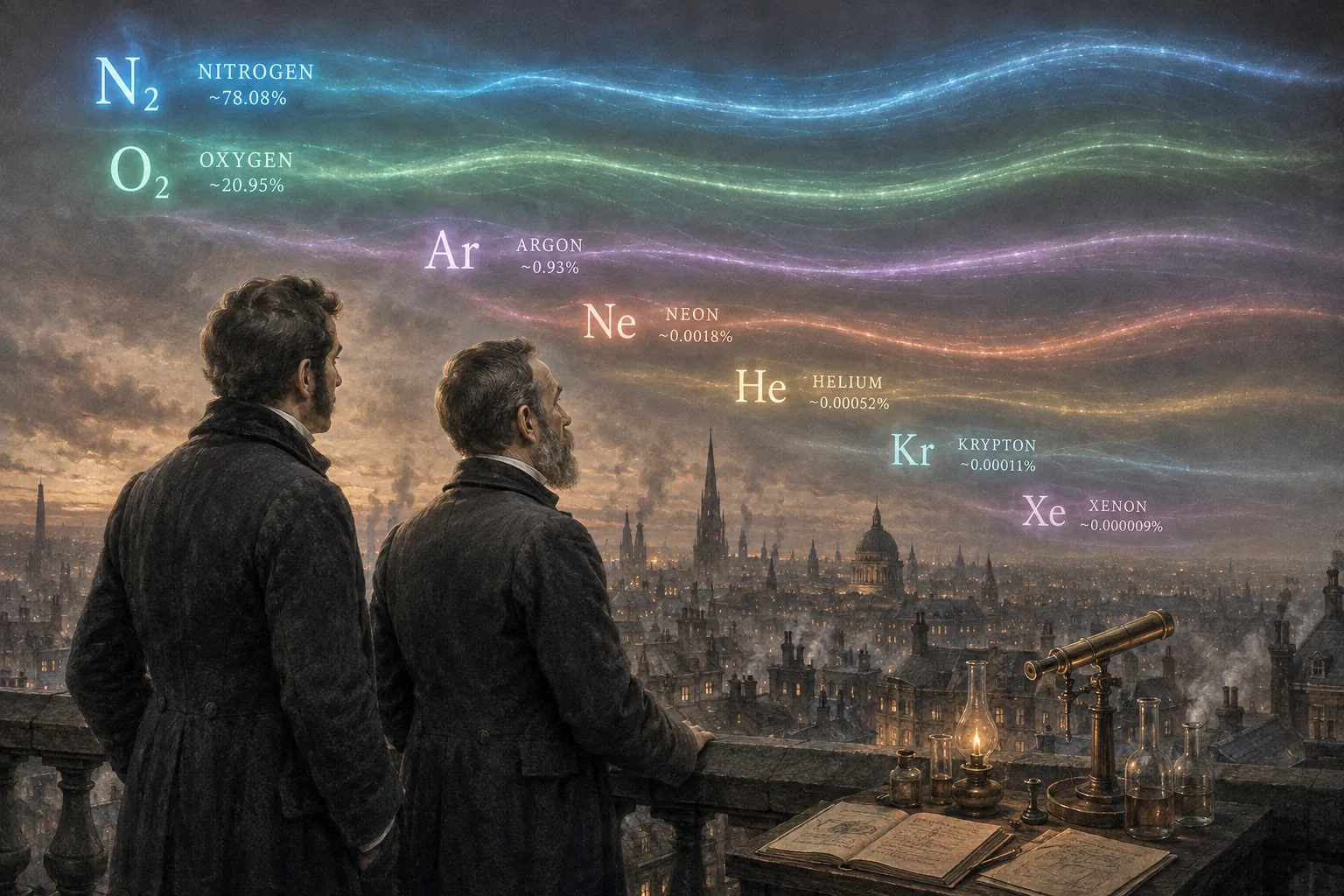
- Argon makes up nearly 1% of the atmosphere — the third most abundant gas in the air — and had gone completely unnoticed until 1894 because it forms no compounds.
- Ramsay's method for argon was subtractive: remove oxygen, carbon dioxide and water vapour from air, then remove the nitrogen itself, and see what refuses to disappear.
- Helium was known from the solar spectrum since 1868 before Ramsay found it in the terrestrial mineral cleveite in 1895 — the first proof that the sun's mystery element existed on Earth.
- Neon, krypton and xenon were separated in 1898 by the fractional distillation of liquid air, with Morris Travers as co-discoverer of all three.
- The gases are monatomic — single atoms rather than molecules — and their refusal to bond forced a rethink of valency that fed directly into the electronic theory of the chemical bond.
- Ramsay's later work with Frederick Soddy showed that helium is produced by the decay of radium, tying the new gases to the emerging science of radioactivity.
Quick Facts
- Discovery
- The noble gases — a complete new group of the periodic table
- Years
- Argon 1894 · Helium isolated on Earth 1895 · Neon, krypton, xenon 1898
- Key figure
- Sir William Ramsay (1852–1916), born Glasgow
- Co-discoverers
- Lord Rayleigh (argon) · Morris Travers (neon, krypton, xenon)
- Post
- Professor of Chemistry, University College London, from 1887
- Category
- Chemistry
- Claim status
- Mixed — see the claim-status box below. Argon shared; helium contested by parallel work; radon not his at all
- Nobel Prize
- Chemistry, 1904 (Rayleigh took the Physics prize the same year)
- Group in the table
- Originally Group 0, now Group 18
- Modern relevance
- Argon welding and lighting, neon signage, helium cryogenics and MRI, xenon headlights
Who Was William Ramsay?
In the closing years of the nineteenth century, Dmitri Mendeleev's periodic table was one of the great triumphs of chemistry. It organised the known elements by their properties and successfully predicted several that had not yet been found. Yet it contained a gap nobody had thought to look for: between the halogens and the alkali metals there was no room for a whole family of elements — and no reason to suspect one existed. The air people had breathed for the whole of human history contained something unaccounted for.
Between 1894 and 1898, William Ramsay led the work that found it. Five new elements in four years is an extraordinary rate of discovery, and it earned him the 1904 Nobel Prize in Chemistry. But the popular version of the story — a lone Scottish genius pulling elements out of thin air — is not what happened, and the real account is more interesting. Ramsay's achievement was to recognise that a tiny anomaly pointed at something structural, and then to pursue it with collaborators until an entire column of the periodic table existed where none had been suspected.
Early Life & Training
William Ramsay was born in Glasgow in 1852, into a family with scientific interests, and studied at the University of Glasgow. Like many ambitious British chemists of his generation he then went to Germany, working under the great Robert Bunsen at Heidelberg and with Rudolph Fittig at Tübingen. That training gave him both rigorous laboratory technique and direct exposure to the most advanced chemical thinking in Europe.
Returning to Britain, he held academic posts in Bristol before becoming Professor of Chemistry at University College London in 1887. He had built a reputation as an outstanding experimentalist with a particular interest in the physical properties of gases and in the young field of physical chemistry — precisely the combination of skills the argon problem would demand. It is worth stating plainly that although Ramsay was Scottish by birth and education, the noble gas work was done in London.
The Nitrogen Density Anomaly
The story begins not with Ramsay but with the physicist Lord Rayleigh (John William Strutt), who had been measuring the density of nitrogen obtained from different sources. Nitrogen prepared chemically from compounds such as ammonia came out slightly lighter than nitrogen extracted from the atmosphere. The difference was tiny — but it was consistent, it survived every check, and it could not be written off as experimental error.
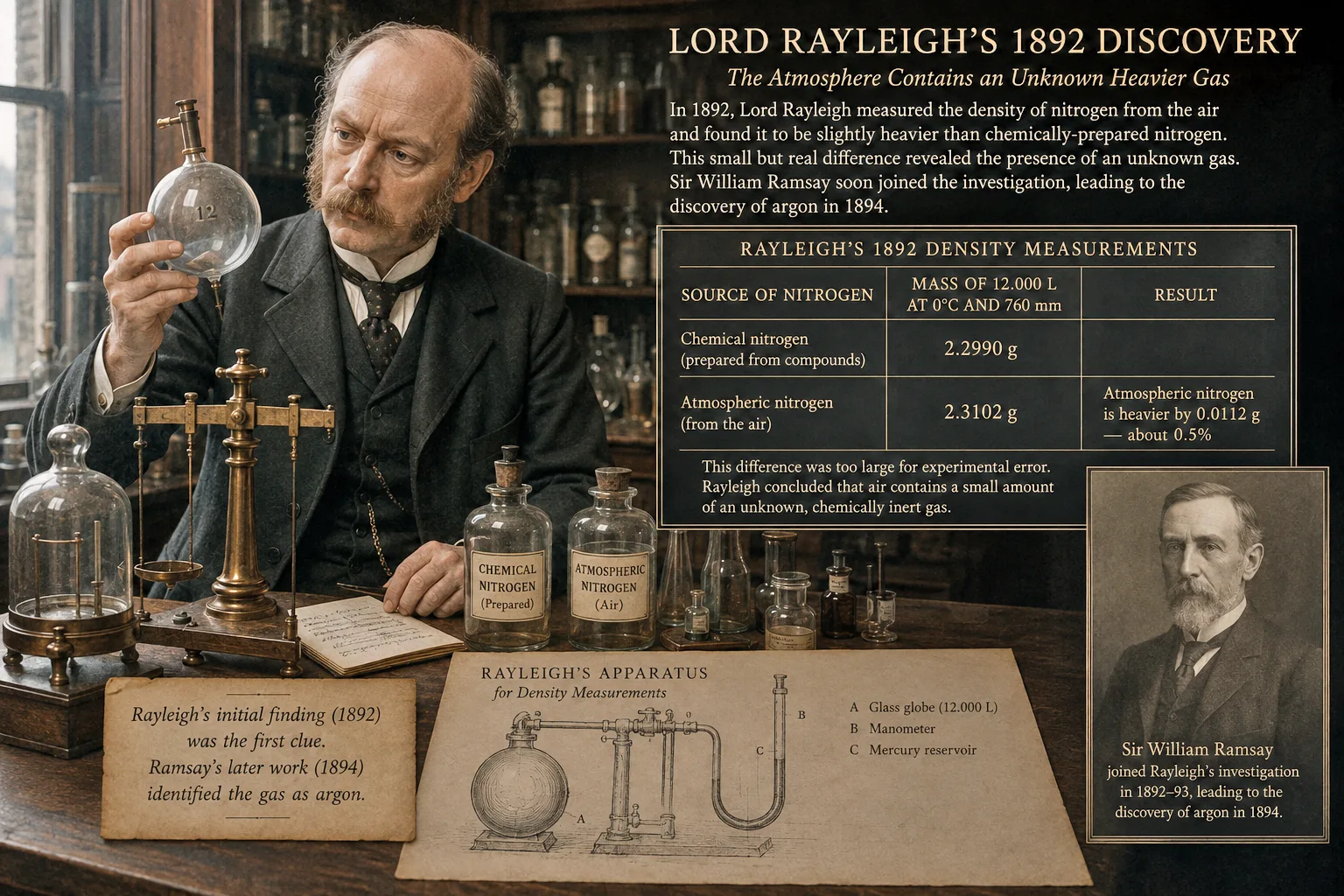
Rayleigh published the finding in 1892 and did something unusually generous: he invited chemists to help him explain it. Ramsay took up the challenge. He suspected the atmospheric sample was not pure nitrogen at all, but nitrogen contaminated with a small quantity of some heavier, unknown gas.
His approach was elegantly subtractive. Strip air of everything known to be in it — oxygen, carbon dioxide, water vapour — and then remove the nitrogen itself. If nothing was left, Rayleigh's anomaly would need another explanation. What Ramsay actually found was a small residue of gas that would not react with anything he put in front of it.
Argon, 1894 — Shared with Rayleigh
In 1894 Ramsay and Rayleigh jointly announced a new element. They named it argon, from the Greek for "lazy" or "inactive", because it refused to combine with anything. It turned out to make up nearly 1% of the atmosphere, making it the third most abundant atmospheric gas after nitrogen and oxygen. An entire percent of the air had escaped detection for the whole history of chemistry, purely because it did not react.
The credit here is genuinely shared, and the Nobel committee's 1904 decision reflects that: Ramsay received the Chemistry prize, Rayleigh the Physics prize, in the same year, for two sides of the same discovery. Rayleigh's contribution was the precision measurement that made the anomaly undeniable; Ramsay's was the chemistry that ran it to ground. Neither would have got there alone.
Helium on Earth, 1895
While working on argon, Ramsay turned to an old puzzle from astronomy. In 1868, spectroscopists had detected a bright yellow line in the spectrum of the sun that matched no known element. They named the hypothetical element helium, after helios. For nearly three decades it existed only as a line in sunlight.
In 1895 Ramsay obtained a sample of the uranium-bearing mineral cleveite, heated it, collected the gas released, and examined its spectrum. There was the yellow line. Helium was not merely solar — it was here, locked in the rocks.
Two honest qualifications belong with this. First, Ramsay did not discover the element; the solar spectroscopists did, conventionally credited to Pierre Janssen and Norman Lockyer. Ramsay found it on Earth. Second, he was not the only one to do so: the Swedish chemists Per Teodor Cleve and Nils Abraham Langlet obtained helium from cleveite independently at essentially the same moment. That is real parallel discovery, not a footnote — and the mineral itself is named after Cleve.
What mattered strategically was the pattern. Helium and argon were both chemically inert, and both occupied positions in the periodic table that had appeared to be empty. If two such elements existed, Ramsay reasoned, there were probably more.
Neon, Krypton and Xenon — with Morris Travers
Working with Morris Travers, Ramsay set out deliberately to complete the family. The technique was the fractional distillation of liquid air: cool air until it liquefies, then let it boil off slowly, capturing each component as it evaporates at its own characteristic temperature. The quantities involved were vanishingly small, and the work demanded exceptional experimental discipline.
In 1898 the pair announced three new elements in rapid succession:
- Neon ("new"), which glowed a brilliant red when an electric current was passed through it.
- Krypton ("hidden"), present in even smaller amounts.
- Xenon ("stranger"), the rarest of the three.
Travers deserves to be named as a co-discoverer of all three, and this page does so deliberately. Popular retellings tend to collapse him into "Ramsay's assistant" because Ramsay received the Nobel Prize and the public recognition, but the announcements were joint work and the record supports joint credit.
With argon and helium, the three new gases formed a complete new column in the periodic table — originally numbered Group 0, today Group 18. Ramsay had not simply added elements; he had identified an entire new class of matter. These gases were monatomic, existing as single atoms rather than molecules, and extraordinarily unreactive. That chemical inertness was exactly why they had stayed hidden.
Radon — the One Ramsay Did Not Discover
The noble gas group has six members, and Ramsay is often loosely credited with all of them. He should not be. Radon emerged from an entirely different line of research: the study of the radioactive "emanations" given off by radium and thorium, in which Ernest Rutherford was the leading figure. It was Friedrich Ernst Dorn who, in 1900, identified the radium emanation as a distinct gas.
Ramsay's connection to radon is real but different in kind: he was among those who later characterised the gas and established its properties and place in the group. That is significant work. It is not discovery, and the distinction matters — particularly on a site that would rather be accurate than flattering.
Impact on Chemistry
The consequences of the discovery went well beyond adding names to a list. It completed Mendeleev's periodic table as it stood at the end of the nineteenth century: after 1898 there were no longer obvious gaps among the stable elements. More importantly, it posed a question chemists could not answer with the theory they had. Why would these elements not react? The search for an explanation drove much of the thinking about valency and chemical bonding that followed, and the noble gases' full outer electron shells became the reference point against which all other bonding behaviour is still taught.
Ramsay's later collaboration with Frederick Soddy, showing in 1903 that helium is produced during the radioactive decay of radium, connected the new gases to radioactivity — and explained, incidentally, why helium had been sitting inside a uranium mineral for Ramsay to find in 1895.
Legacy & Modern Relevance
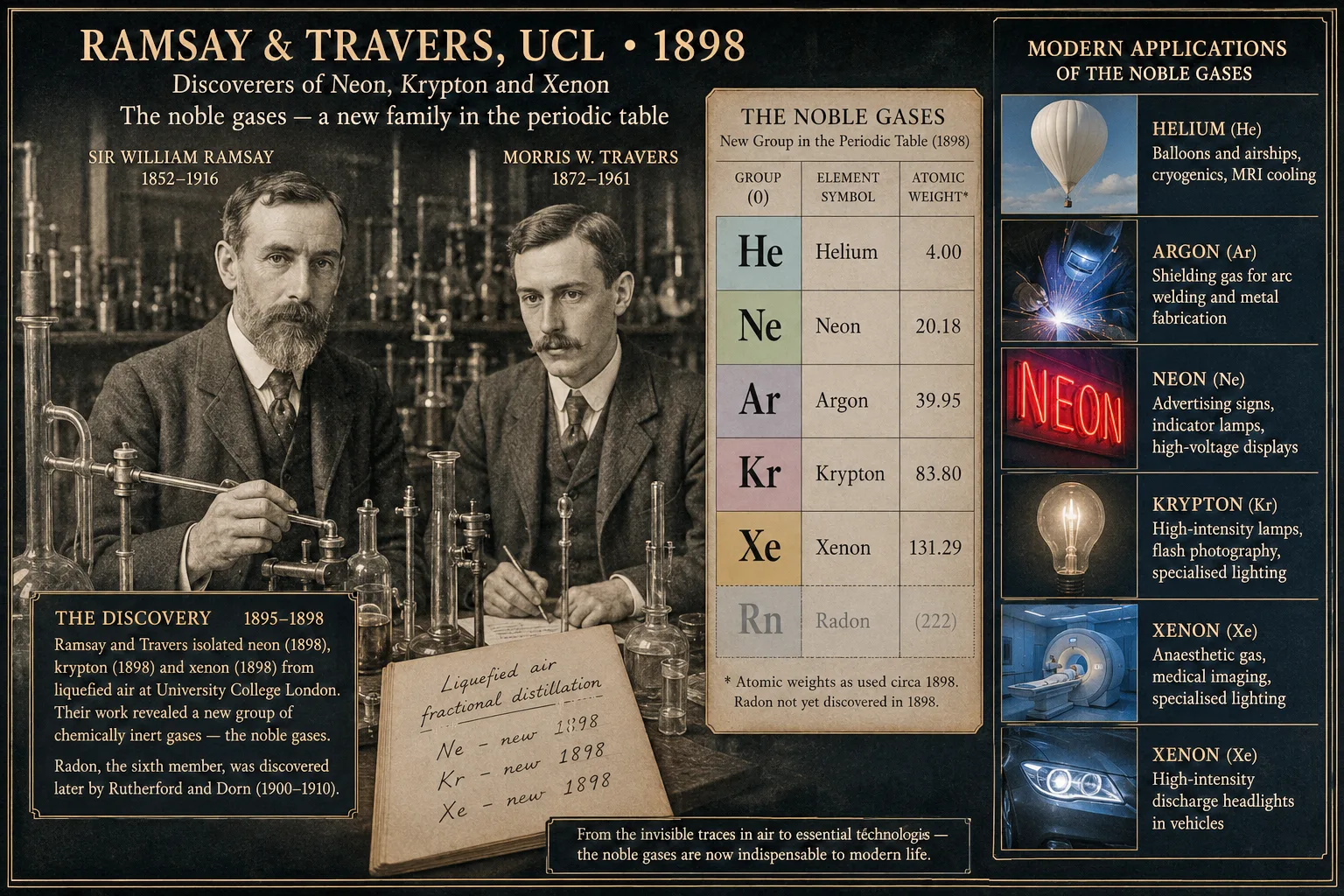
The noble gases are now so embedded in everyday technology that most people encounter several of them daily without noticing. Argon shields welds from oxidation, fills incandescent bulbs and sits between the panes of insulating windows. Neon gives signage its unmistakable red glow. Helium cools the superconducting magnets inside MRI scanners and underpins much of cryogenics. Xenon lights high-intensity vehicle headlamps.
Ramsay died in 1916, aged 63. By then his place was secure. He had revealed a family of elements that had been present all along — in the air of every room he had ever stood in, and in the minerals under his feet — and in doing so brought one of the great eras of chemical discovery to a fitting close. The story is, in the end, one about taking a very small discrepancy very seriously.
Timeline
1852
William Ramsay born in Glasgow
Into a family with scientific interests; educated at the University of Glasgow
1868
A yellow line is seen in the solar spectrum
Astronomers name the unknown element helium, after helios — the sun
1870s
Ramsay trains in Germany
Works under Robert Bunsen at Heidelberg and Rudolph Fittig at Tübingen
1887
Appointed Professor of Chemistry at University College London
After earlier academic posts in Bristol
1892
Lord Rayleigh publishes the nitrogen density anomaly
Atmospheric nitrogen is consistently, slightly heavier than chemically prepared nitrogen; he invites chemists to help
1894
Ramsay and Rayleigh jointly announce argon
Named from the Greek for lazy or inactive; nearly 1% of the atmosphere
1895
Ramsay heats the mineral cleveite and identifies helium on Earth
The same yellow spectral line seen in the sun, found in a terrestrial mineral
1898
Neon, krypton and xenon isolated with Morris Travers
By fractional distillation of liquid air, in rapid succession
1900
Radon identified by Friedrich Ernst Dorn
Following Ernest Rutherford's earlier observation of thorium emanation — not Ramsay's discovery
1903
Ramsay and Frederick Soddy show helium is produced by radium decay
Linking the noble gases to the new science of radioactivity
1904
Nobel Prize in Chemistry awarded to Ramsay
Rayleigh receives the Physics prize the same year for the gas-density work
1916
Ramsay dies, aged 63
Five elements and an entire new column of the periodic table to his name
Myths & Facts
Myth: Ramsay discovered all six noble gases.
Fact: He led the discovery of five. Radon was not his: it emerged from Ernest Rutherford's work on radioactive emanations and was identified as a distinct gas by Friedrich Ernst Dorn in 1900. Ramsay later characterised radon and helped establish its properties, but he did not discover it.
Myth: Ramsay discovered argon single-handedly.
Fact: Lord Rayleigh found and published the density anomaly in 1892 that made the discovery possible, and the 1894 announcement was joint. The two men were awarded separate Nobel Prizes for the same episode in 1904.
Myth: Morris Travers was just Ramsay's lab assistant.
Fact: Travers was a co-discoverer of neon, krypton and xenon, named on the joint papers. The reduction of his role to an assistant's is an artefact of Ramsay's Nobel fame, not of the historical record.
Myth: Ramsay discovered helium.
Fact: He was the first to isolate helium on Earth, in 1895. The element had already been detected in the sun's spectrum in 1868, and Per Teodor Cleve and Nils Abraham Langlet in Sweden obtained it from cleveite independently at almost exactly the same time as Ramsay.
Myth: The noble gases cannot form any compounds.
Fact: True in practice until 1962, and still true of helium, neon and argon under normal conditions — but genuine xenon compounds have been synthesised since, so the modern description is 'extremely unreactive', not 'absolutely inert'.
Myth: The discovery was made in Scotland.
Fact: Ramsay was Glasgow-born and Glasgow-educated, but the argon, helium, neon, krypton and xenon work was done at University College London.
Did You Know?
- Argon makes up nearly 1% of the air — more than carbon dioxide — and nobody noticed until 1894.
- Helium was discovered in the sun 27 years before anyone found it on Earth.
- The mineral Ramsay heated to release helium, cleveite, is named after Per Teodor Cleve — who isolated helium from it independently at the same time.
- Argon means 'lazy' or 'inactive'; neon means 'new'; krypton means 'hidden'; xenon means 'stranger'. Ramsay's naming was refreshingly literal.
- Ramsay and Lord Rayleigh won Nobel Prizes in different subjects — Chemistry and Physics — in the same year, 1904, for the same discovery.
- Ramsay showed that radioactive radium produces helium, which is why helium accumulates inside uranium ores.
Honest Caveats
Argon was a shared discovery. Rayleigh's measurement created the problem; Ramsay's chemistry solved it. The joint 1894 announcement and the split 1904 Nobel Prizes are the record.
Helium's terrestrial isolation was not unique to Ramsay. Cleve and Langlet did the same work independently in Sweden at essentially the same time, and the element itself had been found in the sun in 1868.
Morris Travers was a co-discoverer. Neon, krypton and xenon are joint work, and reducing Travers to an assistant misstates the history.
Radon is not Ramsay's. Rutherford's emanation research and Dorn's 1900 identification produced the sixth noble gas. Ramsay characterised it later.
The work was done in London. Ramsay was Glasgow-born and Glasgow-educated, and trained further in Germany, but the noble gas discoveries were made at University College London.
"Inert" needs a modern qualification. The gases were believed to form no compounds at all; genuine xenon compounds have been synthesised since 1962. Extremely unreactive is accurate; absolutely inert is not.
Frequently Asked Questions
Who discovered the noble gases?
Sir William Ramsay led the discovery of five of the six: argon (1894, jointly with Lord Rayleigh), helium isolated on Earth (1895), and neon, krypton and xenon (1898, with Morris Travers). The sixth noble gas, radon, was not discovered by Ramsay — it emerged from the radioactivity work of Ernest Rutherford and was identified as a distinct gas by Friedrich Ernst Dorn in 1900. So the honest summary is that Ramsay led the discovery of the group, but did not personally discover every member of it, and did not do any of it alone.
Was argon Ramsay's discovery or Rayleigh's?
Both, genuinely. Lord Rayleigh found the anomaly — atmospheric nitrogen was consistently slightly denser than nitrogen prepared chemically from compounds such as ammonia — and published it in 1892 with an open invitation to chemists to explain it. Ramsay took up the challenge and supplied the chemical means of stripping away every known component of air until only an unreactive residue remained. The 1894 announcement was made jointly, and the Nobel committee split the credit across two prizes in 1904: Chemistry to Ramsay, Physics to Rayleigh. Argon is properly a shared discovery.
Did Ramsay discover helium?
He was the first to isolate helium on Earth, in 1895, by heating the uranium mineral cleveite and matching the released gas to the yellow spectral line seen in the sun since 1868. He was not the first to detect the element itself — that credit belongs to the solar spectroscopists, conventionally Pierre Janssen and Norman Lockyer. Nor was Ramsay working alone on the terrestrial isolation: the Swedish chemists Per Teodor Cleve and Nils Abraham Langlet independently obtained helium from cleveite at essentially the same moment, and their work was genuinely independent rather than derivative.
What was Morris Travers's role?
Full co-discoverer of three elements, not an assistant footnote. Travers worked with Ramsay on the fractional distillation of liquid air that yielded neon, krypton and xenon in 1898, and the papers announcing those elements were joint. Popular accounts often reduce him to Ramsay's helper because Ramsay took the Nobel Prize and the public fame. This page names him as a co-discoverer of neon, krypton and xenon because that is what the record supports.
Why did the noble gases go unnoticed for so long?
Because they barely react. Almost every method 19th-century chemists had for detecting a substance depended on that substance combining with something else. The noble gases are monatomic and form no compounds under ordinary conditions, so they simply sat in the air, chemically invisible. They were found only when measurement became precise enough that a tiny discrepancy in the density of nitrogen — a fraction of a percent — could not be dismissed as experimental error.
How did the noble gases change the periodic table?
They added an entire new column. Mendeleev's table had predicted missing elements within its existing groups, but nothing in it anticipated a whole family of inert elements sitting between the halogens and the alkali metals. That new group — originally numbered Group 0, now Group 18 — completed the table as it was then understood and forced chemists to rethink valency and chemical bonding: the question of why these elements refused to react drove much of the electronic theory of the chemical bond that followed.
Are the noble gases really completely inert?
Not entirely, though they were believed to be for decades. Under ordinary conditions they form no compounds, which is what made them so hard to find. From 1962 onwards, chemists succeeded in making genuine compounds of xenon (and later krypton and radon) under forcing conditions with highly electronegative partners such as fluorine and platinum fluorides. Helium, neon and argon remain, for practical purposes, unreactive. The correct modern phrasing is that the noble gases are extremely unreactive, not absolutely inert.
What are the noble gases used for today?
Argon shields welds from oxidation and fills incandescent bulbs and insulating window units; neon gives the red glow of neon signage; helium is essential to cryogenics, superconducting magnets and therefore MRI scanners, as well as to leak detection and lifting gas; krypton and xenon appear in specialist lighting, with xenon in high-intensity vehicle headlights and in anaesthesia and ion propulsion. Every one of those applications traces back to the 1894–98 work.
Was Ramsay Scottish?
Yes. He was born in Glasgow in 1852 and studied at the University of Glasgow before completing his training in Germany under Bunsen and Fittig. His discoveries, however, were made at University College London, not in Scotland — a distinction this collection states rather than blurs. He is a Scottish scientist by birth and formation; the noble gases are not a Scottish laboratory achievement in the geographical sense.
Why did Ramsay and Rayleigh win different Nobel Prizes?
The 1904 prizes recognised two different aspects of the same episode. Rayleigh received the Physics prize for his investigations into the densities of the most important gases and the discovery of argon arising from those studies. Ramsay received the Chemistry prize for the discovery of the inert gaseous elements in air and the determination of their place in the periodic system — that is, for the whole group and its structural meaning, not for argon alone.
How much of the air is noble gas?
Argon is by far the largest share at roughly 0.93% of dry air, which makes it the third most abundant atmospheric gas after nitrogen and oxygen — a genuinely substantial component that had gone entirely unnoticed. Neon, helium, krypton and xenon are present only in trace amounts, which is why isolating them required the fractional distillation of large volumes of liquefied air.
What is the connection between the noble gases and radioactivity?
A direct one. In 1903 Ramsay, working with Frederick Soddy, showed that helium is produced during the radioactive decay of radium — alpha particles are helium nuclei, though that interpretation came slightly later. This tied the newly discovered inert gases to the emerging science of radioactivity, and it is also the reason helium accumulates in uranium- and thorium-bearing minerals such as the cleveite Ramsay had heated in 1895.
Sources & Further Reading
Tier 1 · Primary and contemporary
- Rayleigh, Lord — "Density of Nitrogen," Nature, 1892 (the published anomaly and open invitation to chemists).
- Rayleigh, Lord, and Ramsay, W. — "Argon, a New Constituent of the Atmosphere," Philosophical Transactions of the Royal Society A, 1895.
- Ramsay, W. — announcement of the terrestrial isolation of helium from cleveite, 1895.
- Ramsay, W., and Travers, M. W. — the 1898 papers announcing neon, krypton and xenon.
- Ramsay, W. — The Gases of the Atmosphere: The History of Their Discovery, Macmillan (later editions to 1915).
Tier 2 · Institutional and scholarly
- The Nobel Foundation — Nobel Prize in Chemistry 1904 (Ramsay) and Nobel Prize in Physics 1904 (Rayleigh), award citations and presentation speeches.
- Travers, M. W. — The Discovery of the Rare Gases, Edward Arnold, 1928 (the co-discoverer's own account).
- Royal Society — biographical memoirs and obituary notices for William Ramsay (1916).
- Dorn, F. E. — 1900 identification of the radium emanation as a distinct gas; Rutherford, E. — papers on thorium and radium emanations, 1899–1900.
Tier 3 · Site source document
docs/sources/discoveries/discovery-of-noble-gases.md— the commissioned source document underlying this article.