Discoveries · No. 34 of 50 · Atmospheric Science
Sir Robert Watson-Watt and Atmospheric Radio Science
Long before he invented radar, the Brechin-born physicist Robert Watson-Watt spent two decades teaching the world to "see" the invisible atmosphere with radio waves — locating thunderstorms by the crackle of lightning and timing echoes to measure the ionosphere far above.
Robert Watson-Watt · 1892–1973Atmospheric research · c. 1915–1935Reading time · 22 minUpdated 16 August 2026
TL;DR
- Long before he invented radar, Robert Watson-Watt spent two decades (c.1915–1935) pioneering the use of radio to "see" the invisible atmosphere — locating thunderstorms by the radio crackle of lightning and measuring the height of the ionosphere by timing radio echoes — a genuine scientific achievement in its own right.
- This atmospheric radio science was the essential apprenticeship for radar: by 1935 he had spent twenty years using directional antennas, cathode-ray tube displays and radio pulses to locate distant phenomena, so when the Air Ministry asked whether radio could detect aircraft, he was uniquely prepared.
- His legacy survives directly today: the UK Met Office's lightning-location network, the global "sferics" research field, and continuous ionospheric monitoring all descend from techniques he pioneered — and he even coined the word "ionosphere."
Scottish Impact Index (SI Score)
- Global Impact
- 8/10
- Longevity
- 8/10
- Economic / Material Impact
- 5/10
- Originality / Distinctiveness
- 8/10
- Legacy (Built Upon)
- 7/10
- Recognition
- 4/10
Key Findings
- Robert Alexander Watson-Watt (1892–1973) was born in Brechin, Angus, and graduated BSc in engineering from University College, Dundee, in 1912, where Professor William Peddie introduced him to radio physics.
- From 1915 he worked for the Meteorological Office locating thunderstorms by their radio emissions ("atmospherics" or "sferics") to warn aviators of dangerous weather.
- He proposed in 1916 using a cathode-ray oscillograph to instantly display a lightning bearing — an idea that had to wait until roughly 1923 for reliable cathode-ray tubes to exist.
- At the Radio Research Station, he and colleagues including E.V. Appleton and J.F. Herd developed the "squegger" time-base circuit to time echoes from the upper atmosphere.
- He coined the term "ionosphere" in a letter dated 8 November 1926, though he was not the one to first prove the layer's existence or measure its height — that was Appleton and Barnett, in 1924.
- His twenty years of atmospheric radio work directly prepared him for the 12 February 1935 memorandum and the 26 February 1935 Daventry experiment that launched British radar development.
Quick Facts
- Discovery
- Systematic use of radio direction-finding and pulse-echo timing to locate thunderstorms and measure the height of the ionosphere
- Period
- c. 1915–1935, roughly two decades before his invention of radar
- Key figure
- Sir Robert Alexander Watson-Watt (1892–1973)
- Born
- 13 April 1892, 5 Union Street, Brechin, Angus, Scotland
- Education
- BSc engineering, University College, Dundee (University of St Andrews), 1912
- Mentor
- Professor William Peddie, who introduced him to radio physics and Maxwell's electromagnetic theory
- Founding problem
- Locating thunderstorms by their radio emissions to warn aviators, from 1915 at the Meteorological Office
- Key instrument
- The cathode-ray oscillograph (CRT), proposed by Watson-Watt in 1916 to display a lightning bearing instantly
- Key technique named for him
- Cathode Ray Direction Finding (CRDF), the 'Watson-Watt' or 'Adcock/Watson-Watt' method
- Coined term
- 'Ionosphere' — proposed in a letter dated 8 November 1926 to the Radio Research Board
- Ionosphere height proof
- Edward Appleton and Miles Barnett, 1924 (Nobel Prize in Physics, 1947, to Appleton)
- Collaborators
- E.V. Appleton and J.F. Herd, co-developers of the 'squegger' time-base circuit
- Radar bridge
- 12 February 1935 memorandum and the 26 February 1935 Daventry experiment
- Recognition
- FRS 1941; knighted 1942; US Medal for Merit 1946; Royal Society Hughes Medal 1948
- Claim status
- Established as a genuine, independent body of atmospheric science and the direct apprenticeship for radar — not itself the invention of radar
A Brechin Beginning
Robert Alexander Watson-Watt was born on 13 April 1892 in the cathedral town of Brechin, in Angus, north-east Scotland, at 5 Union Street — the fifth son and youngest child of Patrick Watt, a carpenter and cabinet-maker, and his wife Mary. He attended Damacre Primary School and then Brechin High School, where he was "Dux," the top pupil of his year, before winning a bursary to University College, Dundee, then part of the University of St Andrews.
He graduated with a BSc in engineering in 1912 and was offered an assistantship by William Peddie, Professor of Physics (Natural Philosophy) at Dundee from 1907 to 1942. It was Peddie who steered the young graduate toward "wireless telegraphy" — radio — giving him what amounted to a one-man postgraduate education in radio-frequency oscillators, wave propagation and Maxwell's electromagnetic theory. That mentorship set the direction of the rest of his working life. His later, world-changing invention of radar is a separate, larger story told in full in our Inventions Collection; here the focus is on the atmospheric science that came first and made that later invention possible.
The Atmosphere in 1915
When Watson-Watt began his career, the radio age was barely a decade old, and it had already produced a genuine scientific mystery. On 12 December 1901, Guglielmo Marconi sent a wireless signal across the Atlantic, from Poldhu in Cornwall to St John's in Newfoundland — a result that, by the physics then understood, should have been impossible. Radio waves were thought to travel in straight lines, while the curve of the Earth should have carried the receiving station out of a direct line of sight long before the signal could arrive. Something, evidently, was bending or reflecting the waves back down to Earth.
In 1902, two men on opposite sides of the Atlantic independently proposed the same solution. The American electrical engineer Arthur Edwin Kennelly and the British physicist Oliver Heaviside each suggested that a high, electrically conducting layer of the atmosphere was acting as a mirror, bouncing radio waves back toward the ground. This hypothetical reflecting layer became known as the "Kennelly–Heaviside layer." For more than two decades it remained an unproven hypothesis; many working engineers were openly sceptical that it existed at all. Definitive experimental proof would not arrive until 1924, when Edward Appleton and Miles Barnett measured its height directly — work for which Appleton alone received the 1947 Nobel Prize in Physics.
Lightning presented an even murkier puzzle. Anyone who owned a wireless set knew that thunderstorms produced bursts of crackling interference, nicknamed "atmospherics" or "sferics" by radio operators. But precisely how lightning generated these radio bursts, and whether the phenomenon could be turned to practical use, was poorly understood. This was the specific scientific problem the Meteorological Office handed to the young Watson-Watt in 1915: find a way to detect and locate thunderstorms from their radio emissions, so that meteorologists could warn aviators — flying fragile, fabric-and-wire aircraft — of dangerous weather lying beyond the horizon. It amounted, in effect, to the world's first serious attempt at radio-based weather surveillance.
Locating Thunderstorms
Watson-Watt's basic insight was simple to state and difficult to achieve: every lightning discharge radiates a broadband burst of radio energy that can travel hundreds, even thousands, of miles. If the direction from which such a burst arrived could be measured accurately, a line could be drawn straight toward the storm; combine bearings from two or more separated stations, and the storm's position could be fixed precisely by triangulation.
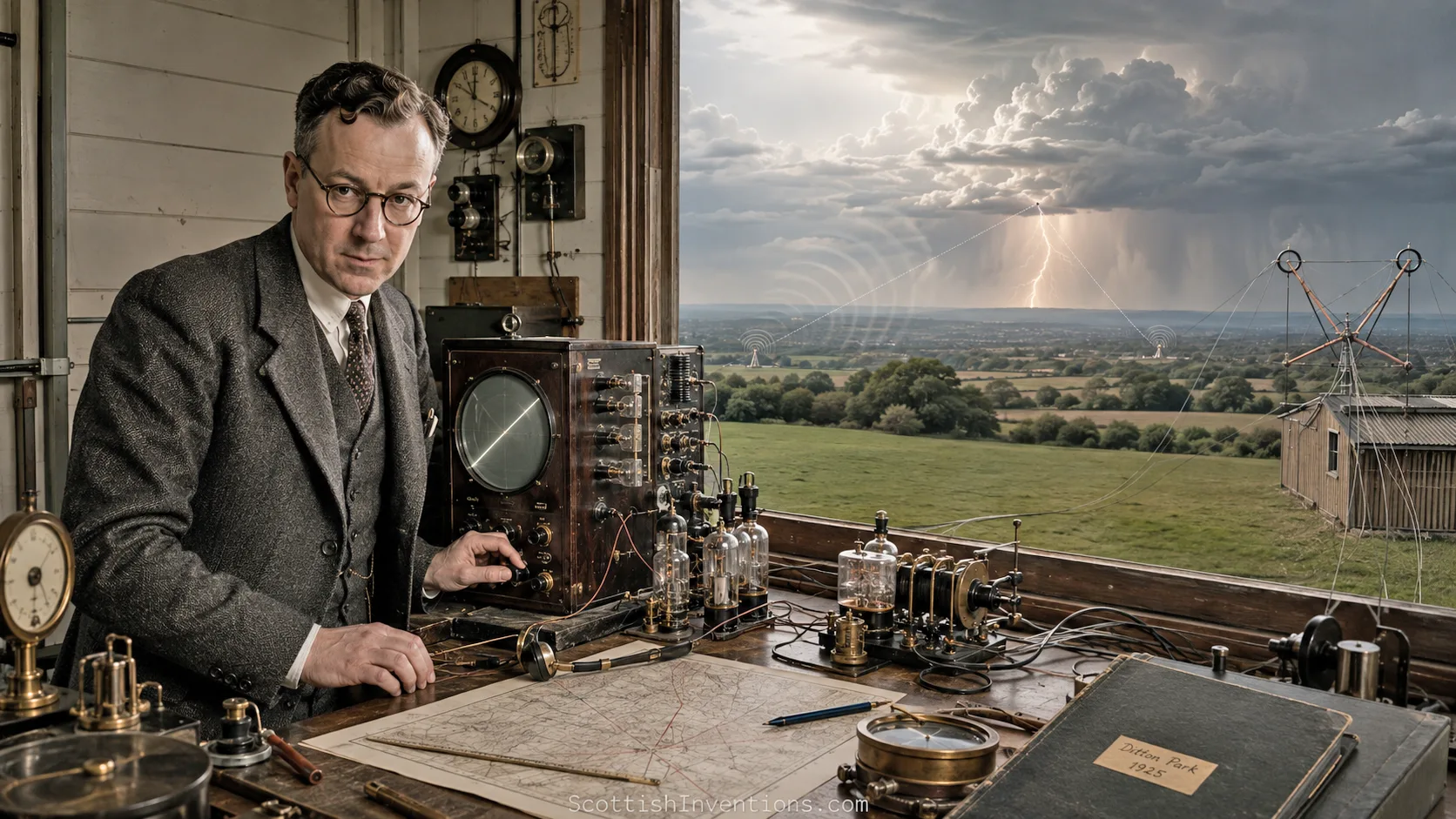
He began this work at the Wireless Station of the Air Ministry Meteorological Office at Aldershot, in a wooden hut where his first wife, Margaret — sometimes called "the mother of radar" — helped solder his apparatus and record observations. The first problem was directional: he used antennas that could be rotated to maximise or minimise a signal, "pointing" toward the storm. The second, much harder problem was speed. A lightning sferic lasts only a tiny fraction of a second — far too fleeting for a swinging needle or a mechanical pen recorder to capture reliably. Watson-Watt's answer, proposed in 1916, was to feed the signal into a cathode-ray oscillograph, so that a single flash would instantly paint a line of light on the screen showing its bearing. The idea was years ahead of the available hardware: reliable cathode-ray tubes only became available around 1923, after which the method finally came into its own.
His earliest scientific publications grew directly out of this work. He produced "Directional Observations of Atmospherics, 1916–1920" (Philosophical Magazine, series 6, volume 45, pages 1010–1026, 1923), and in 1922 published the short note "The Origin of Atmospherics" in Nature(volume 110, pages 680–681), reporting that "actual thunderstorms could be located by direction-finding on atmospherics" in a Meteorological Office investigation begun in 1915. He also co-authored "The Study of Radiotelegraphic Atmospherics in Relation to Meteorology" with C.J.P. Cave, published in the Quarterly Journal of the Royal Meteorological Society in 1923.
In 1924, when the War Department reclaimed the Aldershot site, Watson-Watt moved his work to Ditton Park, near Slough, where the National Physical Laboratory already had a presence. There he gained access to two decisive pieces of equipment: an Adcock antenna — an array of four masts that sensed a signal's direction from phase differences between them — and a modern oscilloscope acquired from Bell Labs. By feeding the outputs of crossed Adcock antennas into the X and Y channels of the oscilloscope, a single lightning stroke produced a line on the screen pointing directly at the storm. This became known as Cathode Ray Direction Finding, or CRDF, and radio engineers still refer to the underlying method as the "Watson-Watt" or "Adcock/Watson-Watt" technique. In 1926, with J.F. Herd, he published "An instantaneous direct-reading radiogoniometer" in the Journal of the Institution of Electrical Engineers (volume 64, pages 611–622), describing the direction-finding instrument at the heart of the whole system.
In 1927 the Meteorological Office's and the National Physical Laboratory's radio research teams were formally amalgamated into the Radio Research Station, operating under the Department of Scientific and Industrial Research, with Watson-Watt appointed superintendent. He became head of the radio department of the National Physical Laboratory at Teddington in 1933. By the early 1930s, the station could locate storms by direction-finding from multiple receivers and correlate them with the movement of cold-air weather fronts — a genuinely remarkable feat of practical atmospheric science for its time. In 1929 he summarised the field for a wider scientific audience in the G.J. Symons Memorial Lecture, "Weather and Wireless," published in the Quarterly Journal of the Royal Meteorological Society (volume 55, pages 273–301, delivered 20 March 1929).
Sounding the Ionosphere
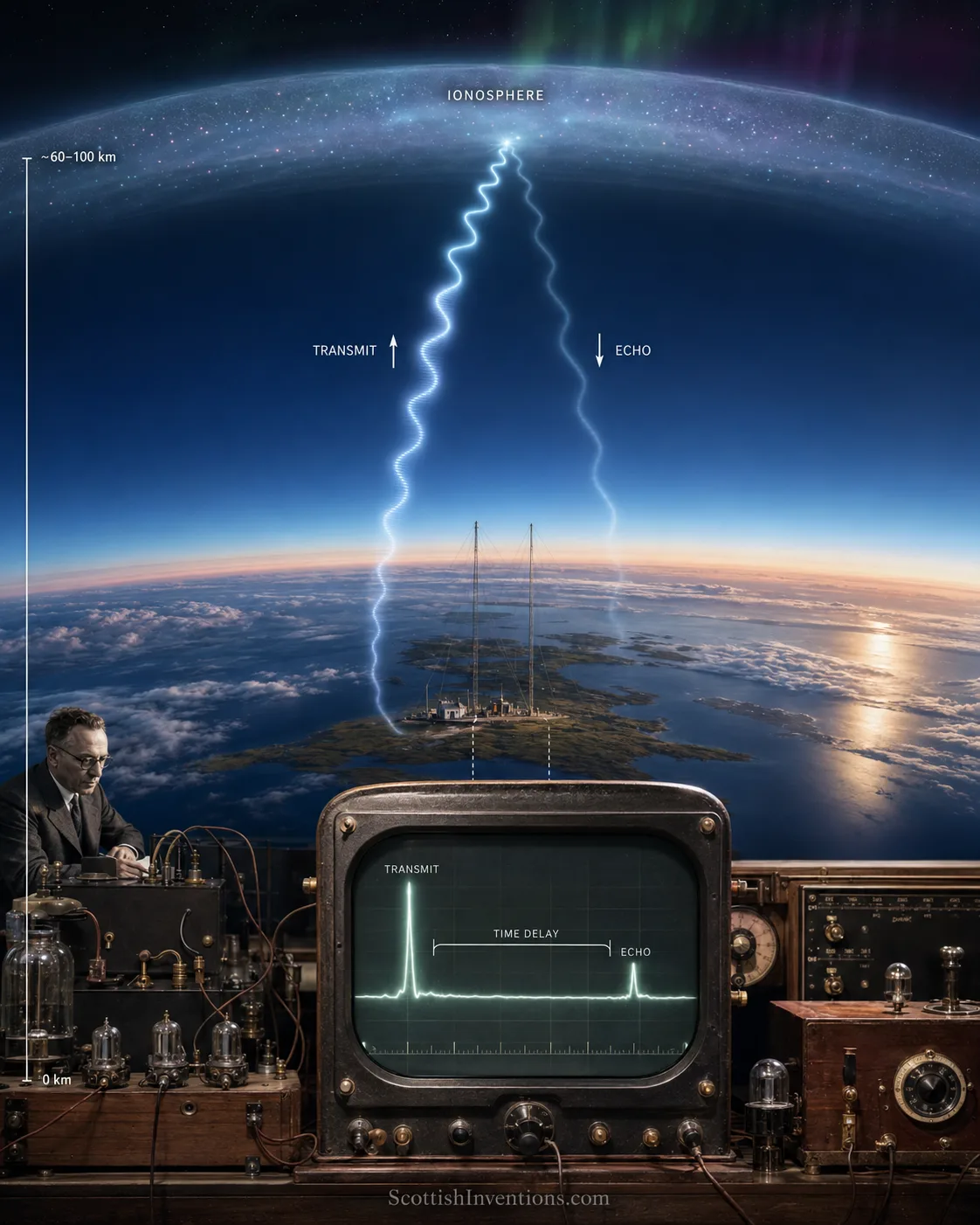
The same basic toolkit that located thunderstorms could also be turned upward, to probe the sky itself. The ionosphere — a term Watson-Watt himself coined — is the electrically charged upper region of the atmosphere, ionised by the Sun's ultraviolet and X-ray radiation knocking electrons off atmospheric gases, beginning at roughly 60 to 100 kilometres altitude. It is precisely the layer Kennelly and Heaviside had hypothesised more than two decades earlier.
Edward Appleton initially measured the layer's height using a frequency-variation method: the 1924 Appleton–Barnett experiment, using a BBC transmitter at Bournemouth, established a reflecting layer at about 100 km, providing the first firm experimental confirmation that the Kennelly–Heaviside layer genuinely existed. Watson-Watt's group at Slough pursued a different, complementary approach — the pulse method — sending a sharp radio pulse upward and timing precisely how long its echo took to return, exactly as a radar set would later time the echo from an aircraft. To make this possible, the team needed a way to sweep the spot on a cathode-ray tube smoothly across the screen at a very high, precisely known speed, so that the echo's delay could be read directly off the display as a height. Working with E.V. Appleton and J.F. Herd, Watson-Watt developed the "squegger" — a self-oscillating time-base circuit — to provide exactly that linear sweep. The work appeared in the joint paper "On the Nature of Atmospherics," published by Appleton, Watson-Watt and Herd in Proceedings of the Royal Society A, volume 111, in 1926. This time-base technology is a direct technical ancestor of the radar display.
It was in a letter dated 8 November 1926, addressed to the secretary of the Radio Research Board, that Watson-Watt proposed the word "ionosphere," reasoning that it deserved a place alongside the newly adopted terms "stratosphere" and "troposphere." The word did not actually appear in print until 1969, but it came into general scientific use during the early 1930s. In 1924 he had also noted an apparent enhancement of the ionosphere during local thunderstorms — an intriguing observation that, remarkably, was not properly followed up until researchers at Reading University revisited it in 2005.
The Scientific Method
The elegance of Watson-Watt's overall approach can be set out in a few plain steps, and it is worth doing so explicitly, because the same steps reappear, essentially unchanged, in radar a decade later.
- A lightning flash is a natural radio transmitter. Each discharge radiates a broadband "sferic" that races through the gap between the ground and the ionosphere and can be detected thousands of kilometres away.
- A directional antenna finds the bearing. Rotating an antenna, or using crossed fixed antennas, reveals the direction of strongest or weakest signal — a line pointing toward the storm.
- Two stations triangulate. Crossing the bearings from two or more separated stations locates the storm's position where the lines intersect.
- The cathode-ray tube reads it in an instant. Because a sferic lasts only milliseconds, the cathode-ray display captures the bearing of each individual flash as a streak of light, fast enough to track a live, moving storm.
- For the ionosphere, send a pulse and time the echo. A radio pulse fired straight up bounces off the ionosphere; the time delay, read off the calibrated cathode-ray time base, gives the layer's height.
Every one of these techniques — directional finding, triangulation, the cathode-ray display, and pulse-echo ranging — is a direct intellectual ancestor of radar. Radar simply turns the same set of ideas on a new kind of target: instead of waiting for lightning to transmit on its own, the radar set provides its own outgoing pulse, and instead of reading an echo from the ionosphere, it reads an echo bounced back from an aircraft.
The Bridge to Radar
By the mid-1930s, Watson-Watt had spent twenty years doing precisely the things radar would require: detecting faint, fleeting radio signals; building sensitive receivers and directional antenna systems; displaying direction and timing information on cathode-ray tubes; and timing radio echoes from distant reflectors to measure range. When, in early 1935, the Air Ministry's H.E. Wimperis asked him whether radio could be used to build a "death ray" capable of disabling enemy pilots, Watson-Watt set his assistant Arnold Wilkins to calculate the energy such a device would require, found the result hopelessly impractical, but — drawing directly on his life's atmospheric research — pointed instead to "the still difficult but less unpromising problem of radio detection."
His memorandum, "Detection and Location of Aircraft by Radio Methods," reached the Air Ministry on 12 February 1935. The relevant committee asked for proof. On 26 February 1935, near Daventry, Watson-Watt, Wilkins and a single witness from the Tizard Committee, A.P. Rowe, used a BBC shortwave transmitter and two receiving antennas to detect a Handley Page Heyford bomber; according to the National Library of Scotland, the aircraft was detected at a range of about 13 miles, a distance later extended to some 75 miles with a more powerful transmitter. The reflected signal deflected the trace on a cathode-ray tube — in essence, his thunderstorm-and-ionosphere apparatus, pointed at an aeroplane instead of the sky. The two decades of atmospheric science had made the man ready; the invention that followed is a fuller story, told in our companion Inventions Collection article on radar.
Legacy: From Sferics to Satellites
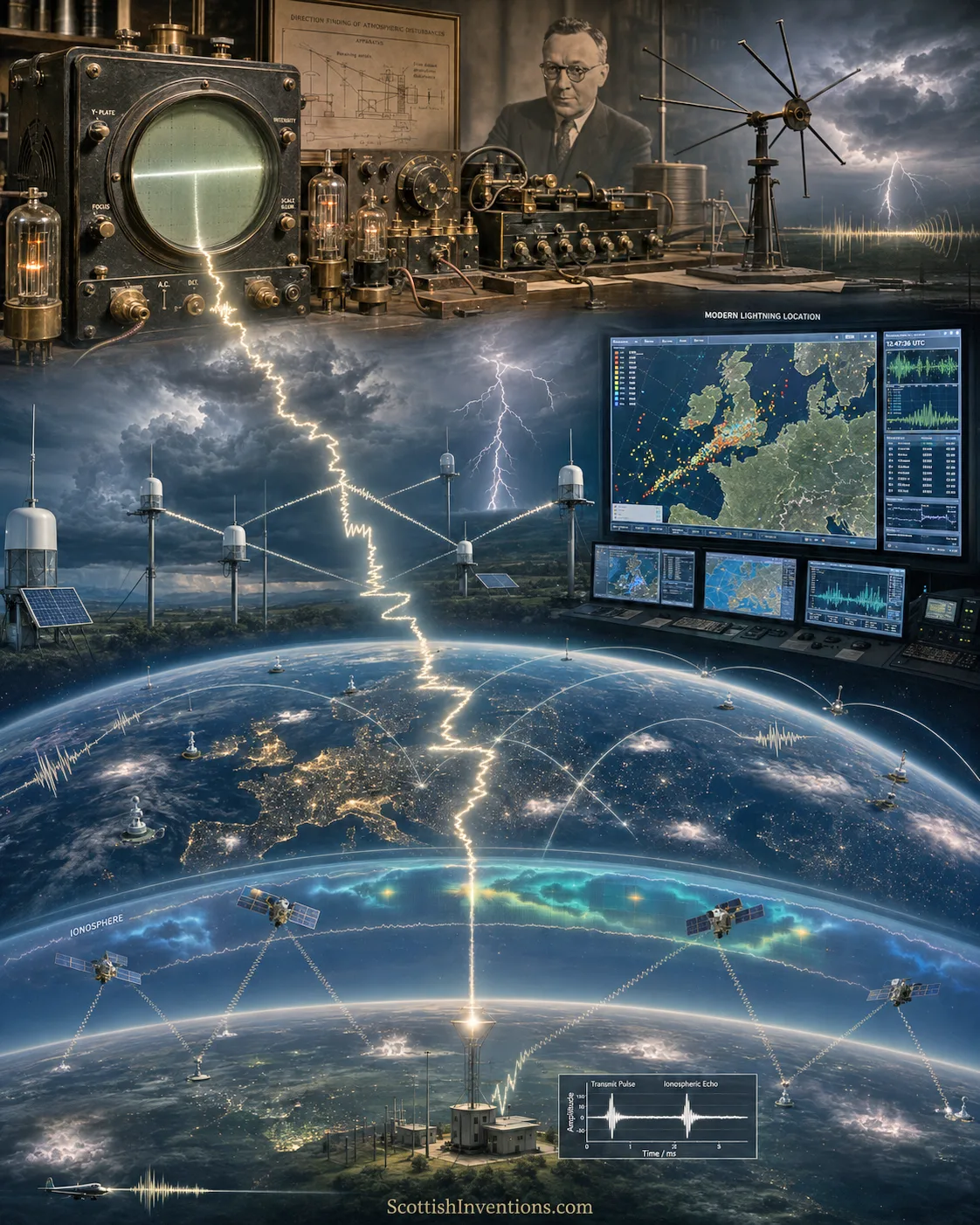
Watson-Watt's atmospheric radio science is not a historical footnote; it remains alive today. The direction-finding of sferics he pioneered in the 1920s and 1930s evolved into the UK Met Office's Arrival Time Difference network, ATDnet, a VLF system the Met Office has run since 1987 that locates lightning to within 1–3 km with greater than 90% cloud-to-ground detection efficiency across the UK and Western Europe. Its 2025 successor, LEELA (Lightning Electromagnetic Emission Location by Arrival time difference), uses a network of eleven sensors distributed around Europe.
Globally, the World Wide Lightning Location Network (WWLLN), operated jointly by the University of Washington in Seattle and the University of Otago in New Zealand, began in 2004 with 18 stations and has since grown to around 70 active VLF receiving stations, detecting sferics in the 6–22 kHz band at ranges up to 10,000 km — the very class of signals Watson-Watt first learned to read systematically a century earlier. The study of sferics is an active research field today, now linked to phenomena such as "sprites" and the global atmospheric electric circuit. The ionosphere, too, remains scientifically vital: it bends and delays GPS satellite signals, so understanding its behaviour matters directly for modern satellite navigation, and continuous ionospheric measurement begun in this era continues worldwide.
For his scientific contributions, Watson-Watt was elected a Fellow of the Royal Society in 1941 — and, tellingly, his citation praised him "for his contributions to meteorological physics, as elucidated by radio methods" and his pioneering use of the cathode-ray oscillograph, wording chosen partly to avoid revealing the still-secret existence of radar. He was knighted in 1942, received the US Medal for Merit in 1946, the Royal Society's Hughes Medal in 1948, and served as President of the Royal Meteorological Society. His major technical legacy publications include the 1933 monograph "Applications of the Cathode Ray Oscillograph in Radio Research," written with J.F. Herd and L.H. Bainbridge-Bell and published by HMSO for the DSIR, and his 1957 autobiography, Three Steps to Victory.
Character and Later Life
Watson-Watt was a prolific, practical, entrepreneurial — and sometimes controversial — figure. He described himself as a "plausible salesman of ideas," a self-publicist who relished attention, and a man of considerable Scottish pride. His most famous working principle was the "cult of the imperfect": "Give them the third best to go on with; the second best comes too late, the best never comes." It was exactly this willingness to deploy a good-enough system rather than wait for perfection that helped put a working radar chain around Britain in time for 1940.
His private life was tangled: he married three times — first to Margaret Robertson in 1916 (divorced 1952), then to the Canadian Jean Drew Smith in 1952 (she died in 1964), and finally, in 1966, to Dame Katherine Trefusis Forbes, founding director of the Women's Auxiliary Air Force, which had supplied the radar-room operators during the war. In 1952 the Royal Commission on Awards to Inventors granted him a tax-free £50,000 "in respect of his initiation of radar and his contribution to the development of radar installations" — the top individual prize from a total of £94,600 the Commission granted to 24 scientists that year, and the highest single payment the Royal Commission ever made. Some contemporaries felt the recognition still fell short of what radar had achieved for Britain.
One of the more delightful stories about him dates to 1956: living in Canada by then, the elderly Watson-Watt was pulled over for speeding by a policeman using a radar speed-gun and was, in the words of Scotland's People, "fined $12.50 on the spot." He is reported to have exclaimed, "Had I known what you were going to do with it I would never have invented it!" — and afterward wrote a wry poem, "Rough Justice," which begins: "Pity Sir Robert Watson-Watt, / strange target of this radar plot / and thus, with others I can mention, / the victim of his own invention." He died on 5 December 1973 in Inverness and is buried at Pitlochry; in 2014 the Princess Royal unveiled a statue of him in his native Brechin.
Timeline
1892
Robert Alexander Watson-Watt born, 13 April, Brechin, Angus
Fifth son and youngest child of carpenter and cabinet-maker Patrick Watt
1901
Marconi transmits a wireless signal across the Atlantic
A result that should have been impossible given the curvature of the Earth, prompting the Kennelly–Heaviside hypothesis
1902
Kennelly and Heaviside independently propose a conducting atmospheric layer
The hypothetical 'Kennelly–Heaviside layer' that reflects radio waves back to Earth
1912
Watson-Watt graduates BSc in engineering, University College, Dundee
Professor William Peddie steers him toward wireless telegraphy and radio physics
1915
Joins the Meteorological Office to locate thunderstorms by radio
The founding problem of his career: warning aviators of storms beyond the horizon
1916
Proposes using a cathode-ray oscillograph to display a lightning bearing instantly
The idea preceded reliable hardware by roughly seven years
1922
Publishes 'The Origin of Atmospherics' in Nature
Reports that thunderstorms could be located by direction-finding on atmospherics
1923
Reliable cathode-ray tubes become available; publishes 'Directional Observations of Atmospherics, 1916–1920'
The CRT direction-finding method finally comes into its own
1924
Moves to Ditton Park, near Slough, after the War Department reclaims Aldershot
Gains access to Adcock antennas and a modern oscilloscope from Bell Labs
1924
Appleton and Barnett measure the height of the ionosphere directly
First definitive experimental proof of the Kennelly–Heaviside layer, using a BBC transmitter at Bournemouth
1926
Develops the 'squegger' time-base circuit with Appleton and Herd
Enables precise timing of radio echoes from the upper atmosphere — a direct ancestor of the radar display
1926
Coins the term 'ionosphere' in a letter dated 8 November to the Radio Research Board
Reasoned it deserved a place alongside 'stratosphere' and 'troposphere'
1927
Meteorological Office and NPL radio teams merge into the Radio Research Station
Watson-Watt becomes superintendent, at Ditton Park under the DSIR
1929
Delivers the G.J. Symons Memorial Lecture, 'Weather and Wireless'
Distills two decades of atmospheric radio research for a wider scientific audience
1933
Becomes head of the radio department of the National Physical Laboratory, Teddington
Publishes 'Applications of the Cathode Ray Oscillograph in Radio Research' with Herd and Bainbridge-Bell
1935
12 February memorandum and 26 February Daventry experiment
Two decades of atmospheric radio science are redirected toward detecting aircraft
1941
Elected Fellow of the Royal Society
Citation praises his contributions to meteorological physics via radio methods and his pioneering use of the cathode-ray oscillograph
1942
Knighted
Recognition following the acknowledged success of the radar chain in the Battle of Britain
1973
Dies, 5 December, Inverness; buried at Pitlochry
A statue was unveiled in his native Brechin by the Princess Royal in 2014
Myths & Facts
Myth: Watson-Watt's atmospheric research was just a minor prelude to radar, not real science.
Fact: It was a substantial, independently published body of atmospheric science in its own right, including peer-reviewed papers in Philosophical Magazine, Nature, the Quarterly Journal of the Royal Meteorological Society and Proceedings of the Royal Society A, and it produced the direction-finding and pulse-echo techniques that are still used today in lightning-location networks, entirely apart from radar.
Myth: Watson-Watt discovered the ionosphere.
Fact: He did not. The Kennelly–Heaviside layer was hypothesised in 1902 by Arthur Kennelly and Oliver Heaviside, and its height was first proved experimentally in 1924 by Edward Appleton and Miles Barnett, work for which Appleton won the 1947 Nobel Prize in Physics. Watson-Watt's group pursued a complementary pulse-echo method and, notably, coined the very word 'ionosphere' in 1926.
Myth: The cathode-ray tube idea and its use were simultaneous.
Fact: They were not. Watson-Watt proposed using a cathode-ray oscillograph to display lightning bearings in 1916, but reliable cathode-ray tubes only became available around 1923 — a gap of roughly seven years between the idea and its practical realisation.
Myth: The Radio Research Station was in Scotland.
Fact: It was at Ditton Park, near Slough, in England. This is a documented error found in at least one secondary source and is worth correcting explicitly.
Myth: Watson-Watt worked alone on this research.
Fact: He collaborated closely with E.V. Appleton and J.F. Herd on time-base circuitry and joint publications, with C.J.P. Cave on early meteorological work, and led a team at the Radio Research Station; his first wife, Margaret, also assisted directly with early apparatus at Aldershot.
Did You Know?
- Watson-Watt spent twenty years using radio to study thunderstorms and the ionosphere before radar — the atmospheric work was both the foundation and the apprenticeship.
- He used a cathode-ray tube to display the direction of thunderstorms years before anyone thought to use the same idea to show aircraft positions.
- He coined the word 'ionosphere' — in a letter dated 8 November 1926 to the Radio Research Board.
- His work made aviation safer long before radar existed, by letting weather forecasters warn pilots of distant storms.
- The Met Office's modern lightning-warning network (ATDnet and its successor LEELA) and global sferics networks like WWLLN descend directly from the techniques he pioneered.
- In 1956 he was caught in a radar speed trap in Canada, fined $12.50, and quipped that, had he known, 'I would never have invented it!'
Honest Caveats
Watson-Watt did not discover the ionosphere. Its existence was hypothesised by Kennelly and Heaviside in 1902, and its height was first proved experimentally by Edward Appleton and Miles Barnett in 1924, work for which Appleton alone received the 1947 Nobel Prize in Physics. Watson-Watt's distinct contribution was the pulse-echo timing method and, notably, coining the term "ionosphere" itself.
"Inventor of radar" is a simplification that belongs to a separate article. Many nations and earlier figures — including Heinrich Hertz and Christian Hülsmeyer — contributed to the broader story of radio detection, and Watson-Watt himself credited close colleagues. This article deliberately confines itself to his atmospheric science and treats radar only as its destination.
Some dates differ slightly between sources. A few accounts give his Meteorological Office start as 1916 rather than 1915; some sources emphasise the 1924 move to Slough, others the 1927 administrative merger into the Radio Research Station — both events are correct and simply refer to different milestones.
His earliest "lightning" publication date is sometimes conflated. One history dates a paper on lightning-generated radio waves to 1922 (the Nature note "The Origin of Atmospherics"), while his major early research paper, "Directional Observations of Atmospherics, 1916–1920," is dated 1923. Both are genuine and distinct publications.
The Daventry detection range varies between sources, with figures from roughly 8 to 13 miles appearing in different accounts; the National Library of Scotland gives about 13 miles, later extended to some 75 miles with a stronger transmitter.
The speeding-ticket year and exact wording vary slightly between retellings. Most sources date the episode to 1956 in Canada with a $12.50 fine; the quotation is reported with minor variations, though the "Rough Justice" poem is consistently attributed to him.
The cathode-ray idea (1916) preceded working hardware (c. 1923). Watson-Watt proposed the display concept years before reliable tubes existed, so credit for the concept and for its practical realisation should be kept separate.
Some claims about his ancestry circulate in popular accounts but are not part of the verified scientific record, and this article does not repeat them; it confines itself to his documented education, mentorship under William Peddie, and his published atmospheric radio research.
Frequently Asked Questions
What did Robert Watson-Watt actually discover, separate from radar?
Between roughly 1915 and 1935 he developed systematic methods for using radio to study the atmosphere itself: direction-finding techniques that could locate thunderstorms from the radio 'sferics' produced by lightning, and pulse-echo timing methods used to measure the height of the ionosphere, the electrically charged layer high above the Earth. This was a genuine, self-contained body of atmospheric science — not merely a prelude to radar, even though it later became one.
Did Watson-Watt invent radar during this period?
No. This article deliberately confines itself to 1915–1935, the atmospheric science years. Radar itself is the subject of the companion Inventions Collection article; here the emphasis is on the twenty years of thunderstorm-location and ionosphere research that made him the obvious person to ask, in 1935, whether radio could detect aircraft.
How did direction-finding of thunderstorms actually work?
A lightning discharge radiates a broadband burst of radio energy — an 'atmospheric' or 'sferic' — that can travel hundreds or thousands of miles. Watson-Watt used directional antennas, and later Adcock antenna arrays, to determine the bearing from which such a burst arrived. Because a sferic lasts only a tiny fraction of a second, he proposed in 1916 feeding the signal into a cathode-ray oscillograph so a single flash would paint an instant line of light on the screen showing its direction. Crossing bearings from two or more stations by triangulation then pinpointed the storm.
What is the ionosphere, and did Watson-Watt discover it?
The ionosphere is the electrically charged region of the upper atmosphere, ionised by solar ultraviolet and X-ray radiation, beginning at roughly 60–100 km altitude. He did not discover it — its existence had been hypothesised in 1902 by Arthur Kennelly and Oliver Heaviside as the 'Kennelly–Heaviside layer', and its height was first measured experimentally in 1924 by Edward Appleton and Miles Barnett, for which Appleton won the 1947 Nobel Prize in Physics. Watson-Watt's group at Slough instead pursued a different, complementary method — sending a radio pulse upward and timing its echo — and he personally coined the very word 'ionosphere' in a 1926 letter to the Radio Research Board.
What was the 'squegger' and why does it matter?
The squegger was a self-oscillating time-base circuit that Watson-Watt developed with E.V. Appleton and J.F. Herd to make the spot on a cathode-ray tube sweep smoothly across the screen at a precisely known, very high speed. This let researchers read the delay of a returning radio echo as a height measurement — exactly the timing principle a radar set later uses to calculate the range to an aircraft. It is a direct technical ancestor of the radar display.
How did this atmospheric work lead directly to radar?
By the mid-1930s Watson-Watt had spent twenty years doing precisely the things radar would require: detecting faint, fleeting radio signals, building sensitive directional receivers, displaying direction and timing on cathode-ray tubes, and timing radio echoes from distant reflectors to measure range. When the Air Ministry's H.E. Wimperis asked in early 1935 whether radio could be used to build a 'death ray', Watson-Watt's assistant Arnold Wilkins calculated that the energy required was impractical, but Watson-Watt, drawing on his life's work, instead proposed the 'still difficult but less unpromising problem of radio detection'. His memorandum reached the Air Ministry on 12 February 1935, and the Daventry experiment on 26 February 1935 proved the concept using a BBC shortwave transmitter and two receiving antennas.
Does any of this atmospheric science still matter today?
Yes, directly. The UK Met Office's lightning-location network (ATDnet, running since 1987, and its 2025 successor LEELA) descends from the direction-finding techniques Watson-Watt pioneered in the 1920s and 1930s. Globally, the World Wide Lightning Location Network (WWLLN), run jointly by the University of Washington and the University of Otago, uses the same category of sferics signals he first learned to read. Continuous monitoring of the ionosphere also remains important today because the layer bends and delays GPS satellite signals, which matters for modern satellite navigation.
Who else contributed to this early atmospheric radio science?
Watson-Watt did not work alone. Edward Appleton and J.F. Herd were direct collaborators on the time-base circuitry and on the joint Royal Society paper 'On the Nature of Atmospherics' (1926). C.J.P. Cave co-authored his early meteorological work on atmospherics. Appleton, working partly independently with Miles Barnett, provided the definitive 1924 proof of the ionosphere's existence and height, for which Appleton alone received the Nobel Prize — a point this article states plainly rather than blur.
What was the Radio Research Station, and where was it?
The Radio Research Station was formed in 1927 when the Meteorological Office's and the National Physical Laboratory's radio research teams were amalgamated under the Department of Scientific and Industrial Research, with Watson-Watt as superintendent. It was located at Ditton Park, near Slough, in England — not, as one secondary source has mistakenly claimed, in Scotland.
Why does his 1941 Royal Society citation sound so vague?
Because it had to be. Watson-Watt was elected FRS in 1941 for his contributions to meteorological physics via radio methods and his pioneering use of the cathode-ray oscillograph — carefully worded language that praised his genuine atmospheric science achievements while avoiding any public reference to the still-secret wartime radar programme he had by then built.
What is the honest one-line summary of his atmospheric science career?
For two decades before anyone asked him about aircraft, Robert Watson-Watt built and proved a working toolkit for using radio to see the invisible atmosphere — locating storms and measuring the ionosphere — and that toolkit, not a sudden flash of wartime inspiration, is what made him ready to answer the Air Ministry's question in 1935.
Sources & Further Reading
Tier 1 · Primary
- Watson-Watt, R.A. — "The Origin of Atmospherics," Nature, vol. 110, pp. 680–681, 1922.
- Watson-Watt, R.A. — "Directional Observations of Atmospherics, 1916–1920," Philosophical Magazine, ser. 6, vol. 45, pp. 1010–1026, 1923.
- Watson-Watt, R.A. and Cave, C.J.P. — "The Study of Radiotelegraphic Atmospherics in Relation to Meteorology," Quarterly Journal of the Royal Meteorological Society, vol. 49, 1923.
- Watson-Watt, R.A. and Herd, J.F. — "An instantaneous direct-reading radiogoniometer," Journal of the Institution of Electrical Engineers, vol. 64, pp. 611–622, 1926.
- Appleton, E.V., Watson-Watt, R.A. and Herd, J.F. — "On the Nature of Atmospherics," Proceedings of the Royal Society A, vol. 111, 1926.
- Watson-Watt, R.A. — "Weather and Wireless" (G.J. Symons Memorial Lecture), Quarterly Journal of the Royal Meteorological Society, vol. 55, pp. 273–301, 1929.
- Watson-Watt, R.A., Herd, J.F. and Bainbridge-Bell, L.H. — Applications of the Cathode Ray Oscillograph in Radio Research, HMSO for the DSIR, 1933.
- Watson-Watt, R.A. — Three Steps to Victory, autobiography, 1957.
Tier 2 · Scholarly and institutional
- Nobel Prize in Physics, 1947 — Edward Appleton, citation on the discovery of the ionospheric layer that bears his name.
- National Library of Scotland — biographical and technical material on the Daventry experiment of 26 February 1935.
- UK Met Office — technical documentation on the ATDnet and LEELA lightning-detection networks.
- World Wide Lightning Location Network (WWLLN), University of Washington and University of Otago — network history and technical specifications.
Tier 3 · Site source document
docs/sources/discoveries/ionosphere-radio-science.md— the commissioned source document underlying this article.